Rare perspective

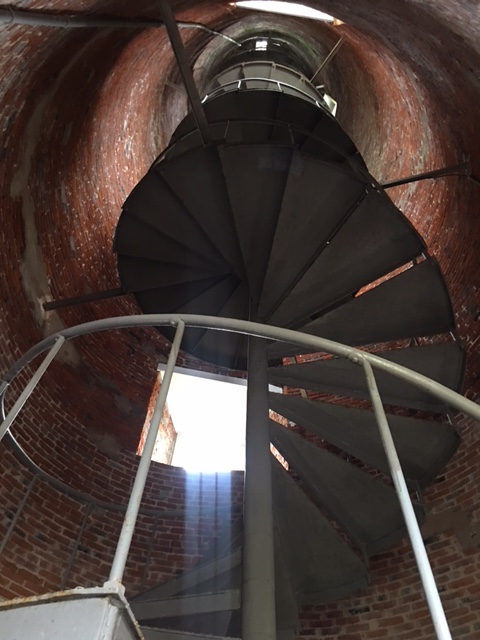
Ocracoke lighthouse inside

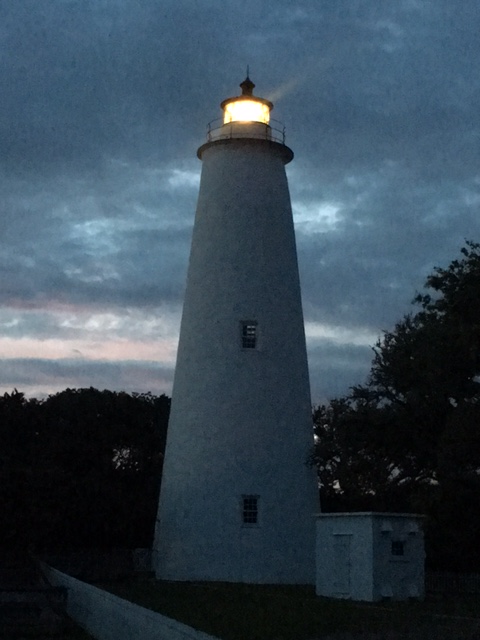
On my recent trip to Ocracoke Island for professional development, courtesy of the North Carolina Center for the Advancement of Teaching (NCCAT), my colleagues and I were treated to something unexpected and rare: A visit inside the Ocracoke lighthouse, which is closed to the general public.

The Ocracoke Light, as it is called, is the oldest and smallest of the Outer Banks lighthouses. So tiny, in fact, that the only person allowed up the spiral stairs is the bulb-changer. There’s just enough room for this maneuver at the top. The bulb is about the size of an average man’s pinky finger. It’s not the bulb, of course, that shines a steady light fourteen miles out into the Atlantic and the Pamlico Sound; the fourth-order Fresnel lens, historic in itself, magnifies the light.

The history is compelling, how the land was purchased for so little (two acres for $50 in 1822), and how this diminutive lighthouse originally operated by burning whale oil. Tiny yet powerful, standing on high ground, this lighthouse still guides ships safely through the inlet to other inner ports. I was also drawn by the graves nearby, almost obscured by a white picket fence and sheltering live oaks, just a stone’s throw from the lighthouse door. I wonder how many people ever notice this.

“Who were they?” I asked the NCCAT facilitator, an island native who had the key to let us inside the lighthouse. Imagine walking around with such a key in your pocket! “The people buried here – were they the original landowners?”

“Some,” was his answer, which set my mind surging so that it was hard to pay attention to the presentation. Who gets to be buried in such a captivating place, on a remote little rise overlooking the sea, at the foot of a lighthouse? What an incredible resting place.

It got me thinking about the human connection to place, to each other.

The original light could only shine about five miles out to sea – not always enough to save some of the ships. With the new lenses, really multifaceted prisms, the light shines almost three times farther. That it is a steady light seems significant to me – it does not blink or rotate at intervals, as other lighthouses do.

Perhaps because I am an educator, I connect this to teamwork, to the light we can shine individually only going so far, and how the strategically focused, combined efforts of colleagues goes so much farther in what we can do for students. There’s power in collaboration, in steadily striving for a common goal, in strengthening one another for the sake of those we are trying to help.

This doesn’t apply only to education. It applies to any organization – in fact, to humanity as a whole.

Which leads me to contemplate the rare perspective of being inside the Ocracoke Light – there’s a tiny bulb at the top with a mighty lens to magnify its illumination during the night, but I am here in the day, and I see natural light spilling in a tiny window.

That, to me, is inspiration. The natural light that shines through whatever little window into the human soul. Such light may leave periodically with the temporary darkness, while the light from the top of the lighthouse shines far for the benefit of others, but it always returns again, driving the darkness away.

We have only limited glimpses into the hearts and minds of others; we can hardly recognize our own, sometimes. There’s no real correlation between the light shining through a window to the inside of a lighthouse and its ability to shine a light at night – but for a human, there is.

Inspire. Be inspired. Appreciate your own rare perspective, and you’ll better see that of others.

A little light goes a long way – longer still, if we magnify that inside each other.
Ocracoke lighthouse


Abiding images

Last week I spent several days on Ocracoke Island, North Carolina, studying writing with teaching colleagues from across the state.  This extraordinary opportunity was provided to us by the North Carolina Center for the Advancement of Teaching – heartfelt thanks to you, NCCAT, for your support of teachers, and for inspiration at a time when it is needed more than ever.

Ocracoke is, in the words of our faculty advisor, who’s native to the island, “a windy, sandy, watery place.” It’s also tiny and breathtakingly beautiful. One of our assignments was to capture abiding images from this idyllic locale in our writer’s notebooks.

Abiding images are symbols with deep personal meaning to us, often recurring, according to dream analysts. Abiding images are part of us, shaping our lives the way the wind and the water continuously shape this island. To poets and writers, abiding images come from a wellspring inside us – stories, dreams, conscious and unconscious memories – each as unique to us as our own fingerprints.

Our task was to walk in this brine-tinged breeze, under the moody sky, without speaking to one another. We were to walk alone, searching for the images that speak to us.

I prefer to think of it as being called by the images that wish to speak to us.

The long beach grass rippled like hair against the ground; the sea, shimmering and calm on the Pamlico Sound side, flowed ceaselessly from left to right like words across a page. Come, was the inherent, compelling invitation. Come. Listen to me. I have stories to tell.

I filled seven pages with abiding images and took pictures of a few.

There were the pink wildflowers, startlingly bright against the beach grass. Marsh pinks, they’re called. Sabatia stellaris. Our advisor said for anything to survive on the island, it must be hardy, yet here were these delicate flowers with perfect yellow stars in the center, as if painstakingly hand-painted by an artist. Incongruous. Surprising. Hopeful, somehow, for these flowers carry the mark of the heavens in their upturned faces.

I came across some shells by a small hole in the sand, out of which grew a thin, solitary blade of grass. No other grass stood anywhere near this one long, lonely strand, this one hair from this one follicle. There are secrets in the sand, the advisor told us. So much more goes on in it and below it than we really know. 

This curious wisp of grass shivers, nods.

I walk farther and discover the ivory-yellow skeleton of . . . something. I don’t have a frame of reference for it, other than knowing it’s a bone, something once alive. It worries me. I want to know what creature it was and why it’s here in such pristine condition, with no other marks in the sand near it in this isolated spot. How long has it been dead?

I learn later that it’s the skull – just the skull, although it’s the size of a chicken – of a red drum. North Carolina’s state fish.

I still don’t know why it was lying there all by itself.

The last of my abiding images is at the marina in front of the NCCAT building, which used to be the old U.S. Coast Guard lifesaving station. As I turn to go back inside, I encounter a rusted handle quite suddenly in the sand near the marina’s edge. It’s sticking upright, clearly attached to something buried there, and it’s obviously been around a long time. What’s THIS secret hidden in the sand? I don’t tug on the handle, although I want to; I imagine pulling it and a door coming forth from the sand to reveal an opening with stairs leading down to . . . anywhere. A bunker, a secret gathering place, another world, another time. Oh, the stories this strange handle evokes!

Perhaps I will write one of them yet.

For now, the images abide in my notebook and in my mind; they shape me, even as I shape my thoughts about them. I carry them with me while I leave a piece of my heart, perhaps a piece of my soul, behind with them.

We belong to one another. That’s what I think as the sun goes down over the Sound, as I hear boats over in the marina rocking as if they are waking from a long sleep, coming back to life.

We abide.


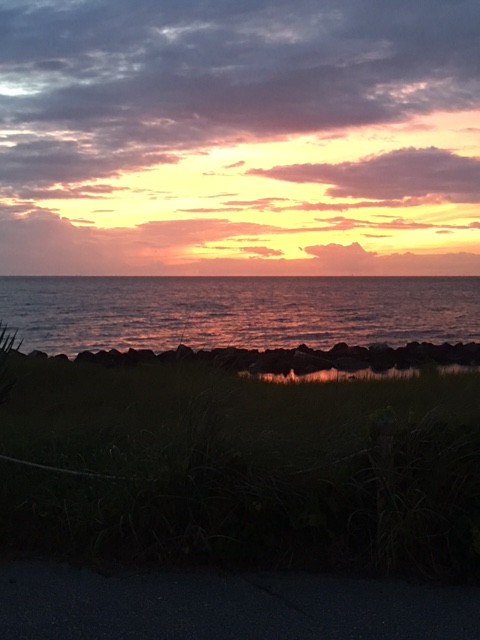
Sunset Pamlico Sound

Sunset on the Pamlico Sound.

In reading and in writing, our instructors told us, “Setting is everything. It drives the story, drives the characters’ actions.” 

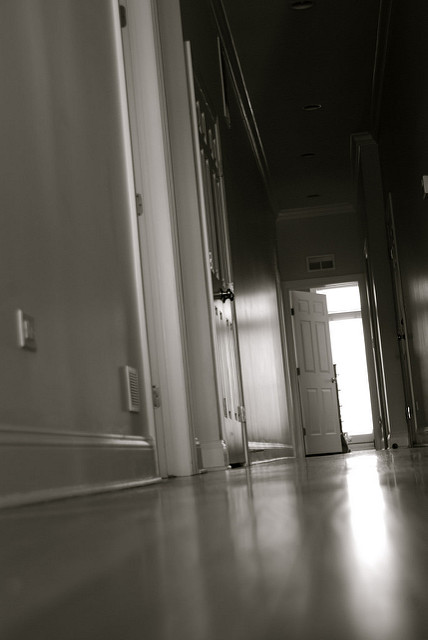
The hallway

Hallway

Hallway. DSC_003. ColinCC-BY

A large part of my job involves helping teachers and students grow as writers. I often define writing workshop as an artist’s studio, a place with time to fall in love with the craft of writing.

As I consider my own writing experiences, the image of a hallway forms in my mind. I am actually in this hallway. I can see numerous doors, one of which stands partially open, and through it I can see a window, and beyond that, trees, bright in the golden light of afternoon, probably in late spring or early summer. The branches sway in a breeze, making the leaves dance and beckon, but there is no sound, not from this vantage point. I would have to go through the door and open the window, probably, to hear the rustling, the insects, the birds, to feel the sun’s warmth and taste the laziness of a free afternoon – if, in fact, the afternoon is lazy and free, as it seems to be from where I stand.

Other doors are closed, and knowing that I can open any of my choosing sends a compelling shiver through me – each door leads to a different place, experience, and story. They are all mine to explore, at my leisure. I will never know what’s behind the doors unless I go and open them. Some lead to the past – when I walk through, I can see my family, some of whom are gone now but alive and remarkably young in this place.  They don’t seem to mind at all when I come – in fact, they seem to welcome my visit the same as they always did. If I go farther, I see old friends, classmates, even people I didn’t know well but who are somehow connected to an idea, a moment in time when I learned something or realized that something mattered. My childhood dogs bounce up at the makeshift gate between the kitchen and the living room in their typical greeting; I smell cigarette smoke, the old Kirby vacuum cleaner, the old worn rug; fried chicken also lingers in the air. But I do not want to stay and wander like a ghost here in my childhood home. I can come back another time, anytime I like.

Behind other doors are chairs where I rocked my babies. Here I sit with their soft warmth in my arms, their fuzzy heads nestled against my neck. I feel them breathing, slow, easy, contented in their slumber. I can stay here a while and just be, just rocking, holding one boy for a long time and then the other. I can see them when they are a little older, one always chipper and friendly, the other absorbed in his own thoughts, spending hours lining up his Hot Wheels or taking things apart to put them back together. They are safe and well in this place, so I will leave them here, after I kiss their satin-soft cheeks once more and tell them that I will always love them.

Other doors, I suspect, lead to worlds that I can still create, both real and imagined. I can only see so far in the future; only some things are certain and I will alternately face them and embrace them as they come. I could linger far too long in the imagined worlds, just to see what will happen, to discover the secrets and the magic, knowing all is of it is at my command.

I am surprised by the door that opens straight into the natural world. I have discovered this about myself, that the workings of nature have a strong pull for me. Some of the discoveries are breathtaking, like the iridescence of a dragonfly’s body, the precise blue and orange painted pattern down a caterpillar’s back, the powerfully sweet fragrance of a gardenia, of honeysuckle, and the tiny war-plane drone of a hummingbird’s wings. Others discoveries are not nearly as pleasant – a horseshoe crab decaying on the beach, a tobacco worm (a non-native North Carolina neighbor recoils in horror – “Is that a dragon?“) crawling on my porch rail, a scar on the wood trim by the roof where lightning struck the house. Not pleasant, but fascinating all the same. I had no idea until I started writing that nature spoke so much to me – just now, as I capture these words, the sun bursts forth from behind the clouds beyond my bay window, shining on the laptop and my hands as I type, like a validation, an invocation.

Other doors lead to mysterious places like cemeteries, where time is irrelevant. I don’t know these people, but I look at the stones, the names, the dates; I read the poems on the older, eroding ones, and I want to know: Who were you? What were you like? What was your life like, what did you love, and how did you die? What’s your story?

The most curious thing of all about this silent hallway is that whichever door I open, in whatever order, wherever I go and however far or for however long, I find myself there. Myself as I was, as I am, as I will be.

I give myself a nod.

And I write.


Turtle meditation

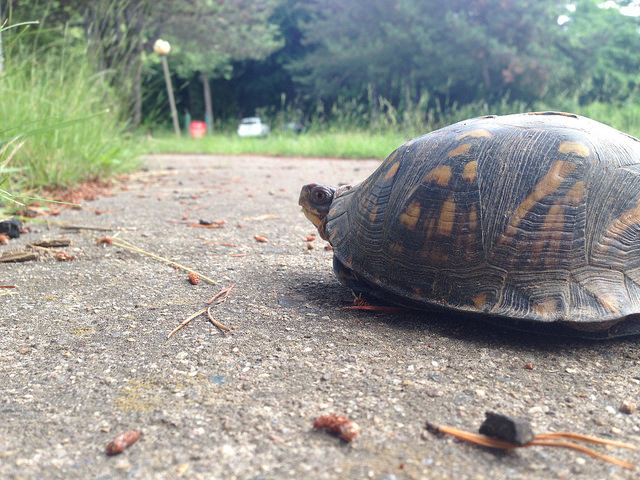
It’s almost summer here in rural North Carolina, which means two things: tobacco is lush in the fields, and turtles are busily crossing the roads.

Which also means that turtles are frequently run over by inattentive drivers.

There by the roadside, these wounded creatures die. Sometimes they leave a trail of blood on the pavement where they dragged themselves to the other side. Any roadkill is disturbing to see, but something about the inner pinkness of the turtle showing through the broken shell pieces troubles me immensely.

Maybe it’s because the shell, perfectly designed to protect the turtle, failed to do so.

But turtle shells are not meant to withstand the weight of a vehicle.

The pinkness represents vulnerability to me; I automatically begin thinking of other vulnerabilities due to failures of structures meant to protect or to edify.

Brokenness occurs on many levels in societies. Governments fail to protect the people, businesses fail to protect employees, family members fail to protect one another.

As an educator, an instructional coach, I see how expectations grow greater all the time and how the weight rests heaviest on teachers. I worry about the cracks, the brokenness, the damage – for, you see, the children are the most vulnerable part, the part we cannot afford to lose.

Any alleviation of this weight, any solution to such brokenness, lies first with the drivers.

Whomever and wherever you are.

Pay attention.

Reflect: Lucy Maud Montgomery wrote: “All things great are wound up with all things little.” Consider the brokenness around you. Repairs and healing will not be complete in a day. Where’s a small place you can begin, in a small but positive way? Positive results only come from positive words, ideas, and actions – and awareness. 

slice-of-life_individual

Song of invisibility

I sit straight up in bed. “Oh dear.”

My husband jumps: “What’s wrong?”

My brain can’t form thoughts yet. I was dreaming about . . . something. Whatever it was has already melted away.

He repeats: “What’s wrong?”

“I don’t know. I am – startled.”

My husband sighs, turns over, goes back to sleep.

I can’t. I lie there with my heart pounding.

I’ll write for a while, I decide.

The predawn house is dark but for a nightlight in the hallway. I creep around, wraith-like, to avoid waking the three sleeping dogs. Heading toward the kitchen, I hear it, loud and clear, as if it’s on the front porch, trying to find a way in:

Whip-poor-will, whip-poor-will, whip-poor-will . . . .

My favorite onomatopoetic sound in all the world. I’ve not heard a whippoorwill that close to the house before.

Is that what woke me? 

And then I start thinking about symbolism, so while my coffee brews, I look up whippoorwills on the laptop. Chilling stuff. Harbingers of death, disasters, impending trouble. Being visited by a talking Raven might be more desirable.

Whip-poor-will, whip-poor-will, whip-poor-will . . . .

Okay, it’s a captivating sound, more enchanting than haunting, I think, pouring cream in my coffee. I’ve loved the call of the whippoorwill since I first heard it, the summer after I moved to rural North Carolina. It dominates a warm country night, an energetic, compelling song rather than a plaintive one. It makes me want to stand still and listen for a long, long time. I continue my online reading, how the whippoorwill is referenced over and over in story, song, and poetry. Folks, it’s really a mating call. That bird isn’t going to be lonely for long.  

And then I read: A group of whip-poor-wills are called a “seek” or “invisibility” of whip-poor-wills.

My imagination takes flight. Those are magical words.

“Seek” implies “seeker,” someone on a quest, not to mention Quidditch. Few words have greater magical connections than “invisibility” – it’s a coveted power. Granted, in this context invisibility and seek define a homely, nocturnal bird that is rarely seen and which is simply  seeking a mate with its fervent night song, but still . . . could there be something more?

I’d awakened with a sense of imminent danger, bolting upright in bed. Oh dear, I’d said, just as I crossed the line between sleeping and waking (this a hypnopompic state; I looked it up just now).  While I cannot remember a dream-creature – or any shadow-people, for the true paranormal enthusiasts out there – attempting to do me harm, I do wake sometimes because of a dry, rubby cough, thanks to the flu earlier this year and my latent asthma. I wonder if irregular breathing is the root of this.

What an unromantic notion.

Whatever the reason:  Suppose the whippoorwill arrived at my house not as a portent of doom but as a protector, a preventive force. What if it knew to sing its song – because, let’s face it, that song is all about life and reproduction, not death – to wake me at the very moment before disaster struck? Exactly what, then, did it seek to drive away or undo – and why? What did my evaporated dream have to do with it?

Whip-poor-will, whip-poor-will, whip-poor-will . . . .

Ah, here are better words to describe the call: Ethereal. Otherworldly. 

A little bit of magic in the still of the night from the seek, the invisibility – although I always hear only one.

I sip my coffee, smiling at my flight of fancy.

Although it could be something more . . . .

slice-of-life_individual

Elegy written in the countryside

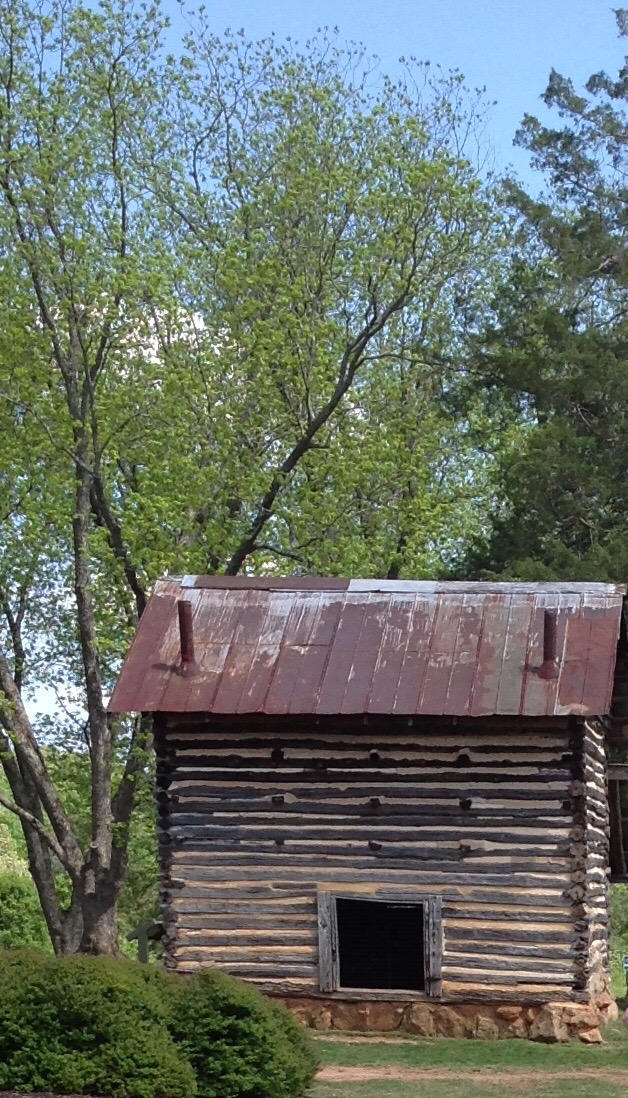
Tobacco barn

A friend tells the story of a visitor from England who, while riding through our rural North Carolina community, asked: “What are all those quaint, narrow houses in the fields?” My friend chuckled: “Those aren’t houses – they’re tobacco barns.” 

I thought: They’re really elegies written all across the countryside.

I love tobacco barns. Within a short radius of my home stands a grand one with a shiny tin roof, another crumbling in a timbered wood, and another housing two mules – seeing this makes me feel as if I’ve stepped back in time. So, with serious apologies to Thomas Gray, I attempt to pay homage to tobacco barns on this last day of National Poetry Month.

Along the winding roads, bereft, they stand
Beyond their use, and most beyond all care,
Just empty shells of creaking wood, unmanned;
Gone gold, within, leaves sweetness in the air.

The fires no longer burn, nor flues convey
The curing smoke, the farmer’s cash-crop dreams;
Those hands and hearts that worked all night and day
Lie spent, burned out, unremembered, it seems

But for the spectral structures standing yet,
Hand-hewn ghosts, whispering to passers-by:
“Press on, work hard before your sun shall set,
Live, love, build well.” – I hear the old barns sigh.

Reflect: What in your landscape, your neck of the woods, speaks to you? What does it say? Why? Listen – and write. 


Celebrate today

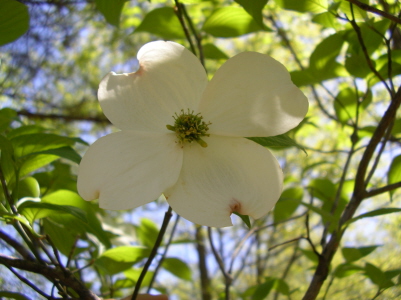
Dogwood

Dogwood. JenniferCC BY

The first day of April – glorious. A sky as blue as it ever gets, hardly a cloud to be seen. Dogwoods and redbuds, bare just days ago, flowering profusely. On the breeze, the scent of blossoms, almost like perfume – winter daphne, I think.

All marking the end of desolation. Nature composes a theme of renewal with color, fragrance, amber light and birdsong.

At the close of the day, I celebrate its beauty. I celebrate the inherent message of hope with the arrival of another spring. Even the news carries a rare inspirational story about a man opening his front door to find his dog, missing for four years, back home on the porch. He sat down and the dog put her head in his lap – what an emotional celebration that must have been.

Today is also the first day of National Poetry month. I have recently discovered a lost booklet of poems that I wrote as a teenager. All things considered, this particular poem struck me as one appropriately celebratory  – winter is over, spring has returned; a lost dog has returned home; my lost poems are found.

I wrote it when I was sixteen. Back then, I called it “Yesterdays.”

Yesterdays are gone

Leaving nothing but memories behind

And, if meant to be, a chance for tomorrow.

So weep no more

For what once was,

For it may be

Once again.

Celebrate today.


O. Henry

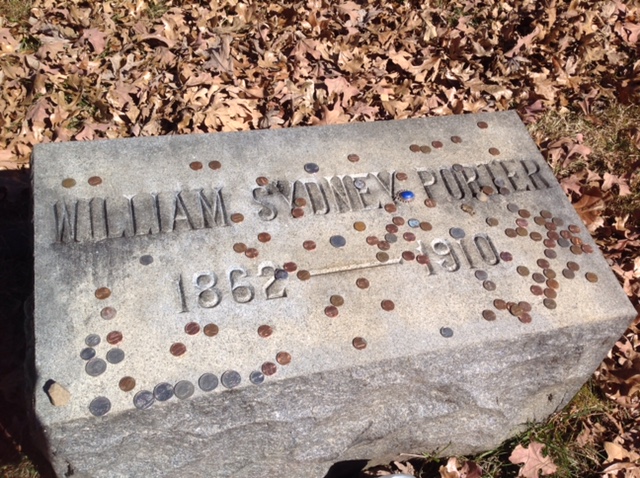
O. Henry grave 

Fall comes early in Asheville, North Carolina. The air is chilly when I get out of the car at the cemetery to visit the grave. I think of winter coming, of Christmas, of this writer’s most famous work. I take a picture, marveling at the coins spread over the gravestone. As I turn to go, a frigid wind gusts, scuttling leaves over the ground and across the driveway.

Leaves . . . I remember that story.

O. Henry’s headstone is covered in coins, mostly pennies, which usually add up to $1.87 –  the amount of money that Jim and Della had at Christmastime in his famous short story, “The Gift of the Magi.” This shortage of money is why Jim sold his gold pocket watch to buy combs for Della’s beautiful hair, and why Della cut and sold her hair to buy a platinum fob chain for Jim’s prized watch. Their sacrificial love for one another has made the story an enduring classic.

There is another story of O. Henry’s that I love almost as well.

I remembered it as I planned to write “Oh, Henry,” yesterday’s post about my son’s dog. I should write about O. Henry next, I smiled to myself. A little word play with the titles. How enticing.

That’s when I thought about the fallen leaves blowing over the writer’s grave.

I scrounged up my old paperback copy of O. Henry’s short stories and reread “The Last Leaf.”

In this tale, two young artists live in a three-story Greenwich Village building. One of them becomes sick with pneumonia. She watches the leaves dropping from an ivy vine against the wall just outside of her window, convinced that she will die when the last leaf falls. To her astonishment, the last leaf hangs on through high wind and rain. To make a short story shorter, the leaf remains because an old artist in the building crawled up a ladder in the dark of a raw November night and painted it on the wall with the vine. The girl begins to recover and the old man, Behrman, dies of the pneumonia he catches from being out in the weather while painting that night.

The old artist had always wanted to paint a masterpiece and never pulled it off – but the last lines of the story have the roommate telling the recovering girl about the leaf: “Didn’t you wonder why it never fluttered when the wind blew? Ah, darling, it’s Berhman’s masterpiece – he painted it there the night the last leaf fell.”

Self-sacrificial love at work again – but there’s more to it.

That leaf symbolized hope, sparking the desire to strive, to overcome. The old artist’s small gesture inspired the young artist to keep living.

This leaves me thinking, in the course of our days as teachers, as writers: Are we not the artists who paint the pictures of possibility, of hope, in the minds of others? Do we spark in others a desire to strive, to reach for what’s beyond their grasp, or to hang on only long enough until this, too, shall pass?

Our masterpieces may never be world-famous; they may be as simple as knowing the right word, the right idea, the right vision, the right story, and sharing it when it is most needed. Inspiration leaps from one heart to another, creating something to hang onto, outlasting high winds and rain. We may never see the full effect of our work, but that’s all right.

We paint the leaves where we can.

I close my old paperback book.

O. Henry, I am so thankful you were here.


slice-of-life_individualEarly Morning Slicer


The storm passes by

Church after tornado 6-18-13

Our phones are popping at the same time:  “Take cover immediately . . . .”

Outside, the wind gusts; objects are striking the building, the windows.

We quickly gather the children who’ve come for Vacation Bible School – there’s about seventy of us in all – and they get down on the floor, balling up with their heads against the painted cinderblocks of the main hallway.

The wind is roaring now. The electricity goes out. The emergency lighting flashes on, bright as spotlights, adding a stark, garish quality to faces and bodies. The fire alarm goes off, a deafening blare, as it’s right above us. A boy with hearing aids rips them out of his ears.

The children are still, silent, as heavy objects strike windows in classrooms – will the windows shatter? For a split second I am tempted to look out and see if Miss Gulch is riding through the air on her bicycle just as she morphs into the Wicked Witch of the West.

Instead I kneel over several children as a shield, leaning my head against the cool concrete wall.

These walls are solid, I think. Safe.

But just around the corner in the fellowship hall is a hutch with a large, framed photo of the church when it was nearly flattened by a tornado twenty years ago.  

Minutes are eternal when destruction is banging on the door.

If we die, I think, at least we are in church.

My husband, the pastor, prays aloud.

The wind soon abates, dies away.  

We go outside to find long strips of vinyl from someone’s home strewn in the parking lot. Big pieces of plywood from who knows where are lying against the building. Shingles are scattered about like fall leaves. The trashcans are way across the graveyard – we trek over to fetch them and we see the gap in the woods where the tornado came through. It cut a path through the cemetery, knocking down a line of gravestones. Silk and plastic flowers, little angel statues and other loose memorials left by families for their loved ones are blown everywhere.

The children retrieve and replace them.

Parents begin arriving, alarmed. Others in the community come to see if everything’s okay.

Just as we are leaving, I turn back toward the church – “Look!”

Arcing up from the woods across the street to the woods behind the cemetery, in the sky directly above the church, a rainbow gleams.

All is well.

slice-of-life_individualEarly Morning Slicer

My grandfather, St. Patrick

Columbus St. Patrick

Columbus St. Patrick Brantley, circa 1924-1925, age 18 or 19.

On a small family farm in Beaufort County, North Carolina, in late September of 1906, my great-grandmother had her fifth of ten children. Her previous children were named Franklin, James, William Hosea, and Penelope (not pronounced pe-nel-o-pee, mind you, but pen-a-lope, rhyming with cantaloupe).  Thankfully the girl was called Penny,  which the family spelled Peaney.

This new son was named Columbus St. Patrick.

We do not know why.

He wasn’t born on March 17th.

The family wasn’t Catholic; they were Baptists and Methodists.

Legend has it that a great-great ancestor came over from Ireland, but this isn’t evident in the family tree roots running deep in North Carolina and Virginia to the 1700s. In fact, as Columbus St. Patrick grew up, his southern dialect carried traces of Elizabethan English: He pronounced his brothers’ middle names as Acey and Hosey – that’s Asa and Hosea – and a neighbor’s name as Miss Etter, which I believed was spelled that way until I saw it on her mailbox: Etta.

His middle name troubled him.

I became fascinated by names around the age of five. My own given name is in honor of my grandmother, Ruby Frances. I asked her: “What’s Granddaddy’s middle name?”

“It’s just S,” Grandma replied.

“S?”

“Yes.”

“How can a name be S? That is just a letter.”

“It’s an initial. He had his name changed to an S.”

I didn’t know anyone could do that. Your name is your name; it’s who you are.

Grandma went on: “It’s S because his middle name was St. Patrick and it bothered him his whole life, so he changed it.”

Even as a preschooler who knew nothing of Saint Patrick yet, I felt a pang at this. What a magical-sounding name. Strange, but pretty.

Later that day I crawled into his lap and in the blunt way of children, asked: “Granddaddy, why did your mother name you St. Patrick?”

Granddaddy shook his head, briefly drawing a hand over his face as if to brush the thought away.

“I have no ideer,” he replied, sighing.

Those who did know were already long gone.

When St. Patrick’s Day rolls around, of course I think of Granddaddy. He was St. Patrick. He was a man of faith and a man of the earth, a farmer; Saint Patrick is depicted holding a cross and a shamrock. Saint Patrick sailed on ships in the fifth century; his namesake built them in World War II. Columbus St. Patrick spent his life serving others, putting their needs ahead of his own, always a compass for doing what is right, what is good.

The venerated saint is said to have driven the snakes out of Ireland. I recall Granddaddy killing copperheads with a hoe on the dirt road of his country home when I was a child. When he grew too old to manage the hoe, he simply grabbed his shotgun and that was it for the copperheads. No harm was going to come to his own, not on his watch.

“Never kill a black snake,” he told me. “They keep rats and mice away.”

I suppose it would not do for North Carolina to be rid of all snakes.

Today I celebrate my heritage as do many others, but I suspect very few can say they are St. Patrick’s granddaughter.

slice-of-life_individualEarly Morning Slicer