A long time ago in a Galaxie far, far away

Galaxie

Truly wonderful the mind of a child is. – Yoda

A long time ago in a Galaxie far, far away . . .

A little girl clutches Mama Bear and Papa Bear. Baby Bear has accidentally been flushed down the toilet.  Clad in a mod red pantsuit instead of a long white dress, and with hair too short for cinnamon buns on the sides of her head, the little girl is nevertheless a princess of sorts, if not a rebel. Yet.

“Stand right there and smile,” says the little girl’s grandmother, who snaps a picture. The little girl really cannot not see the camera, as the sun is in her eyes. She smiles anyway.

Behind her stands the Galaxie  – a 1964 Ford Galaxie 500 that the little girl’s Granddaddy bought, used, for her Grandma. The exterior of the car is red. The interior is red, the fabric of the seats trimmed with silver cord.  The Galaxie doesn’t have power steering or air conditioning. In the summer its windows must stay rolled down if the people inside are to survive. Once it lost a hubcap and the girl’s Granddaddy had to run after it in the city streets.

Yet the Galaxie represents power, things far beyond the little girl. Ford Motor Company named it for the Space Race before the success of the United States over the Soviet Union, which came to pass in 1969, when Neil Armstrong and Buzz Aldrin walked on the moon. The little girl has no memory of this event but likes watching Star Trek with her dad: “Beam me up, Scotty.” She sings The Jetsons theme song:  “His boy, Elroy . . . .” She loves the Jetsons’ dog, Astro. Space gets up close and personal in March of 1970, around the time this picture is taken. A total eclipse occurs in the southeastern United States. The little girl’s family and all the neighbors run out of their apartments in an excited frenzy to watch it. A hush, a stillness, falls over them as the bright day goes as dark as night. The sun disappears,  becoming a mere halo around the huge, black moon. 

“Don’t stare at it,” says Grandma, drawing the little girl close. “It will hurt your eyes.”

The little girl stares anyway, because it is so strange to see the sun go dark.

The world was changing fast. So was my universe. In the year following the eclipse, my grandfather retired. He’d been a shipbuilder since World War II. “We turned out ships in three months in during the war,” I recall him saying, “when it used to take a year.” The war had been over for twenty-five years and it was time to go home; my grandparents packed everything, loaded the Galaxie, and returned to the remote outskirts of Aurora, North Carolina – a tiny town named after the Roman goddess of the dawn. I thought at first it was named for Sleeping Beauty.

My summer voyages began. There on the old dirt roads where my dad ran and played as a child, I learned how to drive with that Galaxie. It was, after all, more indestructible than the Death Star. It was still running after the birth of my first child. My grandparents finally gave it away to the man who hauled trash off for them.

It’s probably running still, somewhere.

Which is more than can be said of our spacecraft.

slice-of-life_individualEarly Morning Slicer


Six-word memoir

Words pour in

“What do you love best? How can you use the things you love to represent you, to describe who you are, in just six words?”

I pause to let the fifth graders think.

“One thing that I love,” I continue, “is the sound of cicadas. Have you heard that sound?”

Hands shoot up. I nod to a girl who replies: “Those bugs that buzz really loud.”

“Yes. Every spring I look forward to hearing the cicadas again – they will buzz all summer long. They remind me of summers spent with my grandparents. The sound was deafening in the thick woods around their home. Hearing cicadas now makes me feel happy and safe, no matter what else is going on. It’s one of the things I love best. So I might try to write my six-word memoir about the sound of cicadas.”

With pencil on paper, using the document camera, I write:

Nature sings to me. I listen.

I see heads nodding.

“I might keep working these six words to see if I can make them represent me better. I might decide to work on another idea. Today you will make a list of things that you love – maybe things you love to do, or favorite objects, or even dreams you have of things you want to do or be – and think about how each thing represents you. Then we will work on capturing and hammering out those descriptions in just six words.”

Off they go around the room, to brainstorm.

I brainstorm, too. What else can I write? What’s another example I can give them?

Well, as far back as I can remember, I loved reading and writing – it’s who I am. It’s what I do. It’s why I’m in this very room this very minute, teaching it.

I think about it all night, and am ready for the next lesson.

“So, ladies and gentlemen, yesterday we brainstormed ideas for writing our six-word memoirs. We thought of things we love and how they might represent us. I thought of something else to represent me. Let me ask you: What do you think represents me? Think about what I do and what you know about me.”

A boy waves his hand: “I know! Harry Potter!”

The class giggles and a few say, “Yessss!”

I laugh. “Excellent. But think bigger than Harry Potter, if possible! Think about who I am and what I do.”

A quiet girl’s hand sneaks up. “You teach reading and writing.”

“There you go. I’ve loved reading and writing all my life. I think this idea might be a great choice for a six-word memoir. It really describes who I am. I have to think now about how to capture this idea in six words.”

With pencil, paper, and the document camera, I write:

I read, I write, I am.

Heads nod – and an image materializes in my mind just then.

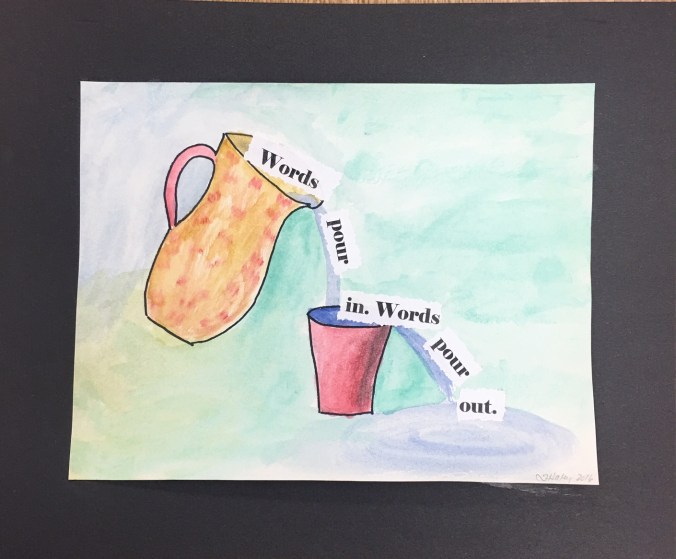
A pitcher, a glass, water pouring . . . .

“I just got an idea of how to make this better!”

I write:

Words pour in. Words pour out.

The children study these words.

“What do you think this means, ladies and gentlemen?”

A boy says, “First you wrote I read, I write, I am and you said you could make it better so I think you mean that if words pour in, you’re reading, and if words pour out, you’re writing.”

Across the room, faces light up.

I smile. “Well done. For a few minutes, share your ideas with your partner and talk about possible ways to begin writing your six-word memoir. Then we’ll all write.”

I listen as the ideas flow in and out, with a hum as vibrant as that of cicadas.

(If you’re interested in reading an earlier Slice on the sound of cicadas: Cicada rhythm)

slice-of-life_individualEarly Morning Slicer

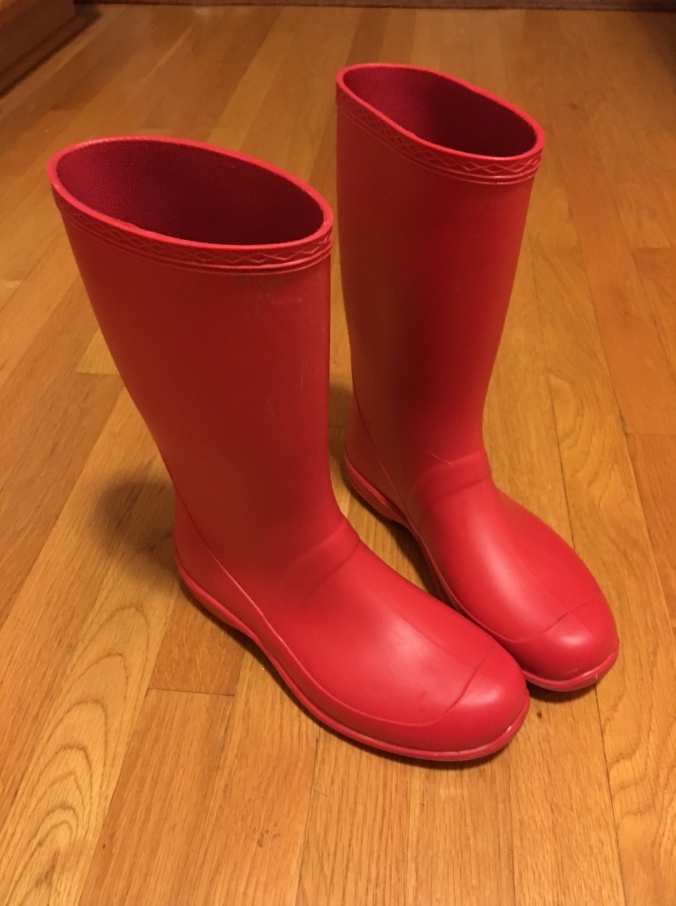
Red rubber boots

red-rubber-boots

It is Sunday, the day my Granddaddy is off from work at the shipyard. It is the day we usually walk to the playgrounds behind the churches across the busy city street, my small hand clasped in his large one, as we wait for the traffic light to change. Today it is raining and we can’t go out. I sit by his recliner on the braided rug beside his feet – he wears black lace-up shoes every day – and sigh.

“What’s the matter, Duck?” he wants to know. Sometimes he calls me Duck, sometimes he calls me Pig. I do not know why. He just does.  It makes me feel warm inside.

“Granddaddy, the girls in kindergarten have red boots to wear when it rains. I don’t have boots.”

“Oh, I see. I guess you been wanting some of those boots?”

I nod my head and crawl up into his lap. “Yes, Granddaddy. For a long time.” His black leather cap is on the side table by the recliner. I pick it up and put it on my head. It smells like him. A little Vitalis and a lot of goodness.

He wraps his arms around me. “Tell me about these boots, what they look like.”

“You can pull them over your shoes … ” I begin.

He got them for me, of course, those red rubber boots that I proudly wore to school and stored on the bottom shelf in the cloakroom, beside the boots of the other girls.

At the time he got them, I did not know that his retirement was imminent, that within the year he’d move back home to the far reaches of eastern North Carolina, three hours away. I would only see him a couple of times a year from then on.

I grew up. I had children of my own. When I went to visit Granddaddy, I sat on the stool by his recliner, as close to him as I could get. He patted my arm. We sat this way for a long time, without any conversation, just being together.

“You remember them red rubber boots I got for you?” he asked eventually. His blue eyes twinkled at me. Every now and then, across the decades, he’d mention those boots.

“Oh, yes, Granddaddy. I remember. I loved them so much.”

He chuckled, patting my arm with his large, wrinkled hand.

He was retired for thirty years, living to be almost 93.

I had nearly forgotten the red rubber boots when I happened to see a pair at the store a year or so ago. They were so like the boots he gave me when I was five.

“Ah, Granddaddy,” I whispered. “You’re never far away.”

I bought them.

They protect me from the rain; they keep me grounded, connecting me to the earth that my grandfather loved, for he was a lifelong farmer even though he had to find better-paying work to provide for his family. The color brightens the gloomiest day. I wear my boots with deepest gratitude for a humble man who knew about sacrifices, great and little, fiercely proud that his blood flows in my veins.

I remember, Granddaddy. I always will.

slice-of-life_individual

Around the bend

white-peacock

Rezervatia de zimbrii Dragos Voda. Cristian Bortes. CC-BY 2.0 

I live in the country.

Long before daybreak, a rooster crows for all he’s worth, a passionate, guttural cry signifying that the dark night is ending.

My kitchen bay window faces east, catching the first glimmers of pink in the sky.

A short drive on the winding road by my home carries me past weathered stables and tobacco barns, abandoned unpainted houses from a bygone era, and fields where farmers still make their living.

There’s a horse or two in the pastures, innumerable goats, and the occasional delightful donkey, silvery-gray and calm. I have learned that donkeys keep coyotes away – how extraordinary.

One day, along a bend in the road, beside an old gate overgrown with brambles, a peacock strutted, the morning light electrifying the brilliant blue of his body. I slowed down, wishing I could see the long green train of his feathers fan out, but the peacock was skittish and went back through the gate via some hidden hole. Surely he should not have been out by the road, although the sight of him made me grateful to be alive. From then on, I looked for him.

Until the day I rounded that same curve and there, in the middle of the road, stood a white peacock.

I could not believe my eyes – I never knew such a thing existed.

But there he was, gleaming like some divine messenger, standing right on the double yellow lines. I slowed to a stop. He looked at me through the windshield; I hardly dared to breathe. He took his time heading back to the lush bank by the brambly gate, as if he owned this road, maybe this entire world, his long white tail feathers dragging behind him like a bridal train or a king’s ermine robe.

I watched him go, oblivious of everything around me except the sheer splendor of his presence.

I have learned, then, that every day is new, that there are unexpected wonders waiting just around the bend. In the middle of the familiar and mundane might be something rare, glorious, breathtaking.

Be watching.

slice-of-life_individual


What lies within


scuppernongs

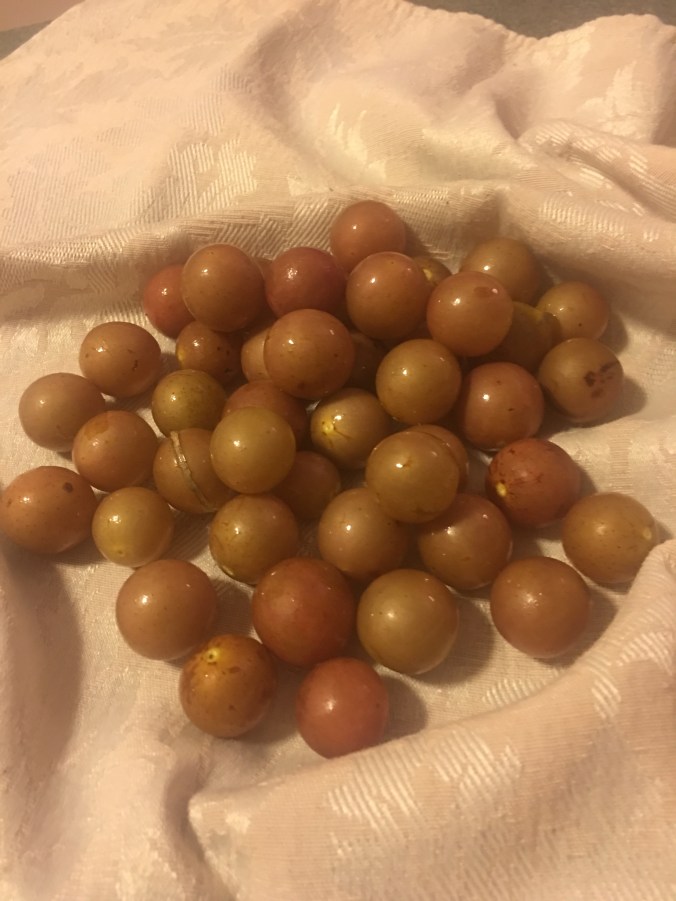
They aren’t beautiful, scuppernong grapes. Their unassuming greenish-bronze skins are flecked as if with age spots. Hardly inviting.

If you have never tasted one, you have not fully lived.

Yes, the seeds are a nuisance, difficult to manage in polite company, as one must spit them somewhere.

But put one in your mouth, gently split its remarkably thick skin open with your teeth … oh! The burst of richness is almost breathtaking. Embryonic wine, a touch of dying summer, a whisper of sweet things to come, something of all Christmases and bit of Heaven is encased in that homely little orb. No other taste on Earth compares. When I first studied mythology, I wondered if ambrosia, the food of the gods, was actually scuppernongs.

I first encountered scuppernongs as a young child. I can see the vines towering over my head, the flickering sunshine and shadow of wide leaves, the poles my grandfather erected, his straw hat, the plaid pattern of his sleeve as his big wrinkled hand reached up to pick the grapes for me. No words; just richness. Just joy.

A lot of things are like scuppernongs – unappealing on the outside, messy and more work than seems necessary. Teaching is like that. Writing is like that. Living is like that. Get beyond that first impression; it’s misleading. Press on to the heart of it. What you find there will take your breath away.

Reflect: When has the appearance of a thing, an experience, deceived you? What surprise was waiting for you within?


So we beat on

fitzgerald-grave

In the summer of 2013, my older son and I embarked on what we now call The Dead Writers Tour. The Great Gatsby film, newly released, was creating a resurgence of interest in the novel and F. Scott Fitzgerald himself. My son had just completed his second year teaching high school social studies, his favorite portion of which is the Jazz Age; he had even begun coordinating his history lessons with the English classes’ reading of Gatsby and teaching his students how to dance the Charleston.

Perhaps it was our shared loved of literature and writing, or the joy of the whole summer lying before us, teachers on the loose, that beckoned us like the green light beckoned Jay Gatsby. Perhaps the movie was the impetus for adventure, capturing the zeitgeist and ending, as the novel does,  with my son’s favorite literary quote:

So we beat on, boats against the current, borne back ceaselessly into the past.

Fitting, indeed, for a young history teacher who was born by a bay (albeit one in Virginia, not New York).

“You know, Mom,” said my son, as we left the cinema, “That quote is on Fitzgerald’s grave.”

“Is it, now,” I mused. “As much as you love it, you ought to go take a picture and put it up in your classroom.”

The light in his eyes was instantaneous. Out came the phone to research the grave’s location: Rockville, Maryland. How far is that from home in North Carolina? A quick check in Apple Maps: Right at four hours.

“That’s a day trip,” I said. “I’ll come with you. It will be our summer celebration kick-off.”

So, on a mid-June morning, we left long before daylight. We ate breakfast while it was still dark, chattering about our teaching accomplishments that year and our dreams about writing, lamenting the constraints of time in the daily grind of making a living. The hours passed quickly, despite the epic traffic snafu of D.C. Once on the other side, however, we sailed right into Rockville.

The cemetery is at a Catholic church in the midst of bustling city streets. After navigating such noise and chaos, I was not expecting utter silence on entering the graveyard. It was like a cosmic mute button was suddenly pressed, or that I had passed through a portal from one world to another. The city receded at once; all I could hear was a faint shivering of tree leaves overhead in the breeze, oddly cool for June, and the occasional flap of little American flags, remnants of Memorial Day, at the graves of veterans.

How incredibly peaceful, I thought.

“There it is,” whispered my son, pointing.

Fitzgerald was easy to find; his grave was the most adorned. As we approached, a brown rabbit hopped out of our path to a more remote patch of sun-dappled grass where it could nibble, undisturbed. At at the foot of his grave a flag commemorated Fitzgerald’s World War I service. On the headstone, the author’s full name signifies an even deeper connection to the flag: his famous cousin wrote the lyrics to the “Star-Spangled Banner.” I reveled in having my own first name in common with these writers and Fitzgerald’s daughter, buried nearby. A pot of daisies had been placed by the headstone, a nod to the love of Jay Gatsby’s life. Most interesting of all is that Fitzgerald’s wife, Zelda, who was at least part of the inspiration for the character of Daisy, is buried with him in the same grave.

Any student of F. Scott Fitzgerald knows his struggles, that he was always teetering on the brink of financial ruin, that he and Zelda lived a frenzied life, that both of their deaths were sudden and tragic, him with a heart attack in his forties and her a few years after, in a fire at the mental hospital where she was a patient. Fitzgerald never knew The Great Gatsby would become the beloved American icon that it is.

We stood there in the stillness, my son and I, drinking in the sight, lost in our own thoughts. After a bit, we took the pictures.

One or the other of us sighed. I am not sure which.

“What do you want to do now?” asked my son.

I looked up at the sky. The day was golden, still young; we had time, perhaps, for another adventure.

“You know,” I grinned, “Baltimore is only forty-five minutes farther. Poe is buried there.”

My son chuckled. He took one last look at the final Gatsby lines etched on the weathered granite slab. “All right, Mom. Let’s go.”

So we beat on.

Reflect: What literary works or quotes strike a deep chord in you? Why?

-Happy Birthday this week, F. Scott Fitzgerald.

Cicada rhythm

cicada-on-post

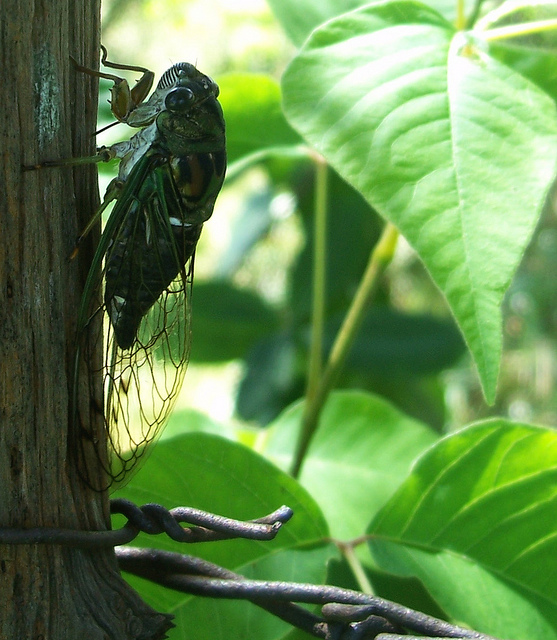
Image: Cicada on a post. Jo Naylor CC BY 

Summer is dying now, taking with it one of the things I love best: The song of cicadas.

If you’ve ever heard cicadas in full throttle, you might not agree with “song” as a fitting description of their cacophonous buzzing. It’s not pretty. The noise can be deafening.

Yet when I hear that first discordant rattle sometime in May, my spirit rises, my own heart sings in response.

The song of cicadas calls to me from long ago, when I was a little city girl spending sultry summers in the country. The song evokes narrow dirt roads keeping an ominous forest from encroaching on rustic homeplaces, tiny cemeteries where baby after baby is buried under white monuments adorned with lambs, and the old church just around the bend. The song is one of ages, the rising and falling of generations, all of us coming and going in our time. It is a song reverberating with tire swings hanging from pecan trees, canals teeming with frogs and turtles, white-tailed deer bounding up from lush ditch banks along fields at dusk. It is the bright song of the sun, of hope, of continuity. It is the dark song of the night, oddly comforting; something out in the blackness is vibrantly alive, maybe keeping watch, while children drift off to sleep. It is the sound of safety, stability, belonging. Calling and calling, the crescendo mirrors the rhythm of life, brimming with promise, echoing eternity. When I hear it, I am a child again, no matter how many summers have come and gone. My home is in the countryside now and it is with a deeper pang each September that I note the song fading out. Every May, as I mark another year of my existence, I listen for the first returning rattle. You’re back! my heart sings. Ah, but we were here all along, they might say, if cicadas had words. There’s a lot of living and loving yet to do. You have today. Carry on.

Reflect: What’s one thing in nature that inspires you? Why?


Lit legacy


Kobo

I love words because of my grandmother.

It’s a simple thing, really, to gather a child on your lap with a book open for the little eyes to see,  and read aloud as if time and duties and all the other business of life do not matter. In truth, none of those things matter more than creating a literate legacy for a child.

Did Grandma know the far-reaching effects these moments would have? She wasn’t a teacher. She just loved to read, and I caught it from her long before I ever started school. Over and over she read The Squirrel Twins to me, the adventures of Chitter and Chatter, immortalized in rhyme:

There were two little squirrels, who lived in a tree

As happy as two little squirrels could be…

She chuckled at the illustrations every time. Cozy there in her arms, enveloped in the light fragrance of her Avon sachet, the cadence of her voice seeped deep into my brain. One day I surprised her by taking the book from her hands and reciting every word on every page:

And this is the song they sang on the way,

“What a hippity-happity-hoppity day!”

“My goodness!”

“What, Grandmama?”

“You memorized all the words!”

I knew what was coming because of the repeated readings, connecting the visual story with the simple pattern of the rhyme before I could actually read the print. It’s such a simple thing: What was poured in came pouring back out.

She poured in so much more than words – the love of words, the love of story, eventually the love of writing. My grandfather retired when I was five years old. He and Grandma moved “back home” to eastern North Carolina, leaving me behind on the Virginia peninsula. “It was the hardest thing I ever had to do,” she said years later. Determined to stay connected, she began writing letters to me. I was soon old enough to write back, and when I told her that my dad (her son) complained about my using up his postage stamps, Grandma promptly sent a letter containing a book of stamps so that “you can write to me whenever you want.” I could almost see the defiant twist of her mouth when I read that line. Every summer when I came to stay for a few weeks with my grandparents, the first item on Grandma’s agenda was taking me to the tiny, musty town library where I checked out more books than I could carry. Nothing was ever deemed off-limits or inappropriate. I was completely free to read what I wanted, as much as I wanted, whenever I wanted.

When Grandma died, I inherited her piano, which now belongs to my musician son, and twenty-five years worth of diaries in which she recorded the minutiae of her days. In those pages, all those we loved and lost are still alive, the grievances of the time are now hysterically funny, almost sitcom-worthy, and her prayers for my teenage self are yet another heart-wrenching reminder of the lasting power of words.

She was a gift, my grandmother. A priceless jewel. Her name, in fact, was Ruby. Of all the things in life for which I am thankful, one of the greatest is that Ruby read.

Reflect: How are you helping light the literate way for the children in your life? Who lit the way for you? How might you return thanks? 

Seeing past the surface

Blue crab

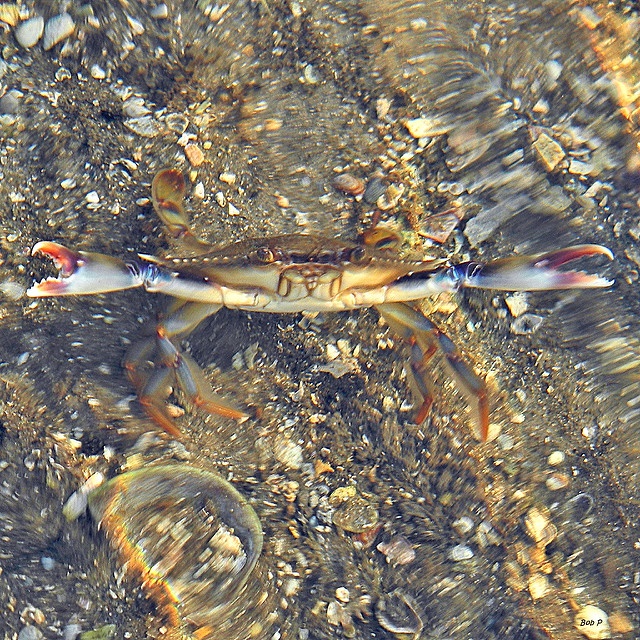
Blue crab (Callinectes sapidus). Image: Bob Peterson CC BY

One summer long ago, my grandmother took me crabbing at South Creek, a tributary of the Pamlico River. We knelt on the weather-beaten pier, tied a long string of twine to a raw chicken neck, and lowered the bait into the murky green depths. Grandma anchored the loose end of twine to a rusty nail jutting out from a piling.

“Now we wait,” she said. “But keep your hand on the string so you can feel when a crab starts nibbling.”

Being a novice, I was sure I felt a crab nibbling right away. I pulled up the length of twine ever so slowly, only to see the fleshy chicken neck. I released the twine. The bait plummeted out of sight again. Within minutes, I was positive I felt nibbles. Reeling in my string, I found only the bait once more.

Grandma chuckled. “You have to be patient. Give the crabs time.”

“I thought I felt nibbles,” I said in my own defense.

“You feel the bait drifting. You’ll know when it’s a crab.”

I waited, my mind wandering. The day was bright; Grandma’s sunhat cast a ruffled shadow on the gray boards, warm and splintery.

Next thing I knew, there were erratic tugs on my line.

“Easy,” said Grandma, sensing my excitement. “Pull slow and easy or you’ll lose it. Pull so the crab doesn’t realize you’re pulling.”

Bit by bit, I inched the twine up through the water to find not one but two – two! – blue crabs picking at opposite ends of the chicken neck. Holding my breath, I pulled until the crabs were just below the surface of the water. I dared not move as Grandma scooped them up with the dip net.

As the crabs scuttled inside a galvanized tub, I tossed the slightly-gnawed chicken neck back into the water, observing: “It would be a lot easier if we could just see to the bottom. Then we would know when we have a crab.”

“Well, isn’t that the fun of it?” asked Grandma. “Not being able to see what’s there, but pulling until you can?”

Decades later, I sat listening to a group of fourth grade intervention students rereading a script.

“You’ve all come a long way with your fluency, recognizing words automatically without needing to self-correct. I can hear some great expression,” I commended them. “I have one question: What is this scene really about?”

As students tossed out random answers, images of a weather-beaten pier, twine, and raw chicken necks came to mind. “Wait, you guys. You’re all skimming along the surface, just seeing the words. There’s a deeper meaning you’re not seeing; it goes past the words into the ideas behind them.” I told them of my long-ago crabbing days, how I knew the crabs were there, hidden from my view, and how I had to watch, feel, and finally pull them to the surface. “Reading is like that,” I told the kids. “There is more than what you see at first. To infer, you have to take your time, go back, and try to feel what’s not actually said before you can grasp the meaning. Some words give you more clues than others, but a deeper understanding is always there. Sometimes you have to wait, think, and work to pull the meaning out.”

Until that moment, I hadn’t imagined crabbing as a metaphor for reading comprehension, or, for that matter, teaching. The students often come to us with their backgrounds, experiences, struggles, and gifts hidden from us at first. The depths can be murky, indeed; how easy teaching would be if we could automatically see everything that each child needs to be successful. The best way to start is by throwing out the greatest “twine” we have: the love of learning. Keep your hand on the string, Grandma said. You’ll know. Pull easy so you won’t lose them. Be patient. 

To me, the true joy of teaching is first hooking students with a love of learning, then watching myriad treasures rise from those depths, especially when students start pulling on their own.

Reflect: Where can you strive to see past the surface of experiences and relationships to something deeper, of value? What unique exploration can you share with a child?