Compassion: a spiritual journey

My friend Kim Johnson chose the Spiritual Journey Thursday theme for October.

Kim is in the process of grieving her father. As she puts it: “I’m in the anger stage of grief, and along with everything else going on the world, I’m feeling the word COMPASSION calling to me as this month’s topic. I need to have more of it as I work my way toward acceptance.”

Compassion literally means to suffer together. The distress of another person sparks within us an intense desire to alleviate it. It is one of the purest facets of our humanity. Not mere emotion. Compassion is complex: I see your suffering. I am wiling to enter it, to help you.

There’s also a thing called compassion fatigue. It comes from prolonged exposure to traumatic events or being overwhelmed by the suffering of others, ultimately leading to physical, mental, and spiritual depletion. Our wellspring of compassion dries up. We find ourselves numb, in a desert devoid of hope, crushed beneath a boulder of distrust, breathing an atmosphere deprived of positivity. What is the point of it all, anymore?

The point is that we all need help. We want to get rid of the pain and anxiety eating us alive. We would heal ourselves, were it in our own power—even as our souls rage and wage war. Our fiery reaction, our fierce retaliation, is a temporary outlet that cannot bring true satisfaction, because it can never bring the peace we crave. How can we find peace when we are so unable to live peaceably? The fight is a wounded animal’s, a defense mechanism when existence is threatened. For…being alive… the innermost part of us is crying out against the knowledge that we will die.

I will speak now of the snake.

A week ago my granddaughter, almost four years old, asked: “Franna, do you like snakes?” She is asking all sorts of intriguing questions: Why is this your house? Why are you my Dad’s mother? She is forming her understanding of the world and affirming her place in it.

I answered as honestly I could. I do not want her to be afraid, like I was, for most of my life: “Do I like snakes? Not especially. But they can be helpful.”

Someday I will tell her how my Granddaddy taught me never to kill black snakes because they eat rats and mice. I may never tell her how he hacked copperheads to death with his hoe, or that when he became too elderly to manage the hoe, he shot them with his shotgun. It wasn’t that he didn’t like snakes. He was protecting his grandchildren and great-grandchildren from potential harm. Out of his love for us.

Note here how the spiritual journey employs foreshadowing. A thing is encountered; give it time. It is soon to reappear with greater significance. A portent.

The week after the snake question, I was at school, walking students down the sidewalk at dismissal, when I saw it, there on the cement by the edge of the grass: A little gray snake. Dead. Its body twisted, white belly frozen in an upward arch.

My first thought: It died painfully, in the act of writhing.

Second thought: Why aren’t the kids flipping out?

Not a one of them noticed the snake lying there.

Not that day, nor the next, or the next.

But I saw it, and it flooded me with…compassion.

For a snake, a creature I recently confessed to not especially liking.

It was alone. Abandoned. Not seen.

It was little. Not venomous (an earth snake). Not harmful.

And it was dead, with no one to acknowledge its existence or to mourn its passing.

I actually mourned it. I am sorry that it suffered, spiraling on itself in great pain as it died.

I am sorry we all have to suffer and die.

Every time I passed the snake the words mortal coil came to mind. Hamlet: When we have shuffled off this mortal coil…

I suppose that is the whole of the spiritual journey, is it not? Shuffling off this mortal coil. Someday shedding this battered body, being freed of the suffering.

Freedom from suffering is the very meaning behind the caduceus, symbol of the medical field. Snakes coiled around a staff. Odd. It just so happens if you research “symbols of compassion,” the caduecus appears. We do not think of it as representing compassion, but healing.

It is also linked to peace.

Many myths are behind the symbol, notably one in which the Greek messenger god, Hermes (Mercury in Roman mythology) saw two snakes fighting and cast his wand between them. The snakes gave up the battle and entertwined themselves peacefully around the wand.

In the Bible, God tells Moses to cast a bronze serpent and place it on a wooden pole as a cure for poisonous snakebite, a direct consequence of the people’s continued rebellion. God, out of his great compassion, provided a cure: Anyone bitten by a snake was healed of its venom by looking at the serpent on the staff, “high and lifted up.”

Herein lies THE point. Is there an antidote to the suffering we experience from the beginning of our existence, all the physical pain, mental anguish, and the thing we fear most—loss? Is it fighting venom with venom, or is it the active decision to stop battling each another, to cease provoking, retaliating, mocking, belittling, degrading, and causing more harm, until we seal our own destruction in utter carnage? Or is it a matter of realizing we’re all snakebit, and in the act of trying to alleviate another’s suffering, we ease our own? Can desperately-needed relief come in the very midst of our pain by desiring to help another….in compassion, “suffering together?” Not pulling others into our pain, but pulling ourselves into theirs?

Is this not THE point of Christ’s ministry and mission? He saw the suffering of people around him, out of compassion. He healed out of compassion. He wept at death for the ugly, unnatural thing it is, out of compassion. He was tortured and gave up his own life for broken humanity, out of compassion.

Compassion is born of love. Selfless love. Sacrifical love. As long as we have such love…we have hope.

Lest I sound too idealistic…today is my father’s birthday. A week ago today marked the twenty-third anniversary of his sudden death and the implosion of our family. It might as well have been dismemberment. Pain sliced us apart like a mighty warrior’s well-honed sword.

It isn’t supposed to be this way.

Someday, someday, we will shuffle off our heavy mortal coil and discover how great God’s compassion truly is…as well as his power to reverse and restore.

Until then, let us keep trusting. Let us wrap our wounds and our arms around each other. The pain will not disappear, not yet; but we can help each other through it.

That’s what the journey is for.

with special thanks to Kim — I hold you in my heart and prayers each day —
and to the SJT band of writers, for so often inspiring me to rise above.

Spiritual Journey: Blossoming

On the first day of May, Carol Varsalona offered the theme of “blossoming” to our group of Spiritual Journey Thursday writers. Carol’s husband passed away at the beginning of April. She writes in her post: “When I signed up to host the Spiritual Journey, I felt blossoming would be an appropriate theme for May since it connotes a renewal, a new beginning, and personal growth. I did not think that I would face the sudden death of my husband and go through a period of grief.” She dedicates this month’s post to his memory, along with a beautiful poem about him; you can read about her spiritual journey here.

Carol is one of the people who aways inspires me to see and savor the beauty of nature. Whenever I read her blog, it’s like taking a rest stop in a flower-filled garden, where one can breathe the fragrance deep and be strengthened for the journey. In her present loss, she writes of May flowers coming along to remind us of renewal and resilience.

To me the blossoming flowers are a metaphor for faith itself. The beauty of the earth pointing us back to the Creator, in a world that buffets us with fear, uncertainty, sadness, brokenness, rage, and loss. The peace and healing our human hearts desperately long for will never be found on this path. “All the world’s a rage,” to put a twist on a Shakespearean line. An ever-maturing faith is able to cut a path through anxiety, blame, and fear with which the world deliberately keeps distracting and demeaning us, where some of the worst pain is inflicted by those we care about most. As the saying goes: Hurt people hurt people. Faith does not retaliate. It withstands. It endures. It continues to bloom, and its fragrance beckons others to carve a better path through the the world’s dense, thorn-filled forest, to the inner garden. It is there, in our hearts. It has always been there…if we choose to see it.

In her poem, Carol wrote of her husband collecting a bouquet for her. I am reminded that one day, our faith will be made sight. We will BE the bouquet, the Lord’s very own, gathered unto him not as cut flowers but ones that shall bloom eternally in his presence, in that promised place where there will be no more tears, no more death, or sorrow, or crying, or pain (Revelation 21:4).

When I am still, I can feel the warmth of the sun on those flowers of peace; they open up, releasing their perfume in the soft breeze that infuses my soul.

Beyond this world’s brambles
Lies a garden of faith-flowers—
Opening, ever-opening to
Sunlight—yes, the
Son’s light.
Our hearts are filled there
Mind-rambles stilled there
In the hush of His garden
Nurtured by the Gardener’s
Grace.

Spring verse

On the second day of National Poetry Month, Leilya Pitre hosts VerseLove at Ethical ELA. She offers this poetic prompt:

A tricube consists of three stanzas, each with three lines, and each line having three syllables—quick, rhythmic, and focused. It’s easy to remember as 3:3:3.

Begin by answering the question: What does spring mean to you?

I think I have an answer…

Spring’s Message

Morning sky
streaked rose-gold:
heaven’s yawn

Birdsong praise
rising on
wings of dawn

Green-robed earth
resurrects—
loss is gone

Saving the best for last

Late in the evening, my husband and I are sitting in the living room watching TV, when all of a sudden he lowers the volume and turns to me.

He says: “You know I love you.”

“Yeeeesss…” I reply, a little bell of warning jangling in my mind. Something in his tone….

“Well,” he goes on, “I have something to tell you.”

Immediate thought: Something is wrong. A doctor has called with not-good news. Anything is possible. Since 2015 my husband has suffered much: the loss of an eye, heart attacks, cardiac arrest, two heart surgeries, a spinal fusion, and this past winter, heart ablation to treat arrhythmias that left him light-headed and out of breath…

What now??

My own heart begins to fail…but I have to ask:

“What is it?” The only thing worse than knowing is not knowing.

He pulls up a photo on his phone:

“What do you think of this?”

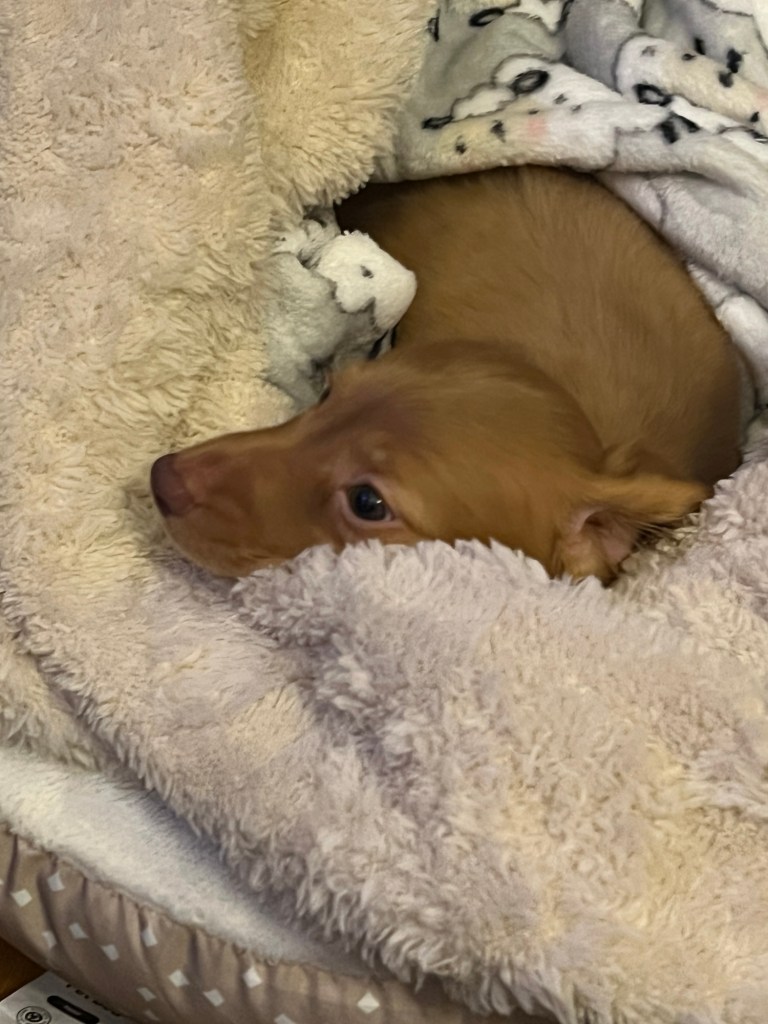
A puppy on a website? I’m confused. “Precious!” I say.

My husband looks at me for a moment. Then…

“He’s ours. I put a deposit on him three days ago.”

What I am hearing? Is this real? Am I dreaming?

And then we both begin to cry.

He knows how much I’ve been wanting a dog since our youngest moved out last fall and took Dennis the dachshund with him.

I know it isn’t fair to expect him to care for a dog when his strength is impaired and I’m at work during the day…and so I’ve tried to let go of my longing.

But ever since the ablation, he’s been strong. Energetic. Renewed.

He is ready.

We are ready.

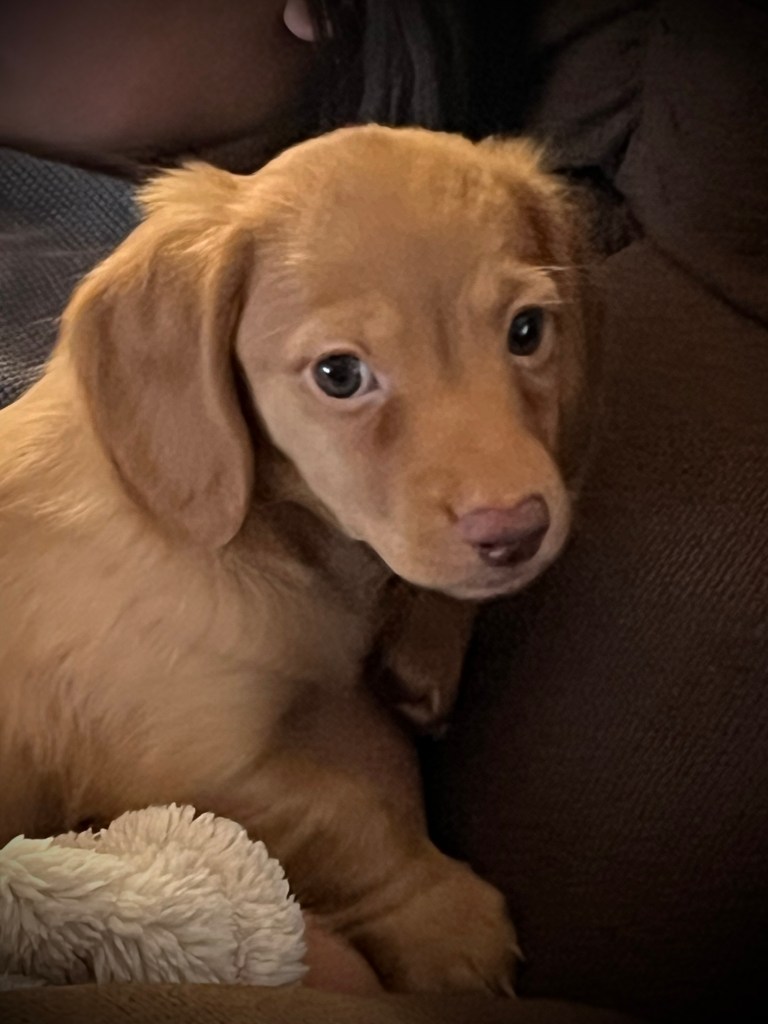
Ready for the next chapter of this beautiful life God has granted us, with our boys married and settled nearby, with our granddaughters growing up, bringing us infinite joy and laughter. Ready to celebrate the milestones of my sixtieth birthday this spring and our fortieth wedding anniversary this summer. Ready to love a little golden-red animal in our golden years…

Favorite lines from Robert Browning come to mind:

Grow old along with me!
   The best is yet to be

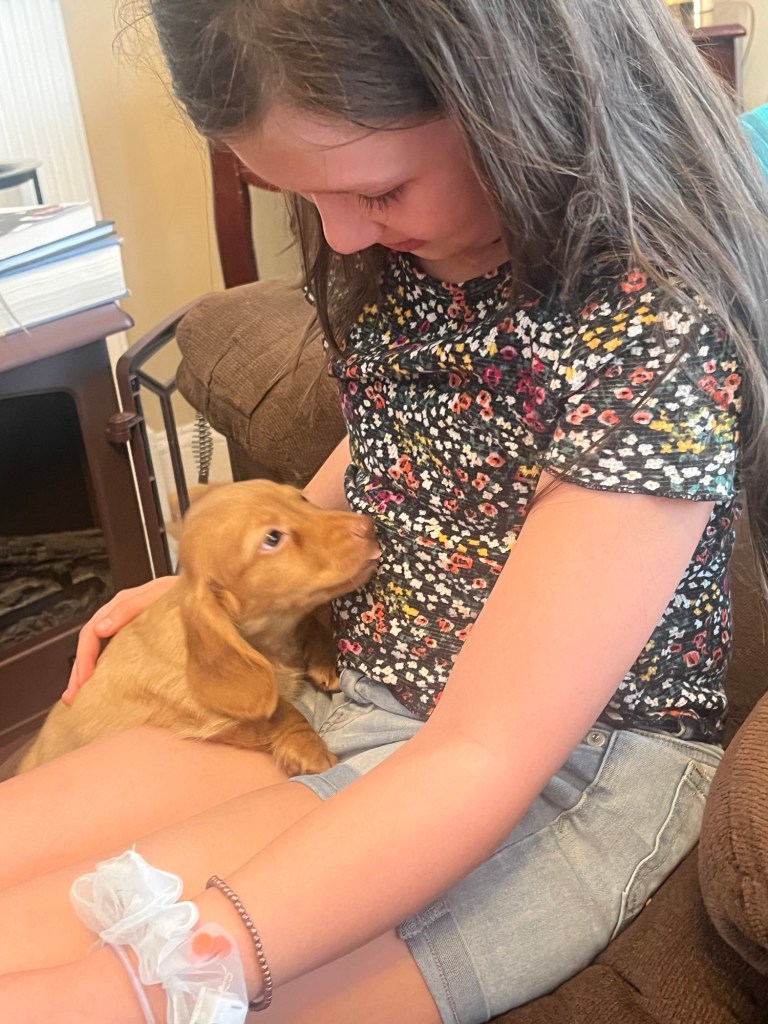
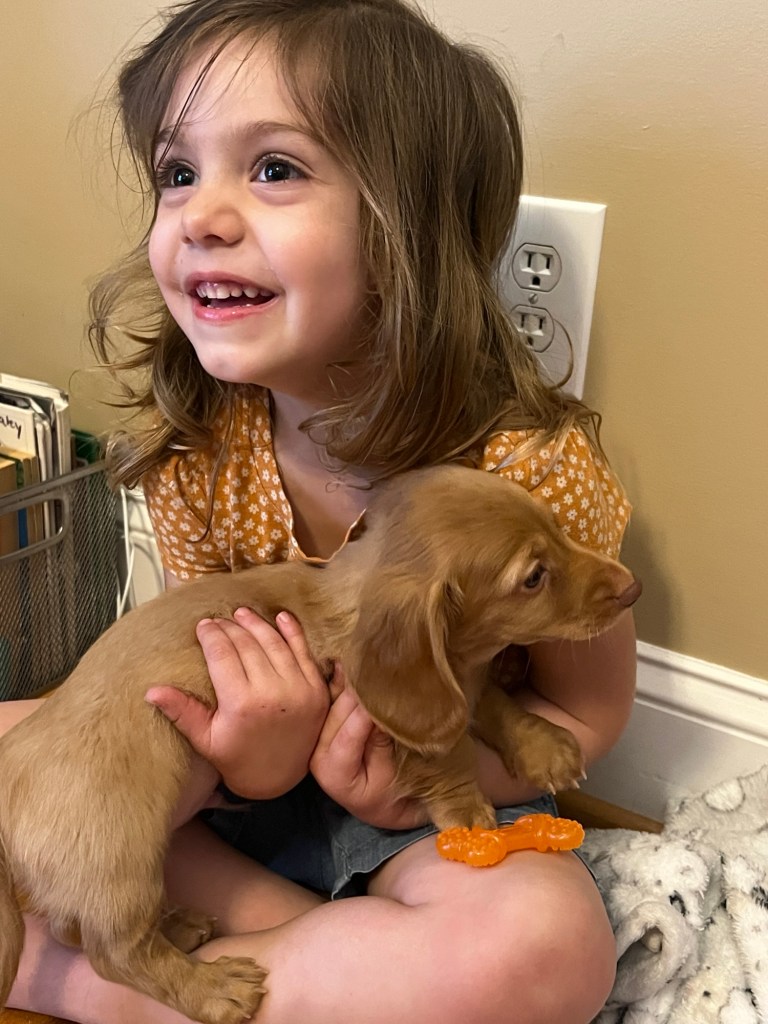
And so it came to pass, on Saturday while the granddaughters were staying with us, that my husband brought our baby home.

Our granddaughter, Scout, was so overcome that she cried.

Our granddaughter Micah’s reaction…glee.

—Exponential joy.

We named him Jesse. Hebrew for God’s gift.

In looking over the breeder’s information, I noticed a thing: Jesse was born on January 28… the day I was driving to work, feeling despondent, praying aloud to God for encouragement…and saw the eagle in the tree…

“Jesse” also means God exists.

My heart is too full for any more words.

I may not be writing many words for a while, anyway, as my hands are pretty full…

Here’s to the ongoing story of life, with all its golden glories shining through every challenge, and wonders untold waiting just around the bend.

*******

with thanks to Two Writing Teachers for the March Slice of Life Story Challenge
—we made it through, fellow Slicers!
I celebrate you all.

Joy to you on your journey.

The wound in the wood

A little slice of memoir

*******

I was five when my dad bought the house where I grew up.

There were good things about the house. A Big Bathroom and a Little Bathroom. Having two seemed luxurious to me, a child accustomed to apartments. Cloud-like swirls on the ceiling that my mother said were made by twisting a broom in the plaster while it was wet. A huge picture window in the living room, through which I could see a very tall tree behind the neighbors’ house. To me, the tiptop of the trunk appeared to be a lady sitting and gazing across the earth like some kind of woodland princess. Day in and day out, she sat there atop of her tall tree-throne, a regal silhouette, never moving.

There were things I didn’t like about the house. The red switch plate on the utility room wall that my father said to never ever touch. I believed that if anyone touched this switch, the furnace would explode and blow us all to smithereens. Even after I outgrew my terror, I steered well clear of that red plate. I didn’t like the thick gray accordion doors on the bedroom and hall closets. Bulky, cumbersome, and stiff, they didn’t really fold. They came off their tracks easily. These hateful doors eventually disappeared; one by one, they were discarded. Our closets were just open places.

The linen closet stood directly across from my bedroom door in the narrow hall leading to the Big Bathroom.

It wasn’t a true closet, just a recessed place with wooden shelves. I don’t remember an accordion door ever being there.

What I do remember is that one of those linen closet shelves had a terrible gash along its edge.

It looked like a raw wound that might start oozing at any moment. A gaping slit. When I pored over pictures of how to do an appendectomy in my parents’ set of medical encyclopedias (and why did we have these—? An exceptionally persuasive door-to-door salesman—?) the pulled-back human flesh and tissue made me think of the wound in the linen closet shelf.

This shiny-pink raw place bothered me. It was ugly. Almost…embarrassing. Something that shouldn’t be seen, shouldn’t be exposed…why had the builders done this? Couldn’t they have turned the shelf around so the wound wouldn’t show? It was an affront to me as a child, before I knew what taking affront meant.

I know now that the flaw is a bark-encased scar. The shelf came from a tree (maple?) that was injured, somehow. Maybe by a cut or fire. An online search produces this AI-generated explanation:

The tree’s cambium layer, which is responsible for producing new bark and wood, starts to grow new cells around the wound, forming a protective layer of tissue called callus. 

As the tree continues to grow, the callus tissue can expand and eventually cover the original wound, creating a scar that is encased within the new bark.

In short: The scar is evidence that the tree worked to prevent inner decay and heal itself after being wounded, and that it went on living for a good while before it ended up as the shelf holding our towels and washcloths beside the Big Bathroom.

I never touched that raw-looking wound in the wood. I averted my eyes from it, even hated it for existing.

Now, when I return in my mind to the rooms and halls of my childhood home, they are always empty, and that old scar in the shelf is the thing I want most to see.

How strange.

Maybe I am drawn to it out of kinship. I do not know the story of the tree’s life, only that this remnant is testimony to its suffering and ability to overcome. I could liken the scar to the ways adults damage children, having been damaged as children. I could see it as a symbol for my mother, whose early wounds festered long, the extent of which would eventually be revealed in addiction.

That’s the real red switch, for it blew us all apart.

Maybe I just want to place my fingers on the old raw place at last, tenderly, in benediction. I would say that I understand now about layers of callus tissue expanding, covering, and absorbing the deepest of cuts over a long, long time…it is always there, but it hurts no more, and I am no longer ashamed to see it or to let it be seen.

In the shelf or in myself.

Image by Wolfgang Eckert from Pixabay

*******
with thanks to Two Writing Teachers for the March Slice of Life Story Challenge

Dictionary poem

Katrina Morrison hosted the March Open write at Ethical ELA on Tuesday.

Her invitation: I am calling [this] a“Dictionary Poem.” If anything can define and expound upon the meaning of a word, it is poetry…pick a word to take apart and put back together in a poem. Begin with the dictionary definition of the word. Obviously, some words will offer multiple meanings. Craft your poem however you will. After the definition, expound upon the word’s meaningthe vicissitudes of life may direct you to write a haiku or a villanelle or free verse today.

I will NOT be attempting the villanelle again anytime soon; I wrestled that form to the ground on Saturday and haven’t recouped the stamina yet to give it another go. I went with an acrostic, because the word “shards” stays in my mind, and I keep turning it around and playing with it anyway, to find out all it wants to tell me. I love this word, so…the poem:

Defining

shard

  (shärd) also sherd (shûrd)

n.

1. A broken piece or fragment, as of pottery or glass.

2. Zoology A tough scale or covering, such as the elytron of a beetle.

Dictionary.com

The Poet’s interpretation:

shards

plural

sharp-edged fragments of memory, or

seeking healing among remnants, despite suffering

Somewhere in the shattering
Healing awaits, disguised
As sharp points
Ready to draw yet more blood…
Dare to touch the memories. Discover
Scattered diamondlight, all around.

Image: beasternchen. Pixabay.

*******

with thanks to Two Writing Teachers for the March Slice of Life Story Challenge

A place to breathe poem

On Sunday, Dr. Sarah Donovan, founder of Ethical ELA, hosted the March Open Write. She invited participants to write about a place you go to breathe and know that everything will be okay.

She offered these opening lines as a model, from poet Christine Hartman Derr in “A Place to Breathe”:

Off the path,
behind some trees,
a clearing sits
and waits for me.

Dr. Donovan asked two questions to prompt our thinking:

  • Where or what are the places that wait for you?
  • Where are the places and who are the people around which you can simply be?

I write of my “breathing place” all the time: my drive through the countryside, to work and home again.

Here’s my poem.

Breathing Place

Along the road
among the trees
the wild things live
and wait for me

They do not know
about things like grace
or that they are
my breathing place

When they appear
as I drive by
my spirit soars
eagle-high

My heart, it sings
oh, glory, glory
for their presence
in life’s story

Peace descends
and folds its wings
—I breathe the breath
of wild things

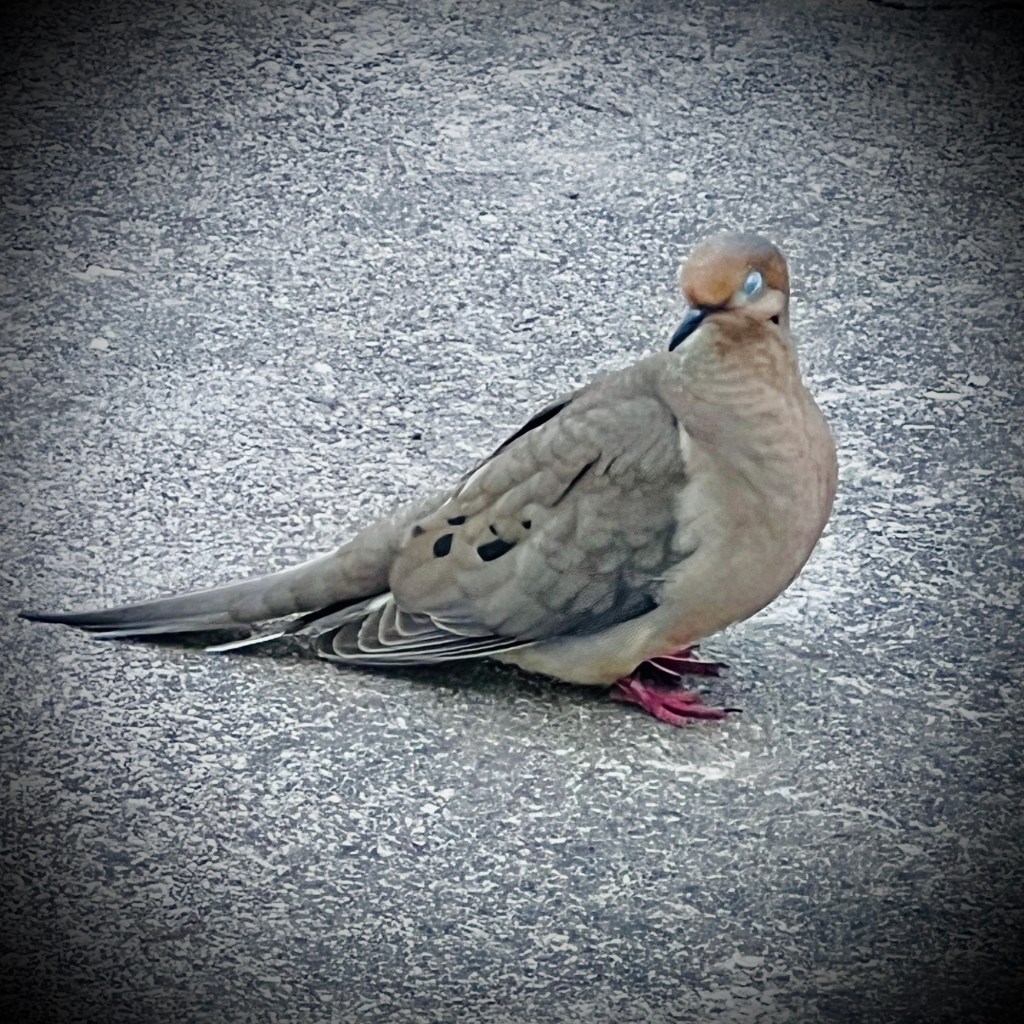
Mourning dove, resting in my driveway

*******

with thanks to Two Writing Teachers for the March Slice of Life Challenge

Grace upon grace

Yesterday Leilya Pitre opened the March Open Write over at Ethical ELA with an invitation to compose poetry inspired by the Ides of March.

The Roman calendar confuses me, with all the backward counting. An “ide” is one day before the middle day of the month. For March, that’s the 15th – yesterday’s date. Leilya gave several poetic form suggestions: villanelle, free verse, limerick. She prompted participants with a choice: 1) Write with “an air of inevitability and doom…mirroring the idea of a foretold fate,” or 2) “Write a poem that celebrates a moment of change or transformation, akin to the original meaning of the Ides of March as a day of transition in Roman history.”

A day of transition…hmmm.

Change.

What needs to change more than the human heart?

I confess to wanting to run for my life at the idea of writing a villanelle (see how much the very word looks like “villain”?). The form is deadly! And there’s only one Dylan Thomas. Nobody else can rage, rage at the dying of the light quite like him. And so I opted for free verse, my default form.

Crickets. Nothing. No ideas on ides.

And so I returned to the villanelle – drat it all! – with “an air of inevitablity and doom,” for sure.

But then: Two repeating lines came to me. I started a rhyme search. A villanelle takes a pile o’ rhyming words. Not all of them will work. One of my favorite images re-materialized in my head: the “golden rim.” Yes. Let us drink from the golden rim of the goblet…no, chalice. Yes. What are we drinking, and why? What’s the point? What does it mean?

Have you ever heard that what you need is there, right within your reach, if you just look?

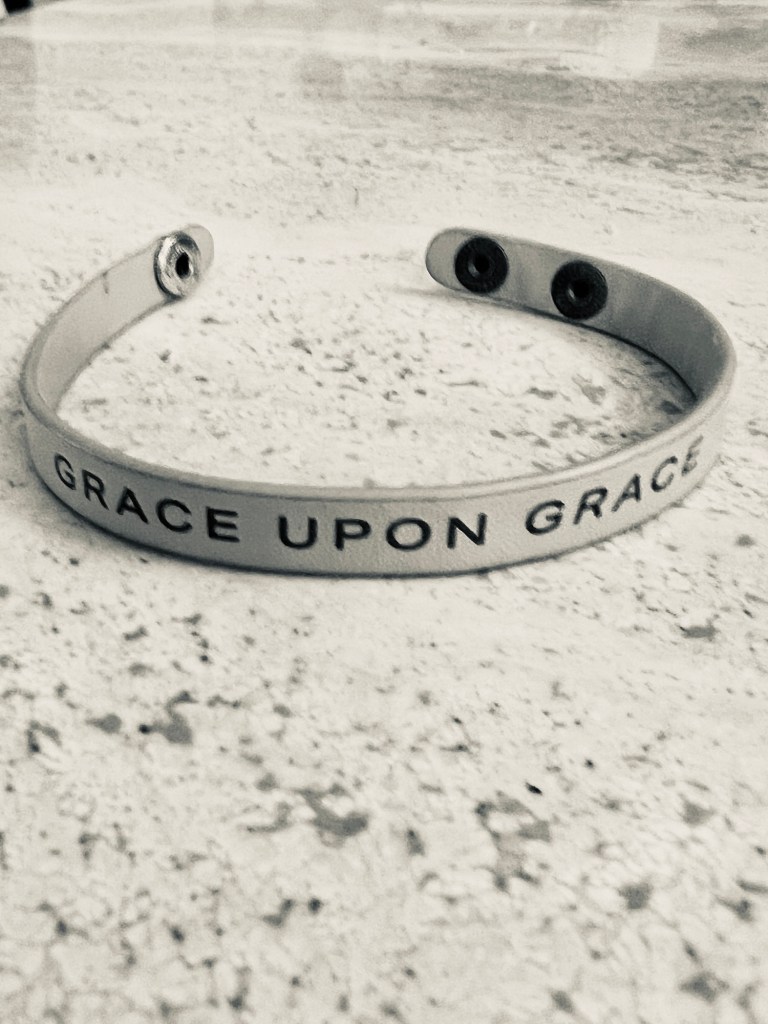
In this case, what I needed was literally right there within reach: the bracelet on my wrist. You’ll see.

Here’s the poem. Still tinkering with it.

Gratiam pro gratia

As evening descends in shadows dim
Let’s toast to ceasefire of life’s fight:
Drink, my love, from the golden rim.

The face of the morrow will be less grim
—See, our ashen embers retain the light
As evening descends in shadows dim.

Toss off your cloak with fraying trim.
Kneel by me, pray, well we might—
Drink, my love, from the golden rim.

There sparkles yet a priceless gem
Within the pocket, glittering bright
As evening descends in shadows dim.

Hold my hand — let’s sing a hymn
Before we take our earthly flight.
Drink, my, love, from the golden rim.

Sweet chalice of life, abrim,
Despite this darkest night…
As evening descends in shadows dim,
Drink, my love, from the golden rim.

My poem’s title is Latin for the words on my bracelet. An excerpt of John 1:16: from the fullness of Christ, we have received “grace upon grace.” I wear it as a reminder to give grace, having received it in such abundance. I purchased the bracelet at a coffee shop called Charis (“Grace”) which has a wall plastered with customers’ prayers written on tiny slips. The owners donate a portion of proceeds to organizations that are working to make the world a better place. Our time here is short. Let us be about this work, in communion with one another, giving each other grace.

*******

with thanks to Two Writing Teachers for the March Slice of Life Story Challenge

Whole

On the first Thursday of each month, a group of us gather online to write to a theme. We call this Spiritual Journey Thursday.

I’ve been out of the loop awhile. Today I take up the invitation again. Denise Krebs is hosting, and she has offered us the topic of wholeness:

What does it mean to be whole, on our spiritual journey?

I feel like my reponse could take a whole book.

Maybe that’s because I understand brokenness.

Last Sunday I wrote a letter to my mother after learning of her death (the post Strewn with loss). We were estranged for almost twenty-three years. It’s a story of mental illness, compulsions, a family paying a price, and no reconcilation. The truth is that after such a shattering we can’t wish wholeness into being; we can only find something of beauty in the pieces. We must learn to treasure that. To be grateful for it. The letter to my mother is to thank her for the beautiful shards amidst the brokenness. There are many. She loved me, once. I loved her. I forgave her. She never knew. She is gone. I could not fix her or the relationship. I had to learn to be whole without her.

The truth is that we are all broken in some way, and sometimes, wholeness doesn’t look or feel like being whole. It’s not perfection. It’s not even peace. It’s more like a path.

If we choose to take it.

To me wholeness being productive, fulfilled, and able to love. Three things I rely on to get me there: Faith, nature, writing.

I’ll take them one at a time:

Faith. I believe God is sovereign. God is at work even when we cannot see it or feel it, and when we can’t seem to make any sense at all of what we are living through. He often does his best work through the least likely people and in impossible situations (for nothing is impossible with God, Luke 1:37). In my current rereading of the Bible, what stands out to me, over and over again, is God’s provision to those who love and obey him. If I am to be honest about my own spiritual journey…I fail at this miserably. But that is the point. I am broken like everything else in this world. The desire for relief from pain or a racing pulse or an anguished heart or a reeling mind is the very desire that pulls me toward God. I do not have to understand ungodly things. I have only to seek God’s help in rising above them all. He will make a way. He will provide. This requires that I know more about him and so I study. Again…wholeness is a path.

Nature. I won’t go into my many bird stories here. I will just say that having a sense of awe, as in understanding that you are part of something greater than yourself, brings purpose and wholeness. It also brings wisdom; King Solomon “spoke of beasts and of birds, and of reptiles and of fish” (1 Kings 4:33). Says my study Bible: “Careful observation of the natural world and how it works it one of the ‘normal’ ways in which people gain wisdom… Solomon was concerned with the natural world.” Nature opens your mind and your heart. It imparts awe in abundance. Trees can communicate with each other. They try to help each other. When grass is cut, it immediately begins to heal itself; that’s the fragrance you smell. That very same chemical is also warning other grass that danger is near. The networkings of mushrooms is mind-blowing. It’s called “The Wood Wide Web.” Not long ago, a first grader told me earthworms are so important that none of us would be here without them (!). Nature offers healing. If you haven’t read Something in the Woods Loves You by Jarod K. Anderson…give it a try. He is frank about his battles with depression and how nature helped pull him out of the abyss and into a better place.

He writes:

Kindness won’t make you rich, but it will make you whole. I know there is hurt in your life…These pains stick to us like burrs. They tell us to lash out, to stop feeling, to turn away and turn inward… But these impulses do not control us. They don’t write our stories, and each time you hear them and answer, “No, not today,” you have given a gift to the world…The world will give back to you in kind, but receiving those gifts can take a little practice… Nature is out there and she is in you. Meet her halfway.

I do this, every day. I meet nature. I look for birds. And more. Here’s the thing: Start looking, and they will come.

So might the feathers of wholeness that grow into wings.

Writing. I haven’t done as much writing this past year as in previous ones. I could say life gets in the way. That I don’t have a lot left to give at the end of the workday. That I am busy with my family, from my husband’s health issues to savoring any time I can get with my granddaughters…these things are true, but they’re not all. The “whole” truth is that I am tired. So, when the March Slice of Life Challenge rolled around again, I decided I would not take it on. Despite having loved it in the past, the idea of writing for thirty-one straight days and responding to others tired me even more. And then I woke up in the wee hours of March 1st and thought, why not write, you will feel deprived if you don’t. And so I got up and wrote. The following day, I wrote that letter to my mother…something I realized I really needed to do even though she will never know about it. That doesn’t matter; she’s free of her suffering in this world. And once again I realized the power of writing. Since I took on the daily challenge, I haven’t been as tired, strangely. I’ve felt stronger. More able. More clear-minded.

More whole.

Most of that is due to you, my friends. Coming back to my writing communities is like coming home to a place of profound belonging.

What is wholeness? Being productive, fulfilled, and able to love. How to attain it? Through faith, nature, writing…

Thank you, my fellow travelers, for being such a vital part of my journey.

And my wholeness.

*******

with thanks to Two Writing Teachers for the March Slice of Life Story Challenge
and to the SJT writers
and to my friend Denise, for her invitation to “wholeness”


Strewn with loss

Yesterday I wrote to the WordPress daily prompt on fate/destiny.

Today’s prompt:

What experiences in life helped you grow the most?

Loaded question.

My title today comes from a line I wrote in yesterday’s post. Will this be my pattern every day I take on the Slice of Life Story Challenge? Don’t know. We shall see.

As to this prompt about experiences…

Doesn’t most growth come from a place of pain?

*******

Dear Mom:

Someday I will do a better job of writing about this than what I am about to do now, but here goes.

I understand you have died. About a year ago.

I’ve not been able to find your obituary anywhere, nor your grave. Your plate on the headstone beside Daddy’s remains blank. My guess is that things were kept private, simple, as inexpensive as possible.

After twenty-three years without any contact, I have a few questions, but not much to say.

I have to say it, even though you’ll never know.

I got over my anger long ago. I had to, or it would have consumed me. I had young children of my own to care for; they were my priority. I now have two beautiful granddaughters. Your great-granddaughters, who will ask for the story, someday.

I got over my fear of your destructive behavior, which marked Daddy’s last years, and which shattered our family. I know it continued because, every so often in the ensuing decades, debt collectors would call my house looking for you. I would tell them the truth: I had no contact with you.

The pattern would not be broken, but people would. There could be no going back. Only forward.

I am past the point of blaming. We make our own choices. We paint our narratives in the colors of our liking, to our own purposes. To keep living with ourselves, I suppose, instead of changing. I chose the filter of Fact. Grannie once told me that she didn’t believe in divorce but she had to do it to survive your violent father. I didn’t believe in cutting ties with my own mother, either, but I had to do it, to survive. In the better part of you – for it was surely still there, somewhere – you would have understood this.

But I am not writing to justify or to judge. It’s not my place. It doesn’t matter now, anyway.

What I want to say is thank you.

Thank you for every sacrifice you made throughout my childhood. You did so much with so little.

Thank you for the sewing machine running late in the night, making our beautiful clothes.

Thank you for playing gospel records that I listened to when I was supposed to be asleep, and for the way you could paint and repair most anything.

Thank you for your humor and your unbridled cackling, contagious laughter; no one else laughed like you.

Thank you for being a safe haven for kids of troubled families in the neighborhood as well as for our neighbor who suffered a nervous breakdown. I see her frantic blue eyes, even now. Thank you for inviting the meanest bully of all to my birthday party without telling me, because you saw a child who was hurting inside, who needed to be part of something happy.

Thank you for advocating (surely, as I can’t imagine it was Daddy’s idea), to get my pet parakeet, and later for the puppies (which he forbade, to no avail; you won out).

Thank you trying to save my sick kitten, Edelweiss, which died in your hands while you tried to feed her with an eyedropper.

Thank you for your incredible creativity, the way you could whip up a costume like magic, and for coming so proudly to my school plays, your sisters in tow.

Thank you for pulling my wedding together, for mending the gown and veil from the discount racks so they’d be presentable, for weeping with sheer relief when Grandma offered to pay for the cake, and for making my all my bridesmaid dresses and my sky-blue going-away outfit. I recall you saying you were married in a blue dress; you didn’t have a wedding gown. And thank you for removing the iridescent white beads you wore to my wedding, pulling them off your neck to put around mine at the last minute, to set off that sky-blue dress as I was leaving.

I bet you thought I’d forgotten, all these long years since.

I have not. I remember it all.

As I said, one day I’ll write about it better than I can right now.

Just one more thing, as I sit by the window on this bright day, with winter fading and spring stirring in a wild dance of golden light and flickering shadows across my kitchen walls and floors: Thank you for taking me to church when I was a child. When I lost you to the darker part of yourself, I still had the church. The faith. The Lord. This has been my life. This has been the life of my family.

You might have forgotten many things. I might be one of them. I will never know.

But it’s okay. I choose to remember the good bits of you reflected in every shard I salvage from this story strewn with loss, set in motion long before I was ever in the world.

Some will say how sad, that no one ever never reached across the abyss to make amends.

I do not say this. I say it is over. The abyss is closed. Filled in. Time takes us all. The hurt is gone, although the healing will never be complete in this life.

I carry the shards.

Peace to you at long last, Mom.

P.S. I dreamed of you awhile back. Small and white-haired, but you looked well. You held your arms out to me in welcome.

“My baby has come home,” you said.

And I hugged you.

Because it was finally safe to love you again.

*******

with thanks to Two Writing Teachers for the annual March Slice of Life Story Challenge.
This is my ninth year participating alongside fellow teacher-writers,
as a means of continually honing the craft.

To those of you out there dealing with loss, death or otherwise:
Writing brings clarity.
Writing in community builds courage.

Write your story and trust.