After

On a mission through the school’s main hall

a casual glance through the glass wall

fresh mulch, a sea of woody brown

a few dead leaves scattered round

—Fall.

It registers after I pass

something else beyond the glass

something crumpled on the woody bed

a conspicuous spot of red.

I turn around. 

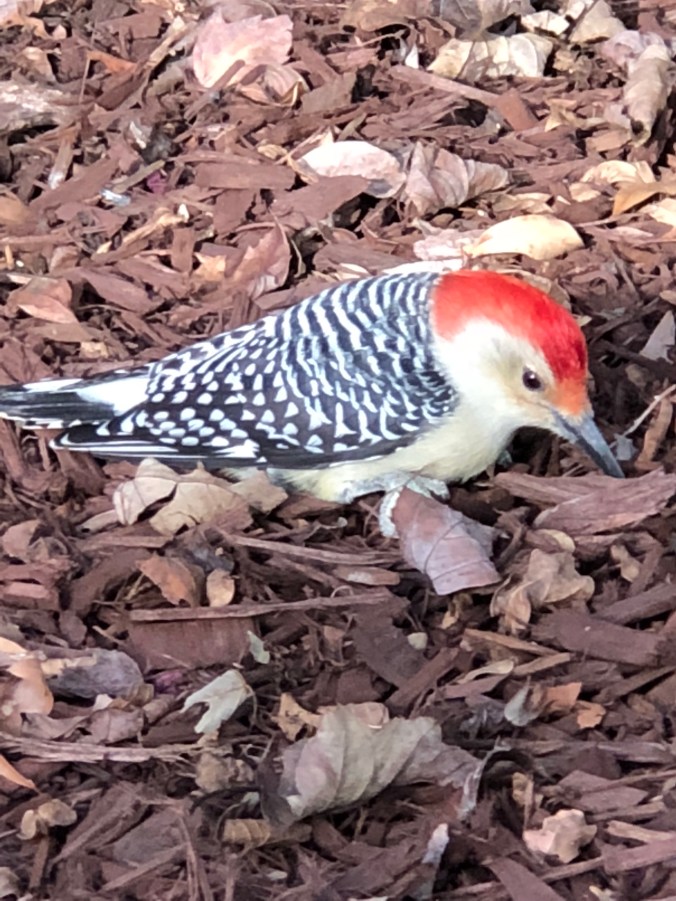
A bird, lying on the ground

flat on its back

speckled white and black

white claws curled, scarlet head.

Little woodpecker. Dead.

Flew into the glass wall, it’s clear

from the way it’s lying here.

A broken neck, I think

but then, then—I see it blink.

What comfort can I give?

Is it even going to live?

I mustn’t touch it, must let it be

I won’t have it die for fear of me.

The hall’s deserted, what to do

people are waiting for me, too

—I’ll hurry. I can never atone

for letting it die alone.

On my hasty return, a wondrous sight

the woodpecker, sitting upright

scarcely moving, still dazed.

I am amazed.

It opens one eye, tests its beak

assessing the damage wreaked

turns that stunning head

of breathtaking red.

I silently celebrate

as I watch and pray and wait

for that one eye remaining shut

to be all right, to open, to see—but

the instant it does, without warning

with a flurry of wings, off in the morning

he goes. I didn’t see him fall

from my side of this glass wall.

I’m just here, rejoicing, for his open eyes

his reclaimed strength, his reclaimed skies.

My heart goes with him, as he flies

—I saw him rise.

Just before he took flight again. A woodpecker happens to symbolize communication, opportunity, and awareness. How grateful I am to have seen him, to have witnessed his overcoming.

Incapacitated

The initial predictions were utter destruction by an epic monster.

Having suffered extensive damage from hurricanes in years past, central North Carolina fortified itself against Florence. I collected a small mountain of dry goods and canned vegetables—”hurricane stash”—that probably could have fed my family of four for two weeks without electricity. Since we’re on a well, we don’t have water when the power goes out; I  even purchased powdered milk to mix with bottled water, for our cereal. Bottled water . . . that took several trips across three days. By 6:30 in the mornings, restocked grocery shelves were again picked clean. I finally scored a 36-count pack of Aquafina and turned to maneuver away from the throng in that aisle when a man, loading his own cart, said, “Here, you better take another.” He hefted a pack of water off the shelf and stacked it on top of the one in my cart. This gesture by a stranger stirred my heart.

At home, the dogs had plenty of food, we had batteries, all the laundry was done, one of the bathtubs was filled with water, the cars with gas. Our porch rocking chairs and the grill were secured in the shed. The television news ran nonstop. My family watched the slow, drawn-out approach of the monster, and although the sun was still shining, school was canceled in anticipation of the onslaught. My mind continually scrolled for every possible preparation. I even boiled the remainder of our eggs so they’d be usable if the power went out for days, as happened in the past.

I planned for everything.

Except my back going out.

It started on the day before Florence was to make landfall and grew steadily worse. I attributed it, at first, to the barometric pressure; I’d heard several people mention headaches and backaches. By the time the wind and rain arrived, however, the grip of pain was too intense for me to sit or walk anymore. Dosed with ibuprofen, I spent the duration of the storm — five days, all told— lying in bed with pillows under my knees.

Unable to do anything.

Except re-read the entire Harry Potter series.

Escapism at its best.

Different things strike me on each reading. This time, as the wind raged on the other side of the walls, as sideways rain whipped in voluminous sheets, slapping the windows with fury, as the encroaching darkness forced me to switch on my phone flashlight in order to see the words on the pages—Lumos!— I lay there contemplating the nobility of the characters, the way they banded together, helped one another, in the face of their own destructive, epic monster. How they found unrealized courage despite ever-increasing darkness. As I lay reading, immersed in Harry’s world,  I caught distant snatches of the news from my own: on the TV in the living room, where my husband and sons tracked Florence’s path, meteorologists warned people that if their houses flooded to not seek refuge in their attics, because there’s no exit. Rescue personnel are not equipped to cut through houses to save people. Meaning that it’s safer to climb on the roof of one’s house than to be trapped.

For a second, everything went still: How could I do that? If it flooded here—never say never—how could I possibly climb to the roof? I can’t even move!

And then I read the words of Mad-Eye Moody to Harry as Harry was about to compete in the Tri-Wizard Tournament: Play to your strengths. 

Harry doesn’t think he has any strengths—this is Book Four, he’s just fourteen —and he has no idea that the Tournament was designed solely to destroy him. Moody growls: Think now. What are you best at?

Lying flat on my back, at the mercy of my own body, helpless against the forces of nature, imagining a flood . . . what strength would I have, just now?

I thought of elderly people in this storm. Then of my Grannie, years ago, when her house caught fire in the dead of night on New Year’s Eve; how, after just having heart bypass surgery in the days when it was a new thing, she climbed out of her upstairs bedroom window onto the porch roof and survived.

Play to your strengths.

In Grannie’s case it was pure grit. As for me . . . well, a streak of that same determination and strong will (Grannie-grit) runs in my own veins, but I think my strength is rooted in something greater. If had to choose what’s deepest within me to tap, it’s hope.

I recently heard hope defined as not wishing, but knowing, trusting. No matter how severe the pain, I know I’d be able to climb to safety. Somehow. I trust my family would help me. Even in my weakened state, I’d find and give the last of my strength to help them, too. A strength that would come exactly when it was needed, not before.

On and on I read. Of Harry’s overcoming, of his concern for others, his willingness to give his own life in order to save them, even those he didn’t know personally . . . .

The darkness, the storms bring out the best in humanity, reminding us that we are, above all, here to help each other. Not to destroy.

—I will write about Severus Snape another day.

And storms, ever how violent, do not last forever.

It didn’t flood here, although our yard remained a bog for a while.

Now we have a plague of bloodthirsty mosquitoes to battle.

And my back pain has diminished, bit by bit, day by day. It remains a twinge, still causing me to be mindful. Strange thing, that. Being rendered powerless during the storm, unable to do anything but read. And endure.

But, in the end, powerless all depends on one’s own perspective. Reading is another great strength of mine, is it not? Didn’t it get me through the storm and the pain? That’s hardly powerless. Not to mention that in my tiny neighborhood, in the heart of a rural area where we frequently lose the power for no apparent reason at all . . . the lights blinked but never went out.

Just like hope.


September 11

Healing field

The Healing Field. Randy HeinitzCC BY

Out of the blue

a student asks:

“Mrs. Haley,

if you could have

one magic power,

what would it be?”

Other students 

look up from their writing

to listen. 

I think of suffering

of strife

of festering

scars and stripes

visible

and invisible.

Broken bodies

hearts

psyches.

The children watch

and wait.

What power would it be?

“Healing,” I say.

They absorb this

without a word

their young eyes

looking far away

or maybe far within

to make

their own meaning.

They nod

as they return

to creating

their own stories.

A fine mess

After being away on vacation all last week, my first order of business on returning home was to check on the four baby house finches that hatched in the wreath on my front door. I’d been chronicling their development daily, so I knew many changes would occur in my absence.

Here is what I discovered:

1) The babies are now well-feathered; their skin-head mohawks have become mere wisps upon their downy crowns.

2) Two of the babies can fly. They sailed out of the nest this morning as I approached. The other two stayed put, their bright little eyes regarding me with a mixture of curiosity and apprehension.

3) Their nest is one spectacular conglomeration of droppings.

To be fair, the droppings are only around the rim; the mother collects them there. What a job, building a wall of excrement. Worse than diapers. When I first wrote of the perfect, flower-graced nest, the pale blue eggs, the hatching of the tiny pink nestlings, I concentrated on the beauty and wonder of life. I pointed out that the collective noun for a group of finches is a charm.

And charmed I was.

There is nothing charming about that nest now.

The fledglings themselves, of course, are enchanting. They’ll soon be gone, the circle of life will go on, and all that will remain of these magical moments is a monumental mess.

But that’s the story of life. It’s messy. It can’t be comprised solely of breathtaking beauty and newness; if it were, we could not recognize these moments for what they are. They’d lose their value. Only when contrasted with ugliness, hardships, and pain can we see and cherish the beautiful when it comes. We inevitably deal with messes, some that occur naturally, some created by others, some of our own making. Therein lie all the stories . . .

Which makes me think of writing. This nest is a tangible (although I do not wish to touch it) reminder of these commonalities:

-Life is messy.

-Writing is messy.

-Thinking is messy.

-Teaching is messy.

To do any of these well, we have to be willing to accept and even embrace the messiness. We must certainly persevere through it to arrive at the beautiful. It takes courage, stamina, and a lot of hard work, to write well, to think well, to teach well, to live well.

The strength to do so, I believe, lies in believing that the beautiful will come. It’s all a matter of trust, of faith. And pressing on.

Although I was appalled by the quantity of accumulated—um, bird-doo—around the nest, I was also amazed that two of my four little finches could fly. Last night they couldn’t; today they can. Tomorrow the others might.

This is a message to me about readiness.

Everyone arrives as a writer, a thinker, a teacher, a good practitioner of life, in their own time. Lots of messes will be made along the way. Sorting this out is what grows us. One by one, as children, as adults, as long as we live, we are continually growing the necessary wings to fly beyond where we are. And it’s truly a collective, collaborative growth; we are to nudge each other when needed, but not too hard, too soon. We’re not to hold back, to hold one another back, simply because we cannot see all that lies ahead and for fear of navigating the unknown. Knowledge comes by trying. By experiencing. By taking risks. There’s an implicit difference between throwing caution to the wind and taking a leap of faith, that being potential self-destruction versus healthy maturation. These finches know. As the day wears on, I watch the two fledglings that can fly going back and forth from the eaves to the nest, coaching their other two siblings on how to do it. See see see, I hear them cheeping. A bit at a time, a bit at a time. At any moment, those last two are going to get up on that nasty, messy rim and let go.

In more ways than one . . . .

So you make a mess. So what? So you’re alive and growing.

Tomorrow you stretch your newest feathers and find you can move on.

To where the beautiful awaits.

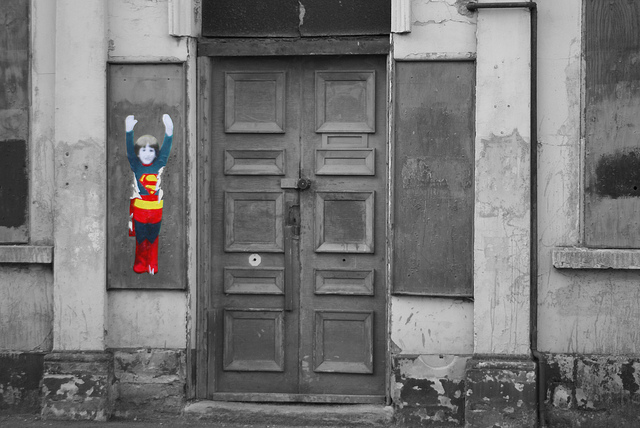
Like Superman

Superman

Superman. Ian HarveyCC BY-SA

I’m seated at the old computer table, listening to second-graders read. Poetry conferences, we’re having. Revisions and final edits before their teacher sends everything off to publish a class book of poems.

“Is it my turn? It is it my turn?” he keeps asking me, from his seat in the middle of the room.

Actually, he’s not on my list of students that his teacher asked me to meet with. So I say, “Not yet. Not yet.”

He manages, somehow, to sneak between his classmates. I look up from notes I’m making to find his impish face beaming up at me. His tiny body wriggles in the chair beside me.

“My turn!” he insists.

I call across the room to his teacher, who’s also conferring with students: “May I PLEASE work with our friend here?”

“Yes, sure!” she answers. “I’m about to meet with him, but if you want to  . . .”

If I want to?

How can I say no?

“Okay, YOUR TURN! Read your poem to me,” I tell my exuberant conferee.

Grinning, he shoves his paper over to me.

There’s nothing on it. Not even his name.

“What, you haven’t written anything yet?”

He shakes his head. He’s still smiling. “No! But my English is bigger!”

He remembers.

At the beginning of the year, I assessed his reading. Just as I was about to console him on his having missed all of the words, he patted my arm and said, “You have big English. Me”— he patted his chest— “little English.”

His perception of everything around him is astonishing.  Whether he has all the words for it or not.

I’ve noticed, in the hallways, that he doesn’t greet me as Haley! anymore. Now it’s Hi, Mrs. Haley. That when I say How are you? he says, I’m good.

“Yes,” I say, “your English is a LOT bigger. That’s for sure. Now, this poem. What do you want to write about?”

He shrugs. “I don’t know.”

“Well, what do you like?”

His face lights up. The response is immediate: “BASEBALL!”

“Okay, so, what do you want to say about baseball?”

I take the paper and pencil.

“I like baseball,” he says.

“Perfect.” I write down the words. “That’s your first line. What else?”

“I like hitting the ball with the bat.” He acts this out. He’s a boy full of endless energy.

“Great. That’s your second line.” I write it down. “What else can you say about playing baseball?”

He thinks, gets excited, garbles his words. Something about running . . .

“Wait, slow down. Did you say running?”

He nods, bouncing in the chair. “I run like SUPERMAN!”

Superman . . . 

The first time I saw him, over a year ago, when he came to the United States, to our school, he had no English at all. Unused to a school setting, he frequently had outbursts because he couldn’t communicate his wants, his needs, his questions, his feelings, anything.

He was a frustrated, forlorn soul.

Wearing a Superman shirt.

My first words to him were, “Hey, you’re Superman.”

I pointed to the on his little shirt.

He didn’t understand, but he smiled.

Now, he understands.

Within five minutes, the poem is written. I point to every word, reading to him, then he points to every word, reading back to me. I watch him bounce away to his desk to copy the poem over in his own handwriting.

I write, too:

So you run like Superman when you play baseball.

Maybe you really mean that you fly

because you do

because you ARE Superman.

We shall stand marveling in your wake

it’s a bird, it’s a plane

it’s you.

Supersonic.

*******

For an earlier encounter with my little friend, read Big English

For the record, poetry is an excellent way to help English language learners—really, any student—write more. Poems can be brief with less emphasis on conventions. Energy can go freely into capturing images, ideas, emotions, and building vocabulary.

Heroes

img_4479

They’re heroes. All of them.

From across the state of North Carolina, they gathered in the capital city. Fighting crowds and full parking decks, between a St. Patrick’s Day parade, a street festival with an Irish band, a pub crawl, and educators arriving for the North Carolina Reading Association conference, the children made it to the Young Authors Project celebration.

These young people, from kindergarten through twelfth grade, and some of their teachers, were previously recognized by their local reading associations for writing on the theme “Show Your Strength.” Finalists went on to be judged by a panel for the state, and yesterday the North Carolina Reading Association awarded winners a book of their published entries and a medal.

Prior to the ceremony, such figures as Batman, Wonder Woman, and the X-Men swept through the audience, greeting the children, congratulating them, posing for pictures with them.

Project Superhero, Inc. and Causeplay Carolinas team up at the NCRA Young Authors Project celebration. Photo: Twitter, @superheroorg 03/17/2018.

Note the word POWER on the photo-op backdrop . . .

I thought immediately of the power in writing.

I watched as the children were called, county by county, to receive their awards on stage, their faces glowing. I’ve read their stories, how they showed their strength by sticking with tasks they thought they couldn’t accomplish, reaching desired goals, drawing inspiration from others, overcoming bullies, conquering their greatest fears, coping with illness, the loss of pets, of family members. How they got through, even when they didn’t think they could.

It takes courage to be a writer, courage to be a child.

There they stood, heroes, all.

Celebrating each other, celebrating their stories.

Celebrating perseverance. Celebrating courage. Celebrating hope.

Celebrating life.

img_4482

The Valentine

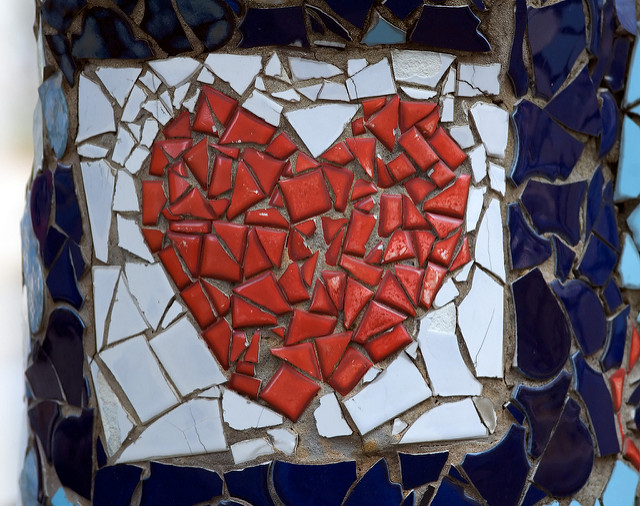
Broken heart

Here’s a mentor text, a modeled memoir originally written for a fifth grade class a few years ago. It’s a true story from my own fifth grade year. These long-ago events etched themselves on my young heart as they unfolded. Some of the minor details are fuzzy, but I remember the intensity of these moments. I see every classmate’s face; I recall every name, although I’ve opted to alter all but my own for a comfortable anonymity in the face of hard truths.

For it’s a hard slice of life.

Today I dust off that Valentine’s Day I’ve never forgotten, reinforce it with a bit of word-glitter and glue, and give it to you  . . . 

On a cold but sunny February afternoon, my fifth grade class gathers on the kickball field to choose teams. The two captains flip a nickel to decide who’ll go first; my friend Shannon wins. She and Davy stand side by side for a moment, scrutinizing the rest of us as if they are drill sergeants and the rest of us are boot camp recruits.

“Allen,” says Shannon.  Allen is always the first pick because he’s a go-cart racer, competitive and very popular. He likes to win.

Allen jogs over to stand behind Shannon.

“Jon,” says Davy.

I think, That’s kind of surprising.

Jon came to our class late in the fall. He used to be the last pick for our teams, since he wears big, thick glasses and doesn’t seem very athletic. At first the boys called him Four-Eyes and the girls said he looked like a little old man because of the way he hunches his shoulders up to his neck most of the time, in addition to the bowl-style cut of his hair. We really don’t notice him that much any more, as Jon is so quiet. When Davy calls his name, Jon trots in his stooped-over way to stand behind him.

“Fran,” says Shannon, after a pause.

YESSSS!” I whisper. I take my place behind Allen, who gives me a high five.

I love kickball. Next to jacks, it’s my favorite game to play with the class—these are really the only two games I’m any good at playing. Once when I slid into home plate I peeled up a whole strip of turf in my shoelaces, but I was safe!

The captains continue choosing players, until only one girl remains.

Eloise.

She, too, is new to our class, arriving just after Christmas break. Eloise is unusually tall, taller than Shannon, who’d been the tallest girl in the school until now. Eloise is as big as a grown woman. Her brown, frizzy hair puffs out from her head like a cloud. It flutters when she walks. One of her front teeth is chipped. Her eyes are the color of the summer sky, and at the moment, they’re a little teary.

Davy sighs: “All right. Eloise.”

Eloise scurries to the end of Davy’s line, looking at the ground.

During the game, Eloise tries with all her might to run and kick the ball, but she misses and loses her balance. When she falls, we can’t help laughing. Eloise, her face pink, gets up by herself and runs to the back of the line once more.

I don’t know what makes me keep my eyes on Eloise, and why I began wondering what it must be like to always be picked last, or to hear other kids whispering things like Neanderthal and  Amazon, never when Mrs. Peterson might hear. I try to imagine how embarrassing it would be if I was too big to be comfortable in the classroom desks and if regular girls’ clothes wouldn’t fit me. I am already clumsy, which is why I’m not good at most sports. Except kickball.

What would I do if no one wanted to sit by me at lunch or went the long way around my desk, the way we do to Eloise?

Watching Eloise with her face turned toward the ground, I suddenly don’t feel like laughing anymore.

Back in class, after a stop at the water fountain, Mrs. Peterson passes out sheets of Manila paper.

“Today, Class, you will write the first letter of your name in cursive on the paper and turn it into an animal or a design that represents you.”

Mrs. Peterson’s first name is Felicia; she holds up  her paper to show how she’s turned her cursive “F” into a giraffe.

Everyone gets to work. Except me. I am stumped for how to turn my own cursive “F” into anything artistic. I have trouble making a cursive “F” in the first place. Everyone says my “Fs” look like “Ts.”

I have no idea what to draw.

To waste time, I get up and sharpen my pencil. I pass right by Eloise’s desk, where she’s bent hard at work. On her paper, she’s written a large, elegant cursive “E,” the fanciest one I’ve ever seen.

She’s turning it into the open wing of a bird.

Before I know what I’m doing, I blurt: “Oh my gosh! That’s beautiful, Eloise!”

Mrs. Peterson comes to look. “It’s lovely. Why don’t you show the class?”

Eloise, looking alarmed, shakes her head. Her fuzzy brown hair bobs like ocean waves.

“May I show them?” asks Mrs. Peterson.

Eloise nods, turning pink again.

Mrs. Peterson holds the paper high. “Just look at what an amazing artist Eloise is, everyone.” She turns slowly so all can see, the way teachers do with pictures in books.

“Oooooo,” breathe my classmates.

Someone says “Wow.”

Eloise’s pink face glows. She smiles, revealing her chipped tooth; her sky-colored eyes sparkle.

I want to freeze this moment for Eloise, and for myself, to capture it for the wonderful and powerful thing it is, but it is quickly gone, and the next day at lunch when she knocks her milk carton over, we all laugh at Eloise again.

Even as we laugh, I feel bad inside.

What’s the matter with me? Why do I laugh when it doesn’t feel right? 

After lunch, Mrs. Peterson gives a speech:

“Ladies and Gentlemen, as tomorrow is February fourteenth, you may bring Valentines to exchange. Listen carefully: If you bring Valentines, you will bring one for everybody in this class. Do you understand?”

Her dark eyes stare right through us.

“Yes ma’am!” we answer in unison.

We know why she makes this point.

Eloise knows, too, and keeps her eyes on her feet.

I’ve already got my box of Valentines and can’t wait to give them out. Inside my box there happens to be a bonus Valentine; I’ve never seen one like it before. It’s about five times larger than the other little cards. It has to be unfolded several times to show the gray, fluffy dog decorated with silver swirls all around. The dog holds a big red heart in its mouth, which reads You are special. This big Valentine is just too beautiful to give away. I am keeping it for myself.

The next day, Mrs. Peterson makes us wait until after lunch to distribute our Valentines. We have to open them together, all at one time.

“Hey, thanks for the candy!” Shannon tells Allen.

“Cool—gum!” says Davy, even though he has braces and isn’t supposed to chew it.

Just then, Eloise cries out. It’s a loud, terrifying sound.

Everyone turns to look at her.

Everything just freezes.

She’s sitting at her desk with her hands over her face, sobbing.

No, I think. Tell me someone hasn’t given her a mean Valentine. Or put something gross in her bag.

Then I recognize, from several desks away, that open Valentine on Eloise’s desk.

The fancy silver dog, the big red heart, the message. You are special.

“Who gave you that?” someone demands.

I walk over to read what’s written at the bottom of that most beautiful card:

Your friend, Jon.

Obviously, Jon’s mom shops at the same store where my mom shops, since we have the same box of cards.

Unlike me, however, Jon has chosen to give his best card away.

To Eloise.

She continues to wail, but we all look from her to Jon, who’s sitting slouched worse than usual at his desk. His face is a darker shade of red than Eloise’s has ever been. He won’t look at the rest of us.

“Oooooo!” says one of the girls.

A boy starts chanting: “Jon and Eloise, sittin’ in a tree . . . ”

But something new is happening here; the energy in the room is changing. This isn’t the regular boy-likes-girl situation. I feel it.

So does Allen.

“Hey, stop it, guys!  Leave him alone!” Allen gets up to stand by Jon.

Mrs. Peterson  is there, too. She places her hand on Jon’s shoulder, her wide brown eyes glimmering with tears. “You, young man, are a noble person.”

I don’t know exactly what “noble” means, but I know that Jon, all of ten years old, is the biggest hero I’ve ever seen.  My emotions swirl inside me like the silver designs on the card—shock at Jon’s choice, guilt over not treating Eloise better, sadness that I hadn’t been the one to give so freely. I look at Jon, the boy new to us this year, who’d endured teasing, too, until he faded into the background in a way Eloise can’t, and I know I want to be like him. Today he isn’t in the background; today he’s the champion of us all. Today he taught us—or at least me—the power of kindness and selflessness, to forget yourself and help someone else.

Perhaps that’s what “noble” means.

I want to be as noble as Jon. I want to help Eloise. So after Mrs. Peterson calms her down, I go to sit beside her.

“You can make Valentines prettier than these, Eloise, the way that you draw.”

“Maybe.”  She shrugs, her face splotchy.

“Don’t you live in my neighborhood?” I ask. “I think I’ve seen you walking that way after school.”

“Yeah. I know where you live. I’ve seen you playing in your yard with your sister.”

“We could walk together sometime. If you like,” I offer.

Eloise looks at me. She smiles. I think of the elegant E-bird she drew; I imagine it stretching its wings just now, preparing to fly high and far in the wide blue sky.

“Sure,” she said. “I’ll walk with you.”

So after school, that’s what we do. We walk together.

Home.

Photo: Broken Heart. David Goehring. CC BY
Big English

Words are our most inexhaustible source of magic. – J.K. Rowling

He finishes his reading assessment and peers over at my screen where all the words are marked red.

I had to tell him every one of them.

He’s only been in this country for a year.

He is tiny, but his dark eyes are bright, intense. They catch and perceive everything. I can tell.

He considers all the red on the screen, then turns those knowing eyes on me.

Before I can say, “It’s okay, don’t worry, you’ll learn,” he reaches over to pat my arm.

“You,” he says. “You have big English.”

He pats his own chest. “Me, little English. I have big Spanish.”

I point to myself, to finish his thought: “Me, I have poco Spanish.”

He grins at me, and I smile back.

We understand each other in a way beyond words. We are okay, in perfect company, because of this wordless knowing between us. No assessment invented by man can capture the height, the depth, the strength of the human spirit. There is no real reason why trust should suddenly be born in such a moment, but it clearly has been.

“I tell you what,” I say to my tiny new friend, for that is what he is now, “I will help you with English and you can help me with Spanish.”

His grin broadens. His eyes shine.

I hold up my hand: “Deal?”

He laughs, slaps my hand with his own. “Deal.”

And he vacates the chair beside me, going off for the rest of his school day in a sea of Big English. Like a salmon, he has a hard battle, upstream all the way.

I expect he’ll swim, rise, leap – I see it in his eyes, sense it in his spirit.

I wonder what the future holds for him. Something of great importance, great value – I can feel it tugging.

Whatever part I can play, let me play it.

Let the magic begin.

Almost

It’s always there,

the ghost of Almost.

What might have been

but was not.

What should be

and isn’t.

Almost – ever how illusory, how ethereal

all but ephemeral –

is a penumbra bleeding from yesterday

into today,

a pulsing presence,

a ponderous weight,

despite its nonexistence.

A walking shadow,

the thief of Now

and its fullness,

the vacuum of Tomorrow

and all its possibility.

Inversion,

implosion.

Just images

without substance,

yet the mass of the universe

compacted

into one knot of aching.

That is the price

of living

with the pretty picture, 

the insatiably hungry, ever-gnawing

all-consuming 

ghost of Almost.

When the notion of Almost first came to me recently, it was about romantic relationships that didn’t work out.  Witnessing the death of the dream, how it takes its toll on the ones who wanted, and tried, to make it work. Broken promises, shattered hopes. It’s easy to cling to the idea of What Might Have Been, when it has been yanked away, leaving a gaping hole in a painful reality.

Then Almost beckoned me with its wispy finger: “Come in — come in, and get to know me better!”

(Before I go any further: Yes, I am borrowing that quote – thank you, Charles Dickens and the Ghost of Christmas Present, and yes, I borrowed “walking shadow.” Honestly, Mr. Shakespeare, it walked in of its own accord).

The ghost of Almost encompasses dysfunction, too. It’s the emissary of unraveling families, friendships. Within Almost are many shades of loss, of varying depths and proportions, all of which can overshadow daily life.

The game almost won.

The job almost attained.

The money almost saved.

The addict almost cured.

The temper almost controlled.

Almosts can go on and on.

Inevitably followed by “I should have … I should have …”

We have some choice, some power in some of those Almosts; in others, none at all. We cannot think for others,  cannot control their actions, decisions, feelings – only our own. Whether the ghost of Almost materializes because we throw the door wide open for it, or it arrives, unbidden, unwelcome, unwanted, through the choices of others, it wants to destroy What Can Still Be.

If we let it.

The only exorcism: See your Almost for what it really is. And release it, for it stays only if you keep hanging on to it. Decide that it will not devour your now, or your tomorrow, any longer. Seek the healing path over the haunted one.

A priceless quote from a friend of mine: “Don’t should on yourself.” No more dwelling on on what you should have done or what should have been. Move forward, one deliberate step at a time, one moment at a time, in wisdom  – for beyond Almost’s shadow, the sun still shines.

Be ready to walk in it.


Today is going to be long ago


Beyond the sundown is tomorrow’s wisdom, today is going to be long, long ago.

-Thomas Hornsby Ferril

Daddy paid the bill and we left the doctor’s office. My arms burned and ached from the allergy injections. We’d waited a long time for the nurse to call my name, despite having an appointment every week on my father’s day off. We’d also waited a long time after the shots, one in each arm, in case of a severe reaction. The day itself was shot now. As we crossed the parking lot to get in the car, I thought: Nothing ever changes. We come, I get the shots, my arms hurt for another two days. I still can’t sleep a whole night through because of asthma attacks. Balling up with my knees under my chest, my head on two pillows, helps me breathe sometimes. I can take in air but I have to push it out. My chest rattles. The wheezing occurs most often at night. It’s worse in spring and fall—every Easter and Thanksgiving, my parents say. Each night Daddy pours more water in the vaporizer in my room, refills the little metal tray in the lid with Vick’s menthol. The contraption steams and sputters for the duration of the night, but the only effect I can see is the loosening of the tape holding my posters on the walls of my bedroom—posters I bought at the book fair, one of a tabby kitten dangling from a limb, captioned “Hang on, Baby, Friday’s coming!” and a red poster of a sunset, with “What lies behind us and what lies before us are tiny matters compared to what lies within us”—until my posters fall down.  Every day I try to stick them back on the moist walls. I am tired. I can’t rest at night, I can’t rest after school because the kids Mom babysits at home want me to play and there’s nowhere to go, no getting away from them. 

I walk in silence by my father across the ugly gray concrete parking lot, my arms burning, knowing those kids will be at the house when I get home. It’s the same, day after day, night after night, forever. Nothing ever changes. 

I don’t know how I can keep going on. 

I was only ten years old.

I didn’t know to attach words to my feelings—boredom, depression, in a rut, despair.  I never communicated the heaviness of my thoughts to anyone at the time. I have always been quiet by nature. When my physical activity had to be limited—I couldn’t run in P.E. because it triggered my asthma in the days before inhalers—I spent more and more time reading and writing.

This was my salvation. My escape. The way out of the daily sameness, the beginning of overcoming, of strength. I described the color and the hot, cinnamon taste of liquid Benadryl in my fifth-grade memoir—the teacher responded, “What clear, great detail!” That was the first time a teacher praised my writing. Here, unexpectedly, was something I could be good at, something to work toward.

It happened slowly.  I don’t remember the exact turn of events, or the length of time it took, only that the moment of long-ago despair was just that—a moment. Things did change. Eventually I got injections in one arm when doctors decided to combine the serums; then the shots stopped altogether. Unless I am around cigarette smoke or cats, I am not troubled by asthma anymore (though doctors warn me one is never “cured”). My mom didn’t babysit the pesky kids forever; I could find my own space again. Most remarkably, I have never had serious bouts of depression, despite the fact that it runs in my family.

Looking back now, I can see where that long-ago darkness might have been the beginning of a very different story. I was fortunate. I endured. As decisions for my health were made with more and more wisdom, I found my way through with words and pages.

I remain today, whole, strong, and grateful, because of it.

Every word, every decision, every moment—wisdom matters.

If tomorrow is to be.