Poetry Friday: Soul shine

I’m a relative newcomer to Poetry Friday. First let me thank Irene Latham for hosting today’s Roundup and Carol Varsalona for extending the invitation on social media to come and honor author Nikki Grimes.

Carol created a lovely rose-adorned Buncee card which reads: “Nikki Grimes—Do more of what makes your soul shine, because you inspire others to write.”

Those words, soul shine, beckoned me to ask … what makes one’s soul shine?

Nikki’s soul certainly shines through her poetry as well as through her faith and her literary contribution to children. I’ve read that her favorite color is purple and it got me thinking that our souls shine with all that we love, all that is most precious to us. I still consider myself mostly a storyteller with poetic leanings, but I thought I’d try capturing this idea of “soul shine” by exploring what our favorite colors might represent in a form that Nikki uses, tanka:

Your soul shines purple
with creative energy

imparting faith, calm,
stability and passion
for people, stories, and words.

My soul shines rose-gold,
a fusion of alloyed strength:
Copper for healing
in gold of faith, hope, and love
for people, stories, and words.

I often think about writing as a means of healing. Today I contemplate writing poetry as a striving to grasp what is just beyond our reach—whether the parameters and inner workings of nature, the universe, or own souls. Sometimes it comes as an anguished cry, other times quiet awe or wonder, a celebratory outpouring of joy, always an embrace of the nearly-inexpressible, real and ethereal, images of life and the living of it. What does the soul crave most? Beauty? Truth? Understanding? Freedom? Peace? It may change as we change.

Whatever the answer … poetry beckons the soul to shine.

Peace is the lofty landing place
Of our souls’ storm-torn flight.
Exhausted, expended
Transcending
Rising still to shin
e—
Your soul and mine.

Thank you, all Poetry Friday Friends, for being the wellspring of inspiration that you are.

Lead photo: Shine. Rodnei Reis. CC-BY

Where the sunbeam ends

In late February, we had our only snow this winter.

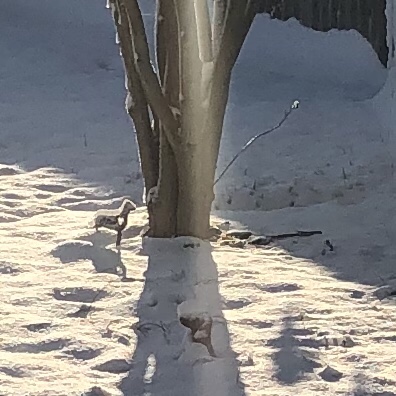
I woke in the morning to find the sun shining through the crape myrtle I planted when we first moved here. Ice crystals glittered on the tree limbs like a thousand prisms—tiny, brilliant rainbow lights. I took a picture. When I looked at the image, the word that came to mind was holy.

Maybe it was the brightness of the sun. The reaching ray of light. The purity of snow. The hush, the stillness. Just a sense of divine glory, of peace.

And then I noticed where that sunbeam ended.

Oh, how I recalled, in that instant, first reading Where the Red Fern Grows when I was around ten years old. It tore my heart out. I wept for weeks. A dog story, of course. And hardship, love, and sacrifice. Wilson Rawls wrote:

I had heard the old Indian legend about the red fern. How a little Indian boy and girl were lost in a blizzard and had frozen to death. In the spring, when they were found, a beautiful red fern had grown up between their two bodies. The story went on to say that only an angel could plant the seeds of a red fern, and that they never died; where one grew, that spot was sacred.

That’s when the boy, Billy, finds a red fern growing between the graves of his two dogs.

Look where my sunbeam ends.

Directly over the grave of my family’s little dachshund, Nik, who was with us for sixteen years. That’s his memorial statue rising up from the snow.

No red fern, of course.

But sacred, just the same.

Walk with me

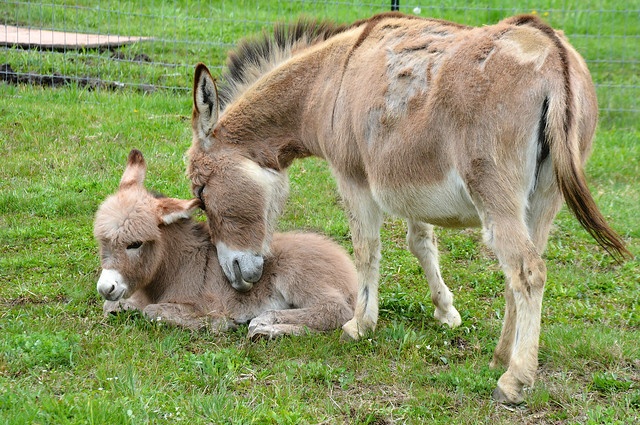
“Jerusalem” donkeys live in a pasture near my home. They are so named for the cross formed by black stripes across their shoulders and down their backs. The donkey is a symbol of peace, for they are peaceable creatures, although farmers know they will protect livestock by driving away coyotes.

The donkey currently plays a significant role around the world with the observance of Palm Sunday and Holy Week. The Gospels of Matthew and John both proclaim the fulfilling of Zechariah’s prophecy that the Messiah would come to Jerusalem humbly, riding the foal, or colt, of a donkey. In Mark and Luke, Jesus directs his disciples to a colt “on which no one has yet sat.” Only Matthew records that the unbroken colt doesn’t come on this mission alone: Its mother walks alongside as it carries Jesus through the shouting crowds in the streets of Jerusalem.

It is the image of the mother walking beside her colt—her child—as a calming presence amid chaos, as a needed coach in fulfilling the sacred duty, that suddenly pierced my heart and inspired today’s post.


Walk with Me

My world is confined

to the home that I know

until strangers come

to lead me away

—please, will you come with me,

walk with me?

I know not the destination

only that it’s far

beyond what I can see

and I can’t go it alone

I need you by me,

to walk with me.

The crowds, the fervor,

what can it all mean

 but that I’m not safe

in this place of screams

don’t leave me now!

Just walk with me.

Such heavy burdens in this

untamed human world

some worthy, some not.

What’s the difference?

—Show me, I am watching you

walk with me.

A step and a step and a step

at a time,

I find I can carry on

as long as you are here

—because you don’t fear

to walk with me.

It is new to me, 

my burden; but it is light

despite the shadows

you are at peace

—and so am I

for you walk with me.

I know, somehow,

you’ll see me home

when this day, these cries,

this purpose, are done

—so walk with me

walk with me

keep me ever close 

and

walk with me.

Jerusalem donkeys

Mother & baby Jerusalem donkeys. Barbara BresnahanCC BY-SA

What delighted you today?

Narnia

Narnia. Mark IrvineCC BY

The sky became bluer and bluer and now there were white clouds hurrying across it from time to time. In the wide glades there were primroses. A light breeze sprang up which scattered drops of moisture from the swaying branches and carried cool, delicious scents against the face of the travellers. The trees began to come fully alive. The larches and birches were covered with green, the laburnums with gold. Soon the beech trees had put forth their delicate, transparent leaves. As the travellers walked under them the light became green. A bee buzzed across their path. 

“This is no thaw,” said the Dwarf, suddenly stopping. This is spring . . .”

—”Aslan is Nearer,” The Lion, the Witch and the Wardrobe, C.S. Lewis

What delighted you today?

That it’s the first day of spring delights me.

The beautiful description of spring coming after a hundred years of winter (but never Christmas) in The Lion, the Witch and the Wardrobe delights me.

That I remember first reading that passage at age ten delights me.

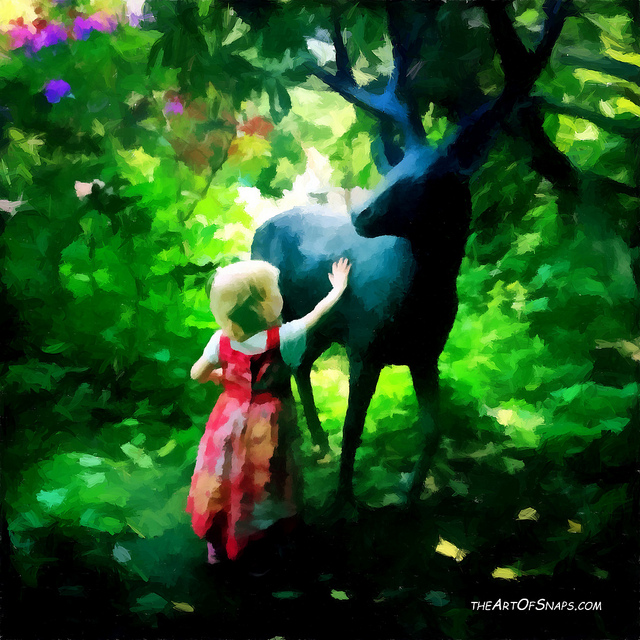
The painting of a child in a green forest clearing, reaching out to pet a deer that may be merely a statue, or might be real, or will become real at the touch of her hand, delights me.

—I’ve decided to notice things that delight me, every day.

As way of stopping to breathe in the daily grind, of pushing back the domineering world, of finding a moment of stillness, even seconds of stillness, to savor something I see, hear, taste, touch, smell—or simply sense within my soul.

Such as:

the three finch eggs in the nest on my front door

birdsong early in the morning

my youngest son asking when I’ll be home so we can go walking

my husband’s laughter

Henry the dog’s ecstasy at any sighting of me

finally writing something down after its wings have beating in my head or heart for ever so long

What delighted you today?

All around us are affirmations, if we open ourselves to receive them. The wondrous exists in close proximity, is even ours for the taking, if we remain aware. As grand as a bald eagle at the roadside, as pure as the light in a child’s eyes, as simple as a stranger passing by with a genuine smile and a “Hello! How are you today?”

What delighted you today?

Might even pay to keep a journal of delight, to read and re-read when most needed, to create a pocket of peace amid the clamor, to strike a spark in the dark.

Every day has its gifts, small and great, that await.

What delighted you today?

—And what delight will you be?

The song

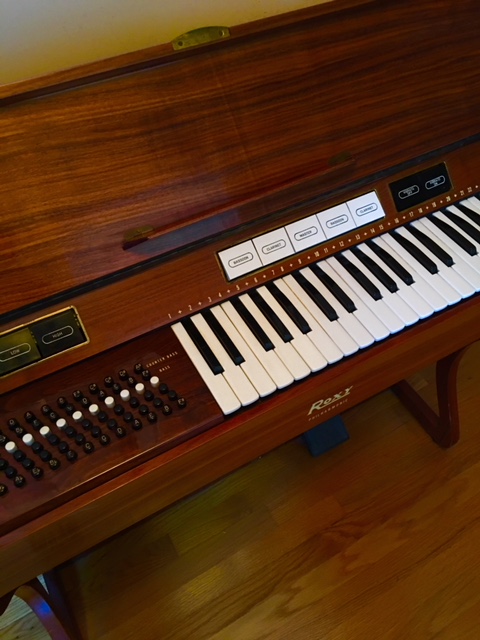
Grandma's organ

I love Granddaddy’s and Grandma’s apartment. The walls are knotty pine and the floors are made of a different wood; they shine under Grandma’s braided rugs.  There’s a booth curving around a table in one corner. It makes me think of the ice cream shop where we sometimes go for milkshakes. This booth is where Granddaddy, Grandma and I eat supper. Sometimes we have jelly doughnuts or apple turnovers for dessert; Grandma is very fond of apple turnovers and so I am I. There’s an odd, glass-less window between the bedroom and the “front room,” as Grandma calls it. I call it the living room. Grandma has curtains on this weird window and I can remember, dimly, my aunt holding me in her arms on one side as Grandma pulled the curtains apart on the other, crying “PEEK-A-BOO!” We all dissolved with laughter. A fancy ashtray with a curved handle that’s either a ram or a goat – some horned, leaping  animal – stands on a tall, thin pedestal beside my grandfather’s worn leather recliner, but no one ever smokes here.

Many wonders exist in this cozy place, but one of the prettiest is Grandma’s organ.

It’s made of polished wood, with curved legs. It stands gracefully against the front room wall, under shelves of family mementos and photographs.

Grandma knows how to play it. She has a piano down home in the country, but it was too big to bring to the apartment. When Granddaddy went to work at the shipyard during the War, my grandmother had to leave her piano behind. So, he bought her this organ one Christmas. 

He knew how much she loved to play.

One afternoon she says, “I will teach you.”

I am nervous and excited at the same time – I have never touched this organ.

Grandma opens the top. She lowers the little stand that holds a book. She has a booklet of hymns and one of Christmas songs; she places the Christmas book on the stand.

“Watch and listen,” she says, her blue eyes soft and bright. “This is my favorite.”

She plays “Silent Night.”

She sings, and I know the song. I sing some of the words with her:

Sleep in heavenly peace, sleep in heavenly peace.

“Now it’s your turn,” she says.”See these numbers? That’s what you play with your right hand. These circles with letters are the chords – you play the buttons with your left hand.”

She takes my hands in her own. 

5,6,5,3 – Si – i -lent night

5,6,5,3 – ho – o -ly night

She puts my fingers on the right keys, pressing the white “C” major button until we switch – gracious! – to “G” and “F.”

I am very slow – it seems a lot to do at one time.

But Grandma guides me, and soon I have played a song.

A whole song.

“Now try it on your own,” she says.

I labor. My keys and my chords are not exactly in sync, but I play. I am playing the song by myself!

Grandma sings behind me. Her voice carries me on.

She hugs me when I finish; I smell her Avon Cachet cream, light and clean.

Her eyes glisten with tears, but she’s smiling.

It was the first of many lessons I’d learn from my grandmother. In those days before I started school, I thought the white major buttons sounded like a wedding; all the minor and diminished buttons sounded like something in haunted houses.

Pretty much the theme music of life – celebrations and dark, mysterious moments. Sometimes I would play the buttons by themselves, listening to the happiness and strangeness of the chords.

I made my own stories out of these sounds.

I realized, decades later, the legacy my grandmother left me: There was always a song of hope and faith in the heart to carry me through the darkest times. That being a wife and mother often meant sacrifice. She was the quintessential teacher, without being formally trained – my foray into the music she loved followed the perfect I do, we do, you do pattern.  She guided my fingers on the keys, my feet on the path, my heart on the things that matter most.

Above all, she believed in me.

There’s no greater gift to a child.

When I was in the sixth grade, I was invited to attend a summer program for gifted students in writing, drama, and photography.

My father couldn’t afford the fee.

Grandma paid it. “Children need to have a chance to do things that matter to them,” she said, with a startling ferocity.

Much later I learned that she wanted to take piano lessons when she was in her early teens and that her family couldn’t afford them during the Depression. A young minister’s wife, however, taught my grandmother how to play.

In everything I do, she’s still there behind me, singing, urging me on, never far away. She is gone, yet she isn’t; her song sings in my soul, in time with the beating of my heart. I am who I am because of her.

Today my youngest son – a college student and music minister – plays her piano and sings the old songs. Her organ stands in my foyer – the first thing that people see when they come to my home.

Her legacy lives, from generation to generation.

I often think how thrilled she’d be to hear my boy’s beautiful playing and singing. “Oh, how my Grandma would love to hear this,” I tell him.

Even as I say the words, I know she knows.