Once upon a long, long time ago, I boarded a ferry with my dad and grandmother to visit her sister, my great-aunt Nona.
She lived so deep in the countryside that it felt otherworldly. An old, old place. Old unpainted house, old separate kitchen joined to it by an old porch, old outbuildings…old outhouse. The memory has lost much of its detail now, like an aged sepia photograph, fading and fragile.
What remains are the bright sunshine and the green, green grass where I ran and played while the grown-ups talked and laughed on the porch. They were having a great visit…until I ran through a clover patch and fiery pain seared my ankle.
Bumblebee sting. I collapsed in the clover, screaming.
The grown-ups leapt off the porch in a single bound.
I can’t remember Grandma’s reaction. She was typically soothing: I know it hurts, honey. I am sorry.
I can’t remember Daddy’s reaction. He was typically irritated: All right, calm down! Stop making such a racket.
But I remember Aunt Nona’s reaction.
Sweet-faced, graying black hair pulled into a bun, silver cat-eye glasses…she said to my father:
“Give me one of your cigarettes.”
He did.
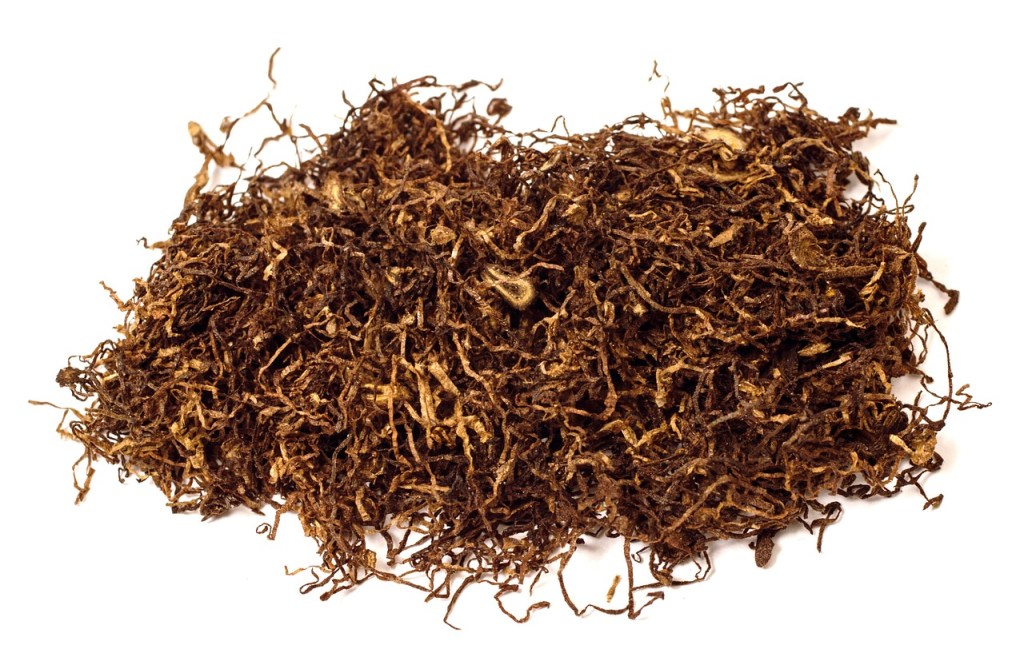
She peeled the paper back, put the tobacco in her mouth, made a paste, and dabbed it on my ankle.
“That’ll take the pain away,” she said.
As for me (weird kid that I was), the sight of the wet brown clump on my ankle was nearly as horrifying as the sting. Now I sobbed and screamed.
Sometimes I question the details of this memory: Was that really a cigarette she chewed, or snuff? It was so long ago…but cigarette is what I remember.
And I remember my gentle Aunt Nona, kindest of souls, bearer of wisdom from the old days, the old ways, a humble woman who played piano by ear and composed her own hymns. She lived to be 101.
All these ages and ages hence, I marvel at her tobacco remedy and resourcefulness.
Just a little leaf of memory, now pressed and preserved here, before time finishes burning it away.
In 1906, Theodore Roosevelt was president, Upton Sinclair published The Jungle, and the San Franciso earthquake killed around three thousand people. The Panama Canal was under construction and Cuba had its first president. Susan B. Anthony died that year. Lou Costello, Estée Lauder, and Anne Morrow Lindbergh were born.
In the far reaches of eastern North Carolina, a farm woman named Claudia Amanda Victoria delivered another of her ten children. A boy. She would have only two girls; one would die of diphtheria at age four.
But this baby boy would be hardy. He would outlive them all.
She named him Columbus St. Patrick.
Some folks called him Columbus. Those who knew him best called him Lump.
I called him Granddaddy.
As I grew up listening to the old stories, I tried to imagine living in his era. Seeing an early Ford Model T. Mail-ordering live chickens, delivered in wire cages by horse and buggy. Raising ducks that wandered off to the swamp on a regular basis, only to be herded back home again to eat bugs in the garden and to provide eggs for breakfast. Learning to plant and to harvest, to be in tune with the rhythms of the earth, following the steps of that ancient choreography, the seasons.
He was five when the Titanic sank, seven when World War I began. His older brother, Jimmy, served in the Great War and returned; I would know him and his wife Janie in their old age. They lived in a little tin-roofed house along one of the many dirt roads of my childhood summers. Jimmy and Columbus had a brother who drowned long before my time. Job Enoch. One brother accidentally shot and killed another on the porch of the family home. I knew their sister Amanda, who had a high-back pump organ adorned with brown-speckled mirrors in her house. The organ sounded and smelled of ages and ages past…but she could play it, and she could sing.
Columbus didn’t sing, but he loved country gospel songs and bluegrass to the end of his days.
And Columbus St. Patrick loved Sunday School. He had perfect attendance for years, garnering long strings of pins awarded to him. He did not enjoy regular school. He quit in the fourth grade to work on the farm. Later in life he had some regrets about this. But his father walked out on the family and Columbus rose to the role of provider.
He participated in community hog-killings, with the farm wives taking the backbone to flavor collard greens. The pork was preserved in barrels with salt brine. Some of the folks enjoyed scrambling hog brains into their breakfast eggs.
Columbus St. Patrick worked hard. He plowed fields with mules. He took part in the making of molasses, which required several people. Mules walked in a circle, harnessed to poles attached to large grinder where sugarcane was fed to extract the juice. The juice would be collected and heated in trays over a fire, skimmed numerous times until it became rich, blackstrap molasses. At the end of a meal, he sopped his biscuits in molasses, and poured his hot coffee in the saucer to cool it.
He competed with a scrappy little woman named Lula for the honor of being the community’s top cotton-picker. She often beat him.
Lula would be widowed when her husband Francis hung himself in the woods. One of their daughters would find his body.
Columbus St. Patrick’s youngest brother married another of those daughters.
Columbus made some time to hang out with the young people, attending taffy-making parties in their homes and driving groups of friends to the movies in town…all the while noticing Lula’s daughter with the wavy blonde hair and straight posture. There was a certain spark about her.
She considered him her mother’s friend. The “older” set. She was nine years younger and she had her eye on the preacher’s son, who would surely follow in his father’s footsteps: How wonderful, to be a preacher’s wife!
It didn’t happen. Desires of the heart sometimes come to unexpected fruition: I would be a preacher’s wife, a half-century later.
This daughter of Lula’s ended up marrying a farmer: Columbus St. Patrick. They planned to wed in September but he had the mumps. And so it came to pass in mid-December instead.
My grandparents.
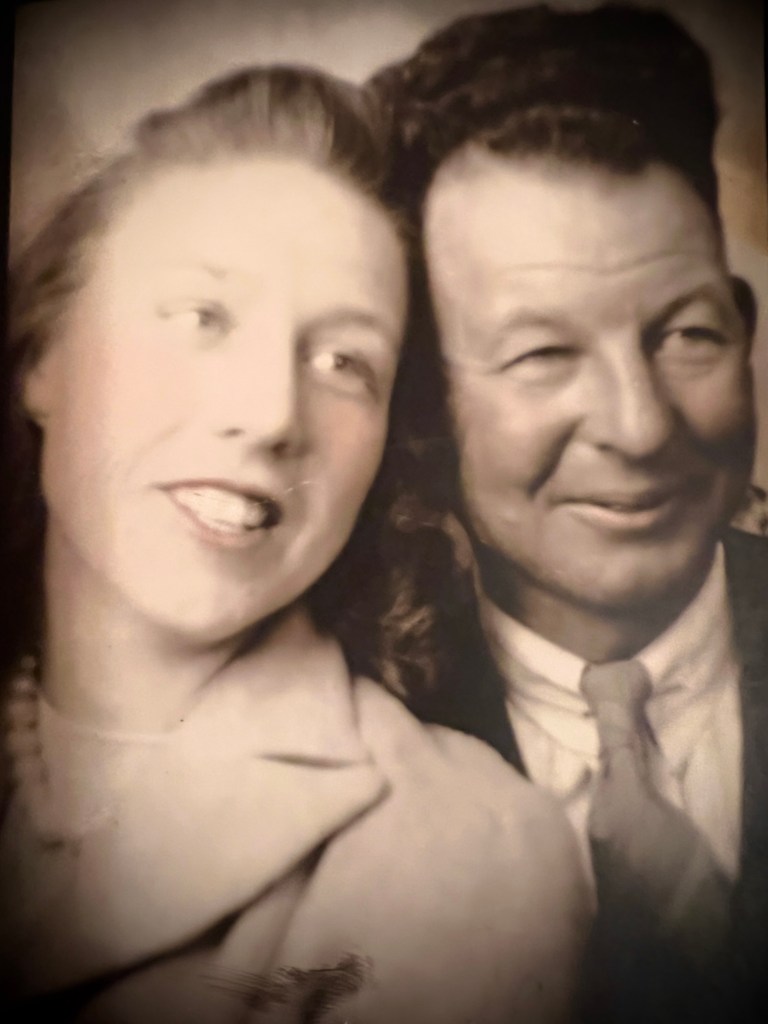
Here’s a photo taken sometime early in their marriage:
Ruby Frances and Columbus St. Patrick, circa 1937–1938. She would have been around 23. He would have been 31 or 32. If this photo was taken prior to October 1937, my father was not yet born.
They would endure the Great Depression and the second World War with a small child. My father. When Columbus St. Patrick couldn’t make a go of tenant farming and sharecropping, he traveled to the shipyard nearly 200 miles away with a group of men from down home. He was working there, building cradles for ships, when Pearl Harbor was attacked. Suddenly U.S. ship production went into overdrive; the Yard turned out ships in three months versus the usual year.
He would try, after the war, to make a living farming, painting, and doing other handyman jobs. By that time there were three children to care for. Columbus opted to go back to the shipyard, staying in a boarding house during the workweek and coming home to see his wife and children on the weekends.
For ten years.
His son (my dad) became senior class president and entered the United States Air Force after graduation. The oldest daughter was a high school basketball star; Columbus St. Patrick nailed peach crates to posts out in the yard for her to practice. By the time his youngest daughter was ready for high school, he’d had enough of separations. He moved the family to an apartment near the shipyard.
Hilton Village, built between 1918 and 1921, is the first federal wartime housing project in the U.S. It was created for shipyard workers. These quaint, English-style rowhouses would be the setting of my first memories. I would awaken in the dim gray morning at my grandparents’ upstairs apartment and my grandmother soothed me back to sleep while my grandfather, having risen at four, made his own breakfast before going to work. On Sundays, his day off, he took me to the playgound behind the Methodist church.
I felt as safe as I ever have in life, walking hand-in-hand with him.
He retired after I started school and lived another twenty-nine years. He saw my children. He survived the removal of his bladder after a cancer diagnosis. My grandmother would empty the urostomy bag and dress his stoma (surgical opening) every day until his death.
They would lose their middle child, their basketball star, to multiple sclerosis in her fifties. She died on Good Friday; they buried her on Easter Sunday. Their son (my dad) was just recovering from bypass surgery after his first heart attack. He would not survive the second, but Columbus would not be here to suffer the loss of his son.
Granddaddy died of lung cancer under hospice care, at home his own bed, as he wanted, on a fine spring day. He refused morphine in favor of keeping his mind clear. And it was, to the very end.
St. Patrick’s Day rolls ’round again and stirs all the memories. They spring to life, as rich and sweet as molasses that Granddaddy and I sopped with our biscuits. He was always embarrassed by the oddity of his middle name. I am proud of it. I have loved it all my life, just as I’ve loved him. Fiercely. I have learned many a valuable lesson from Columbus St. Patrick: Treat people well. Help those in need. Money doesn’t buy happiness (back in the old days, he said, nobody had any money but everybody was happier). Love your family. Love your neighbor. Get a dog to love. Work hard. Persevere. There’s always a way. Tend the earth. Do your duty. Spend time with children, for they are precious. Go to church. Trust in the Lord. Return thanks.
One day, he said, we will meet again in a better place. I am looking forward to it.
Me, too, Columbus St. Patrick.
Me, too.
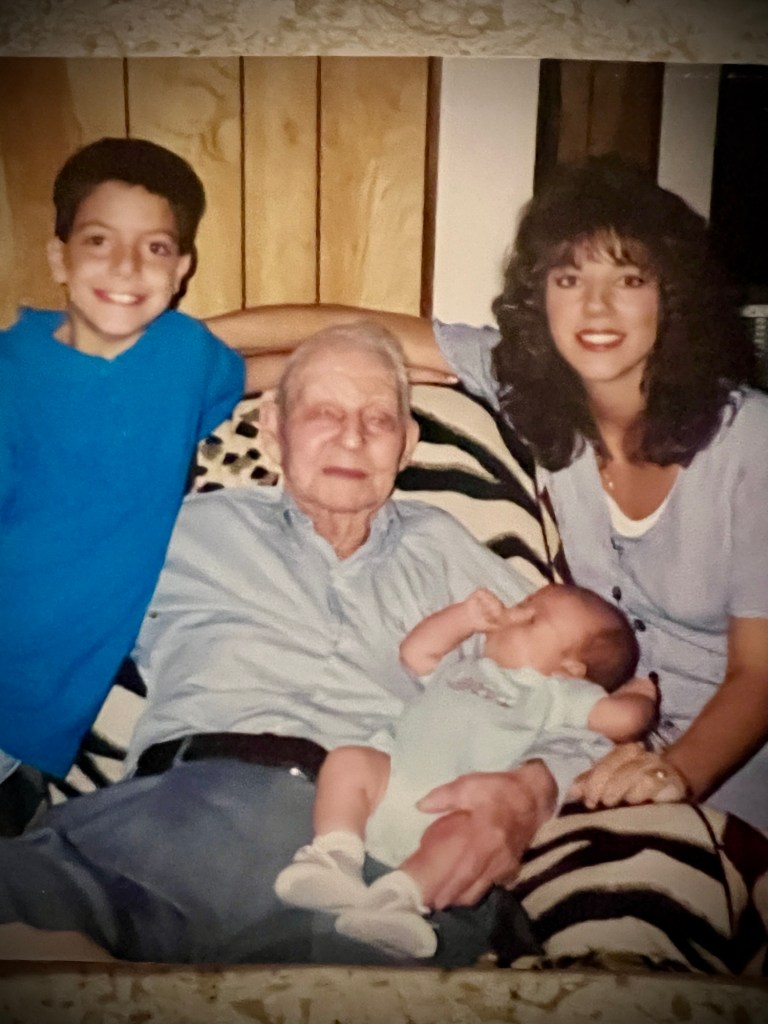
My boys and I visiting Granddaddy for his 91st birthday, 1997. My youngest was six weeks old.
*******
with thanks to Two Writing Teachers for the March Slice of Life Story Challenge
from on high: the cry this kingdom is mine mine mine hear ye, hear ye, all
Our resident red-shouldered hawk was staking its territorial claim on Monday morning. If you look closely at the large tree branches in the center of the video frame, you will find it perched above the “play” arrow. The cry starts at 14-15 seconds in.
I think of hawk symbolism. I will include it below, because it’s fascinating, especially since I am sharing this with a community of writers taking on a daily challenge; I marvel at how much seems especially applicable. I will say that for me the hawk’s wild cry evokes something within that I cannot quite name. A longing, I think. Maybe to rise above the world with clearer vision. Maybe to have been an ancient warrior along green woodland paths, following the king’s bird. Maybe to respond, living thing to living thing, in natural communion as apparently existed before Genesis 9, when animals began to fear people. And, I daresay, likewise. Loss unimaginable.
As I wrote in yesterday’s post: I watch birds and am awed by the way they know and “read” so much. Instinct, you say. Well, of course. And extraordinary intelligence, I must add.
Here’s what artificial intelligence has to offer on red-shouldered hawk symbolism (do a search; this comes up with links):
The red-shouldered hawk can symbolize a variety of things, including guidance, strength, and the ability to see the bigger picture.
Guidance
A red-shouldered hawk can be a messenger from the universe, bringing support and insight
It can be a sign that you should trust yourself and your inner wisdom
It can be a reminder to explore the unknown and take risks to reach your goals
Strength
Hawks can represent strength, focus, and poise
They can show you your hidden abilities to lead yourself and others
Seeing the bigger picture
Hawks can help you see the bigger picture and avoid getting caught up in small details
They can help you elevate your perspective and activate your inner sight
Connection to the spirit realm
A red-shouldered hawk can signify a powerful connection to the spirit realm
Vision
The Cherokee believed that red-shouldered hawks are messengers of vision
They believed that when you see a red-shouldered hawk, whatever you were thinking about at the time is happening around you
Across cultures, hawks have been used to convey teachings and wisdom.
—There you have it, writer-friends. Hearken unto the calling.
Meanwhile, I know that as I stand watching this magnificent bird, it is watching me, with considerably less awe. I am simply on its turf.
*******
with thanks to Two Writing Teachers for the annual March Slice of Life Story Challenge. This is my ninth year participating alongside fellow teacher-writers.
Way back on Day 10 of this current Slice of Life Story Challenge, I had a lot of fun playing around with a prompt asking what the first line of my autobiography would be. I really prefer the idea of memoir…my definition: Mining one’s memories for the stories that matter most, digging in the storied strata of one’s past.
I came up with this “opening line” for it:
My father named me for his mother, and that was the beginning of everything.
Truth.
From the moment I entered this world, my grandmother and I were bound together by blood, love, and namesakery. Long after she’s left it, our bond remains unbreakable.
Were I ever to write an extended memoir, her stories would be layered throughout. I am part of them; they are part of me.
She would say, You were named for me like I was named for my Papa. I loved him so. He was very religious, sang in the choir every Sunday. He had a beautiful bass voice…he used to keep bees when I was young and I’d help him get the honey.
She was sixteen in March of 1932 when her Papa, Francis, died by suicide. On his sixtieth birthday. I don’t know the whole story but what little I do know, I shall keep for now. Grandma told me they brought him home in a wooden casket lined with black oilcloth and that she sat up with him all night before the burial.
The point is that my grandmother’s stories made me hungry to know as much as I could about her childhood, daily life long ago, how people endured such hard times. Many didn’t. The old cemeteries tell stories of their own.
I asked her about the 1919 influenza epidemic: I don’t remember it. I was little. I do remember people talking about “hemorrhagic fever” and Mama saying she made big pots of soup for the neighbors who were sick. Papa carried it to them and left it on their porches. He wouldn’t go in because he didn’t want to bring the sickness home.
I asked her about meeting my grandfather: Oh, we always knew each other. He’s nine years older than I am and he and Mama used to pick cotton together…
Granddaddy would say: We’d all see who could pick the most cotton and it was always Lula [Grandma’s mother] or me. That was before the boll weevil came along and people started planting tobacco.
Grandma said: When tobacco came along, I was a looper…you had to be careful. That juice was sticky and would stain your clothes; it was hard to get out…using a wringer washing machine or washboard, I might add.
The setting of all this is a tiny community called Campbell’s Creek, established around 1700, way down east in the far reaches of Beaufort County, North Carolina. It’s part of Aurora although the actual town is five miles away. Most of the town is now in serious disrepair and the place is so remote that when I happen to encounter people who’ve been there, they typically say something like “I thought I was going to the end of the world.”
It is one of the places I love best on this Earth. The beginning of everything…Aurora is Latin for “dawn,” you know.
My grandparents, Columbus St. Patrick and Ruby Frances, were born here in 1906 and 1915, respectively. They married during the Great Depression. Their first home was a tenant house; their first child, my father, was born there. Granddaddy was a sharecropper. He plowed fields with mules. He was skilled with farm tools that people seldom use now, like an adze. This would give him a unique advantage when he “couldn’t make a go” of farming and went to Virginia to find a job as a shipwright, just as war broke out and ship production went into overdrive. When the war was over, he tried his hand at a number of things, but he had two more children to provide for; he went back to the shipyard until he retired.
All of his life, Granddaddy was a farmer at heart: I can remember when we ordered chickens by mail and they’d be delivered in cages by horse and buggy. I was three or four when I saw my first automobile…
That would have been around 1910. A Model T.
Time was, he’d say, in his country dialect bearing faint traces of Elizabethan English, that the whole family could go off for a week to visit somebody and you didn’t have to lock your house or barns because nobody would bother them.People looked out for each other. There won’t no nursing homes. When somebody was sick we all took turns helping out.
Grandma said: I was sitting with a friend’s mother. She’d been sick awhile and we all knew her time was near. She hadn’t spoken a word in days, hadn’t moved or responded to anyone. She was just lying there in the bed when all of a sudden she sat up and opened her eyes. She started laughing: “Can you hear them? Can you hear them?” Her face just glowed...it had to be angels. A little while after, she was gone.
I grew up on these stories and so many more.
My summers were spent learning things that I wasn’t even aware I was learning, things that will drive my interests for the remainder of my days: story, history, culture, nature.
Faith.
And science.
I’ve written much about the little dirt road that ran past Granddaddy and Grandma’s house. It’s one of my life’s greatest metaphors. I can recall, in the 1970s, when it was covered with gravelly “rejects” from phosphate mining, Aurora’s biggest industry since 1964. Granddaddy and Grandma were so excited for their grandchildren to come digging in the road to find sharks’ teeth—some were quite large — coral skeleton, and various fossilized bones of sea creatures. Someone of official status must have soon realized the value of these rejects and they weren’t scattered on the old dirt road anymore. Instead, they were taken to a newly-created fossil museum in town. Today, children from all over come to dig for fossils they can keep, and they can learn about the history in the little museum. There’s even an annual fossil festival at the end of May; last year I went for the first time with my seven-year-old granddaughter.
This excerpt is from an article in the April 2023 edition of the magazine Our State: Celebrating North Carolina:
Beneath our state’s soil and waves is a lost world waiting to be discovered—a geologic trove we claim as our own…about 50 years ago, coral specimens were found in drilling samples near present-day Aurora. They were sent to the Smithsonian Institution, whose scientists soon visited—and identified the area as one that proclaims the most prolific fossil record of the Miocene (2.3 million to 5.3 million years ago) and Pliocene (5.3 to 2.6 million years ago) marine life on the Atlantic coast.
About fifty years ago… I’d have been a child playing in the gravel on the old dirt road, collecting shark’s teeth, unware of the true treasures of my life.
The Aurora Fossil Museum, writes the author, “continues to keep the past alive.”
It’s analogous to to me: Scientists finding bits of ancient creatures, trying to piece them together to understand stories of this “lost world,” and how I hold to bits of story from this same place, the lost world of my grandparents.
Generations rise and fall…layer upon layer of story strata settling in their wake.
I am a remnant of their world. From early childhood Grandma infused me with story, unknowingly turning me into amateur oral history exacavator, archivist, curator…the stories still live in me.
My father named me for his mother, and that was the beginning of everything.
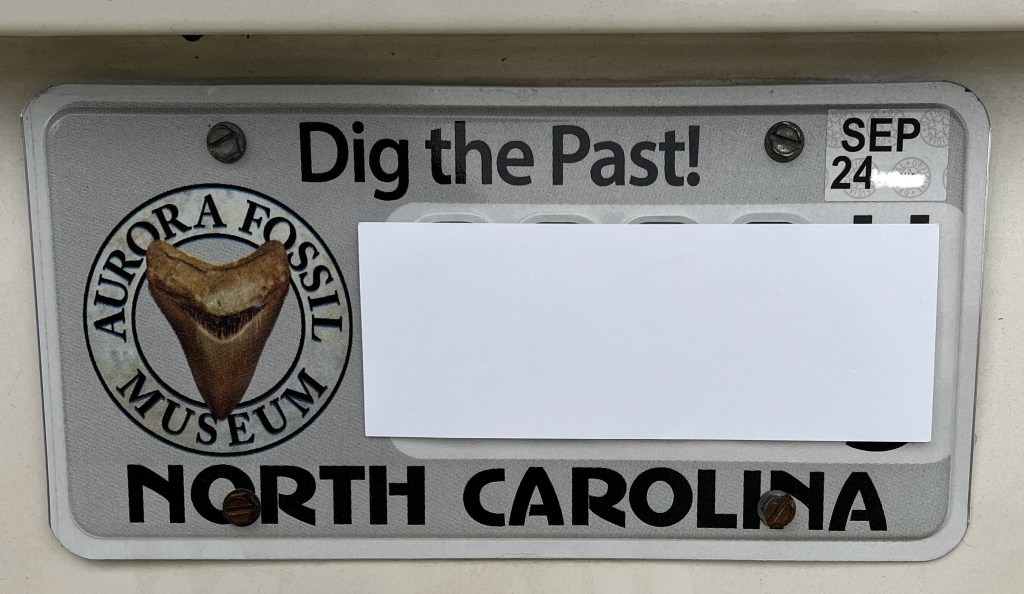
Imagine my delight when I learned last year that the Aurora Fossil Museum had been approved for an official historical site license plate with the NCDMV. I applied for one right away….it finally came, a couple of months ago. I’m among the first to have it:
I imagine Granddaddy’s beaming face. I hear Grandma’s typical expression of surprise: My land!
Dig the Past! the license plate reads.
I do it every day that I live. I go on mining my memories for stories, working their meanings out bit by bit, trying to preserve them for the priceless treasures they are.
Keeping the past alive. For the future. For right now.
That’s what memoir is for.
*******
Composed for Day 30 of the Slice of Life Story Challenge with Two Writing Teachers
I grew up in the city, a child of sidewalks, stoplights, bridges, and clattering trains. I could walk to church, to the 7-Eleven for Slurpees or candy, to Woolco buy the latest hit song on a 45 RPM record, and to all three public schools I attended from kindergarten through twelfth grade.
The memories of nature from my neighborhood, other than the maple tree which dropped its leaves in the front yard every fall, are the gray roly-polies I played with on the concrete steps at the back door, the slugs I salted to watch them dissolve (sorry, slugs), ants, and eastern tent caterpillars with their beautiful rainbow patterning. I caught them put and them into recycled butter tubs with lids, to be disappointed when they turned into such plain moths. Oh, and the random mouse that got in the house to startle my mother, who screamed. And the ditch rat that got into my bedroom… another story for another day, that.
I know there were birds. There had to be birds.
I can’t remember them.
I longed to live in the country, with my grandparents. Even though the mosquitoes, yellow flies, and ticks might eat me alive, I could find tiny gray toads the size of my thumbnail. I would marvel at the dazzling colors of dragonflies, once I got over my terror of them. Hummingbirds zoomed past me for my grandmother’s flowers, never minding my presence, their emerald and ruby feathers gleaming like jewel-fire. Cicadas rattled the earth and my heart with their rhythms. There were deer, rabbits, snakes (alas!), and birds, always birds, chattering and singing incessantly in the dense woods…
The longing never left me, so when my husband and I settled in the countryside, I knew I was home. I rejoiced that our boys would grow up treasuring a closeness to nature…
So I thought.
The oldest always wanted to live in the city (is this always the way? Wishing for the exact opposite of what we have?).
He grew up. He went to the city.
He was miserable.
He came back…got married, became a father…
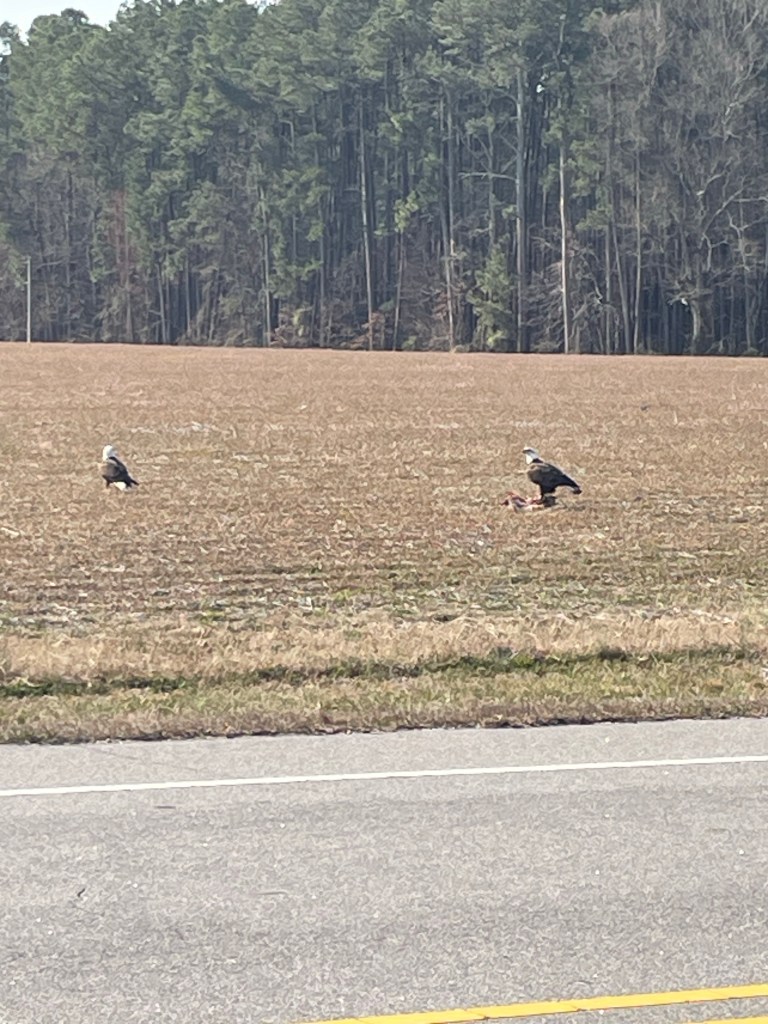
He texted me a photo recently, with tremendous excitement: Look what I just saw!
A barren field along a deserted country road…
Where stood two bald eagles.
His eyes sparkled when he saw me later: They were huge! So beautiful…
It is better than I ever dreamed, this life, here in the country.
Isn’t it, Son.
*******
Composed for Day 22 of the Slice of Life Story Challenge with Two Writing Teachers
On Day Two of the Slice of Life Story Challenge, I had a lot of fun playing with backwards names (You, reversed).
Today I am thinking about family names and the legends or lore surrounding them.
My mother had a unique name. My Grannie named her after her sister, Verlee. When I was little, Mama explained her name to me: It’s from the Bible. From the word “verily.”
Verily is an archaic English translation of several different Hebrew and Greek words throughout the scriptures. It means truly or certainly.
Grannie had six children by the time she was twenty-two, during the Great Depression. My mother was the last. They had a hard, hard life. I only know bits and pieces of their story; most of those who lived it are gone now. They experienced a lot of loss. A baby boy, Thomas, coming a year before my mother, died when he was a few days old. Grannie spoke of him to me when I was a child: I felt so empty, coming home without him. She never forgot him.
Mama said that when she was born Grannie brought her home from the hospital in a basket.
These images have lived in my head for years and years.
Quite some time ago, I started crafting a story about a family…not my mother’s, but with a few borrowings. I have a long version (incomplete) and a short story version. Every once in a while I go back and tinker with the tale , to see what the characters are up to…
Since the word came to mind today, I’ll share a little excerpt.
From my short story entitled “Verily, Verily”
One afternoon, when we was playing school on Grandma’s porch, a long black car that looked like it ought to belong to the mill owners pulled up.
Out stepped Mama.
At first I hardly knowed her. She didn’t look much like herself. Pure skinny for one thing, her legs just little bitty bird’s legs beneath the dress that the ladies’ sewing circle made and carried to the hospital for her. Her face, all sharp edges. Her eyes had changed the most. Huge, wild, like some hunted creature was looking out of Mama’s eyes.
When she seen us up on the porch, she tried to smile, but them too-big eyes filled with tears. “Well, girls – ain’t you even going to come hug your Mama’s neck and see what I brung you?”
Me and Artie May flew down the steps to throw our arms around her. Mama felt like paper and twigs, like a good breeze would carry her rattling away. She couldn’t hug us back very much because of the basket over her arm. Whatever she had in there was covered up with blankets.
“What is it, Mama? What’d you bring us?” shouted Artie, jumping up and down, trying to see inside the basket.
“Goodness, Artie May,” said Mama, “you don’t mean you’re just happy to see me on account of the surprise, are you?”
I felt happy to see Mama but I wanted to know what was in that basket, too. Just then, I seen something move under the blanket.
“Mama, you got a puppy in there!” I hollered.
Mama smiled then but her eyes didn’t smile with her. “No, Ollie Fay, it ain’t a puppy. It’s better than that. Come see.”
She kneeled in the yard. Artie May and me crowded close. Mama didn’t even smell like herself no more; she smelled like the inside of medicine bottles and new cotton cloth. I wondered what on earth could be better than a puppy, except maybe two puppies, as Mama pulled back the blankets.
Artie went Ohhhhhh and I ain’t never been more shocked in my life, to see a baby asleep in that basket. It had a round pink head with a little bit of dark fuzz for hair.
Mama said, “Girls, this here’s your little sister.”
Me and Artie just stared and stared before Artie finally asked, “What’s her name, Mama?”
“Well, I wanted to name her something from the Bible. I thought on it a long time and decided to call her Verilee.“
Now, I knowed something of Mary, Martha, Ruth, and Hannah, but I ain’t never heared of no Verilee in the Bible before. Artie must of been thinking the same thing, because she asked, “Who was Verilee in the Bible, Mama? What did she do?”
I guessed, on account of the basket: “She was Baby Moses’s sister.
Mama shook her head. “No, Ollie Fay. That was Miriam. There won’t nobody named Verilee in the Bible. I took it from something Jesus said: ‘Verily, verily, I say unto you, he that believeth on me hath everlasting life.’”
Then Mama’s mouth started wobbling.
Grandma spoke from the porch: “Rose.” We got so caught up with the baby none of us even knowed she’d come out. She stood there with her arms crossed over her bosom. “That’s it, Rose. He’s gone and you know there ain’t no suffering where he is. Call the child whatever you want, she’s a sign that life goes on. We can only pray it ain’t always going to be so everlasting hard. Get in the house, girls, your supper’s on the table.”
Hmmmmm.
Maybe it’s time to tinker some more? Hammer out the many kinks and let these characters get on with their lives?
Verily, I say to y’all… that might be a whole lot of story.
My Grannie holding my mother, 1941.
******* Composed for Day 5 of the Slice of Life Story Challenge with Two Writing Teachers
A thought: Dialect is often discouraged in writing because it’s hard do to well and can be challenging for readers. But sometimes that’s how the story wants to tell itself.
On Day Two of July’s Open Write at Ethical ELA, host Mo Daly invites us to write a poem in Fibonacci sequence: six lines with syllables of 1, 1, 2, 3, 5, 8.
The Fibonacci sequence appears over and over in nature, from shells to flowers to trees to our own DNA.
Maybe that’s what led to thisdouble-reverse attempt…
Hey, Ancestors
composed after a trip to the home place
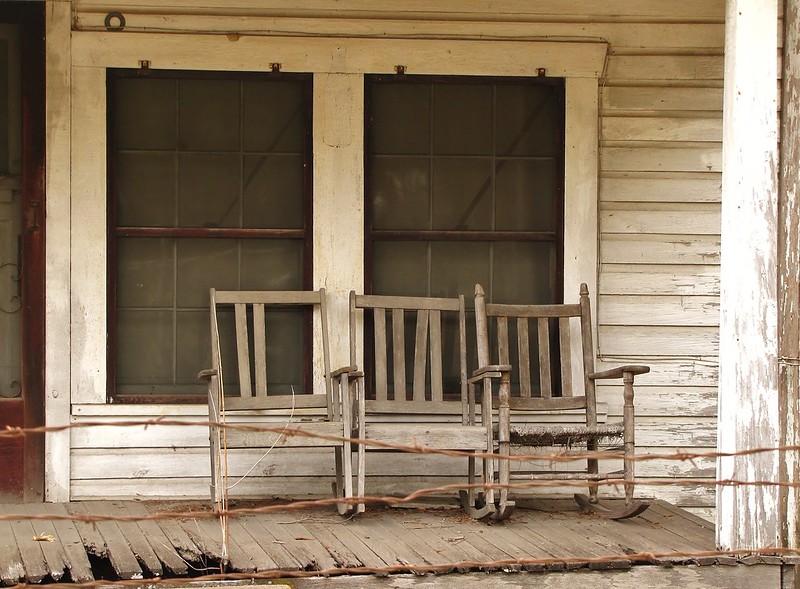
Come sit a spell on the porch. I want to know you. Tell me the stories of your life. I don’t mind your being a ghost. Just (if you please) try not to rock your chair too much.
And so it comes to pass, at long last, that I return to the site of my sun-kissed childhood summers.
My ancestral homeplace in eastern North Carolina. Literally the land of my fathers: My dad, my grandparents, my great-parents, my great-greats were all born within a small radius of a tiny town and crossroads that were old long before my appearance on this Earth.
Thus began my fascination with Time.
In the bend of a dirt road stood my grandparents’ home, where my father grew up. My youngest aunt was born here in the same room where her father, my Granddaddy, would die fifty-three years later at 92. He wanted to die at home. He did, peacefully and “full of days,” as the Scriptures say of Abraham, Isaac, and Job: After this lived Job an hundred and forty years, and saw his sons, and his sons’ sons, even four generations. So Job died, being old and full of days (Job 42:16-17).
Likewise, my grandparents saw four generations. They lived to see my children. Incidentally, Granddaddy had a brother named Job who died in the 1920s (he drowned, if I recall correctly; this is a coastal area).
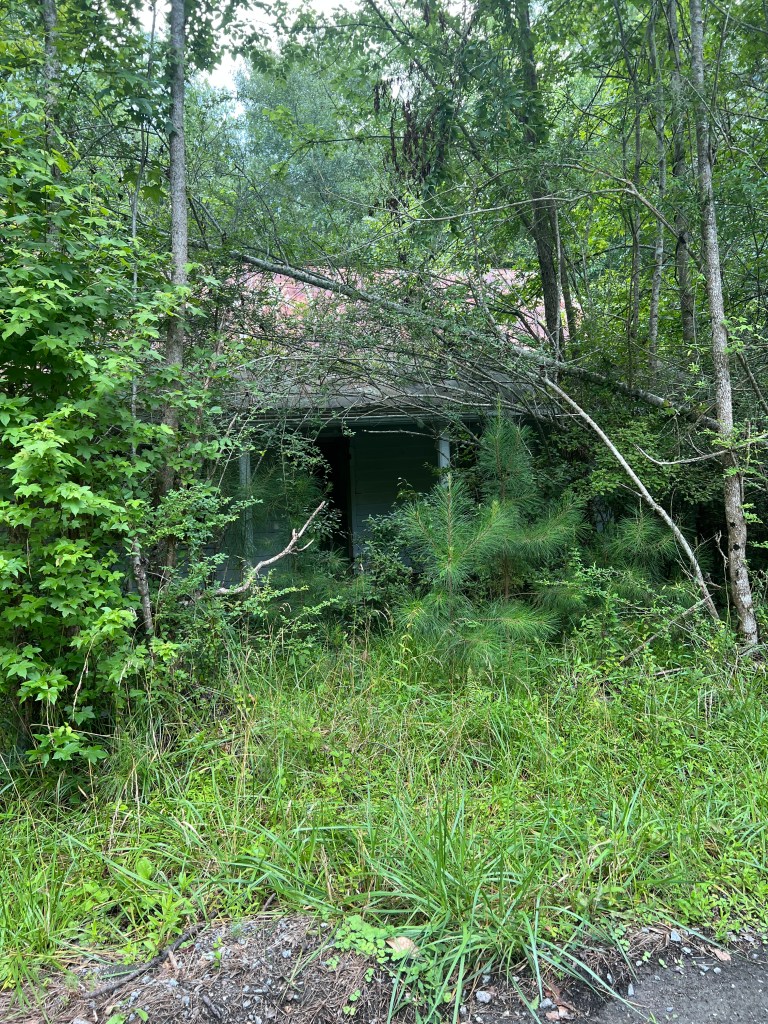
So it was that I grew up on stories of the old days and ways, a little city girl mesmerized by my deep country roots. In my time the once-thriving community was already history; nature was reclaiming the unpainted houses, one by one. Some were still visible through the woods (an early memory: a cypress shingle roof in the treetops, if you looked just right) and others were in various stages of falling down with yards still mowed by descendants.
On this return journey a few weeks ago, I discovered that my grandmother’s homeplace from the early 1900s is being swallowed by the forest:
A terrible jolt, as I can remember it having a hedge, a lawn, a porch swing, a screen door. I remember the layout inside and my great-uncle living there, tending to a patch of sunflowers.
And I knew, prior to this journey, that my grandparents’ house, which stood on the corner a little farther on, is gone.
This story is a little different, however. Instead of the forest reaching its veiny green fingers to reclaim its own, a young couple has built a home right in the middle of what was once my grandfather’s garden. I can’t help thinking how Grandma would marvel at the beauty of this new house and its lovely landscaping.
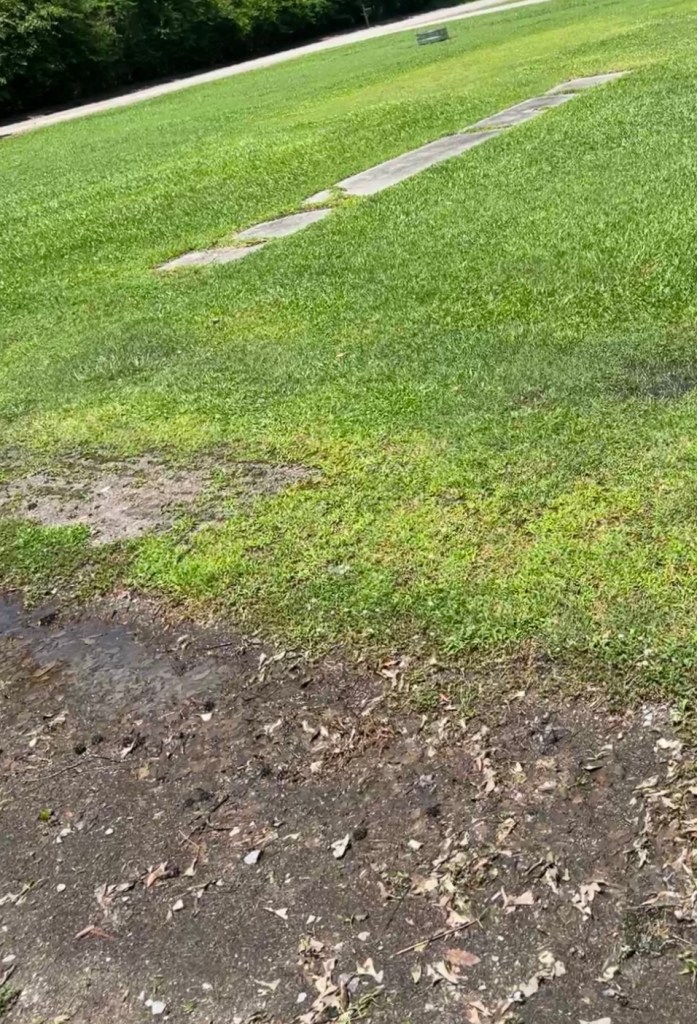
All that remains here from the enchanted summers of my childhood half a century ago (and from time before me) is the pumphouse, one of Grandma’s crepe myrtles (now wistfully draped in Spanish moss, which never used to be in these parts), and the sidewalk that once led to the front porch of Granddaddy and Grandma’s home:
As a teenager I wrote a song about a sidewalk. Haven’t thought about it in ages:
Where does this lonely sidewalk lead? You think by now I’d know Footsteps into yesterday That’s where I want to go…
I had no idea, then, that only the sidewalk would remain in this place I loved so well, where I used to play outside in the sweltering bug-infested heat, where Grandma would sit at her piano in the evenings to have me sing old hymns with her as Granddaddy listened from his recliner, where I felt loved and wanted and sheltered and that I belonged…
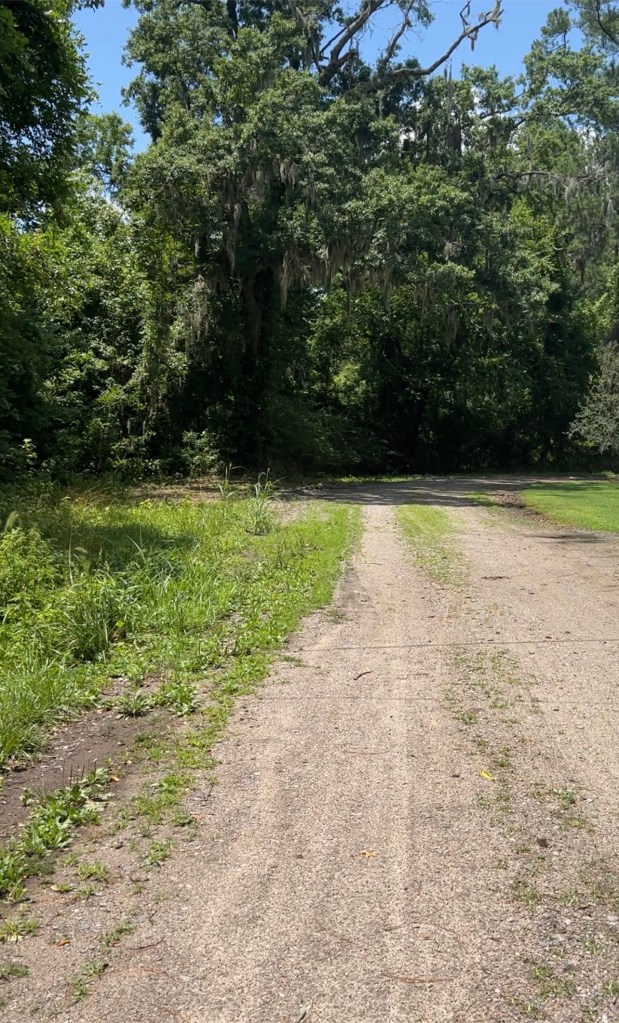
The old dirt road remains, too, of course.
There was another dirt road branching off of it here in the shadows to the left; it once led, Grandma said, to a two-story antebellum house with a double balcony. I could hear admiration for that house in her voice. In my childhood the road was just two tracks through grass and thickets. The path faded more and more with every passing summer. Now you would never know it had ever been anything but woods.
From this vantage point, my grandparents’ yard is on the right, and to the immediate left is an old family cemetery. Not my family’s, although I walked it often with Grandma over the years. When I was a child, I was afraid ghosts would come out here at night. Grandma assured me they would not. She offered this dubious comfort: No need to fear the dead. Fear the living.
When I wondered at the graves of so many babies, she said people just didn’t know what to do for them when they were sick.
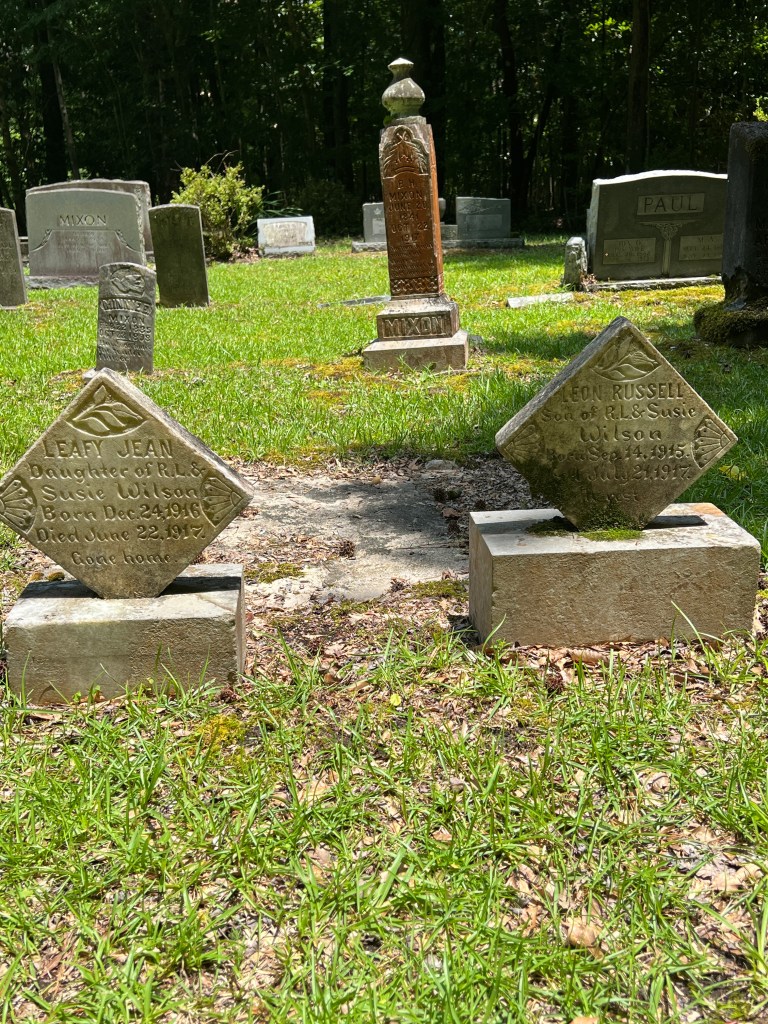
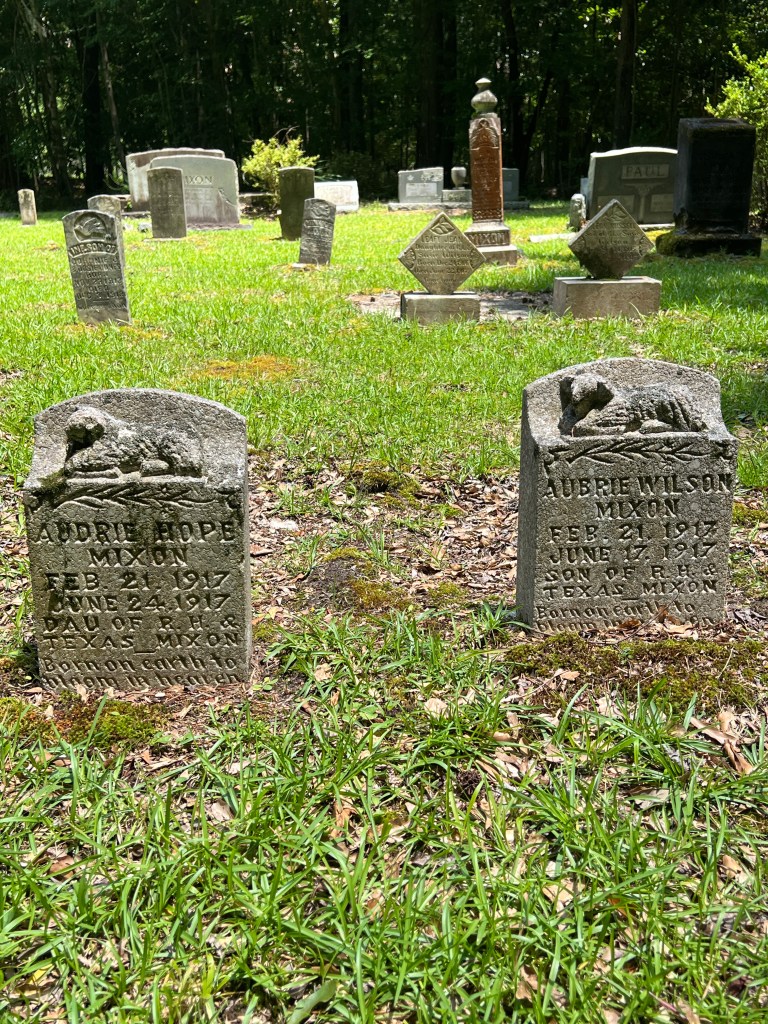
It’s clear how much the children were loved and mourned. This tiny cemetery remains painstakingly tended and strangely outside of time:
Hello again, baby Leafy Jean and big brother Leon Russell.
These siblings died a month apart in 1917. Grandma was born three months after Leon, almost a year to the day before Leafy, in the soon-to-be obscured homeplace just around the bend of the road.
Four-month-old twins Audrie and Aubrie died a week apart during that same summer.
The greater wonder, in its way, are the children who survived disease and mothers who died giving birth to them, which almost happened to Grandma: her mother delivered a stillborn baby three months before she was born. My grandmother was a twin. Grandma journaled this because I asked her to; in her writings, she says several women in the community who recently had babies helped nurse her while my great-grandmother was so ill that she “almost didn’t make it.”
—Why am I just now realizing that Grandma’s lost twin would have come around the same time as Leon Russell? Could his mother have been one of the women who preserved my newborn grandmother’s hungry life? if so …imagine saving someone else’s child and losing your own…
So many mysteries in this place. I’ve always felt the pull.
Over fifty years after I first walked this cemetery with my grandmother, I’m awed by the good condition of the headstones. I halfway expected them to be eroding into illegibility — after all, these people’s earthly homes have long since crumbled. No greater mystery than Time…
I cannot linger here, ruminating, for there’s another place to visit. Really just a good walk “around the horn” to the church, a journey I’ve made many times.
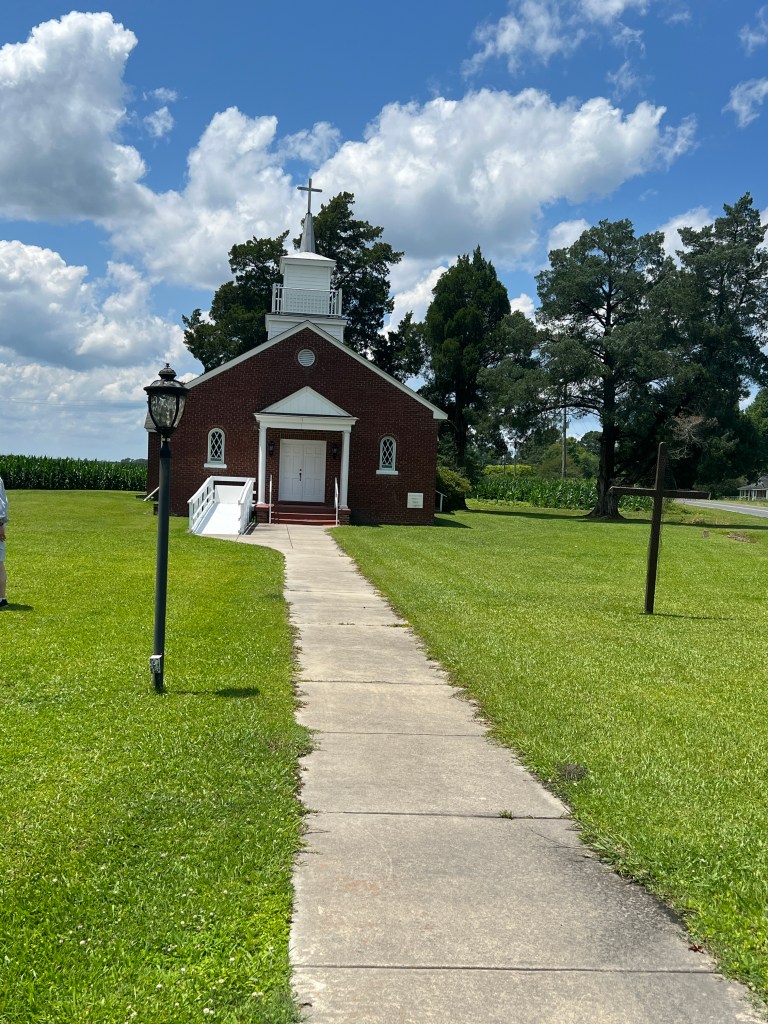
This was once the heart of the bustling farm community. The church was built on land given by my grandmother’s predecessors. Her father, mother, brothers, and other family are buried to the right of this crossroads.
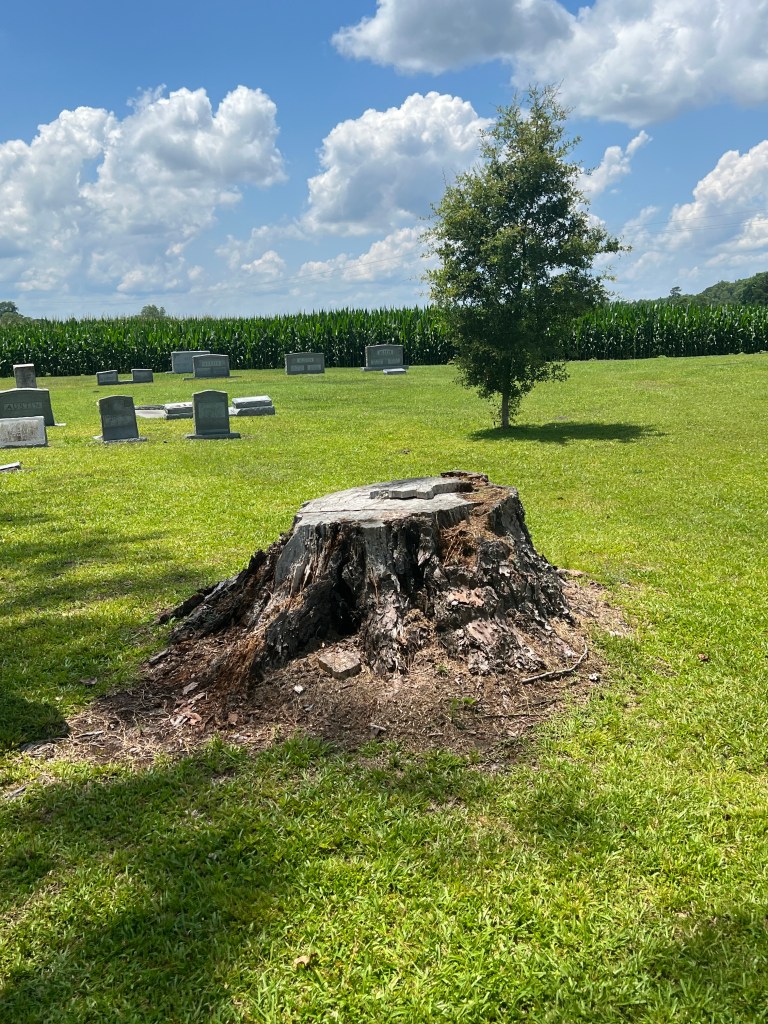
Granddaddy and Grandma are buried in the churchyard, to the left.
Such a beautiful little resting place, presently bordered by a lush cornfield. An old live oak felled by a hurricane in recent years has been replaced by a new one nearby.
Grandma would be so pleased to see how well-tended everything is.
There’s even a new footbridge over the ditch at the churchyard, for easy access to the little community center across the road. This building stands where Grandma’s three-room grade school used to, she said in her journal.
Here’s where old and new converge most for me, where Time is most relevant and paradoxically elusive. The spirit of this place is old; my own memories are growing old.
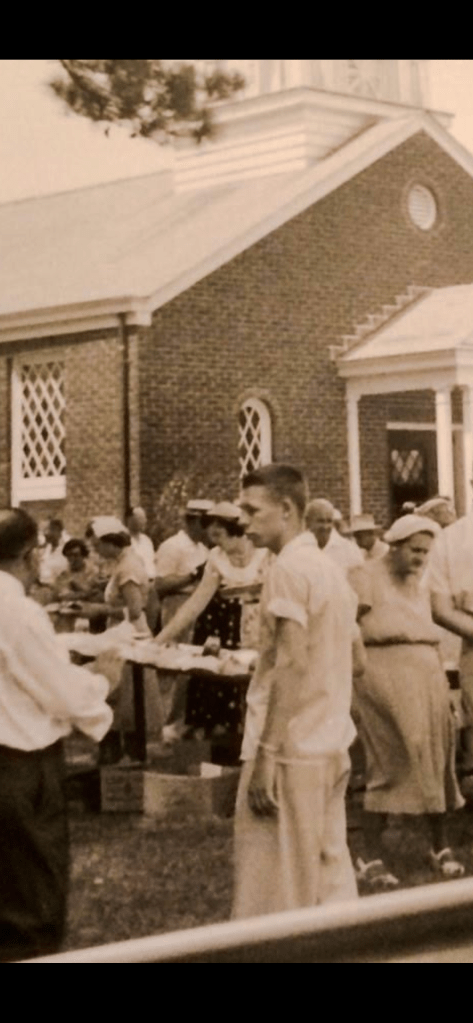
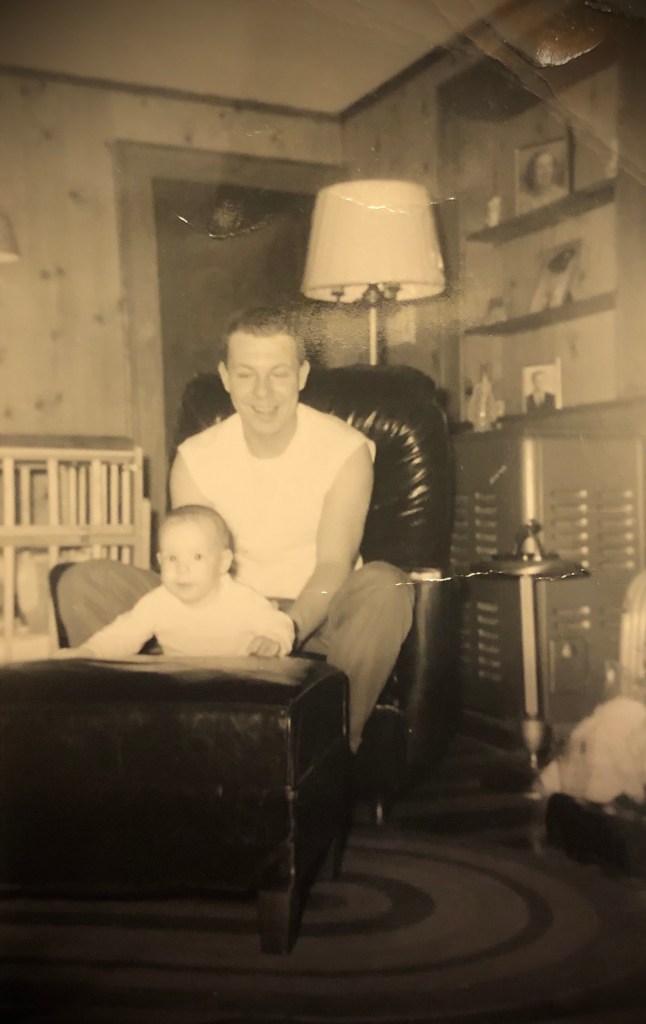
My father as a teenager, in the churchyard
I am the keeper of memories older than mine.
But I came for the new.
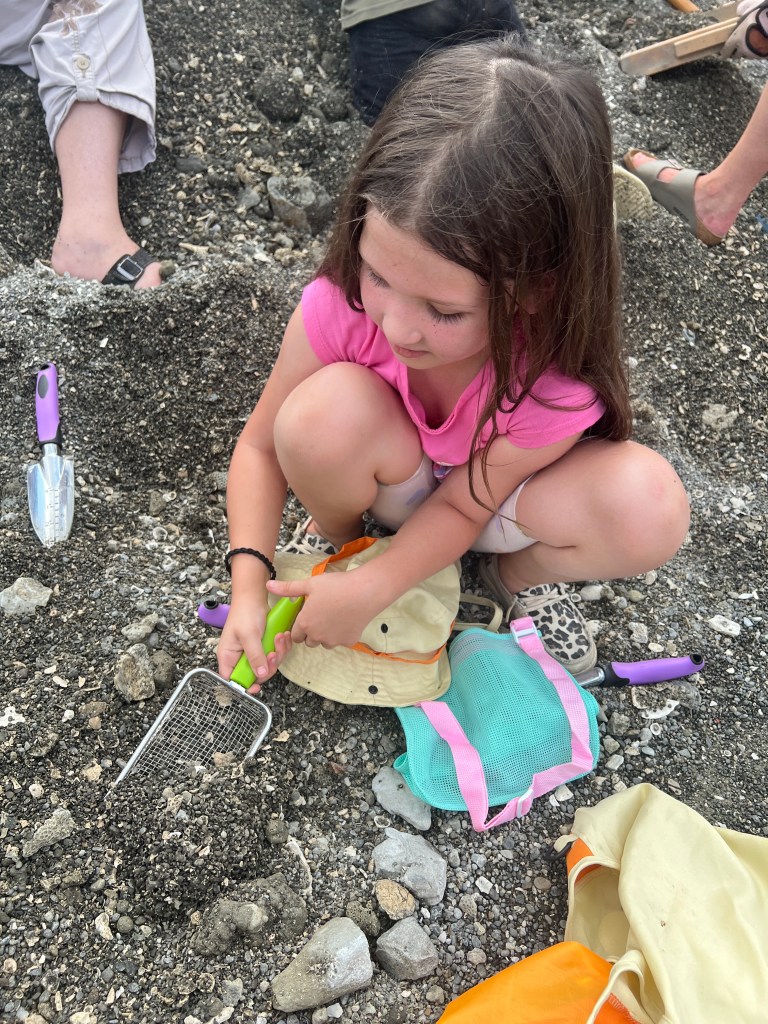
I brought my granddaughter, you see.
All along the journey, I told her stories. Of the old days, the old ways.
I brought her to dig for fossils at the Museum in town (which is where the phosphate mining company sends its rejects now, instead of scattering treasures on the old dirt roads).
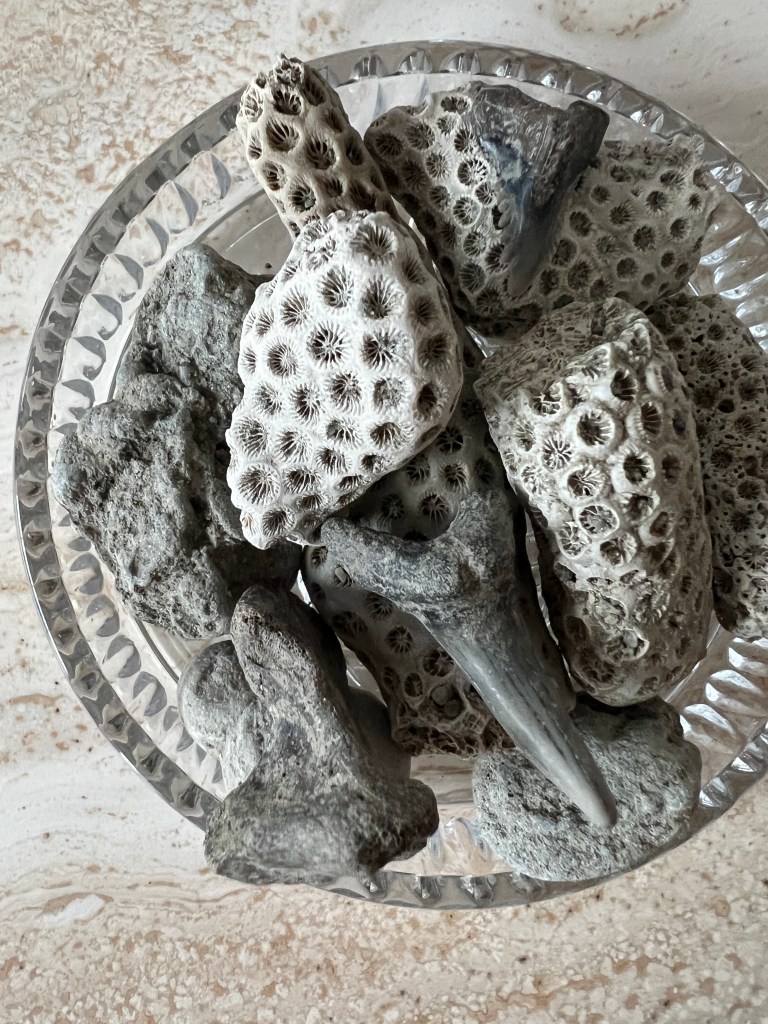
We found a bit of coral skeleton, shark’s teeth, and some bony things I’ve yet to identify:
Making new memories from the old… even from the ancient, from time before recorded time.
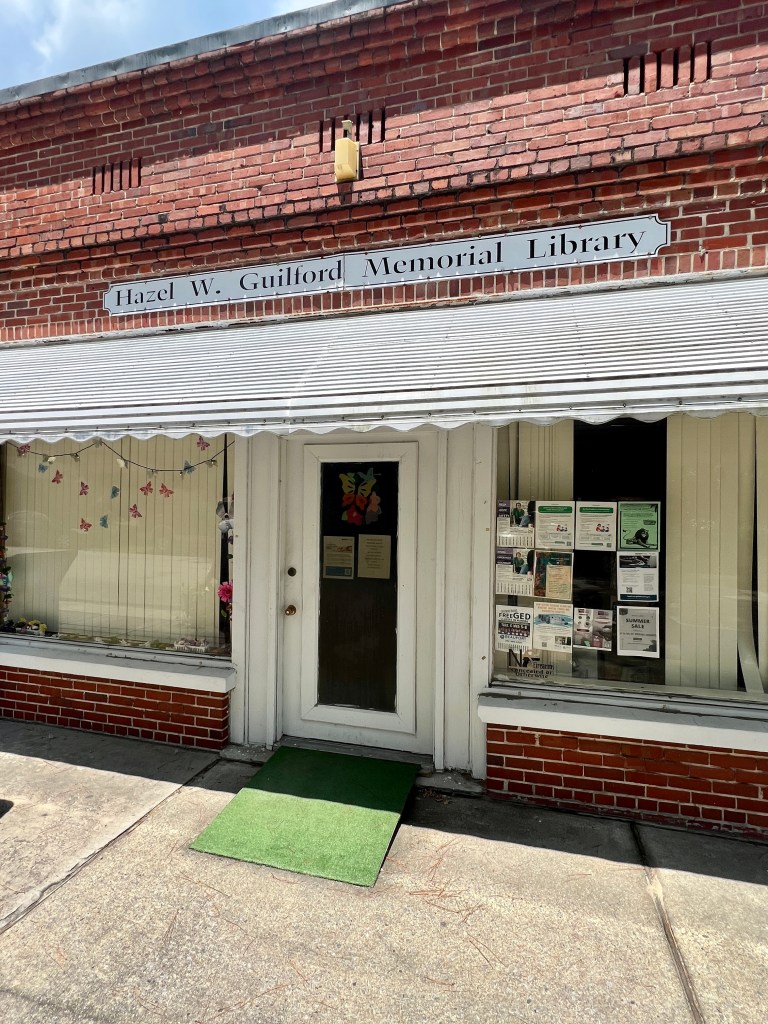
As we were leaving, I discovered that the old library in this old, old town looks the same as it did five decades ago when Grandma drove me to pick out books to read at her house in the summer. I halfway expected to see her coming out with the armful she had to help me carry…
And I think this is used to be, or is at least near, the butcher shop where Daddy worked as a teenager.
There’s so much more to be said about memory, legacy, endurance, overcoming, and family… about the whole spiritual journey of life. The greatest gift my grandparents gave me, beyond their unconditional love and their stories, is that of faith lived out. I learned long ago that eventually there comes a homecoming so bright, so glorious, that all the former shadows are forgotten.
I expect I’ll recognize my little corner of Heaven, having had such a foretaste here.
Until that time, I carry on in the footsteps before me, praying I walk even half as well.
My now, my tomorrows ❤
From Everlasting to Everlasting: A Prayer of Moses
Lord, you have been our dwelling place in all generations. Before the mountains were brought forth, or ever you had formed the earth and the world, from everlasting to everlasting you are God.
You return man to dust and say, “Return, O children of man!” For a thousand years in your sight are but as yesterday when it is past, or as a watch in the night…
Let your work be shown to your servants, and your glorious power to their children. Let the favor of the Lord our God be upon us, and establish the work of our hands upon us; yes, establish the work of our hands! Psalm 90: 1-4;16-17
*******
with thanks to my Spiritual Journey friends who write on the first Thursday of each month and to host Carol Varsalona who posted this reflection and question for July:
Pause and praise God for His wondrous gifts! What are you rejoicing over this summer?
And so this festive feast day rolls ’round again, leaving me pondering my (supposed) green roots.
I grew up wearing green on this day just so I wouldn’t get pinched at school.
We weren’t Catholic, so for a long time I didn’t understand the history of saints and feasts.
I did understand leprechauns, however, because I loved books of legends, lore, and mysterious creatures.
The generations before me were Protestants hailing from rural eastern North Carolina, and despite my ancestry of Rileys on one side and Mayos on the other, our Irishness wasn’t discussed.
Except.
I write about this every year: My Granddaddy’s middle name was St. Patrick.
For real.
He didn’t love it at all (being a Methodist, or… because that’s really odd?) He had it legally changed to the initial S. in my lifetime.
But my aunt Pat was already named for him.
When I was a young adult, my dad tried to trace the Irish family line, maybe in search of a reason for this peculiar name choice borne by his father (whose brothers mostly had Biblical names like James, Hosea, Job Enoch, Asa…). And Granddaddy’s rustic accent bore traces of Elizabethan English: His brothers Hosea and Asa were Hosey and Acey; a neighbor, Etta, was Etter. Listen to Brits pronouncing Diana today and you may catch it: Dianer.
In short: All I can recall from my dad’s research is a convoluted story without a clear end.
But.
I did hear Granddaddy mention his grandfather speaking of Dublin. Just once, long, long ago.
Nowadays, with all of them gone, I am left to wonder, except that my DNA report says my ancestry is 92% British and Irish. As for strongest Irish evidence, County Dublin is listed second; County Mayo, fourth.
I do know that Saint Patrick’s Day wasn’t an official public holiday in Ireland until 1903…Granddaddy was born in 1906, so…hmmm…
All in all, despite the mysteries, I feel an affinity for the ancient Apostle of Ireland and his Christian ministry. My grandparents were devout salt-of-the-earth people. I am who I am largely because of their faith, their prayers. My husband and oldest son—with a surname tied to an ancient Irish family seat—are ministers.
That’s enough green threads for me to honor the day with a few favorite quotes attributed to the saint. There are prayers that I find profoundly beautiful and worth meditating upon, every day.
But I’ll leave you with these little pearls that make me smile:
Never trust a dog to watch your food.
May the light always find you on a dreary day.
We cannot share this sorrow if we haven’t grieved a while. Nor can we feel another’s joy until we’ve learned to smile (#WhyIWrite).
And from one of my life’s verses, Psalm 46:10:
Be still and know that I am God. Be still and know that I am. Be still and know. Be still. Be.
I shall, Saint Patrick.
I shall.
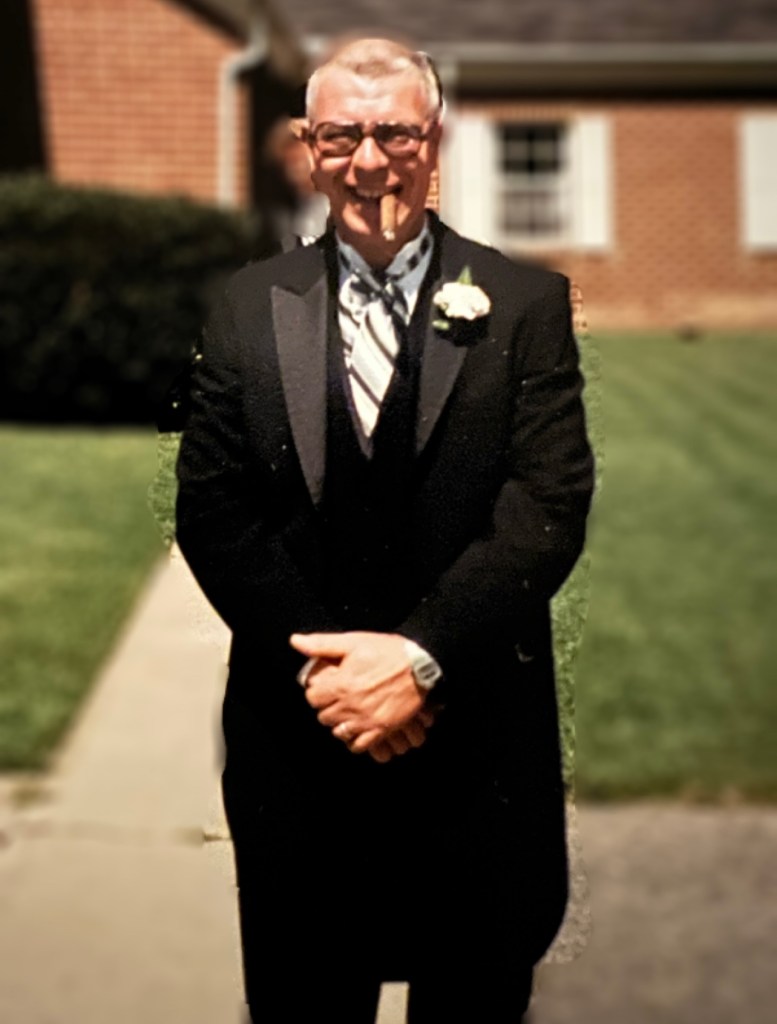
Honestly, Granddaddy did resemble this a bit, sans beard.
*******
with thanks to Two Writing Teachers for the monthlong Slice of Life Story Challenge









 lit bits and pieces