
‘You were my favorite memory’

BoJangles

New BoJangles at night. Mr. Blue MauMauCC BY

Spring arrives amid a flurry of wings, bird voices rising with the morning sun, daylight hours stretching perceptibly longer, the first warm breath of promise to come.

On such a day, two years ago, my youngest son’s lifelong friend died in an accident.

She was eighteen.

She was one of the prettiest children I’ve ever seen. Big, brown, doe-like eyes in a round cherub face. Musical, like my son. They grew up in children’s choirs at church, were in band together throughout high school. She played the flute. My son occasionally accompanied her and their other childhood friend on the piano during worship services. All three of them sang:

I’ve had many tears and sorrows

I’ve had questions for tomorrow

There’ve been times I didn’t know right from wrong

But in every situation

God gave blessed consolation

That my trials come to only make me strong.

Through it all,

Through it all . . . 

Their voices blended beautifully. Hers was high, clear, pure, almost ethereal.

I wrote to her, told her so. Said that she needed to sing more often.

Perhaps that note was in her things, still, when her mother began going through them after her death. I do not know.

But an essay she’d written in high school was there.

Its title: My Favorite Childhood Memory.

Her mother copied it, sent it to my son and their other friend—for she wrote of them.

I wondered, when I first learned of this essay, what the memory was. Maybe a birthday celebration, as they were all born in August of three successive years. Maybe working Vacation Bible School or Bible Sports Camp together as youth. Maybe it was the time they went shopping and bought two betta fish that my son named after gospel bass singers, or one of the summer beach trips they took, growing up. The three of them even went to the prom together, once.

My son let me read her essay.

She wrote of Sunday nights when the three of them would go with her family to BoJangles for supper, how they told hysterically funny stories, how she laughed and laughed. She said these were the best times of her childhood, that she would always remember them . . . .

She is gone. Her words, her love for her friends, remain:

You were my favorite childhood memory.

It seems almost like a thank-you letter, now.

My son says once in a while, when he’s out walking laps around the church, exercising his body, easing his mind and his soul—he can hear her singing.
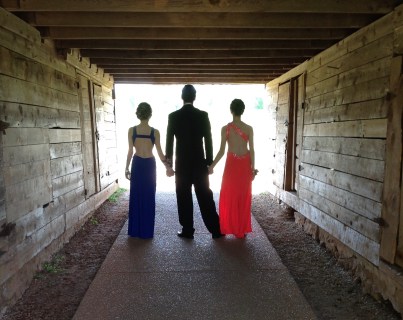
It’s two years today, a Sunday. Tonight her family and friends will gather at BoJangles in her memory.
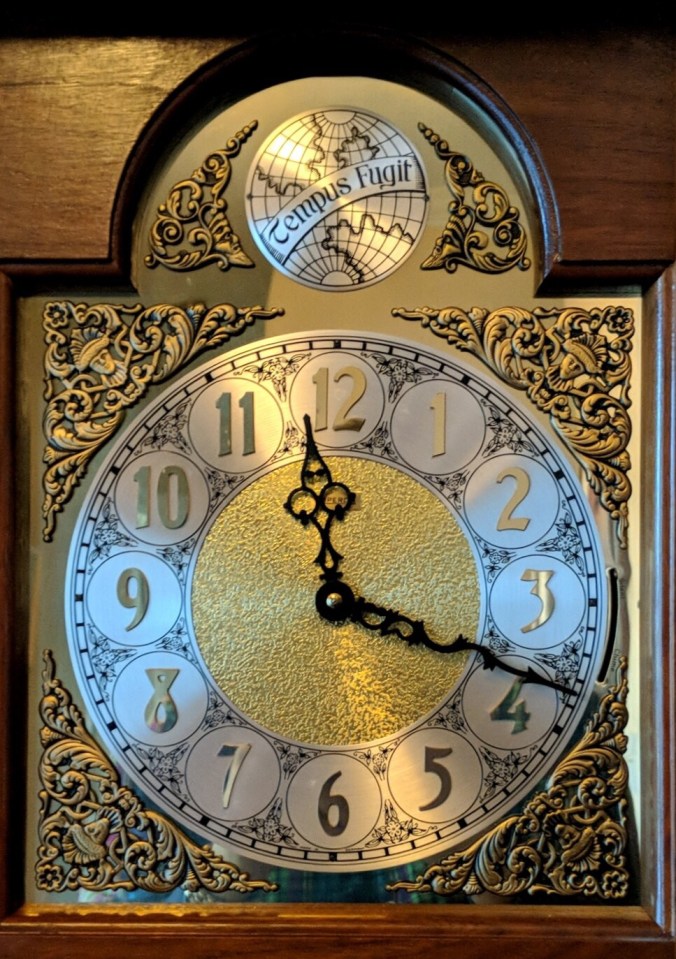
Tempus fugit

Tempus Fugit

(Time Flies)

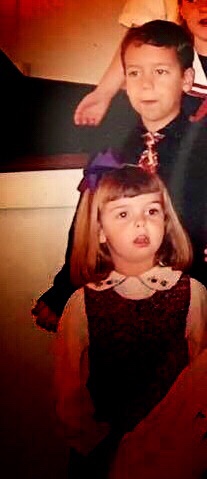
They should still be preschoolers

singing in the children’s choir

round-faced cherubs, both

ever so serious.

Time flies.

Or

children on vacation

tasting salt on their tongues, brine in the wind

with sand on their toes, in their hair

eating pickles from a jar.

Time flies.

Or

teenagers at Bojangles’

laughing, cutting up

marching in the band, going to the prom

still singing the old hymns together.

Time flies.

Or

college kids, going their separate ways

friends temporarily parted

by finding their own paths, until

one ended on a fresh spring night.

Time flies. 

She wrote that he was part

of her favorite childhood memory.

On the eve of her funeral, he dreamed

he heard her singing

of the ocean.

Time flies

Time flies

Time flies.

*******

One year ago today, my younger son (the Cadillac man) lost his childhood friend in an accident. 

She was eighteen. 

The little hand

Hands

Untitled mural. Rob SwystunCC-BY

She’s the tiniest student in our first grade class, beautifully dressed, hair neatly swept up in beaded ponytail holders. She speaks little; she is shy. Her big brown eyes, framed with long, thick lashes, take in everything. 

I often catch her eyes resting on me. I wonder what she’s thinking. I smile at her. She looks away, but I can see the corners of her mouth twisting up, that she’s deliberately suppressing her natural response.

I am not the teacher; I am a teacher in training, working as an assistant. The teacher soon pairs me with this tiny girl. We are to read together for a few minutes every day. My shy friend is a struggling learner.

She has many struggles.

I learn that this child is the oldest of several siblings and that they all live with their grandmother. This child suffers with asthma – common ground with me.

“I have asthma, just like you,” I tell her one day.

“You do?” Little eyebrows elevate over the big brown eyes. She studies my face, and for the first time, a smile breaks over her solemn countenance, like a flicker of light.

The teacher and I notice how our little girl scratches herself, her arms and her neck in particular. Patches of thick, scaly skin appear to be eczema – they flare when she’s stressed. She scratches and scratches.

I take over the class while the teacher ushers our friend to the sink and shows her how to use a nail brush to clean away the necrotic tissue collecting under her fingernails.

After conversations with Grandma, a tub of cream is brought to school. When we open it, the cream is peppered with flakes of our little friend’s skin, from multiple dabbings and applications.

On the worst days, we take turns holding her in our laps, rocking her while she cries, holding her hands in ours to keep her from scratching and drawing blood, while the other kids run and play at recess or spread across the room to do their work.

The teacher fears that the thick patches of skin are permanently altered.

We cry, too.

One morning, after an unpleasant encounter with an adult in the building, I enter the classroom and find a quiet place to sit away from the children. Passing by, en route to morning meeting, the teacher whispers to me: “Are you all right?”

“I will be,” I reply. “I just need a minute to breathe.”

As the students gather on the floor around the teacher, my tiny friend creeps over to me. She crawls up in my lap, featherweight that she is. I put my arms around her. 

She reaches out her little hand and pats my neck.

Your skin is all red,” she says.

And she sits there with me, not to be comforted this time, but to comfort. The only child who perceived that something wasn’t right.

She rocks, humming a tune. I don’t know it. Turns out that my friend is a singer – there’s an astonishingly big, expressive voice inside that tiny ravaged body.

She begins singing more and more. She makes us laugh – her classmates love to hear her. 

One afternoon, after several weeks of reading together – beginning with picture walks and my reading pages to the girl and her reading them back to me, repeating until she can read with few to no errors, with increasingly complex books – she sits regally in the chair beside me and takes the new book out of my hand before I can introduce it.

“I can do it myself,” she announces.

I hold my breath the entire time, restraining myself from intervening as she works through this new, harder text on her own. She labors in some places, but she keeps moving, until the final word.

“YOU DID IT!” I shout. People walking at the end of the hallway stop and turn around.

My little friend, face aglow, radiant, throws her braided head back and laughs for all she’s worth.

I carry those moments – I carry her – in a corner of my heart forever.

For me there’s no question of who really taught whom, who was the greater blessing to the other.

Many years have passed, but when I think of diverse student needs, of overcoming, I see her solemn face, her beautiful eyes. I hear her cries, her laughter, and marvel at the resilience of children. I feel the pat of her little hand, the innate empathy in it, born of suffering, recognizing suffering, seeking to alleviate it; our exterior, our skin, is not the whole of us. Her songs, resonant with untaught vibrato, bubbling up from some pure wellspring deep within, represent the indomitable human spirit – full to overflowing, even in the face of hardship, even in the smallest of us.