Happy St. Patrick’s

Happy St Pat's

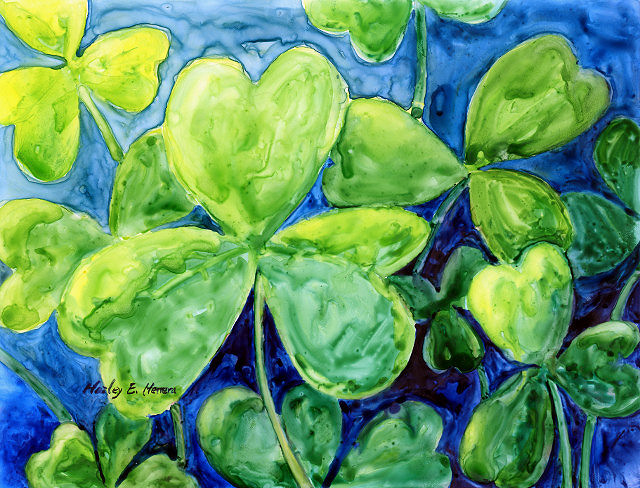
Happy St. Patrick’s Day. Hailey E. HerreraCC BY

Last year on this day, I wrote about being St. Patrick’s granddaughter.

My grandfather, born in 1906 in the far reaches of Beaufort County, North Carolina, was named Columbus St. Patrick. (Read the post if you like).

You’d think our family would be Catholic, celebrating this day with the best of them, but we aren’t and we don’t. What a mystery, his having that name. Legend has it that his grandfather came to America from Ireland, but records are sketchy. One of these days I’ll have my DNA tested by Ancestry.com to prove how green my blood really is (it’s metaphorical, Mr. Spock. Although being related to you would be . . . fascinating).

I love Irish things. My wedding band bears a Claddagh. Hearing an Irish tenor takes my breath, stirs my soul, fills me with an ache, a longing. Whenever I visit New York City, I have to stop by St. Patrick’s Cathedral; I could stay inside indefinitely, savoring the profound beauty, the grandeur, the reverent hush. It’s one of my all-time favorite places. I adored Frank McCourt and met him years ago when he came to speak at North Carolina State University—it was snowing that night. Magical. I have a shamrock growing in a pot on my kitchen table and I even had an Irish Setter once. His name was Dublin. I grew up eating Irish potatoes grown by my grandfather or from the potato sheds of his farming community; Granddaddy’s pronunciation was ishe (for years I thought he was saying ice) potatoes. I’d love to visit Ireland.

I thought, to commemorate this day, that I’d post a lovely quote from St. Patrick and reflect upon it, maybe in verse.

This, however, is the quote I found, and for the life of me (remember the Irish keen sense of humor), I can’t find another one to top it at present.

So, Happy St. Patrick’s Day, one and all—with a special nod to Harry Potter fans:

Do you suppose it’s true, that St. Patrick was a Parselmouth, and his Muggle friends never knew?

~David J. Beard (1947–2016), tweet, 2012 March 17th

saintpatrick


Roadside treasure

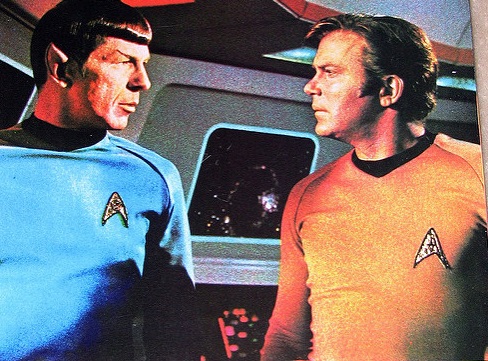
Spock & Kirk

Star Trek Monthly Magazine Poster Book (cropped). Joe HauptCC BY-SA

The following is a narrative/memoir written several times with students in grades 3-5. I wrote a bare-bones version in front of students, then revised to model the vast difference of “showing, not telling” by adding detail and dialogue. “I can see it all happening!” the kids always exclaim, as the narrative comes to life. Yesterday’s eclipse brought this piece back to mind – the fascination with space, the many hours I spent watching and playing Star Trek when I was the age of these students. During the writing process, the kids ask countless questions. My favorite moment is when they realize what the story is really about.

I shake the device in my hand before I flip the lid and press the button to speak. “Do you read me, Spock?”

Nothing, not even static.

I pull the antenna out as far as it will go. I bang on the device a couple of times with my fist. I shout into it: “COME IN, SPOCK!”

My sister pokes her face from around the corner of our house. “This really ain’t logical!” she calls. She’s not even holding the device up to her mouth.

I sigh.

My sister is eight, I am ten, and we are tired of playing Star Trek. The batteries in the communicators we got for Christmas have quit working, and it’s no fun for Captain Kirk (me) and Mr. Spock (my sister) to keep yelling messages to each other across the yard, which has just one decent tree. There’s only so many pretend worlds we can explore when it all looks the same, with nowhere to hide from alien life forms.

My sister meets me at the street in front of the house. We leave our useless communicators behind in the grass and sit down on the curb as ourselves, not Kirk and Spock anymore.

“Let’s walk to the 7-Eleven and get a Slurpee,” says my sister. She likes the straws with the spoon on the end. She plays with them more than she drinks her Slurpee.

“I’m broke. I spent my last fifty cents on cinnamon Now-and-Laters and green apple bubble gum day before yesterday and it’s all gone already.” Our dad can’t stand green apple bubble gum. He says it stinks but I think it’s delicious, even though it turns my teeth and tongue green. “Do you have any money?”

“Nah, I thought you did,” says my sister, kicking at the grit beside the curb.

“Not anymore.”  I wish I had some green apple gum right now. I stretch my legs, which are getting long, out into the road. If a car comes, which isn’t all that often in our neighborhood, my sister and I will pull our legs up to our chests until it goes by.

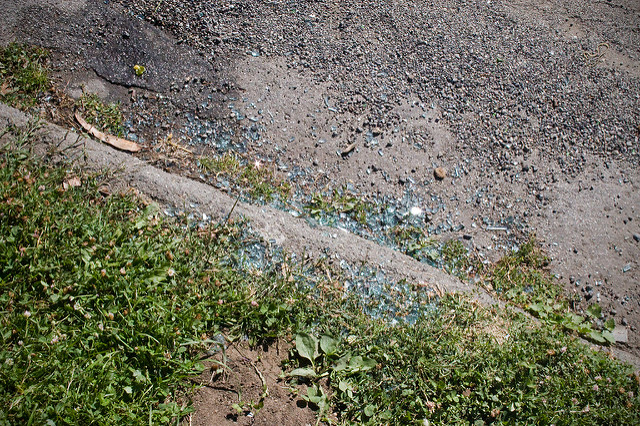
I look down at the edge of the curb where it meets the street, at the little loose rocks lying there. I see a stubby twig and pick it up to write my name in the dust when I notice tiny chunks of pale blue-green glass. I wonder where these came from. Someone must have thrown a Coke bottle out of a car and shattered it.  I push the pieces around with the twig, inspecting them – they don’t look sharp. Time and weather, maybe, have smoothed away the roughest edges.

“What would you do if you had a million dollars?” asks my sister.

“I don’t know.” I pick up a bumpy chunk of the glass and roll it around in my hand; it sparkles in the sunlight. “Maybe I would have a horse and a big house. Maybe I would travel all over the world and be famous. What would you do?”

“I’d give some to poor people for their kids to have toys and bikes and then I would get me a bunch of dogs. What is that?”

I show her the bit of glass in my hand. I smile: “It’s an aquamarine. March’s birthstone. If you were born in March I would give it to you but since you weren’t, I will sell it for thousands of dollars.”

“Hey!” My sister is half amused and half irritated. “Look here—I got my own aquamarine!” She plucks up another bit from the curbside dust.

Suddenly we’re both on a wild treasure hunt, crawling along the curb so fast that we’re scraping our knees. We find bits of brown glass; we say it’s topaz. Green bits are emeralds, my birthstone. The clear ones are diamonds, of course. We can’t find any sapphires, my sister’s birthstone. We forget that this is trash, just pieces of bottles tossed out because someone else didn’t have the manners to put them in a trashcan. In no time we have amassed enough jewels for a princess, maybe two.

The sun shines warm on our backs and a couple of cars go by, slowing down, almost stopping, as they pass. Maybe the drivers are nervous about two girls crawling so close to the street or maybe they’re just trying to figure out what we are doing there in the dirt, but the quartz in the pavement winks at us, glinting like gold, and I know my sister and I are rich beyond compare. We are not afraid to pick our jewels out of the dirt, because dirt is just part of the world, and right now, we own the world.

Broken glass

Broken glass, curbside grass. Orin ZebestCC BY

slice-of-life_individual

A long time ago in a Galaxie far, far away

Galaxie

Truly wonderful the mind of a child is. – Yoda

A long time ago in a Galaxie far, far away . . .

A little girl clutches Mama Bear and Papa Bear. Baby Bear has accidentally been flushed down the toilet.  Clad in a mod red pantsuit instead of a long white dress, and with hair too short for cinnamon buns on the sides of her head, the little girl is nevertheless a princess of sorts, if not a rebel. Yet.

“Stand right there and smile,” says the little girl’s grandmother, who snaps a picture. The little girl really cannot not see the camera, as the sun is in her eyes. She smiles anyway.

Behind her stands the Galaxie  – a 1964 Ford Galaxie 500 that the little girl’s Granddaddy bought, used, for her Grandma. The exterior of the car is red. The interior is red, the fabric of the seats trimmed with silver cord.  The Galaxie doesn’t have power steering or air conditioning. In the summer its windows must stay rolled down if the people inside are to survive. Once it lost a hubcap and the girl’s Granddaddy had to run after it in the city streets.

Yet the Galaxie represents power, things far beyond the little girl. Ford Motor Company named it for the Space Race before the success of the United States over the Soviet Union, which came to pass in 1969, when Neil Armstrong and Buzz Aldrin walked on the moon. The little girl has no memory of this event but likes watching Star Trek with her dad: “Beam me up, Scotty.” She sings The Jetsons theme song:  “His boy, Elroy . . . .” She loves the Jetsons’ dog, Astro. Space gets up close and personal in March of 1970, around the time this picture is taken. A total eclipse occurs in the southeastern United States. The little girl’s family and all the neighbors run out of their apartments in an excited frenzy to watch it. A hush, a stillness, falls over them as the bright day goes as dark as night. The sun disappears,  becoming a mere halo around the huge, black moon. 

“Don’t stare at it,” says Grandma, drawing the little girl close. “It will hurt your eyes.”

The little girl stares anyway, because it is so strange to see the sun go dark.

The world was changing fast. So was my universe. In the year following the eclipse, my grandfather retired. He’d been a shipbuilder since World War II. “We turned out ships in three months in during the war,” I recall him saying, “when it used to take a year.” The war had been over for twenty-five years and it was time to go home; my grandparents packed everything, loaded the Galaxie, and returned to the remote outskirts of Aurora, North Carolina – a tiny town named after the Roman goddess of the dawn. I thought at first it was named for Sleeping Beauty.

My summer voyages began. There on the old dirt roads where my dad ran and played as a child, I learned how to drive with that Galaxie. It was, after all, more indestructible than the Death Star. It was still running after the birth of my first child. My grandparents finally gave it away to the man who hauled trash off for them.

It’s probably running still, somewhere.

Which is more than can be said of our spacecraft.

slice-of-life_individualEarly Morning Slicer