Zen

Zen is the Japanese pronunciation of a Chinese word, ch’an, which comes from a Sanskrit root meaning “thought,” “absorption,” or “meditation.” And meditation is at the heart of Zen, along with an emphasis on self-control and insight.
—Vocabulary.com

adjective
INFORMAL
1. peaceful and calm.
—Dictionary.com

I feel so calm
in this space

the teachers say
whenever they stop by
my room
during the day

a shared space
where three of us
keep lamps burning
on our desks
in all our comings
and goings

a safe place
to rest and gather
one’s thoughts
in the cool shadows
or to decompress
from all the stress

to eat some chocolate
perhaps
or to have a voice
that’s valued
or just to know someone
is listening
without judgment

we can often answer
each other’s questions

but not always
no, not always

the important thing
is that they feel comfortable
asking

and that they feel welcome
to just be

for a while
in our circle
of lamplight

they are
the heart
of this hallowed place

—my room
during the day
whenever the teachers
stop by and say
I feel so calm
in this space.

*******

As one of three instructional coaches working from the same room, I know the needs in schools are great. If student needs are to be met, teacher needs must be met first.

Beginning with what I told a panel of professional educators in a recent interview: We need each other.

In that same vein: Today I rejoin the online community of Two Writing Teachers for the Slice of Life Story Challenge…

a safe place
to rest and gather
one’s thoughts


or to decompress
from all the stress

to have a voice
that’s valued
or just to know someone
is listening
without judgment


we can often answer
each other’s questions


but not always
no, not always


the important thing
is to feel comfortable


and welcome
just to be


for a while
in this hallowed place…

A place of peace, carved out just to be, and be here, for one another.

As teacher, writers, human beings.

I know I need it.

Darkness into light. jasleen_kaurCC BY-SA 2.0.

Coaching metaphor

During recent professional development sessions on “Coaching the Coach” at Ocracoke Island, the facilitator charged participants with finding a metaphor for coaching.

We were to take a photo. We would write to it.

There were no other parameters.

Ocracoke is a tiny place full of narrow, twisting roads, quaintness, legend, and mystery. It has around a thousand inhabitants. In tourist season one has to drive with extreme care as the streets become clogged with pedestrians, horses, bicyclists, golf carts, and cats (the island has a rampant feral cat population). The word island might as well be a synonym for enchantment or mystical; a sense of these hang in the air along with the salt. Sort of like expectancy.

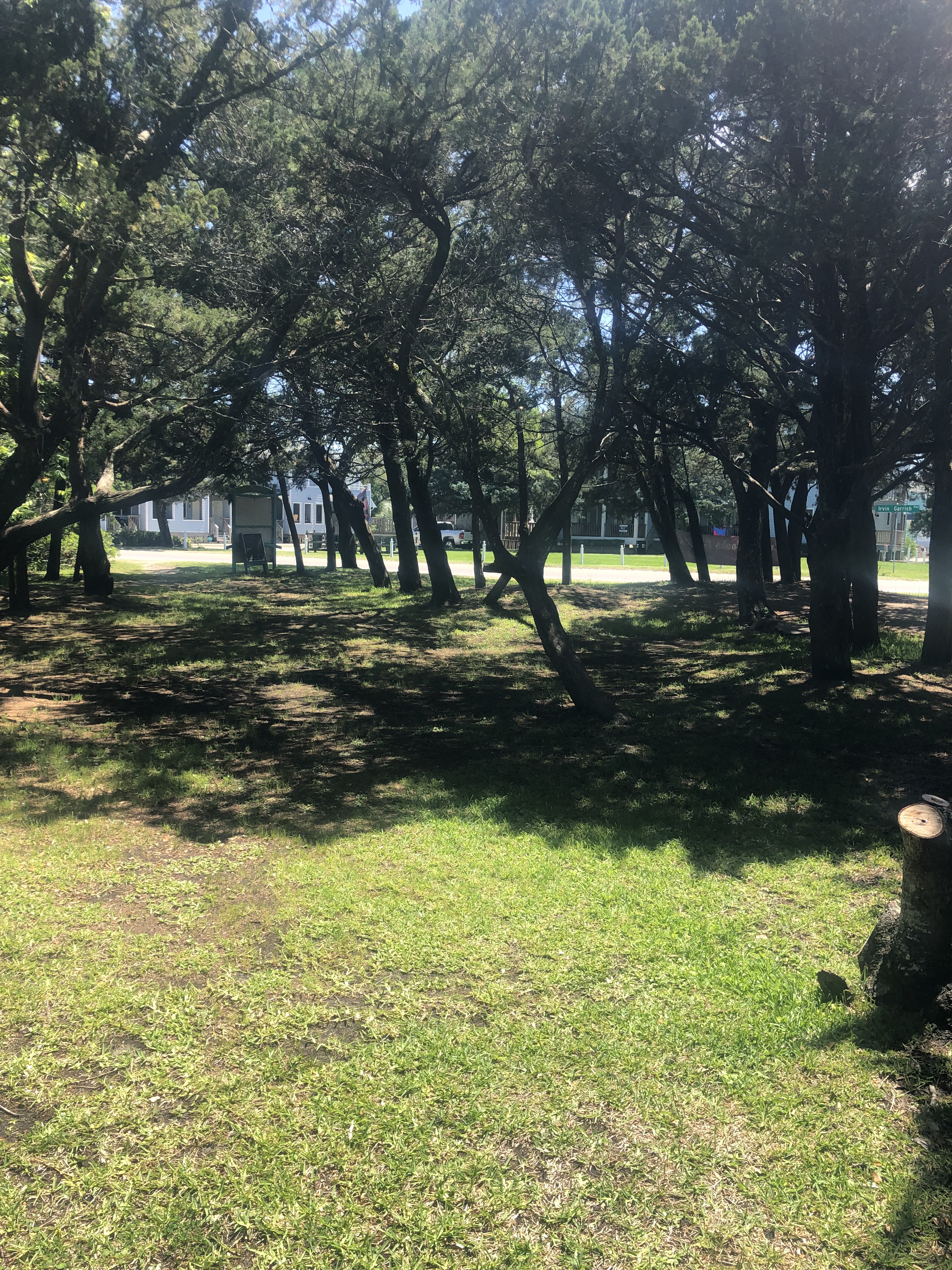
When I first saw the grove of trees—predominantly live oaks—on the corner lot of a house converted to a bookstore, I thought: What a restful place. It has its own particular allure. While there are larger live oaks, individual, ancient giants, elsewhere on the island, these smaller trees grow together, toward one another. I read somewhere that live oaks focus their energy on growing out, not up; perhaps this is especially important in a place where ocean winds continually carve the landscape. These trees survive hurricanes. They flourish in salty places.

The early May afternoon was hot; the sun blazed overhead. I noted the profuse shade under the trees. They stand leaning inward, reaching to one another, as if intentionally collaborating to benefit all who enter their realm of existence. No one tree stands out. It’s a joint effort. I walked into their proffered coolness, this respite, this shelter, envisioning how their roots are deeply intertwined, that they draw collective strength in their mutuality. They are anchored together. That’s part of how they endure. A foundation from which to grow, branch out, and sustain their own lives and others’.

There is more, there is always more, to a metaphor, for it knows no parameters, either. It can keep on going and going, changing shape, developing new layers in new light. It’s supposed to, just like learning. Like life. I just choose to stop here.

For now.

Coaches, teachers

gathered

in rapport, mirrored

growing together

toward one another

is strength

and refuge.

For all.

Anchored

Seahorse

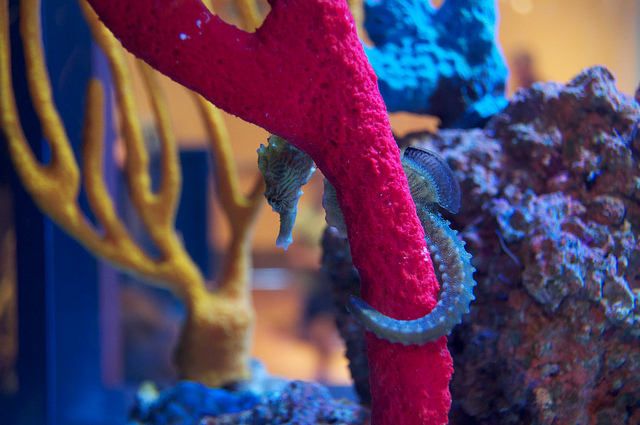
Seahorse. Brandon LeonCC BY-SA

The seahorse was the motif of my summer.

He turned up everywhere – on my new beach bags, on a bracelet from a friend, on a spiral notebook given to me, in a pile of decorations for writing journals at a summer institute.

Seahorses galore.

This sudden proliferation was odd, too odd to be random. Loving symbolism, interpretation, and looking things up in general, I researched seahorses, curious about what mysterious meaning or significant message they portend for my life at the moment.

I already knew, of course, that the males bear the young, which is the reason I am mostly using the pronoun he, in honor of the seahorse dads.  I really couldn’t make much of a connection to this appealing characteristic, however. I am the only female in a household of males (including three dogs and two guinea pigs), none of whom are about to become a gestational vehicle.

In the metaphorical realm, seahorses apparently represent a great number of things: patience, persistence, inventiveness, creativity, whimsy – all enchanting. I celebrate and welcome all of these things.

I learned that the scientific name for the seahorse, hippocampus, is the same word for the part of the human brain thought to be the center of emotion and memory.

Speaking as a writer – utterly fascinating.

Seahorses can also symbolize stubbornness (my father’s word was “hardheaded”). Speaking as a human – ouch. Ahem.  I prefer to call it “determination” or “perseverance,” but we’ll keep moving along here.

The thing that strikes me most about the seahorse is that it’s a poor swimmer – one species being the slowest-recorded swimmer in the animal kingdom – and that its tail is invaluable to its survival. National Geographic puts it this way: Seahorses are rather inept swimmers and can easily die of exhaustion when caught in storm-roiled seas . . . they anchor themselves with their prehensile tails to sea grasses and corals.

Ah. A ray of light shines here in the murky depths of symbolism.

The seahorse began appearing, and appeared most often, in things connected with my work as an educator – on a tote bag with a book order, on my notebook and journal.

Education today – might that be the storm-roiled sea, full of conflicting ideologies and solutions that sometimes beget more problems, just for starters? It’s not that educators are inept (“poor swimmers”) but that the ever-changing currents in our ecosystem are vast and powerful, so to shrink one’s spirit and drain one’s energy just trying to keep up, to stay afloat.

Seahorses can die of exhaustion if they aren’t anchored.

I think about how often the word anchor appears in the educational realm – anchor text, anchor standard – signifying the foundation of something upon which other things will be built, or that subsequent learning will connect back to.

But I don’t think that’s why the little seahorse loomed so large of late. In my mind I see him, small and shadowy against a backdrop of coral and waving sea grass, anchored by his tail, swaying peacefully despite the surging sea. I think of teachers and the demands they face. I think of students, who, above all, are too easily caught in a virtual riptide.

What’s the anchor here?

We are.

We anchor one another. Teacher to teacher. Whatever’s raging around us, we support each other, we help each other along. Ultimately, we form the solid thing, the reef, where students can anchor themselves, where their best interests are tantamount to our own, where they are sheltered, nurtured, and given outlets for inventiveness, creativity, whimsy, even in the most uncertain, troublous times.

Hang on, hang together, and believe.

Says the seahorse not just to the educational world – but to humanity.

Seahorse motif