Blue Valentine

Sunday dawns oyster gray, cold.

Rain rolls down the windows like tear-streaks of the wind, which howls in anguish under the eaves like a maimed creature.

In the backyard, pines stand in solidarity, like soldiers at a burial. Knee-deep in a sea of mud.

All dreary in its own right. I do not need to color it more so with my own thoughts, or to further stir my restive soul. Day after day after day of rain. No snow. At least no ice.

Am I unhappy?

No.

It’s Valentine’s Day. My husband and I have exchanged cards, chocolate, a sampler of hot sauces. “Burning Love,” the box reads. The flames on it are certainly a bright spot.

Am I tired?

Not as much as I was at the end of the workweek, the final one of remote teaching. We return to campus this week. Hard to envision the epic regulations to be enforced, the acrobatics of keeping elementary children distanced in imaginary bubbles.

Am I worried?

Concerned is a better word. It is a time to be like the pines, standing in solidarity despite the grayness, the bleakness, the muddiness, the wearing-on of things. I don’t know if I have it in me. This is not like me. My patience is peeled unusually thin; turpentine burns too near the surface. I do not like the feel of it.

Is my spirit failing me this Sunday morning? I should think not. It is a seasoned spirit. Today also happens to be the anniversary of my husband’s ordination, many, many years ago. We were so young, setting our feet on a path we could not clearly see, but we walked, and we walked, moment by moment, in sun, in shadows, over years, across decades…and here we are. I am grateful. He has already gone to church. I am getting ready, mulling this miserable scene beyond the blinds. I should have kept them closed.

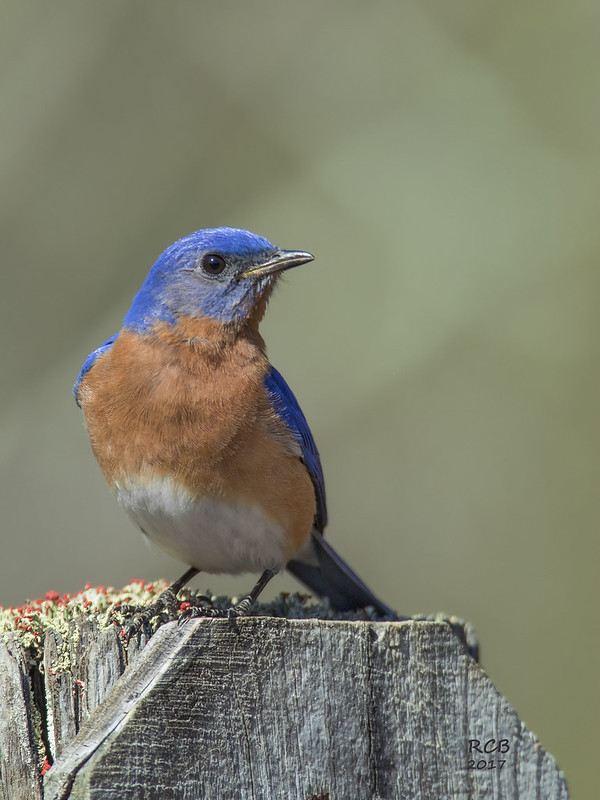
I wish I could see the bluebird. He shows up almost every day, if I’m watching at the right time. He sits on the deck railing for long stretches. Little messenger of brightness.

Why should seeing him make me feel better-? Maybe hope is electric blue. Never thought of that before.

I sigh, and am turning away, when I catch a fluttering of wings…

The female. Not the bright blue I am longing for, but still. This means a nest may be in the works, nearby! Might I see baby bluebirds this spring? Dare I hope for such bounty? Do I deserve it?

She takes a bath, there on the railing. I think of Esther’s yearlong preparation for her union with the King.

And then my little lady bird is gone. I wait. The railing remains bare. He will not come. Maybe it’s the rain. I can’t keep watching. Must get to church or I will not be in good graces with the pastor, which is a problem I don’t need, since I live with him.

Happy Valentine’s Day, bluebirds, I say in my mind as I bundle up to leave.

And then, at the last, a flash of blue, landing on the railing…it’s him, it’s him! No, wait! Both! I have never seen them together before.

Rain never interferes with the mail and this is surely addressed to me as much as an envelope bearing my handwritten name.

A gift of love, my blue Valentine.
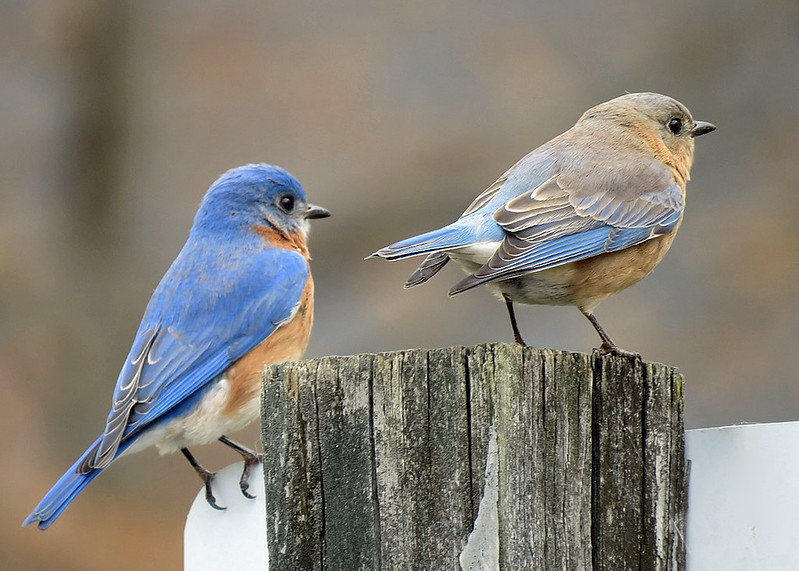
One day I will be poised just right to get a photo of MY birds, which look exactly like this. Eastern bluebirds are known to begin nesting in February. Let us hope…

Update: The Phrontistery definition: “valentine – of birds, to sing to a mate.”

If you are so inclined, here’s a little poem written on the occasion of the first sighting last week: First bluebird.

*******

Photos:
Vintage postcard. Kaarina Dillabough. CC BY-SA
Eastern Bluebird. 611catbirds, too. CC BY
Wherever I Gogh

He just keeps turning up everywhere I go.

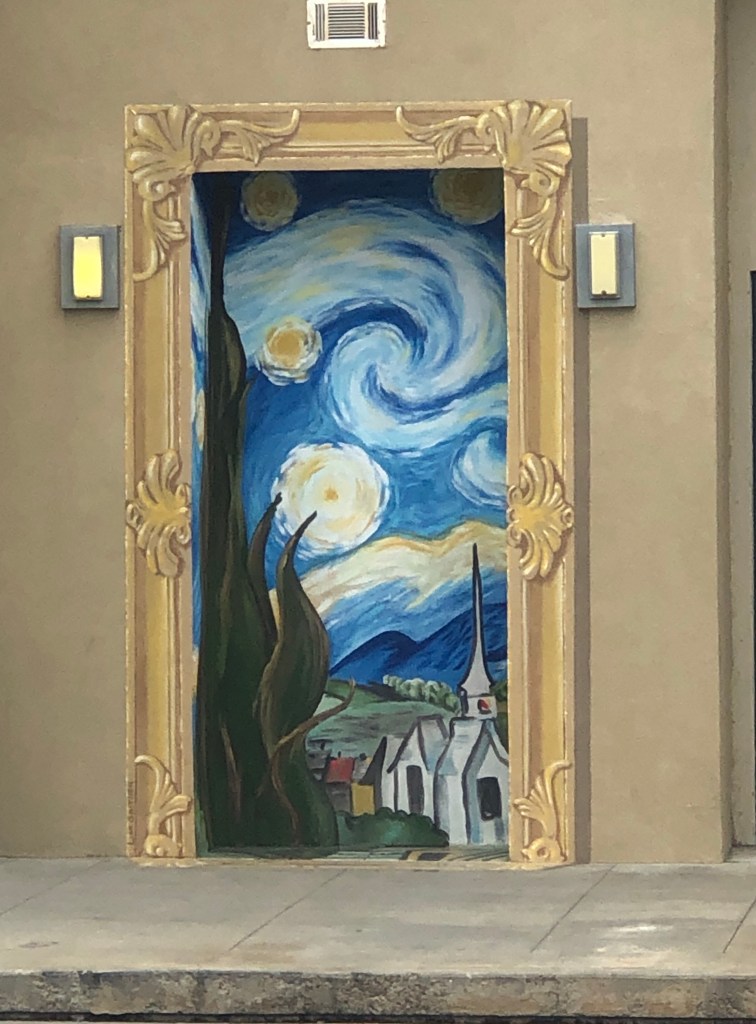
It started with the painting on the otherwise unremarkable side of a building in an uptown shopping mall last summer. An unexpected portal:

Got me thinking a lot about imagination, passages, transitions, transcendence, overcoming…and faith. See how prominent the church is. And maybe a touch of magic—who has not encountered mysterious doors leading from one world to another in fantasy novels?

The Starry Night beckoned, took me in, adopted me. It became a personal motif during the COVID pandemic. Consider these definitions of motif:

a usually recurring salient thematic element (as in the arts); especially : a dominant idea or central theme.  —Merriam-Webster

a symbolic image or idea that appears frequently in a story. —literaryterms.com

My version: A “salient” (noticeable, as in you can’t miss it) symbol that keeps recurring, that has significant meaning to a narrative. Which is, in this case, my life. For I began taking note of how often van Gogh’s famous painting appeared in my daily existence, and what it could mean. Perhaps it is those deep blues, or those stars, or the peaceful village, or the presence of the church, or all of the above, that impart a sense of calm, benevolence, and well-being to me in the time of crisis. Maybe much as the artist felt when he painted it.

I have The Starry Night on a mask. A sort of literal and figurative protection. I used its imagery in a poem I wrote about awe, the word that adopted me when I turned the pages of my planner from 2020 to 2021 and found it in a quote there on January 1st. Awe and well-being are also deeply linked. When I wrote the poem I was thinking of all those blues in the painting and how blue is the rarest color in nature. Like forgiveness. Hence my closing lines: “The color of forgiveness/in the blue hour.” Those lines were born of awe just after The Starry Night resurfaced yet again in a startling way; one day I will be able to explain, but the time is not yet ripe for that story. Let us leave it at love, for love and forgiveness do not exist apart from one another.

And so we come to February.

Where this quote appears in the pages of my planner:

He just keeps turning up everywhere I go.

I marvel at those words and their truth for an artist, a student, a teacher, a writer.

Furthermore, we learn life by doing it.

One more thing…

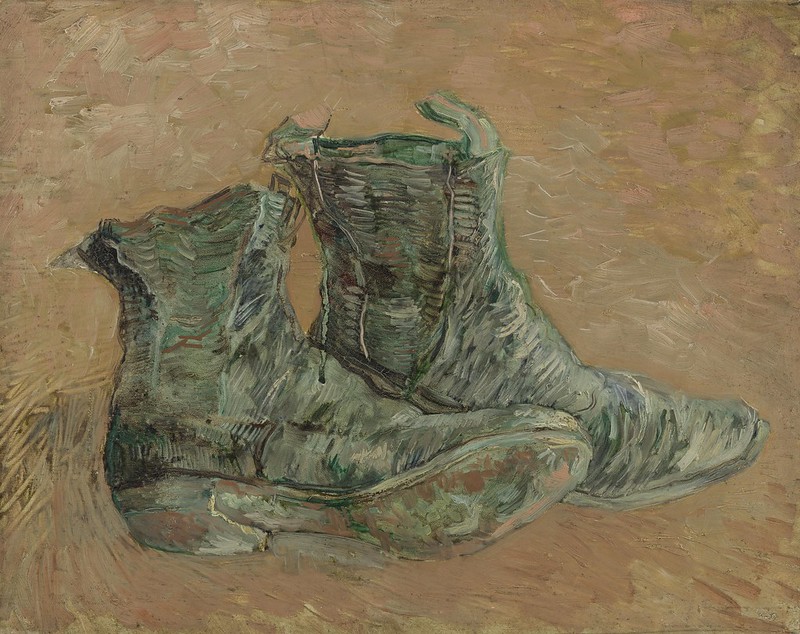
I recently stumbled across van Gogh’s paintings of shoes. I wasn’t aware that this was a favorite subject for him. The story is that he would buy old shoes from flea markets and wear them through mud until they were interesting enough to paint.

I have to wonder about the symbolism. Shoes are necessary protection in daily life. A motif with many meanings in many cultures. A fashion obsession and status symbol in some. Deep spiritual connotations in others; shoes are often mentioned in the Bible, especially removing them as an act of reverence and faith. I wonder if van Gogh thought while he painted about the places these shoes had been, the people who wore them, what their life-journeys were like. What stories the shoes might tell, maybe just metaphorically, humbly, in their layers of dust and mud from long, hard travels on this Earth.

Lots to ponder with van Gogh and his shoes.

As I travel through life in my own.

He really does keep turning up, everywhere I go.

My shoes.

I’ve found these to be the most comfortable since breaking my foot, a year ago today.
Lots more to explore there, on brokenness and healing
.

How perfect is it that they are Vans. Wherever I may Gogh.

*******

written for the Tuesday Slice of Life Story Challenge with Two Writing Teachers.
Our stories often remind us of where we’ve been, where we are going, and who we are.
Writing them leads to surprising discoveries.
Sometimes those within ourselves.
Sometimes awe, at what lies beyond.

First bluebird

Today
when I rose
it was
not dark

Windows backlit
winter-pale, eggshell
embryonic
but light

Still cold
beyond the blankets
when I open
the blinds


To find
a bluebird
resting on
old deck railing

Plump and poised
for one long minute
his feathers painted
with sky and rust of earth


Little harbinger
on weatherworn wood
-while it is yet winter
spring is yawning

I hold my breath
in shell-light, shivering
as the promise
takes wing, and flies

*******

A bit of rough-draft offering for Poetry Friday.
Thanks to Jone Rush McCulloch for hosting.

Photo: Bluebird. Rick from Alabama. CC BY.because I couldn’t get to my camera in time. The poem is my snapshot.

Capitol recollections

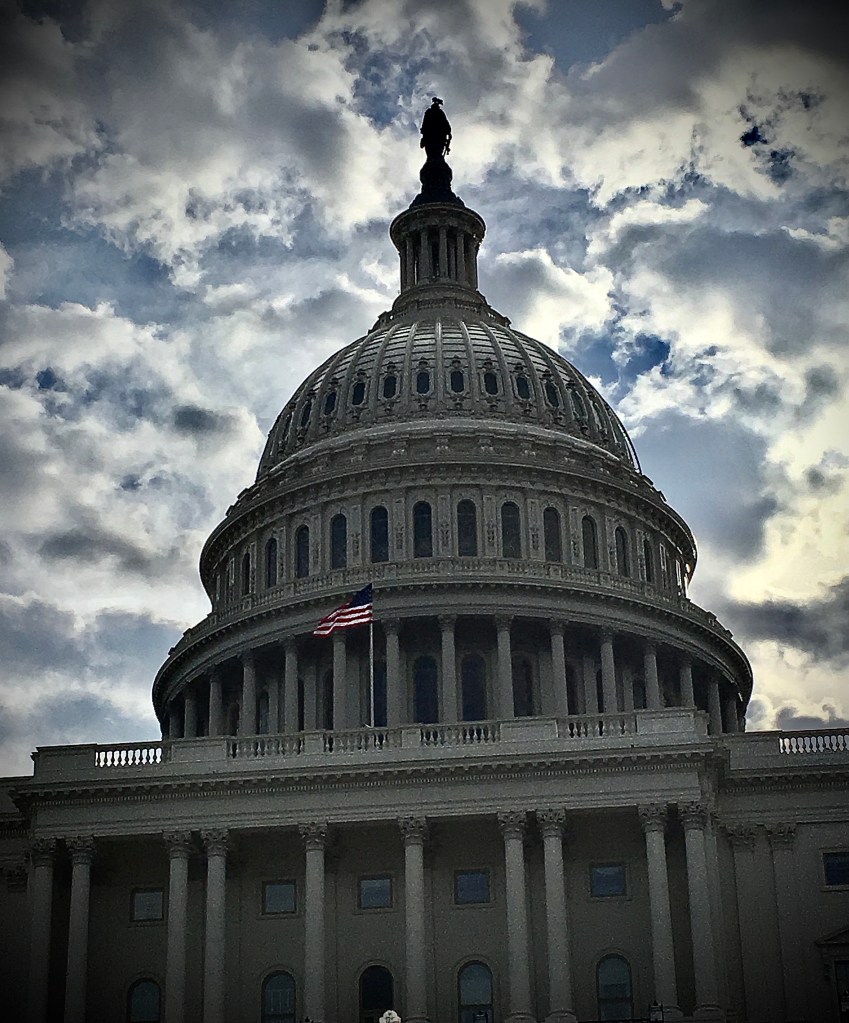
Morning breaks over the Capitol. March 2018.

I was eleven the first time I saw it with my own eyes. 6th grade field trip. In those days, parents could ride on the bus with the children; they didn’t have to follow behind in a car. That is how my mother got to go. She volunteered to chaperone. She didn’t have a driver’s license. I think it was the first time she’d ever been to D.C.

All along the mall, teachers strategically organized students for photos with the best view of the Capitol behind them. Everywhere you looked were rows and rows of children, many carrying small flags. Not all were American, but all seemed excited. I walked, listening to the musicality of many languages I couldn’t understand.

I cannot remember if it rained, or what we ate, but I recall the beauty of my country’s capital enchanting me. In some gift shop I bought a crinkly parchment reproduction of the Declaration of Independence. We hold these truths to be self-evident, that all men are created equal, that they are endowed by their Creator with certain unalienable Rights, that among these are Life, Liberty and the pursuit of Happiness…I was happy that day. The Declaration came with a feather pen, to my delight. Then I spied a horse ornament on a glass shelf behind the register. Dark, stormy gray mingled with cream, frozen in the act of rearing up, forelegs arcing in the air, powerful muscles so realistically rendered, mane flowing in an imaginary breeze.

I did not know, at age eleven, that a horse symbolizes courage. That it can also represent overcoming adversity and caring for one’s emotional, mental, and spiritual well-being.

I only knew this twelve-inch plastic horse was beautiful and mighty. Captivated, I handed my last dollars to the clerk who wrapped my horse in layers of paper. I cradled it close all the long bus ride home.

It remained on the shelf in my bedroom until I married and moved out.

I’d return to D.C. again via Amtrak at nineteen, to meet my cousin who lived there. He would accompany me to an audition for acting school in New York City (that is another story). It was winter, icy-cold. Bundled and laughing, we roamed the windswept streets, past the lofty steps of the Capitol, talking of life, of the future, of being mavericks of the family.

Life takes many an unforeseen turn. He died young. I never went to acting school.

I had a family of my own instead.

Over the course of years, my husband and I made several visits to D.C. He’s a history-lover, an original poli sci major turned pastor. We took our children when they were small. Our last visit was early spring, 2018, with friends. What I noticed most on approaching the Capitol in early morning: the deep silence. Few people were out. The brooding sky made a compelling backdrop for the ornate dome, topped by Freedom. I took a picture. I tried to remember my first visit as a child, how enchanted I felt…long before I understood that relationships can disintegrate in unimaginable ways. In families, communities, countries.

The day after the attack last week, as I turned on my computer screen to meet with young elementary students, I felt numb, unfocused, ill-prepared. One by one at the appointed times, the children popped in, their faces aglow because…it might snow! A pandemic, ten months of reinvented school and life, volumes of ongoing, unfolding horrors in the news…yet they greet me with when is the snow is supposed to start?

It set a little part of my hippocampus jingling. Snow, as a literary symbol, means innocence, purity, tranquility. Even blessing.

Suddenly that old storm-gray horse souvenir resurfaced, vivid, nearly tangible, in my memory.

Strange.

I can’t say it’s symbolic of the American spirit. What does it mean to be American?

Maybe it’s symbolic of a child’s spirit. What makes it so mighty?

All I am sure of is this: a longing for overcoming and well-being.

For all.

*******

My previous post is a poem on the power of words to wound and heal: When.

Here are words inscribed in the U.S. Capitol:

On the Rostrum of the House Chamber – “Union, Justice, Tolerance, Liberty, Peace”

Behind the vice president’s chair in the Senate Chamber – “E pluribus unum” (“Out of many, one”)

On the stained glass window of the Congressional prayer room – “Preserve me, O God: for in thee do I put my trust.” Psalm 16:1

*******

with thanks to Two Writing Teachers for the Slice of Life Challenge, in itself a testimony to the power of stories and community.

Alight with expectancy

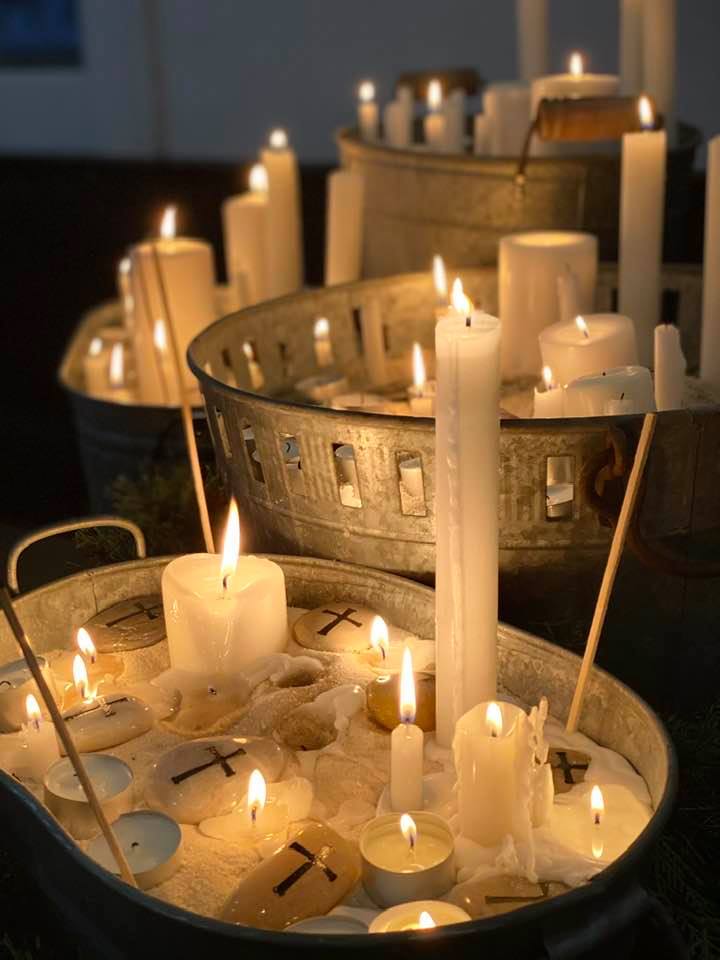
The following is an invented form of poetry called “Spirit’s Vessel(see shadowpoetry.com). It’s three stanzas of six lines, each line containing six syllables. Rhyming is “a plus.” It’s also an acrostic designed to convey faith: VESSEL OF YOUR… with a final six-letter word chosen by the poet. My final word: SPIRIT. I have entitled this piece “Alight with Expectancy” for two reasons: the title is a nod to “Awe(another acrostic). If you know about the One Little Word tradition, you know about choosing a guiding word for the new year. After the year that was 2020, I hadn’t planned on choosing a word for 2021…more on that later. Just know that “awe” chose me as soon as the calendar turned. Who doesn’t need awe? Reason #2 for the title : This photo. It sparked my desire to try the Spirit’s Vessel for the first time. Those candles, at a church Christmas Eve service, in the time of COVID… thank you to photographer Ann Sutton and to Margaret Simon for sharing it on “This Photo Wants to Be a Poem” at Reflections on the Teche.

Thanks also to the Poetry Friday gathering and to Ruth in Haiti for hosting the Round Up.

My first post of 2021: Alight with Expectancy

Votives cast haloed light
Eclipsing dark of night
Shadows flicker and play
Stained-glass luminants pray
Expectant, glistening
Lord, we are listening

Offering petition
From hearts of contrition
Your conduits, help us be
Of Your all-healing sea
Undulating with grace

Rippling out from this place

Salvation receiving
Penumbral believing
Illumination starts

Restoration of hearts
In holy candleglow
Touched by the Spirit—know

December dawn

I wake
after having slept
without rest
mind weary
of turning, turning


I throw off
the heavy blanket
of night
of darkness
to stand shivering
on the chilly cusp


there is no sound
just hush


and my heart grasps
before my eyes glimpse
the glimmering

before I know it
I’ve thrown open the door
to stand
barefoot in the frost
still nightgowned
as birds glide high above
round and round
tracing infinity signs

against rose-gold clouds
in silence
in ceremonial welcome
of day


first light, ever bright
parts the pink veils
a sun so, so old
yet so golden-new

peeks through

and I think
of beginnings
not endings
of possibility
not inadequacy

of movement
not stasis

there are no words
only the distant
occasional rustle
of feathered wings
from on high


and in that

I rest


*******


with thanks to Two Writing Teachers for the weekly Slice of Life invitation to write
and to all who gather here to encourage one another
on the writerly journey

The sound of gratitude

playing with a variation of pantoum, on gratitude found in favorite sounds

When I listen, I can hear
the sound of gratitude

in the rattle of summer’s last cicada, clinging
and crystal tones of children, singing

The sound of gratitude—
in the distance, church bells ringing
and crystal tones of children, singing
then at your voice, my heartstrings quiver

In the distance, church bells ringing
Jesu, Joy of Man’s Desiring
then at your voice, my heartstrings quiver
one last “I love you” before retiring

Jesu, Joy of Man’s Desiring
—when I listen, I can hear
one last “I love you” before retiring
in the rattle of summer’s last cicada, clinging.

*******

Cicadas are ancient symbols of renewal, rebirth, transformation, change, resurrection, immortality, spiritual realization. Socrates linked the cicada song with divine inspiration in religion, poetry, art, and love.

Thanks to Ruth at SOS: Magic in a Blog for the sounds of gratitude inspiration & to Susan Bruck for hosting Poetry Friday Roundup at Soul Blossom Living.

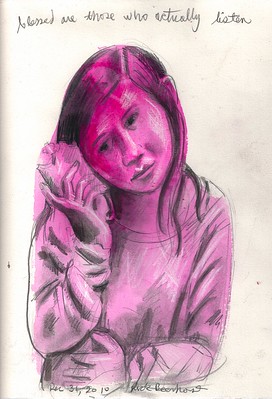
Photo: Listen. Artists Rick & Brenda Beerhorst. CC BY

13 ways of looking at a black cat crossing your path…

A list poem, of sorts, inspired by Wallace Stevens “Thirteen Ways of Looking at a Blackbird,” shared this week on Ethical ELA. The Open Write challenge: “To look outside ourselves to the larger world. Craft a poem about it…the larger world is many different things to people, and in many cases, it’s America.”

Everything hinges on interpretation. There are infinite ways of looking.

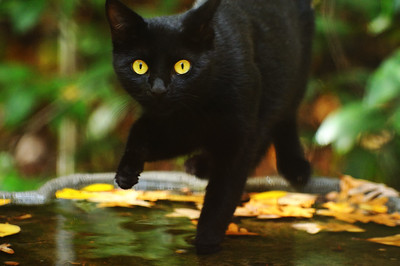
It just so happened that this week marked my return to campus in preparation for student cohorts transitioning back to the building. Driving along the familiar back road for the first time in what seemed like ages, car piled with stuff, brain churning with things to do and how to do them, trapped in a constant state of COVID suspension, in a fog very like the one rising from the ground, smoky swirls lending a seasonal eerie-ness to beguiling red-gold trees against an obscured sky, what to my wondering eyes should appear but the sudden darting of a black cat from the woods just ahead on the right. Neatly across the ditch bank it sailed, mission-like, directly across the road in front of me…

13 Ways of Looking at a Black Cat Crossing Your Path in the Time of COVID-19 While Driving to School to Teach Online Near Halloween of Election Year 2020

I.
Unexpected poetry in motion from the russet woods, long, lithe feline fluidity rippling low along the golden ditch bank, ebony mercury flowing across the gray asphalt, a thing of beauty, a joy forever or at least until…
II.
Still alive. I didn’t hit it.
III.
Spawn of inexplicable, maniacal laughter
(nowhere near the Joaquin Phoenix level)
IV.
The omen of—misfortune? As in—Google crashing?—no Wi-Fi?—more lost instruction?—a forgotten mask? —one more directive on what to do or not to do with data, disinfectant, distance?
V.
Will I even make it to school today?
VI.
Will students (onscreen)?
VII.
Spirit of the season, shape-shifter running to and fro on the Earth, demon on the loose, witch’s familiar, unholy harbinger …
VIII.
This election. Heaven help us.
IX.
Misrepresentation and slaughter of God’s creatures.
X.
Curiosity. Where are you running to, little black cat? From where? From what—or whom? Do people other than scientists know that your fur holds secrets to disease resistance? Can the mystery be unlocked, decoded?
Pandemics of rats and bats.
What if healing sprung from cats.

Poetic justice.
XI.
Portal of memory… I had a little black cat, once. She had no tail and no one else wanted her. The last left in a box of kittens a guy at college was giving away. Brought her home, named her after a magic cat who was exceedingly wise, in a book I read as a child. Couldn’t take her with me when I married and moved into an apartment so I gave her to my dad. He bought turkey from the deli, tore it into small bites, and fed her on the countertop.
She wasn’t magical. Just full of ever-purring love.
XII.
The great portender, seeming to be what you are not… all I know is you are poetry in motion. Run on, blithe spirit. Run on, long, lithe spirit-lifter, ebony mercury flowing… how glad I am our paths crossed.
Fear not. We bring one another no harm.
XIV.
I skipped #13. Too unlucky.

*******

Note on IX: For centuries, beginning in medieval times, superstition and associations with evil led to widespread killing of black cats. Many shelters today will not allow black cats to be adopted near Halloween for fear of their being used as decorations and mistreated, tortured, sacrificed, or abandoned. Just one way of looking at those lines.

With thanks to Ethical ELA for inviting many ways of looking and to the fine folks celebrating Poetry Friday, especially Jama Rattigan for hosting the Roundup. Jama’s blog, An Eclectic Feast of Food, Fiction, Folderol and Chewy Culinary Verse is a mind-bogglingly gorgeous work of art. I don’t know how she does it!

Thanks also to Keats, Shelley, Stevens, and Patricia A. McKillip. I haven’t forgotten you, Moriah.

Lead Photo: Ralph Daily. CC-BY

Old red barn

Old red barn
testament to ingenuity
the rust in your coat
counterintuitively
preserving against decay

Still standing today
on your windswept plain
amid long amber grasses
continually bowing
their homage

Like sun-cast gold at your feet
despite encroaching shadows
ever-shifting with clouds
under the benevolent blue
striated sky

A skeleton tree
veils your face
attempting to conceal
the emptiness behind
your window-eyes

You’ve no weathervane
pointing heavenward
with its rooster of betrayal
—can you hear geese calling
fly on fly on fly on

Old red barn
vignette of yesterday
rustic testimony never reduced
—I will not think of you
as desolate

*******

With special thanks to Margaret Simon for the prompt in “This Photo Wants to be a Poem,” her journalist friend Jan Risher for sharing the photo of the old barn, and to Tabatha Yeatts at The Opposite of Indifference for hosting today’s Poetry Friday Round-Up.

The portal

Written for Spiritual Journey Thursday.

As COVID restrictions finally began to lift, my husband and I ventured out to a nice restaurant for lunch. We practically had the place to ourselves. Afterward, as the day was bright and breezy, we decided to walk along the outdoor mall’s trendy shops and boutiques. The sidewalks, normally crowded, were empty, perfect for a promenade… I almost felt as if I should be holding a parasol and that my husband should be wearing a striped jacket, a straw hat, and carrying an ornamental cane…on and on we strolled, aimlessly, just drinking in the glorious early-summer afternoon, temperate and rare.

“Let’s cross over here,” said my husband, grasping my hand, when I looked up to see…

on an otherwise blank, unremarkable wall…

a magical door.

“Oooh! Wait!” I said, dropping my husband’s hand to take a picture: I must write about this…

A painted portal. With light fixtures on either side to illuminate it at night. Even though it isn’t really a door.

—Or is it?

It seems straight out of a fantasy novel: A door to another world, a conspicuous portkey, an enchanted painting like that of the Narnian ship Dawn Treader hanging on a bedroom wall, coming to life as Eustace, Edmund, and Lucy rushed at it and fell through into the ocean…

Standing there on the vacant sidewalk, on that bright, ethereal afternoon so strangely devoid of other people, I could almost believe the portal was real, that it led to… something beyond.

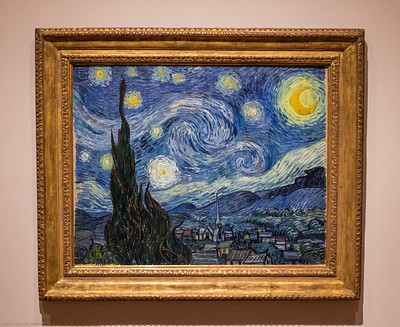
I recognized the depiction, of course—a modified version of one of the best-known works of art in the world. Vincent van Gogh’s The Starry Night. He painted it in his asylum room. It’s the view from his window, facing east, before the sunrise. He would write to his brother that “the morning star was very large.” The scene is dark. It is blue. At the time, van Gogh’s mind was dark and blue; he was a deeply religious man who’d suffered much mental and emotional pain, who’d sacrificed for his art to his own detriment, though most others found little value in his paintings until after his suicide. The full scope of the village can’t be seen here in the portal on the wall, and it wasn’t a village that van Gogh saw as he painted the original; it was in his mind. Those are cypress trees dominating the foreground—funerary trees, symbols of mourning.

I thought: Is this a portal I’d want to pass through? A place where I really want to find myself?

But then… my husband and I had just come out of a dark place. The COVID stay-at-home order. Shadowy, uncertain days swirling with horror and mourning as the worldwide death toll spiked. Refrigerated trucks needed for storing corpses, images of caskets lined up for burial… which of us ever expected to find ourselves here? Public places closed for the sake of public health, at last re-opening, tentatively, with social distancing requirements… we were still (and still are, even now) unable to return to church where my husband pastors…

—The church. Note how large it is, there in the mysterious doorway. Much larger in proportion to the one van Gogh actually painted. He wanted to be a pastor. He failed the exams. He became a missionary, gave up his own comfort on behalf of the impoverished congregation, and slid deeper into psychosis and poverty.

This artwork hits me anew with its unique, transformative force… for that is what art does. It speaks to the spirit. Van Gogh didn’t paint what he saw; he painted his interpretation of it. The tormented man looked through the asylum window and focused on the stars. A hundred and thirty-one years later I stand on a sidewalk before a quasi-reproduction of his famous work, looking at the enlarged church, with the words of C.S. Lewis echoing in my mind: “At present we are on the outside of the world, the wrong side of the door. We discern the freshness and purity of morning, but they do not make us fresh and pure. We cannot mingle with the splendours we see. But all the leaves of the New Testament are rustling with the rumour that it will not always be so. Some day, God willing, we shall get in.”

A spiritual portal, leading to something beyond.

The Starry Night by Vincent van Gogh (MOMA). Photo: Wouter de Bruijn, 2014. CC BY-NC-SA.

*******

Much gratitude to Margaret Simon for hosting Spiritual Journey Thursday for August on her blog, Reflections on the Teche. Margaret said: “My topic is spiritual art. I often find that art speaks to me in a spiritual way, like poetry.” Sparked by this challenge. my thoughts went straight to the portal, this painting, and van Gogh. Visit Margaret’s post, “Art for the Soul,” for more odysseys.

The C.S. Lewis quote is from The Weight of Glory, a wartime sermon first published in 1941. The title is derived from 2 Corinthians 4:17: “For our light affliction, which is but for a moment, worketh for us a far more exceeding and eternal weight of glory.”