Red rubber boots

red-rubber-boots

It is Sunday, the day my Granddaddy is off from work at the shipyard. It is the day we usually walk to the playgrounds behind the churches across the busy city street, my small hand clasped in his large one, as we wait for the traffic light to change. Today it is raining and we can’t go out. I sit by his recliner on the braided rug beside his feet – he wears black lace-up shoes every day – and sigh.

“What’s the matter, Duck?” he wants to know. Sometimes he calls me Duck, sometimes he calls me Pig. I do not know why. He just does.  It makes me feel warm inside.

“Granddaddy, the girls in kindergarten have red boots to wear when it rains. I don’t have boots.”

“Oh, I see. I guess you been wanting some of those boots?”

I nod my head and crawl up into his lap. “Yes, Granddaddy. For a long time.” His black leather cap is on the side table by the recliner. I pick it up and put it on my head. It smells like him. A little Vitalis and a lot of goodness.

He wraps his arms around me. “Tell me about these boots, what they look like.”

“You can pull them over your shoes … ” I begin.

He got them for me, of course, those red rubber boots that I proudly wore to school and stored on the bottom shelf in the cloakroom, beside the boots of the other girls.

At the time he got them, I did not know that his retirement was imminent, that within the year he’d move back home to the far reaches of eastern North Carolina, three hours away. I would only see him a couple of times a year from then on.

I grew up. I had children of my own. When I went to visit Granddaddy, I sat on the stool by his recliner, as close to him as I could get. He patted my arm. We sat this way for a long time, without any conversation, just being together.

“You remember them red rubber boots I got for you?” he asked eventually. His blue eyes twinkled at me. Every now and then, across the decades, he’d mention those boots.

“Oh, yes, Granddaddy. I remember. I loved them so much.”

He chuckled, patting my arm with his large, wrinkled hand.

He was retired for thirty years, living to be almost 93.

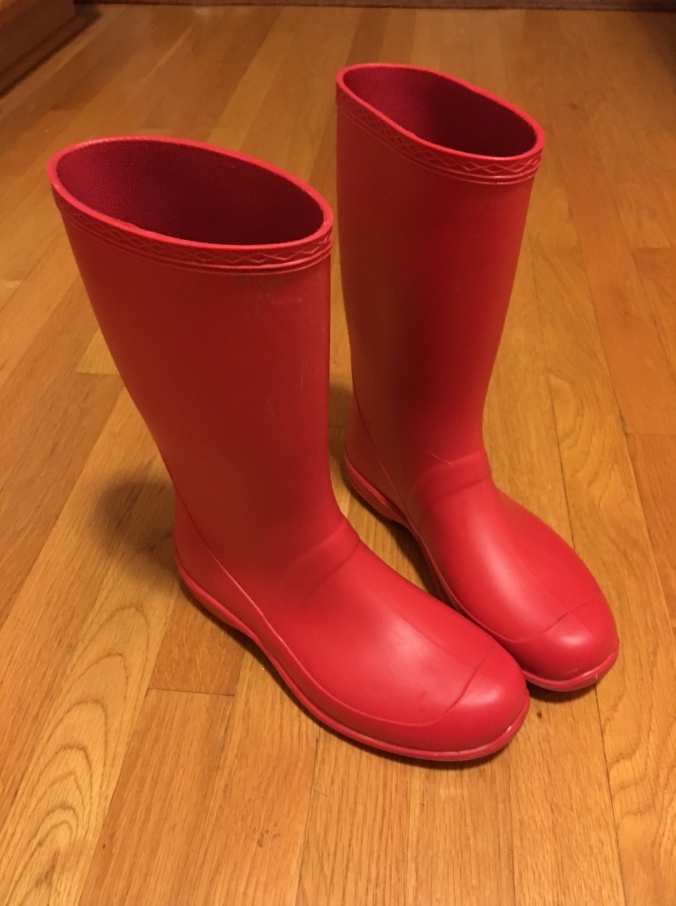
I had nearly forgotten the red rubber boots when I happened to see a pair at the store a year or so ago. They were so like the boots he gave me when I was five.

“Ah, Granddaddy,” I whispered. “You’re never far away.”

I bought them.

They protect me from the rain; they keep me grounded, connecting me to the earth that my grandfather loved, for he was a lifelong farmer even though he had to find better-paying work to provide for his family. The color brightens the gloomiest day. I wear my boots with deepest gratitude for a humble man who knew about sacrifices, great and little, fiercely proud that his blood flows in my veins.

I remember, Granddaddy. I always will.

slice-of-life_individual

My Patronus

As a headmistress and co-founder of my school’s Harry Potter Club, I was recently admonished to take the Pottermore Patronus quiz, as all other Patronus quizzes are essentially heresy. I approached the task with a bit of trepidation, having heard of people attaining aardvarks and the like.

For the non-Potterite: The Patronus charm produces a silvery animal guardian, usually representative of the individual casting it.

Being a fantasy fan since childhood, and considering my headmistress role, it was necessary: I plunged into the virtual dark forest to seek my symbolic protector. On the site, ghostly words appear in groups of three amongst the trees; the seeker chooses one and is moved onto the next set. At one point in this quest, when I paused too long, the words evaporated with a reprimand: “You are too slow. This game requires quick reflexes.” Silently chiding myself for overthinking simple word choices, certain that this blunder would land me with an armadillo or caterpillar, I picked up my pace. At last, in the ominous forest, a silvery shape materialized.

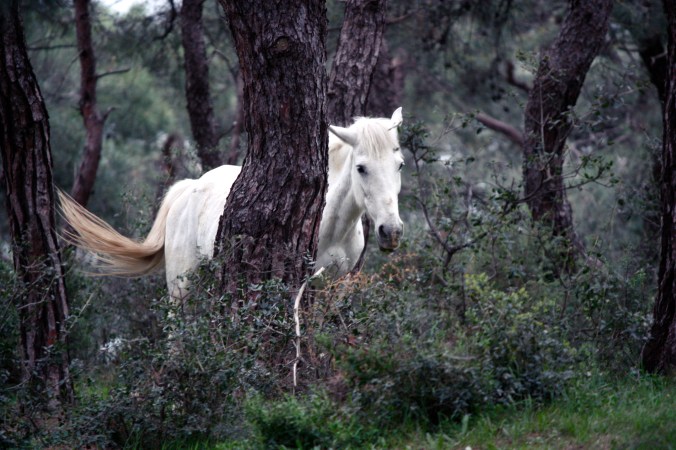
A white mare.

Beautiful and powerful, my white mare galloped through the forest, luminous against the darkness. Enchanting.

My next quest, naturally, was looking up the symbolism.

From various sites, the synthesis is that a white horse represents wisdom, power, loyalty, heroism, nobility, victory – encouraging, yes, but also inversely raising an intrinsic, lofty bar: am I worthy of the white mare? Do I deserve her? Never mind the fact that I gained her by playing a game with an end product based solely on word choices, not short answers or soul-searching responses. The writer in me delves deep into the metaphorical.

I already knew that white horses can symbolize death or the end of the world. They are considered psychopomps, creatures that guide human spirits on their journey from Earth to the afterlife.

As I pondered these connections, my Patronus suddenly conjured up road trips with my father and sister. Three hours is an eternity to young children cooped in a car, so to pass the time, Daddy taught us a game he played as a child:

“When we go by any horses, if they’re on your side of the street, you get a point for each horse. If you have a white horse on your side, it’s worth ten points, because you don’t see many of those.”

My sister and I instantly glued our faces to our respective windows, for we’d been by these random pastures before. We’d often seen horses grazing, strolling, sometimes galloping. I was sure – I just knew – I’d get a white horse. Maybe more than one!

“The thing is,” Daddy continued, “if we pass a graveyard, and it’s on your side of the street, you lose all your horses.”

So we played the game. My sister and I gained horses with glee, then lost them with loud groans, without realizing that one of us would win on the journey to the destination and the other would win on the return trip.

Daddy drove on in peace, smiling to himself.

How many horses I won and lost, I’m not sure, nor do I recall how many were white, only that they were there by the wayside on a long, tiresome journey. Those white horses are obscured by time now, very dim, but still real, ever more priceless, in my misty memory.

Enchanting, indeed, that one should reappear as my guardian after so many years, and that I should have gained it in a game venue that didn’t exist when I was a child.

Daddy, I think, would be pleased. Perhaps he is, from his place on the other side.

Reflect: What creature might symbolize you, and why? I’ve often played a game with students, challenging them to think of an animal that begins with the first letter of their first names (I’ve always chosen fawn in these scenarios – perhaps I should change it to foal?). No two can be the same, so each student ends up with a unique animal and has to think of ways the animal might represent them or their lives. Think – and write. 


The secret gates

ditch-gate

Into the ditch. jam343 CC BY

When I was a child, my neighborhood flooded regularly.

I lived on a block where all the backyards joined at a long ditch. When I went to play with a friend, I took a shortcut by running alongside the ditch and jumping over it, taking care not to land in it, for the ditch was lined with thick, black mud; if it did not stink outright, it certainly smelled organic, stagnant. Sometimes fleabane, tiny, hairy daisies, grew along the banks. That’s about it for ditch decor.

Whenever a heavy rain came – and a few times during a moderate rain – the ditch overflowed. Storm drains in the curbs overflowed as well, until water covered the streets and most of the yards. My friends and I had fun wading through it as we walked home from school, sloshing as much as we could.

My father, however, was irate every time.

As soon as he saw the water backing up, he got the city on the phone.

“Listen, I’ve called before,” he’d snap at the City Official on the receiving end. “You ought to have a record of it. This whole neighborhood is flooded AGAIN. Get whoever is paid to do it to open those drainage gates.”

Every time, the City Official pleaded ignorance about said gates.

I watched Daddy’s florid face redden. “You people always act like you don’t know what I’m talking about, but I am telling you, there are flood gates controlled by a switch and somebody up there knows how to use it. There’s NO EXCUSE for a place to flood like this. Open the gates!” He glanced through the picture window in the living room. “A canoe is going down my street right now. So help me, I will get in it, come down there, and find that switch myself.”

A canoe was going down our street, neighbors having dragged out their camping stuff, rowing merrily along. A teenage boy in waders, hip-deep in the water, pulled younger siblings on a raft behind him. To my horror, one young neighbor tossed a puppy from the front steps out into the water to make sure it could swim. It could; that the puppy swam back to its owner amazed me.

Daddy’s voice got louder, his face redder, until he hung the phone up in disgust, but within an hour of his call, the flood began to diminish.

As the water level went down, so did the color in Daddy’s face. In his eyes was a glint of victory, or perhaps vindication. The City Officials had, yet again, scrambled to open the secret gates they kept forgetting about. Good thing they had my dad to remind them.

Did the gates actually exist? Did they lead to the nearby river, or where? I never knew for sure, but the timing between my father’s phone calls and the floodwaters receding is intriguing, suggesting more than a fluke.

Our regular neighborhood floods were mild annoyances in comparison to the devastation experienced by anyone whose home has been lost or whose life has been endangered. The forces of nature are beyond human control, despite the best of foresight and man-made safeguards. On a small scale, my father did what was within his power to change a situation. One voice, persisting. Today I think of the labyrinthine educational system, of American politics, the overwhelming need for change when so much is at stake, and those who are suffering. What are the gates to clearing the way, and where lies the switch? Change is a force within human control. As Anne of Green Gables author Lucy Maud Montgomery penned: “All things great are wound up with all things little.”

Believe, be the voice, reclaim what is of value, before it is lost.

Reflect:  Water is a symbol of life, as well as adaptability, healing, and cleansing. When things become overwhelming, one of these might well be a switch to seek. Which might be yours? How might you help others?


Cicada rhythm

cicada-on-post

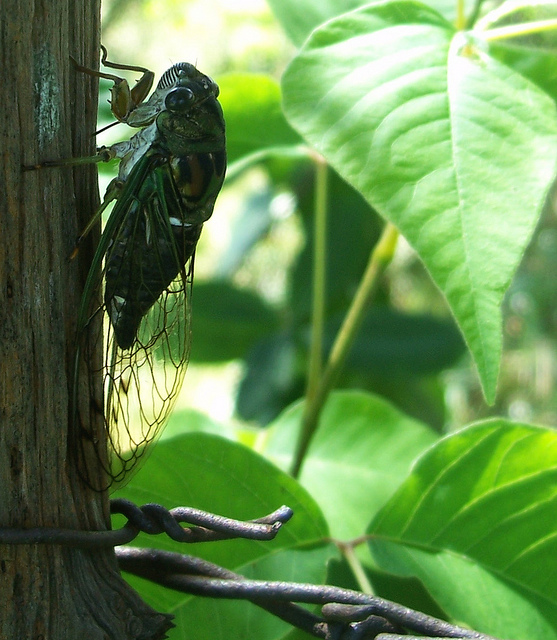
Image: Cicada on a post. Jo Naylor CC BY 

Summer is dying now, taking with it one of the things I love best: The song of cicadas.

If you’ve ever heard cicadas in full throttle, you might not agree with “song” as a fitting description of their cacophonous buzzing. It’s not pretty. The noise can be deafening.

Yet when I hear that first discordant rattle sometime in May, my spirit rises, my own heart sings in response.

The song of cicadas calls to me from long ago, when I was a little city girl spending sultry summers in the country. The song evokes narrow dirt roads keeping an ominous forest from encroaching on rustic homeplaces, tiny cemeteries where baby after baby is buried under white monuments adorned with lambs, and the old church just around the bend. The song is one of ages, the rising and falling of generations, all of us coming and going in our time. It is a song reverberating with tire swings hanging from pecan trees, canals teeming with frogs and turtles, white-tailed deer bounding up from lush ditch banks along fields at dusk. It is the bright song of the sun, of hope, of continuity. It is the dark song of the night, oddly comforting; something out in the blackness is vibrantly alive, maybe keeping watch, while children drift off to sleep. It is the sound of safety, stability, belonging. Calling and calling, the crescendo mirrors the rhythm of life, brimming with promise, echoing eternity. When I hear it, I am a child again, no matter how many summers have come and gone. My home is in the countryside now and it is with a deeper pang each September that I note the song fading out. Every May, as I mark another year of my existence, I listen for the first returning rattle. You’re back! my heart sings. Ah, but we were here all along, they might say, if cicadas had words. There’s a lot of living and loving yet to do. You have today. Carry on.

Reflect: What’s one thing in nature that inspires you? Why?