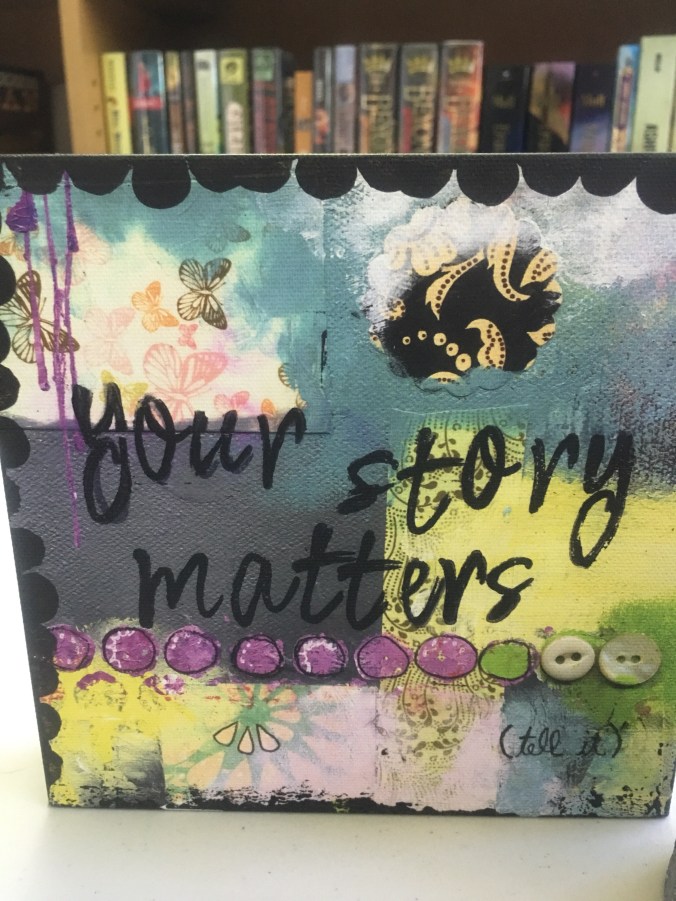
Your story matters

img_4990

“The world needs stronger stories.

We’re here to live a story and we’re made to live a good one.”

– Ruth Ayres

The focus of Day Two of my district’s Teacher Summer Writing Institute was Your story matters, with the driving question for teachers: “Why is it important for me to see myself as a writer?”

The bottom line is that we grow strong at writing by writing. If teachers expect to help students grow as writers, teachers must be actively writing. And teachers must believe in the craft, in the process, in the transformative power of writing, if they expect students to. As Ruth Ayres states in Enticing Hard-to-Reach Writers (Stenhouse, 2017): “When writers believe their words matter, nothing can stop them.”

Our group of K-12 cross-curricular teachers took some time to delve into their own stories by charting “peaks and valleys” from their life experiences. Peaks meaning moments or experiences that were positive—not necessarily milestones like getting married, seeing your newborn child, etc., although these can be peaks. Exploring moments or memories that have stuck with us over the years, those that carry great emotion, can impart greater insight to why we are who we are (see Your why for the expanded explanation of this activity). One of my peaks, for example, is from 5th grade, when I saw a classmate  do something extraordinarily brave. It’s my definition of “noble” to this day (if you want to read that story, see The Valentine ).

Valleys, or pits, are harder moments that have also defined who we are and why. They’re often ones of loss, but not always. Sometimes the valleys are moments of despair or disappointment, especially in yourself. Yet there’s great learning and insight attached to these moments. One of my valley-moments occurred when my mother invited a boy who bullied me to my birthday party.  When I began writing this piece, I recalled only my anger at my mother and our conflict. But a funny thing happens when one continues to write . . . I learned a truth that has stayed with me, subconsciously, all these years; it continues to shape me and my relationships with other people (you may read this story, if you like: The birthday ).

So the teacher-writers explored their peaks and valleys. They watched an extraordinary Ted Talk on perspective and assumptions of others, The Danger of a Single Story,” by Chimamanda Ngozi Adichie. They read articles and books of their choosing on writing. They studied visual texts.

Their takeaways:

“Writing about the peaks and valleys was so therapeutic.”

“I loved having the space to write. I began writing about one of my peaks and my mind hopped to something I saw recently; these two things don’t seem to be remotely connected . . . I wrote that instead because the image and what I was thinking were so vivid. I don’t know the last time I wrote like this.”

“I thought about things I haven’t thought about in years.”

“It’s so cool how writing takes you to places you don’t expect.”

You stories matter. Not just to you, but to others who may need to hear them.

Write first, Writer, to know thyself.

Find your stories and to discover where they take you, and what they mean. What they reveal to you about who and why you are.

Then tell your stories. Encourage others to tell theirs.

That’s what stories are meant for.

Stone speaks

img_4963

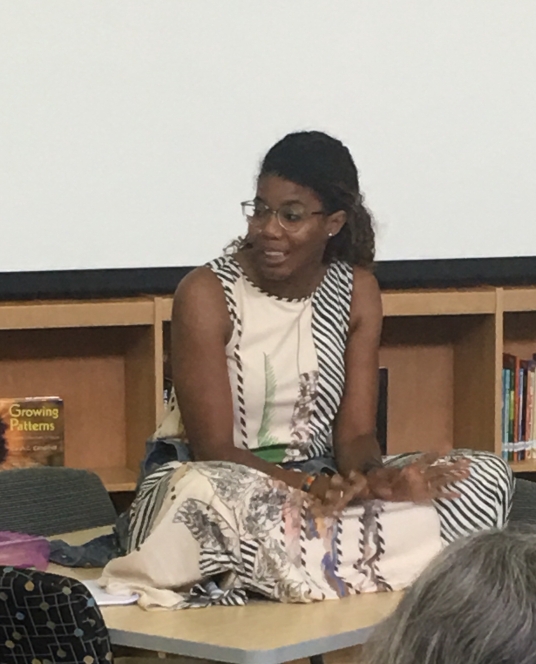
Author Nic Stone shares her passion and insight with teachers.

I scribbled notes as fast as I could while Nic Stone spoke to the gathering of teachers yesterday.

Stone is the author of the young adult novel Dear Martin. She’s straightforward, funny, warm, and passionate about reading and writing. The teachers are K-12 cross-curricular educators from across my district who’ve chosen to attend our second annual Teacher Summer Writing Institute—an entire week dedicated to growing as writers and teachers of writing. As a co-facilitator of this event, I sat in the back of the room for the panoramic view: The writing guru, seated comfortably on a tabletop, delivering her wisdom to the crowd who eagerly awaited.

Here are my favorite words of Stone:

“Literacy is about collaboration. Reading and writing are collaborative efforts. We have to be able to talk to each other.”

“I wanted to write from an early age but it took me until age twenty-eight to really try . . .  finding your voice is validating yourself and what you think and feel . . . READ what makes you think and feel.”

“Write for yourself first.”

“The beauty of writing is that it is always in your head.”

“You don’t have to write every day, but you have to develop the habit of writing.”

“Writing is solitary. Storytelling is collaborative.”

“Schools with the highest reading and writing successes are those where students have freedom to choose what they want to read and write about. Kids see each other doing it.”

“These are conversations you should be having in your buildings: Why do standards exist? What does it mean to be literate?”

“That you keep on doing the work without answers . . . that shows your amazing strength.”

“There’s no room for being wrong in American schools. Kids need to know it’s okay to fumble; it’s how they learn  . . . they need a soft place to land.”

“Reading and writing can unpack fears.”

“There’s no better way to help students find their power, their agency, their validity as human beings, than in the beauty of books, in words, in writing.”

“The thing about research is how one thing leads you to another. Everything connects. Reading and writing are all about connecting. Our connecting to the world around us, our connecting to each other.”

“Emphasize the fun in research.”

“For authentic writing, voice is more important than grammar. Let students drop commas, play with punctuation, write run-ons, fragments . . . tell them they have to know the rules before they’re allowed to break them.”

“All first drafts are garbage. They’re supposed to be.”

“Do yourself and the kids a favor: Don’t grade first drafts. Assign a date to have students finish them. They’ll have a sense of accomplishment in just finishing. Then after a couple of days, have them go back and revise.”

“I finish writing a draft before I revise, or I’d never finish.”

“Do what’s best for you to get your work on the page . . . it’s just not in the first draft.”

“Your writing doesn’t have to be be good to get an agent. It has to be good to get an editor.

“Always be working on something else. Always.”

“I’m amazed at the compassion I’ve developed just from writing books.”

“Writing is my life. I can’t not do it.”

Stone opened and closed our time together with three-minute timed free writes; the closing prompt: Now that this mess is over, I feel . . . 

My final lines in response, in my journal: I feel validated in so many ways, as teacher, writer, human spirit.

For all of these connect.

img_4989.jpg

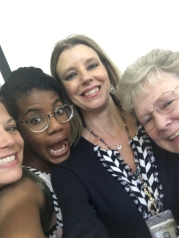
Kindred spirits: My co-facilitators and I with Nic Stone.

*******

See my post Write me for more background on the Summer Teacher Writing Institute and the value of teachers as writers.

Write me

Write me

Write me. Menno Abbink. CC-BY

As I stood at a checkout counter this weekend, the young lady ringing up my purchase eyed my #WhyIWrite T-shirt.

“So, you’re a writer?” she smiled, scanning my items.

Someone asks me this every time I wear the shirt in public. The interest always surprises me.

And, in spite of blogging for two years, having an untold number of stories in various stages of completion since I was six, and continuously capturing ideas in notebooks for more things to explore through writing, I still pause when asked this question. Funny how hard it is to own I am a writer. 

After a slight beat, I gave the young lady my short answer: “Yes. And I teach writing.”

Although she kept smiling, a shadow crossed her beautifully made-up face. “I struggled with writing in high school,” she said. “I speak well” —unmistakable pride glimmered in her dark eyes— “but I can’t write as well as I speak.”

There was something almost apologetic in her self-assessment. A trace of shame over this perceived shortcoming.

I hear this in people’s voices every time they tell me that they’re “not good writers.”

Some of them are teachers.

And I mourn, because, somewhere along the way, others have made them believe this.

“How often did you see the writing process modeled?” I asked the cashier, already knowing the answer. “Did you see examples of what the teachers wanted you to do, to make it concrete? Did you get feedback from the teachers during the writing of your essays, to help you improve your writing?”

She shook her head. “Oh, no. We were just told ‘Here’s the assignment, here’s when it’s due.’ ”

She completed my transaction. A long line of people waited behind me; I couldn’t ask this affable, well-spoken cashier if she’d ever enjoyed writing, or tried it for fun, just to see what she could do. I couldn’t say: You think you’re not a writer, but that is not the end of your story. 

I left the store knowing that I’ll have to return for a follow-up conversation in which I will say these things and encourage her to write. Maybe I’ll even take her a journal. I have several lovely ones waiting to be used.

My checkout conversation reiterates to me, yet again, that students struggle with writing because teachers struggle with teaching it. Writing is labor-intensive. It’s time-consuming. Teacher education programs often offer very little in the way of solid writing pedagogy, and unless teachers have access to professional development that provides them with the “how” and “why”—positive writing experiences of their own—the struggle goes on. Systems, administrators, and teachers battle over a clear vision of what quality writing instruction is, what the authentic writing process is versus any program, and why effective writing instruction matters (that’s another whole post in itself). I know educators who confess to “not being good” at teaching writing. Some happen to be in positions where they are advocating for the removal of writing workshop in schools.

In truth, it all begins with So, you’re a writer?

For the answer to that question must be yes before one is equipped to be a teacher of writing.

As for me, I’d start a grassroots SAVE EDUCATION THROUGH WRITING movement if I could.

In the meantime, I content myself with helping whomever I can, whenever I can, to grow themselves as writers.

The timing of my checkout encounter happens to be uncanny; I was, in fact, preparing to co-facilitate my district’s second annual Teacher Summer Writing Institute, which starts today.

In a few hours, I’ll meet the participants, elementary through high school cross-curricular educators who are willing to give up seven hours a day for an entire week during their vacation, ultimately to benefit the students they serve. Part of our institute rationale reads:

Everyone has the capacity to write, writing can be taught, and teachers can help students become better writers.

Writing grows out of many different purposes. 

Participants will be invited to be writers and engage in creative struggle.

We become experts at teaching writing by writing.

We will coach one another as we want our students to be coached on their writing journeys.

I know great things lie in store for the teachers who are coming. Not because of anything I or my co-facilitators say or do, but because of what lies within these teachers, these writers. I anticipate my own surprises— about the craft, about myself—because it always happens when I work at writing. The wellspring never runs dry. Never. Whenever writing is involved, I’ve learned to expect the unexpected. And to let it pour.

However these teachers may feel about writing, they’re already illustrating an important truth before Day One is up and running: This is not the end of the story.

It’s a beginning.

New pages await, expectantly, beckoning:

Write me.

You can do it.

And so can that cashier . . . .

*****

See Stone speaks for words of wisdom on teaching, literacy, reading, and the power of writing as shared by author Nic Stone on Day 1 of the Teacher Summer Writing Institute.

Last times

To commemorate my last post of the month-long Slice of Life Story Challenge with the Two Writing Teachers community—this is my second year of completion—I write about “last times.”

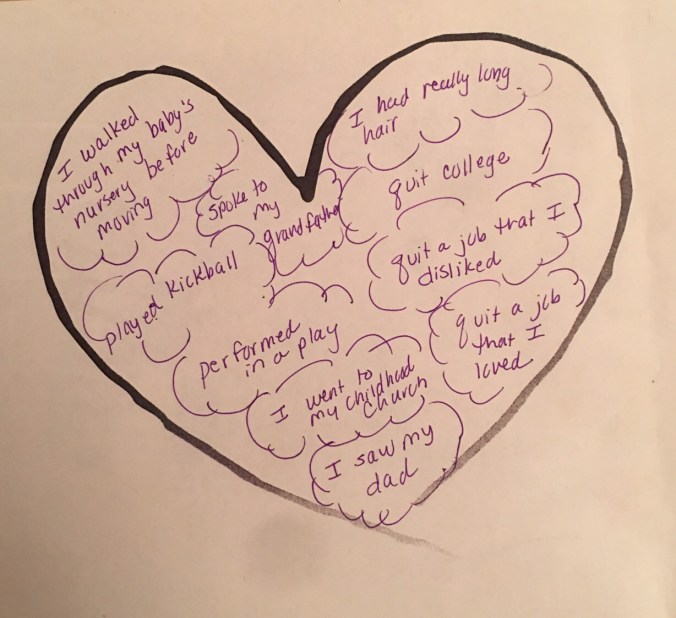
Yesterday I shared the “first time” heart map template from Georgia Heard’s Heart Maps: Helping Students Create and Craft Authentic Writing. I use these templates when I lead professional development for teachers in writing; it’s astonishing how often I hear teachers say, “I used to love writing but I don’t do it anymore.” More frequently, I hear: “I’m not good at teaching writing.”

The first step is simply to start writing.

The first and last time maps are excellent guides for this, and, furthermore, when teachers have taken these back to their classrooms, they tell me they’ve been amazed at what they learned about their students: “One of my boys wrote ‘the first time I rode a camel’. The class was so intrigued that he had to tell the story right then! We never would have known this if we hadn’t used the first times map.”

On to last times . . .

Here are mine, maybe to be spun out into full stories, one day:

The last time I walked through my baby’s nursery before moving. My older of two sons was born when my husband was in his first pastorate. The parsonage where we lived was a former sea captain’s house, built in 1915 (the year my grandmother was born), two blocks from the Chesapeake Bay. The congregation was mostly elderly; there hadn’t been a baby in the church, or the parsonage, for a long time. I was just twenty-two when my husband and I moved in, and I got to choose the wallpaper for the bedrooms. For the room that adjoined the master bedroom, I picked an ivory paper with little muted-red hearts between dusty blue stripes. A year later, I bought ivory crib sheets and bumper pads along with coordinating quilts and wall decor all adorned with these same little rustic hearts, teddy bears, and rocking horses. Our son was three when we left the Eastern Shore of Virginia to serve a church in North Carolina. I walked through the empty nursery last, where the only the little hearts remained on the walls; I stood there, running my fingers over them, and wept.

The last time I had really long hair. From kindergarten and first grade, when my hair was cut in an assortment of horrible shags, not to mention my cowlicks, I wanted long hair. By fifth grade, it was finally beginning to happen. In sixth and seventh grade, my hair reached down to my waist, was parted in the middle and as straight as a stick. In eighth grade I had a crush on a boy in my algebra class. He sat behind me. He’d speak to me occasionally, sometimes asking for help (which shows what dire straits he was in, to ask ME for help with algebra). I decided to cut my hair solely to get this guy’s attention . . .

The last time I played kickball. That was about a week ago! Due to a series of unfortunate events, there was a shortage of substitute teachers at my school on fourth grade’s quarterly collaborative planning day. I found myself taking a class to recess. It was a sunny, first true spring-like day, and the kids produced a kickball. “Mrs. Haley, will you pitch for us? Pleasepleasepleaseplease?” I haven’t played kickball since I was ten years old . . . but I was good at it, so . . . I took my place on the pitcher’s mound. My beginning teacher in kindergarten, walking past the game with her class on the way to the gym, stopped to gleefully take pictures.

The last time I quit a job I disliked. I’d had enough. I told the employers so and walked out. I never went back. Better things came along. Since then, when colleagues and friends have spoken of how much they detest their jobs, I’ve asked: What are you going to do about it?  Life is too short to be spent doing something that makes you miserable every day.

The last time I performed in a play. I was in my second year of college. I planned to be a theater arts major, having performed in numerous high school productions, and I’d just auditioned and been accepted to the American Academy of Dramatic Arts in New York City. This really sounds like a story of beginnings, doesn’t it? To stay immersed until I left on this huge new venture, I performed in community theater. At the audition for the very next play, after receiving my letter of acceptance to the Academy, I walked in, saw the handsomest man I’d ever seen in my life . . . and got married that summer instead of going to acting school.

The last time I went to my childhood church. My husband and I attended the service honoring my retiring childhood pastor, who’d become mentor to my husband, the last of over fifty young men my pastor ordained into the ministry. The church building was large; I remembered how, as a child, I’d occasionally run upstairs—there were flights and flights of stairs, some of them not adjoining; I’d have to run across some entire floors to pick up other staircases—and I’d go as far as I could, up to a little door with a dark window. I tried the doorknob. It was locked. I wondered: What’s behind there? Can I go any higher? Is God on the other side, somewhere? Who keeps the key?

The last time I spoke to my grandfather. He was dying of lung cancer, at ninety-two. He stayed at home with hospice care and refused morphine. From his years around loud equipment in the shipyard, Granddaddy was notoriously hard of hearing. He never talked on the phone for this reason, but one day when I called to see how he was, he answered the phone. Grandma had stepped outside. I talked to him for just a few minutes, almost shouting into the phone so he could hear me. He understood every word. I said, I love you, Granddaddy. You’re safe in God’s hands. He said, emphatically: I love you, Honey, and there’s no better place to be.

The last time I saw my dad. It was the week of July 4th. I’d come home with my boys to stay a few days, as Daddy wanted to take us to the shipyard to see the fireworks. He was retiring at the beginning of October, after almost forty-one years as a security guard, so this would be the last time, the only time, we’d get to do this. There’s a lot to the story that I’m not up to telling, even now; maybe one day . . .  so we went, my boys and I. As I sat there in the dark, watching the sky explode in lights over the vast, beautiful river of my childhood, sipping the ginger ale Daddy brought to share, I thought: Surely this is the beginning of better times. Daddy’s going to have more time to spend with us now. In my heart, I celebrated for him, that his working days were just about done, that soon he could take it easy and enjoy life . . . I could never have imagined it would be the last time I’d see him.  In September, just three days before he was to retire, he died with a massive heart attack. In uniform, on his way to work.

Writing about last times can be so hard, so hard, so hard.

But not always . . . as my workshop participants tell me, there’s that last car payment, that last mortgage payment, causes for celebration, indeed. Maybe even a step toward health, as in the last time someone smoked a cigarette.

So I close my thirty-one day writing streak, celebrating that I made it to the last post, celebrating my fellow Slicers who did the same, who wrote alongside me, who walked a part of the journey with me every day. Here’s to writing, friends. Here’s to sharing each other’s stories as long as we can, though perhaps not daily until next March.

Thank you all.

Here’s to your first and last times, to what’s in your heart, and to life.

Keep trusting.
First times

Georgia Heard’s book, Heart Maps: Helping Students Create and Craft Authentic Writing, has been out for a couple of years now, but when I facilitate writing workshop training for teachers in my district, many still haven’t heard of heart maps.

Since the first step in being an effective writing teacher is to write, I show teachers how to use this tool for themselves first.

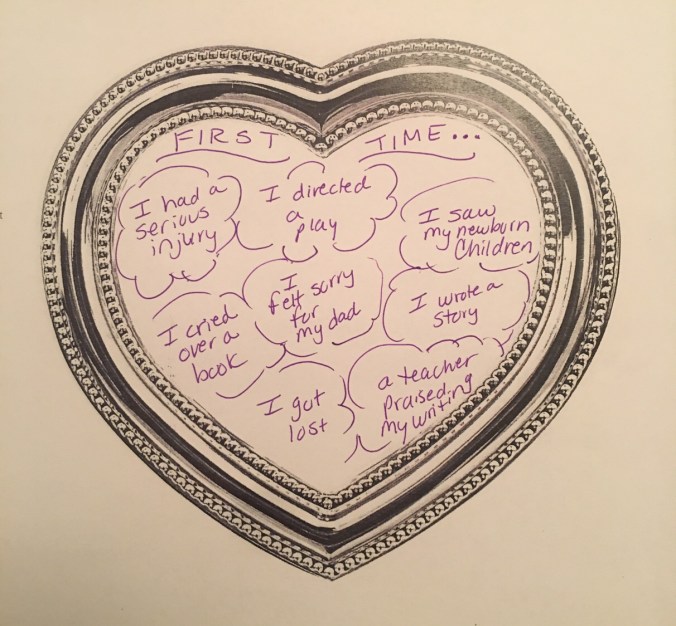
The photo is of Heard’s “First Times” heart template. I’ve filled in many of my personal “first times” which can be spun into stories. Such as . . .

The first time I had a serious injury. I was in the fourth grade, on the playground, standing on a tire cemented to the end of a pole (two of these poles would be used to hold up a volleyball net; this pole was lying down, and I was standing up on the tire’s edge) with the intent of jumping and grabbing hold of the tallest chin-up bar. I missed. I broke my left arm. When I get around to writing this story in all of its gory detail, I must also include my dad, who came to take me to the orthopedist. He brought me an old, smudged doll that I didn’t play with anymore. It was humiliating, but at the same time, seeing him there, holding that bedraggled doll I’d outgrown, his face pinched because of the pain I was enduring, I understood that he was trying to help in the best way he knew how. Yes, I’ll need to write this story, one of these days.

The first time I directed a play. I was a high school senior and my drama teacher was  asked to send two students to the elementary school to lead a small production for advanced learners in the fifth grade. I was chosen to direct the play and a classmate was chosen to teach the students some of the tech, such as scenery and lights. One little boy in the elementary group was painfully shy; I gave him the role of the bad-boy motorcyclist and, well . . . I need to write that story.

The first time I cried over a book. Fourth grade again. The teacher read Charlotte’s Web to the class. Later in the year, she read Old Yeller to us. I didn’t think I’d live through fourth grade (broken arm notwithstanding).

The first time a teacher praised my writing. Fifth grade. The class had written “All About Me” books and the teacher complimented my description of the allergy medicine I had to take. Until this moment, I had no idea my writing had any real value.

The first time I felt sorry, really sorry, for my father. When he got paid at the end of the week, he would cash his check and go to the store for our family’s groceries. Once the shopping was done, he’d put the rest of the money in the bank. One day, when I was a young teenager, Daddy got in line with his loaded cart, reached for his wallet to pay the cashier—and discovered that his wallet was missing. Along with his whole week’s pay.

So, I walk teachers through the process of brainstorming their own “first times” for writing inspiration, before we ever talk about how students might use the heart maps.

And the teachers write. Some stare off into space, thinking; others smile. There’s not a lot of tears when we write about first times.

Those tend to come when we write about last times.

How do I inspire them?

Inspire

Inspire. chattygdCC BY 

The crowd of educators goes to lunch, posting their “gots” and “wants” on a chart as they exit the morning’s session on growing young writers. My co-facilitators and I look over these sticky notes, preparing to address the “wants” in the afternoon when the participants return.

One note in particular grabs my attention:

I want my students to be excited about writing and to write more. How do I inspire them?

“It’s all yours,” say my colleagues.

I smile.

This is what I love.

Educators talking about inspiration. It’s vital to professional development, to the work that we do

To inspire, one must first be inspired.

Author Avi, in a Skype with students at my elementary school a couple of years ago, defined inspiration as breathing life.

Writers are life-breathers.

So are teachers.

Lucy Calkins, speaking of launching writing workshop, says: “No matter how tentative and insecure you may feel, role-play your way into being confident of yourself and your children because they will hitch a ride on your enthusiasm.”

It’s more than modeling the writing; it’s modeling a passion for writing. It’s digging deep within yourself to find your own stories, your own ideas, your own stances, and giving life to them . . .

The crowd returns. Little knots of teachers, support personnel, and administrators spanning kindergarten through high school, chattering, laughing. They take their seats one by one; an air of expectancy settles over all as my co-facilitators and I respond to their “wants.”

It’s my turn.

I want my students to be excited about writing and to write more. How do I inspire them?

“If we want students to get excited about writing, we must be excited about writing. We must write more ourselves, for ourselves first. Walk the walk; if we’re telling them writing is important, we’d better be writing ourselves. That’s why I started my blog, to keep me writing consistently. Tap into your own memories, the things that matter to you. Write in front of the students; show them every step of the way, how the ideas and images come to you, why you want to say what you’re trying to say, why it’s important.  That’s authentic writing. Tell students writing is the closest thing to magic that there is. Show them the power that’s in it. That what THEY think and feel matters. Good writing is labor-intensive; they have to get a taste of why it’s worth it. Tap into their emotions; there’s always a way . . . help them see that writing isn’t just something to be done for school for a grade, over and done. Writing is about life itself . . . .”

Breathe life. From your writing to theirs, from your soul to theirs.

There’s a whole world within each young writer. There’s a world around them that they’re grappling to understand. A world with a place for each of them. We don’t create these worlds for them. We just open the doors.

“Another world is not only possible, she is on her way.

On a quiet day, I can hear her breathing.”

– Arundhati Roy