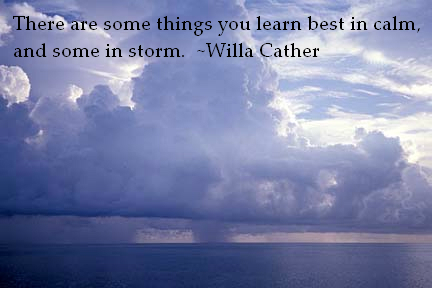
Storm. lawtherjamie. CC BY
The initial predictions were utter destruction by an epic monster.
Having suffered extensive damage from hurricanes in years past, central North Carolina fortified itself against Florence. I collected a small mountain of dry goods and canned vegetables—”hurricane stash”—that probably could have fed my family of four for two weeks without electricity. Since we’re on a well, we don’t have water when the power goes out; I even purchased powdered milk to mix with bottled water, for our cereal. Bottled water . . . that took several trips across three days. By 6:30 in the mornings, restocked grocery shelves were again picked clean. I finally scored a 36-count pack of Aquafina and turned to maneuver away from the throng in that aisle when a man, loading his own cart, said, “Here, you better take another.” He hefted a pack of water off the shelf and stacked it on top of the one in my cart. This gesture by a stranger stirred my heart.
At home, the dogs had plenty of food, we had batteries, all the laundry was done, one of the bathtubs was filled with water, the cars with gas. Our porch rocking chairs and the grill were secured in the shed. The television news ran nonstop. My family watched the slow, drawn-out approach of the monster, and although the sun was still shining, school was canceled in anticipation of the onslaught. My mind continually scrolled for every possible preparation. I even boiled the remainder of our eggs so they’d be usable if the power went out for days, as happened in the past.
I planned for everything.
Except my back going out.
It started on the day before Florence was to make landfall and grew steadily worse. I attributed it, at first, to the barometric pressure; I’d heard several people mention headaches and backaches. By the time the wind and rain arrived, however, the grip of pain was too intense for me to sit or walk anymore. Dosed with ibuprofen, I spent the duration of the storm — five days, all told— lying in bed with pillows under my knees.
Unable to do anything.
Except re-read the entire Harry Potter series.
Escapism at its best.
Different things strike me on each reading. This time, as the wind raged on the other side of the walls, as sideways rain whipped in voluminous sheets, slapping the windows with fury, as the encroaching darkness forced me to switch on my phone flashlight in order to see the words on the pages—Lumos!— I lay there contemplating the nobility of the characters, the way they banded together, helped one another, in the face of their own destructive, epic monster. How they found unrealized courage despite ever-increasing darkness. As I lay reading, immersed in Harry’s world, I caught distant snatches of the news from my own: on the TV in the living room, where my husband and sons tracked Florence’s path, meteorologists warned people that if their houses flooded to not seek refuge in their attics, because there’s no exit. Rescue personnel are not equipped to cut through houses to save people. Meaning that it’s safer to climb on the roof of one’s house than to be trapped.
For a second, everything went still: How could I do that? If it flooded here—never say never—how could I possibly climb to the roof? I can’t even move!
And then I read the words of Mad-Eye Moody to Harry as Harry was about to compete in the Tri-Wizard Tournament: Play to your strengths.
Harry doesn’t think he has any strengths—this is Book Four, he’s just fourteen —and he has no idea that the Tournament was designed solely to destroy him. Moody growls: Think now. What are you best at?
Lying flat on my back, at the mercy of my own body, helpless against the forces of nature, imagining a flood . . . what strength would I have, just now?
I thought of elderly people in this storm. Then of my Grannie, years ago, when her house caught fire in the dead of night on New Year’s Eve; how, after just having heart bypass surgery in the days when it was a new thing, she climbed out of her upstairs bedroom window onto the porch roof and survived.
Play to your strengths.
In Grannie’s case it was pure grit. As for me . . . well, a streak of that same determination and strong will (Grannie-grit) runs in my own veins, but I think my strength is rooted in something greater. If had to choose what’s deepest within me to tap, it’s hope.
I recently heard hope defined as not wishing, but knowing, trusting. No matter how severe the pain, I know I’d be able to climb to safety. Somehow. I trust my family would help me. Even in my weakened state, I’d find and give the last of my strength to help them, too. A strength that would come exactly when it was needed, not before.
On and on I read. Of Harry’s overcoming, of his concern for others, his willingness to give his own life in order to save them, even those he didn’t know personally . . . .
The darkness, the storms bring out the best in humanity, reminding us that we are, above all, here to help each other. Not to destroy.
—I will write about Severus Snape another day.
And storms, ever how violent, do not last forever.
It didn’t flood here, although our yard remained a bog for a while.
Now we have a plague of bloodthirsty mosquitoes to battle.
And my back pain has diminished, bit by bit, day by day. It remains a twinge, still causing me to be mindful. Strange thing, that. Being rendered powerless during the storm, unable to do anything but read. And endure.
But, in the end, powerless all depends on one’s own perspective. Reading is another great strength of mine, is it not? Didn’t it get me through the storm and the pain? That’s hardly powerless. Not to mention that in my tiny neighborhood, in the heart of a rural area where we frequently lose the power for no apparent reason at all . . . the lights blinked but never went out.
Just like hope.

 lit bits and pieces