She’s still here.
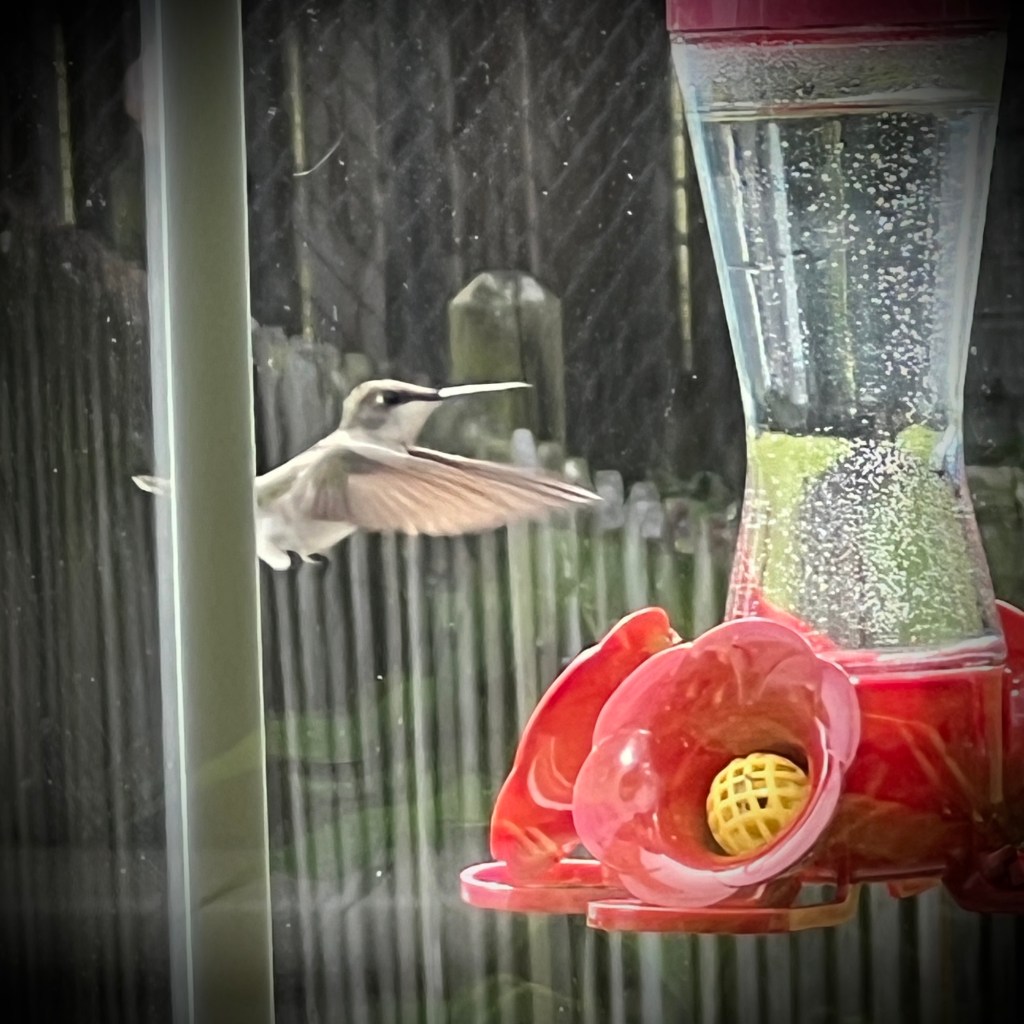
As of yesterday evening, anyway, after I went out in the rain to refill the almost-empty hummingbird feeder.
One little female, silvery-cream, with the faintest dark speckling on her breast.
Upon my return to the house, I stand a few feet back from the window in the unlit kitchen, and —zip! —she appears like a fairy out of nowhere. She perches on the feeder (attached to my window with a suction cup hanger), gripping the thin red rim with unspeakably tiny feet. Her back appears gray in the dusk but I know how it shimmers in the sunlight: gold-dusted, olive-green, smooth as glass. Ethereal. I marvel at the exotic lining around her eye. For a moment, I forget to breathe.
For several days prior, she and another hummingbird were fighting like mad for possession of the feeder. Clearly a high-stakes frenzy. Remarkably loud squeaking. Palpable urgency. Throughout the summer, four or more of them kept vying for a turn. They do not share. They drive each other away. Each bird has her own unique markings, but the astonishing speed of movement sometimes makes individual identification impossible. Except for the one female with a rare dot of red at her throat. Fancy.
Ornithologists say that male ruby-throats return first each spring, but my first hummingbird sighting this year, at the outset of April, was a female. I pushed up the kitchen blinds one chilly morning and there she was, right before my eyes, hovering for a split second before darting away. I caught the implied question: Ummm…where’s my nectar?!
I like to think it was this same female. The first to arrive. The last to leave.
I wonder why she lingers.
It’s mid-September. The males left at the end of August. Punctually. I saw the last one on the last day of the month: A male perched on the feeder, his black ascot turning to crimson-fire whenever he lifted his head. I watched him take his fill of sugar-water. I noted the date. By Labor Day, I knew that was it. He’d gone, as if in keeping with the calendar page flipping or an inner alarm clock going off: Ding! Male hummingbirds vanish all at once. Now you see them, now you don’t. Poof.
Females remain for a few more weeks. I’ve sensed that mine have been leaving, one by one, in the last few days. Off to Mexico or Central America or wherever they winter. I am curious about where my birds go. I am certain each goes to its own exact spot; there’s no shadow of turning with hummingbirds.
I’ve read of their long, lonely, exhausting migration, but I can’t imagine hummingbirds ever feeling sorry for themselves. Prosaic writers have described them as “made of air” and “tricks of light” — I love the lyricality. I also know that the hummingbird’s fragile appearance belies a tenacity and ferocity unrivaled by any other bird around, even the huge red-shouldered hawk that sits so majestically on our power lines and poles, scrutinizing the landscape for prey.
Last week I heard the cries of a hawk. I went out on my porch to listen and was rewarded with the sight of two red-shouldered hawks flying, one after the other, in the patch of tall pine woods across my street. I suspect there’s a nest nearby. While I stood gazing in awe, there came a sudden vibration: vvvvRRRR! A female hummingbird materialized to hover three feet away from my face, her wings beating like tiny fan blades on high.
I said, Oh it’s you.
I feel sure she was saying the same thing.
We seem to be equally curious about each other.
Maybe she was the one that still lingers, my last hummingbird.
She won’t stay much longer.
In the predawn hours, with a rainstorm raging and my electricity out, it’s too dark to see anything beyond my window except for the feeder. It still holds. Freshly replenished. I will ensure that it remains so for as long as my hummingbird should have need of it.
When she’s gone, I’ll experience a little autumnal pang of loss, the expected but unwanted shedding, the indefinable ache of transition, the instinctive pulling-inward preparation against the coming cold and dark. For a time. A season.
Until the morning I push up my blinds and we meet face-to-face once more.
Godspeed, precious spark.
*******
With thanks to Two Writing Teachers for the Tuesday Slice of Life Story Challenge
and to the hummingbird that remains
even now, in the wind and rain
while I write



 lit bits and pieces