The wound in the wood

A little slice of memoir

*******

I was five when my dad bought the house where I grew up.

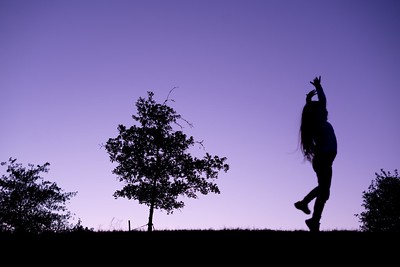
There were good things about the house. A Big Bathroom and a Little Bathroom. Having two seemed luxurious to me, a child accustomed to apartments. Cloud-like swirls on the ceiling that my mother said were made by twisting a broom in the plaster while it was wet. A huge picture window in the living room, through which I could see a very tall tree behind the neighbors’ house. To me, the tiptop of the trunk appeared to be a lady sitting and gazing across the earth like some kind of woodland princess. Day in and day out, she sat there atop of her tall tree-throne, a regal silhouette, never moving.

There were things I didn’t like about the house. The red switch plate on the utility room wall that my father said to never ever touch. I believed that if anyone touched this switch, the furnace would explode and blow us all to smithereens. Even after I outgrew my terror, I steered well clear of that red plate. I didn’t like the thick gray accordion doors on the bedroom and hall closets. Bulky, cumbersome, and stiff, they didn’t really fold. They came off their tracks easily. These hateful doors eventually disappeared; one by one, they were discarded. Our closets were just open places.

The linen closet stood directly across from my bedroom door in the narrow hall leading to the Big Bathroom.

It wasn’t a true closet, just a recessed place with wooden shelves. I don’t remember an accordion door ever being there.

What I do remember is that one of those linen closet shelves had a terrible gash along its edge.

It looked like a raw wound that might start oozing at any moment. A gaping slit. When I pored over pictures of how to do an appendectomy in my parents’ set of medical encyclopedias (and why did we have these—? An exceptionally persuasive door-to-door salesman—?) the pulled-back human flesh and tissue made me think of the wound in the linen closet shelf.

This shiny-pink raw place bothered me. It was ugly. Almost…embarrassing. Something that shouldn’t be seen, shouldn’t be exposed…why had the builders done this? Couldn’t they have turned the shelf around so the wound wouldn’t show? It was an affront to me as a child, before I knew what taking affront meant.

I know now that the flaw is a bark-encased scar. The shelf came from a tree (maple?) that was injured, somehow. Maybe by a cut or fire. An online search produces this AI-generated explanation:

The tree’s cambium layer, which is responsible for producing new bark and wood, starts to grow new cells around the wound, forming a protective layer of tissue called callus. 

As the tree continues to grow, the callus tissue can expand and eventually cover the original wound, creating a scar that is encased within the new bark.

In short: The scar is evidence that the tree worked to prevent inner decay and heal itself after being wounded, and that it went on living for a good while before it ended up as the shelf holding our towels and washcloths beside the Big Bathroom.

I never touched that raw-looking wound in the wood. I averted my eyes from it, even hated it for existing.

Now, when I return in my mind to the rooms and halls of my childhood home, they are always empty, and that old scar in the shelf is the thing I want most to see.

How strange.

Maybe I am drawn to it out of kinship. I do not know the story of the tree’s life, only that this remnant is testimony to its suffering and ability to overcome. I could liken the scar to the ways adults damage children, having been damaged as children. I could see it as a symbol for my mother, whose early wounds festered long, the extent of which would eventually be revealed in addiction.

That’s the real red switch, for it blew us all apart.

Maybe I just want to place my fingers on the old raw place at last, tenderly, in benediction. I would say that I understand now about layers of callus tissue expanding, covering, and absorbing the deepest of cuts over a long, long time…it is always there, but it hurts no more, and I am no longer ashamed to see it or to let it be seen.

In the shelf or in myself.
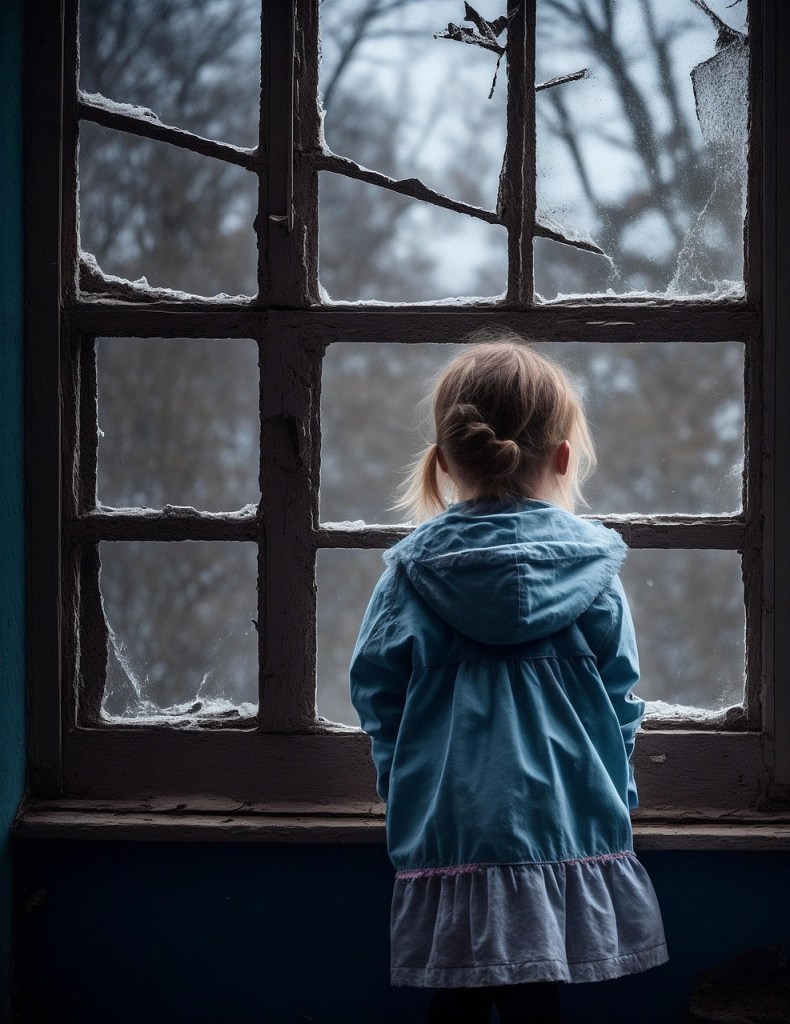
Image by Wolfgang Eckert from Pixabay

*******
with thanks to Two Writing Teachers for the March Slice of Life Story Challenge

Haibun poem: Breath

On the first day of National Poetry Month, Glenda Funk kicks off VerseLove at Ethical ELA with haibun poetry writing:

“Haibun originated in Japan and combines prose and haiku. Haibun can feature many genre forms, including narrative, biography, diary, essay, prose poem, travel journal, etc. The prose section comes first and is followed by the haiku, which an article on Poets.org describes as ‘a whispery and insightful postscript’

Compose a poem juxtaposing ideas about rest with the haibun form…I’ve noticed the economy of words in the haibun and believe this is achieved by omitting as many being verbs (and dare I say adjectives) as possible.”

I have never written haibun before.

I do not know why the image of the child struggling to breathe in the night came to mind, but she did.

More on that after the verse…

Breath

Night takes the stage like a magician bent on harm, draping the child in her bed with a velvet cape intended to suffocate. Ghost-hands press theme music from her lungs, just pipes and whistles, an accordion straining, straining to get enough air in and out. Carnival music distortion, chorusing with the machine at the bedside rattling and spewing steam. It doesn’t help. The child craves release. Air. Sleep. PleasePlease…she wriggles against the ghost-hands, piling her pillows, drawing her knees to her chest underneath her, not knowing this is how she slept as a baby. Not knowing she’s a victim of in-betweenness, planted in a time before widespread use of inhalers and eras beyond physicians prescribing the remedy (for adults, anyway) of smoking jimsonweed. Nightshade. The magician’s sleight of hand, again. In the fog-filled room, moisture trickling down the walls, she’s akin to the bald cypress in the bog, relying on knees to —stabilize? —to breathe? She does not know that even trees rest at night (measure the droop of their branches; see it restored at morning). Like trees repatriating nutrients before winter, turning their fragile leaves loose, she knows she has one hope for staving off ruination. Her knees. In this pocket, the ghost-hands lose their grip; the magician is undone. The velvet cape slips away. 

Sleep repairs the brain
but there would be no breathing
at all, without trees

#Repost @_sunkissed_gal_ ・・・
The trees are our lungs, the rivers our circulation, the air our breath, and the earth our body. — Deepak Chopra.
Sterling College. CC BY 2.0.

—I was the child, suffering with asthma.

A tree for a tree

This week I read that you can tell how long it’s been since a field has been reclaimed by forest. If the forest has a lot of pines, maybe twenty years. If there are more hardwoods than pines, maybe forty years.

We own a tiny of patch woods behind our house. Beyond that is a field (not ours). Once upon a time, this was all field, and long before that, all forest.

I cannot recall what these trees looked like when our house was new, twenty years ago. I can see we have quite a few hardwoods now in our tiny bit of forest.

This week one of our pines toppled in a wind gust preceding a thunderstorm. The trunk’s resting partly on the fence (which is holding up, surprisingly). On the other side, the treetop is a shattered, mangled mess. My plant identifier app tells me it’s a loblolly pine with Crown Gall caused by bacterial infection. It must have been slowly starving for water or nutrients. The extent of its brokenness there on the grass makes me wonder how much the tree suffered and if others of its species tried to help or not (trees do this for one another).

At any rate, it’s gone. A fat sand-colored dove lands on the fence to survey the damage also. Maybe it is simply paying respects.

There is nothing I can do. The fallen tree will have to be cleaned up. I imagine the confusion of rabbits, the next time they come out to nibble clover and find this mess. I turn to go back to the house, whereupon I discover a curiously bright and fresh plant quite to itself where the pinestraw ends and grass begins.

Sweetgum. A baby hardwood. Encroaching toward the middle of the yard.

I look at back at the grown sweetgums waving their starry leaves from among the cedars and pines. I imagine the mother tossing her seeds as far she could (not very far, only a few feet; maybe birds or animals helped but the wind apparently didn’t, not much).

Still. Cannot help thinking about that reading I’ve just been doing…as in, this cheery neon-green baby being a strategic move in the decades-long hardwood takeover and that sick pine, an occupational casualty.

I wonder what the trees tell one another, what old secrets live deep in the understory.

I wonder what the dove knows, and the wind, as it blows.

Something of belonging and primeval balance, surely.

Maiden in the woods

For years now, I’ve caught glimpses of her when I’m driving down a certain road near my home. Between fields and old farmhouses are patches of woods, and that is where I see her.

I might confess that ever since I was a child, whenever I ride by an expanse of woods, I’ve daydreamed about seeing people amongst the trees as I go whipping past. Maybe people of long ago, making a reappearance on the land where they once lived and hunted. Maybe enchanted people, unable to go beyond some magical barrier, or simply relegated to this place of relative obscurity where they are least likely to be detected. In summer, the woods are full and dark; their secrets are more secret than ever, but in winter, the woods are revealing. So many trees are bare and shafts of sunlight illuminate the papery russet detritus of the forest floor…when I ride past in wintertime, I imagine someone stepping back in the shadows, or bending over a cookpot, or doing whatever it is one would do in a secluded woodland semi-existence.

So, actually seeing this maiden in the nearby woods for the first time gave me quite a turn. Now, of course, I know she’s there. I’ve been trying to figure out who or what she is. Perhaps a dryad (Narnia, anyone?), the shy female spirit of a tree, usually an oak in Greek mythology. Dryads look something like their trees and can live for centuries. Or maybe a hamadryad, a nymph so intimately bound to her tree that if the tree dies, she dies, too (anyone remember the scene in The Last Battle when the beechtree nymph runs to the Narnian king, Tirian, to say the talking trees are being felled, then falling and vanishing as her own tree is cut down?).

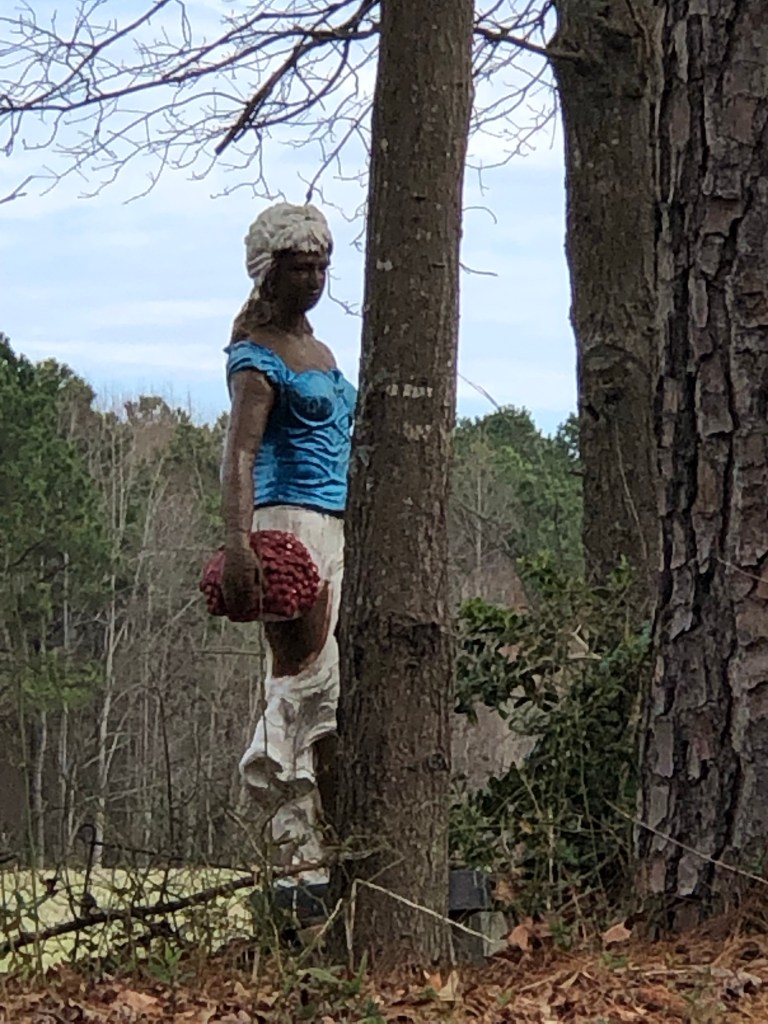
Although I could never get a good enough look at this maiden in the woods to decide if she might be a dryad or hamadryad, she didn’t seem “tree-ish” enough. No. For one thing, she wears clothes. A top as blue as the bluest untroubled sky, the kind with no clouds in sight, so blue it imparts an inexplicable ache in the heart. She has a long white skirt and some kind of white headdress. And she carries something red in her hands—berries? Grapes? What IS that, and what is she, and why is she standing out here in these woods?

One day, I kept telling myself, I’m gonna stop this car and get a picture…

And so I did.

Last week I pulled off the road and quickly got my shot… I dared not go too far or get too close, as I don’t know whose land this is and… well… you know… possible enchantments…

She appears to be a young Roman woman carrying a harvest of grapes home from a nonexistent vine. Not a goddess, not a dryad. I can’t discern why she’s here. A puzzle. No obvious reason that I can see. I wonder, too, if she was once pale marble or all bronze or solid gray cement—turned to stone, perhaps?—before some artist, whomever it was, chose to spruce her up with color. No telling how old she is, how long she’s been here, and why, why…so many untold stories…

I bet the trees know all about it. I would ask, if only I understood Tree. For they do speak to one another, you know. They have a whole communication network of their own, underground, in the air…

But I am merely human, and as always, the trees hold their mysteries close.

*******

with thanks to Two Writing Teachers for the Slice of Life Story Challenge every day in the month of March.

The slant of the light

January morning
clear and still
rose-gilded clouds
aflame in the sky
like a royal canopy

fiery pink
presiding over
the stone-gray world

as I drive on
smoke wafts and lingers
after a slow descent
from chimneys

around the bend
a curious slanting of light
from behind me

winter-tilted Earth
catching the rising sun
at strange angles

the treetops ahead
become gold filigree
sun-dipped coronets
adorning bodies
enshrouded with shadow

the road I travel
twists and turns

the slanted light shifts,
striking the tree trunks

turning them crimson

blood-red

like arteries

conduits of life
not competing for sunlight
in this one moment,
just standing transformed
by oblique rays

—I revel
in the winter-slanted light,
thinking of how blood rises
to the surface
and how age-old secrets
stay hidden
deep within.

*******


I couldn’t take a picture of the scene on my early morning drive to work today. I can only try to recreate it with words. The sight left me awed and grieved at the same time: that the slant of the light could turn the treetops to lacy gold, could paint their trunks blood-red, and that these conditions might never replicate themselves exactly this way again.
I just happened to be in the right place at the right time to catch the haunting colorplay between the Earth and sun.

So much depends on perspective.


Trees know

Yesterday they came back.

Just a few of them.

The others will have their turn, soon. For now they wait in the wings and on the screens…

In a month when masks are normally worn for celebrating, they came masked for protection—of others.

Several of us stood as sentinels in the misty gray morning, waiting, also masked. Gloved, thermometers ready, when the first bus rolled up and its door opened to release three children.

Another bus carried only one.

But when the first child passed inspection and entered the building, the gathered staff cheered. Applauded. Like welcoming a hero home.

They are heroes.

These kindergarteners, these first, second, third graders in their colorful masks, quietly navigating the building, sitting socially-distanced (alone) at lunch… I suspect these images are etched deep in my brain for the remainder of my days.

I saw this verse on a StoryPeople print by Brian Andreas (1993):

When I die, she said, I’m coming back as a tree with deep roots & I’ll wave my leaves at the children every morning on their way to school & whisper tree songs at night in their dreams. Trees with deep roots know about the things that children need.

I think about how trees

help us breathe

cleanse the air

provide refuge

absorb storms

soften hard edifices

beautify

welcome

are calming

are cooling

change with the seasons, yet remain constant

color the world

Tree leaves do whisper. Trees talk to each other (they do). They live in groups and look out for one another.

They carry the stories they live within them. You can read them, in their rings.

I cannot decide which is best, to be the tree with deep roots, waving my leaves at the children on the way to school, singing in their dreams…or to be the child, asleep, hearing the tree-song…

I stand, a sentinel in the gray silence of the empty bus loop, masked, gloved, thermometer in hand, watching bits of red and yellow and fiery orange swirling through the air as if stirred by an unseen hand… tree confetti, celebrating life, letting go in order to hold on through the coming winter, who knows how dark or cold, and I’m seized by the sudden desire to run into those dancing colors…

—I am bits of both.

*******

Thanks to Two Writing Teachers for the invitation to share on Slice of Life Tuesdays and for also knowing about the things that children need. They, too, carry their stories within them…

Photo: Donnie Ray Jones. CC BY

Social distance of trees

One of the best books I’ve read in recent years is The Overstory, Richard Powers’ novel of the American chestnut blight that wiped out almost all of those beautiful trees by the end of the 1930s. Powers wraps stories of people’s lives around that core like concentric rings. The novel won the Pulitzer Prize for Fiction on April 15, 2019, a year ago yesterday. Author Robert Macfarlane’s enthusiastic praise of the book led me to read it and to plunge deep into the secretive, endlessly fascinating world of trees. They communicate with one another. They have memory. Maybe they are whispering their secrets to us … This week Macfarlane shared an article on Twitter about the social distance practice of some trees, the phenomenon known as crown or canopy shyness, their treetops (“overstory”) not touching in order to survive in the competition for resources like sunlight. That was the clarion call to me: Write something. About trees and how they do this. But what? How? Then I stumbled across a different article about the Fibonacci sequence of trees, oaks in particular: as their branches grow, five branches to two spirals, a pattern is formed. Could I combine these ideas, somehow?

Doesn’t poetry always make a way?

A Fibonacci poem on the social distance practices of trees:

Trees
keep
distance:
crown shyness,
their overstory,
shared but not touching each other.

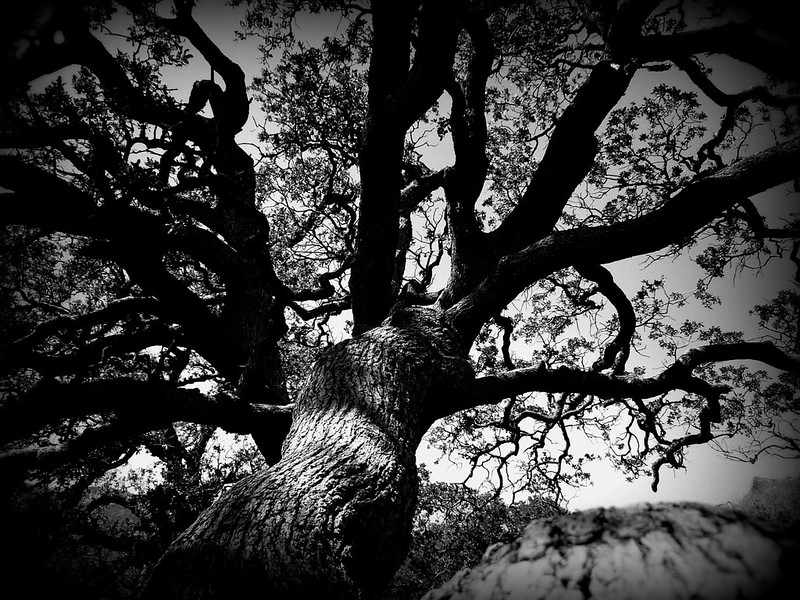
Photo: Old oak. Dave Parker. CC BY.