Yesterday Leilya Pitre opened the March Open Write over at Ethical ELA with an invitation to compose poetry inspired by the Ides of March.
The Roman calendar confuses me, with all the backward counting. An “ide” is one day before the middle day of the month. For March, that’s the 15th – yesterday’s date. Leilya gave several poetic form suggestions: villanelle, free verse, limerick. She prompted participants with a choice: 1) Write with “an air of inevitability and doom…mirroring the idea of a foretold fate,” or 2) “Write a poem that celebrates a moment of change or transformation, akin to the original meaning of the Ides of March as a day of transition in Roman history.”
A day of transition…hmmm.
Change.
What needs to change more than the human heart?
I confess to wanting to run for my life at the idea of writing a villanelle (see how much the very word looks like “villain”?). The form is deadly! And there’s only one Dylan Thomas. Nobody else can rage, rage at the dying of the light quite like him. And so I opted for free verse, my default form.
Crickets. Nothing. No ideas on ides.
And so I returned to the villanelle – drat it all! – with “an air of inevitablity and doom,” for sure.
But then: Two repeating lines came to me. I started a rhyme search. A villanelle takes a pile o’ rhyming words. Not all of them will work. One of my favorite images re-materialized in my head: the “golden rim.” Yes. Let us drink from the golden rim of the goblet…no, chalice. Yes. What are we drinking, and why? What’s the point? What does it mean?
Have you ever heard that what you need is there, right within your reach, if you just look?
In this case, what I needed was literally right there within reach: the bracelet on my wrist. You’ll see.
Here’s the poem. Still tinkering with it.
Gratiam pro gratia
As evening descends in shadows dim
Let’s toast to ceasefire of life’s fight:
Drink, my love, from the golden rim.
The face of the morrow will be less grim
—See, our ashen embers retain the light
As evening descends in shadows dim.
Toss off your cloak with fraying trim.
Kneel by me, pray, well we might—
Drink, my love, from the golden rim.
There sparkles yet a priceless gem
Within the pocket, glittering bright
As evening descends in shadows dim.
Hold my hand — let’s sing a hymn
Before we take our earthly flight.
Drink, my, love, from the golden rim.
Sweet chalice of life, abrim,
Despite this darkest night…
As evening descends in shadows dim,
Drink, my love, from the golden rim.
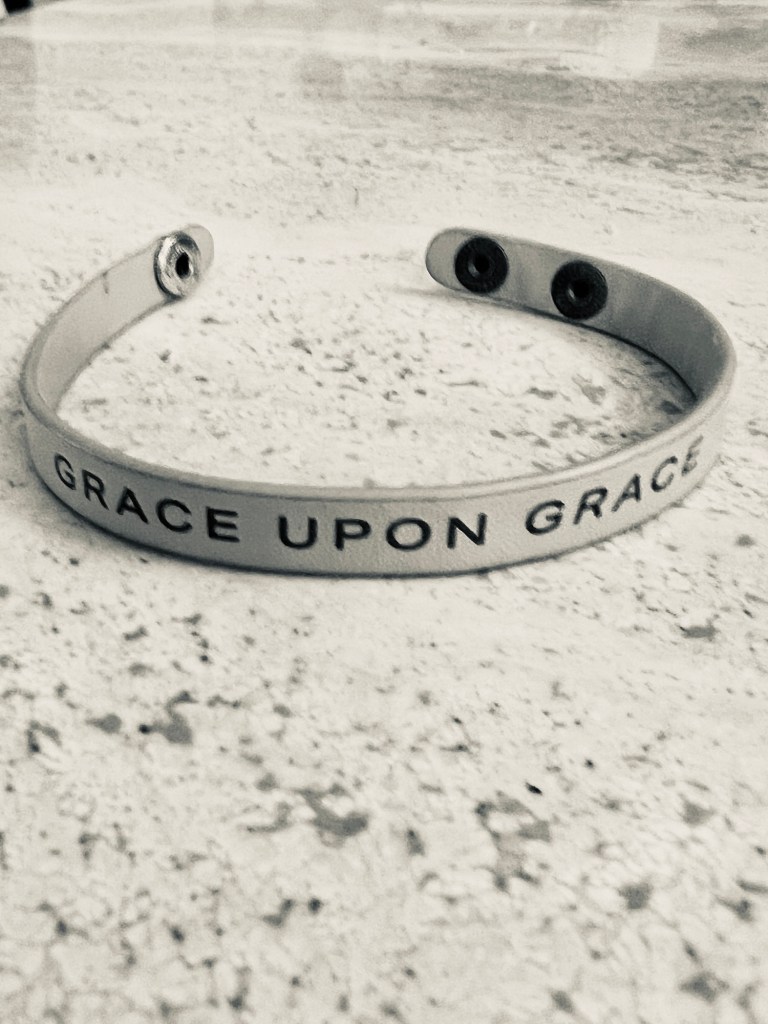
My poem’s title is Latin for the words on my bracelet. An excerpt of John 1:16: from the fullness of Christ, we have received “grace upon grace.” I wear it as a reminder to give grace, having received it in such abundance. I purchased the bracelet at a coffee shop called Charis (“Grace”) which has a wall plastered with customers’ prayers written on tiny slips. The owners donate a portion of proceeds to organizations that are working to make the world a better place. Our time here is short. Let us be about this work, in communion with one another, giving each other grace.
*******
with thanks to Two Writing Teachers for the March Slice of Life Story Challenge
 lit bits and pieces