Zest

noun

keen relish; hearty enjoyment; gusto.

an agreeable or piquant flavor imparted to something.

anything added to impart flavor, enhance one’s appreciation, etc.

piquancy; interest; charm.

liveliness or energy; animating spirit.

the peel, especially the thin outer peel, of a citrus fruit used for flavoring: lemon zest.

—Dictionary.com

I’ve been thinking about “zest” recently.

Truth be told: I needed a “z” word anyway for my post title today, as this is the 26th day of the March Slice of Life Story Challenge and I secretly decided to stick with the abecedarian approach that worked for me last year. “Ta-daaa,” as my sixteen-month-old granddaughter would say.

But there’s also the fact that I haven’t felt much zest for anything of late, having battled viral congestion for the last four weeks, in the midst of this already extremely challenge-riddled school year. One really cannot have zest for sleep, right? It’s an oxymoron. I did crave citrus, however, for one zest-ish connection. Last week I stocked up on clementines and three kinds of juice; nothing has been more restorative than drinking giant glasses of pure o.j. on ice throughout the day. Clearly I needed the vitamin C, for I am almost well now. That plus time…

It just so happens that I’ve been reading about zest being part of necessary human strengths as defined by positive psychology, which focuses on eudaimonia, Greek for “good spirit.” Turns out that zest, or enthusiasm, is linked to courage and other traits necessary for individual happiness, satisfaction, mental health, and living life well. It’s a relatively new and accordingly controversial domain of psychology… yet I hear a ring of truth in it.

Maybe I should say I can taste the truth in it.

Consider these phrases from the Dictionary.com definition of zest: keen relish, hearty enjoyment, gusto; anything added to enhance one’s appreciation; piquancy, interest, charm; liveliness or energy; animating spirit...

In short, a person must have positive experiences to look forward to (akin to hope) that bring true enjoyment. The very knowledge is energizing; so is the savoring of the experiences. In its own way, zest is the antidote to the inertia of despair. If we are zest-deficient, what can we do about it? It’s different for different folks…does it mean finding a new job or career, or being an agent of change where you are? Does it mean taking up skydiving, parasailing, horseback riding, or volunteering in a place where people are suffering? Is zest in itself an end goal, or does it forge a path to a different kind of fulfillment tied to purpose and value?

All food for thought. In the end, zest is a motivator for something intrinsically rewarding. There are people with a zest for cooking, gardening, sports, hiking, biking, singing, building, redecorating… the greatest connective tissue I see is energy. These are physical activities.

I think about writing. I love it. I work at it. I set a goal to write a meaningful post every day last year and I accomplished it. Yet I cannot say zest was often or even occasionally involved…which brings me to ask myself: Where is there zest in my life? Once upon a time, people might have jokingly mentioned the soap; remember the slogan “You’re not fully clean until you’re Zestfully clean”?

As soon as I ask, an image begins forming in my mind…

A birthday party a few years ago, with extended family. The guest of honor, turning sweet sixteen. Dark eyes sparkling, cheeks rosy from all the attention on this special day. She loves acting, her grandmother informed me. Wants to perform onstage.

She could have been me, years ago. I relished performing in plays at her age…I wanted to do it for the rest of my life. Zest!

It is not what happened for me, but as cake and ice cream was served, immense gratitude for the life and family I have flooded my soul.

Zest, by the way, is also linked to gratitude; a savoring, as I mentioned.

I took my plate of cake and ice cream, which I expected to be vanilla, but—oh!

“Is this lemon ice cream?” I asked. I knew it was. Unexpected and amazing. Not tart. Just sweet silken cream, with a breath of light lemon fragrance…

“Yes,” came the answer. “It’s homemade.”

I had to have the recipe. I thought immediately of two people for whom I wanted to make it: my daughter-in-law and my sister-in-law. They love lemon. I like it, say, in old-fashioned (real) lemonade, in my ice water, in pound cake…not so much in meringue pies. This ice cream, though, was divine.

And so I’ve made it several times since, usually as a topping for blueberry cobbler straight from the oven. Last time I made it was at the beach. My sister-in-law arranges for our families to vacation there each summer. She started doing this after her brother, my husband, had a massive heart attack and was almost taken from us. And so we celebrate togetherness and the good life (another translation of eudaimonia). I sat at the big wooden table in the upper room of the beach house while my nephew-in-law cooked dinner. Everyone was laughing and talking, we were hungry from having been in the sun all day, the ocean sparkled like diamonds beyond the windows, and there was a faint taste of salt on my lips as I grated the lemon rinds to make this ice cream.

Zest. For my family.

My sister-in-law took one spoonful and said, “That’s the best ice cream I’ve ever had in my life.”

It’s also the simplest…as the best things in life are.

No machines, needed, just a bit of work and a willing spirit, ready to share.

Of course this post would not be complete without the recipe…

A bit of zest for your day, friends, on the wings of wellness.

Lemon Ice Cream

1 pint whipping cream
1 cup sugar
2 tablespoons lemon zest
1/3 cup fresh lemon juice

Combine whipping cream and sugar; stir until sugar dissolves

Stir in lemon zest.

Sir in fresh lemon juice.

Pour into freezer-safe container, and freeze.

Savor.
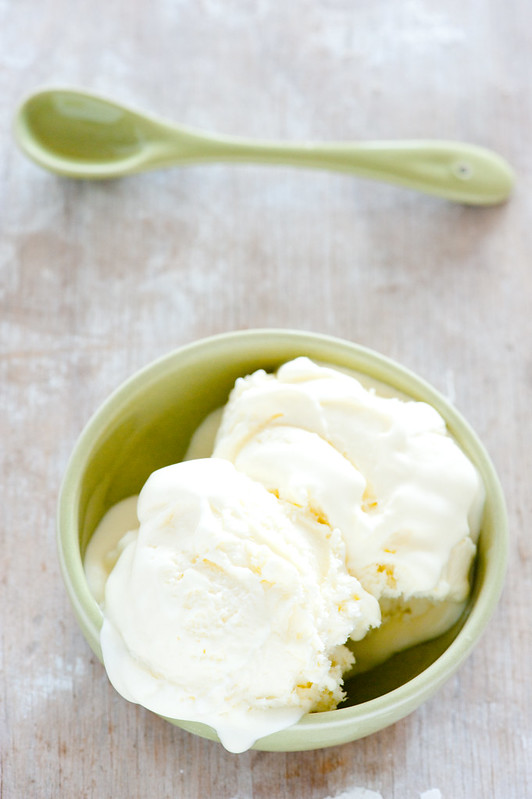
lemon ice cream. jules:stonesoup. CC BY 2.0.

Time for a hygge

with thanks to Kim Johnson, who recently reminded me of the word

It really is a hug
that you give yourself
perhaps on darkest days
in the dead of winter

when forecasts of snow and ice
fill the news
or maybe you already hear
tiny frozen pellets
striking the windows

but inside
you have a little crackling fire
jars of dancing candlelight
wafting balsam and spice
a bunch of fleecy blankets
a few brand-new books
and bookmarks
and maybe soft new slippers
(mine say “Sleeps with Dogs”
with fancy scrollwork. They are
blissfully snug)

maybe your Christmas tree
is still up (like mine)
or at least your strings of lights
outside, sparkling
in the bitter cold
where the faint sound
of windchimes drifts in
from a distance

with your favorite brew brewing
knowing you don’t have to be going
anywhere
or doing anything
except savoring the now
with a slothful-as-you-please
slowness

go ahead now,
give yourself
a hygge.

Dennis the dachshund is a master at hygge (pronounced hue-gah).

Originating (or at least perfected) in Denmark, hygge is the act of intentionally creating an atmosphere of warmth, coziness, and well-being, however it works for you, regardless of whatever is raging beyond your own walls.

We are getting reports here that the ice may cometh soon. Dennis clearly has his hygge on. I am preparing for it…got my new books and and my slippers ready.

Threads

While National Mental Health Awareness Month (May) is still weeks away, the COVID-19 pandemic has called greater attention to the need for support. Youth.gov explains the purpose of the national focus: “Mental Health Month raises awareness of trauma and the impact it can have on the physical, emotional, and mental well-being of children, families, and communities.” 

I note that children are mentioned first. They are at the mercy of the grown-ups, and when the grown-ups in their lives are suffering, children suffer. They often don’t understand or have a framework for understanding, not for years to come, or maybe ever. To a child, your norm is your norm. You have little to no power of your own. Think of how long the Turpin children suffered, before one managed to escape and get help.

Last month, in the neighborhood of the school where I work, a little girl was found dead with her mother in an apparent murder-suicide. I didn’t know this child; she wasn’t one of our students. But I have mourned her, mourned for whatever she suffered in her short life, mourned that a mother, unable to cope with whatever lies in her untold story, would resort to taking the life of an estranged partner and then her child.

People speak of unbreakable bonds, of the ties that bind. Sometimes those threads are very, very fragile.

Some of the threads running through the background are beautiful and bright, even as the family portrait bleeds away from the canvas. 

Sometimes destruction doesn’t come all at once, but by a long, slow unraveling.

Threads 

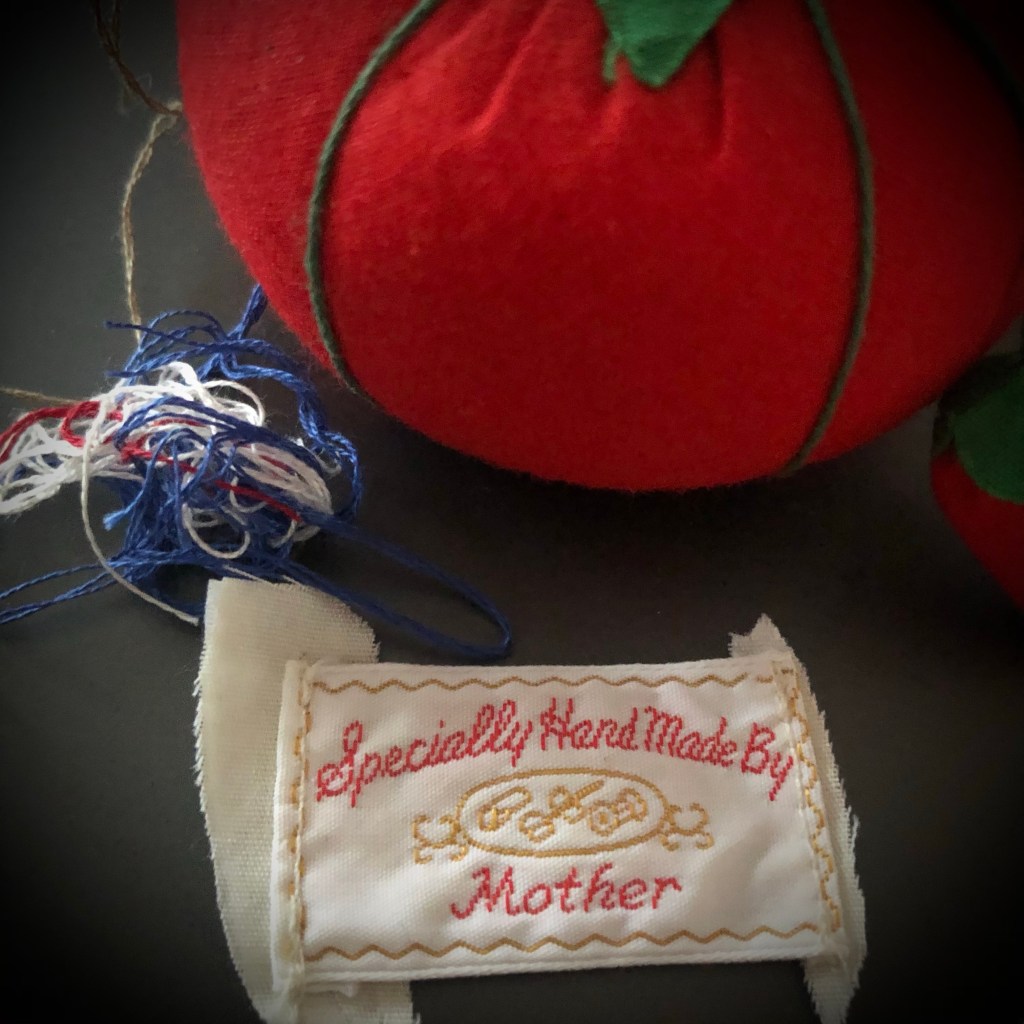
This morning I trimmed the threads off of my patchwork writing journal.

As I balled them up to throw them away

I realized the tangle of color in my hand.

They spoke to me: Remember?

Oh yes, I used to see you all over the floor when I was a child.

Rolling lazily across the hardwoods when we walked by

or nestled in the frayed carpet of the living room.

Fragments of my mother’s handiwork

vestiges of the artist she was

crafter of clothes we wore

tailor for many more.

Who’d have believed that such a creator

could destroy so completely?

A family of threads, each one its own vibrant color

in seams ripped apart

scattered far and wide

drifting on

and on

and on.

*******

The annual Slice of Life Story Challenge with Two Writing Teachers is underway, meaning that I am posting every day in the month of March. This marks my fifth consecutive year and I’m experimenting with an abecedarian approach: On Day 20, I am writing around a word beginning with letter t.

The poem has been sitting as a draft for exactly two years today while I pondered publishing. I wrote the original draft as a participant in professional development for literacy coaches, of all things. I can’t remember the prompt now, only that we were to share our poems with a colleague.

My colleague wept.

I share it for the children.

Inspiration comes on wings and paws

I saw her a couple of times across the convention center lobby. She wasn’t deliberately calling attention to herself. With her flowing blonde hair and elegant bearing, she couldn’t help standing out in a room full of people. 

I smiled at first glimpse of her: A service dog. 

And such a beautiful one.

I suppressed the urge to go over to her, knowing that service dogs are on duty. I briefly wondered if the man she accompanied had impaired vision or special medical needs and whether this throng of humans had the animal on heightened alert.

Instead I focused on my upcoming break-out session. For the second year, my colleague and I were sharing the effects of my school’s Harry Potter club with attendees of the North Carolina Reading Association. It’s a fun and meaningful presentation centering on the sense of identity that develops among diverse learners in third to fifth grades; many students find it such a place of belonging that they ask to be in the club semester after semester, even if we are reading the same stories and making the same crafts.

The best part is how excited teachers are to attend this session at the conference. Never underestimate the power of Potter . . . as my colleague and I set up the slideshow, the room filled quickly with participants and an air of festive expectancy.

Then—in strolled the service dog! Her person took a seat near the front (he wasn’t vision-impaired; he read the welcome slide and made eye contact in conversation with others). The dog immediately lay on the floor alongside his chair, flat on her side, utterly still. Her gleaming dark eyes gazed toward the front of the room.

What a gentle face. I looked back at those sweet eyes for a lingering second, my curiosity thoroughly piqued with regard to her service role, as my own role of presenter began.

—Here’s hoping you like Harry Potter, little canine friend. 

There she lay throughout, even at the conclusion when teachers came to the front of the room to select materials for making a craft like the club kids do: A clear ornament filled with strips cut from pages of an unsalvageable, falling-apart copy of Harry Potter and the Sorcerer’s Stone, a feather pen, a pencil broom, a flying key. 

The dog’s person chose to make a flying key. When I went to check on his progress, he introduced me to his canine companion:

“This is Palmer.”

Her big eyes considered me benignly.

“Hi, Palmer. You’re a beautiful dog!” I desperately wanted to stroke her lustrous yellow-white fur.  

“Want to see what she can do?” asked Palmer’s person.

“Sure!”

She does tricks, then? Do service dogs actually DO tricks?

I had no idea what to expect.

Couldn’t have predicted . . . .

Her person stood. Palmer instantly stood before him.  Her person produced cards with words on them. As he displayed them one by one, Palmer did exactly what the words on the cards said. Sit, lie, stand . . . her trainer—as that’s clearly what he was, now—even shuffled the cards behind his back, held them up again, and Palmer still enacted the word on each card. Accurately.

At this point the entire room was agog: “The dog’s reading the cards!”

Her trainer smiled. “Palmer helps kids at my school learn to read. Especially first graders with sight words.”

I blinked back a sudden welling of tears, envisioning the children with this dog in the classroom, the joy of it. “How wonderful.”

—”Want to take a picture with her?”

I recovered myself: “Oh—absolutely! I’d be honored!”

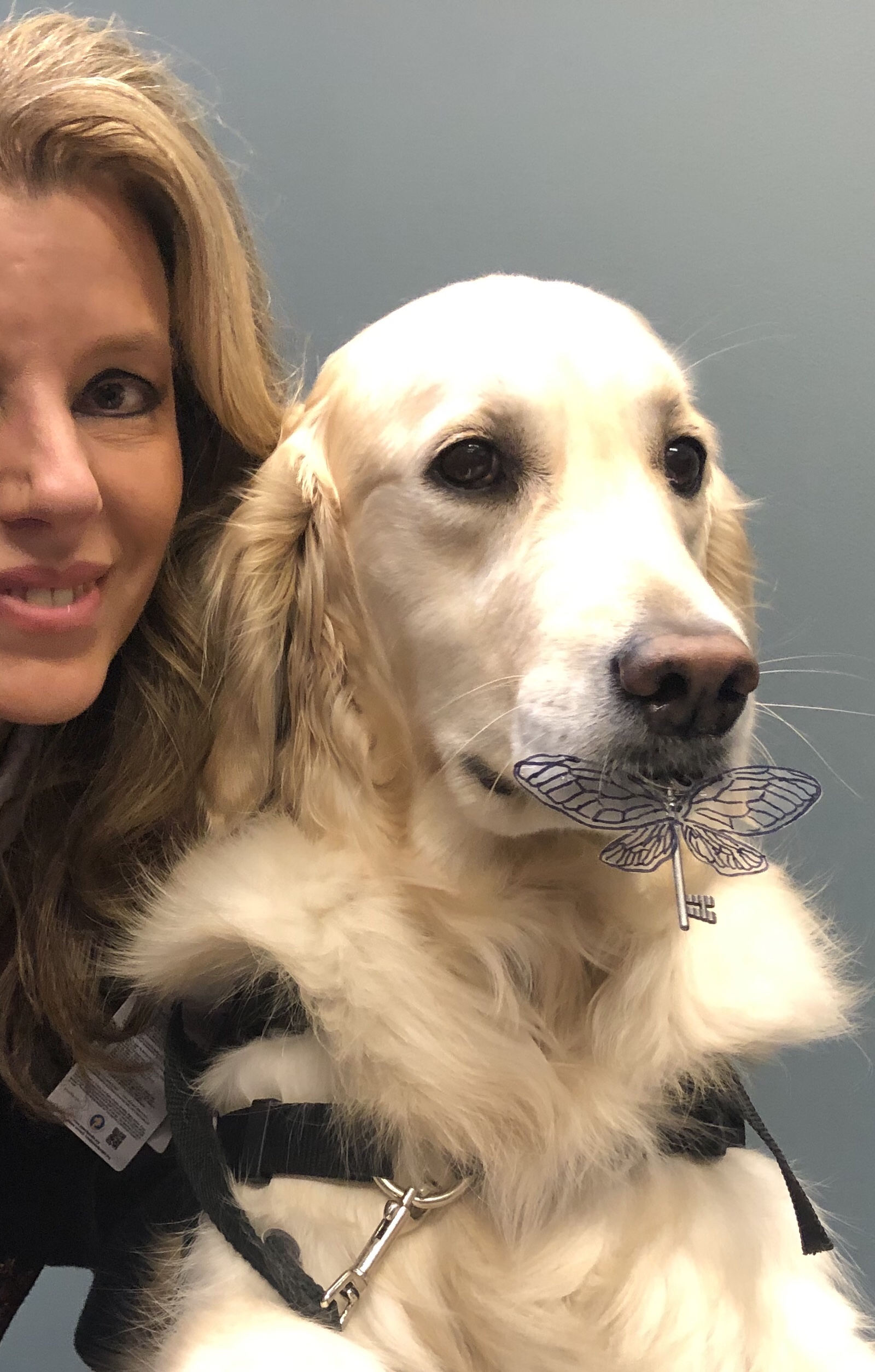
So Palmer posed beside me at a table, her paws resting on top. Her trainer held out his newly-made winged key: “Hold it, Palmer.” 

And she took it, ever so gently, in her mouth. She held it for all the photos.

Which, to me, holds great significance.

I always think of the winged key as a symbol for unlocking problematic doors in reaching an important goal, as it did in Harry Potter and the Sorcerer’s Stone. I think of it as a metaphor for inspiration, as in flying above and beyond learning obstacles, especially with regard to challenges that some of our Potter club kids have faced.

And here is Palmer, herself a symbol of meeting social-emotional needs, for I have since learned that she goes above and beyond motivating young children who are learning to read. She also helps children at her school attain their behavioral and academic goals. If they need extra encouragement while working on math, or the comfort of a warm, benevolent, stabilizing presence close by, Palmer is there for them. She is a key to overcoming whatever challenges they face. 

—I can think of few things more magical and inspiring. 

Palmer, Educational Assistance Dog.  April 2, 2019.


A healing presence

One of the kids in our Harry Potter club, a third grader, wanted to know:

“Mrs. Haley, if you could do any of the magic, what would it be?”

That’s an easy one.

“Healing,” I say.

The children think I mean “episkey,” the little mending of a broken nose or split lip (its name coming from Greek for ‘repair’).

But I mean the healing song.

The one without words, that puts the maimed, the mortally wounded, back together; the song that knits gaping wounds closed.

In the books, the strange song, invented by Professor Snape—perhaps the ultimate antihero—heals devastating physical wounds. They’re obvious; the injured people lie around bleeding profusely.

So many people walk around in the real world just as wounded, emotionally, spiritually, mentally.

Sometimes it is obvious.

Sometimes it is not.

I am not a magical character in a fantasy series nor a trained medical professional. I am no alchemist, apothecary, or angel. I cannot dispense healing.

But I write.

My words don’t grant healing, but maybe they can stir hope of it.

I can listen.

I don’t have a healing song, but I can have a hearing heart.

I can be still.

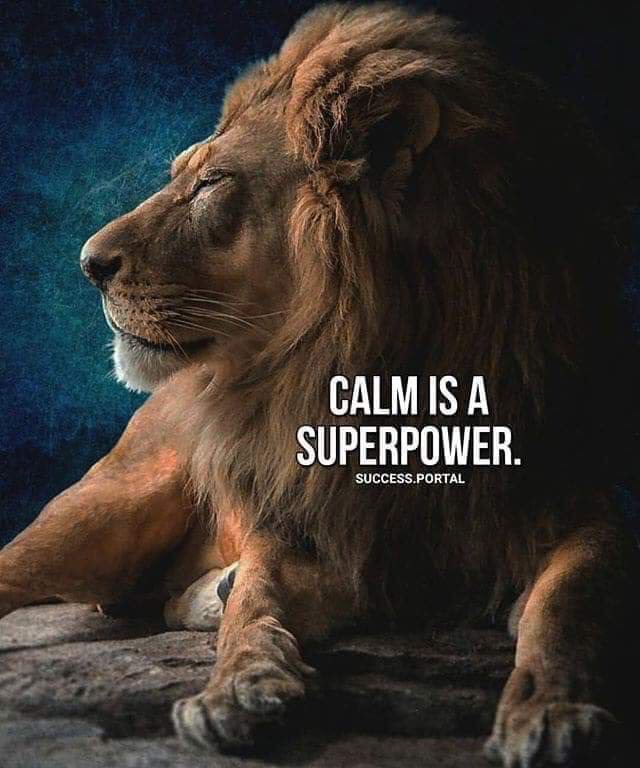
I can be a pocket of calm inside a world of clamor.

It’s not in my power to fix broken hearts, broken spirits, broken minds, broken families. If I could, I would have done so for many I’ve loved.

I can only be a presence, a voice, an encouragement to be strong in the broken places.

—Yes, healing.

—That is what I wish, children.

Image result for if you don't heal what cut you


I see you

From the desk (so to speak) of Henry Rollins Haley (HRH), “pawthor” of the Henry Writes posts

[With right paw, adjusts laptop lid for best camera angle. Commences typing with one foreclaw]

Hello again, at last.

It’s been a while, has it not?

I’ve not forgotten you.

It’s just that I SO RARELY get screen time.

Can you see me—?

Because I can see you.

And, frankly, I’m worried. A lot.

You seem tired. Tense. Does your head hurt? Your bones? Your heart?

Something does. I sense it.

It makes me anxious.

Not for myself.

For you.

See, I have this innate, overwhelming, all-consuming need for everything to be okay, and it can’t be, if you are not okay.

I have no alternative but to dispel this disequilibrium. I am utterly compelled to restore a balance of Well-Being and Goodwill, for, otherwise, I simply cannot cope.

I’m unable to speak this, as you know. I must communicate via the only means I have.

Fortunately, I can type . . . .

But better still, I come as close as possible to you. I wait for you to see me. To acknowledge me, welcome me, invite me. Give me a sign. Then I will offer you my questing paw, my nudging nose, the long, velvety-warm magnificence of Me, custom-made for absorbing your sadness, your tears, your aches, your angst, so that they melt deep and far away, into insignificance, to irrelevance, nearly to nonexistence.

My gift is calm. My presence, peace. Your being, my being.

And so I wait and watch, hoping, hoping, forever hoping. Can you see it in my eyes?

Can you see me?

I see you.

*******