with thanks to Dr. Stefani Boutelier on Ethical ELA’s #VerseLove today. She writes of the way a title can change the interpretation of a poem, or how it might add layers of metaphor: “I invite you to write a poem where the title helps identify its content, theme, or purpose. The topic and form are up to you–the focus today is on the title.”
I will share my poem’s title at the end.
For Day Fifteen of National Poetry Month
The stories of time before my time I lived them through your telling felt them through your pounding heart breathed them with your young lungs until I wanted to run coughing from the reek of smoke the acrid taste of ash and I think of how you spent your years giving yourself to others despite the ghosts that surely clung as smoke clings to clothing and as I enter the doorway I can hardly breathe for the cloying scent of flowers and there you are on the table ready and waiting in your little box conveniently resting in a little white tote I dare not trust the handles I just wrap my arms around you and carry you against my heart like I did my babies only there’s no car seat needed now
still, I must keep you safe in your new lightness so I strap the seatbelt across us both pondering the measure of a man larger than life so reduced
but I’ve got you, I’ve got you cradled close see now, I’m driving you home sun and shadows flickering over us like old newsreels of liberation
******
Title: What Remains
Dedicated to my father-in-law, a World War II veteran.
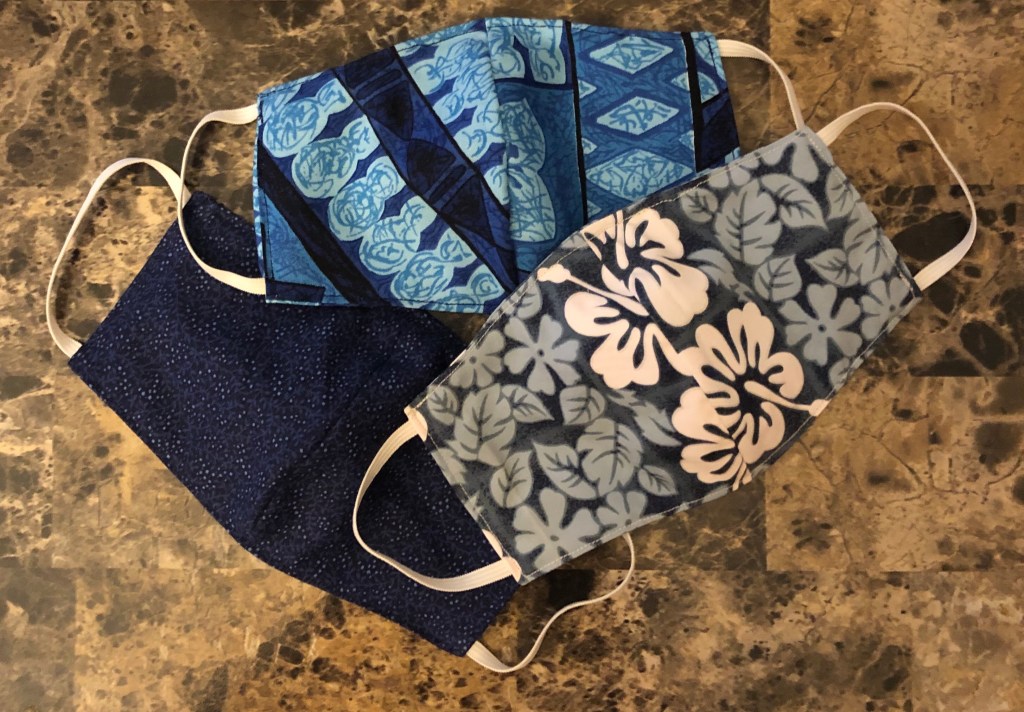
A friend wanted to know if my family would like some face masks.
She is making them.
She sent us pictures of the fabric—she has bolts of it—for us to choose the prints.
Yesterday she and her husband pulled up in our driveway to drop off the masks. My husband and I went out to meet our friends, offering our thanks only in words, no hand-grasps or hugs … a time to embrace, and a time to refrain from embracing … a few weeks back, we were all sitting around the dining room table here in the house, laughing and telling stories after a lasagna dinner. It seems long ago.
When will we be able to do so comfortably, again?
When I look at these masks, I see all that they represent. Shields in time of trouble. A friend channeling inertia into something productive, a practical means of battling an unseen enemy. Self-care spreading out like a blanket to cover others. Homemade love. Colorful patterns against the dark backdrop of our days.
These masks are artifacts of our times. Symbols of our story as we live it. And nothing connects humanity as much as story.
As I walked out to the driveway to receive these gifts, my grandmother’s voice echoed from across the years:
You won’t believe it, but where these woods are now used to be houses and farms, up and down this little road … when the Spanish flu came, it hit all but a couple of them … twelve people died in one week … Mama made pots of soup and Papa would carry it to their doors. He wouldn’t go in, of course …
Grandma wouldn’t have had living memory of this. When the influenza pandemic began in January 1918, she was only two. But she knew the stories. If my own memory serves me correctly, as I walked the tiny country cemeteries surrounding her homeplace, listening to her narratives of the people resting there—for she knew all their stories, and how they were connected— there was an unexpected commonality.
A death year. 1917.
That was before the Spanish flu.
Grandma nodded. There was a sickness before: They called it hemorrhagic fever. People would bruise and bleed from their noses and ears and eyes … a lot of people who tried to take care of the sick caught it and died, too …
She was hardly more than a baby then, a girl born and raised in a hard place in hard times, but here she stood, by the weather-worn stones under a cloudless blue sky, telling the stories seven decades later.
Because of story, these events are lodged in my memory a hundred years after they happened.
My father was Grandma’s first child, born during the Great Depression. Flour companies made their sacks with patterns and bright colors so people could make clothes out of them … look at my handmade face masks and tell me they aren’t reminiscent. A second child, my aunt, arrived with the war. Granddaddy moved the family from North Carolina to Virginia; he found work in the shipyard, where production increased to the point of cranking out ships in less than a third of the time it normally took. How can one not compare that to the scramble for mass production of ventilators today …
Grandma said: It was so hot that summer. I was miserable, being pregnant. I’d sit by the upstairs window and watch the iceman delivering blocks of ice to grocers … companies stopped making refrigerators … everything went into the war effort. I just cried. I’d have given anything for some of that ice … then we had ration cards and could only get certain things at certain times … once my sister Jack and her husband pooled their gas ration cards with ours and we all went on a trip to Massachusetts … it was so beautiful and so cool there …
I look at these masks and that is what I see.
The story of overcoming. Of determination. Of resourcefulness in time of scarcity. Of finding a means to be a good neighbor, a good friend, a real and present help in time of need, even if from a safe distance. Sharing so that everyone has enough. Acts of service, gifts of love. Sacrifice.
A little girl clutches Mama Bear and Papa Bear. Baby Bear has accidentally been flushed down the toilet. Clad in a mod red pantsuit instead of a long white dress, and with hair too short for cinnamon buns on the sides of her head, the little girl is nevertheless a princess of sorts, if not a rebel. Yet.
“Stand right there and smile,” says the little girl’s grandmother, who snaps a picture. The little girl really cannot not see the camera, as the sun is in her eyes. She smiles anyway.
Behind her stands the Galaxie – a 1964 Ford Galaxie 500 that the little girl’s Granddaddy bought, used, for her Grandma. The exterior of the car is red. The interior is red, the fabric of the seats trimmed with silver cord. The Galaxie doesn’t have power steering or air conditioning. In the summer its windows must stay rolled down if the people inside are to survive. Once it lost a hubcap and the girl’s Granddaddy had to run after it in the city streets.
Yet the Galaxie represents power, things far beyond the little girl. Ford Motor Company named it for the Space Race before the success of the United States over the Soviet Union, which came to pass in 1969, when Neil Armstrong and Buzz Aldrin walked on the moon. The little girl has no memory of this event but likes watching Star Trek with her dad: “Beam me up, Scotty.” She sings The Jetsons theme song: “His boy, Elroy . . . .” She loves the Jetsons’ dog, Astro. Space gets up close and personal in March of 1970, around the time this picture is taken. A total eclipse occurs in the southeastern United States. The little girl’s family and all the neighbors run out of their apartments in an excited frenzy to watch it. A hush, a stillness, falls over them as the bright day goes as dark as night. The sun disappears, becoming a mere halo around the huge, black moon.
“Don’t stare at it,” says Grandma, drawing the little girl close. “It will hurt your eyes.”
The little girl stares anyway, because it is so strange to see the sun go dark.
The world was changing fast. So was my universe. In the year following the eclipse, my grandfather retired. He’d been a shipbuilder since World War II. “We turned out ships in three months in during the war,” I recall him saying, “when it used to take a year.” The war had been over for twenty-five years and it was time to go home; my grandparents packed everything, loaded the Galaxie, and returned to the remote outskirts of Aurora, North Carolina – a tiny town named after the Roman goddess of the dawn. I thought at first it was named for Sleeping Beauty.
My summer voyages began. There on the old dirt roads where my dad ran and played as a child, I learned how to drive with that Galaxie. It was, after all, more indestructible than the Death Star. It was still running after the birth of my first child. My grandparents finally gave it away to the man who hauled trash off for them.


 lit bits and pieces