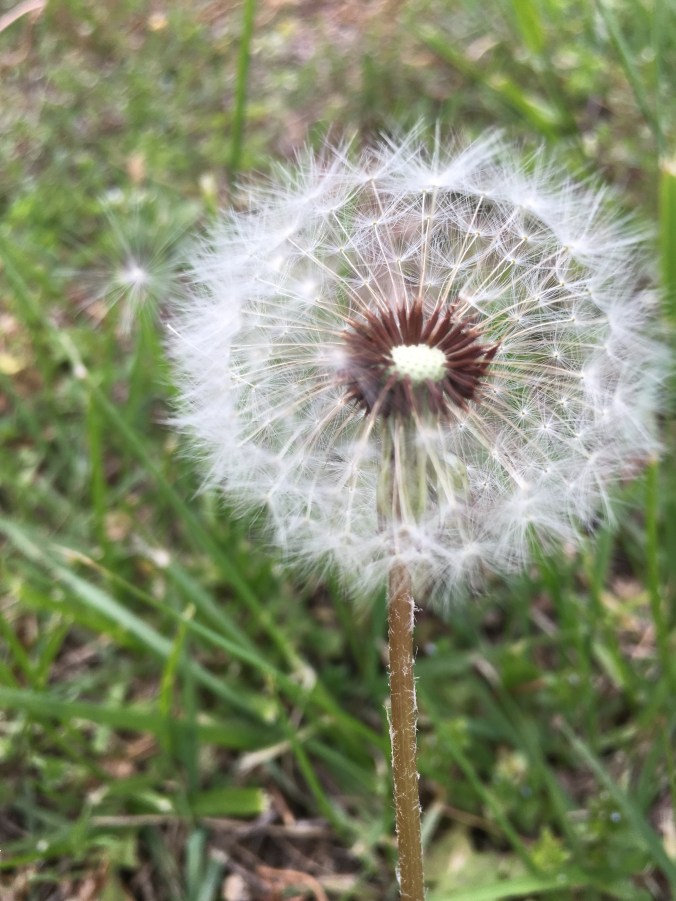
Yesterday, while outside with my old dachshund, Nikolaus, I saw this old dandelion.
It stood trembling in the soft spring breeze, holding its seeds tight under its parachute sphere, and I thought Any second now they’ll be blowing in the wind.
Which reminded me of the song.
When I was a child my parents had a stack of record albums, and in it was Peter, Paul and Mary’s In the Wind. Only now do I wonder which of them purchased it, for my young father and mother seemed more representative of the fifties than the sixties. No beads and long hair or tie-dye. Daddy wore a crew-cut all of his adult life. My parents were . . . just parents. Pretty mainstream. I don’t know how old I was when I first heard the album, but as a child I played it over and over on the old stereo, a huge, bench-like piece of furniture on four legs that took up half the length of the living room wall.
Bob Dylan’s “Blowing’ in the Wind” was one of my favorites, mostly because Peter, Paul, and Mary’s harmony was as haunting as his lyrics. But it wasn’t the song I loved most on the album.
That was “Stewball.”
It’s about a racehorse, the underdog, and how a man laments betting all of his money on “the gray mare” and “the bay,” how he wishes that he’d bet on Stewball, who somehow managed to win the race.
The ballad’s content is mournful—Oh, the hoot owl she hollered, and the turtledove moaned, I’m a poor boy in trouble, I’m a long way from home—but the instrumentals jingle along, almost incongruous with the words. Perhaps not as incongruous as me, less than ten years old, swinging as hard as I can, round and round on a tire swing that Granddaddy hung from a pecan tree in the yard of my father’s childhood home, singing at the top of my lungs: Oh, Stewball was a racehorse, and I wish he were mine, he never drank water, he always drank wine . . . .
So long ago.
Funny how songs can weave their way through chapters of our lives, as they do through movies. There are stories to be told about the poor choices of adults, and the consequences, with “Stewball” playing in the background.
Nik the dachshund makes his way back to me, staggering in the grass. At sixteen he’s unsteady on his feet and blind; he plows into the old dandelion. Instantaneously the perfect white sphere dissolves, the seeds go airborne.
The answer, my friend, is blowin’ in the wind
The answer is blowin’ in the wind.
Maybe it’s answers I seek.
Maybe they’re seeking me.
I do not know.
But I do know that ideas are everywhere, blowing in the wind; I sense them and I know they’ll land, somewhere, sometime, that they’ll take root and grow. If I write them, they’ll spawn more and more ideas.
I gather Nik in my arms, careful of his old, fragile bones, and go back inside the house, humming.
 lit bits and pieces