I want to be riding the contours of my students’ writing—not judging it.
–Ralph Fletcher, quoting poet and writing teacher William Stafford
Day Four of our Teacher Summer Writing Institute opened with reflection on the quote above.
“I think the use of the word riding is significant,” said a colleague. “It means that students should be in the driver’s seat with regard to their writing. The teacher is a passenger.”
Another participant chimed in: “The word contours really stands out to me. I think of waves”—her hands move through the air as if tracing curves, rising, falling—”and how the path of each student’s writing is so different, because they’re all in different places.”
With a focus on “Writing to Transform,” teachers spent the better part of the day exploring the research and impact of specific feedback, along with tools and approaches to conferring with student writers. They practiced with each other. Teachers at the secondary level discussed the use of Screencastify and Google Keep as a means of giving feedback to large numbers of students.
They continued writing pieces from yesterday. A science specialist told me: “I started writing poetry and I couldn’t stop. I went home last night and wrote more.”
I listened to her, feeling as if I were living in a dream, straddling the line between reality and ethereality. Reminded, yet again, that the need to create is embedded deep in the hearts of humans.
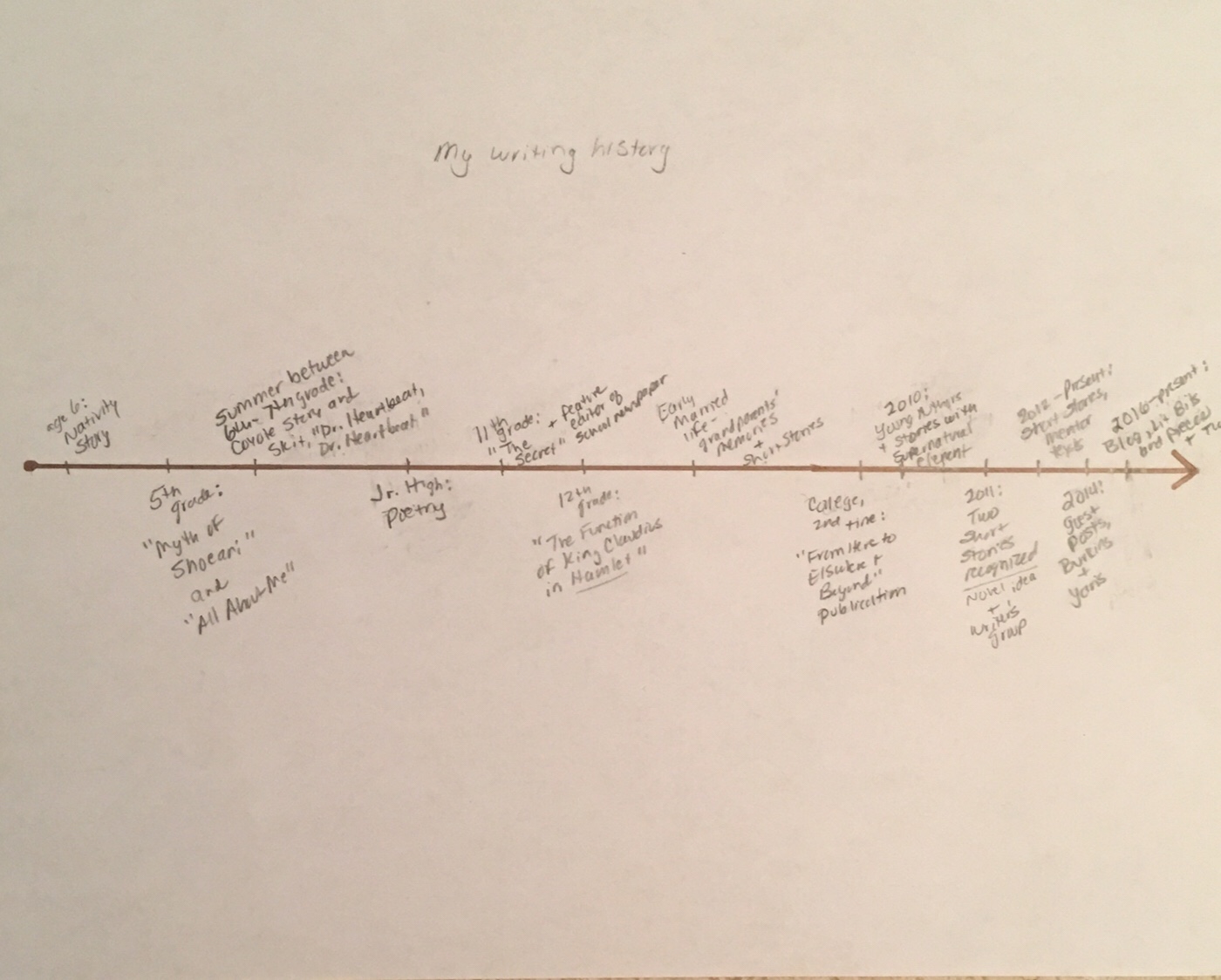
We all took some time to reflect on our own writing histories, moments that shaped us into the writers we are at present.
For there’s a why to the writers we are.
I walked my colleagues through my own writing history (having spent much time pondering this recently). I made my first feeble attempts at writing stories just because I wanted to around age six. I don’t remember any more writing until about fifth grade, when I had great fun creating “The Myth of Shoeani” on how shoes were invented (we were studying mythology) and an autobiography that drew praise from the teacher regarding my “vivid detail.” I recall how surprised I was by the compliment. I went through a heavy poetry-writing phase in junior high, clearly a means of surviving my adolescent self. As a young wife, I suddenly realized that I was the bridge from the past to the future; I began recording my grandparents’ stories. How glad I am now that I did. My grandmother wholeheartedly encouraged my writing, believed I had a gift for it . . . but that’s what grandmothers do. Even as I won recognition for literary criticism and placed in short story competitions, as I amassed stacks of unfinished stories and mentor texts written in front of students as models, I thought of myself as someone who loves to write, who loves to encourage others to write, not “a writer.”
Not sure exactly when the shift occurred, only that it wasn’t so long ago.
The realization that writing is not just something I do.
It’s who I am.
A writer.
“Something we must remember,” I told my teacher colleagues as they began contemplating their own writing journeys, “is that we are currently helping to shape our students’ writing identities.”
Riding those contours, as individual to each student as patterns to snowflakes.
For we do not transform our young writers.
Their own words will.
We just help them harness their power.
From our place in the passenger seat.
When writers believe their words matter, nothing can stop them.
-Ruth Ayres, Enticing Hard-to-Reach Writers
 lit bits and pieces