Love returns

In the fading light
on the last day of January, I hear it:

a loud, merry squawk! on the front porch.

First time I’ve heard that precious sound
since last April, when the silence set in
without warning, when the whole nestful
of beautiful finch fledglings in my door wreath
died.

Season after season, tiny life
came into being
on my portal,
taking wing from sky-blue eggs
to blue-egg sky, until the April day
when it stopped.

The hardest part of loss
apart from the emptiness
is the unanswered why.

For now we see through a glass darkly,
wrote the Apostle in his chapter on love.
Those words echo in my memory
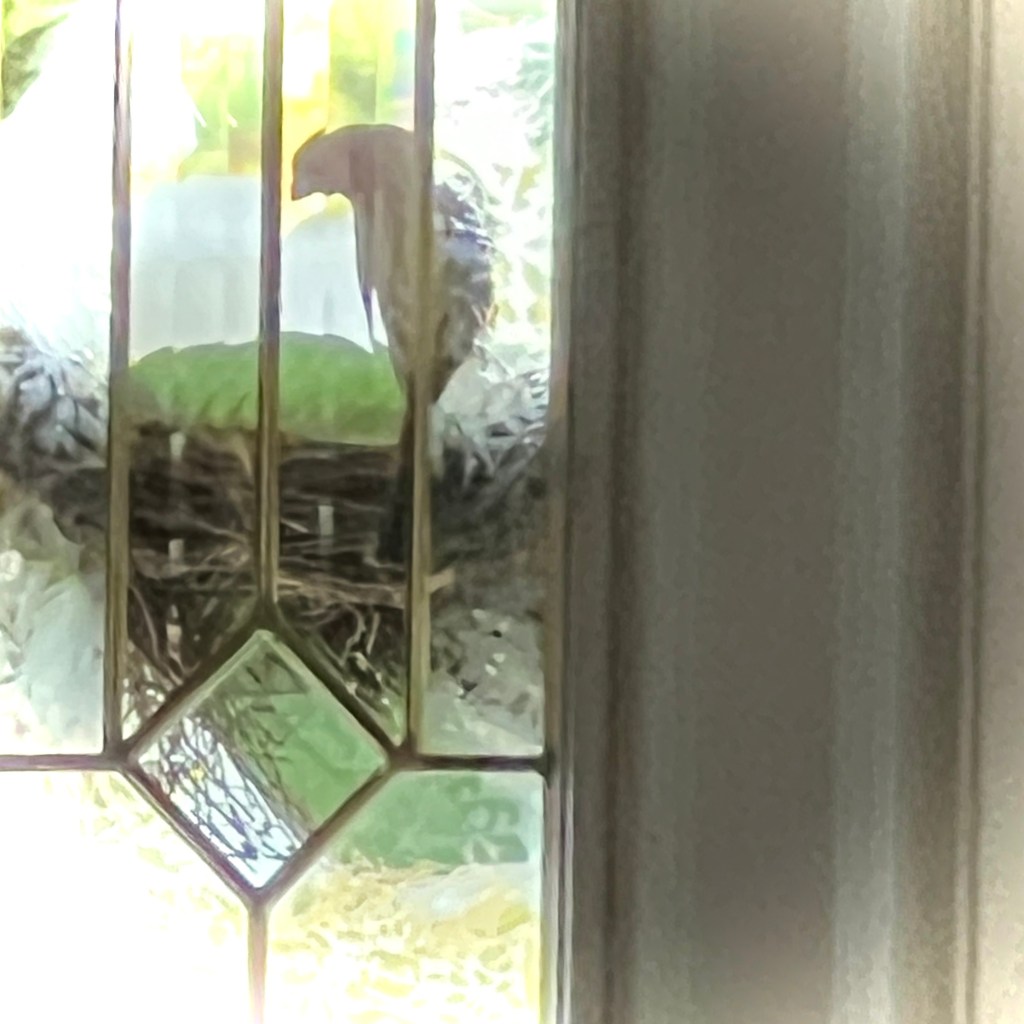
as I look through the etched-glass window
of my door, where the silhouette
of the visitor perches on
the replacement wreath.

I don’t know, but I suspect
he’s the father, returning to
scout for a safe nesting-place
as in seasons past.

I don’t know if I am hoping
he’ll choose this wreath
as bird courtship
goes into full swing.

I don’t know, here on the cusp
of Valentine’s Day, if my heart
is willing to risk
giving itself away
after such
a shattering

but at the sound of that squawk!
it instantaneously leaps

and I can’t help remembering
how Grandma used to phone me,
saying
I just wanted to hear
your precious voice.

You cannot know, little Finch
on the other side of the glass,
how precious your voice is to me
or how I marvel
at your resiliency.

In the long continuum of things,
our stories are interwoven
as much as the grasses and tiny flowers
and random sweet feathers in all
your former nests.

If you dare to build again
here in my sanctuary
I will dare to love again.

If you do not, I will understand
that your new life will go on elsewhere
as I go on cherishing
every bright memory
and the sound.

The return

Fallow

Halfway between work and home
I noticed the field.
How could I not, such vibrant green
popping against the panorama
of brown grass and tired trees
giving way to winter.

I needed this shot
of unexpected freshness
after these first days back
to full-time work
with my husband at home
in the middle of a slow recovery
from spinal surgery.

The waning afternoon light
slants gold across the green
and there, there,
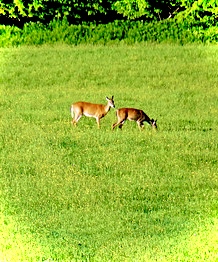
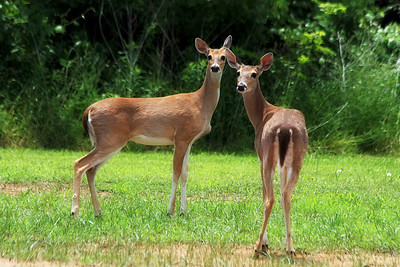
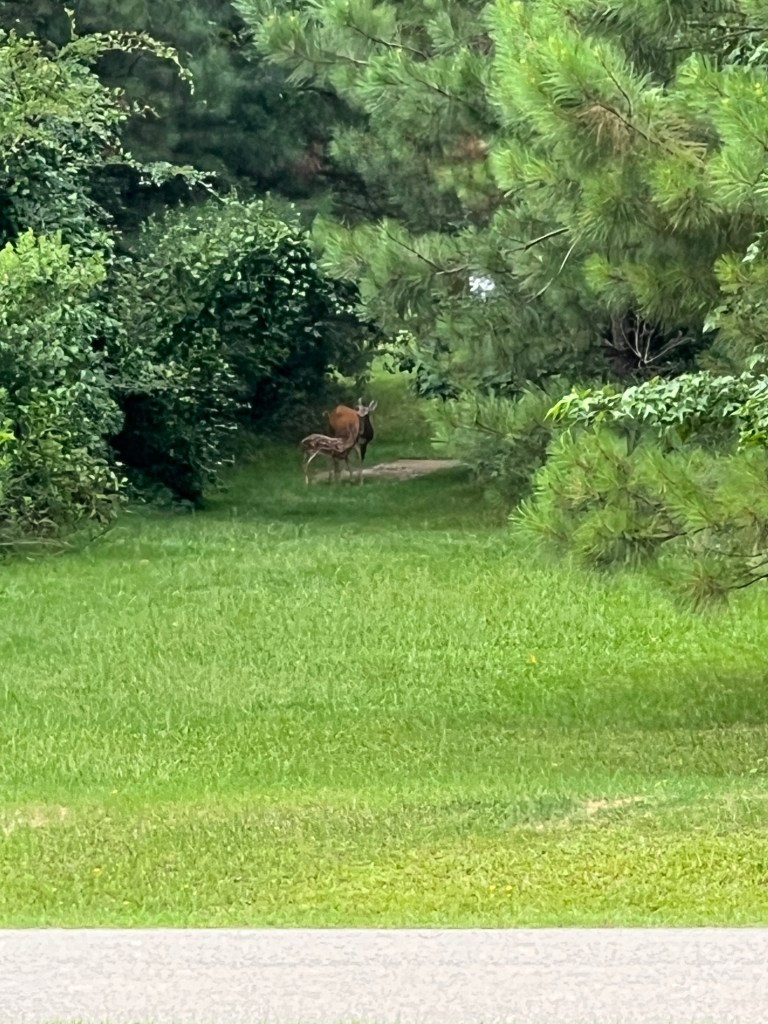
clear as day, two deer
graze, gilt-edged
and peaceful
and perfect

as if it isn’t hunting season
as if carcasses of their kindred
aren’t lying mangled by the roadside
within their view
as if the long in-betweenness of
hours and days and seasons
and breaths
is no consequence

as if all that matters
is this field left fallow

for their sustenance

and now
mine.

NS-01036 – Whitetail Deer. archer10 (Dennis) CC BY-SA 2.0

Whitetail Deer.TexasEagleCC BY-NC 2.0

Renewal: Spiritual Journey

This week I’m honored to host fellow Spiritual Journey writers who gather on the first Thursday of each month.

In choosing the theme of renewal, I note that one definition of the word is resuming an activity after an interruption. That’s exactly what I’m doing now: writing my first blog post in two months. My blogging life went on hiatus while a lot of other life happened. I spent the summer keeping granddaughters. I returned to work at school in a new role. And my husband, a pastor, slowly succumbed to debilitating back pain. Unable to stand for very long, he’s been preaching while seated in a chair. Surgery was inevitable. Having spent four days in the hospital at the end of October, he’s now home and slowly ‘resuming interrupted activities’ like sitting, standing, and walking, which are, at times, excruciating.

Considering my husband’s journey, I might have chosen the word endurance. He lost an eye to a rare condition in 2015. In 2019, he survived two heart attacks, cardiac arrest, and two subsequent surgeries. He was still convalescing when the COVID-19 pandemic hit. Through it all, something he came to enjoy, and which helped him regain his physical strength, was hiking at a nearby dam. I’d return home from work and he’d tell me: “I saw an eagle at the dam today!”

I started accompanying him on weekends, armed with binoculars and my bird identification apps. We saw (and heard) a wondrous variety of birds, most notably the ospreys with babies in their nest, the great blue heron at the waterfall, and the gorgeous red-shouldered hawk that flew ahead of us in the woods to perch on a low branch, where it stared right back at us, with considerably less awe.

No eagles.

As time wore on, my husband’s back wore out, and there were no more hikes.

When the pain relegated him to preaching from a chair, he finally scheduled the surgery. It was more than he wanted to endure. He was tired of enduring.

Which brings me to the need for renewal.

Circle back with me, for a moment, to the eagles.

A few years ago I had a medical issue which required an outpatient procedure. My husband drove me to the hospital and back home afterward. It was winter; I watched the bare trees and old farm outbuildings whipping by my window when I saw… could it be? A bald eagle sitting, big as life, at the roadside! If I’d been on a bike I could have held out my hand and touched it (theoretically).

I was, however, still woozy from anesthesia…perhaps it was a figment…

But my husband cried out: “That was an eagle!

He turned the car around.

The eagle might have ignored our passing again, but it grew suspicious when we slowed down. It unfurled its mighty wings and headed for a gnarled old oak.

Call it fanciful, if you like…sighting that eagle reassured me that all would be well with my medical situation.

So it was.

Four months later my husband’s heart stopped; he was resuscitated, with a shattered sternum; he survived emergency stents and bypasses.

He went walking at the dam as rehab. He saw eagles.

Although I’ve looked and looked, I haven’t seen one since that unique roadside appearance.

Until this last surgery.

Our oldest son offered to stay the first night with his dad in the hospital so I could come home and sleep. I was exhausted. I would stay the next night.

Early on the following morning, somewhat rested, I drove back to the hospital. October in the North Carolina Piedmont is breathtakingly beautiful. Along both sides of this particular highway the forest stretches out in a visual paean of orange, red, and yellow. That day, the blazing colors were framed by a brilliant blue, cloudless sky. Our son had texted that his dad had a rough night. We all knew to expect it it; the intensity of post-op pain for spinal surgery is severe. My husband has already been in tremendous pain for so long. He’s already suffered and endured so much…he knew he needed this surgery, but will he have the strength to endure the aftermath?

Will I?

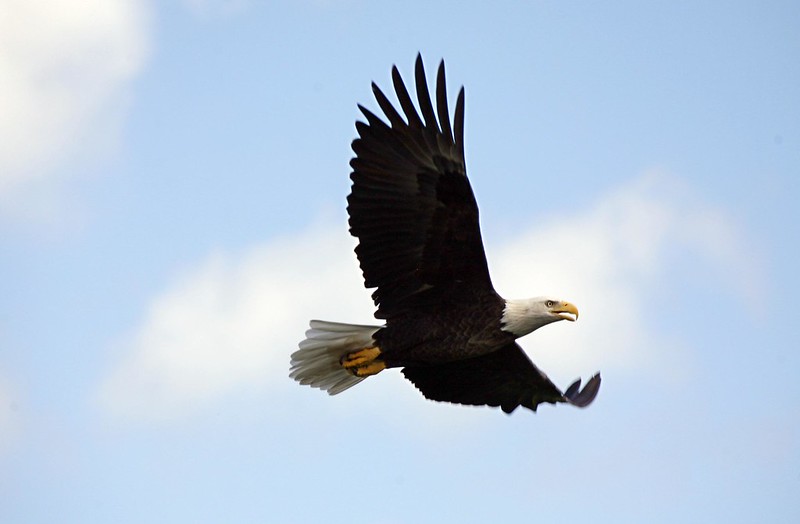
Such were my dark thoughts that bright morning, inching my way back to him in the congested workday traffic, when a solitary bird glided into view in the tranquil blue above the gridlocked cars. A big, dark bird with long, broad wings, white head shining bright in the sun…

It can’t be, I thought. After all the times I’ve tried to see one…that it should be now…I leaned as far as I could toward the windshield, taking advantage of the stopped traffic to stare upward.

It came nearer, sailing with easy grace, low enough for me to see its gleaming white, fan-shaped tail.

No mistaking it.

Isaiah 40:31 came immediately to mind:

But they that wait upon the LORD shall renew their strength; they shall mount up with wings as eagles; they shall run, and not be weary; and they shall walk, and not faint.

Renewal. An infusion of new strength, sufficient for the day. An assurance of more for the difficult days ahead. These words were originally given by the prophet Isaiah to the Israelites, foretelling the end of their Babylonian captivity. The people would make the seven-hundred-mile journey back home; they would be restored. The chapter begins with Comfort, comfort my people, says your God. The phrase they shall walk seems especially significant in light of my husband’s situation, that he shall soon walk without the pain that’s plagued him. There’s more to say about the biblical symbolism of eagles, but in this verse, the original language seems to allude to feathers rather than wings and an ancient Jewish belief that when the eagle molts, his youth and vitality are restored.

My husband’s battered body will not be restored to youth in this life. Vitality, however, means strength and energy, which brings us to another definition of renewal: a return to vigor. A return of physical strength and good health. That is our prayer for his healing.

Most importantly, the verse speaks to strength renewed by waiting on, or depending on, or clinging to, the Lord. More than renewal of physical strength. It’s spiritual rehab.

That eagle, appearing on the morning after my husband’s surgery, buoyed my spirit. As did the other I saw by the road on the day I was concerned for my own health.

We continue to wait on, to cling to, the Lord as we travel this long road of recovery. Daily renewal of strength comes from nowhere else.

Let me close by saying I’m awed, anew, by His use of visual aids for the spiritual journey.

Harbingers

I. That Morning You Drove Me Home From the Medical Procedure

back country byway, winter-brown grass
trees, old gray outbuildings, zipping, zipping past
small pond clearing, wood-strewn ground
bald eagle sitting roadside—too profound—

I thought it was the anesthesia
until you saw it, too,
before it flew.

And I knew.

II. On the Morning I Returned to the Hospital After Your Surgery

lanes of heavy traffic, day dawning bright
our son says you had a painful, painful night
dew on the windshield, fog in my brain
all hope of moving past this gridlock, in vain
but for the glory of autumn leaves, a-fire
against cloudless blue where a solitary flier
glides by, white head and tail gleaming in the sun…

I promise, beloved one.

Your healing
has begun.

Bald Eagle by Gary Rothstein, NASA. Public domain.

Dear Spiritual Journey Writers: Thank you for traveling alongside me!
Click here to add your post links.

Grace reflections: Spiritual Journey

My fellow Spiritual Journey writers post on the first Thursday of each month. Our host for September, Patricia Franz, offered these bursts of thought for reflection: Life at the speed of grace. Grace is my shorthand for God. How will Grace find you?

To me, grace, like love, is a many-splendored thing. It has many facets, casting fiery rainbow-sparks like a diamond ring.

When Patricia says It’s my shorthand for God, I remember discovering my aunt’s spiral-topped notebook when I was a child. The pages were covered in curious swirls and curls, an otherworldly language, impossible code. I was awed by the way my aunt, a civil-service secretary, could interpret these runes into words which would become an official letter typed on behalf of the U.S. military. To this day I cannot read or write shorthand. In this way, grace is code written in the offices of Heaven, authored by God, signed and sealed with His unfathomable, unconditional love. It is the language of love. To be a true recipient of grace is to be an authorized and expected giver of it, in turn.

But what IS grace, aside from aesthetics: clean lines, beauty of movement, a blessing over food before we partake? One dictionary definition says it’s the unmerited favor of God, something echoed over and over in the New Testament. My favorite grace-verse is probably Romans 5:8: God shows his love for us in that while we were still sinners, Christ died for us (ESV).

I have a bracelet that bears this paraphrase: I loved you at your darkest.

Grace.

In preparation for a lesson I recently taught at church, I arrived at another understanding of grace. In the same epistle to the Romans, the Apostle Paul writes: For by the grace given to me I say to everyone among you not to think of himself more highly than he ought to think, but to think with sober judgment, each according to the measure of faith that God has assigned (12:3). In this message to the Roman community of believers, Paul expounds on the characteristics that (should) set them apart from the rest of the world. That opening phrase is what catches my attention: For by the grace given to me…suddenly a portion of the code becomes clear. Grace is more than unmerited favor writ in the blood of unconditional love. Grace is a force for living. A sustainable fuel for powering us throughout all of our days.

I can never write about grace anymore without thinking of Eugene Peterson and his paraphrased reflection of Christ’s words in Matthew 11:29: Learn the unforced rhythms of grace.

Which of these word holds the most transformational power?

unforced

rhythms
grace

Learn.

For me, it’s learn. That is where I must begin. Grace begins with God. The unforced rhythms of grace are currents that have existed long before me and will continue long after me. Learn, as in learn to swim. Therein lies a unique freedom, being carried by that current and never being swept away by it. Grace seeps into one’s heart, becomes a beat in one’s blood, in one’s soul. A rhythm, a song, a dance. A unforced force for living.

Learn.

Of this, I will be forever a student. But all around me, every day there are reminders, endless grace-analogies making themselves known. During Hurricane Idalia last week, the hummingbirds never stopped coming to my window-feeders. The gusting wind and rain appeared to have no effect on these tiny creatures. Completely undeterred, the feisty hummers came for their nectar amid the storm, steady, straight, and sure, same as they do every day.

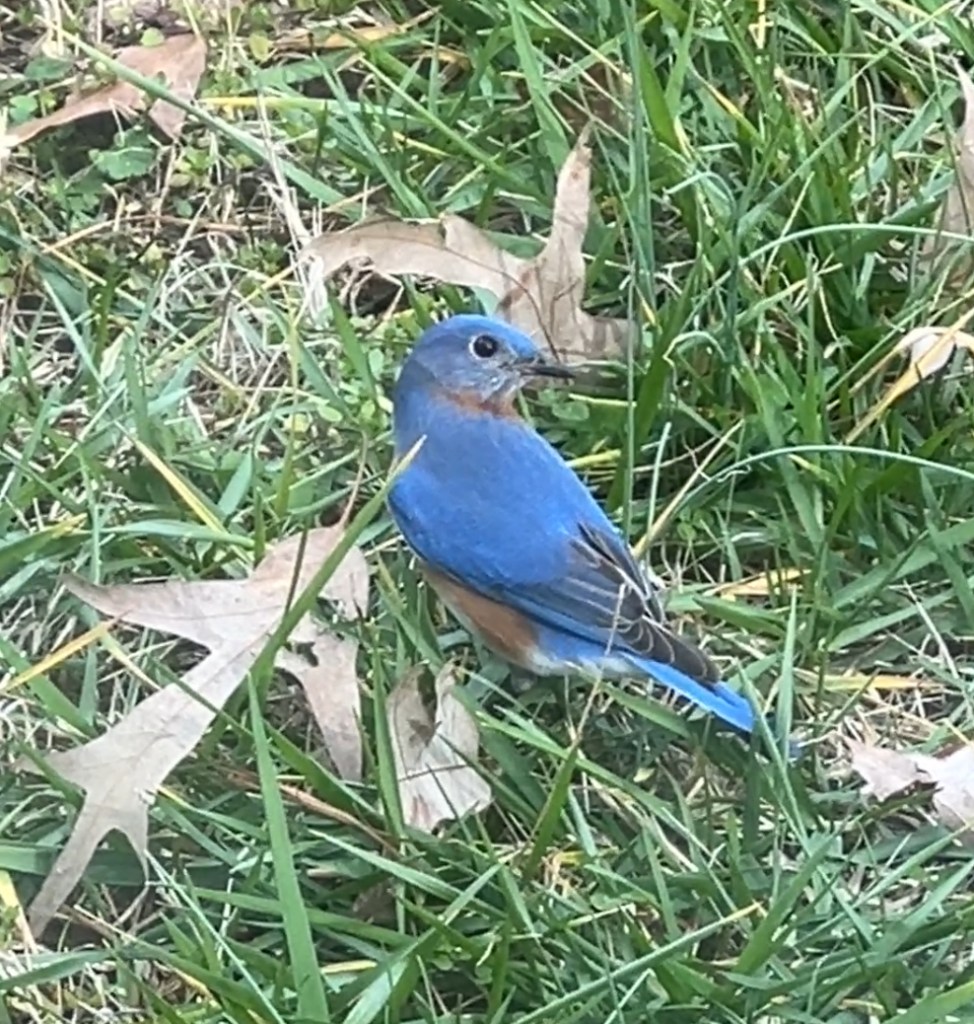
I have an entire bluebird family that appears, morning and evening, like clockwork, around their little log cabin birdhouse on the old grape arbor. When the birdhouse was on my dilapidated back deck the parents raised several broods in it. When I removed it for the deck to be torn down and rebuilt, the puzzled parents came searching for their home. It shattered my heart. I put the birdhouse on the arbor, not knowing what to expect. They found it immediately. The bluebird family followed it. They still lay claim to it, still operate from it. They are devout about it. I might add that there’s a little cross on the top of the birdhouse; my granddaughters call it the bird church. I might also add that it held during the hurricane…during several hurricanes, actually, including a few before it was moved.

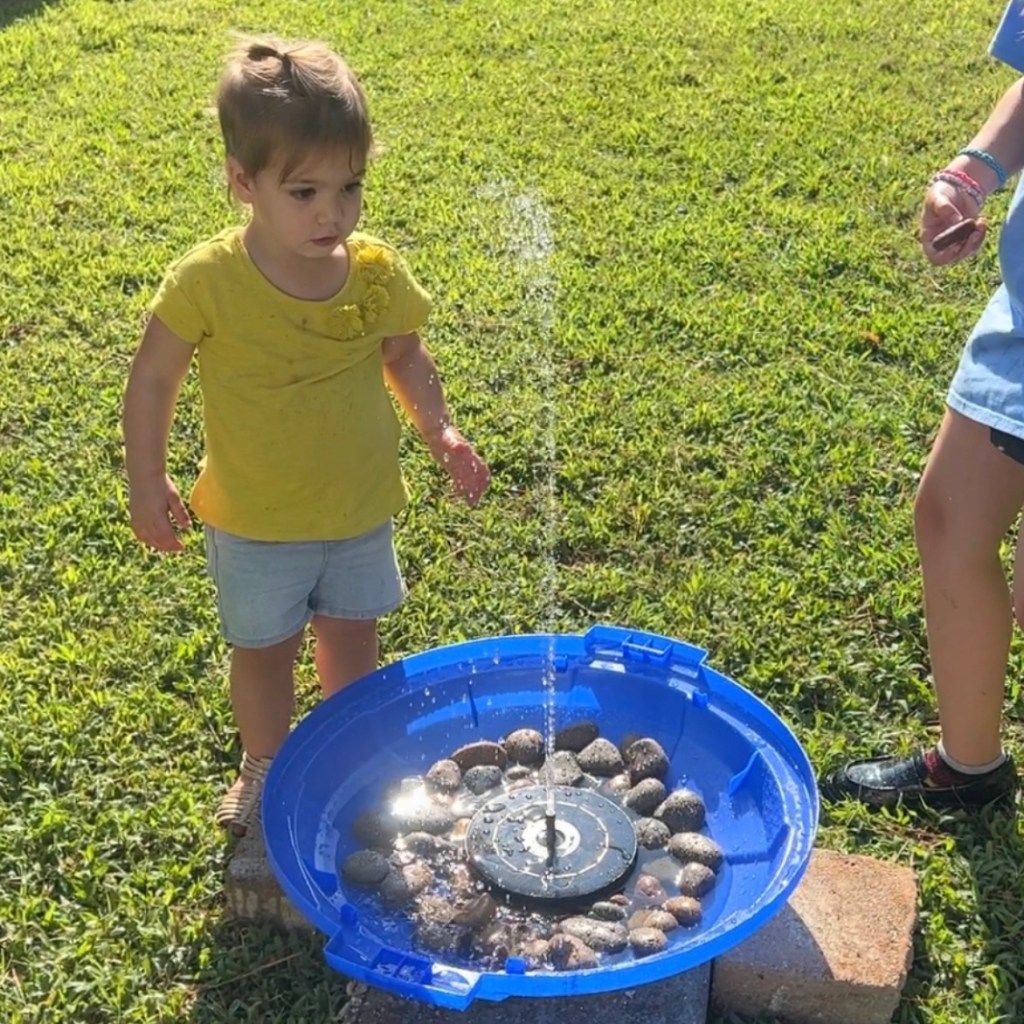
I consider the makeshift birdbath my granddaughters and I built with an upturned trashcan lid and rocks. The solar-powered fountain kept spraying in the storm, even though there was no sun that I could see in the grayness…

For me, all of these echo unforced rhythms of grace.

Most every morning and afternoon since school has started again, on my drive to work, I’ve seen the great blue heron I love at its pond in the corner of picturesque little farm. I’d much rather be birdwatching and soaking up nature than playing around online, but I couldn’t resist a “what bird are you” quiz I came across online. I gave it a try. The results: You are a snowy egret.

That same morning, when passing the pond, I didn’t see the blue heron. Instead I saw a white egret in flight, reflected in the pond.

The very image of grace.

I am more amused than awed: If that egret represents me, I’d be the reflection of it. I cannot be the breathtaking, winged creature itself, skimming with perfect ease above the water. But somewhere in my being is an image of it.

And so it is with God, in whom all things connect, from whom all blessings flow.

Unforced rhythms of grace on the wing, in every breath, in the often-turbulent currents of life, a never-ending song, a ceaseless rising.

Funny how I’ve just now remembered a thing, during this writing: When my husband became a pastor many, many years ago, I was asked to sing my first solo at church. I was twenty-two. Scared and unsure, I tried my best. I fell dismally short of what I hoped for. But an elderly man, a woodcarver, made a gift for me to commemorate the occasion: a white egret on a little base. Underneath, he etched the title of the song: Amazing Grace.

Let me throw my wings wide
to rest in and ride
the currents,
O Lord.
Let me abide
in the depths of your grace
as a wanting but willing
conduit.

Snowy Egret reflection. Wendi Schneider.

Screenshot

Usually it’s the sound of cicadas that stirs my soul, their rattling courtship-chorus reaching a feverish crescendo in late August. Summer hits its brutal zenith just before it begins to die. Interesting how August means to increase.

On the last Sunday of August, it’s not the sound of cicadas which captivates me.

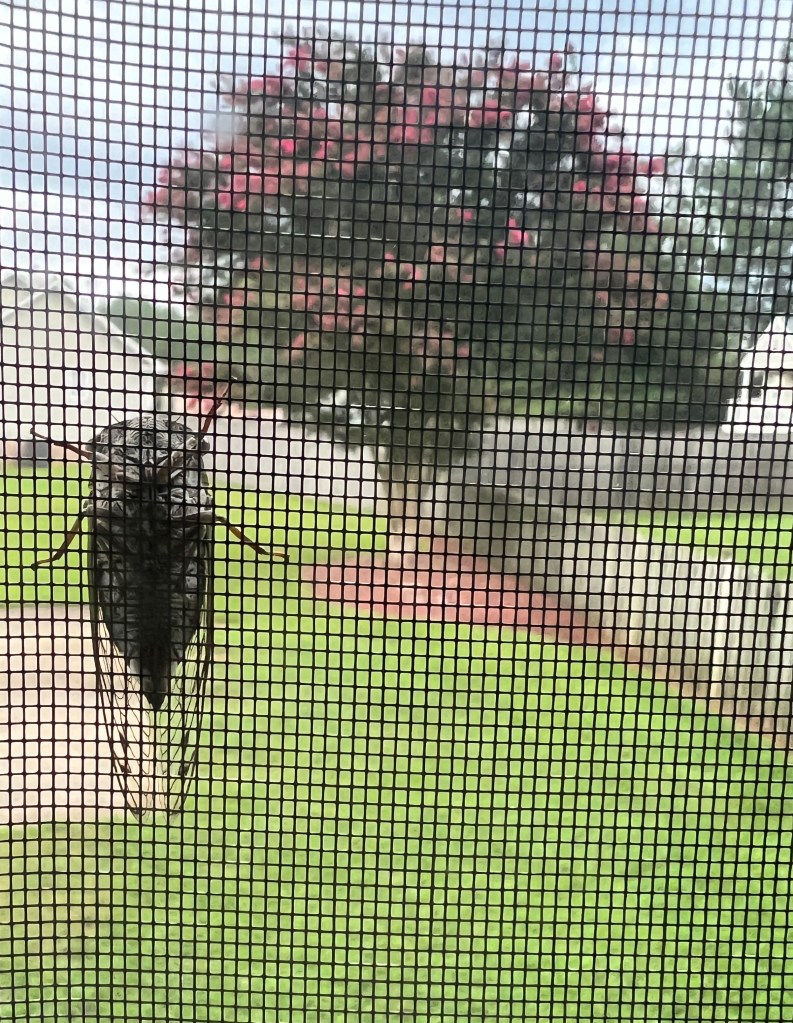
It’s the sight of one clinging to the screen in the kitchen window, early in the morning.

So still that I wonder if it’s dead.

I am tempted to go out and see, but I don’t. Let it be. If it’s dead, it will still be there after church and I’ll save its body to show the granddaughters. Cicadas are big insects that evoke terror in many people; I do not want the girls to fear them. The antidote to fear is understanding. Study. Fear not. Maybe even learn to love.

I take a photo instead.

It is a dark morning, like the one in the sermon text for this day, Mark 1:35: Jesus rises “very early in the morning, while it was still dark” to find a desolate place to pray. He’d spent the previous day healing the sick, including Simon Peter’s mother-in-law, and driving out demons.

When I return home, the cicada is gone.

Not dead.

All I have is this snapshot of it resting alone in a quiet place on the grid, with the crape myrtle by the old dog’s grave blooming in the background.

I could write an entire book, perhaps, on the symbolism and metaphor here.

I settle for a poem.

Clinging to the grid
In respite from work
Crape myrtle abloom
August’s crescendo is the last
Defying death in the wings
As love drives resurrection

The cicada and crape myrtle are symbols of life, longevity, immortality, and resurrection.
Summer is dying, but only for now.

*******

with thanks to Two Writing Teachers for the weekly Slice of Life Story Challenge

If you build it…

The Birdbath

We built it, we three
my sweet granddaughters and me
fountain birdbath, see

spray sparkling in sun
although birds have yet to come
awe, already won

My little bird-girl Micah, 20 months

*******

with thanks to Two Writing Teachers for the weekly Slice of Life Story Challenge

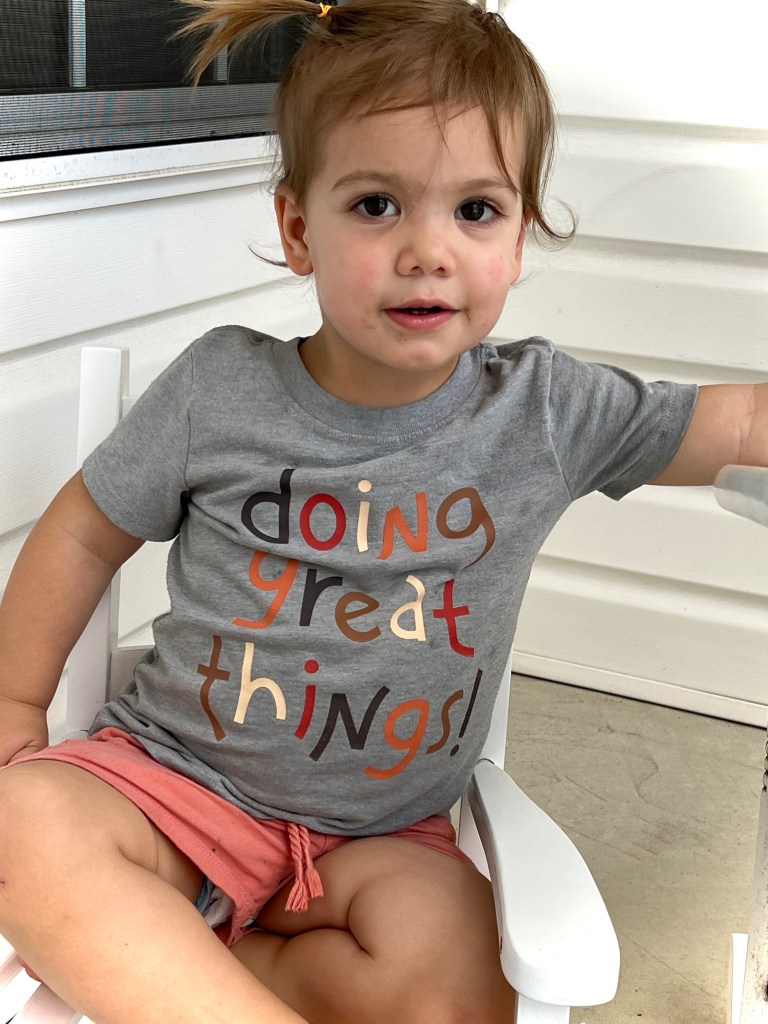
Doing great things

for Micah

Once upon a time, which is now, the second summer of your being, you reign supreme in the province of Franna’s house. Each day holds untold wonders. Every moment is rimmed with pure gold; with every tick of the clock, you are gaining strength and power.

Speaking of which: You are enchanted by the grandfather clock in the foyer, even though it’s not working at present. You have discovered, if you stand close enough and jump hard enough, the bells will chime for you.

You are so proud of the two ponies you wear in your hair. When you are in your bed, fighting sleep, you pull the ponies out.

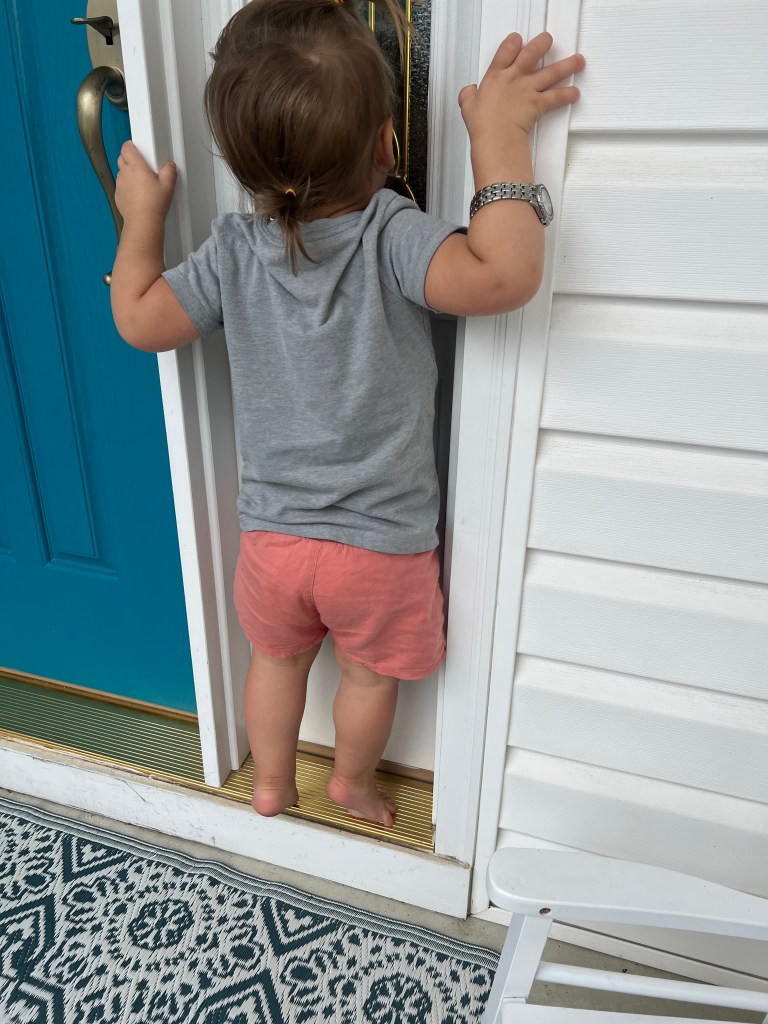
You are a study in language acquisition and word associations. Homonyms don’t throw you. Rock, for example. You understand perfectly well it means the big gray thing out by the woods as well as the movement of the white chairs on the porch. It’s one of your favorite things to do; a dozen times a day, you have your hand on the front door handle, asking to rock.

Another dozen times a day, you hold your hands up to me (got you) with the directive Watch. Birds. And I hold you at the windows where we watched the bluebirds going in and out of their house from early spring to summer, feeding two successive broods of babies until they fledged and flew. You mimic my whisper: Watch. Watch. You became especially fond of the Dada bird, so vibrantly blue, and you knew he was helping to feed his babies (often with a big bug in his beak).

Then you see Grampa in the rocking chair. He’s wearing his big black wristwatch. Your big brown eyes (so like your father’s, so like mine) miss nothing: Grampa watch. A thought flickers across your face. I get it, you say. Back in the house you go, looking for my watch on the kitchen table where it’s charging in a patch of sunlight. You slide it onto your little arm and hold it up with pride: Watch.

You don’t yet know about time. Tempus fugit, says the face of the grandfather clock. Time flies.

You will know this soon enough. For now you are exploring all the windows of your world. On tiptoe.

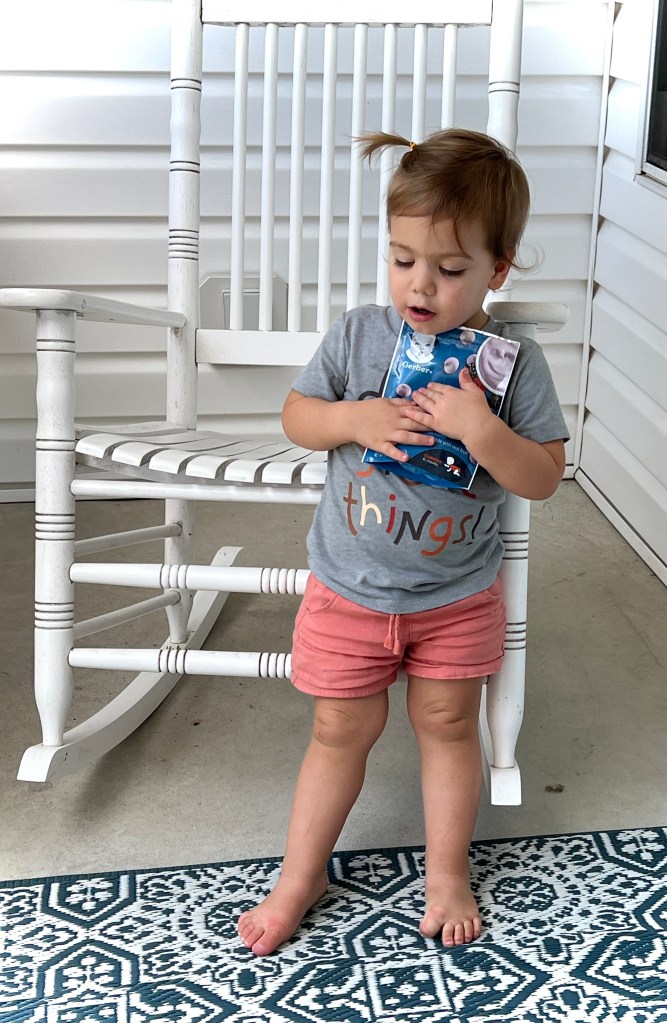
You know love. You rock your dolls (babies). You see the Gerber baby on the packet of yogurt melts that Franna always, always keeps on hand. Awww, Baby, you say.

You hug the Gerber baby, too.

Your curiosity knows no bounds. It outweighs your fears. You say loud when a plane flies over; you cover your ears, but you love planes. When they disappear from view, you say Bye, plane. You keep looking for another.

This week a helicopter flew over Franna’s yard and utterly captivated you. You are grappling with that word, helicopter (Franna understands it even if others can’t yet).

The hammering of the new deck construction is loud but you have found a just-right seat on the telescope base to watch the man working.

The Lowry organ in Franna’s living room is way too loud for you so we don’t turn it on; you are perfectly happy sitting on the bench, pressing the silent keys, flipping the couplers (that control pedals, special effects, swell, and great) up and down. That is, in fact, what you call the organ: up down.

You are learning to question. If a toy rolls under a table or bed: Where’d it go? When there are no birds outside the window, you call in your singsong voice: Birds, where are you? When you want to watch a music video on my phone, you pat my pockets or stick your hands between the sofa cushions: Where is it? Phont. I get it.

For you adore music. You sing. You dance. You ask for specific song videos (we know exactly what these are, don’t we): Na Na Na, Sunny Day, Shine, Ba Ba Minion, Giant, B-I-B-L-E. Not to mention do-do-do-do-doot-doot-do Bluey on TV.

You play drums with spatulas on my big kitchen bowls. One two, you say. We are working on three four.

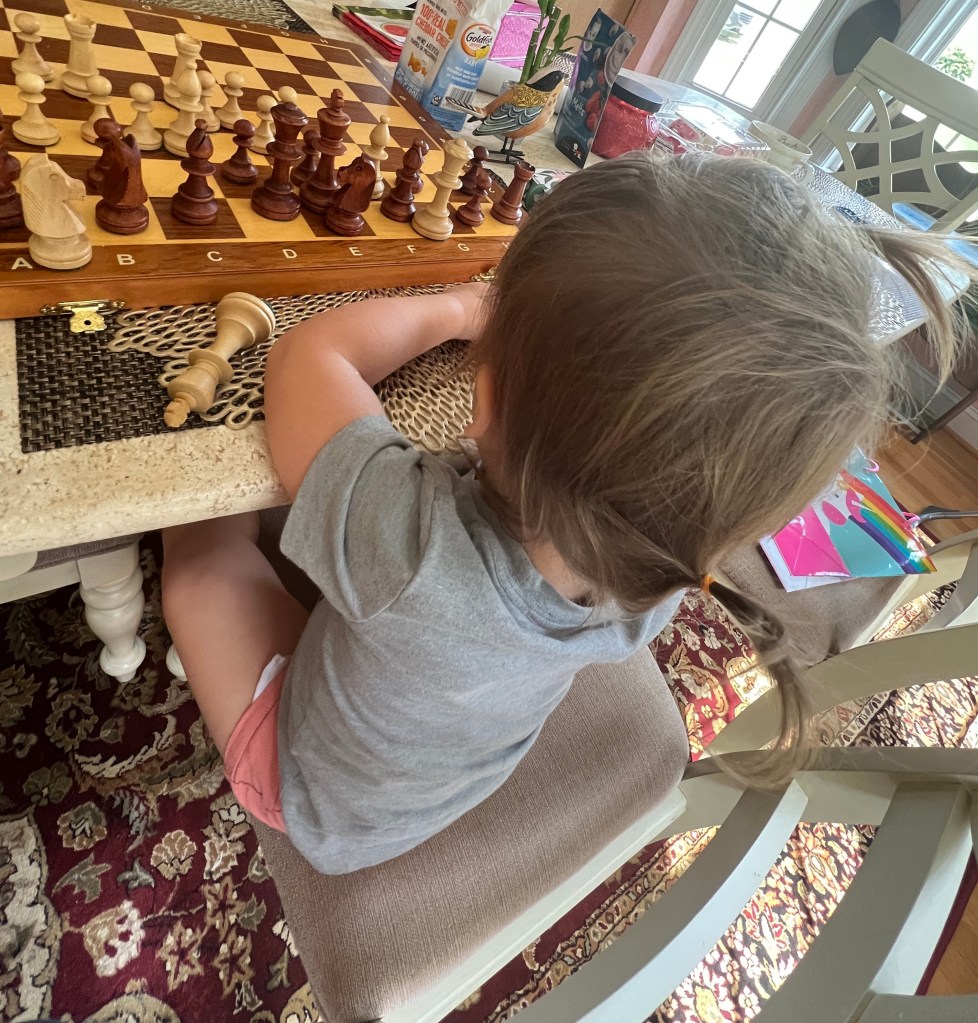
You want to do the things you see your big sister doing. This summer, at age seven, she taught Franna how to play chess.

You are determined to play, too.

One of your newest words is try. You so want to do things for yourself. At twenty months you aren’t a baby anymore. Although you still like to be held. A lot.

You try. You watch. You shine. You show your love by curling your little body around your Franna so you can’t be put down. So Franna holds you for as long as you like.

Your Dada tells me that you are refusing naps at home and that you lie in your crib crying Frannaaaaaa…!

This is a great thing to your Franna. A very great thing.

Every moment of every day, you are doing great things.

I write them here for you, thinking of all the great things yet to be.

For that is what grandmothers are, memory-keepers.

Until the time your memories become your own, while we live this story of our beautiful once upon a time, which is now, oh, I cherish the keeping.

*******

with thanks to Two Writing Teachers for the weekly Slice of Life Story Challenge

Home poem

For today’s Open Write on Ethical ELA, participants are invited to write poems about “places we call home”.

Nothing pulls on the heart like home… I can almost hear the Beatles’ song “In My Life” playing in the background: “There are places I remember all my life, though some have changed…” The memory of these places, and the spirit of them, really are the theme song of our lives.

Of all the places I remember and could write about…have written about…I choose my home now. I have lived here the longest. I became a grandmother here. I have learned a lot more about savoring here. Usually I try to make my poem title do more work, but today, no other will do. 

Home

In the first moments
of pale-pink light
the big brown rabbit
comes from the woods
to nibble away
at the clover

in the ever-thickening branches
of the crape myrtle
my husband and planted
years ago
I can spot hummingbirds
hiding among the leaves
always alone
never together 

they dart, one by one
to the kitchen-window feeder

silvery-green females
perfect, pure
ethereal as fairies

a male, ruby fire at his throat
(brighter than the cardinal-flame
landing over on the fence)
impossible greens and turquoise 
shimmering on his back

unaware of his utter tininess
he sometimes perches
atop the feeder
as if to say I am King
of this Water-Mountain

a pair of doves feeds
on the ground by the tree line
then takes flight on pearly wings
vanishing in the pines and sweetgums
where their nest is secreted

robins, robins everywhere
just last week
a speckled fledgling on the back deck
both parents in the grass
chirping ground-control instructions

the mockingbird in the driveway
strutting and stretching his banded wings
as if he knows how legendary he is

a trill of finch-song from a nearby tree
so plaintive I fear my heart may burst

and the bluebirds
oh the bluebirds

if only I spoke green language
I would explain that I removed their house
from the back deck 
because it is about to be torn down

that I waited
until their unexpected second brood
flew out into the world

never imagining these parents
would return to the empty rail corner
a day or two later
clearly so puzzled
to find their house gone…

if I were the hermit wizard-woman
of this semi-enchanted nook
(as I sometimes pretend to be)
I would have known what to do

but my unmagical self did my best:
placing the birdhouse atop
the old wooden arbor
built by my oldest
when he was a boy

well away
from the impending deck destruction

and to my astonishment
the bluebirds have followed
their home

I do not yet know
if more eggs have been laid
in the house relocated
to the arbor

but as evening draws
and the pine-shadows fall
across the arbor
and the crape myrtle
and the big brown rabbit
back in the clover
and the old dog’s grave
and the old deck
about to be made new

I ponder
my length of time on this Earth
and the continuous carving-out
of home
how it goes on and on

a path forever unfolding before me
that I must follow

like the doe in the little clearing
across the road
pausing for one long moment
with her two fawns
before disappearing
in the leafy green

One fawn has already been ushered across

*******

with thanks to Ethical ELA and Two Writing Teachers
for the inviolable, invaluable writing spaces
and the inspiration

Fibonacci poem: Hey, Ancestors

On Day Two of July’s Open Write at Ethical ELA, host Mo Daly invites us to write a poem in Fibonacci sequence: six lines with syllables of 1, 1, 2, 3, 5, 8.

The Fibonacci sequence appears over and over in nature, from shells to flowers to trees to our own DNA.

Maybe that’s what led to this double-reverse attempt…

Hey, Ancestors

composed after a trip
to the home place

Come
sit
a spell
on the porch.
I want to know you.
Tell me the stories of your life.
I don’t mind your being a ghost.
Just (if you please) try
not to rock
your chair
too
much.

Old rockers. Poor Ole RichCC BY-SA 2.0

Mask poem

The July Open Write on Ethical ELA begins today with host Mo Daley, who invites poets to “Consider the masks you or those around you might wear. Using a format of your choosing, write a poem about a mask or masks.”

My first thought in response, with masks being linked to ancient theatrical performances, was writing around Shakespeare’s “All the world’s a stage, and all the men and women merely players…”

But then a little creature appeared in my head and ran the rest of it away.

Which may be for the best…

Mask Obscura

Raccoon was named
for the way it uses
its “hands”

rubbing and rinsing
its food
in water

not for the mask
forever typecasting Raccoon
as bandit-trickster
in human lore.

Unlike humans
these creatures know one another
by their individual masks

not donned as shields
or ritual
or protocol
or festivity
or theatrics
or deeds of darkness

but serving to
absorb light
in the night

to see

to survive.

Yet like humans
Raccoon covets shiny things

and can be trapped by them.

Hunters of yore
eventually learned
to cut holes in logs
to place a bit of tin inside
to hammer in nails
around the small circumference

knowing Raccoon
would be beguiled
would reach its hand inside
for the bright thing.

Once the fist is clenched
the creature will never let go
to set itself free…

in paradoxical symmetry
so does the creature
that named itself 
for its supreme intelligence.

Might it have been better named
for its own myriad masks
and motives, ever disguised?
Or for the hubris and folly
accounting for so much of its
own demise?

If only Raccoon
had the ability
to write,
there might be annals
of Ring-Tales
read aloud in the night
at a gathering deep in the forest
by crackling firelight:

To see or not to see*…
Lord, what ultimate Tricksters
these Homo sapiens be!
 
There in that circle, perhaps
with shivery spines
and whiskers a-tremble
they name us
not for our deeds or dominion
but for the way
we wash our hands.


*Note: The collective noun for raccoons is a gaze.

Procyon lotor (raccoon).jpgCC BY-SA 3.0.

Procyon lotor is derived from Latin for “washer”