Out of the shadows

Late June afternoon on the porch. A long-settling stillness, the day’s brilliance deepening to amber, shadows slanting across lawns and pavement, a cool pre-dusk breeze riffling trees and wind chimes, carrying the sound of a child calling in the distance. It’s not a child; it’s a little goat from a neighbor’s pen, hidden in a patch of woods. Bleating for its supper, I suspect. Startlingly humanlike voice. A neither-here-nor-there sound, disembodied, suspended in the air like time itself, clinging to these green and gold moments, unwilling to let go…

“Mom, let’s go for a walk,” says my youngest son (aka Cadillac Man).

I grab my shoes.

Walking beside me along our neighborhood street, my boy speaks, as he always does, of music. Songs he is learning, one he wants me to practice with him (it has to be simple for me. He can sing any part he likes in any key he likes; he can play anything he wants on the piano or guitar). I say I’ll try. He speaks of his new job at the funeral home; we reflect on the recent death of a beloved friend who’s the same age I am. Fresh-grated sadness, still surreal.

As we talk I note that no neighbors are out and about this afternoon. We seem quite alone. At one house, pool towels draped over the front railing billow in the breeze. American flags on front porch flagpoles ripple and flap with crisp smacks. A couple of cicadas rattle from high in the trees that frame backyards. Our long shadows stretch out on the pavement before us, where flecks of quartz wink; when my boy and I turn at the road’s end, the shadows disappear.

We pass a row of cypresses where there’s sudden movement in the grass. A black shape materializes, runs after us, crosses right in front of us…

Good thing we aren’t superstitious.
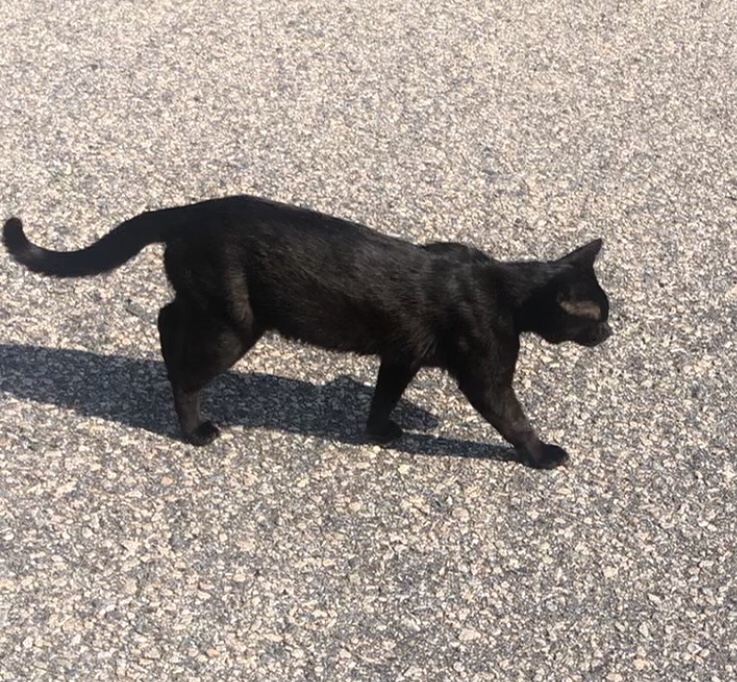
A young black cat, meowing.

“Awww,” says Cadillac Man, as it rubs against his legs. “What a sweet little cat.”

It comes over to me, rubs against my legs, purring madly.

We are devout dog-people. I can’t have a cat. I’m allergic. I learned this at age five or six when my family took in a stray Siamese (Mr. Cat, we called him) that took refuge on the stoop of my childhood home during a storm. Swollen eyes and asthma didn’t stop me, however, from bringing home a black kitten nobody else wanted when I was in college…

“It looks so much like my cat Moriah,” I tell my son. The name came from a magical cat in The Forgotten Beasts of Eld, a book I read when I was about twelve.

Cadillac Man bends down, picks up the creature. “I would keep it if you could breathe.” The little cat nestles against him. Animals love my boy. They seem to sense his gentle spirit.

After a moment, the cat twists to get down. Cadillac Man releases it.

“It looks kind of thin. I wonder if it’s hungry…” Do moms always think about this first? Is this our deepest default, this hard-wired compulsion to feed all little living things, to keep them living?

The cat sits looking up at us with big, unblinking, green-yellow eyes. Meow.

And it trots right beside us, like a good dog would, back to our driveway where I feed it some of Dennis the dachshund’s steak-flavored food in an old dish.

“I hope it stays,” says Cadillac Man. “It can be an outside cat.”

I examine the cat as it eats. “It has all its claws.”

“We should name it,” says Cadillac Man.

“Look how rusty its fur is in the sunlight,” I observe. “Black cats aren’t exactly black. It’s a genetic mutation of the tabby pattern. See the faint rings in its tail, there at the tip? So much like Moriah, only she was smaller and didn’t have a tail…” another mutation. She was the last kitten left in the Free Kittens box on campus the day I found her and took her home. Shelters say black cats are the hardest to find homes for; no idea on stats of cats with stumps for tails…

“We aren’t naming it Moriah, Mom.”

“Of course not. She was one of a kind and besides, this one’s a boy.”

Cadillac Man is silent for a moment. The cat has nearly finished his steak dinner. “Well, you know it has to be a musician’s name…”

This is what he does. Since childhood he’s named pet fish after bass singers; his dachshund, after drummer Dennis Wilson of The Beach Boys.

I can see what’s coming: “Brian, I suppose?”

Cadillac Man smiles. “Not quite. I christen this cat Douglas.

Brian Wilson’s middle name. I was close.

After licking the bowl clean, Douglas follows us up the sidewalk, cutting in front of Cadillac Man to roll over just like Dennis the dachshund does for a belly rub.

“Awww,” says my boy, rubbing the proffered belly. “Listen—he’s purring like a truck!”

Indeed he is.

It’s getting late. We need to go in to wash up and have our own supper, so we stroke Douglas one last time. I make sure to wash my hands well, with extra soap.

We peek out of the windows from time to time. Douglas is lying on the porch, and then he’s gone.

But not really.

He’s curled up under the rocking chair, sound asleep.

When he wakes, I take one of Dennis’ soft blankets out and put it in his chosen sleeping spot. Douglas sits on it at once.

“There,” I tell him. “Now you know that if you need a safe, comfortable place to sleep, you have one. If you’re hungry, I’ll feed you whenever you come around. I’ll leave water out for you. It’s summer, see…”

Douglas purrs as if he understands…and maybe he does, for the next morning he comes to polish off a whole bowl full of food, and he’s waiting in the driveway to greet us on Wednesday night when we return from prayer meeting.

And then he vanishes.

A day passes, and another, and another. No Douglas.

It storms. Thunder, lightning. Rain gushing from the gutters.

I hope he’s all right, wherever he is. If he belongs to someone, I hope he’s back home and happy. We ought to have named him Macavity, the Mystery Cat.

I shake out his blanket, fold it, replace it. I toss yesterday’s water from his new dish and refill it with fresh.

I think of Mr. Cat. Of Moriah. So long ago.

I wonder if it’s absurd to keep leaving fresh water out for a cat that may never return.

But I do it anyway, because I told Douglas I would.
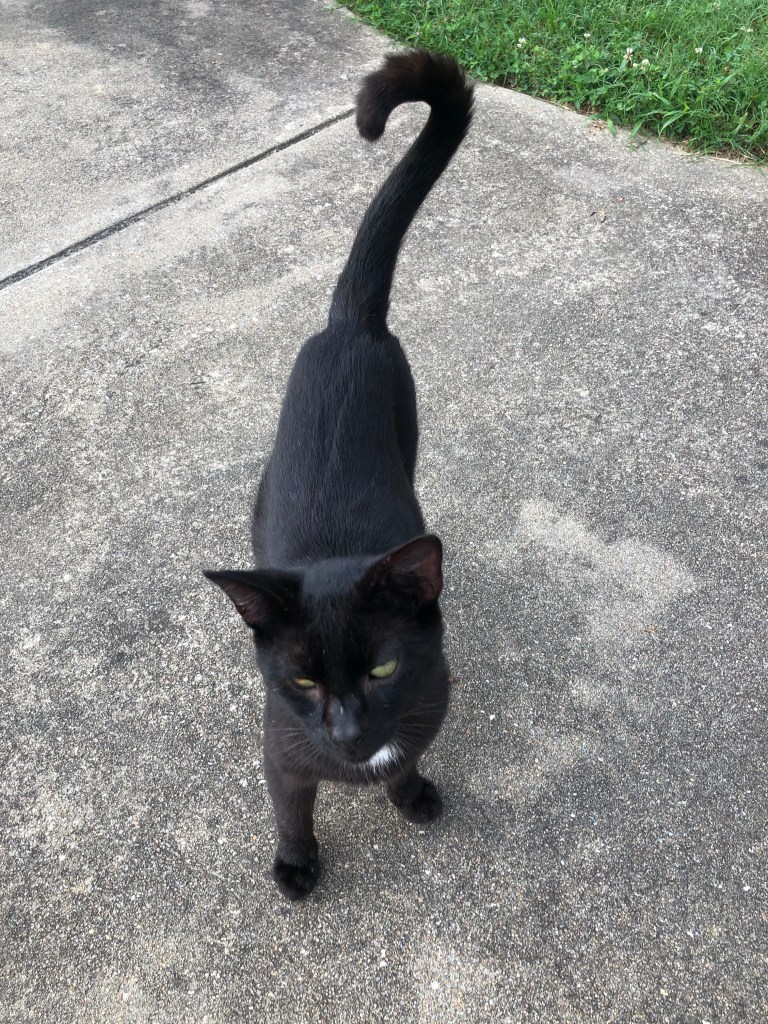
I also told Cadillac Man we could have named him Question Quigley (from Harry Potter) for that tail
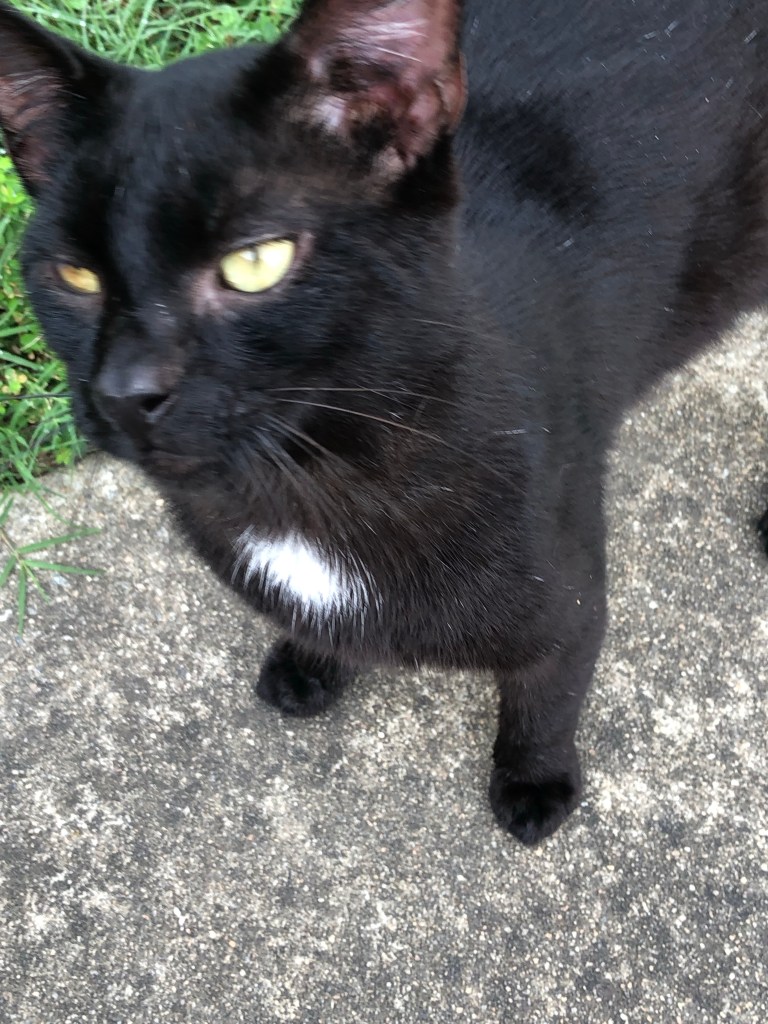
The best shot I could get of his face; Douglas kept trying to rub against me while I attempted to take his picture
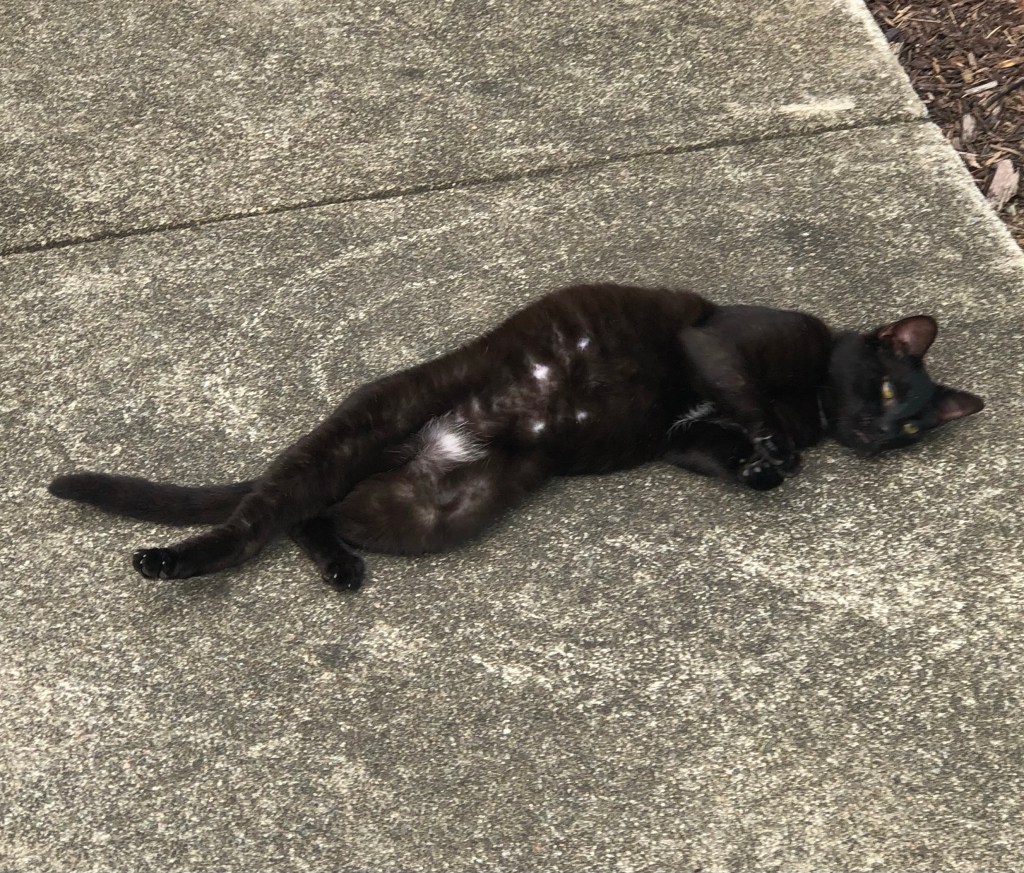
Asking for a belly rub
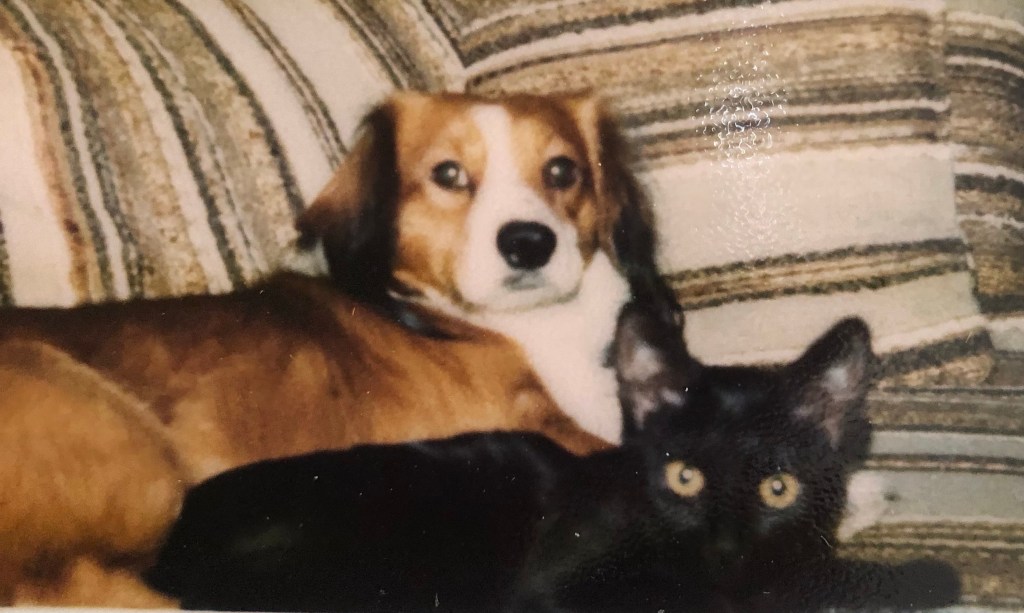
For comparison: my cat Moriah, almost forty years ago, with my childhood dog, Bagel
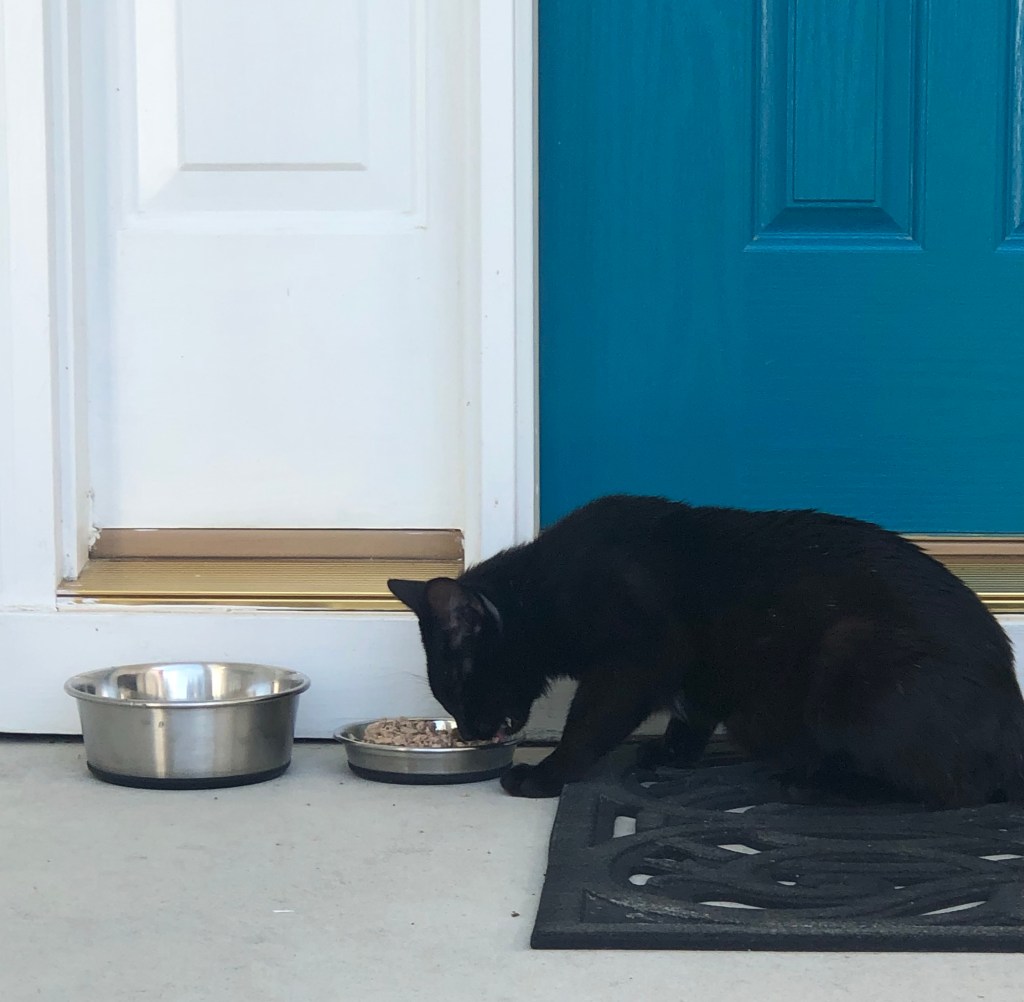
—OH, and P.S. Guess who came for dinner last night?
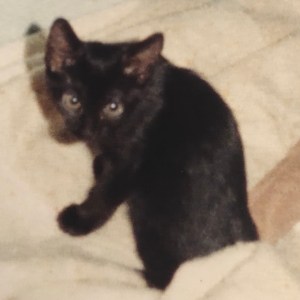
Memories, like little shadows, return, too.

*******

And so it is that black cats are my favorite, despite their long-maligned history (another reason I feel concerned for Douglas). I wrote another take on them if you’re so inclined: 13 Ways of Looking at a Black Cat Crossing Your Path in the Time of COVID-19 While Driving to School to Teach Online Near Halloween of Election Year 2020.

with special thanks to the Slice of Life community at Two Writing Teachers.
We are our stories.

Apothecary of the soul

Today, the first Thursday of the month, my Spiritual Journey gathering writes around the theme of “Nurturing Our Summer Souls.” Deepest thanks to my friend, teacher-poet-artist Carol Varsalona, for hosting.

Summer itself is about journeys, is it not

In my previous post, A walk back in time, I told of a long-awaited trip to the Country Doctor Museum in the small town of Bailey, NC. I expected to learn about rural physicians and their practices in the 19th to early 20th centuries. I didn’t expect to be mesmerized by the first exhibit, a reproduction apothecary shop replete with show globes (which became the official symbol for pharmacies), exquisite leech jars, real live leeches, rows of dried herbs and powders displayed in large glass jars bearing labels of names so poetic and compelling I itched to look them all up right there on the spot, and black pills made in the shape of tiny coffins because they contain a measure of poisons like mercury, so an illiterate population would be mindful not to overdose.

I certainly wasn’t expecting the large painting on the wall behind the counter…

Apothecary of the soul painting, circa 1700-1750. Artist unknown.
Image: Joyner Library, East Carolina University.

It dominated the wall—the whole room.

“These ‘apothecary of the soul’ paintings are rare,” the docent told our tiny tour group of four, one other couple plus my husband and I. “Most come from Germany. You can see here that Christ is the apothecary. He’s holding the scales, weighing his Crucifixion against the weight of a man’s soul… behind them, jars are labeled with the virtues…we’ve had visitors who are fluent in German and they tell us that this is an old form of the language, much of it is complicated to translate…”

I can make out two Bible references, though. Here’s the King James translation:

Matthew 11:28:

Come unto me, all ye that labour and are heavy laden, and I will give you rest.

Isaiah 55:1:

Ho, every one that thirsteth, come ye to the waters, and he that hath no money; come ye, buy, and eat; yea, come, buy wine and milk without money and without price.

My tour group moved on too soon. I couldn’t linger to study the work at length, to grasp more of its symbolism, so I’ve since visited the Museum’s website for more information. There I learned that an apothecary may have commissioned the painting. Apothecaries wanted to draw people to their shops; they sought to be alluring, to the point of extravagance (hence the elaborate show globe towers and gilded leech jars). But imagine the effect on the ordinary townsperson, in need of help, relief, comfort, entering the shop to find Christ adorning the wall. If customers weren’t able to read the verses (from Luther’s 1545 translation of the Bible, I wonder?), they could see that Christ’s right hand holds the scales and that his sacrifice outweighs the man’s sins, represented by a horned beast. The man holds a banner reading My sins are heavy and overwhelming and grieve me from the heart.* Christ’s left hand rests on what appears to be crosswort, a plant often used to treat wounds, headaches, and other ailments, possibly representing a cure-all from the hands of the Great Physician (or Apothecary) himself: the dispensation of spiritual healing as well as physical, “without money and without price.”

I left the shop thinking about the level of trust one must have in the apothecary, and feeling as if I’d been on a pilgrimage versus a museum tour. This happened to be my first journey of summer, which has come at last, bright and beckoning, as the world strives to heal from the COVID-19 pandemic…

Here is to rest, ongoing spiritual journeys, and nurturing the soul.

*******

*Source: Apothecary of the Soul video, ECU Digital Collections, via the Country Doctor Museum website (see Learning). The Museum belongs to the Medical Foundation of East Carolina University, under the management of the Laupus Health Sciences Library.

Other Apothecary of the Soul paintings can be found online; they contain much of the same symbolism.

A walk back in time

After many years of mentioning it, my husband and I finally visited the Country Doctor Museum. Off the beaten path in a nearby town, the museum consists of three small buildings, one of which is a combination of two actual 19th century doctors’ offices. The museum began as a memorial to rural physicians, expanding over time to include the nursing profession, home remedies, and the apothecary. It now houses an impressive collection of artifacts from the 18th to early 20th centuries.

I expected to learn things. I didn’t know, for example, that this is the oldest museum in the United States dedicated to the history of rural healthcare, or that it’s been taken over by my alma mater, East Carolina University. The docent said: “That saved us during COVID. We had the funding to reopen. Many private-funded museums could not.”

I mourned the loss of museums that had to close for good as we crossed the threshold of the apothecary… where an otherworldly, unanticipated, delicious strangeness awaited on that side of the portal…

A mammoth cabinet of gleaming cherry wood with ornate scrollwork, sunbursts, and Victorian spindles runs the length of the left wall. On its shelves, behind glass doors, stand hundreds of large jars bearing white labels and names of their contents—assorted dried herbs, powders, and liquids—in large black script: Crocus, Cloves, Mace, Valeria, Aq. Rosa., Pond’s Ext., Sol. Benedict Quantitative, Lotio Pilocart Morrow, Pepsengia. Some labels look new; others appear to be timeworn, the lettering nearly illegible. The docent speaks in a low, unmodulated voice about paregoric, opium, mercury, and poisons that were often part of remedies mixed by the apothecary, dispensed to a largely illiterate population which couldn’t read labels. In order to prevent overdose, some of the pills were fashioned into tiny black coffins.

As I look at these coffin-pills, trying to imagine ingesting such a thing, the docent points to the show globes in the cabinet. Tall, decanter-like vessels of different-colored liquids—green, yellow, blue, red—stacked upon each other in rounded triple towers. They seem art deco or like something from the 1960s. “Show globes are an official symbol, like the striped pole is to the barber,” says the docent. “People entering a town would know this is where to find the apothecary. The show globes were displayed in the shop’s front window, and every color had a meaning. The apothecary kept a recipe for mixing dye in water and a guide for when to display certain colors. Red, for example, would warn travelers that there’s widespread sickness in this town, an epidemic…”

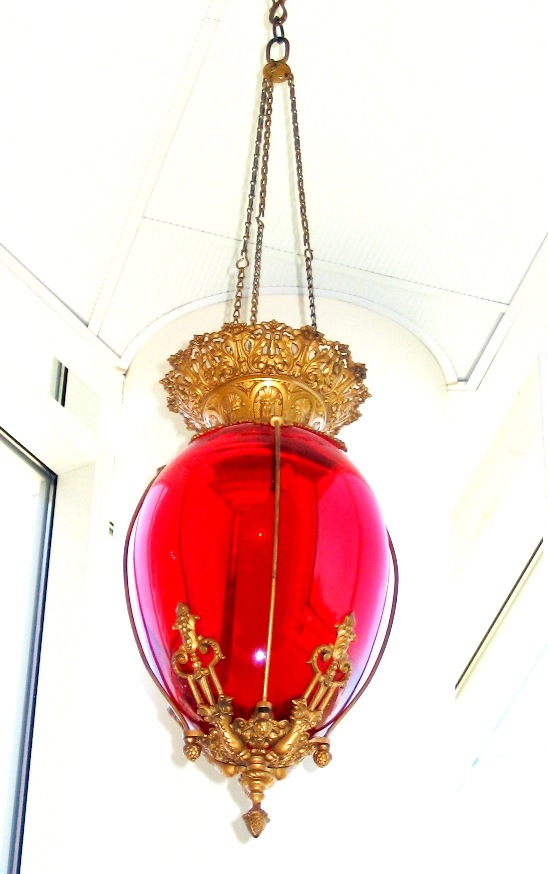
I turn to see a large, single-tier show globe with antique bronze trim sitting alone on a pedestal behind me. Full to the brim with bright red, transparent liquid.

Of course, I think. The docent is wearing a mask. I wonder if the all the museum guides came by cover of night in March of 2020 to mix this red solution. And if it will remain red until COVID-19 makes its full departure.

Hanging show globes were sometimes mounted in the apothecary’s shop window.

The docent is now speaking of bloodletting and leeches.

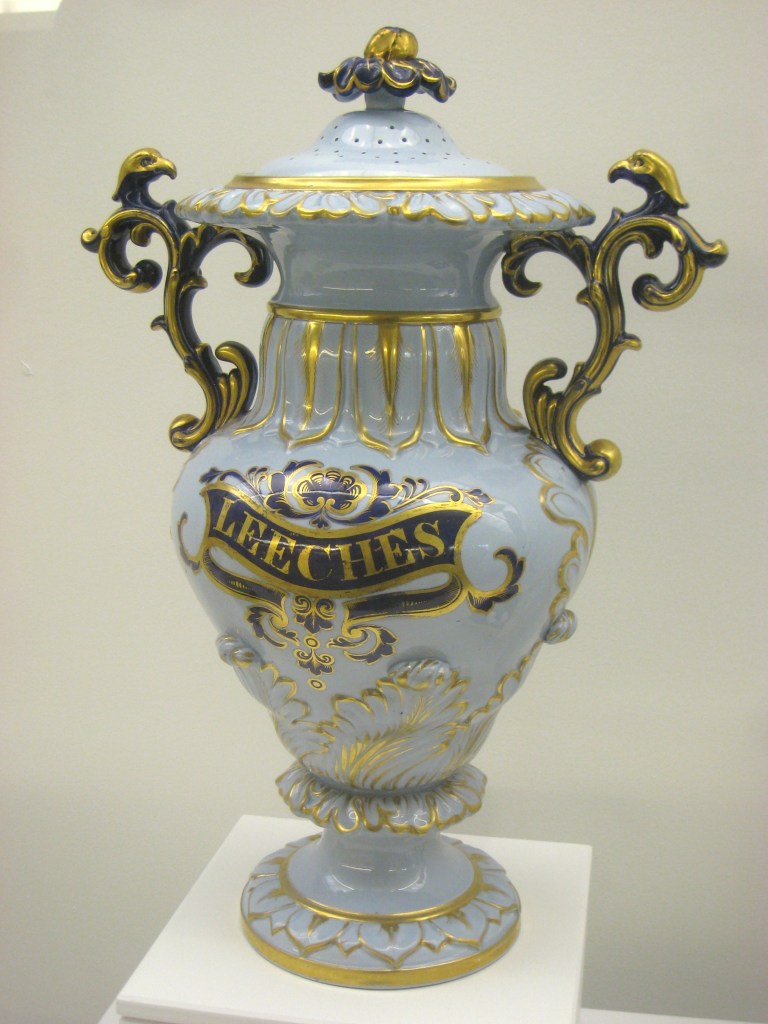
There are, in fact, live leeches on display. They’re floating contentedly in a clear glass bowl of water beside a large vase decorated with a delicate floral pattern…along with the word LEECHES in utterly incongruous, glorious gilt adorning a black banner.

The museum’s leech jar is very similar to this, only with a sweet pattern of tiny pink flowers and vines.

“The apothecary kept leeches in leech jars such as this…” the docent is saying. “It was advertising. The fancier the jar, the better the quality, people believed…”

I’m awed by the jar, that it was designed solely to hold worms. Albeit important ones… and I read once, somewhere, that leeches are amazing escape artists: A more recent druggist had a leech that chewed through a modest gauze lid covering; he found the escapee several days later, lounging on the turntable of his record player.

The docent continues: “Leeches are still in use today. We had a plastic surgeon visit once. He told us of reattaching someone’s ear and using a leech there to increase the blood flow for healing…leeches are often used when fingers are reattached…you don’t feel the leech, of course…”

We are about to move into the next room where there’s a real human skull and kits of amputation tools from the Civil War era, but I want to linger here, I have a thousand questions about the tinctures and remedies and practicesand I want to study the magnificent 1700s era painting on the right wall, above the counter where the apothecary would make pills by mixing powders and dough, rolling and cutting with a pill-roller. The artwork depicts Christ as an apothecary, with elaborate calligraphy in old German. It presides over the whole room.

But time does not wait; it moves on and so must I… prying myself away from the painting and jars and show globes, I content myself with the knowledge that a healing-herb garden waits at the end of the tour. I hurry into the next room just to make the intriguing discovery that I am now standing in the office of a Victorian doctor whose not-very-common surname is my own maiden name.

What a peculiar sense of belonging…and, I think, beginning, of something I’ve yet to name.

*******

I plan to write more about the painting on Thursday.

You can visit the Country Doctor Museum online to learn more and to view many fascinating artifacts.

Escape

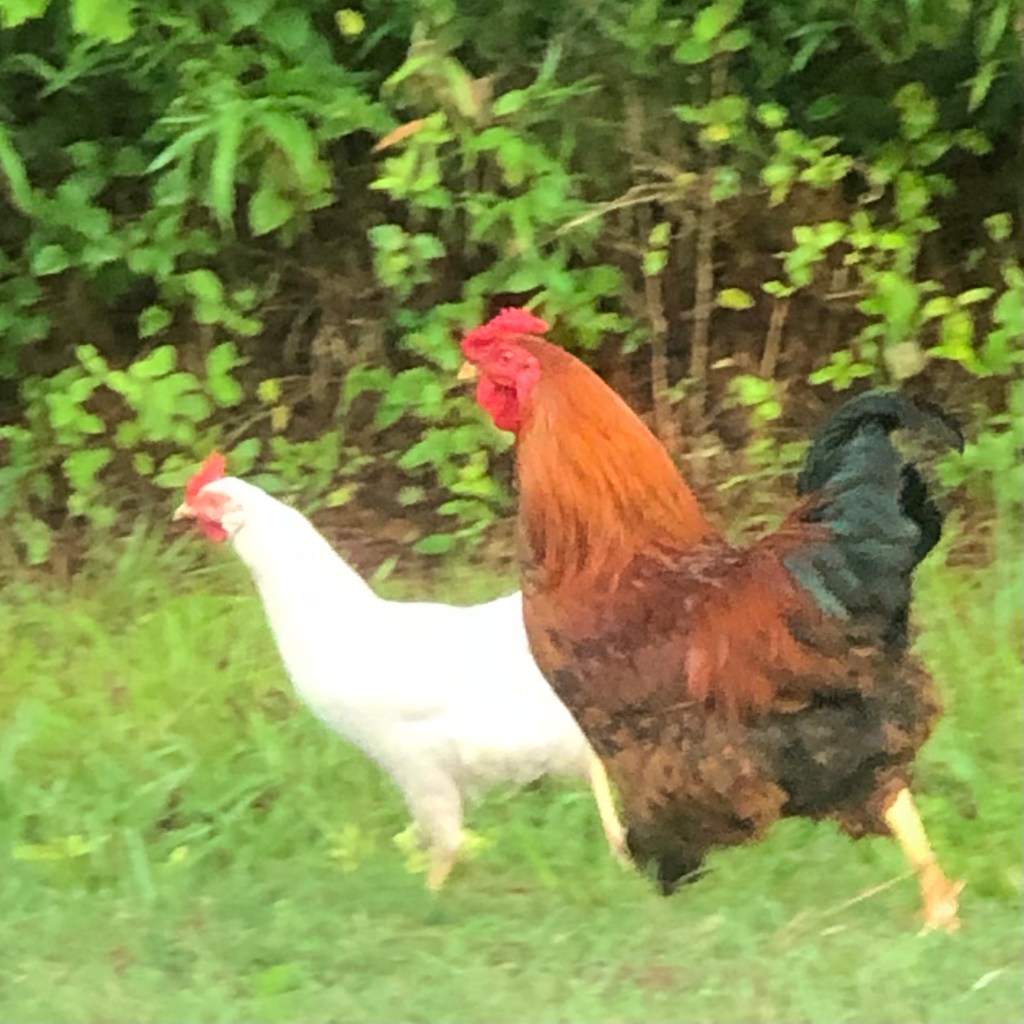
On the first day of summer the young lovebirds venture a rare morning stroll, having flown the coop for a bit of adventure in a lush green paradise all their own, the cocky young fellow squiring his best girl away from the prying eyes of her sisters, sunlight gleaming on his proud coppery coiffure, a pulse-quickening sight, iconic, idyllic, how could she refuse, indeed she cannot, as she bows her little red maiden’s coif, demurely casting her eyes downward, considering the grass beneath her feet, on the constant lookout for insects crawling by while preening her pristine white finery, mostly out of nervousness, mind, as she’s not accustomed to such freedoms, all this overwhelming dewiness, this newness, this green green greenness—ah, they suddenly realize I am watching, so they pretend they are supposed to be here, but of course I know better; I strain for snatches of their deliberately muffled discourse as they turn to walk in the opposite direction, like this is a perfectly ordinary occurrence versus an illicit escape…ba-gock, ba-gock, ba-goooock…we may not speak the same language, my free-ranging friends, but I shall leave your to your day in the sun, yes, here’s to this longest day of the year and savoring every bright moment, I cannot blame you at all for stealing away, with a little piece of my own heart…

My neighbor’s runaway rooster and hen, enjoying their summer morning stroll in the grass across the street from my driveway. My five-year-old granddaughter onomatopoetically refers to chickens as “the ba-gocks.” We seldom see them; their coop is tucked in a patch of woods. But we hear them “ba-gocking” throughout the day, and Rooster (we really should give him a name) never tires of crowing. He sometimes gets in a crowing match with my granddaughter, who “ur-ur-ur-ur-UUURRRRs” back at him. I hear him even now, as I write.

Just a little spirit poem

inspired by Denise Krebs on today’s Ethical ELA Open Write, after teacher-poet Stacey L. Joy. Stacey’s original simile poem centered on the word love. Denise’s, on the word alcohol.

Mine, on the word spirit.

Perhaps you know someone with this kind of everlasting joie de vivre…

Spirit…
Your spirit is bright
radiating like a summer campfire
popping, sparking, illuminating the night
Exhilarating spirit infused with silver starlight
Effervescent spirit of a child’s Christmas morning delight
Freewheeling spirit like an eagle in flight
An encompassing kind of spirit.

King’s Highway, Kissimmee. R9 Studios FL. CC BY

I dream a world

after Denise Krebs on the Ethical ELA Open Write today. Denise wrote after Langston Hughes’s poem “I Dream A World.”

—What world do YOU dream?

I dream a world

where Wisdom walks the thoroughfares

holding her lantern high

where Mercy kneels in lamplit paths

unfastening her cloak to enshroud

the transgressed

and the transgressor

where Comfort seeks out the lonely, the broken

to offer a cup of cheer, leaning in

with her elbows on the table

and her palm outstretched

where Truth looks up from the old rocker

in the corner by the bookcase

pushing his spectacles back up on his nose

as he turns the page of an ancient volume

but not before smiling at the twins

Mystery and Miracles

playing at his feet

in the flickering circle of lamplight

while Love closes the curtains

humming, always humming

her beautiful song

tears glistening like diamonds

on her cheeks

and where Judgment pauses at the door

listening, one skeletal hand raised to knock

but reconsiders 

and chooses to leave

giving a curt nod to Wisdom and Mercy

and stepping aside as they pass by

—I dream a world.

Photo: “Do not be afraid…” Fan D. CC BY

Memory, like morning (on the day of a friend’s funeral)

with thanks to Denise Krebs who shared the hay(na)ku form on Ethical ELA today.

First draft:

On waking before dawn on the morning of a beloved friend’s funeral

Memory
Like morning
Shimmers with light

Gathering
For Christmas
Across the years

You
Playing Santa
Giver of gifts

Laughter
Colorful, bright
Exquisite as snow

Stories
Like wine
Better over time

Dinners
Savored moments
Ending too soon

Envisioning
Your eyes
Always Christmas-bright

Awe
At love 
Given so freely

Embracing
Many others 
Ever-widening circle

Gathering
Together today
In your memory

Celebrating
Your life
Colorful, bright, exquisite

Testimony
To faith
In Lord Jesus

Returning
your body
to your homeplace

Earth
Where our
Young selves walked

Gathering
For Christmas
Across the years

Now
In springtime
Oceans of flowers

Bloom
Like promises
Around your grave

Friend
No good-byes
Only more homecomings

Rising
From darkness
In heaven’s embrace

Memory
Like morning
Shimmers with light

Pencil wizard

Once upon a time, I said that writing is the closest thing there is to magic.

Here is why.

Magic is not, well, magic. It is a lot of work (or why would Hogwarts exist? Just saying).

Writing is a lot of work.

Work (a lot of it) makes the magic happen.

Here is a true story of magic moments at the end of this dystopian school year (know that I am suppressing the urge to compare virtual learning to disapparating, i.e., teleporting from place to place, or essentially vanishing). After end-of-grade testing—I said dystopian, right? What does the State expect this data to look like?—a fourth-grade teacher sent me a note:

One of my students has been writing a story in his free time. He wants to read it to the class. He knows it needs some work and I am wondering if you have any time to help him? He’s not usually motivated to write…

I made time. I would shift heaven and earth for this.

He came to my room wearing a giant grin, clutching his pencil and notebook. I recognized the cover—it’s a notebook our district distributes to teachers. His teacher must have given it to him especially for his story, for in grades 2-5, our district doesn’t use writing workshop any more (and that, Dear Readers, is a whole ‘nother tragedy for the telling on another day).

“Come in, come in!” I said. “Have a seat here beside me and read me your story.”

Without giving too much away (for the story is his): It’s a fantasy, a battle between humans and wizards, the protagonist a young wizard with power to make living things grow. The student read it all aloud and then we went back to make some changes for clarity and flow, with my asking:

“What exactly do you mean here, when…”

“What is it you are trying to tell the reader? What do you want readers to think or feel here?”

“Think of an action to add here, so readers or your audience can better see what’s happening in their minds, like we do when we watch a movie. What are you seeing here in your own mind? That’s what you need to get across.”

“What’s a better word choice here, to make the meaning clear?”

While the boy thought and elaborated aloud, I began typing the story. As I read the lines back to him, his face glowed: “Perfect! That’s amazing!”

“That is the power of revision,” I told him. “When you start writing, it’s all about getting your ideas down. When you go back to make the meaning clear, by adding these kinds of details and taking out what you don’t need, that’s where all the magic happens.”

“We’ve made a lot of changes,” the boy observed, “but it’s SO much better.”

And yet the story remained the story he wanted to write.

We’d changed city to town, people to townspeople. He made the stylistic choice to capitalize Humans. We’d added transitional phrases to keep the readers from falling out of the story. We added gestures for the young wizard when he makes vines grow (“I need to see how the wizard does this,” I explained). The student vetoed my suggestion to go ahead and incorporate “earthbending power” (a phrase borrowed from video games): “I am not ready to tell readers yet about earthbending power,” he stated. —Such a tone of authority!

“All right then! You’re the author. Save it for when the time is right in the story. Just make a note here to add earthbending power later.”

And then the word tome… “Is tome the word you want here, where you say the wizard found a tome in the laundry?”

“Yes. It’s a big book of spells.”

I blinked. “Indeed! That’s impressive. Just make sure your readers know what you mean here, that they can see and understand what you mean by tome.” It became an ancient tome of spells, hidden in a robe in the laundry, that the young wizard began to read “without realizing the power he now carried”—those are the student’s own words, not mine.

And thus I spent the last days of school this year watching the love of writing take root and flourish in the heart of a child…magical, indeed, in a year where so much felt anything but, even in some of my own writing of late.

As I write this morning, sunlight streaming in my window like all the glories of summer on the cusp, I recall my final words to this child as he carried his typed version away in a bright yellow folder: “Keep writing!”

In my mind’s narrative, I add: Young word-wizard, with earthbending power.

For that is the magic of writing.

May he cultivate it all of his life.

Imagine. Indy Sidhu. CC BY

with my thanks always to Two Writing Teachers, a community dedicated to the craft, power, and love of writing, for all Humans.

Indelible (a tritina poem)

Finished a poetry course this afternoon, with the writing of my first tritina.

The form: ten lines comprised of three tercets and a final line. The tercet lines end with three different words, in this pattern: 123, 312, 231, with the final line containing all three words, usually in 123 order.

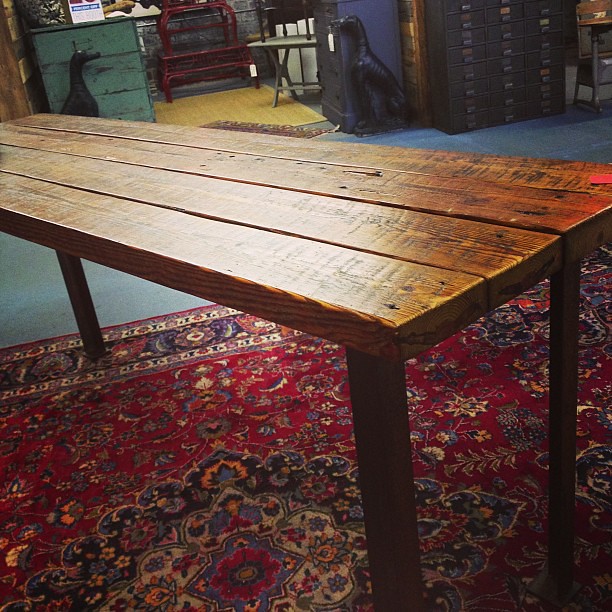
The image of an old table finally came to mind, along with the three end words. As I started writing, I noted that my first couple of lines happened to have eight syllables. It then became a “thing” for me to keep eight syllables in EVERY line…so here you have it:

Indelible

Heirloom table, cross-hatched with scars
I would refinish your surface
if not for erasing stories

family-gathering stories
traded while the bread knife yet scars
daily life, beneath the surface.

-Oh, how the memories surface
as I stroke these silent stories
told by generational scars.

Our scars surface in our stories.

1880s heart of pine table. Paris on Ponce & Le Maison Rouge. CC-BY

Preparing

She comes into the house, suitcase in tow, little face aglow at spending a couple of nights while her parents keep doctor’s appointments. She hugs them good-bye and before they’re halfway down the sidewalk, she grabs my hand:

“Franna, want to play with me?”

Isn’t there only one answer to this question?

“Of course! What do you want to play?”

“Family.”

Ah.

We head to “her” room, where I keep books and blocks and bears and dolls and even a couple of old baby blankets for wrapping them. She’s always the mom. I am always the oldest child. I have to help her hold, feed, and potty-train the toys…er, my siblings.

“First I need to unpack,” she announces.

“Okay,” I say, as she unzips her suitcase, navy-blue with pink and white unicorns. “So, tomorrow we find out if you’re having a brother or sister! Isn’t it exciting?”

She nods: “I want a sister.”

“I know you do…but a brother would be nice, too” (because her parents and I think the baby is a boy).

She nods again, pulling a couple of stuffed animals out of her suitcase. She sets them on the bed. “Mama told me to be happy if it’s a boy.”

I am about to speak but just then, I notice something…

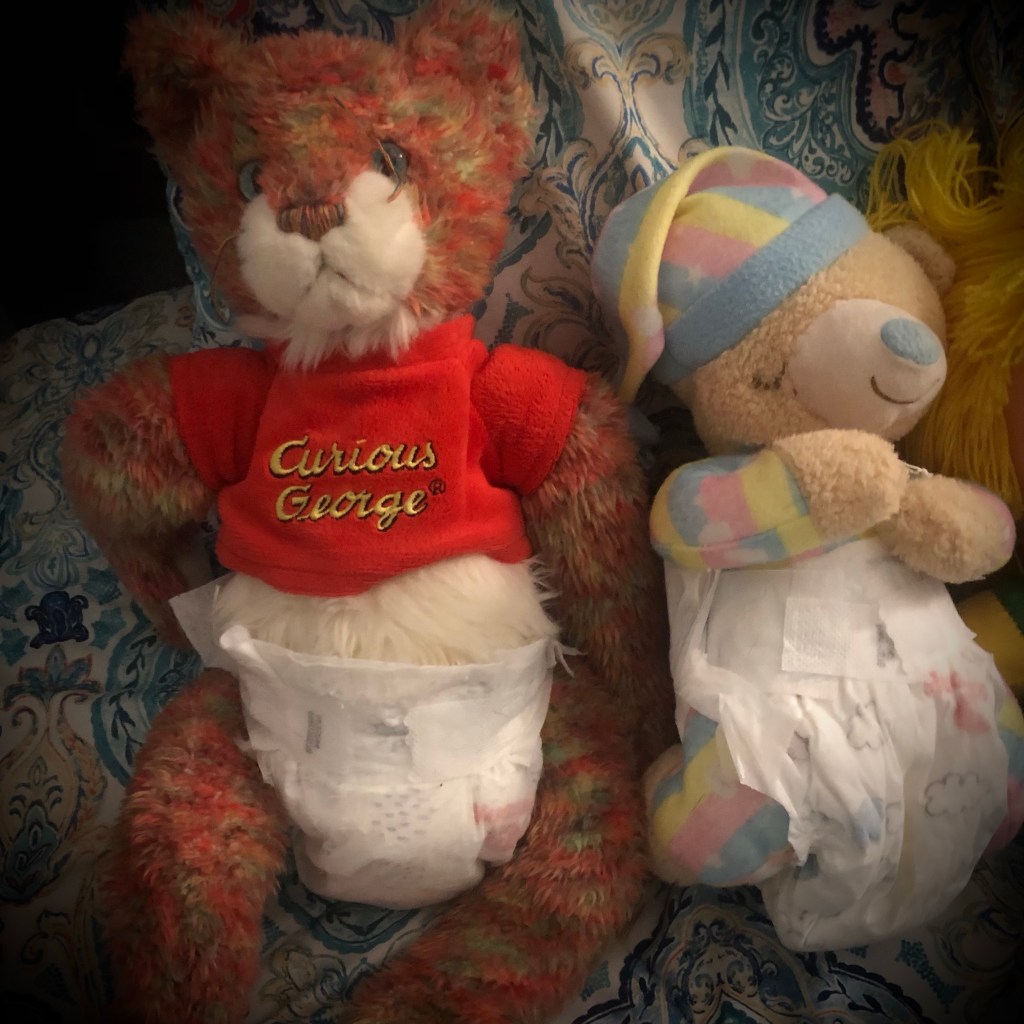
She’s brought Allioop, the raggedy orange cat that belonged to my son when he was little. She’s dressed him in Curious George’s T-shirt. He leans against the pillow beside a woolly bear sporting a pastel nightcap.

Allioop and the bear are wearing diapers.

“Did you put these diapers on your toys?”

“Yes. I’m practicing for the baby. Watch…” She shows me how to remove and replace the diapers with their little Velcro tabs.

Strikes me as one of the greatest acts of love I’ve seen.

Preparing.

Her parents FaceTimed to tell us that the new baby is, in fact, a girl.
My granddaughter, who’s five, bounced up and down with joy:
“My wish came true!”
She later told my son that she can’t wait to teach her sister the word “photosynthesis.”

Dear Baby, what a wealth of love surrounds you, already.

*******

with thanks to the Two Writing Teachers community for the weekly Slice of Life Story Challenge.