Red, white, and blue reflections

The words are in my head when I wake.

Memorial Day.

I should write about it, I think.

But my brain is restless.

For one thing, the weather.

I rise with the sun and patter, barefoot, to the kitchen. Pink light is spilling through the blinds before I open them. Thunder rolls in the distance. The forecast is severe. I stand in the bay window’s rosy glow as a soft rainshower begins. No birds in sight. The usual morning chorus of robins, house finches, cardinals, Carolina wrens is paused. Silence, but for the occasional caw of a crow near the woods. My neighbors’ freshly-planted roses are blinding red against the green grass, the weathered-wood fence. Stark white curtains hanging from their gazebo flutter like ghosts, like prelude…what’s past is prologue, as states the murderous Antonio in The Tempest.

That’s the second thing. Ghosts.

The imagery distracts me.

I ordered a ghost from a catalog, once. When I was a child. True story.

It was disappointing.

That was before I knew that ghosts have many manifestations. And to be careful what you wish for.

There’s always a cost. Ghosts aren’t free.

Why I’m thinking this just now, as the sun fades away into gray, as the lights in the house blink, as the skies crack open, releasing the predicted deluge, as my little dachshund curls into a ball on the kitchen rug, shivering uncontrollably…I do not know, exactly.

On the table I have a small arrangement of red, white, and blue flowers, in honor of the day and my country’s fallen soldiers. I recall learning that my first real home was once an Army hospital morgue.

It’s dim, but I can remember living in that shadowy house at age three, until my family was forced out. I wonder which WWII soldiers were brought there before their burial, before my time.

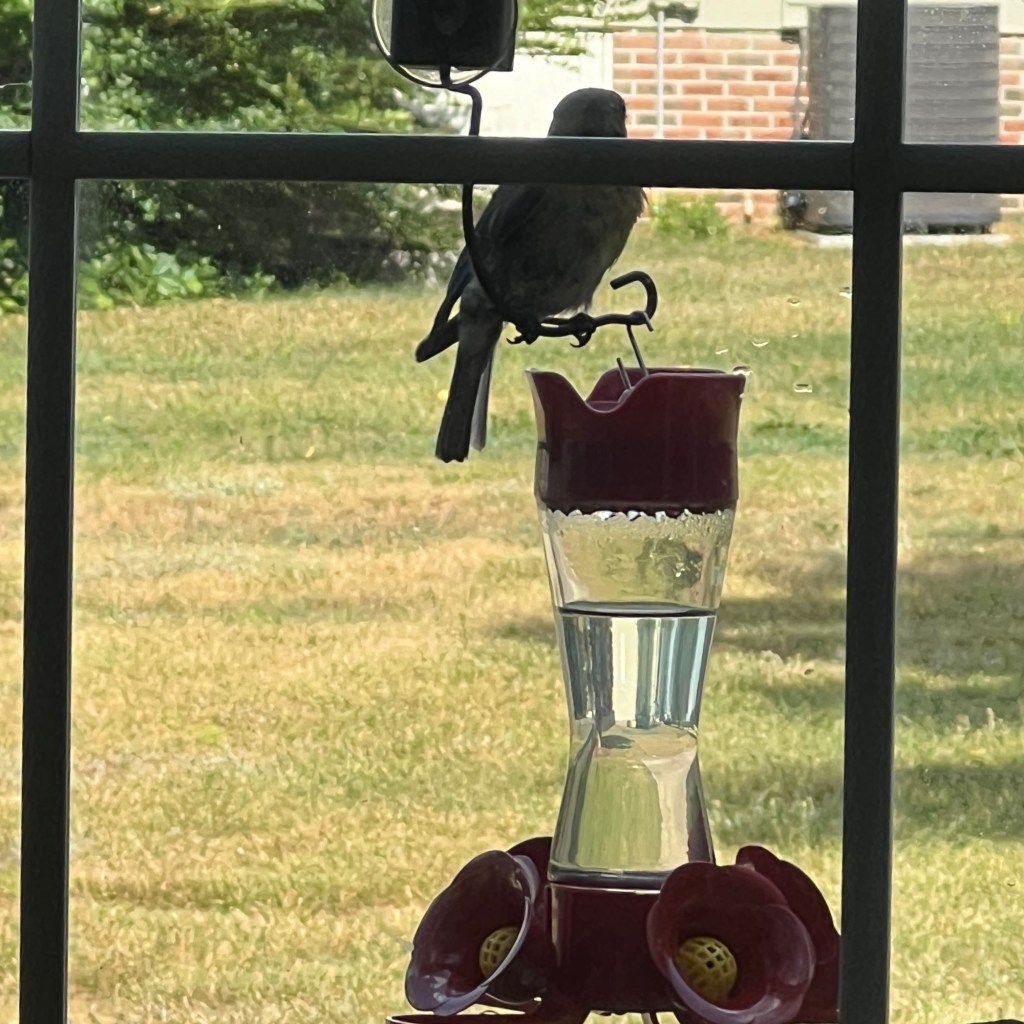
I light a candle by the flowers, against the encroaching darkness. At the window, a tiny ember-red flash. Male ruby-thoated hummingbird, undeterred by the tempest, coming for a drink of sugar-water at my feeder. Over by the wooden fence,in front of the gazebo’s billowing white veils, a fluttering of blue wings… bluebirds seeking to feed their young. Despite all. Above all.

Sustenance.

New thought: That’s what this day is about.

Sacrifice, prayer, and peace, too…in fact, the word prayer is mentioned four times in the legal language for the holiday (read it for yourself: 36 U.S. Code § 116 – Memorial Day). Peace appears twice. Contextually, in a call to pray for permanent peace, according to each individual’s faith.

That’s in the law of our land.

As the storm descends, I pick up my trembling dachshund. There’s no way to tell him it’s only temporary. I can only hold him ’til it’s over. Sustenance. The lesson of the birds. The whole purpose of prayer. Of faith.

Memory. It’s for teaching. If what’s past is prologue…it cannot be changed; but the present, the future, can. If we remember. If we do not remember the past, as the saying goes, we are condemned to repeat it.

That’s the lesson of the ghosts.

*******

with thanks to Two Writing Teachers for the Tuesday Slice of Life Story Challenge
-sharing your writing is a true act of courage.


The letter

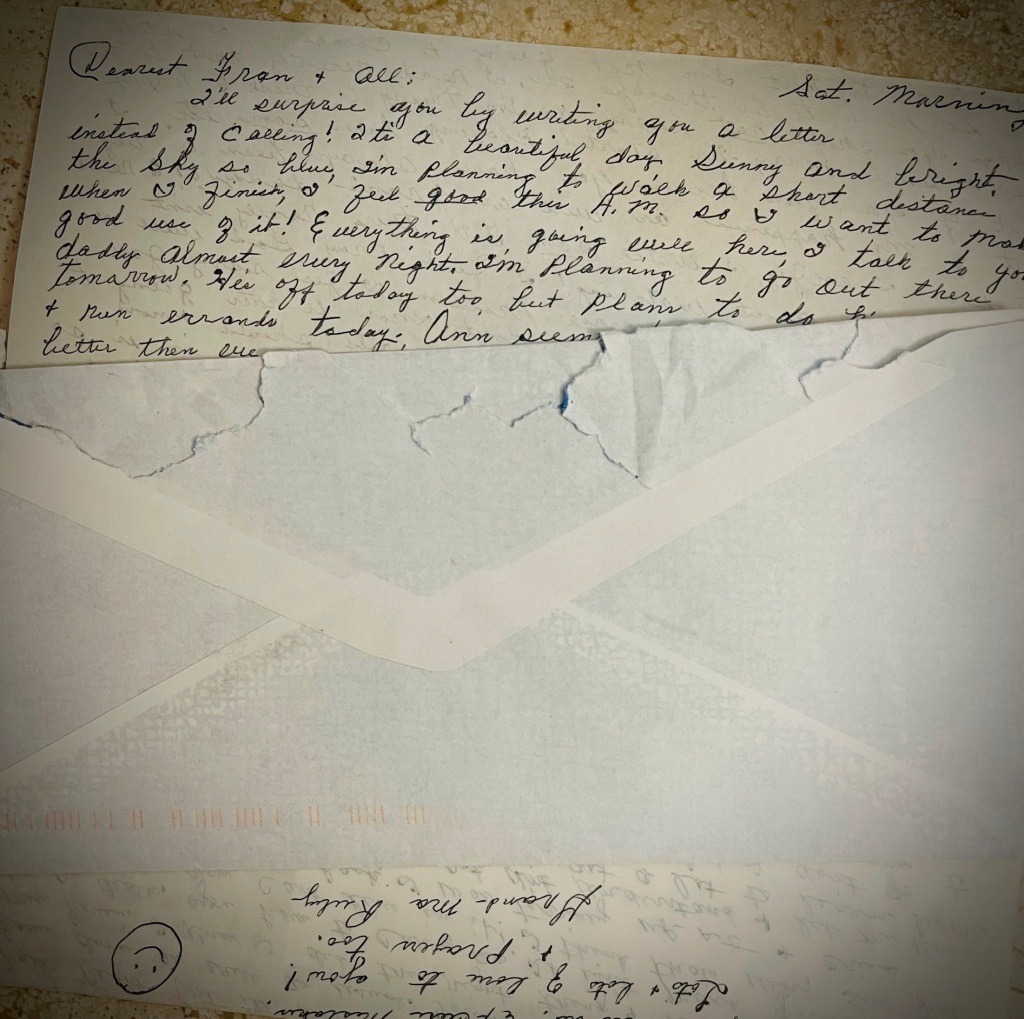
I found it in one of my old Bibles when I was preparing to speak at a women’s conference.

A letter from my grandmother.

Postmarked September 29, 2001…not long after 9-11. In the wake of what seemed the end of the world.

She wanted to surprise me with a letter. She’d written dozens to me throughout all the years we lived in two different states, since I was six. In her eighties, however, her fine penmanship had begun to look shaky on the page. She had taken to making phone calls more and more.

She writes of the beautiful day: sunny and bright, the sky so blue. I’m planning to walk a short distance when I finish and feel good…

She writes of family, that she talks to my daddy every night, and tomorrow she will see him. She writes that my mother seems to be doing good, better than we even thought! I no longer remember the context of this statement; my mother was frequently in poor health, in body and in mind.

She writes of my Aunt Pat’s moonflower, presently blooming, and asks if I remember her moonflower growing around the stump of Granddaddy’s pecan tree by the old dirt road and that she once had another by the pump house…its runners grew on the pump house, shrubs nearby, and the fence.

For a minute, I am there, walking in long ago, seeing the profusion of white blooms, breathing their perfume…

Then she tells me not to worry about her. She had given up her house and had come to live with my aunt; at 85, unsteady on her feet and occasionally falling, she could no longer live alone. She writes: I have accepted it, like a death. You have to carry on.

She admits to crying a lot at first. Then: I’m not going to complain. I still have so much to be thankful for. I read recently that to be happy, you should act happy, so I’m trying to think happy thoughts and smile more…I think of you often because you have always been a big part of my happiness as well as Grand-daddy’s!

She read books; she played tapes of gospel music; she prayed for God to see fit to take care of our world problems. She writes of violence and violent people not knowing what being happy is.

She misses her piano, her most-prized possession. She says that since she couldn’t take it with her when she gave up the house, she’s glad I wanted it: I hope it will bring much happiness to you and the boys.

She would never know that my youngest would learn to play on that piano, that he would become a phenomenal musician, that he would learn to sing all the harmonies in gospel songs, that he would eventually obtain a college degree in this, that he would lead choirs.

She writes that she hopes to see me and the children soon, even if for a little while, knowing I’d go visit my parents, too. She so wanted to spend time with my children…

She closes with her love and prayers too.

Two tiny notes are included also, one for each of my children, then ages twelve and four. In the note to the youngest she mentions hummingbirds…they will soon be flying to a warmer climate but will come back at Easter.

As I hold these written treasures in my hands, savoring every word, a little shadow flickers at the kitchen window. A hummingbird, coming to my freshly-refilled feeder.

A year to the day after Grandma wrote this letter, my father would die suddenly. The flood of grief would overwhelm her; dementia would soon settle in, and she would be in a nursing home for four years until her death at age 90.

I reread of the beautiful day, sunny and bright, the sky so blue, that she’s talking to my father every night, that my mother’s doing better than anyone ever expected… I reread her words of acceptance and carrying on, of her great love and prayers for me. I think about how these buoyed me through every day of my life…even now.

I fold the letter back into its old envelope. I finish my lesson for the women’s conference, on learning the unforced rhythms of grace.

I carry Grandma’s letter with me.

I carry on.

*******

with thanks to Two Writing Teachers for the Tuesday Slice of Life Story Challenge

Prayer poem: Learning rhythms of grace

Last weekend I spoke on Matthew 11:28-30 at a women’s conference. Jesus, under increasing oppostion, extends this invitation to a Galilean crowd oppressed by their religious leadership and Rome:

Come unto me, all ye who are weary and heavy laden, and I will give you rest. Take my yoke upon you, and learn from me, for I am meek and lowly in heart, and you will find rest for your souls. For my yoke is easy and my burden is light.

In The Message, a contemporary rendering of the original languages into that of the modern day, pastor and biblical scholar Eugene Peterson paraphrases Christ’s words: Walk with me and work with me—watch how I do it. Learn the unforced rhythms of grace.

That last line plays in my head like a continous prayer, pushing away the constant challenges of life in this world by sensing and seeing the unforced grace given by God.

And, in turn, to give it.

Learning Unforced Rhythms of Grace

How do I learn them, Lord?
Let me count the ways…

Listening for Your voice
in the cadence of my days

Seeking to still my spirit’s
frenetic beating wings

Perceiving the song
all of Creation sings

Releasing judgment, 
not mine to make

Forgiving and forgiven daily,
a flow of give and take

Bearing pain and scars
accrued in life’s syncopated race

Opening my arms, my heart
to YOU, my resting place

Acknowledging the story
pulsing though others’ veins

Knowing You have the final Word
Your sovereign remedy remains

Desiring patterns of peace
in a prosody of embrace, erase…

Walking in step with Your pierced feet, O Lord
I learn unforced rhythms of grace.

Jesus preaching. ideacreammanuela2.

True or False poem

My friend Denise Krebs hosts VerseLove over on Ethical ELA today with a profound “true/false” list poem based on the work of Dean Young. By all means, read her poem and the prompt.

Here’s what I have, so far…

True or False?

  1. I am much older than I appear.
  2. Green is the color of ordinary time.
  3. Angels can sing.
  4. Stars can sing.
  5. Trees can sing.
  6. Just because it’s myth doesn’t mean it isn’t true.
  7. There’s a reason I use seven asterisks for section breaks.
  8. A seahorse holds the reins of your memory and emotions.
  9. Salt water heals all.
  10. Blood is thicker than water.
  11. Blood cries.
  12. I will live to see another solar eclipse.

*******

Bonus points will be awarded for citing evidence in support your answer for #10.

Tip: Double check #3 before submission.

*******

MDavis.D, CC BY-SA 4.0 https://creativecommons.org/licenses/by-sa/4.0, via Wikimedia Commons

*******

with thanks to Two Writing Teachers for the Tuesday Slice of Life Story sharing

Alphabeticals poem

For VerseLove today on Ethical ELA, host Jennifer Guyor Jowett extends this invitation to participants: Pick any letter from the alphabet. Think about its shape, its function, how else it might be heard or understood. Play with variations. See what might be discovered. 

Welp… I find I’ve gotta go with this.

Ode to F

Let’s face it:

F is not the most alluring
letter of the alphabet.

It indicates failure.

It stands for an expletive.

Technically, it’s fricative,
a sound made by forcing
air through a narrow channel,
in this case, by placing the
teeth on the lower lip

looking rather like
trepidation

or, rather,
fearfulness.

Seems a humble
(if not humiliated)
letter
not to mention
nearly impossible
for a young child
to write
in its capital cursive form:
France, for example,
looks like Trance.

But
let’s face it:

F happens to be
a banner letter.
Case in point:
when a small child
has to turn her
first name initial
into an object
for a class assignment
and the girl beside her
is drawing E as
the gorgeous wing
of a bird in flight
the F girl’s got nothing
until she finally thinks
of a flagpole.

A universal
symbol of
freedom

and where would we be
without that?

It stands nobly
there in JFK and RFK

not to mention
twice ceaselessly
in F. Scott Fitzgerald.

A banner letter,
indeed

woven into the very
fabric of our existence…
how could we function
without

Fibonacci sequence
flora and fauna
forests
fish
family

or finches?

Or FRIDAY
or friends?

Or fearlessness.

Or faith.

Stand tall
and proud, 
oh F,
waving your
two little fronds
in the wind
forever.

Fly on.

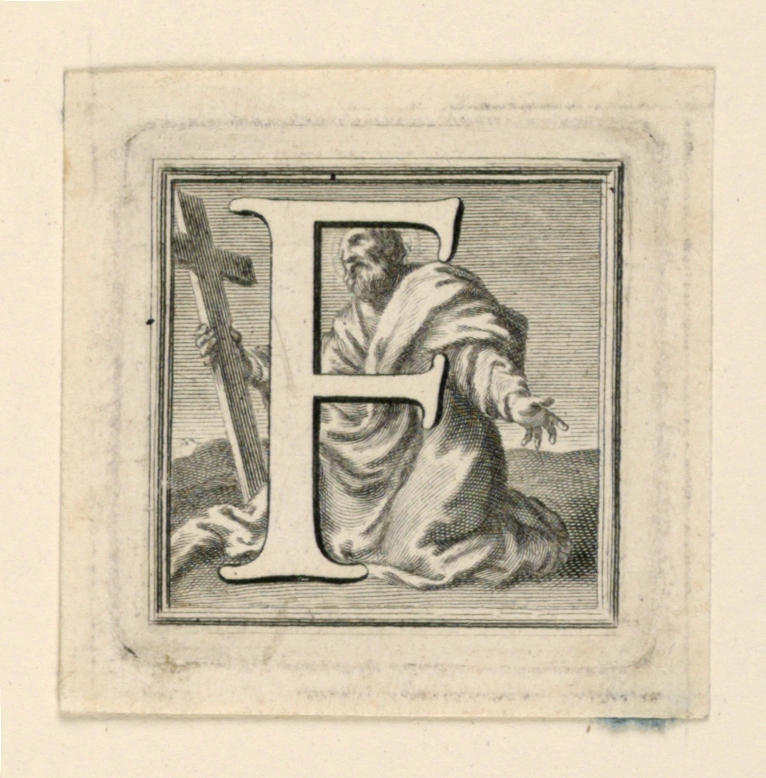
Decorated Capital Letter F“.Jakob Frey, Swiss, active Italy, 1681 – 1752. CC0 1.0.
Public domain, Smithsonian.

Inspirational place poem

For VerseLove on Ethical ELA today, host Wendy Everard invited participants to “Take some time to rabbit hole online.  Discover some places that were inspirational to your favorite author or poet.  You can write about a place you’ve visited or one that you’ve discovered today, through some research.”

Ah. See if you know this place and, more importantly, the person that inspires me.

Remember the Signs

Sometimes
there is
a magic
that
chases you
from one
world
to another

such as when
you visit
a Tex-Mex restaurant
in North Carolina

dedicated to Elvis

and as
the hostess
leads your party
to your table
you happen
to notice

high on the wall
above all the 
hodgepodge
framed photos
that aren’t even 
of Elvis at all
but instead are 
of food 
and dogs 
and cars
(the ceiling
is a mass
of actual
gleaming chrome
hubcaps)

…that high
on the wall
above these
eccentric displays
is a wooden sign

and that
is when
you know
you know
you know
magic is 
afoot

the air begins
tingling with it

and if
you can somehow
explore this wall
without being noticed
by anyone else

you might
very probably
find, if conditions
are right,

a hidden door…

It is here,
somewhere,
I am sure.

Someday,
so help me, 
I shall find it

I shall get in

to find myself
I suspect

in the Rabbit Room
of an Oxford pub
where a group of men
light their pipes and order
another beer as they
debate the manuscript
on magic chasing you
from one world
to another

by mysteriously
connected rooms
and secret portals…

inside the Tex-Mex
Elvis restaurant
I stand staring
at this sign
(later,
I will have trouble
remembering
if I actually
saw it)

knowing magic
is afoot

—it’s more than
a pretty strong
inkling…

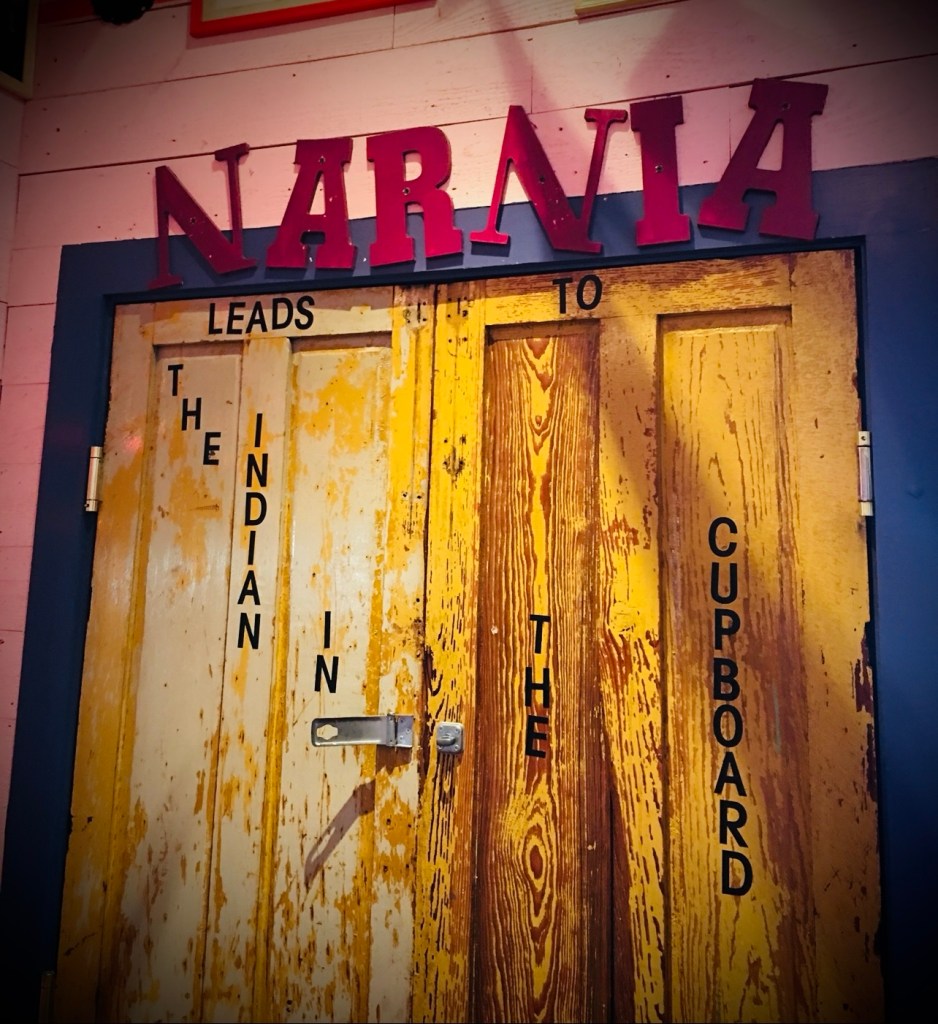
A photo of the actual sign — and door—! on the wall inside the Tex-Mex Elvis restaurant in NC.

*******

*REVEAL* in case you did not know:

The Rabbit Room was a private lounge in the back of the Oxford, England pub, The Eagle and the Child (nicknamed The Bird and the Baby), where C.S. Lewis, J.R.R. Tolkien, and others (“The Inklings”) met regularly to share their working drafts. My poem’s title, the tingling magic, the door leading to another world are all Narnia/Lewis references. Even “I shall get in” is taken from Lewis, whom I’ve loved since age ten. The manuscript being debated in the poem is The Lion, the Witch, and the Wardrobe – Tolkien didn’t like it and basically told Lewis it would never work. While writing the poem I actually forgot what the sign (“NARNIA”) looked like in my local Tex-Mex-Elvis restaurant; I recalled it as an obscure reference to that magical world. I had to scroll around for the photo I took, to remember…but even my forgetting the sign ties directly into the plot of one of The Chronicles of Narnia books (The Silver Chair).

The sign’s presence in this odd place is definitely magical to me…one day…I shall get in…

Hashtag and magic box poems

April is National Poetry Month, and over at Ethical ELA, VerseLove is well underway.

My friend Kim Johnson kicked off the daily poetry writing yesterday by inviting participants to introduce themselves via hashtag poems. Kim shared the process:

Write your name vertically down the left side of a page.  You can use your first name, nickname, or full name – your choice! 

Place a hashtag in front of each letter of your name.

Jot a list of your hobbies, your passions, and any other aspects that you might use to introduce yourself to someone getting to know you.  You can scroll through photos, Facebook posts, or past poems to help you think of some ideas. 

Finally, use the letters to make a hashtag acrostic to introduce yourself to your #VerseLove family! You can #smashyourwordstogether or #space them apart. 

My hashtag poem (I used my favorite variation of my name, what my granddaughters call me):

#HeyY’all #ThisIsMe

#finchologist
#rise&write
#aweseeker
#naturereveler
#nowletmelookthatup
#anothercupofcoffeeplease

Today, Bryan Ripley Crandall hosts VerseLove with a “Magic Box” poem – the directions are somewhat extensive, but very intriguing; check them out here.

My Magic Box poem:

The Golden Rim

I discovered the jewels
right here at home
       whispering rules, awaiting accruals
like longing, lingering talismans
to put in my pockets, protection from fools

I shall not suffer them, removing my saffron socks
barefootedly heading for another world
where winter is fading
       adventure, a’waiting
already, I savor the welcoming salt

I wished, and the grail materialized
in my hand, like a poem
       capturing the wellspring of my heart
       hoping for rhythms of grace
with these words etched around the golden rim:
Write Me

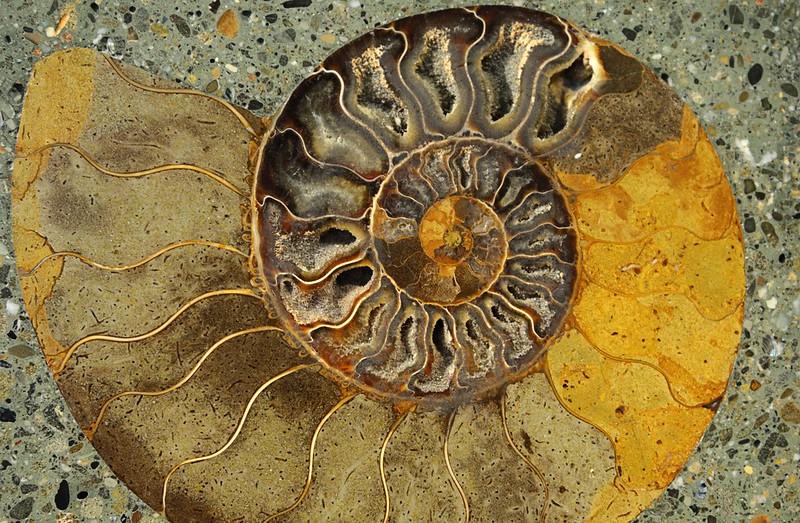
Oh, this spiral shell of Time, wobbling on crustaceous legs!
It’s sweet as honey and bitter as medicine in tentative turn
luring me to press myself
between the musty pages
with my new ink, riding the roaring waves of the past
in the bubbling clean foam of Now.

Fossil nautilus.HitchsterCC BY 2.0.

Speaking of Now…what will you write?

******

with thanks to Kim and Bryan at Ethical ELA
along with those sharing for Slice of Life Tuesday at Two Writing Teachers

Easter echoes

Easter morning. I am six. My little sister is four. We’ve torn apart our Easter baskets. The green plastic grass is strewn all over and we’ve eaten the heads off our hollow chocolate bunnies. We didn’t go to church because Mama isn’t feeling well. She has trouble with her back and sits in traction for a while every day, in a chair by the bedroom with her chin in a sling that hangs from the top of the door. I am in the kitchen when the phone rings and she comes to answer it.

Oh no, she says. Oh, no. She starts to cry. Tears stream down her cheeks.

Listening to her side of the conversation with her friend from church, I learn that our pastor died this morning. At church. Standing at the pulpit to give his sermon when he sank to the floor. People thought at first he was kneeling to pray, strange for a Baptist, but…it is Easter…

In the days to come, the church people will comfort each another by saying this is exactly how he’d have wanted to go.

*******

Easter morning. I am eighteen. I’m not in church. I quit going a few years ago. I have been cutting my college classes more and more to run with my colorful theater crowd. I’ve decided to make my living perfoming on stage. It’s all I care about. My aunt, Mama’s sister who never married nor had children, says I’m “caught between the moon and New York City.” Deep down I know this is not the best that I can do: I don’t want to be at home anymore, I’m not getting along with my father, my grandmother is worried about me. I know she prays, because…

I have lost my way.

*******

Easter morning. I am nineteen. I am not in church, but I’m looking at a card that arrived at the end of the week. A beautiful Easter card from Miss Margaret. I didn’t know she had my address. I met her during my recent hospital stay, when I ran a high fever with a virus and needed an IV. Miss Margaret was my roommate. A large Black lady with a beautiful smile and a voice as warm as as a blanket. She was in for a mastectomy. She’d asked me, just before I left and before she went for surgery: Do you go to church?

No, ma’am, not like I should…(I didn’t say not at all).

Hmm, she replied. That young man who’s come to see you. Brought you those flowers. Have you been going out with him for long?

No, ma’am. I haven’t been out with him at all yet, actually. I got sick on the day of our first date and ended up here instead…it was also opening night of the play we were both in and I missed that, too.

What I didn’t tell Miss Margaret is that I was afraid the guy would give up on me…but he hadn’t, yet.

She nodded. Listen to me, Child. You are young. Watch out for yourself, hear? He seems a nice young man. You ought to get yourself back to church.

So here I am on Easter morning, not in church, looking at this card she mailed me… an Easter prayer signed Love and Blessings Always from Miss Margaret, P.S. I’m doing fine.

II wonder: Is it too late to get to church today?

I call my boyfriend.

*******

Easter morning. I am twenty-one. I’ve come back to my childhood church with my husband…the guy who didn’t give up on me when I got sick and missed our first date as well as opening night of the community theater production we were both performing in…a play entitled “Whose Life Is It Anyway?” We’ve been married for a year and a half, we’re both working, we just left our one-bedroom apartment for a new townhouse, first time homeowners. Up until these last months, we thought we would move to New York and pursue acting careers. I’ve been accepted to The American Academy of Dramatic Arts and they have allowed me a grace period to come….if we can figure out how we are going to afford to live there.

But my husband has recently told me: Honey…we need to talk.

And then he just says it: I know God’s calling me to preach.

His beautiful face is so earnest. I tell him the only thing I know to say: If He’s really calling you, then you have to try.

The huge sanctuary is packed today. Hundreds of people. The pastor has been here for fifteen years, the successor of the one who died here on that long-ago Easter morning. Today he preaches from Acts 17, Paul addressing the Areopagus on the resurrection of Christ; Paul is mocked, but one man and one woman are called out here in the passage by name for joining him in belief: Dionysious and Damaris.

When the pastor offers the invitation, I grab my husband’s hand: We are rededicating our lives today.

We walk the aisle. In all that crowd, we are the only ones who do: One man, one woman.

I tell my pastor that my husband is called to preach.

He will take him under his wing, the fifty-third and final young man he ordains to the ministry.

He will tell us later: It won’t be easy; I had to step into the pulpit of a man who died there. But the Lord will provide. He always comes through…sometimes at last minute when you are thinking all is lost, but He always comes through.

Then he’ll look at me: You were in my teen Bible School class, I recall. It’s been a while. I remember you coming to church with your mother when you were a child. Your dad didn’t attend and your mother didn’t drive.

Yes, sir. That’s right. My dad works most Sundays. Mama didn’t drive. She’s just recently gotten her license.

He will nod: You walked to church until we got our bus ministry started. Your mother was the first person to sign up for it.

I didn’t know that.

*******

Easter morning. I am twenty-five. Life is a blur with a baby boy to care for. I meant to change the old wreath hanging on the front of the parsonage, over by the wide porch swing. When the weather is warmer I will sit here and sing to him, but right now it’s still a little chilly, with the beach breezes blowing up from the bay. Before we go to church, I will put up the Easter wreath. Better late than never.

When I reach for the tattered old wreath, a bird flies out, startling me. There’s a nest in it, with babies cheeping… I had no idea.

Awed by the discovery of brand-new life on this particular morning, I let it be.

I save the new Easter wreath for next year.

*****

Easter afternoon. I am thirty. My family is gathered at the Baptist church in Daddy’s hometown for the funeral of his sister, my aunt. She was fifty-four, spent the last years of her short life in a nursing home, bedridden with mutliple sclerosis. For all of these years my grandmother drove a sixty-mile round trip each week to visit, taking her daughter’s soiled laundry home and returning it fresh and clean, and trimming her nails because the nursing staff said they weren’t allowed to.

Beside her in the pew, Daddy is pale. He’s recovering from a heart attack and four bypasses.

When my husband and I followed the limo to the church, I could see Daddy and Grandaddy in the back of it, side by side…two silver heads, exactly alike.

Grandma is broken but her faith is not. She says, I’m truly glad she isn’t suffering any more but oh, it hurts. It hurts.

She died on Good Friday, Grandma, I tell her. Like Jesus.

Grandma looks at me a long moment, her watery blue eyes gleaming: I can’t belive I haven’t thought of that.

The service begins. On Grandma’s other side, Granddaddy bows his head. Tears are trickling down his cheeks.

This is the only time I’ve ever seen him cry.

*******

Easter morning. I am thirty-seven. My husband and our boys have only been in our new house for a month and I’m still scrambling to get organized. I love the house, not that I wasn’t grateful for parsonages having been provided all these years, it’s just that eventually we will retire and you can’t do that in a parsonage. Plus…I can’t say exactly why, but this place somehow reminds me of my grandparents’ home. The great irony being that they’ll never see it. None of my childhood family will. Granddaddy’s been gone four years. Grandma’s in the nursing home; she’ll never travel again. Daddy died suddenly seven months ago and I’m still trying to process it, especially since everything fell apart with my mother afterward and there will be no repairing the ripping apart of our family…I think about how she took me and my sister to church…how she was the first person to sign up for the bus ministry…I have to remember the good, I must choose to remember the good, for it was there and real and even though a person may be destructive with those wheels already in motion long before she brings you onto the planet, there were always good things.

I cannot dwell on this anymore, I have two children of my own to get ready for church now and Easter is our biggest day…it really won’t do for the preacher’s wife to be late. Again.

*****

Easter morning. Today. Let’s just say my fifties will soon be coming to a close. Depending on when you read this, I will either be headed to church or having returned home. My husband is still preaching. Our oldest is in his fifth year of pastoring a church nearby, close enough that our two granddaughters come over often, including these past couple of days, to play with their Franna. Our daughter-in-law is an extraordinary pastor’s wife and mother as well as an incredible artist. So many gifts. Our youngest is playing piano for today’s worship service and he’ll sing the solo for the choir on “Rise Again” in his beautiful, beautiful voice… his fiancee is deeply compassionate, loving, always smiling. They are happy. Yesterday I wrote of digging the past and mining your memories for the stories that matter…today I write, my heart overflowing with abundance of life, for now, now, now. Today I write of the peace that passes understanding, for with God, the story does not end. The message of Easter that echoes through the ages is not one of death, but of life; not of lost causes, but of new purpose; not of despair, but of overcoming…it is a message of redemption, sacrificial love, forgiving, being set free. I think of those words, rise again, as I drive out of my neighborhood to see a hawk take flight, the morning sun flashing on its white belly, and discovering, that same day, the house finches have, indeed, built a new nest in the front door wreath, despite last year’s tragedy of all five babies dying suddenly. The mother began laying eggs during Holy Week.

Five of them.

The father sang a beautiful song after each egg was laid.

A song of new life, hope, and joy.

I know it so, so well.

The echoes of Easter.

*******

Composed for the 31st and last day of the Slice of Life Story Challenge with Two Writing Teachers

—thank you all for being such a loving, supportive community;
please keep writing ❤
Dig the past

Way back on Day 10 of this current Slice of Life Story Challenge, I had a lot of fun playing around with a prompt asking what the first line of my autobiography would be. I really prefer the idea of memoir…my definition: Mining one’s memories for the stories that matter most, digging in the storied strata of one’s past.

I came up with this “opening line” for it:

My father named me for his mother, and that was the beginning of everything.

Truth.

From the moment I entered this world, my grandmother and I were bound together by blood, love, and namesakery. Long after she’s left it, our bond remains unbreakable.

Were I ever to write an extended memoir, her stories would be layered throughout. I am part of them; they are part of me.

She would say, You were named for me like I was named for my Papa. I loved him so. He was very religious, sang in the choir every Sunday. He had a beautiful bass voice…he used to keep bees when I was young and I’d help him get the honey.

She was sixteen in March of 1932 when her Papa, Francis, died by suicide. On his sixtieth birthday. I don’t know the whole story but what little I do know, I shall keep for now. Grandma told me they brought him home in a wooden casket lined with black oilcloth and that she sat up with him all night before the burial.

The point is that my grandmother’s stories made me hungry to know as much as I could about her childhood, daily life long ago, how people endured such hard times. Many didn’t. The old cemeteries tell stories of their own.

I asked her about the 1919 influenza epidemic: I don’t remember it. I was little. I do remember people talking about “hemorrhagic fever” and Mama saying she made big pots of soup for the neighbors who were sick. Papa carried it to them and left it on their porches. He wouldn’t go in because he didn’t want to bring the sickness home.

I asked her about meeting my grandfather: Oh, we always knew each other. He’s nine years older than I am and he and Mama used to pick cotton together…

Granddaddy would say: We’d all see who could pick the most cotton and it was always Lula [Grandma’s mother] or me. That was before the boll weevil came along and people started planting tobacco.

Grandma said: When tobacco came along, I was a looper…you had to be careful. That juice was sticky and would stain your clothes; it was hard to get out…using a wringer washing machine or washboard, I might add.

The setting of all this is a tiny community called Campbell’s Creek, established around 1700, way down east in the far reaches of Beaufort County, North Carolina. It’s part of Aurora although the actual town is five miles away. Most of the town is now in serious disrepair and the place is so remote that when I happen to encounter people who’ve been there, they typically say something like “I thought I was going to the end of the world.”

It is one of the places I love best on this Earth. The beginning of everything…Aurora is Latin for “dawn,” you know.

My grandparents, Columbus St. Patrick and Ruby Frances, were born here in 1906 and 1915, respectively. They married during the Great Depression. Their first home was a tenant house; their first child, my father, was born there. Granddaddy was a sharecropper. He plowed fields with mules. He was skilled with farm tools that people seldom use now, like an adze. This would give him a unique advantage when he “couldn’t make a go” of farming and went to Virginia to find a job as a shipwright, just as war broke out and ship production went into overdrive. When the war was over, he tried his hand at a number of things, but he had two more children to provide for; he went back to the shipyard until he retired.

All of his life, Granddaddy was a farmer at heart: I can remember when we ordered chickens by mail and they’d be delivered in cages by horse and buggy. I was three or four when I saw my first automobile…

That would have been around 1910. A Model T.

Time was, he’d say, in his country dialect bearing faint traces of Elizabethan English, that the whole family could go off for a week to visit somebody and you didn’t have to lock your house or barns because nobody would bother them. People looked out for each other. There won’t no nursing homes. When somebody was sick we all took turns helping out.

Grandma said: I was sitting with a friend’s mother. She’d been sick awhile and we all knew her time was near. She hadn’t spoken a word in days, hadn’t moved or responded to anyone. She was just lying there in the bed when all of a sudden she sat up and opened her eyes. She started laughing: “Can you hear them? Can you hear them?” Her face just glowed...it had to be angels. A little while after, she was gone.

I grew up on these stories and so many more.

My summers were spent learning things that I wasn’t even aware I was learning, things that will drive my interests for the remainder of my days: story, history, culture, nature.

Faith.

And science.

I’ve written much about the little dirt road that ran past Granddaddy and Grandma’s house. It’s one of my life’s greatest metaphors. I can recall, in the 1970s, when it was covered with gravelly “rejects” from phosphate mining, Aurora’s biggest industry since 1964. Granddaddy and Grandma were so excited for their grandchildren to come digging in the road to find sharks’ teeth—some were quite large — coral skeleton, and various fossilized bones of sea creatures. Someone of official status must have soon realized the value of these rejects and they weren’t scattered on the old dirt road anymore. Instead, they were taken to a newly-created fossil museum in town. Today, children from all over come to dig for fossils they can keep, and they can learn about the history in the little museum. There’s even an annual fossil festival at the end of May; last year I went for the first time with my seven-year-old granddaughter.

This excerpt is from an article in the April 2023 edition of the magazine Our State: Celebrating North Carolina:

Beneath our state’s soil and waves is a lost world waiting to be discovered—a geologic trove we claim as our own…about 50 years ago, coral specimens were found in drilling samples near present-day Aurora. They were sent to the Smithsonian Institution, whose scientists soon visited—and identified the area as one that proclaims the most prolific fossil record of the Miocene (2.3 million to 5.3 million years ago) and Pliocene (5.3 to 2.6 million years ago) marine life on the Atlantic coast.

About fifty years ago… I’d have been a child playing in the gravel on the old dirt road, collecting shark’s teeth, unware of the true treasures of my life.

The Aurora Fossil Museum, writes the author, “continues to keep the past alive.”

It’s analogous to to me: Scientists finding bits of ancient creatures, trying to piece them together to understand stories of this “lost world,” and how I hold to bits of story from this same place, the lost world of my grandparents.

Generations rise and fall…layer upon layer of story strata settling in their wake.

I am a remnant of their world. From early childhood Grandma infused me with story, unknowingly turning me into amateur oral history exacavator, archivist, curator…the stories still live in me.

My father named me for his mother, and that was the beginning of everything.

Imagine my delight when I learned last year that the Aurora Fossil Museum had been approved for an official historical site license plate with the NCDMV. I applied for one right away….it finally came, a couple of months ago. I’m among the first to have it:

I imagine Granddaddy’s beaming face. I hear Grandma’s typical expression of surprise: My land!

Dig the Past! the license plate reads.

I do it every day that I live. I go on mining my memories for stories, working their meanings out bit by bit, trying to preserve them for the priceless treasures they are.

Keeping the past alive. For the future. For right now.

That’s what memoir is for.

*******

Composed for Day 30 of the Slice of Life Story Challenge with Two Writing Teachers

Cluttered recollection

During the March Open Write over at Ethical ELA, host Rex Muston invited participants to craft “Junk Drawer Affirmations” because, writes Rex: The most urgent motivations to fix something or do something purposeful are tied to the things often gathered there.  The eventual rummaging through the drawer lends to varied levels of reminiscencePick your favorite junk drawer and explore it with a search that settles on something that carries deeper meaning.

I could have chosen one of several drawers, truth be told. But this one called to me. I’d already gone to rummage in it recently, and…well, it takes writing a poem to get to deeper meanings.

Cluttered Recollection

I forgot
what brought me
to the old rolltop desk

and what I was looking for
in this drawer

it isn’t the box 
of sheet protectors
left behind by my youngest
marking his time
in high school band

not the psychedelic folders
I bought to hold
copies of songs for
kids at church to practice
the neon-swirl flower-covers 
peeking out from under
the folded map of
the British Isles
this juxtaposition
conjuring a sense
of the 1960s 
and The Beatles…
can’t buy me love, oh
no no no no…

not the bag
of unsharpened pencils
I won at a staff PD session
(why haven’t I used them?)

or the phone chargers,
wires twisting and coiling
over and around
five clear marbles
I hid here last year
to keep them away
from my toddler granddaughter

or the tag she tore off
my Princess Diana
Beanie Baby bear
(ripped away,
just like
the Princess)

or the flat little Ziploc
lying so unobtrusively
in the midst of it all
like an untold secret
carried within

—don’t know why I saved it,
this tiny snakeskin
pale as sand
fragile as a minute,
an exhaled breath

I found it
in the garage last spring
just a remnant
of a shy earth snake
that was once here
then gone
leaving only this papery bit
of itself behind

I remember putting it
in this baggie

I think I meant
to show it
to the granddaughters

but I forgot
just like I forgot
what brought me
to this old rolltop desk
that I’d given to their dad
when he was still a boy.

*******

Composed for Day 29 of the Slice of Life Story Challenge with Two Writing Teachers