Beautiful child

At a recent meeting of educators, I heard a woman speak of her child’s transition to a new school. The child came home bubbling with excitement on Day One:

“Mom, my teacher looks like me!”

This is the first time her child ever had a teacher of the same race, the woman said. In fact, she went on to say, with quick finger quotes for emphasis, her child was “the only ‘beautiful’ child in the class last year.”

I understood what she meant: Her child was the only one of their race in that classroom.

I’m a mom. I know the protective, fiery love for one’s own, above all else. A proverb comes to mind: “There’s only one beautiful child in the world and every mother has it.” This mom didn’t say there’d been a problem at the previous school but as an educator I know that a sense of belonging and identity are vital to learning. I know that every school and classroom should strive to value, support, empower, and celebrate each child (as well as the adults). For that is how children learn to value, support, empower, and celebrate each other. That’s humanity at its best.

Which is why, as a human being hearing these words from another, a mother and educator, I came away with one heavy, lingering question:

Aren’t ALL children beautiful?

Rabbit reverie

I saw the first one of the season just about a week ago, while driving along a back road on the blackest of nights. Through an infernal, eternal, cold Carolina rain, my headlight beams caught a flash of brown, a glimpse of white cottontail zigzagging like lightning off to the right.

—Rabbit.

—Spring is near.

The cheery thought sent me into a rabbit reverie.

My husband used to tell our boys when they were small that fog was really the rabbits making soup.  I immediately envisioned hundreds of tiny cast-iron pots over miniature campfires out in the woods, with rabbits meticulously stirring and stirring the steaming contents—Where’d you get this fanciful idea? I asked. My husband smiled: It’s what my father used to tell me. To this day, our sons, grown men,  look outside on a foggy day and nod sagely: “Rabbits making soup again.”

Baby rabbits hung out on our porch during the spring I was expecting the second of the two boys. The older one, seven turning eight, sat at the windows of his baby brother’s nursery-in-progress to watch them up close: Look, Mom, look! There they are! Easter bunnies!

I decorated the nursery with a Peter Rabbit theme.

The first good animal drawing that I ever did, that my first-grade classmates sincerely complimented, was of a rabbit. I didn’t tell them I’d traced it, as that seemed a totally insignificant point at the time.

I recalled my father mentioning the local radio station of his 1940s childhood, WRRF. He said it stood for We Run Rabbits Fast.

Life runs faster than rabbits, doesn’t it, Daddy. Too, too fast.

With that, all my rabbit thoughts left me as rapidly as they came.

Until I promptly stumbled upon this garden photo with two baby bunnies nestled in a head of—cabbage?

So that’s what this is about. I am clearly dealing with a motif.

Okay, Bunnies, I acknowledge you, your contribution to my life, your secret culinary arts, your near-omnipresence in children’s literature, your real and mystical connections to springtime, even your voracity.

I’m grateful for you.

I’m also thankful that I don’t have a garden for you to destroy, just saying.

And I am really, really sorry that I carried around that rabbit’s foot (dyed aqua) when I was nine. It wasn’t lucky anyway; that’s the year I broke my arm . . .

Seems I’ve long since redeemed myself, little friends.

Sun day

Here in the heart of North Carolina, epic snow and bitter temperatures haven’t been an issue.

We’ve had a different plague.

For nine dark days in a row, it’s rained.

Rain rain rain rain rain rain rain rain rain

Small rivers flowing over roads and through parking lots. Yards turned to absolute bogs. Maybe we can raise a bumper crop of Venus flytraps.

The farmers say it’s good for the cows, that continuously pulling their feet up high from so much mud as they walk builds their muscles (is this true? The rain is beefing up the beef?).

Not so for humans. The utter gloom left us in a zombie-like stupor.

Gray day after gray day after gray day . . . .what did the sun even look like? Feel like?

Wait—I remember reading something like this. I first encountered it long, long ago. A story of bad enchantment. . .

“When you try to think out clearly what this sun must be, you cannot tell me. You can only tell me it is like the lamp. Your sun is a dream; and there is nothing in that dream that was not copied from the lamp. The lamp is the real thing; the sun is but a tale, a children’s story” . . . Slowly and gravely, the Witch repeated, “There is no sun.” And they all said nothing. She repeated in a softer, deeper voice: “There is no sun.” After a pause, and after a struggle in their minds, all four of them said together: “You are right. There is no sun.” It was such a relief to give in and say it.

—C.S. Lewis, The Silver Chair

How easy to forget there ever was a sun, succumbing to the mind-numbing sound of rain, rain rain, just as Prince Rilian, Eustace, Jill, and Puddleglum fell under the spell cast by the strum, strum, strum of the Witch on her stringed instrument.

Until yesterday, that is, when I heard a sound other than falling water.

Just outside my bedroom window, birds were singing. Merrily.

Despite the pouring rain, on a morning with no sun, they sang with pure zest.

How it lifted my spirits. Surely the sun could not be far from returning. Surely the birds knew it, were proclaiming it ahead of time: This this this too will pass pass pass. This this too will pass pass pass, wait and see, wait and see . . .

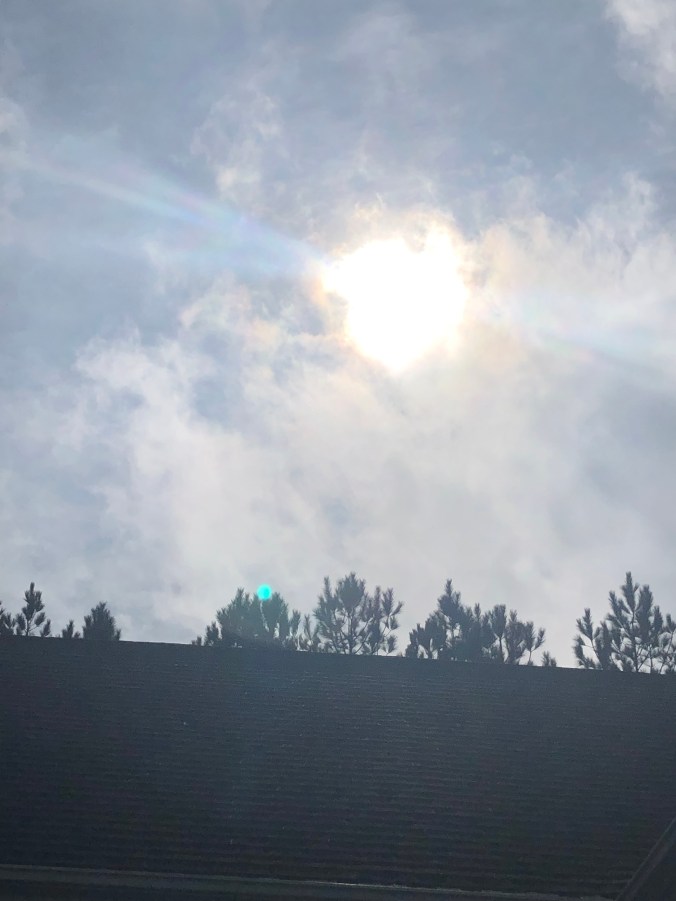
Then, today, bit by bit, the grayness lifted. Yellow shafts of light suddenly spilled through the blinds; I ran right outside to revel in the brightness. Now, as the afternoon wanes, shimmering golden fingers are playing across my keyboard, my hands, the table, the walls. I think of a happy child, dancing, full of joie de vivre, joy of living.

Today just so happens to be Sunday.

And now I have a bit of song for you, little harbinger birds:

Little darling, it feels like years since it’s been here
Here comes the sun
Here comes the sun, and I say
It’s all right.

—George Harrison

Tale of two chocolates

Last night I was privileged to have guests, one of whom is a three-year-old girl.

While seated at the dinner table, my son’s Valentine stash on the counter caught her eye.

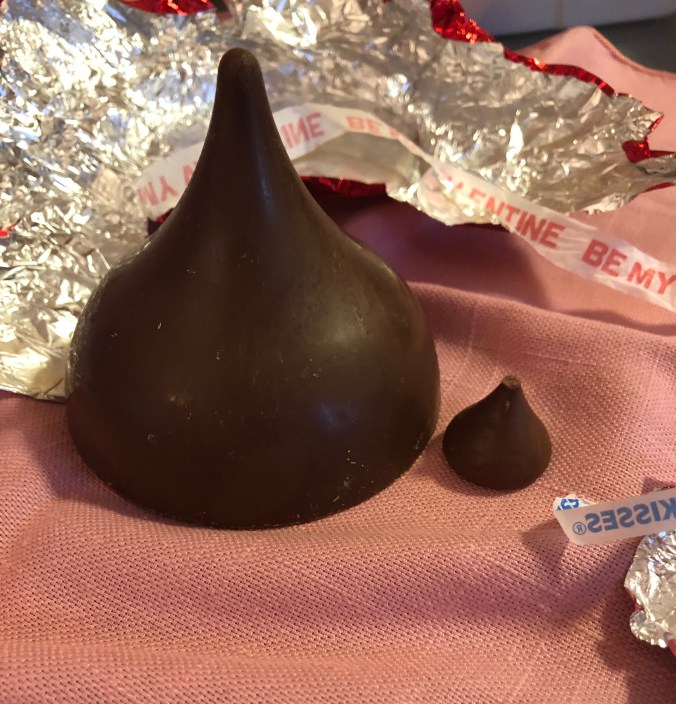
“What’s that?” she asked, pointing to a giant Hershey’s Kiss wrapped in red foil.

“Chocolate,” we told her.

“I want it!” she said.

“No, that’s too much chocolate,” said her mom.

Our little visitor looked at my husband (for support? For overruling authority?). She maintained solemn poise for a few seconds: “Mom says no.”

Then her mouth quivered and her blue eyes went watery.

Poor brave baby, I thought. Trying to accept ‘no’ is so hard.

Her mom got up and reached into the candy basket. “Wait, here’s a little one. You can have this little chocolate, okay?”

The watery eyes brightened: “A tiny one? I can have a tiny one?”

“Sure,” smiled her mom, handing over the regular-sized Kiss.

Small, chubby fingers nimbly divested this Kiss of its pink foil. But the child didn’t eat it. She studied it, then observed: “It’s a baby.”

The rest of us chuckled.

Our small visitor pointed back to the big Kiss and told my son: “I want to see it!”

“Okay,” he obliged. He got up from the table and fetched the giant chocolate.

“Open it! Open it!” demanded the girl, bouncing up and down in her chair.

Her mother looked hesitant as my son unwrapped it: “Just look—you’re not going to eat it, okay?”

As soon as the foil fell away, our little visitor’s face glowed. “It’s the mama!” She held the little Kiss up to the big Kiss: “Here’s your baby.” Wiggling the little Kiss, she said: “Hi, Mama! I missed you.”

As the rest of us dissolved in laughter, a grin spread across the child’s winsome face. She promptly ate the “baby” Kiss and went back to eating her dinner while my own thoughts enveloped me, momentarily drowning out the grown-up conversation.

The beauty, the lightning-quickness of a very small child’s mind, stirring, brimming, spilling over into a narrative with which she identifies, a defining of her world—a child, in fact, who hasn’t been verbal for very long. Easy to dismiss as a simple spur-of-the-moment burst of imagination, but in reality, it’s so much more. This is understanding at its finest, coming naturally through play, through story.

Oh, to bottle it . . . no. Never that. Oh, to open it, let it breathe, let it steep, becoming ever more potent each day, invincible against time and factors that will systematically dilute and evaporate it. Imagination, play, story, the core of who we are from our very beginning . . . the Mama Kiss.

—How we miss you.

I see you

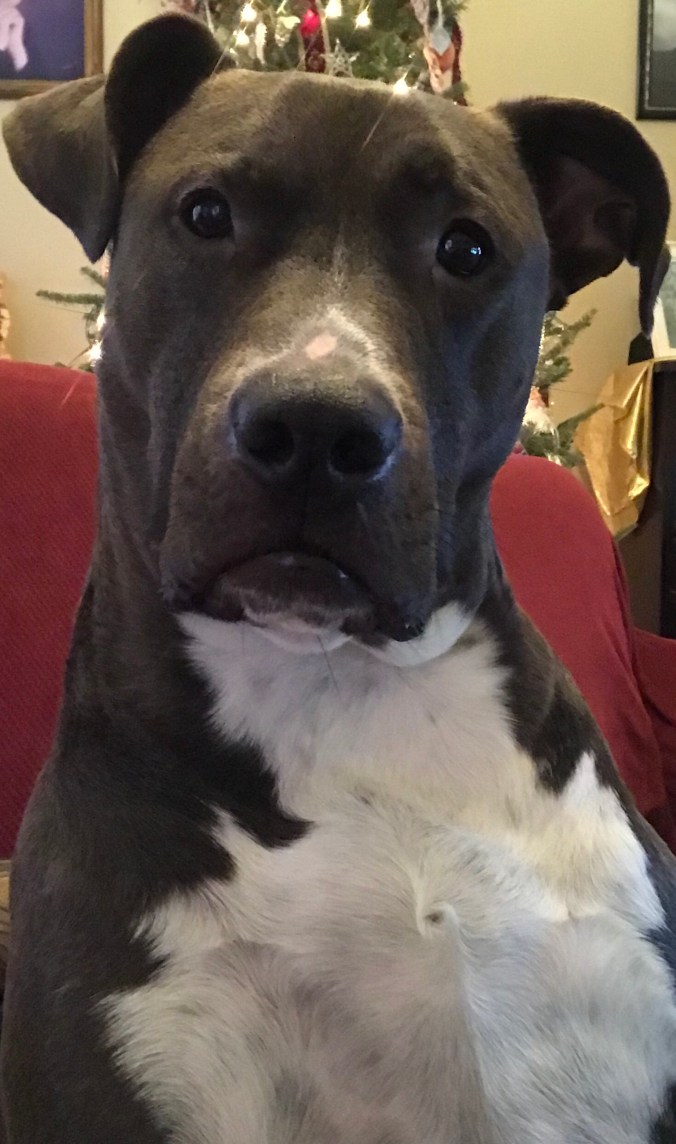
From the desk (so to speak) of Henry Rollins Haley (HRH), “pawthor” of the Henry Writes posts

[With right paw, adjusts laptop lid for best camera angle. Commences typing with one foreclaw]

Hello again, at last.

It’s been a while, has it not?

I’ve not forgotten you.

It’s just that I SO RARELY get screen time.

Can you see me—?

Because I can see you.

And, frankly, I’m worried. A lot.

You seem tired. Tense. Does your head hurt? Your bones? Your heart?

Something does. I sense it.

It makes me anxious.

Not for myself.

For you.

See, I have this innate, overwhelming, all-consuming need for everything to be okay, and it can’t be, if you are not okay.

I have no alternative but to dispel this disequilibrium. I am utterly compelled to restore a balance of Well-Being and Goodwill, for, otherwise, I simply cannot cope.

I’m unable to speak this, as you know. I must communicate via the only means I have.

Fortunately, I can type . . . .

But better still, I come as close as possible to you. I wait for you to see me. To acknowledge me, welcome me, invite me. Give me a sign. Then I will offer you my questing paw, my nudging nose, the long, velvety-warm magnificence of Me, custom-made for absorbing your sadness, your tears, your aches, your angst, so that they melt deep and far away, into insignificance, to irrelevance, nearly to nonexistence.

My gift is calm. My presence, peace. Your being, my being.

And so I wait and watch, hoping, hoping, forever hoping. Can you see it in my eyes?

Can you see me?

I see you.

*******

The gesture

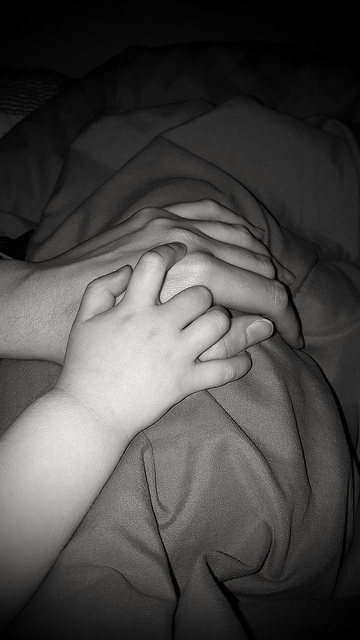
Pure love

Pure love. SurFerGiRL30CC-BY

Sunday morning at church. I took a seat by the aisle where sunlight poured through the stained glass window, where pale patches of pink, green, blue, and gold glimmered down the white wall.

In front of me sat a young man, a young woman, and a little girl, three years old.

The young man stretched his arm along the back of the pew, nearly but not quite embracing the young woman and child, just an easy drape of affection, of togetherness.

I could just see the top of the child’s head, two pinned-up pigtails coming loose, where his hand rested.

Then a chubby little hand crept up to pat his arm, once, twice, with all the grace of a ballerina. Two slow, deliberate, barely-discernible pats, before the dimpled hand disappeared again.

I watched, pierced by this silent message.

Maybe it was I love you. Or Thank you for being with me. Or quiet reassurance—I am fine, you are fine, we are fine together. Maybe even I’m here, you’re here, all is well with the world.

Such pureness of heart in that simple gesture. Such trust and confidence, such peace. How naturally it comes to a child, reaching out to someone else in benevolence, faith, and belonging.

And I mourned the incremental loss of it as we grow older, that it should fade like the colored patches of stained-glass light against the wall, that clarity of purpose should be obscured even as we accrue the words and language to better communicate our thoughts and feelings, that we should have to think twice about reaching out, or being the first to do so.

Two gentle pats, in them contained the original order and design of things, that together is the best place to be, that we are here for one another.

And so the children remind us.

Getting to the heart of writing workshop

I wasn’t sure how the day would go.

There were a lot of strikes against it before it even started.

Normally when I facilitate writing workshop training for teachers they’ve specifically signed up for it. They want to be there. This year, due to an oversight somewhere at the district level, the workshops weren’t scheduled. At the last minute, this workshop training was added as Day Two of Balanced Literacy (as Day One focused only on reading).

Meaning that teachers who signed up learned that they had two whole-day sessions to attend instead of one.

How would they feel about that?

Normally the overview of writing workshop alone is spread across three afternoons. Now I had to condense it all into one day.

Nothing like prioritizing content . . .

And, with the adoption of a new curriculum, writing workshop—and balanced literacy—won’t be offered to K-5 teachers any more. Just to K-2.

I felt I’d landed in no man’s land on some dismal shore, ineffectively beating back the waves of despair crashing all about me.

But I chose to keep my footing on a solid foundation, to hang onto all that I value about writing and teaching writing. The lifeline. Not just for me, but for the children, for their teachers.

This has to be worth their while, I sighed to myself.

And I got to work revising the training.

The day of reckoning comes. I start with who we are and why we’re here, rolling right into the what of writing workshop: Create the conditions for good writing to occur (credit Donald Graves). Understanding that writing workshop is not a program, is not about a product, but is a time set aside to fall in love with the craft (my definition) and to learn the real writing process.

Then we go deeper, into the why of writing. It’s at the very core of being human.

I read aloud to my participants:

Five-year-old Paul writes. Children want to write before they want to read. They are more fascinated by their own marks than by the marks of others. Young children leave their messages on refrigerators, wallpaper, moist windowpanes, sidewalks, and even on paper. 

Six-year-old Paul doesn’t write. He has gone to school to learn to read. Now that he is in school, the message is, “Read and listen; writing and expression can wait.” Paul may wait a lifetime. The odds are that he will never be truly encouraged to express himself in writing.

Paul will wait and wait to write because a higher premium is placed on his ability to receive messages than on his ability to send them. Individual expression, particularly personal messages in writing, will not be valued as highly as the accurate repetition pf the ideas of others, expressed in their writing. Since Paul will write so little, by the time he graduates from high school he will think of himself as a poor writer and will have a lowered sense of self-esteem as a learner. He will have lost an important means of thinking and will not have developed his ability to read critically.

-Donald Graves, Children Want to Write

I notice, as I read this, how heads begin to nod in acknowledgment . . .

Next we read portions of two articles with quotes from people in the business world. How young would-be employees have a hard time organizing their thoughts and articulating them, and that, when possible, employers should hire the better writer, because writers understand how people work, have better interpersonal skills . . .

We read these even though the participants of this training are K-2 teachers. 

Because this is where all the writing begins. 

Here, with them.

Then I read a bit from Colleen Cruz in The Unstoppable Writing Teacher, how a boy, Robert, discovers what his personal essay is really about. This is in a chapter entitled “I’m Finding Some Student Writing Repetitive and Boring.” Cruz writes: “Kids, and some adult writers, have a subconscious need to write about particular topics, but they don’t understand why.” Robert had chosen the topic ‘Christmas is my favorite holiday.’ His reasons are food, presents, and videos. While conferring with Cruz, Robert finally says that watching videos is the most important  thing about the holiday because his family had recorded every Christmas; he goes deeper and deeper into the meaning, until: “Since my dad died, Christmas is the only time I get to see him. My mom can’t stand to watch all the videos at any other time. But on Christmas she lets us watch them, and it’s like we’re all together again.”

The why of teaching writing: We owe it to the children to find their stories, to tell them.

It begins with our finding and telling our own.

Here’s where I carve out time to write in this workshop training. We lift lines from our writing to create an interactive poem; we brainstorm for more writing with heart maps (credit Georgia Heard).

At this point, I have to gently ask the teachers to stop writing.

For we’ve reached the how of writing workshop, beginning with minilessons. The vehicle for teaching standards and process, for modeling, for creating that atmosphere, those conditions, for good writing to occur. Opening the windows for student ideas to flow. Choice, voice. Meaning and mattering.

And it’s time for lunch. I tell the teachers that when they return, we’ll spend the rest of the afternoon on the backbone of writing workshop: Conferring. It merits its own what, why, and how. Academic feedback in the effort to reach a goal, growth versus grades, meeting each child, each writer, individually . . . .

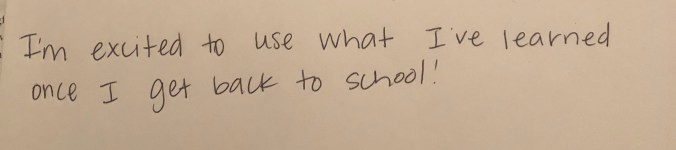
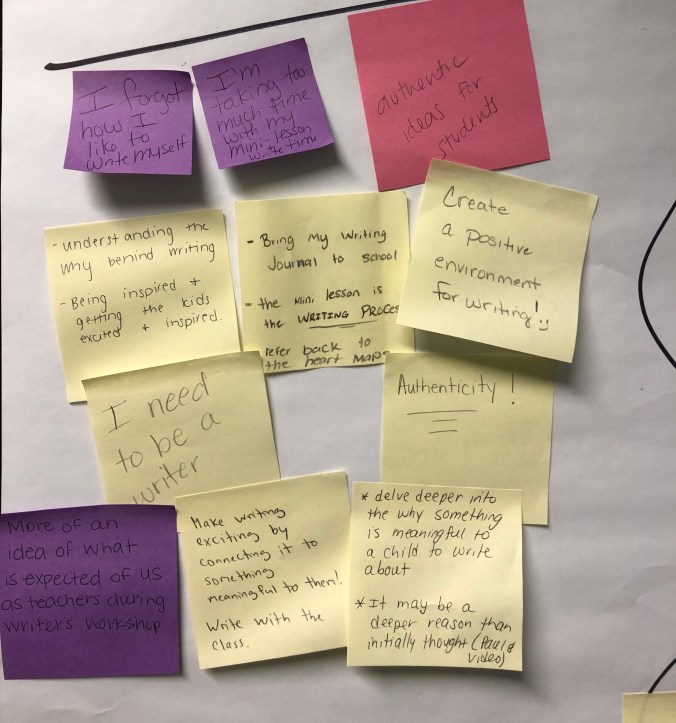
As they exit, the teachers seem happy. They leave sticky notes with their “gots” and “wants” on a chart. Personally I celebrate that the “gots,” pictured at the top of this post, far outnumber the “wants.”

Their notes revive my spirits. I’ve a sense of standing on a shore just as the sun breaks through the clouds. I feel the warmth of it. I can almost hear distant gulls, or something, calling and calling, wild and free; I can taste promise like salt in the breeze.

We’re not even done; we’ve only just begun.

I believe it’s gonna be a great day, after all.

*******
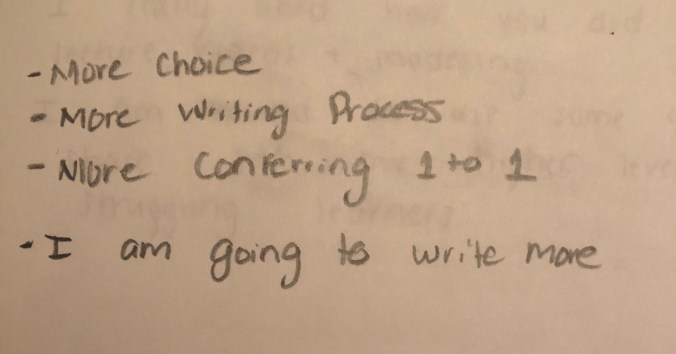
-Bits of the teachers’ final reflections at the end of the day.

Something to say

All you have to do is open

All you have to do is open . . . Mike HartnettCC BY

If you want to absorb rich dialogue, hang out at a hair salon. I keep thinking that a lively full-length play could be derived from the banter and candidness between a stylist and clients, with minimal staging needed. Conversations are not constrained; there are no boundaries, no topic is taboo.

I confess that I cannot help listening with writer’s ears every time I visit my salon. Not that I eavesdrop. Nobody whispers. It’s all just out there.

So it was, while waiting for my turn at a recent appointment and helping myself to the coffee bar, that I heard a woman with her head in the nearby shampoo bowl mention the word writing to her stylist (visualize how I froze, ears perked, coffee stirrer held aloft):

“My son never liked writing. He didn’t do well at all with it until he went to college. When I saw his first college paper, I actually said: ‘What? YOU wrote this? You didn’t get somebody to write it for you?’ But he’d really written it himself. I couldn’t believe it!”

They laughed together as the stylist lathered up the client’s hair.

I stirred half-and-half into my coffee, thinking: The boy finally had something to say.

I don’t know who he is, this college student. I don’t know where he attended school or anything about him other than those few sentences. But as I sipped my hot cinnamon dolce, I wondered about those statements.

My son never liked writing. 

What made that change? What drove him to pour the words onto the page and to hammer them into shape? Was this the first time he felt passionate about his topic, whatever it was? Had he ever been able to choose his own topic before, one that mattered to him? Did he have any authentic writing experiences in elementary or secondary school, or was it all formulaic, step-by-step, assigned for a grade? Surely this college paper was assigned, too, but apparently something new—within the writer—had given it life.

He didn’t do well at all with it until he went to college.

What was his process, or was it just real for the first time? Did someone in college give him feedback on his strengths, validate his ideas? Did he visit the campus writing lab for help with this paper? Or was there a professor who inspired him, stirred his interests, made him realize he had a voice and something to say, at last?

I caught myself sighing between swigs of cinnamon dolce. Why, why, why did it take him all the way to college to “do well” as a writer?

Maybe it’s simply freedom. His not being confined by what’s all too often considered “writing” in school, but being able to articulate what he really thinks, what he feels in the depths of his heart, and having a safe, supportive venue for communicating his perspective to a real audience, even to the world. Maybe he got a professor who loves to write, who showed the students how and why to write. All I know for sure is that SOMETHING was the game changer for this young man; even his mother was amazed. Could it be that someone finally believed in him? That’s where the true business of education begins—in throwing doors wide open, not in closing them. Learning and understanding are like coming from a stuffy closet into a living room, or from a comfortable living room into the whole vibrant outdoors.

Or the hair salon, where you can speak what’s on your mind, where someone listens and responds, where voices are not constrained, where there are no boundaries, and no topic is taboo.

Writing teacher rhapsody

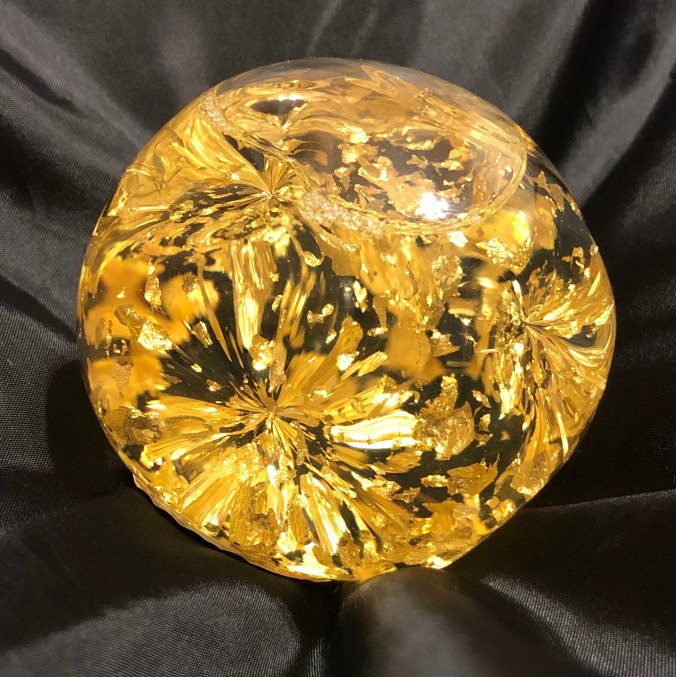
Globe with gold suspended in water

Writing time.

Expectancy painted on their faces.

They know something’s coming,

just not what, yet.

But something.

Ideas.

Their own.

In this moment

I’m just the crossing guard

from the unit 

to the universe.

Ever expanding.

They do not know, yet,

that they’re made 

of the same stuff as the stars.

That the stuff without

is always calling

to the stuff within.

They are children

but not too young to discover

they’re oceans

containing more than simply

water 

and salt.

But I know 

there’s millions of pounds of gold

infinitesimally dispersed

throughout the oceans.

Here is where

those priceless grains 

rise to the surface

take shape

become substance.

Now is when they start spilling

onto the page

to shine

with a light of their own.

The whole of my task

is to stir

release

and be swept away.

A boy and his secret

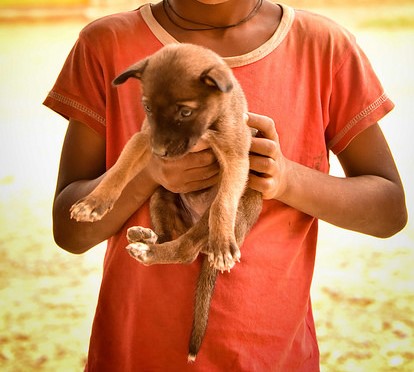
boy & puppy

Boy and Dog, Adigrat, Ethiopia (cropped). Rod WaddingtonCC BY-SA

One day when I was off campus, the school psychologist sent me a text about a student:

He’s looking for you. He has a secret he wants to tell you.

—Gracious.

I texted back: Tell him I’ll see him first thing tomorrow morning.

The student is my tiny friend who came to our school from another country several years ago. He landed in first grade with no English and a lot of frustration. When I met him that year, he was wearing a Superman T-shirt. I pointed to it and said, “Hey, you’re Superman.”

He smiled.

That’s how our friendship began.

I’ve written before about his perceptiveness, such as how he explained, after his bleak performance on a mandatory reading assessment, that he had Big Spanish while I have Big English. His English continues growing “bigger,” just as he’s growing in stature with each passing year. Although he remains physically small for his age, it’s hard to encapsulate or convey the power of his personality. He has enormous presence. He’s a dynamo. Strong-willed, yet a charmer. Witty.  His thoughts are like quicksilver—always moving, fascinating, alive. He’s a keen observer; when he didn’t understand directions in class, he’d watch what other students did and quickly followed suit.

He tells his teachers: “Mrs. Haley is my friend.” He usually greets me by flying faster than a speeding bullet to throw his arms around me with a joyous cry: “Mrs. Haley!”

Then he asks if we can read or write.

That’s alchemy. When the gold finally appears.

So, as to this big secret he had for me . . .

I’m waiting for him when he gets off the bus. He barrels right to me, face beaming:

“I been looking for you! I have a secret!”

Extricating my midsection from his hug, I bend down. “That’s what I hear! So tell, me, what IS this big secret?”

“Shhh!” he says, in overly dramatic fashion, looking around. What a wonderful stage actor he’d be. He’s larger than life. He beckons me to lean in closer. He whispers: “I got a dog!”

I can’t imagine why this needs to be secretive, but, okay, I’ll honor it. “You did? That’s great! I LOVE dogs. What’s his name?”

He looks me dead in the eye. “Her,” he says. “It’s a girl.”

He has no idea what he’s just done. It’s profound. A sign of how well he’s mastering the language, for pronouns are often terribly challenging for English learners. I want to bask in it indefinitely, but I can’t stall now, I have to respond. Blinking, I stammer: “Oh, um—sorry! What’s her name?”

He looks around to be sure no one can hear, and whispers into my ear:

“Mrs. Haley.”

And then he skips away, grinning from ear to ear, this bit of quicksilver, bright as the blinding winter-white sun above us.

I can barely see for the tears welling in my eyes as he blends into the throng of students going to breakfast. I cannot verify that the story is true—that there’s really a dog, that he really named it after me—but this doesn’t matter. The story is his, either way. Born from his heart.

And he shared it.

A gift of pure gold.

That I’ll carry with me, always.

*******

Previous posts about my inspiring young friend:

Big English

Like Superman