Suncatcher

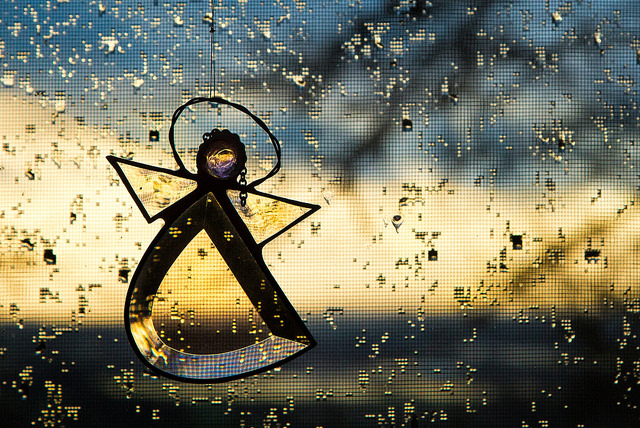
Sun angel

Sun angel. Sheila SundCC BY

 Into each life some rain must fall
But too much is falling in mine
Into each heart some tears must fall
But some day the sun will shine
Some folks can lose the blues in their hearts
But when I think of you another shower starts
Into each life some rain must fall
But too much is falling in mine.

-Allan Roberts

Yesterday morning the sun beckoned from among striated clouds, streaking the sky with silver and gold. Birdsong—it’s a brand-new spring. The scent of fresh-cut grass from the day before lingers, and nothing takes me back to my childhood and my father quicker than that sweet green fragrance.

Even as the sun shone, a soft rain pattered down.

In my heart, in the hearts of my community, too much rain is falling.

Yesterday we buried a young lady who grew up here, was one of us, was an only child and grandchild. She was a college freshman, eighteen, a year younger than my second son, his childhood playmate and lifelong friend. She went to church with us all of her life, sang in the choir, and was beautiful. She caught the light and scattered it like a faceted gemstone quietly scatters tiny, vivid rainbows on objects close by.

Death, when it comes suddenly to someone so young and full of promise, can only be likened to a great ripping apart.

She is ripped away.

The church was full and overflowing an hour before the service. People stood around the walls of the sanctuary, packed the fellowship hall, lined every hallway on both sides throughout; a huge crowd waited outside because there was no more room.

My husband officiated. He was at the hospital the day this child was born. He ended the eulogy with a little twist of Shakespeare: “Good-night, sweet princess; and flights of angels sing thee to thy rest.”

As the crowd walked to the burial site, the sun shone for all it was worth. The clouds were gone; a warm breeze ruffled dresses, suit jackets, hair.

Even so, the rain will fall within us for days and days to come, yet it doesn’t mean that our little suncatcher won’t keep catching and scattering the light in the quiet way she always did. More light than ever is reflected in the myriad drops of rain, like iridescent droplets of diamonds quivering with celebration that she lived, that she was a gift.

She will always be.

slice-of-life_individualEarly Morning Slicer


O. Henry

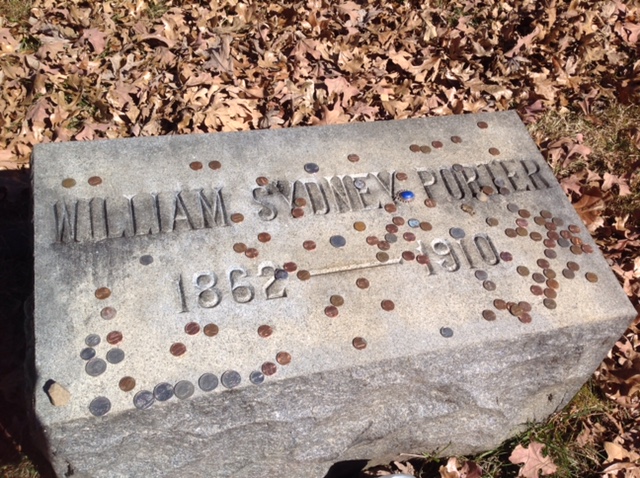
O. Henry grave 

Fall comes early in Asheville, North Carolina. The air is chilly when I get out of the car at the cemetery to visit the grave. I think of winter coming, of Christmas, of this writer’s most famous work. I take a picture, marveling at the coins spread over the gravestone. As I turn to go, a frigid wind gusts, scuttling leaves over the ground and across the driveway.

Leaves . . . I remember that story.

O. Henry’s headstone is covered in coins, mostly pennies, which usually add up to $1.87 –  the amount of money that Jim and Della had at Christmastime in his famous short story, “The Gift of the Magi.” This shortage of money is why Jim sold his gold pocket watch to buy combs for Della’s beautiful hair, and why Della cut and sold her hair to buy a platinum fob chain for Jim’s prized watch. Their sacrificial love for one another has made the story an enduring classic.

There is another story of O. Henry’s that I love almost as well.

I remembered it as I planned to write “Oh, Henry,” yesterday’s post about my son’s dog. I should write about O. Henry next, I smiled to myself. A little word play with the titles. How enticing.

That’s when I thought about the fallen leaves blowing over the writer’s grave.

I scrounged up my old paperback copy of O. Henry’s short stories and reread “The Last Leaf.”

In this tale, two young artists live in a three-story Greenwich Village building. One of them becomes sick with pneumonia. She watches the leaves dropping from an ivy vine against the wall just outside of her window, convinced that she will die when the last leaf falls. To her astonishment, the last leaf hangs on through high wind and rain. To make a short story shorter, the leaf remains because an old artist in the building crawled up a ladder in the dark of a raw November night and painted it on the wall with the vine. The girl begins to recover and the old man, Behrman, dies of the pneumonia he catches from being out in the weather while painting that night.

The old artist had always wanted to paint a masterpiece and never pulled it off – but the last lines of the story have the roommate telling the recovering girl about the leaf: “Didn’t you wonder why it never fluttered when the wind blew? Ah, darling, it’s Berhman’s masterpiece – he painted it there the night the last leaf fell.”

Self-sacrificial love at work again – but there’s more to it.

That leaf symbolized hope, sparking the desire to strive, to overcome. The old artist’s small gesture inspired the young artist to keep living.

This leaves me thinking, in the course of our days as teachers, as writers: Are we not the artists who paint the pictures of possibility, of hope, in the minds of others? Do we spark in others a desire to strive, to reach for what’s beyond their grasp, or to hang on only long enough until this, too, shall pass?

Our masterpieces may never be world-famous; they may be as simple as knowing the right word, the right idea, the right vision, the right story, and sharing it when it is most needed. Inspiration leaps from one heart to another, creating something to hang onto, outlasting high winds and rain. We may never see the full effect of our work, but that’s all right.

We paint the leaves where we can.

I close my old paperback book.

O. Henry, I am so thankful you were here.


slice-of-life_individualEarly Morning Slicer


The coaching tree

Coaching Tree Lg

Early in the school year, my instructional coaching colleagues and I attended district training where participants were tasked with creating an image to explain the coaching process.

My group thought for a moment.

“You know, coaching is an organic thing,” I said. “Or at least it should be. We all know it takes time to develop relationships and trust. It’s about honing practices, sure, but this is a growth process for us as well as for our teachers. We grow together to reach goals.”

A colleague said, “Yes! I’m seeing a tree, branching out . . . .”

In a few minutes we’d sketched the tree. We began to label it, recognizing coaching elements that correlated to parts of the tree. The more we worked, the faster the ideas came.

Relationships are key in coaching, the foundation, but certain things must feed the relationships before the process can begin. These roots are trust, the human connection, listening, collegiality, safety, empathy, and support. Coaches must meet teachers where they are and be willing to plug in with what teachers want to accomplish – it’s not as much about seeing the work as it is seeing a fellow human being. The vision develops from there, and needs to be a shared one.

The trunk of the tree symbolizes this togetherness with inspiration from Shel Silverstein’s The Giving Tree. Near the bottom of our tree, we placed a little heart: Coach + You. The heart of coaching is just that – having a heart for each other.

A solid, thriving coaching relationship branches out into nearly endless possibilities, aspirations, and directions, such as goals, the 4 Cs (communication, creativity, critical thinking, collaboration), encouragement, self-modifying learners, reflection, growth mindset and learner agency.

My coaching colleagues and I stood looking at our work, feeling pretty happy with our Coaching Tree.

“We need to put the sun in,” said a colleague. “The sun is the climate, of course – a warm climate conducive to coaching is necessary for the process to work. That’s where administration comes in.”

We put the sun in.

At this point, something struck me – “Trees bear fruit! What is the ultimate goal of coaching, the payoff? What’s the fruit of our labor?”

We created a basket then, and labeled it The fruit of our combined efforts. It holds apples: Love of learning, data, increased student achievement, teacher fulfillment, students graduating college or career ready. 

As teachers are fulfilled and productive, we desire to branch out into new areas. The growth continues. As students achieve, as they go on with their lives, some will go into the teaching field and the cycle begins anew.

At the close of the training, small groups presented their work to the whole assembly of coaches. The other groups had designed diagrams, cycles, or flow charts, all of which artistically, appropriately encapsulated the continuous reflective coaching cycle of support.

My group was the only one to present the coaching process as a living thing, something organic.

We were startled by the enthusiastic applause from our fellow coaches.

Upon returning to school, my colleagues and I recreated the Coaching Tree in the teachers’ lounge. It stands there to encourage, invite, celebrate, and maybe inspire or spark hope when we all need it, a visual reminder that our work is not in vain, that we’re in this together, to help each other along, and the sky is the limit.

slice-of-life_individualEarly Morning Slicer

The storm passes by

Church after tornado 6-18-13

Our phones are popping at the same time:  “Take cover immediately . . . .”

Outside, the wind gusts; objects are striking the building, the windows.

We quickly gather the children who’ve come for Vacation Bible School – there’s about seventy of us in all – and they get down on the floor, balling up with their heads against the painted cinderblocks of the main hallway.

The wind is roaring now. The electricity goes out. The emergency lighting flashes on, bright as spotlights, adding a stark, garish quality to faces and bodies. The fire alarm goes off, a deafening blare, as it’s right above us. A boy with hearing aids rips them out of his ears.

The children are still, silent, as heavy objects strike windows in classrooms – will the windows shatter? For a split second I am tempted to look out and see if Miss Gulch is riding through the air on her bicycle just as she morphs into the Wicked Witch of the West.

Instead I kneel over several children as a shield, leaning my head against the cool concrete wall.

These walls are solid, I think. Safe.

But just around the corner in the fellowship hall is a hutch with a large, framed photo of the church when it was nearly flattened by a tornado twenty years ago.  

Minutes are eternal when destruction is banging on the door.

If we die, I think, at least we are in church.

My husband, the pastor, prays aloud.

The wind soon abates, dies away.  

We go outside to find long strips of vinyl from someone’s home strewn in the parking lot. Big pieces of plywood from who knows where are lying against the building. Shingles are scattered about like fall leaves. The trashcans are way across the graveyard – we trek over to fetch them and we see the gap in the woods where the tornado came through. It cut a path through the cemetery, knocking down a line of gravestones. Silk and plastic flowers, little angel statues and other loose memorials left by families for their loved ones are blown everywhere.

The children retrieve and replace them.

Parents begin arriving, alarmed. Others in the community come to see if everything’s okay.

Just as we are leaving, I turn back toward the church – “Look!”

Arcing up from the woods across the street to the woods behind the cemetery, in the sky directly above the church, a rainbow gleams.

All is well.

slice-of-life_individualEarly Morning Slicer

Courage (part two)

The surgery took longer than expected, but the surgeon came to the waiting room at last.

“It went well,” he said. “Your husband’s eye is removed and the implant is in place, covered by membrane and attached to the muscles as it should be, if he were to get a prosthesis.”

He paused.

If it went well, why is he pausing? Something’s not right.

He continued: “I had to remove a lot of extra tissue, as it was dark and there’s no way for me to tell if it’s just natural pigment, or bruising, or melanoma.”

I was shaking. “What does this mean?”

“I took all of the dark tissue but he may never be able to wear a prosthesis, as there may not be enough support for it,” said the surgeon, gently.

I nodded. How are we going to tell him?

“Pathology will send the eye to Wills Institute in Philadelphia – they’re the best. They’ll analyze the tumor, whether or not any cells have spread . . . .”

 I closed my eyes as he spoke, not having considered this possibility.

I recalled the oncologist’s words when we consulted him: By the time it’s found, it’s usually metastasized. Radiation and chemotherapy are ineffective. It’s nasty.

That doctor had treated five patients with ocular melanoma in the last two decades.

All five had died.

Please, God. Please let those cells not have spread.

And then I went to recovery to hold my husband’s hand.

He squeezed mine, hard.

Half his head was bandaged. When an eye is surgically removed (enucleated), that side of a person’s face bruises badly. A conformer, a clear plastic piece like a huge contact lens, is put under the eyelid to hold its shape during healing so a prosthesis will fit.

The pain is intense for the first few days.

When the bandage had to be removed the first time for the application of antibacterial ointment, my husband said, “Get me a mirror.”

I handed it to him.

“Dear God,” he said, looking at his reflection.

It was the only time he cried.

After that, he never complained, not once – all of his energy went into healing.

The first night back home, when he went to bed, my husband said, “I see a light.”

“There isn’t a light,” I said. “I just turned it off.”

“I see it with my . . . what used to be my eye,” he said. “A bright light at the floor. Then it sort of swept up to the ceiling.”

I thought about amputees who still feel rings on fingers that are gone, or sensations in legs that are not there anymore. Phantom pain.

“I think it’s a phantom light,” I told my husband.

 He saw it for a few nights, this ghost light, the optic nerve trying to adapt to not seeing anymore. And then it stopped.

The bruising absorbed in a week or so and the eye – what do you call an eye that’s not an eye? A non-eye? – didn’t look as alarming as one would imagine. Just a pale orb, sort of like sclera without an iris. Not frightening at all, nothing like a hallowgast from Miss Peregrine.  Just different.

And every day we wondered about that pathology report.

Three long weeks went by before the surgeon called:

“No rogue cells in the tissue around the eye! The timing couldn’t have been better – the tumor was in the early stages.”

We threw our arms around each other; we could get on with living.

It wasn’t all that easy.

At first my husband wore a black eye patch to shield the removed eye. Everywhere we went, little kids called out, “Look, a pirate!” My husband just laughed and waved at them. An eye patch, however, is quite convex. It bumped against the lens of his glasses, which he had to wear all the time now for his remaining eye, as it was becoming strained.

He tried adhesive bandages designed for eyes next. Our grown sons said, “Dad, the eye patch looks better than those Band-Aids. A lot better.”

My husband sighed. He decided to try wearing a contact lens in the real eye, doing away with glasses so he could go back to the eye patch, which worried all his doctors:

“You only have one eye now – you can’t afford an abscess or corneal infection,” they told him.

He tried it anyway – and learned that in order to put a contact in, you really need two eyes to see what you’re doing.

At last he resorted to tinted lenses and gave up on coverings altogether.

He had trouble with depth perception, driving after dark, merging onto the highway. He was startled by people approaching him on his left side, because he couldn’t see them coming.

He bumped into things, hard enough to leave bruises.

He had trouble reading, which worried him more than anything else – he’s a minister, and reading is the foundation of his life’s work. He got a magnifying glass to be able to study his Bible.

He became restless, quiet.

At an appointment for his strained eye, the neurological ophthalmologist asked: “Why haven’t you gotten a prosthesis?”

“The surgeon said with all the tissue he removed, there may not be enough support for it,” answered my husband.

“Hmmm,” said the ophthalmologist. “How long has it been since your surgery?”

“A year.”

“I think you should investigate it. Here’s the name of the ocularist. He’s only about an hour away.”

We called, and learned that the ocularist sets appointments in the morning. If the patient is a candidate for a prosthesis, he makes it in his office that day and the patient leaves wearing it.

My husband hung up the phone, his face alight with hope.

“What if . . . ” I struggled, “what if you’re not a candidate?”

“Then I tried, and that’s all I can do.”

I worried the whole trip about how the idea buoyed his spirits, fearing that we’d be sent away, and how would that affect him?

Our younger son drove us. The three of us sat in the office together as the ocularist examined my husband.

“Oh, that was a lovely surgery,” he said. “Lovely. Great movement of the implant. Let’s get to work.”

“Do you mean,” I hardly dared to confirm, “that he will be able to wear a prosthesis, after all?”

“Sure – not a problem.”

I sat there watching as the mold was made of my husband’s non-eye, then as the resin was poured into it to create the prosthesis, thinking, This is like a cross between a medieval apothecary and Lemony Snicket. It might have been downright gothic, except that the room was sunny and cozy, being part of a house converted to an office.

The last step of the process was painting the prosthesis. We watched this man, this artist extraordinaire, open his set of paints and create his little masterpiece. He held the prosthesis up to my husband’s eye for comparison: “You have a lot of ocher in your iris. I have to add more.”

Back to dabbing paint he went.

As long as I live, I do not expect to see anything like it again – it was nothing short of a miracle when the ocularist placed the prosthesis over the implant, and my husband looked at me with two big, beautiful brown eyes.

My mouth fell open.

So did my husband’s, when the ocularist handed him the mirror.

We arrived at 8:00 that morning.

We left at 3:00 that afternoon, with the new eye.

On the porch of the office as we were leaving, in the bright the afternoon sun, my husband said, “Tell me how it looks.”

A perfect match – one would not know which was the real eye.

“It’s unbelievable,” I said. “Amazing.”

“It looks great, Dad,” said our son.

“I feel like myself again,” said my husband. A grin spread across his face.

“I just wonder how long it will be before someone asks if I can see out of it,” and he dissolved with laughter.

That was just three weeks ago.

He hasn’t stopped smiling since.

*******

(Note:  Just before the surgery, when we didn’t know what would happen next, we made the seemingly insane decision to adopt a seven-week-old Lab puppy who needed a home. If you are interested in the puppy’s story in relation to this experience, here’s a previous post: The unplanned baby.

slice-of-life_individualEarly Morning Slicer

Morning snow

Snow

There was crisp, dry snow under his feet and more snow lying on the branches of the trees. Overhead there was a pale blue sky, the sort of sky one sees on a fine winter day in the morning. Straight ahead of him he saw between the tree trunks the sun, just rising, very red and clear. Everything was perfectly still, as if he were the only living creature in that country.

-C.S. Lewis, The Lion, the Witch and the Wardrobe

Snow swirled down in the gray dawn yesterday, winter whispering farewell in its dying breath: I’m still here, but not for long. Just one more time . . . .

There’s a silence, a stillness, to Sunday mornings anyway, a sense of expectancy, an invitation to step away from the world.

Of course I think of Narnia. I always do when it snows.

I was ten years old, scouring the school library shelves for a book I hadn’t read yet, when I encountered a compelling title: The Lion, the Witch, and the Wardrobe. 

“Sounds interesting,” I thought, opening the cover, not realizing that it was a portal to another world that I’d never fully leave  – or want to leave. I fell in and never climbed all the way out again. Part of that pull is the longing C.S. Lewis infused into the Narnia Chronicles, the sense of “realness” that pervades the magic. Lewis poured what he loved into the stories, and they live because of it.

Having facilitated a writing workshop for teachers just the day before on “creating the magic” – writing about what matters to you, tapping into your heart, your dreams, your struggles, your memories, making your writing authentic so you can help students do the the same – I watched the snow, remembering Narnia.

Writing is the closest thing to magic that there is. As teachers we create the atmosphere for our writers. It’s one of excited expectancy, of energy, when young writers discover the power within them, learning how to harness words to impact readers. Writing, after all, is meant to be shared – it’s the connecting of human minds and hearts.

Which is why, for me, Narnia is never very far away.

Especially when it snows.

slice-of-life_individualEarly Morning Slicer


A long time ago in a Galaxie far, far away

Galaxie

Truly wonderful the mind of a child is. – Yoda

A long time ago in a Galaxie far, far away . . .

A little girl clutches Mama Bear and Papa Bear. Baby Bear has accidentally been flushed down the toilet.  Clad in a mod red pantsuit instead of a long white dress, and with hair too short for cinnamon buns on the sides of her head, the little girl is nevertheless a princess of sorts, if not a rebel. Yet.

“Stand right there and smile,” says the little girl’s grandmother, who snaps a picture. The little girl really cannot not see the camera, as the sun is in her eyes. She smiles anyway.

Behind her stands the Galaxie  – a 1964 Ford Galaxie 500 that the little girl’s Granddaddy bought, used, for her Grandma. The exterior of the car is red. The interior is red, the fabric of the seats trimmed with silver cord.  The Galaxie doesn’t have power steering or air conditioning. In the summer its windows must stay rolled down if the people inside are to survive. Once it lost a hubcap and the girl’s Granddaddy had to run after it in the city streets.

Yet the Galaxie represents power, things far beyond the little girl. Ford Motor Company named it for the Space Race before the success of the United States over the Soviet Union, which came to pass in 1969, when Neil Armstrong and Buzz Aldrin walked on the moon. The little girl has no memory of this event but likes watching Star Trek with her dad: “Beam me up, Scotty.” She sings The Jetsons theme song:  “His boy, Elroy . . . .” She loves the Jetsons’ dog, Astro. Space gets up close and personal in March of 1970, around the time this picture is taken. A total eclipse occurs in the southeastern United States. The little girl’s family and all the neighbors run out of their apartments in an excited frenzy to watch it. A hush, a stillness, falls over them as the bright day goes as dark as night. The sun disappears,  becoming a mere halo around the huge, black moon. 

“Don’t stare at it,” says Grandma, drawing the little girl close. “It will hurt your eyes.”

The little girl stares anyway, because it is so strange to see the sun go dark.

The world was changing fast. So was my universe. In the year following the eclipse, my grandfather retired. He’d been a shipbuilder since World War II. “We turned out ships in three months in during the war,” I recall him saying, “when it used to take a year.” The war had been over for twenty-five years and it was time to go home; my grandparents packed everything, loaded the Galaxie, and returned to the remote outskirts of Aurora, North Carolina – a tiny town named after the Roman goddess of the dawn. I thought at first it was named for Sleeping Beauty.

My summer voyages began. There on the old dirt roads where my dad ran and played as a child, I learned how to drive with that Galaxie. It was, after all, more indestructible than the Death Star. It was still running after the birth of my first child. My grandparents finally gave it away to the man who hauled trash off for them.

It’s probably running still, somewhere.

Which is more than can be said of our spacecraft.

slice-of-life_individualEarly Morning Slicer


Lighting the way

Lumos

Yesterday a fifth-grader caught me in the hallway:

“Mrs. Haley, do you have a copy of Harry Potter and the Chamber of Secrets in your room?”

 “I have two copies. Ask your teacher if you can walk with me to get one.”

He did. As we walked, I said, “The Chamber of Secrets is a great book. I enjoyed it more than The Sorcerer’s Stone.”

“Yeah, I haven’t read Chamber of Secrets. I saw the movie and my favorite part is when Harry gets the cloak of invisibility and finds that mirror where he sees his family.”

“Ah, the Mirror of Erised … I just read that aloud to two classes at another school last week while they were studying fantasy.”

In that chapter, Harry receives the cloak of invisibility at Christmas with an anonymous note explaining that it had belonged to his father; he is admonished to “use it well.” He sneaks around Hogwarts, hidden by the cloak, and ends up in a remote, off-limits part of the building in what appears to be a storage room. He finds a large, ornate mirror. Erised backwards is desire – looking in the Mirror of Erised shows a person the deepest desires of his or her heart. Harry’s family is dead; he desperately wishes he could have known them. He is transfixed by their images in the mirror – they wave at him, and his mother wipes away her tears as she smiles at Harry.

I think, as I rummage through my basket of Potter books, Fascinating how it’s the humanity that draws us, more than the magic. 

“Here you, go,” I say to the student. “The Chamber of Secrets.”

His face lights up when I place it in his hands. “Thanks, Mrs. Haley!”

“Read it well,” I call after him, as he walks away, flipping pages.

I look around my room, my own chamber decorated with Potter memorabilia that draws children from across grade levels. They love to drop by to show me their owl collections, to ask if I’ve read The Cursed Child, to share anything Harry Potter that they’ve recently acquired. The Harry Potter club meets here twice a month, students from third through fifth grades, and we talk so much more about what motivates the characters than the magic they employ.

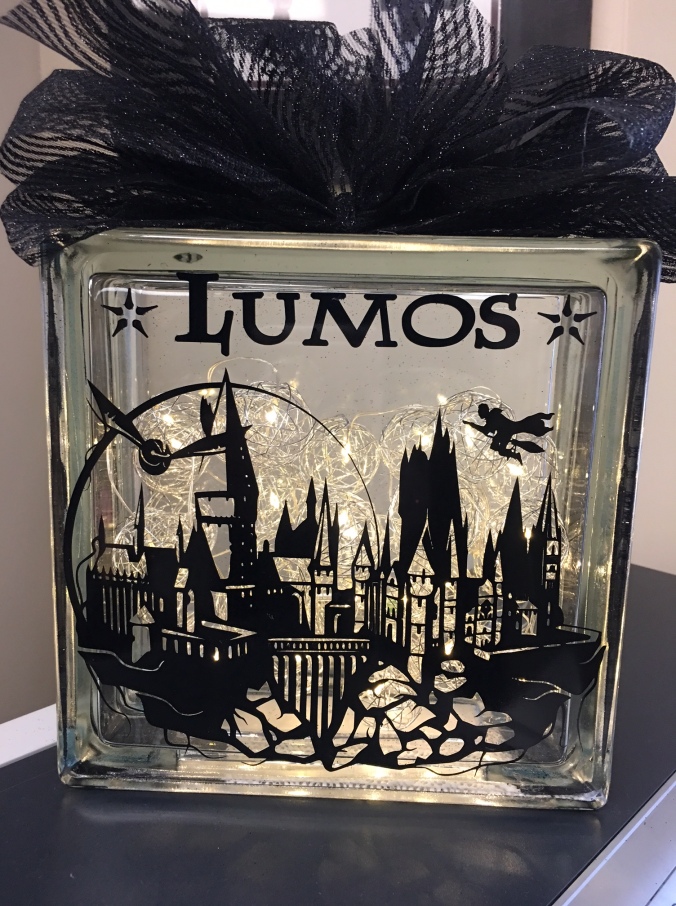
My Lumos glass box gleams in the corner by the doorway. I think of all the times that teachers might wish we had magic wands to show us everything the kids need, to fix all that needs fixing. I recall J.K. Rowling’s quote from her 2008 Harvard speech, now connected to her Lumos charity on behalf of children:

“We do not need magic to transform the world. We carry all the power we need inside ourselves already.”

It’s apparent whenever I read with the kids, whenever the Potter club meets and someone has an epiphany about a character, whenever I walk into a classroom to write with students and teachers. The essence of teaching, of reading, of writing more than anything else, is the connection of human minds and hearts. It’s all part of same story, the triumph of the human spirit. Teach it, read it, write it well – tap into all you’ve known, all you’ve loved, all you’re wrestling with, and watch their faces.

It’s all inside you. Light the way.

slice-of-life_individualEarly Morning Slicer


Writing the truth

i-like-my-mom

Ernest Hemingway once said that it is the writer’s job to tell the truth. In A Moveable Feast, he describes his process:

“All you have to do is write one true sentence. Write the truest sentence that you know.”

I am sharing here one of the truest pieces of writing I have ever seen.

The background: When he was small, our younger son often went with my husband to church early on Sunday mornings. The little fellow sat in the church office and busied himself with writing sticky notes that he delivered to me on my arrival.

I saved them – they’re all in the bottom of my jewelry box.

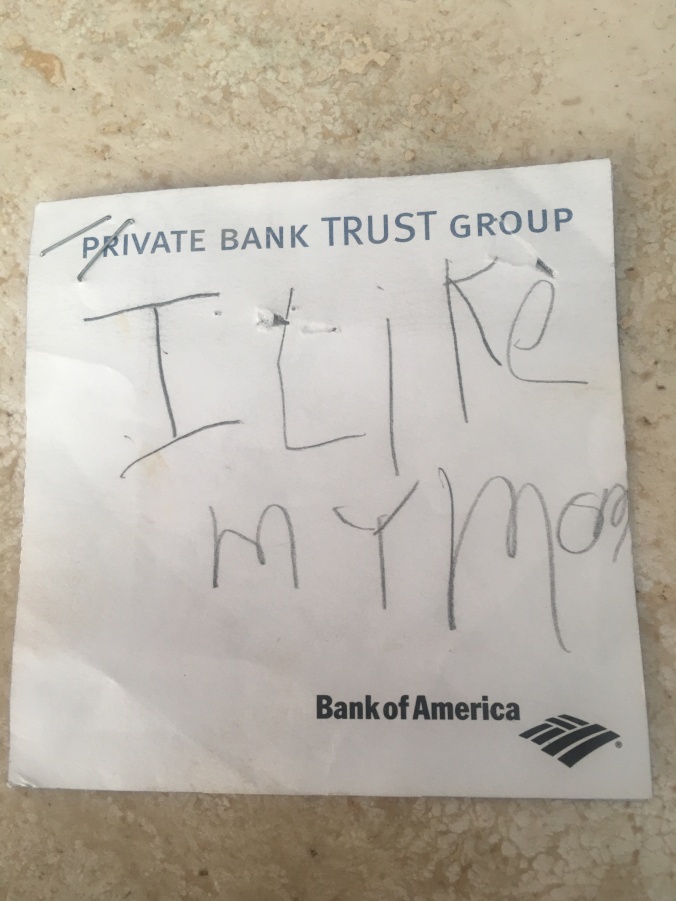
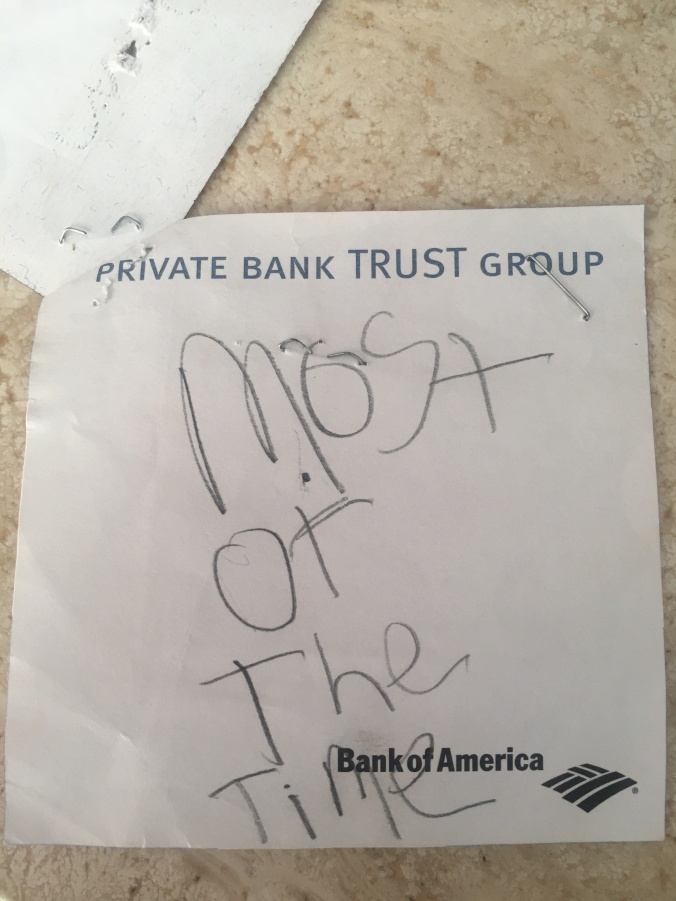
This one is my favorite. As you can see, the note says “I like my mom.”

Not love, mind you . . . .

But this is a two-pager (see the staples?). The sentence continues on Page Two:

most-of-the-time

“I like my mom – most of the time.”

I ask: Has a truer sentence ever been written?

slice-of-life_individual

Crossing the bay

cape-charles-beach

Chesapeake Bay, Eastern Shore, Virginia. Ken LundCC BY-SA

But such a tide as moving seems asleep,
   Too full for sound and foam,
When that which drew from out the boundless deep
   Turns again home.

-Alfred, Lord Tennyson, “Crossing the Bar”

I walked the little beach many times in the five years I lived in Cape Charles. With the ebb and flow of the tide, tiny periwinkle snails bury themselves in the sand. Gulls hovering overhead cry in their piercing, lonely voices. Storms churn the Chesapeake Bay, stirring its hidden contents so that afterward, treasures can be found on the shore – sand dollars, whole and unharmed, prizes to a beachcomber. I collected many.

I was alone on the beach the day I saw the old train coming to the end of the line at the harbor. I’d never seen it come through – Cape Charles is a tiny railroad town that almost didn’t survive the loss of the industry.

Where’s that train going? I wondered. Has it gotten on the wrong track? There’s nowhere to go – nothing but the bay ahead of it. Will it turn around, somehow? Or back up? 

Is it going over the edge, into the water? 

The train kept rolling forward, slowing to a stop at last.

I relaxed.

And the train began to float away from the land, as if by magic, as if it were Chitty Chitty Bang Bang, sprouting a flotation device.

It’s on a barge!

I watched, marveling, as the train sailed out into the bay, a majestic, most rare sight. I imagined visiting fishermen looking up from their bait and tackle to gawk as the train drifted by their boats.

There was something poetic about it, both grand and poignant, filled with awe and tasting of sadness. The gulls cried; a salt-tinged breeze caressed my face. I watched as the train grew smaller and smaller on the bay, until I could see it no more, and turned again home.

slice-of-life_individual