Titanic relic

pier-54-april-2012

Pier 54,  April 21, 2012 – exactly one hundred years after the sinking of the Titanic.

Arriving by bus in New York City, the tour guide said, “This is Hudson River Park.”

Looking through the window, I saw a sign: Chelsea Piers.

Chelsea Piers – why does that sound so familiar?

The words buffered around my brain for a second or two, retrieving the information: Chelsea Piers is where the old old ocean liners docked. 

Pier 54 is where the Titanic survivors were delivered by the Carpathia – hey, that’s exactly a hundred years ago this week!

I scrambled for my phone and opened the camera.

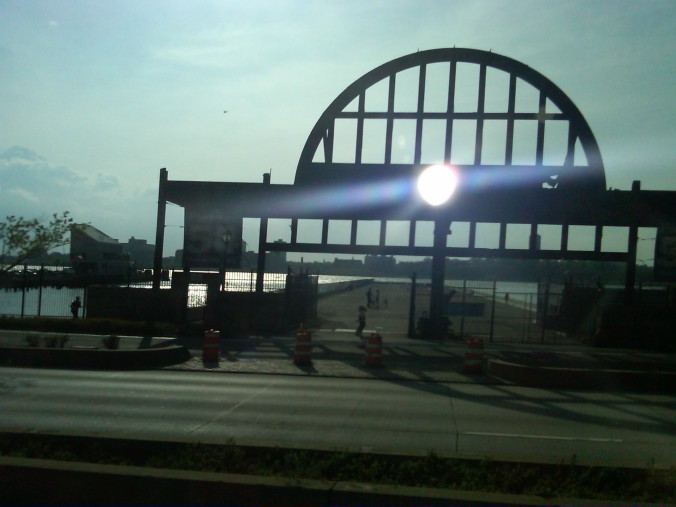
I took the shot just as we passed.

There is no magnificent dock anymore, only a corroding steel arch standing like a neglected, tired sentinel as people go about their daily lives. It’s hard to imagine this unremarkable structure as a portal to luxury, to adventure, to the stuff dreams were made of over a century ago.

C.S. Lewis wrote in The Voyage of the Dawn Treader, in the chapter entitled “The Dark Island”:

“Do you hear what I say? This is where dreams  – dreams, do you understand – come to life, come real. Not daydreams: dreams.”

In other words, nightmares.

I tried to envision the crowd, the men in overcoats, the women in long dresses, everyone wearing hats, as the Titanic survivors disembarked on April 18, 1912. It was night. For a fleeting second, I could sense the darkness, the shattered dreams, the unspeakable horror of watching that massive, beautiful ship break apart in the icy sea, taking so many passengers with her to a deep, watery grave. The nightmare was real; it would never leave the survivors.

In an instant, the darkness vanished, my glimpse of long ago ended. I blinked in the broad daylight. As my bus sailed on, I studied the photo. A bright light shines in the very center of the arch, which once bore the words White Star. I cannot tell if my camera was poised just right to reflect a flash in the window, to be captured perfectly in the middle of that haunting remnant, or if it is a phenomenon of light from some other source; nevertheless it shines like the sun over this relic of ruin, like day following night, driving the nightmares, the ghosts, away, hallowing this entrance to another time.

slice-of-life_individual


Signals

signals

Untitled. abarndwellerCC-BY

The Scottish poet Robert Burns wrote, in “To A Louse: On seeing one on a Lady’s Bonnet at Church”:  O wad some Pow’r the giftie gie us/ To see oursels as others see us! It wad frae monie a blunder free us…

I have often pondered that idea, people needing to see themselves as others see them. To see myself as others see me. What a frightening prospect. Certainly the power to see ourselves as others see us would free us from many a blunder … one would hope.

The lines spark a question I pose to myself and teacher colleagues: What signals are we unwittingly sending to students?

Years ago, I wasn’t sure I wanted to teach. I thought I would try it, almost reluctantly, as I needed a job and my own children were still in school. I wasn’t thinking of teaching as a calling or whether or not I was cut out for it. I took a temporary position, fifth grade remediation in reading and math, with some trepidation.

“I am not sure what to do,” I confessed to the hiring principal. “I don’t know if I can really help the kids.”

She smiled. “Just love them. The rest will come.”

Here goes, I thought on Day One, as I stepped into a classroom where kids milled about, working collaboratively on math. It’s sink or swim.

From across the room, a boy saw me standing in the doorway. He didn’t know me, didn’t know why I was there, but he shot across the room through the throng of his classmates to throw his arms around me.

That was my induction to being a public educator.

A child, sinking fast, clung to me like I was a life preserver. Perhaps he perceived, instantly, that we were in – or out – of the same boat. It was sink or swim for both of us.

In this classroom, I watched the boy try his hardest to swim. He struggled academically. He struggled with controlling his impulses. He struggled socioeconomically – he wore the same heavy black ski jacket every day, even when the weather was hot. He was chastised by his teacher for every infraction, great or small. The teacher – widely respected by colleagues – was clearly suffering from burnout,  undoubtedly tired of swimming herself. Whether or not she intended it, she sent a signal: Do not approach me or question me.

Do we, as teachers, send a signal – with  or without words – that we are safe harbors or treacherous ground?

I remembered a teacher of my own. She stayed in a constant state of frustration with our geometry class, once giving me detention for leaving paper in my desk despite my impassioned protest that I hadn’t done it. Math wasn’t my strong suit and I sank to the point of dropping the course, as I had all the math credits I needed to graduate. Later that year I landed a role in the school play and this teacher came to watch it. As people congratulated me backstage after the performance, this teacher stepped forward:

“Well,” she said, “I never would have believed you had it in you.”

You decide: Would I have ever been successful in her class?

One last note on my little friend back in the fifth grade: He went on to graduate.

On his behalf, I thank all those teachers who were, along the way, safe harbors for him.

Reflect: What messages do you send to others, verbally and non-verbally, about their value? Think of the teachers you had: Were they repellents to the learning in their classrooms, or were they encouragers? Were they the treacherous ground or the safe harbors? Write. Find a viable preserver when you need to. Rest a for bit. Then keep on swimming, mindful of those who are swimming so hard, so close by. 

Open a book and dance

dance-metaphor

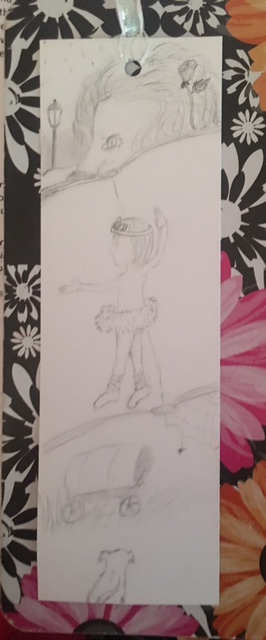
During a recent study of Who’s Doing the Work? How to Say Less So Readers Can Do More (Burkins and Yaris, 2016), the facilitator encouraged participants to jot notes or sketch on blank bookmarks as reflections of our learning.

Throughout the book, the authors use dance lessons as a metaphor for how learning to read works. As aspiring dancers watch proficient ones with a desire to emulate them, to navigating increasingly challenging choreography, so young readers develop skills along with a desire to read for the sake of it. My chapter was “Independent Reading: Learning to Love to Read,” in which independent reading is compared to a dance recital. Students have practiced and the teacher watches from the wings, not interfering when there are missteps, but “noting ways to fine-tune the their next performance.” The line that struck me most: “Most important, teachers let students read, allowing them the glorious luxury of falling in love with books.”

That got me thinking about my early reading life and the hand that teachers played in it.

In fourth grade, my teacher began the year by reading Charlotte’s Web to the class. Naturally we wept at the death of Charlotte (don’t we all, still?). I was so captivated by the story that I bought a copy at the book fair, to reread it to my heart’s content. This teacher knew what she was doing: she ended the year by reading Old Yeller aloud to outright sobbing from the class. I had to read the book again on my own, to grapple further with Travis’s extraordinary courage and the horror of the decision he had to make after that old yellow dog had saved his life. Old Yeller was outdone only by my own discovery of Where the Red Fern Grows in the school library – I cried every day for weeks after that one. I remain eternally grateful to Mrs. Cooley for hooking me with the power of story.

My fifth-grade teacher suggested that I read the Little House series. I loved Laura so much that I sometimes wore my long brown hair in braids and had my mother make sunbonnets for me (to wear at home, not to school). Laura was real. She wasn’t perfect and she knew it; I admired her backbone and the way she faced challenges. I also loved going back in time, reveling in Laura’s descriptions of the natural world and everyday life long ago. There’s such poignancy in the line “Now is now. It can never be a long time ago” (Little House in the Big Woods). As a child I pondered that line, knowing the story took place over a hundred years in the past – then realized that, in the pages of a book, time is preserved, all that happened is still unfolding, those who are gone still live. In the pages of an engrossing book, at least, now is now. How wise my teacher was, guiding me to books that would make reading part of my everyday life.

I was given lots of opportunity to explore books in the sixth grade. That year I was scouring the school library shelves for titles I hadn’t already read when I encountered an especially intriguing one: The Lion, the Witch and the Wardrobe.  “Sounds interesting,” I thought, taking it from the shelf, never suspecting what a defining life moment this would be. When I opened the cover, the magic poured out and pulled me in; I devoured every one of the Narnia Chronicles with an insatiable hunger. I loved them for the beauty of the setting, for their Britishness, for the author’s gift of turning a phrase and his humor, and most of all, for the hope they contain. I was encouraged to reenact scenes from the book for my classmates: I roped a friend into portraying Jadis while I dressed up as Aslan, complete with mane and tail. It’s the old good vs. evil theme, resurfacing many times throughout one’s academic and life experiences.

The influence and insight of my  of my teachers, along with the freedoms they gave me, had much to do with the reader I am, with person I am, today. They provided me the “glorious luxury of falling in love with books” – as you can see in the bookmark above, my tribute to them. I was never much of a real dancer, but metaphorically speaking – as a reader – I dance each day with wild abandon and absolute joy.

Reflect: Who helped you fall in love with reading? Write about this experience – and if these people are still living, write to thank them for their great gift to you. If you teach: How can you better provide “the glorious luxury of falling in love with books” for your students?

My Patronus

As a headmistress and co-founder of my school’s Harry Potter Club, I was recently admonished to take the Pottermore Patronus quiz, as all other Patronus quizzes are essentially heresy. I approached the task with a bit of trepidation, having heard of people attaining aardvarks and the like.

For the non-Potterite: The Patronus charm produces a silvery animal guardian, usually representative of the individual casting it.

Being a fantasy fan since childhood, and considering my headmistress role, it was necessary: I plunged into the virtual dark forest to seek my symbolic protector. On the site, ghostly words appear in groups of three amongst the trees; the seeker chooses one and is moved onto the next set. At one point in this quest, when I paused too long, the words evaporated with a reprimand: “You are too slow. This game requires quick reflexes.” Silently chiding myself for overthinking simple word choices, certain that this blunder would land me with an armadillo or caterpillar, I picked up my pace. At last, in the ominous forest, a silvery shape materialized.

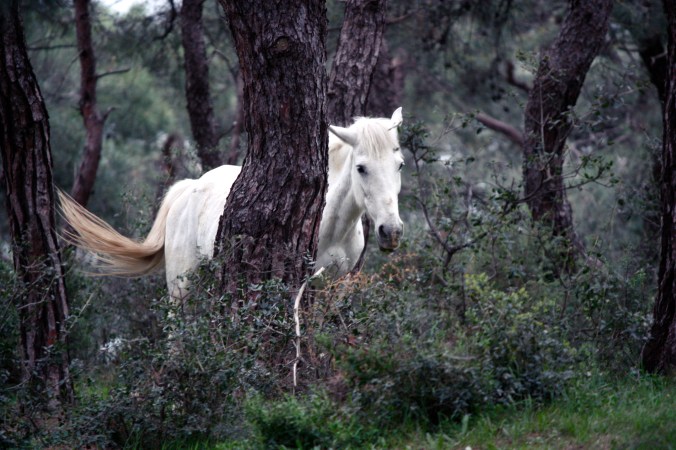
A white mare.

Beautiful and powerful, my white mare galloped through the forest, luminous against the darkness. Enchanting.

My next quest, naturally, was looking up the symbolism.

From various sites, the synthesis is that a white horse represents wisdom, power, loyalty, heroism, nobility, victory – encouraging, yes, but also inversely raising an intrinsic, lofty bar: am I worthy of the white mare? Do I deserve her? Never mind the fact that I gained her by playing a game with an end product based solely on word choices, not short answers or soul-searching responses. The writer in me delves deep into the metaphorical.

I already knew that white horses can symbolize death or the end of the world. They are considered psychopomps, creatures that guide human spirits on their journey from Earth to the afterlife.

As I pondered these connections, my Patronus suddenly conjured up road trips with my father and sister. Three hours is an eternity to young children cooped in a car, so to pass the time, Daddy taught us a game he played as a child:

“When we go by any horses, if they’re on your side of the street, you get a point for each horse. If you have a white horse on your side, it’s worth ten points, because you don’t see many of those.”

My sister and I instantly glued our faces to our respective windows, for we’d been by these random pastures before. We’d often seen horses grazing, strolling, sometimes galloping. I was sure – I just knew – I’d get a white horse. Maybe more than one!

“The thing is,” Daddy continued, “if we pass a graveyard, and it’s on your side of the street, you lose all your horses.”

So we played the game. My sister and I gained horses with glee, then lost them with loud groans, without realizing that one of us would win on the journey to the destination and the other would win on the return trip.

Daddy drove on in peace, smiling to himself.

How many horses I won and lost, I’m not sure, nor do I recall how many were white, only that they were there by the wayside on a long, tiresome journey. Those white horses are obscured by time now, very dim, but still real, ever more priceless, in my misty memory.

Enchanting, indeed, that one should reappear as my guardian after so many years, and that I should have gained it in a game venue that didn’t exist when I was a child.

Daddy, I think, would be pleased. Perhaps he is, from his place on the other side.

Reflect: What creature might symbolize you, and why? I’ve often played a game with students, challenging them to think of an animal that begins with the first letter of their first names (I’ve always chosen fawn in these scenarios – perhaps I should change it to foal?). No two can be the same, so each student ends up with a unique animal and has to think of ways the animal might represent them or their lives. Think – and write. 


Shine

born-to-shine


This is the cover of my mentor text notebook, housing the writing I’ve done with and for children across grade levels.

I believe that every child is a writer, because every child has a story. Every child has feelings and ideas. The writing teacher simply shows how to tap into these feelings and ideas, to give voice to them, to organize them, so that the mind and heart of the writer impacts readers.

Writing is about the human experience: We are all born to shine.

We shine through our fears, our losses.

We shine beyond the choices we make and the choices of others, beyond the things done to us and the things we have done.

We shine no less in our failures than in our successes; in fact, in learning and pressing on, we shine the brighter.

We shine in knowing what to hold onto and what to let go.

We shine when we harness anger before it burns away all that’s of value within us.

We shine by leaving footprints of hope for others to follow, for the human heart runs empty on despair.

We are ALL born to shine. Whether or not we do is up to us.

Reflect:  In the book The Forgotten Beasts of Eld by Patricia A. McKillip, 1974, a mysterious creature had the power to turn people’s eyes around to see inside their minds; they died from what they saw there. Writer, know thyself. Look deep within. You will be surprised by what you discover – the beautiful and the not. Write – and shine.


The Harry Potter club

harry-potter-club

Every semester a new group of them arrives, fresh-faced, wide-eyed, often clutching owls or wands, quivering with excitement and  ready to be sorted into one of the four houses … no, they’re not at Hogwarts. These are third, fourth, and fifth grade students who signed up to be in the Harry Potter club at our magnet school.

A colleague and I are the founders, the “co-deputy headmistresses” of the club, formed in conjunction with the school’s mission to expand arts and science integrated opportunities for the students. Staff chooses what to offer; students can sign up for anything from cooking classes to a foreign language to astronomy. Since it began, the Harry Potter club has operated at maximum capacity. Once we know students’ names, they receive their own rolled parchment letter of acceptance (as yet not delivered by owl, but we headmistresses are working on that).

My colleague and I expected to have fun – after all, we chose a theme that was fun for us. We expected that the kids would have fun, and they do. From Day One when they are sorted with the help of an online quiz  – we call it the “technological Sorting Hat” and we always end up with an alarming number of Slytherins, prompting discussions about character traits – through sessions of making their own wands, Quidditch pencil brooms, golden snitches, and patronus pictures, the students savor every moment. One of us, a teacher or student volunteer, reads aloud from the books while the club members work on their crafts. As students are sorted, someone reads Harry’s sorting experience to the group; when students make wands, one of us reads the scene where Harry goes to Ollivander’s for his wand. All students chime in right on cue, because they’ve seen the movies and they know: “The wand chooses the wizard.”

What my colleague and I didn’t expect were the far-reaching effects. Parents frequently tell us: “My child is SO excited about being in the Harry Potter club!” We didn’t expect the depth of the discussions students would initiate on their own, regarding various characters and their motivation:

“Professor Snape was really protecting Harry the whole time, not trying to hurt him.”

“That’s because Snape loved Harry’s mother – they knew each other when they were little, before she knew Harry’s father.”

“It was Harry’s mother’s love that protected him – she died to save him, and that’s why Voldemort couldn’t defeat Harry.”

One would have expected students to be drawn most by the magic, the fantastic, or the old good vs. evil theme, but at the ages of eight to ten or eleven, the students talk more about love, the huge, shining thread that winds through the stories and ties them all together.

My colleague and I certainly never anticipated one student’s attending the club from its inception to the day he left for middle school. As the club is in high demand, repeaters are not usually allowed. One of his teachers made the appeal: “He doesn’t like school, but he loves the Harry Potter club. He’s always here on club days. Can he please be in it again?”

His mother said: “It’s all he ever talks about – the Harry Potter club.”

Our young friend turned out to be a jubilant Gryffindor (as is yours truly, for the record). By his third go-round in the club, he was made Head Boy; he coached newcomers on club matters. He occasionally stopped by my room to discuss Potter trivia and other topics of his interest, always smiling. When he graduated from the fifth grade, my colleague and I presented him with a Hogwarts T-shirt. He wore it for the ceremony.

Just before his departure, our veteran member was asked why he loved the club so much. His brow furrowed in thought for a moment before he replied: “It’s this whole story about a boy who loses his parents and everything is hard for him all the time, but he still tries to save everyone. He’s so brave.”

He paused. We listeners wondered, with tears brimming, what sage, profound connection might be coming next. Our Head Boy just shrugged: “And there’s no Star Wars club.”

Ah, perspective.

Reflect: The power of story is limitless. Read a story to someone. Tell yours. It matters.


The secret gates

ditch-gate

Into the ditch. jam343 CC BY

When I was a child, my neighborhood flooded regularly.

I lived on a block where all the backyards joined at a long ditch. When I went to play with a friend, I took a shortcut by running alongside the ditch and jumping over it, taking care not to land in it, for the ditch was lined with thick, black mud; if it did not stink outright, it certainly smelled organic, stagnant. Sometimes fleabane, tiny, hairy daisies, grew along the banks. That’s about it for ditch decor.

Whenever a heavy rain came – and a few times during a moderate rain – the ditch overflowed. Storm drains in the curbs overflowed as well, until water covered the streets and most of the yards. My friends and I had fun wading through it as we walked home from school, sloshing as much as we could.

My father, however, was irate every time.

As soon as he saw the water backing up, he got the city on the phone.

“Listen, I’ve called before,” he’d snap at the City Official on the receiving end. “You ought to have a record of it. This whole neighborhood is flooded AGAIN. Get whoever is paid to do it to open those drainage gates.”

Every time, the City Official pleaded ignorance about said gates.

I watched Daddy’s florid face redden. “You people always act like you don’t know what I’m talking about, but I am telling you, there are flood gates controlled by a switch and somebody up there knows how to use it. There’s NO EXCUSE for a place to flood like this. Open the gates!” He glanced through the picture window in the living room. “A canoe is going down my street right now. So help me, I will get in it, come down there, and find that switch myself.”

A canoe was going down our street, neighbors having dragged out their camping stuff, rowing merrily along. A teenage boy in waders, hip-deep in the water, pulled younger siblings on a raft behind him. To my horror, one young neighbor tossed a puppy from the front steps out into the water to make sure it could swim. It could; that the puppy swam back to its owner amazed me.

Daddy’s voice got louder, his face redder, until he hung the phone up in disgust, but within an hour of his call, the flood began to diminish.

As the water level went down, so did the color in Daddy’s face. In his eyes was a glint of victory, or perhaps vindication. The City Officials had, yet again, scrambled to open the secret gates they kept forgetting about. Good thing they had my dad to remind them.

Did the gates actually exist? Did they lead to the nearby river, or where? I never knew for sure, but the timing between my father’s phone calls and the floodwaters receding is intriguing, suggesting more than a fluke.

Our regular neighborhood floods were mild annoyances in comparison to the devastation experienced by anyone whose home has been lost or whose life has been endangered. The forces of nature are beyond human control, despite the best of foresight and man-made safeguards. On a small scale, my father did what was within his power to change a situation. One voice, persisting. Today I think of the labyrinthine educational system, of American politics, the overwhelming need for change when so much is at stake, and those who are suffering. What are the gates to clearing the way, and where lies the switch? Change is a force within human control. As Anne of Green Gables author Lucy Maud Montgomery penned: “All things great are wound up with all things little.”

Believe, be the voice, reclaim what is of value, before it is lost.

Reflect:  Water is a symbol of life, as well as adaptability, healing, and cleansing. When things become overwhelming, one of these might well be a switch to seek. Which might be yours? How might you help others?


Haunting forevermore

Ah, distinctly I remember it was in … June, 2013.

My older son and I, teachers inspired by a love of The Great Gatsby,  celebrated the arrival of summer vacation by driving from North Carolina to Rockville, Maryland, where we visited the grave of F. Scott Fitzgerald. Having accomplished this mission before nine o’clock in the morning, my son asked: “What do you want to do now?”

“You know,” I grinned, “Baltimore is only forty-five minutes away. Poe is buried there.”

Thus was our Dead Writers Tour born. Off to Baltimore we went.

In contrast to a midnight dreary, the morning sun was blinding at the Westminster Hall and Burying Ground. The old Gothic-Revival church, the gate, the trees, the headstones, all cast the blackest, sharp-edged shadows, as if intentionally evoking the last lines of  “The Raven”:

And the lamp-light o’er him streaming throws his shadow on the floor;

And my soul from out that shadow that lies floating on the floor

Shall be lifted – nevermore!

And there, to the immediate right of the entrance, was the author’s grave under a large, shadowy monument bearing a plaque with his likeness. One wilting yellow rose and a couple of little rocks rested on the base.

Poe is buried with his wife, who was also his cousin, aged thirteen when he married her and twenty-four when she died, and her mother, his aunt.

“This isn’t the original grave,” my son pointed out. “Poe was first buried somewhere behind the church. He was moved here to to the front later.”

“That figures,” I said. “The man was unsettled for most of his life. He couldn’t even be settled in death.”

Just then a black bird flew by to land on another headstone, where it sat watching us from the stark shadows.

“Is that a raven?” I whispered.

Quoth my son, wide-eyed: “Geez, Mom!”

“No, it can’t be,” I assured him. “Ravens are bigger than that … I think. Let’s go find the first grave.”

This cemetery is old, dating from the late 1700s. The pathway from the entrance to the back is narrow,  leading past massive domed slabs somewhat reminiscent of Quonset huts. Years and weather have left black streaks running down the sides of these burial slabs to form odd swirls and patterns. Ghostly patterns, painted by nature’s fingers.

“Check out this stain,” I said, pausing. “Does it look like a skull to you?”

“Oh, wow – it does!”

Rounding the corner of the church, we came upon a marble table with thick legs and a top so sunken in the middle that it seemed impossible for such a heavy substance. A plaque informed us that this “gravity-defying” monument was mentioned in a Ripley’s Believe It or Not! article. A Revolutionary War veteran is buried beneath this oddity.

From there, my son and I could see Poe’s original grave, as the crowned headstone is embossed with a raven. On nearing the cenotaph – the empty tomb – the words arching above the bird become visible: “Quoth the Raven – Nevermore.” The stone informs visitors that Poe rested in this spot from 1849 to 1875.

“Do you remember reading about the mysterious person who showed up every year on Poe’s birthday, wearing a cloak or something, to leave roses at the grave?” I asked my son, a trivia expert extraordinaire.

“Oh, right – the Poe Toaster. He wore a hat and white scarf. He left cognac, too.”

“At this marker or the other?” I wondered.

“This one, I think. He came for decades, until just a couple of years ago. No one ever figured out who the Toaster was.”

“That’s hard to believe, in this day and age.”

“What’s really strange is that just before Poe died, he was found in the streets of Baltimore, out of his mind, wearing someone else’s clothes, and no one ever knew why.”

“It’s haunting, but mostly sad,” I pondered aloud. “Something straight out of his own work.”

We turned to leave, walking past a line of eroding tombs and vaults on the far side of the little cemetery. Some stone vaults had iron closures that appeared damaged. My fanciful imagination took flight: Had someone tampered with the doors, trying to get in – or out?

I shuddered despite the brightness of the day, recalling something my grandmother told me when I was a child afraid of the tiny graveyard across from her house in the country: Never fear the dead. Fear the living.

“I don’t think I’d want to be here at night,” I said to my son.

We simultaneously picked up our pace toward the exit.

“Nor would I.”

Back at Poe’s final resting place by the gate, my thoughts turned to his poetry, the glorious rhythm of “The Raven,” which drew me as a child the first time I heard Vincent Price reading it on TV. The poem wields mesmerizing, unique power. It is meant to be read aloud. Once when I was working to help third graders comprehend a text they were reading, we encountered the word raven.

“What’s a raven?” they wanted to know.

“It’s a bird – a black bird,” I told them. “There’s a famous poem about a raven.”

“Read it to us!” demanded the kids.

After a quick Internet search, I read the opening stanzas.

The children listened, spellbound. When I stopped, one of them sighed:

“Oh, Mrs. Haley – that sounds just like music.”

It does, indeed.

Ever after, the kids greeted me with “Hi, Mrs. Haley! Once upon a midnight dreary, while I pondered, weak and weary!”

Having paid my respects at last to Edgar Allan Poe, I walked back through the gate, just as the church’s bells began striking eleven – as if the word master himself was sending a message:

Keeping time, time, time,

As he knells, knells, knells,

In a happy Runic rhyme,

To the rolling of the the bells —

Of the bells, bells, bells —

To the tolling of the bells,

Of the bells, bells, bells, bells,

Bells, bells, bells–

To the moaning and groaning of the bells.

It couldn’t be coincidence – could it?

Today is the 167th anniversary of Poe’s death.

Reflect: What written works sing in your head, call to you, haunt you? Why?
 

So we beat on

fitzgerald-grave

In the summer of 2013, my older son and I embarked on what we now call The Dead Writers Tour. The Great Gatsby film, newly released, was creating a resurgence of interest in the novel and F. Scott Fitzgerald himself. My son had just completed his second year teaching high school social studies, his favorite portion of which is the Jazz Age; he had even begun coordinating his history lessons with the English classes’ reading of Gatsby and teaching his students how to dance the Charleston.

Perhaps it was our shared loved of literature and writing, or the joy of the whole summer lying before us, teachers on the loose, that beckoned us like the green light beckoned Jay Gatsby. Perhaps the movie was the impetus for adventure, capturing the zeitgeist and ending, as the novel does,  with my son’s favorite literary quote:

So we beat on, boats against the current, borne back ceaselessly into the past.

Fitting, indeed, for a young history teacher who was born by a bay (albeit one in Virginia, not New York).

“You know, Mom,” said my son, as we left the cinema, “That quote is on Fitzgerald’s grave.”

“Is it, now,” I mused. “As much as you love it, you ought to go take a picture and put it up in your classroom.”

The light in his eyes was instantaneous. Out came the phone to research the grave’s location: Rockville, Maryland. How far is that from home in North Carolina? A quick check in Apple Maps: Right at four hours.

“That’s a day trip,” I said. “I’ll come with you. It will be our summer celebration kick-off.”

So, on a mid-June morning, we left long before daylight. We ate breakfast while it was still dark, chattering about our teaching accomplishments that year and our dreams about writing, lamenting the constraints of time in the daily grind of making a living. The hours passed quickly, despite the epic traffic snafu of D.C. Once on the other side, however, we sailed right into Rockville.

The cemetery is at a Catholic church in the midst of bustling city streets. After navigating such noise and chaos, I was not expecting utter silence on entering the graveyard. It was like a cosmic mute button was suddenly pressed, or that I had passed through a portal from one world to another. The city receded at once; all I could hear was a faint shivering of tree leaves overhead in the breeze, oddly cool for June, and the occasional flap of little American flags, remnants of Memorial Day, at the graves of veterans.

How incredibly peaceful, I thought.

“There it is,” whispered my son, pointing.

Fitzgerald was easy to find; his grave was the most adorned. As we approached, a brown rabbit hopped out of our path to a more remote patch of sun-dappled grass where it could nibble, undisturbed. At at the foot of his grave a flag commemorated Fitzgerald’s World War I service. On the headstone, the author’s full name signifies an even deeper connection to the flag: his famous cousin wrote the lyrics to the “Star-Spangled Banner.” I reveled in having my own first name in common with these writers and Fitzgerald’s daughter, buried nearby. A pot of daisies had been placed by the headstone, a nod to the love of Jay Gatsby’s life. Most interesting of all is that Fitzgerald’s wife, Zelda, who was at least part of the inspiration for the character of Daisy, is buried with him in the same grave.

Any student of F. Scott Fitzgerald knows his struggles, that he was always teetering on the brink of financial ruin, that he and Zelda lived a frenzied life, that both of their deaths were sudden and tragic, him with a heart attack in his forties and her a few years after, in a fire at the mental hospital where she was a patient. Fitzgerald never knew The Great Gatsby would become the beloved American icon that it is.

We stood there in the stillness, my son and I, drinking in the sight, lost in our own thoughts. After a bit, we took the pictures.

One or the other of us sighed. I am not sure which.

“What do you want to do now?” asked my son.

I looked up at the sky. The day was golden, still young; we had time, perhaps, for another adventure.

“You know,” I grinned, “Baltimore is only forty-five minutes farther. Poe is buried there.”

My son chuckled. He took one last look at the final Gatsby lines etched on the weathered granite slab. “All right, Mom. Let’s go.”

So we beat on.

Reflect: What literary works or quotes strike a deep chord in you? Why?

-Happy Birthday this week, F. Scott Fitzgerald.

Making it real


4790195477_6dc88e3c93_b

Image: Porch front. Liz West CC BY

Many of the second graders were bent over their desks, writing. Others were rereading their work with pencils in hand, like diminutive journalists editing reports in a newsroom. A few more looked off into space, thinking, before returning to the pages lying before them.

One of the joys of my role as literacy coach is getting to write with students and teachers across grade levels. The previous day I had come to model realistic fiction writing for this class, focusing on how to bring the stories to life with detail and dialogue:

“When I write realistic fiction, ladies and gentlemen, I often use what has happened in my own life. That’s why you were sad when my main character’s favorite toy got ruined – you felt what she felt, because it was something that had happened to me. I could give a lot of descriptive detail because I really lived it. That’s why you laughed at the conversation between my characters, because those were real conversations I had when I was that age. I just let my characters say those things. If you want to bring your realistic fiction to life, try using some things you have really seen, said, done, or felt.”

The children decided individually whether dialogue or more detail in setting was the thing they most needed to work on, and today I was back to see how it was going. One by one, I knelt beside them to hear revisions they’d made. I noted excited twitches as I approached – these kids knew their work was better.

I paused by a desk where a girl was absorbed in writing. I remembered her piece from the day before, in which she described a porch where two little girls were having a conversation. When she’d read it aloud, I could envision the girls sitting together on the porch, but the dialogue didn’t seem to be about anything in particular. “Try to think of what might matter to these girls,” I had advised. “Are they happy about something? Worried? Think about what matters to you and see if you can help your characters have a meaningful conversation that a reader would want to read.”

Now I knelt beside her. “Do you want to read your writing to me, or keep working?”

“I want to read it to you.”

She did. As I listened, a line from Emily Dickinson’s letter to a publisher sprang to mind, asking if her verse “was alive”: Should you think it breathed – and had you the leisure to tell me, I should feel quick gratitude . . .

“What a major improvement in dialogue! This part, here, where your main character tells her friend that she’s excited about getting a stepfather to do things with, but is also a little afraid – that’s the best line in your story. This is where it really comes to life. It’s great writing.”

She looked up at me, eyes big and solemn. “I did what you said. That’s how I feel. My mom is getting married again.” And she bent back over her writing, drawn like a duck to water or a swallow to the air, a compulsion I fully recognized, for when we write, we are putting pieces of our souls on the page. Facing our fears, meeting ourselves where we are, daring to hope, finding a safe haven, maybe to heal. Even in the second grade.

Very real, indeed.

Reflect: What truth will you write about today?