Here, says the student,
is my rainbow-wing dragon.
For just a moment
the dreary day fades.
On these bright, magical wings
I am transported.

Here, says the student,
is my rainbow-wing dragon.
For just a moment
the dreary day fades.
On these bright, magical wings
I am transported.
I find there is nothing that drives away dark thoughts as much as Sunday morning, especially when it follows a night of strange and troubled dreams after a week of increasing tensions at work in a school year that seems never-ending. As I wake, pondering the attrition of humanity in general with a hymn-line playing in my head, Change and decay in all around I see, unable to tell if I am feeling heartsick, soul-sick, or just plain sick, the Sunday stillness settles my spirit. My stomach, on the other hand, needs more time…not sure if I will make it to church or not. A riotous melody from the front porch works like a tonic: a finch fantasia. The mohawk-headed babies that hatched in my door wreath should have flown on by now. I am glad they linger. I need these bright notes. I wish I could interpret them and know exactly what the finches are saying to one another… if they were not here, the silence would be so loud. There is a time for silence and it is not now. It is not the same as stillness. Sunday brings stillness, the finch song brings stillness, the wall clock with whirring crystals brings stillness. I am craving prolonged stillness, I am so tired, but I make myself go.
And if I had not done so, I would have missed it.
Backing out of the garage, closing the door, turning down the driveway… there.
Across the street, lying on the grass in front of a tangled green thicket, a large white cat, so still it seemed an alabaster statue. It didn’t move as I approached. It gazed at me as if it belonged in that very spot (I have never seen it before).
Sphinx-like. Pristine. Regal. Otherworldly. Breathtaking. I think I whispered the word Amazing.
I could have stayed and stared, I think, forever.
But, without movement of any kind, the white cat reminded me that stillness isn’t an untroubling; it is, instead, a submerging, away from surface-level fear, a shaking off, a resting place, a deep abiding.
Which paradoxically involves moving on.
I feel certain it winked at me as I did so.

Curiosity drove me to look it up: Pure white cats are rare, 5% or less of the population.
It didn’t seem to mind my taking its picture.
*******
special thanks to Two Writing Teachers for the weekly Slice of Life Story Challenge
He sings alone
just before light
Farewell, farewell
beloved night
Summer is nigh
yet again keep
echoing hope
—all do not sleep
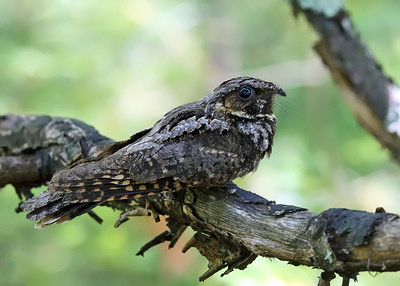
Whip-poor-will in the woods behind my home about an hour before dawn. Such longing and long-ago in the sound, for me. When my oldest boy was three, our family moved from Virginia’s Eastern Shore to the North Carolina Piedmont. We lived in a parsonage beside a little church high on a hill. It was June. All that first summer, when dusk settled in and I put my boy to bed for the night, the whip-poor-wills began calling. Over and over and over. Usually just one. The sound carries; it echoes through the darkness from the woods across the ponds and pastures, from old and deep places, affixing itself to the listening soul. I rejoice in its returning.
There are
certain advantages
to having
a young son
in the mortuary business
such as when
he tells you
that you really
ought to set up
a “pre-need”
and pay for
your funeral
in advance
or
when he texts you
a picture
of a rose-gold casket
because he thinks
you will love it
(okay, it IS beautiful
—still…)
but most of all
when he brings you flowers
while you’re living
because he
remembers Mother’s Day
and he works
right next door
to a killer florist.

*******
with thanks to Two Writing Teachers community for Tuesday Slice of Life sharing
As I write, the National Anthem’s being sung at Churchill Downs for the start of the Kentucky Derby.
I’ll be pulling for a horse not favored to win.
His owner grew up in eastern North Carolina on a little stretch of road in the country. It’s paved now, but people have living memory of it being dirt… and I have an affinity for old dirt roads in these far reaches.
Once upon a time, I was a child who stayed in a little house on a dirt road in the summertime. I swung from a tire swing that Granddaddy hung from the pecan tree all studded with woodpecker holes. I swung to the deafening rise-and-fall rhythms of cicada-rattles, alongside the old dirt road across from the clearing where timeworn gravestones stood over people my grandmother knew when she was a child. I swung back and forth, round and round through the dappled afternoon, singing a favorite folk song from my father’s Peter, Paul, and Mary album…
Stewball was a racehorse
and I wish he were mine
he never drank water
he always drank wine…
The song goes on to say how the speaker bet on the gray mare and the bay, when:
ahead of them all,
came a-prancin’ and a-dancin’,
my noble Stewball.
The hoot owl, she hollered…
This past week, early one morning, I recorded a hoot owl (barred owl) hollering from the pines behind my home.
Memory runs so deep, so strong.
And so I pull for the horse named Barber Road, whose odds keep going down in these remaining moments before he gets to the gate.
Here’s to my own beloved road by another name in eastern North Carolina, and childhood, and belonging, and ol’ Stewball who wasn’t favored to win, either, but did, and to the hoot owl, the stories, the songs, and overcomings.
And here’s to you, Barber Road.
Run on.

Thoroughbred racehorse. MIKI Yoshihito. CC BY 2.0.
Update: Barber Road finished 6th. By now the world knows that Rich Strike, the least-favored horse (80-1,) took the Derby in the second-biggest upset in its 148-year history. Secretariat, the first racehorse I remember, and who still fills me with awe to the point of tears, holds the record.
On Ethical ELA today Glenda Funk takes inspiration from what can a poem do? by Darius V. Daughtry. Her invitation to teacher-poets: “Compose a poem in which you celebrate what a poem can do and imagine the possibilities for more poetry specific to an issue or concern.”
In the Non-Rhyming Scheme of Things
A poem cannot
erase the past or
bring back people I’ve loved
and lost
A poem cannot
still the storm or
turn back tides
of war
A poem cannot
repair the whole world or
remake the human heart
but it’s a start
with thanks to Tammi Belko, who encouraged teacher-poets to write on the topic of cheese today at Ethical ELA: “Poets have been mysteriously silent on the subject of cheese” (G.K. Chesterton).
an extended haiku, of sorts
For Love of Grilled Cheese
Mama and Grannie
decide they want Chinese food
I don’t like the smell
they’re frowning at me
holding my nose in Kam Ling’s
ordering grilled cheese
—not on the menu
I’m confusing the waiter
Just take bread, I say,
two pieces, and put
a slice of cheese in between
and butter outside
fry it in a pan…
a loooong time later, it comes
miraculously
(was someone dispatched
to a nearby grocery
in great vexation?)
Not long afterward
Mama has a surgery
Grannie comes to stay
Daddy is working
and doesn’t cook, anyway
I ask for grilled cheese
Grannie makes the thing
in the toaster… No, I say,
that’s not how Grandma Ruby
makes my grilled cheeses
Grannie’s face goes Mr. Hyde
like on Bugs Bunny
she shouts—the house shakes—
I’M. NOT. YOUR. GRANDMA. RUBY!
Heaven help me please
I may not get grown
if grown-ups demolish me
for love of grilled cheese

Grilled Cheese Sandwich @ Thunder Bay Regional Hospital. istargazer. CC BY-NC-ND 2.0.
Note: I love Chinese food now.
And my Grannie. Mutual forgiveness and gratitude, for so many things.
Today on Ethical ELA Leilya Pitre invites teacher poets to “walk to your place of comfort.” The idea is to take a break, rest, relax, maybe noting things that capture your attention when you’re on a walk, or maybe walking back in time, through memories, or recalling a personal revelation that occurred on a walk. Just walk, poetically.
I love walks and have written of many… today, I meander back through memory to a place of comfort.
Walking with Granddaddy
Sunday afternoon
sidewalks aren’t crowded
no rush hour traffic
clogs the street
just a few cars
stopped at the intersection
can’t walk over to Rose’s
at the corner today
to buy a toy
like my Slinky
or click-clacks,
glass amber spheres
suspended on a string
to pull back and hear
that loud CLACK CLACK,
or a powder-blue
sachet ball made of satin
decorated like a lion’s head
with blue googly eyes
and an aqua feather-tuft mane
no, Rose’s is closed today
so is the drugstore
at the end of our row
no chocolate-covered cherries
or Peppermint Patties
or those caramel creams
that you love so
no, today we walk
hand-in-hand
across the street
while cars wait
at the lights
past the fire station
round back of the
Baptist church
to the playground
you let me climb
the big sliding board
not letting go
of my hand
until I am sitting at the top
you are there
at the bottom
when the sliding stops
you push me in the swing
until my feet touch the sky
I am a bird
flying so high
until the shadow
of the steeple-cross
grows long on the grass
hand-in-hand again
I watch our feet pass
back over the pavement
crossing the street
each step measured in time
of heart-to-heart beats
—oh, how yours to mine
still talks
so long after
our Sunday walks
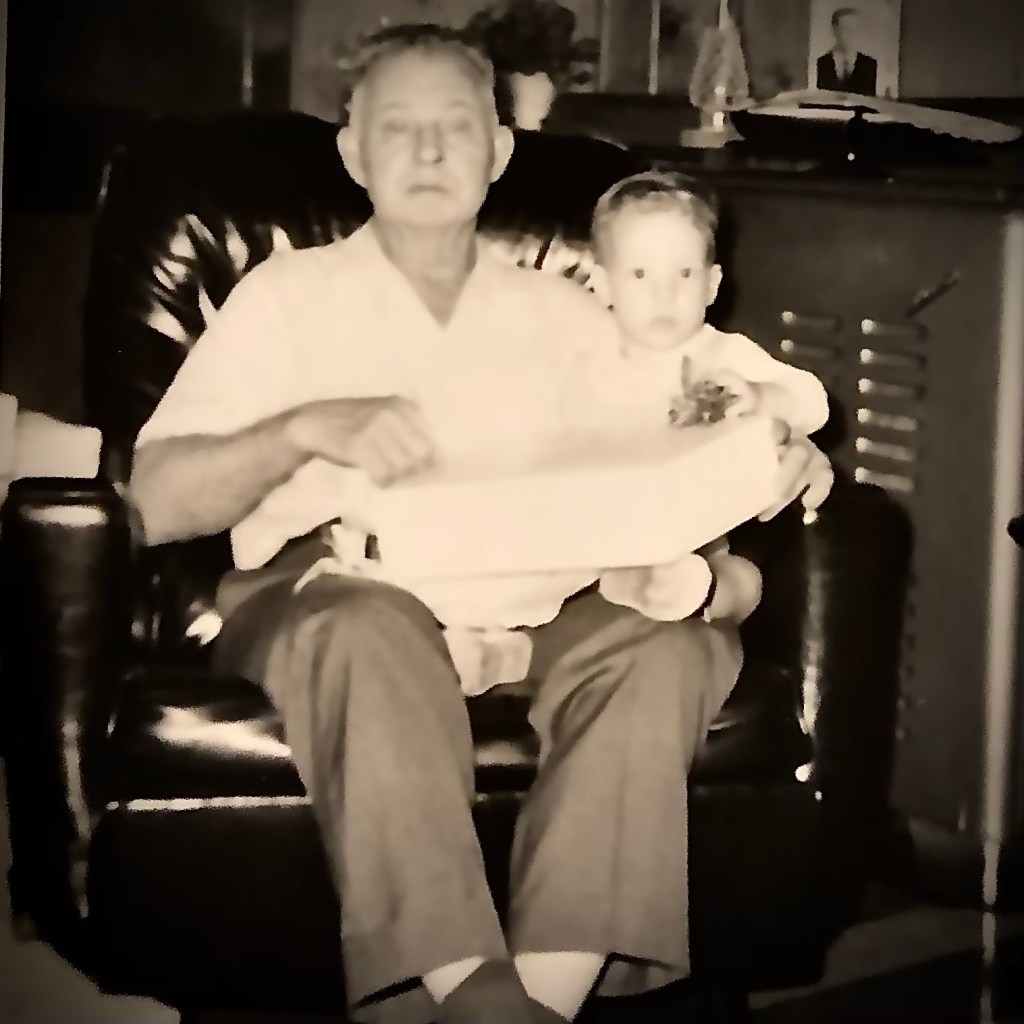
Granddaddy and me on his 61st birthday.
I am two and a half.
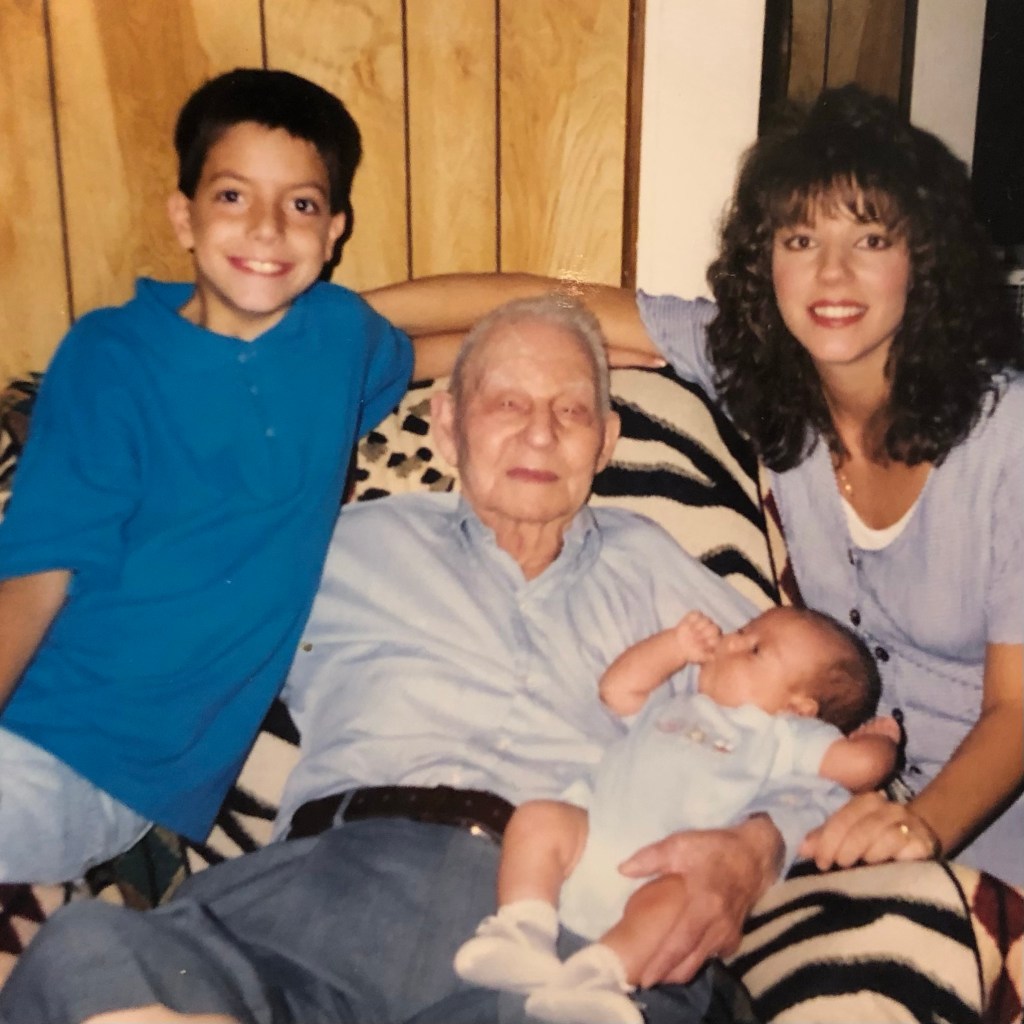
Thirty years later:
Granddaddy with my boys and me, on his 91st birthday,
a year and a half before he died.
He is gone, but never far away.
For VerseLove on Ethical ELA today, Andy Schoenborn invites teacher-poets to write “tumble down poetry” about shoes:
“For the small spaces they occupy, poems can cause writers to freeze. To break a poem free, try writing a paragraph or two of prose and, then, watch a poem tumble down with this process… today let’s write about shoes. Please take three minutes and write in prose about a pair of shoes that you’ll never forget… Once your paragraph is written, look for naturally occurring repetition, alliteration, striking images, and moments of emphasis fit for enjambments. Then play with the structure and form as a poem ‘tumbles down’ the page.”
It’s amazing, when you stop to think about it, how many shoe stories we have… this memory from long ago quickly overshadowed all others for me today.
Shoe Story
Fifth grade
studying mythology
the teacher says:
Now you will write
your own myth
sometimes myths
are about inventions
or journeys
or transformations
what can I write
about any of these?
I think
I sigh
I look
around the room
rainslapped windows
there was a time when
my parents would have made me
pull galoshes over my shoes
I hate hate hate my shoes
saddle oxfords
— I call them sadlocks—
black and white
or in my case,
black and gray
needing polish
again
everyone else
wears Hush Puppies
suede desert boots
Be grateful
for what you have
I’ve been told
by various grownups
in my life
(who do not have to wear
sadlocks)
I wonder
who ever invented
these stupid stupid shoes
I wonder when shoes
were invented
—wait—
a picture forms in my mind
a boy, living in a village
by the sea
where the sand is soft
where no one needs shoes…
I grab my pencil
I write him into being
this boy who had to save
his village by climbing
the mountain
where sharp rocks cut his feet
where he made shoes
from big leaves, tied
with strips of bark
on his return to the village
everyone started wearing shoes
in honor of their hero,
Shoeani.

Saddle oxfords. MBK (Marjie). CC BY-NC-SA 2.0.

Ancient shoes. Falling Outside The Normal Moral Constraints. CC BY 2.0.
For Day 11 of National Poetry Month, my friend Kim Johnson invites teacher-poets to compose quirky poems for VerseLove at Ethical ELA: “We all do quirky, bold things that break the ice and bring us closer together. Think of a time that you’ve done something quirky – with friends, with family, with students or even complete strangers. Let’s share our quirky exchanges today and whatever emotions they bring – in whatever form of poetry we choose.”
I hardly have to think about this one…
Quirky Legacy
What goes around
comes around
particularly in
prankster families
like mine
Once upon a time
my husband hid
our oldest’s shoe
The boy (in his teens)
hunted high and low
demanding to know
(laughing)
where his dad hid it
because he knew
exactly who
had done this
Funny thing is,
my husband forgot
where he stashed
the shoe
Years later,
in the midst
of redecorating,
I moved
an antique pitcher
and discovered
the shoe inside
By that time,
the boy had achieved
retribution
many times over,
the most legendary
of his pranks
involving
his dad’s cell phone
suspended in jello
(a Ziploc bag
didn’t help at all;
my husband hauled
the boy and
the ruined phone
to Verizon
for a replacement
while the clerks
tried but couldn’t keep
straight faces)
Years later
the boy
(now a dad)
texts me
while I’m out shopping:
Mom, can you pick up
a copy of Prince Caspian?
He was reading
the Narnia series
for the first time
and his daughter,
age six,
had hidden the book
from him
and couldn’t
remember where
What goes around
comes around
particularly in
prankster families
like mine

 lit bits and pieces