Shield of virtue

A Spiritual Journey Thursday offering

with thanks to my Spiritual Journey writing friends and to Karen Eastlund for hosting on this first Thursday in September. Our theme is “virtue.” I began writing on this topic last month: What is virtue?

Allow me to start my circuitous spiritual journey route today with a question, Dear Readers: Do any of you remember a vintage device called Viewmaster? From back in the olden days before cable, videos, DVDs, movie channels, and Virtual Reality headsets?

My grandmother bought one for me in the early ’70s. It looked exactly like this:

My Batman & Robin Viewmaster 3D Viewer and Reels. 1966. Jimmy Big Potatoes. CC BY-NC-SA 2.0

You’d remove the reels, ever so carefully holding them by the rim, not getting your fingerprints on the little squares of film. Notches on the rim indicated proper insertion; these would be centered at the top. Then you’d hold the Viewmaster up to your eyes, aim for a light source—lamp, overhead fixture, or window—and voilà! The magical 3D scene would draw you in. When you were ready for the next scene, you’d push down the little lever on the right.

I didn’t have Batman reels as pictured in the photo above. I had Lassie, Casper the Friendly Ghost, Bambi, some others I can’t recall at the moment, and the first set Grandma ever purchased for me: Sleeping Beauty.

I recall my childhood horror of Disney’s Maleficent and her curse on Princess Aurora, who was subsequently disguised as Briar Rose, relegated to living in the woods. My child’s blood ran cold at the spindle scene in which the young girl pricked her finger (creepy multiple hands appeared there), which ushered in her enchanted sleep instead of death…

Enter Prince Philip, her rescuer.

The good fairies Flora, Fauna, and Merryweather, always working on Aurora’s behalf, gave two objects to the Prince: The Sword of Truth and the Shield of Virtue.

That Shield of Virtue has lain dormant in my memory for decades.

Today I retrieve it, blow off the layers of dust, and consider its gleaming significance.
The Shield of Virtue (vignette). C-Lemon. CC BY-NC-ND.

The shield, emblazoned with a cross, protected Philip from Maleficent’s fiery breath when she transformed into a dragon; in the movie, she cries: “Now you shall deal with me, O Prince, and all the powers of hell!” (yes, this is an animated Disney movie made for children. Fairy tales, as you know, can be quite Grimm).

As I contemplated writing on the topic of virtue again, this shield kept rising to the viscous surface of my thoughts. It is more than a magical token.

There’s a real Shield of Virtue. A gold one, awarded to the first Roman emperor, Caesar Augustus (Octavian), so inscribed: The senate and the Roman people give to Augustus, son of the divine Caesar, in his 8th consulate, the shield for virtue, clemency, justice, and piety towards the gods and his native land.
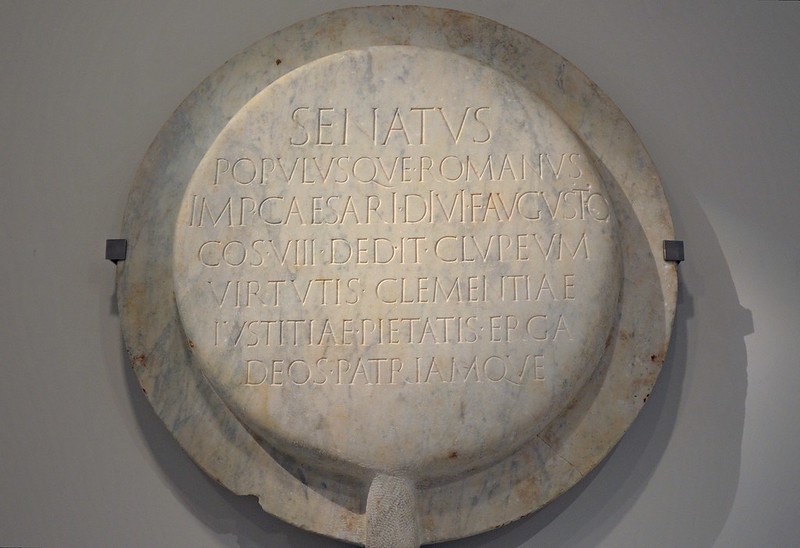
Marble copy of the Shield of Virtue (Clipeus Virtutis) of Augustus. Carol Raddato. CC BY-SA

The Shield of Virtue is a thing that was given. It denotes battle. Above all, valor. It is a defense. By very nature of its name, the Shield of Virtue represents high standards, mercy, fairness, loyalty, acting on behalf of others.

I return now to the spiritual journey. A path of treacherous turns, often littered with brokenness. Dark forests of encroaching thorns and dragonfire as ever the fictitious Prince Philip faced. Ongoing warfare, threat of destruction…

Armor is desperately needed. As Paul wrote to the Ephesian believers:

For we do not wrestle against flesh and blood, but against the rulers, against the authorities, against the cosmic powers over this present darkness, against the spiritual forces of evil in the heavenly places. Therefore take up the whole armor of God, that you may be able to stand in the evil day, and having done all, to stand firm…in all circumstances, take up the shield of faith, with which can extinguish all the flaming darts of the evil one…(Ephesians 6:11-16).

The spiritual battle is real. A shield is given; one of faith. It occurs to me that virtue and faith are inextricably intertwined. Courage is born of believing in something greater than oneself (my favorite definition of awe). Tapping into this disperses unique fuel in one’s veins, enabling one to grasp the shield and to power through, trusting. Scriptures repeat that the battle isn’t even ours, but the Lord’s. His faithfulness will be your shield and rampart… (Psalm 91:4).

Somehow, an acrostic seems called for.

Valor. Let it not be born of vainglory but of an
Infusion of love, of mercy, of divine strength.
Righteousness not fashioned by humanity,
Tempered and refined in heat of battle.
Upward, toward the light, let me always cast my
Eyes.

Strength to all.

*******

Another lens through which to view virtue, from my previous post on this theme:

Within the angelic hierarchy of Judeo-Christian tradition is a class of angels known as Virtues. They are connected to motion and order of the cosmos, dispensers of grace, exceptional courage, unshakeable faith, and miracles. They are balance-bringers; in a world so unbalanced of late, the angelic Virtues must have their hands full. As I write, I imagine them roaming the streets, unseen, fervently seeking ways they can impart divine strength.
What is virtue?

A Spiritual Journey Thursday offering


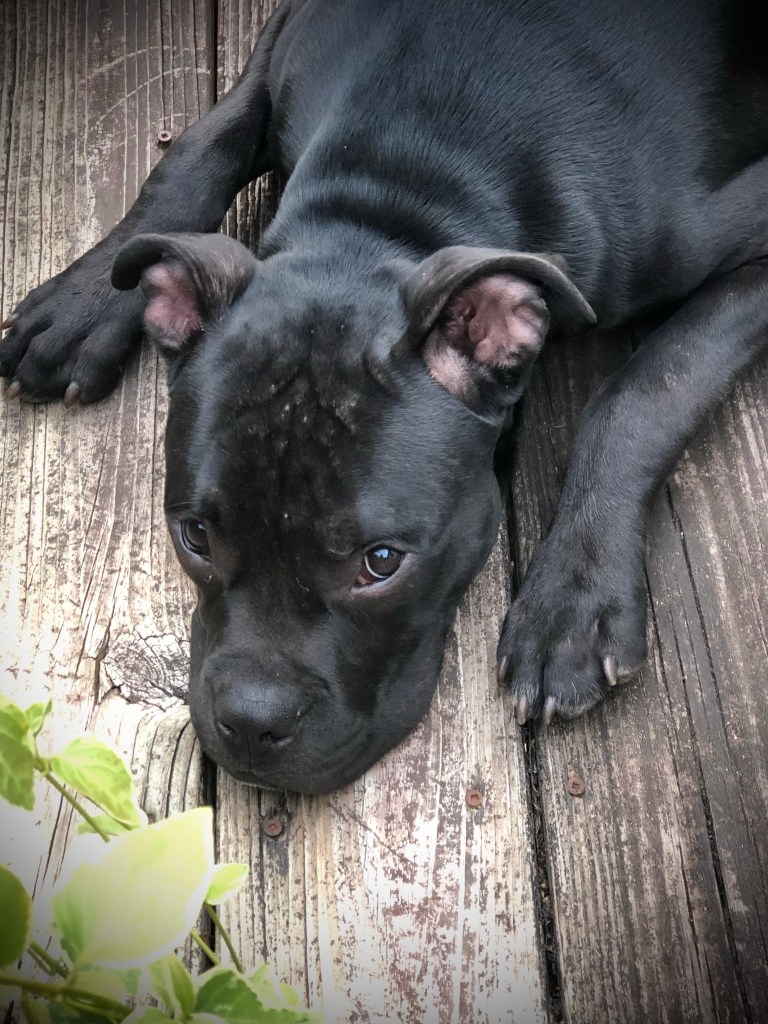
While walking with my son this week, out of nowhere a shape descends upon us…

A dog. Not just any dog…

A pit bull.

Wriggling all over for joy, jumping up as if he knows us.

Begging to be petted and to play.

Glossy back coat, merry eyes, laughing face (yes really). Still a puppy, soft-mouthing our hands in greeting. Same as my older son’s pit, Henry, does.

“He is beautiful,” I say to my son. “He must belong to somebody.”

“I wish he was mine,” says my boy. Never mind that he already owns one of the mightiest breeds of all time: a dachshund.

The dog follows us home. We put him in our backyard until we can locate his owner. He doesn’t like being left alone. He cries when we are out of sight. He rejoices on our return. When we sit on on the deck chairs, he lies at our feet; when we rise, he rises to stand by, ready and willing to do whatever it is we are getting ready to do.

We learn from asking around the neighborhood that he’s roamed the streets before and that people shoo him away. Uninvited dogs, especially pits, are not especially welcome. I begin to think about harm that could befall him, aside from the danger of being in the street: What might a startled, frightened, or angry person do to him?

He raises his head as if he hears my thoughts. He looks at me with a wistful expression.

We find his owners. We send him home.

The next morning, he’s back. Curled up on our front porch mat.

Poor sweet boy. He shouldn’t be allowed to roam…or maybe he’s just an escape artist.

And I realize how powerless I am to do anything except hope for his safety and enjoy him whenever he should visit. He’s not mine and he’s disappeared again. I find myself missing him, looking for him.

He’s on my mind as Spiritual Journey Thursday rolls around; he seems, somehow, to be connected to the question, “What is virtue?” The four cardinal virtues of classical philosophy and Christian theology are Prudence (wisdom), Justice (righteousness) Fortitude (strength; overcoming fear), and Temperance (restraint; self-control). We usually think of virtue as people demonstrating goodness or excellence of character (the virtuous woman of Proverbs 31), or as the beneficial quality of a thing: patience is a virtue.

I cannot help thinking that this pit embodies virtue, too. He’s a good dog. He is loving. He is eager to share his affection and exuberant joy with whomever he encounters…he’s perceptive, willing to to serve, and, I suspect, highly trainable even if somewhat uncontainable at present. Above all, he’s one of God’s creatures.

Which reminds me that within the angelic hierarchy of Judeo-Christian tradition is a class of angels known as Virtues. They are connected to motion and order of the cosmos, dispensers of grace, exceptional courage, unshakeable faith, and miracles. They are balance-bringers; in a world so unbalanced of late, the angelic Virtues must have their hands full. As I write, I imagine them roaming the streets, unseen, fervently seeking ways they can impart divine strength.
I am not sure of connections between the Virtues and the mass adoption of dogs during the COVID pandemic…just musing over shapes that heavenly comfort, courage, and sustained strength might take.

Most of all I think about the desire to serve, to do good versus harm in a spirit of fear and distrust.

Perhaps…perhaps virtue arises where it is welcomed, and when it does, it opens our eyes to the virtue of others.

*******

with thanks to my Spiritual Journey writing friends and to Linda Mitchell for hosting on this first Thursday in August. As it turns out, “virtue” is supposed to be theme for September. Today the group is focusing on “respect.” I caught this after I wrote the post, alas, which leaves me with a choice: write another one and save this for September or let this one fly, regardless. I’m choosing to post now. It is, after all, written from a place of respect for the cosmically happy adventurer we’ve taken to calling “Harold.”

Decima poem debut

On the Ethical ELA Open Write for Educators today, Mo Daley invites poets to try the decima. Originating in Spain, the form is comprised of ten-line stanzas, eight syllables each, with the rhyme scheme ABBAACCDDC.

These poems typically go on for forty stanzas. I’ve managed only one!

Here’s my decima debut, as well as far more important debut…

First Poem for My Granddaughter, Micah (Whose Name Means “Who is Like God?”)

But seek ye first the kingdom of God, and his righteousness; and all these things shall be added unto you.  —Matthew 6:33

Three things he said he’d never do:
marry, have a child, start preaching
like his dad, all the while reaching
out for what is solid and true.
God brought your mother. And now you,
Beloved One, coming this fall.
Blessing and fruition of all
my boy always longed for, despite
his fears. Now with tears of delight
he embraces his Father-call.

Franna loves you so much already, Baby Girl.

What’s in a name poem

I love the mid-monthly Ethical ELA Open Write for educators. The kickoff for July is hosted today by Mo Daley, who offers the invitation to explore your name, and who you are, through poetry.

I happened to write a post about my name in March: Frances. This morning I rework it here, with a few more layers of meaning…

Early morning
before the dawn
as first birds begin to sing

I light a candle
on my table

I sit
by its wavering halo
to write
about my name.

In the beginning
I didn’t even know
it was my name.

My kindergarten teacher, Mrs. Brown, 
called the roll: 
Frances?…Frances?

She finally narrowed her eyes at me: 
Aren’t you Frances?

Sitting before her at a tiny table, I blinked: 
No. I’m Fran.

An inauspicious start
to my academic career.

The first shaky foot
on the lifepath
of learning who I am.

I didn’t love it at first,
my name.

Early on
(sometime after kindergarten,
that is)
Daddy told me
it was after his mother,
Ruby Frances

Grandma

my consummate storyteller
avid letter-writer
daily diarist
devout reader
tireless defender-angel
Grandma

On the day you were born
I stood at the nursery window

and cried.

You looked
like a little angel.

Grandma

My life’s memories
begin in her arms
on her lap
being rocked
in time to the beating of her heart
and the cadence of her voice
singing
Jesus loves me, this I know
or reading reading reading
until I could recite
the rhyming stories
by heart, page by page
long before I went to school

Grandma

who read the entire Bible aloud
several times over
to Granddaddy
who could not read it 
for himself

Grandma

who was named
after her beloved Papa,
Francis

a very religious man

who nevertheless hung himself
on a tree in the woods
in front of her childhood home
when she was just sixteen

Grandma,

I asked, when I was around sixteen,

did you know
that the name Frances
means ‘free’

or ‘one who is from France?’

We talked about it in French class
today

—Does it? I didn’t know.
I loved taking French

—You took French? Really?

—Yes. Such a beautiful language

I didn’t tell her
we got to choose French names
for class
and I chose to be Renée 
without realizing 
that it means born again

or that the kids back in elementary school
could never get our name right:
Hi, France! they’d cheerfully greet me.

I’d grit my teeth:
It is Fran
or Frances.
Not ‘France’.
I am not
a country.

No one else in school
had my name.

It wasn’t cute or popular
since maybe 1886

not to mention
the spelling problem
such as on labels
from the pharmacy:
Francis

Does the world at large
not understand
or care
that the feminine spelling
is with an e?

I wanted to hurl
those little orange bottles
through the window

along with my problematic name

until the day I was teaching
a group of little Spanish-speaking girls
how to read English
and one of them grabbed my badge
to decode my name:
Fran

Very good! That’s really my nickname.
It’s short for Frances.

Ooooo, breathed my little student.
That sounds just like ‘princess’.

In all my years
I’d never thought of that

even though Princess Diana’s middle name
was Frances

and I have to laugh a little now
because Daddy always said
You ought to take Spanish instead of French,
it would be more useful.

He couldn’t have been more right, alas.
He usually was.

I wonder what he’d say now
if he knew my DNA tests
reveal a dollop of French ancestry
that he very likely
passed down…

and as I’ve been writing
the sun has risen
bright and ever-new

a red dragonfly
lands on the little statue of Saint Francis
by my front steps

never minding that I’m not Catholic

nesting birds find sanctuary here
on my porch
along with a host of small creatures
seeking a resting place
even the occasional stray cat in need
for whom I leave fresh water.

The candle’s wavering halo
is invisible now
in the sunlight spilling
through the windows

as I write about my name
this inheritance
I’ve come to treasure
at last

and it just so happens
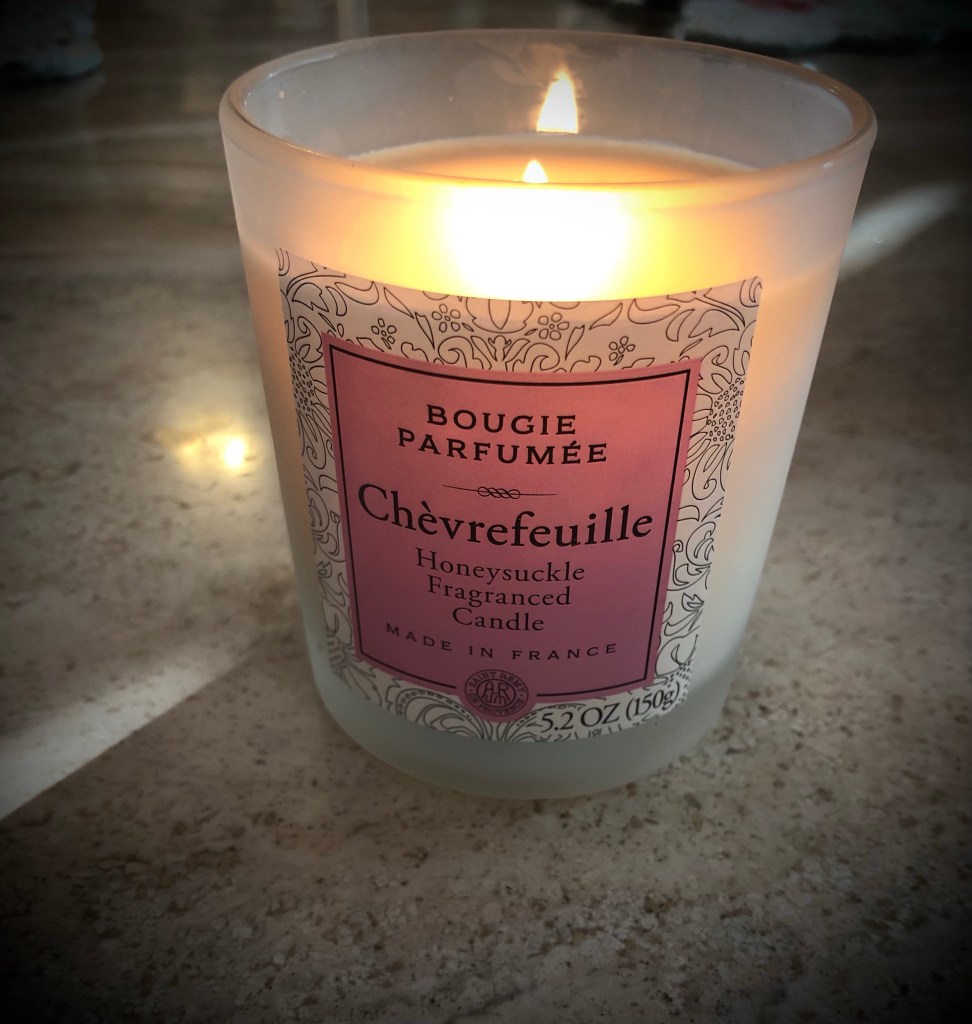
that the candle’s fancy label says
chèvrefeuille
French for “honeysuckle”

the flower and scent
of happiness
of hardiness
of devotion
and everlasting bonds

like a legacy of love

and unseen angels

that are
always near.

Note on red dragonflies, mentioned also in my most recent post: I’ve seen them for the first time this summer. They’re stunning and in some cultures, considered a sign of the sacred.

Out of the water

Summer storm passes
leaving debris in its wake.
I open the door

to investigate
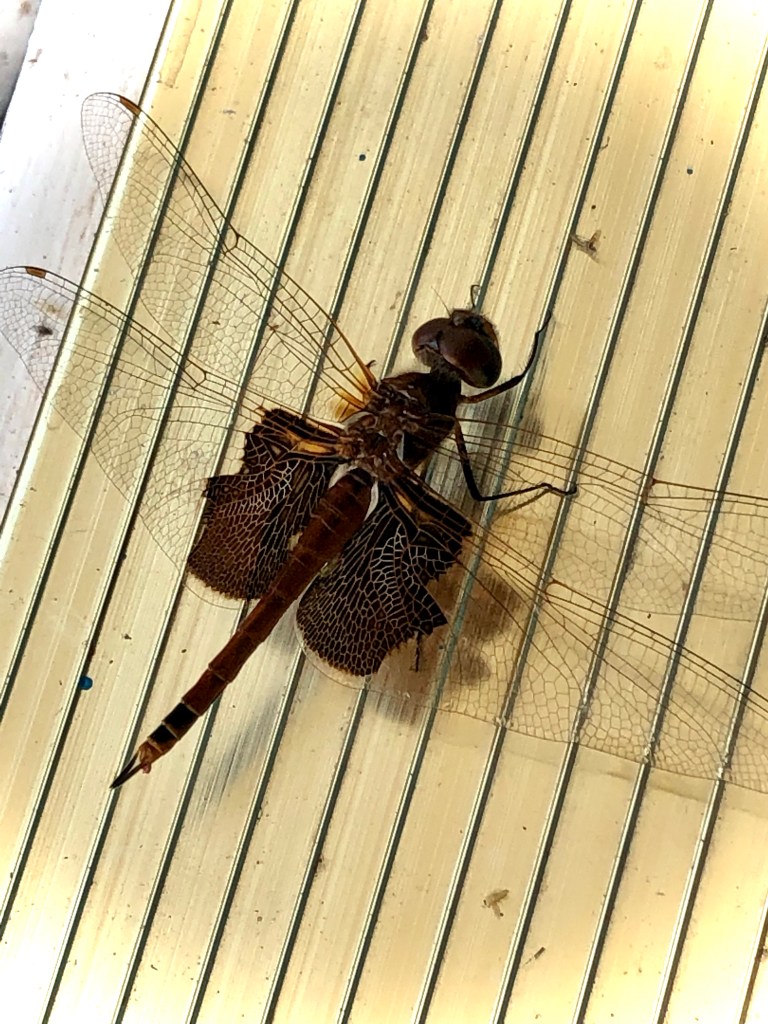
and discover a creature
there on the threshold

Dragonfly resting
weary, heavy-laden wings
—what ARE those patches?

Curiosity
drives me to investigate.
I learn that your name

comes from your luggage:
Carolina Saddlebags.
What do you carry?

Ancient traditions
abundant superstitions
folklore taking flight.

Symbol of wisdom
messenger between the worlds

born underwater

to rise new, transformed.
Your stories go on and on,
tired traveler.

My phone’s search engine
resolves one more mystery
from a day ago:


That red dragonfly
—the first one I’ve ever seen—

may have been your mate.

So otherworldly,
that darting scarlet body.
I caught just glimpses

for it never stilled.
Now I learn red dragonflies
are believed sacred.

A slight fluttering
of your strange saddlebag wings
seems to validate.

To me, you are rare.
Pleased to make your acquaintance
here on this portal

this dividing line
between shelter and tempest,
living and dying.

Take your repose, then.
I ponder birth and rebirth
as I close the door

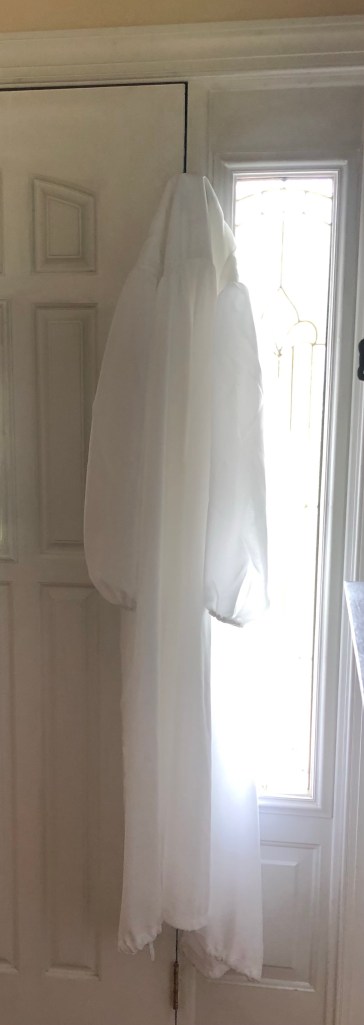
where I discover
my husband’s baptismal robe
hanging up to dry
.

*******

My pastor husband doesn’t like to dry his robe in the dryer. After a recent baptism, he happened to hang it here on the door where the sidelight flooded it.

I’ve seen many dragonflies in my life, but this is the first Carolina Saddlebag. I hope to get a photo of the male, which has a brilliant red body and a violet head. That might be a feat; I read that they don’t land often. The female on my threshold soon regained her strength and flew away.

The sightings on each side of the portal filled me with awe—the word that chose me this year. More reminders to stay open to it every single day, not to miss it.

As a lover of symbolism…well, there’s enough here to last me pretty much forever…

The post is written in haiku, as dragonflies have spawned infinite haiku and inspiration in Japan where they are considered harbingers of life, prosperity, courage, happiness, strength. They have also represented the emperor and immortality. In Native American tradition, the dragonfly is a symbol of resurrection.

Special thanks to the Slice of Life community at Two Writing Teachers for also spawning courage, inspiration, and strength through the writing and sharing of stories. To teach young writers how to write, we must write, and by writing we discover infinitely more about the world and ourselves.

Apothecary of the soul

Today, the first Thursday of the month, my Spiritual Journey gathering writes around the theme of “Nurturing Our Summer Souls.” Deepest thanks to my friend, teacher-poet-artist Carol Varsalona, for hosting.

Summer itself is about journeys, is it not

In my previous post, A walk back in time, I told of a long-awaited trip to the Country Doctor Museum in the small town of Bailey, NC. I expected to learn about rural physicians and their practices in the 19th to early 20th centuries. I didn’t expect to be mesmerized by the first exhibit, a reproduction apothecary shop replete with show globes (which became the official symbol for pharmacies), exquisite leech jars, real live leeches, rows of dried herbs and powders displayed in large glass jars bearing labels of names so poetic and compelling I itched to look them all up right there on the spot, and black pills made in the shape of tiny coffins because they contain a measure of poisons like mercury, so an illiterate population would be mindful not to overdose.

I certainly wasn’t expecting the large painting on the wall behind the counter…

Apothecary of the soul painting, circa 1700-1750. Artist unknown.
Image: Joyner Library, East Carolina University.

It dominated the wall—the whole room.

“These ‘apothecary of the soul’ paintings are rare,” the docent told our tiny tour group of four, one other couple plus my husband and I. “Most come from Germany. You can see here that Christ is the apothecary. He’s holding the scales, weighing his Crucifixion against the weight of a man’s soul… behind them, jars are labeled with the virtues…we’ve had visitors who are fluent in German and they tell us that this is an old form of the language, much of it is complicated to translate…”

I can make out two Bible references, though. Here’s the King James translation:

Matthew 11:28:

Come unto me, all ye that labour and are heavy laden, and I will give you rest.

Isaiah 55:1:

Ho, every one that thirsteth, come ye to the waters, and he that hath no money; come ye, buy, and eat; yea, come, buy wine and milk without money and without price.

My tour group moved on too soon. I couldn’t linger to study the work at length, to grasp more of its symbolism, so I’ve since visited the Museum’s website for more information. There I learned that an apothecary may have commissioned the painting. Apothecaries wanted to draw people to their shops; they sought to be alluring, to the point of extravagance (hence the elaborate show globe towers and gilded leech jars). But imagine the effect on the ordinary townsperson, in need of help, relief, comfort, entering the shop to find Christ adorning the wall. If customers weren’t able to read the verses (from Luther’s 1545 translation of the Bible, I wonder?), they could see that Christ’s right hand holds the scales and that his sacrifice outweighs the man’s sins, represented by a horned beast. The man holds a banner reading My sins are heavy and overwhelming and grieve me from the heart.* Christ’s left hand rests on what appears to be crosswort, a plant often used to treat wounds, headaches, and other ailments, possibly representing a cure-all from the hands of the Great Physician (or Apothecary) himself: the dispensation of spiritual healing as well as physical, “without money and without price.”

I left the shop thinking about the level of trust one must have in the apothecary, and feeling as if I’d been on a pilgrimage versus a museum tour. This happened to be my first journey of summer, which has come at last, bright and beckoning, as the world strives to heal from the COVID-19 pandemic…

Here is to rest, ongoing spiritual journeys, and nurturing the soul.

*******

*Source: Apothecary of the Soul video, ECU Digital Collections, via the Country Doctor Museum website (see Learning). The Museum belongs to the Medical Foundation of East Carolina University, under the management of the Laupus Health Sciences Library.

Other Apothecary of the Soul paintings can be found online; they contain much of the same symbolism.

Memory, like morning (on the day of a friend’s funeral)

with thanks to Denise Krebs who shared the hay(na)ku form on Ethical ELA today.

First draft:

On waking before dawn on the morning of a beloved friend’s funeral

Memory
Like morning
Shimmers with light

Gathering
For Christmas
Across the years

You
Playing Santa
Giver of gifts

Laughter
Colorful, bright
Exquisite as snow

Stories
Like wine
Better over time

Dinners
Savored moments
Ending too soon

Envisioning
Your eyes
Always Christmas-bright

Awe
At love 
Given so freely

Embracing
Many others 
Ever-widening circle

Gathering
Together today
In your memory

Celebrating
Your life
Colorful, bright, exquisite

Testimony
To faith
In Lord Jesus

Returning
your body
to your homeplace

Earth
Where our
Young selves walked

Gathering
For Christmas
Across the years

Now
In springtime
Oceans of flowers

Bloom
Like promises
Around your grave

Friend
No good-byes
Only more homecomings

Rising
From darkness
In heaven’s embrace

Memory
Like morning
Shimmers with light

Spiritual Journey: Blossoming of joy

with thanks to my fellow Spiritual Journey writers who gather on the first Thursday of each month, and to Carol Varsalona for hosting today. Carol chose the theme “Blossoming of Joy.”

The flowers appear on the earth; the time of the singing of birds is come, and the voice of the turtle is heard in our land.
Song of Solomon 2:12

One of my favorite things about spring in North Carolina is the birdsong. Each morning when I rise, it’s to a chorus of cheery songs in myriad bird voices, a tiny angelic choir singing praise for the day from the pines surrounding my home. I listen, and am strengthened.

Another favorite thing is wisteria. It usually blooms for a short while in April. The pendulous blossoms hanging from trees fill my soul with nostalgia, for bygone times walking with my grandmother along the old dirt road of her country home, listening to stories of people who lived, loved, and died long ago. Wisteria threads through the landscape like pale purple banners of celebration for spring. It’s both old and new every year, full of secrets and mystery…and this year, for some reason, it is continuing to bloom into May.

I am not questioning.

I am just savoring.

Mysterious how
wisteria lingers on
disregarding May

This week I have been working with some kindergarteners on letter sounds and names. One little boy had his head down on his desk, buried in his arms, when I arrived. We started a game of naming objects that begin with “y” and he informed me that “yacht” is a boat and “people have parties on them.”

I sat blinking while he played with the toy yacht. He smiled at me: “I am feeling happier now.”

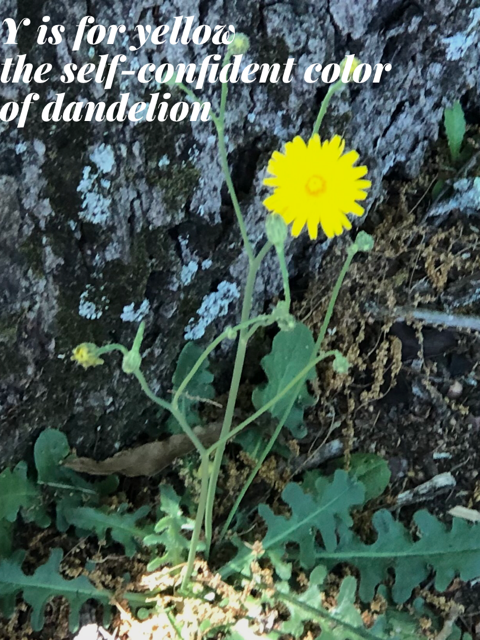
On leaving school, I saw a dandelion growing as close as it could to an old tree:

Y is for yellow
the self-confident color
of dandelion

Thanks to Carol’s prompt today, I am thinking of many facets of “blossoming of joy.” An image returns to mind from last week. At my church there are three women expecting babies in May, June, and July. We threw a shower for them on Sunday; it was one of those perfect spring afternoons, when the sun shines bright and a soft breeze blows like a comforting and encouraging caress from on high.

Sunday afternoon
three young women sat outside
their fellowship hall

greeting well-wishers
arriving in the driveway
bearing baby gifts

a drive-through shower
a celebration of love
a church family

multiplying grace
blessing by blessing outpoured
on expectant moms

blossoming with joy
and the new life they carry 
despite pandemics

My own son and his wife are expecting a baby in the fall.

There’s simply just so much to celebrate.

Abundant blossoming of joy.

Saying something back poem

with thanks to Katie at #verselove on Ethical ELA yesterday. She inspired poets to look around the room for an object of great personal significance, followed by a brainstorming process for finding the object’s own voice and characteristics: “Now that you have stilled this object in order to distill it in a piece of art, it’s time to bring it to life. Listen to it, and once you are ready, consider: If it were a character…and say something back.”

For Day Twenty-Nine of National Poetry Month

Repository

high-backed
mahogany cracked
infinitesimal spider veins

ever musty
oh so dusty
relic of bygone days

when the harmonies rang
and people sang
songs by shape note

now more of a reliquary

with touch-memory
of her hands
on your beloved keys

they don’t forget

somewhere in that
high-backed
mahogany cracked
prized-possession frame

amid your hammers and strings
and octavian dreams

surely you must
hold her dust
alongside mine
skin cells of
the child I was

relics of bygone days
side by side
just as we used to be
on your bench, of a summer night
in pale lamplight

singing
of the sweet by and by
when we shall meet on that beautiful shore

in the meantime
despite your need for tuning
and your wonky key

her great-grandson
stirs the slumbering chords again
the dust
the strings
the house
the blood in our veins
pounding out the glory
of the old, old story

blood does not forget

she’d be overjoyed
with my boy

as you must surely be

as you whisper to me

in high-backed
mahogany cracked
corners
where silence
aches

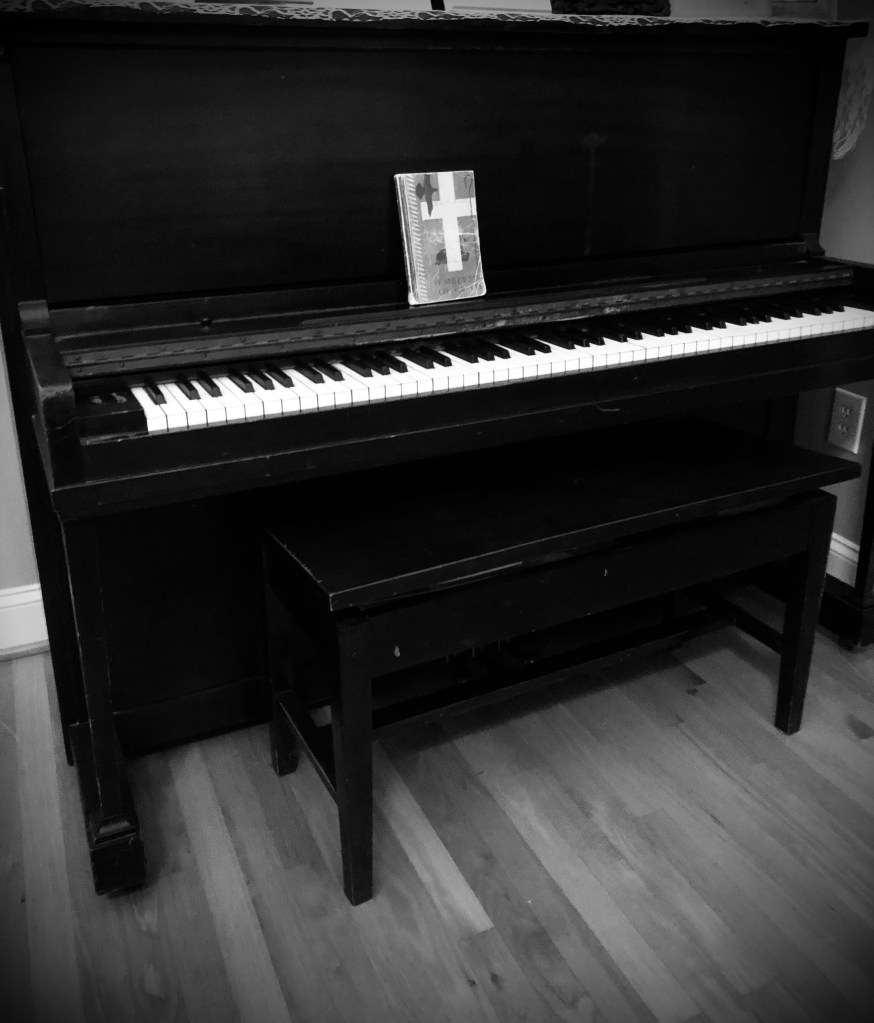
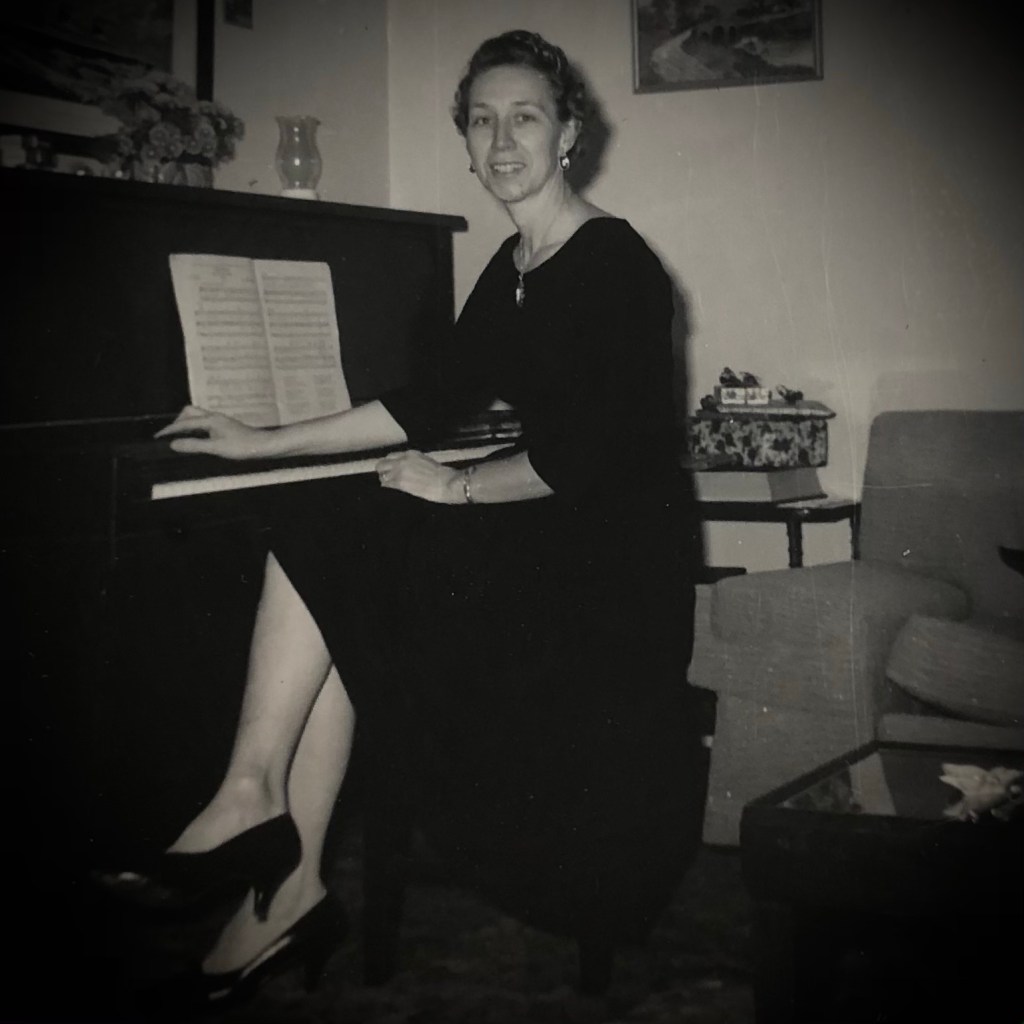
The piano dates to pre-WWII days, possibly the 1920s. My grandfather bought it secondhand for my grandmother. I spent many hours beside her on the bench as she played and sang alto to my soprano. In her last years she moved in with my aunt and finally the nursing home. She gave the piano to me: “It’s my most-prized possession, you know.” I never learned how to play but my my youngest son grew up loving old gospel songs. He’s a magnificent pianist who graduated from college with a music ministry degree; not a day passes that I don’t think of how elated she’d be to know this.

The piano knows, and remembers all.

My grandmother at the piano, long before my time

Out of the tomb pantoum

In honor of Easter, on Day Four of National Poetry Month

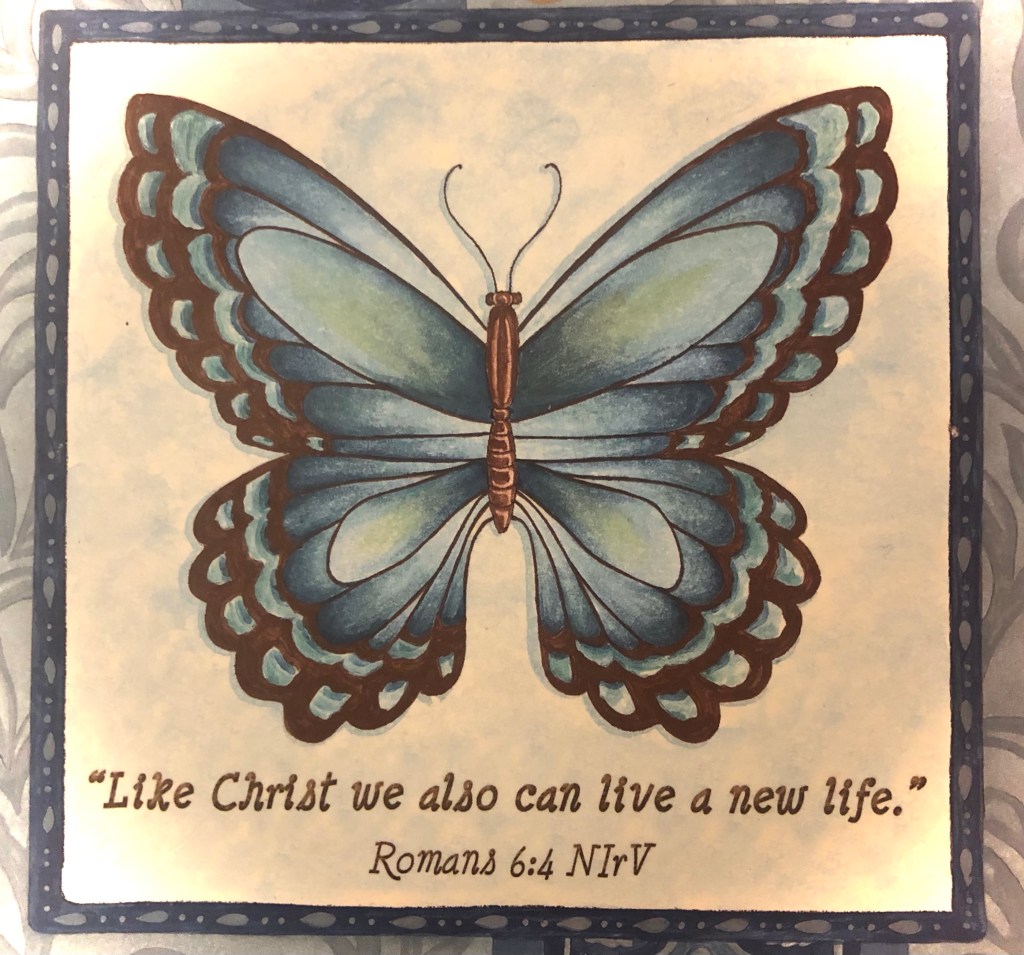
Like Christ we also can live a new life
Out of darkness into light
Offering forgiveness amid strife
As sunrise conquers longest night

Out of darkness into light
Eyes blinking, faith made sight
As sunrise conquers longest night
On the wings of morning, take flight

Eyes blinking, faith made sight
Releasing what is past
On the wings of morning, take flight
Heart’s stone removed at last

Releasing what is past
Offering forgiveness amid strife
Heart’s stone removed at last
Like Christ we also can live a new life

*******

Note: A pantoum doesn’t have to rhyme, although mine does. It is a form comprised of repeating lines in this pattern:

  1. Begin by writing four original lines.
    1 2 3 4
  2. REPEAT lines 2 and 4 and expand ideas in lines 5 and 6:
    2 5 4 6
  3. REPEAT lines 5 and 6, expand ideas in lines 7 and 8:
    5 7 6 8
  4. FINALLY, repeat lines 1, 3, 7 and 8 in the following order:
    7 3 8 1