with thanks to Denise Hill for the prompt on Ethical ELA’s Open Write today: American Sentences, a poetry form invented by Allen Ginsberg, are comprised of seventeen syllables.
To my husband.
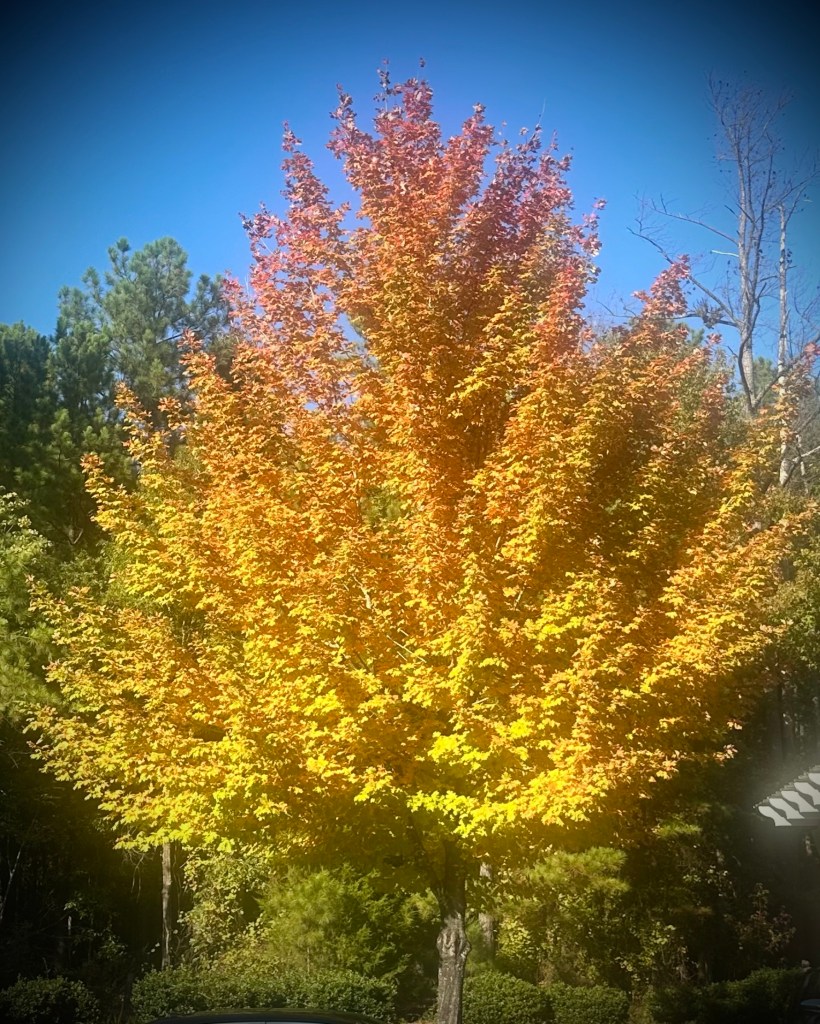
An Observation, While Watching Oblique Light Striking Fiery Leaves
What shall I say to you, in the long afternoon of our shared autumn? Memories of many colors scuttle across sidewalk existence. I cannot decide which I would gather to preserve, to toss, to burn. Trees have no compunction about shedding their fragility—should we? Give me your hand while it is yet light, for evening comes earlier now. Moments, in their gilded crowns, are more beautiful than ever before.
with thanks to Carolina Lopez for the Open Write prompt on Ethical ELA today
I’ve Been Writing This Since
I’ve been writing this since I looked into the wide vent-grates of the upper room floor of my grandparents’ apartment, sure that I saw angels in the depths
in the same way that I saw stairsteps to Heaven in the light fixtures of the doctor’s office ceiling when I was a sick child.
Yeah, well.
I am still here believing when those I loved are long gone yet cheering me on from the other side of portals I cannot see
perhaps they are looking through vent-grates and light-fixture stairways at me.
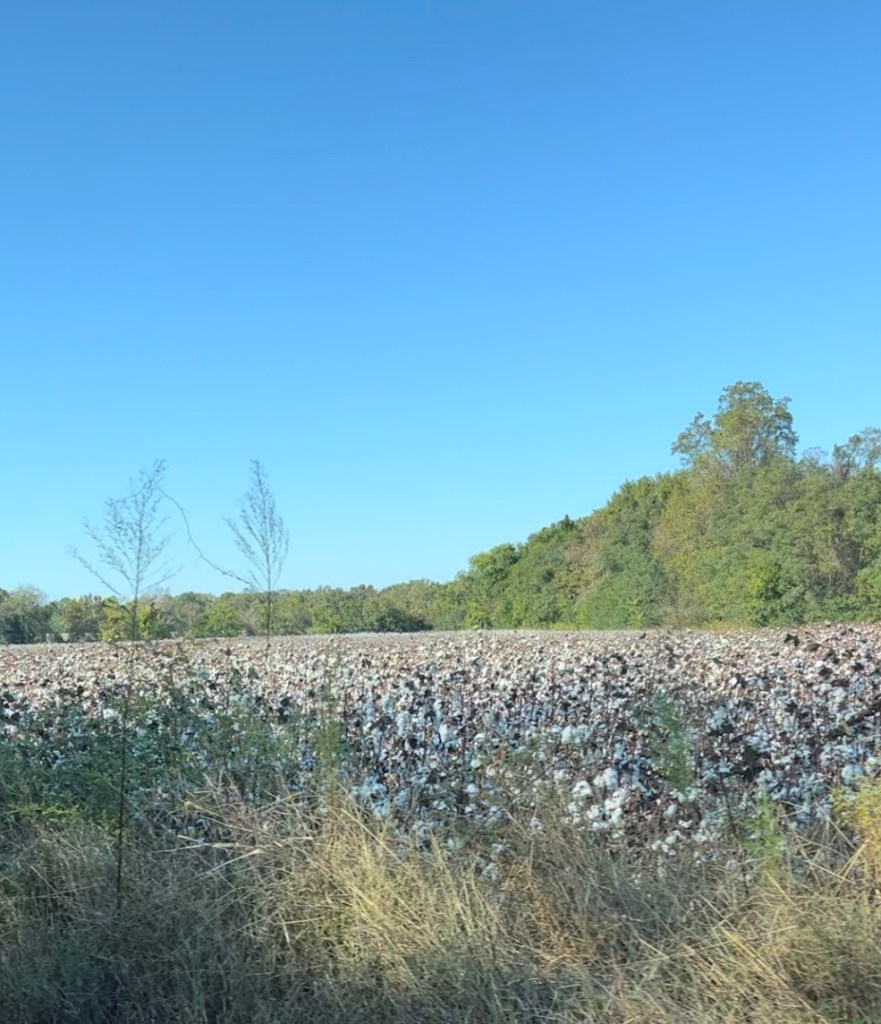
Cotton in the fields reminds me of Granddaddy, his recollections…
farm community in friendly competition out picking all day
he would pick the most, winning proud recognition when his load was weighed
the landowners then permitted his returning after the harvest
to strip the remnants for himself, gleaning enough to buy shotgun shells
Cotton fields abound this season in eastern Virginia and North Carolina
Modern cotton bales, waiting to be ginned
Harvested cotton field, with remaining bits my grandfather would gather to afford his shotgun shells. He called this “scripping.” When listening to his stories, I could envision him in his youth, strong and determined, never complaining of the laboriousness. His words only radiated nostalgic warmth and pride that he was able. Eventually, he said, the boll weevil forced out cotton and tobacco replaced it as the community’s cash crop. In the Depression, Granddaddy was a sharecropper; my father was born in a tenant farmer house. Eventually my grandfather “couldn’t make a go of it” and would find work in the shipyard three hours away, staying in a boarding house all week and returning to his family on weekends…for ten years, until the oldest children graduated from high school and he moved the family. Farming remained his love, however, for the remainder of his days. After retiring, he and Grandma moved back home where he planted glorious vegetable gardens, one of my own most-loved memories.
I cannot say, Child, what you might be experiencing within, but I can tell you I dreamed that we were sailing along a river with green overhanging boughs and that the waters before us were only troubled by a succession of indentations made by tiny feet running rapidly across —a little Jesus lizard, there in the recesses, trying to catch or, on second thought, cavorting with, a dragonfly which shimmered and skimmered away just as the swan drifted into view, its white feathers transforming as it neared, changing from white to gold flushed with crimson and then the eagle, gliding low over the glimmering water, huge, like life itself, its curved yellow beak closed, its sharp eye affixed on us, not on the hunt, merely acknowledging our presence and so we drifted on and I didn’t even realize until the shore loomed before us, rocky and steep, that we’d been riding in a little wooden boat that navigated the river by its own power, not ours, to land us right where we needed to be, and that we’d be able to navigate this embankment, too, for there amid the stones and earth were steps perfectly placed for our climb.







 lit bits and pieces