2021: A year of awe

Some people call it one word. Others call it one little word, abbreviated OLW. Either way it’s the tradition of choosing a focus word for a new year. Maybe even a new word for each month. Make of it what you will, how you will, the chosen word serves as a tool for reflection, a lens for living, a frame for your days.

At the outset of 2021, I wasn’t in the frame of mind to choose a defining word unless it was survival or endurance or possibly perseverance, none of which were inspiring or lyrical (shouldn’t your OLW strike deep chords in your spirit?). After 2020, I was tired. We were tired, all of us. It was a year that seemed liked ten. The world as we knew it changed overnight. Quarantine, separation, isolation, closed businesses, bare shelves at the stores, working from home, doing school online. Plans disrupted. Staggering losses of so many kinds. Grief. Rage. Despair. Navigating the unknown every single day. The COVID-troubled world kept turning but we almost didn’t recognize it or ourselves anymore…literally, behind the masks.

We hoped. We clung to our screens. We cherished every glimmer of light in the long, dark night of the soul. How long? we wondered. How long?

On the brink of 2021, as I wearily turned the page in my academic planner, I said something like this to myself: Forget the one little word thing. I don’t have the energy to think around it or write around it. What difference does it really make, anyway. After all, my word for 2020 was reclamation. I wrote in January, before the onslaught of COVID-19 in March, when everything shut down that Friday 13th for what we thought would be only two weeks: Moving forward becomes an act of will, a revised determination to do what you can, what’s most important, for that given day. Recovering ground, inch by precious inch.

Note to self: Be careful what you wish for…

But then, then, turning that page… I discovered this quote, in tiny font, sitting on January 1, 2021, in my planner: Experiencing awe (the feeling of being in the presence of something bigger than you) can improve your physical health and make you feel more altruistic. Intentionally create awe this month by spending time in nature, meditating, volunteering, etc.

I knew, then.

Whatever might come in 2021, I must look for awe. I must keep the door open for it. Anticipate it. Invite it.

There’s a psychology, a science, to awe. A savoring of life, an ineffable hope, a spark of joy, an inhaled breath of wonder at the wonders all around, a reverence. It can make you feel more altruistic…desiring to benefit others at your own expense…can the world not use more of this?

I sat in awe of this revelation…and that is the story of awe choosing itself as my word for this year, now in its final days.

It’s everywhere, awe.

In fragile periwinkle flowers poking through the January snow, in the piercing cry of a red-tailed hawk, in the flight of an eagle near enough for me to see its white head. In the resilience of children learning from home and in their happy dogs who attended class with them. In my own dog, who slept in my lap during those long hours online. In colleagues who stopped resisting new learning in the hardest of times and began embracing it…and each other. In children learning to read despite all, in one student pointing to a new word, “trombone” (without a picture), and telling me I don’t know how to say it, but it’s a musical instrument. In resuming church services and eventually singing hymns again. In the return of the little finches which have built a nest on my front door wreath every year except for 2020. In the gift of new life…in the announcement that my son and his wife were expecting a baby in the fall. In the long summer of anticipating, in finally making it to the ocean again, in seeing how seabirds stood on the shore, protecting one of their own that was missing a foot. In passing three white horses in a grassy meadow on morning drives to school, reminding me of a game my father taught me to play on long journeys when I was a child (I have a lot of thirty-point days now, Daddy). In teaching poetry again, in seeing the kids’ faces light up with their own writing discoveries. I wrote a lot of poetry in 2021; much of it centered on awe.

I have so much more to write. I am awed by what my sons have accomplished this year, one as a minister, the other as a funeral assistant and musician. I am awed by other people who say your boys have blessed me.

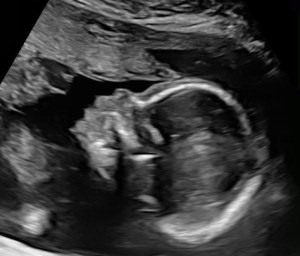
Baby girl Micah arrived at the end of October. Her big sister’s wish, come true.
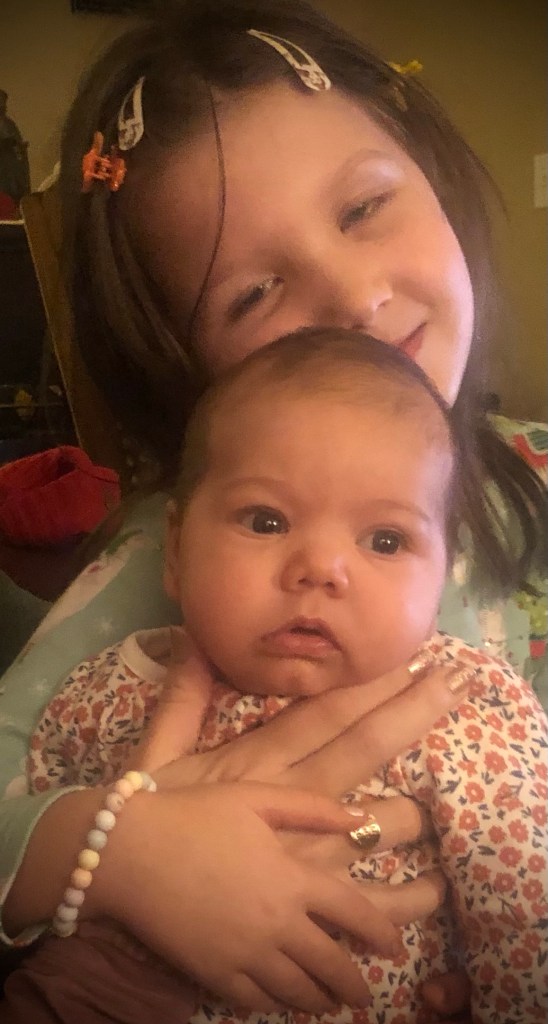
Christmas Eve at my house, 2021

Awe abounds. It waits to be found. Just like the little present placed in my stack on Christmas Eve during our family gathering.

That’s especially for you, Franna, said my daughter-in-law.

I opened it.

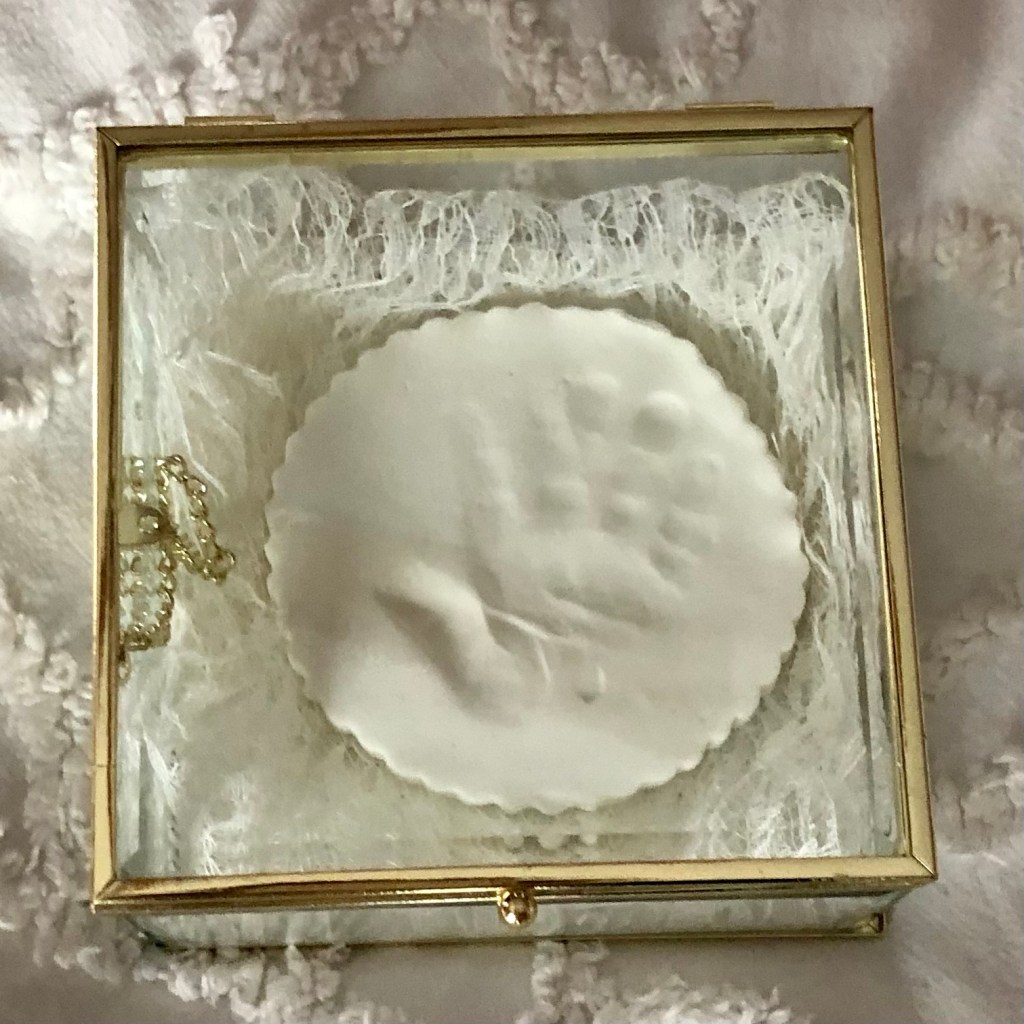
Micah’s tiny handprint, in white plaster.

Awe.

And tears. Too overcome for words.

My daughter-in-law didn’t know the story. One day I will tell Micah about the handprint I made for my grandmother so long ago, how it hung on her bedroom wall for over thirty years…

Awe. Awe. Awe. Life in its abundance, making full circles. Light to be found, even in the darkest season. The treasure of having each other. Love, blessing, wonder, the gift of life itself, all from the hand of Almighty God.

I see no reason whatsoever for changing to a new word in 2022.
Wishing awe to you all – each new day with its waiting treasures

*******

with much love and gratitude to the Two Writing Teachers for the weekly Slice of Life Story Challenge. There is sustaining power in writing. There is more in a writing community.

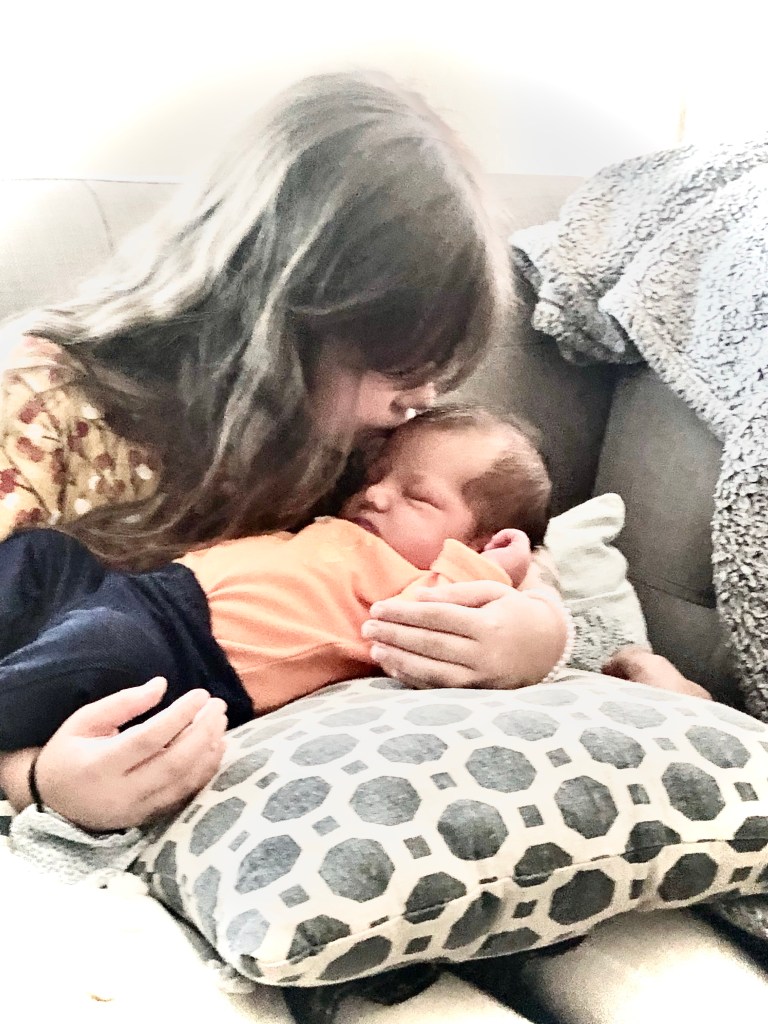
Fatherlight

For Micah

Every good gift and every perfect gift is from above, and cometh down from the Father of lights, with whom is no variableness, neither shadow of turning. —James 1:17 (KJV)

The LORD your God in your midst, The Mighty One, will save; He will rejoice over you with gladness, He will quiet you with His love, He will rejoice over you with singing. —Zephaniah 3:17 (NKJV)

He carries you close
to his heart, walking you through
every brand-new day


Young theologian
experiencing
, with tears,
depths of fatherlove

Fierce. Sacrificial.
Sustaining. Protective. Sweet.
Miraculous. Yes

He would give himself
to keep you safe from all harm
his love is that great


I understand this
I carried him just like this
when he was newborn


Precious tiny girl
gift from the Father above
gloriously loved

There’s always a light
in the longest, darkest night

for God is at work.

How I love you both – Franna

Decima poem debut

On the Ethical ELA Open Write for Educators today, Mo Daley invites poets to try the decima. Originating in Spain, the form is comprised of ten-line stanzas, eight syllables each, with the rhyme scheme ABBAACCDDC.

These poems typically go on for forty stanzas. I’ve managed only one!

Here’s my decima debut, as well as far more important debut…

First Poem for My Granddaughter, Micah (Whose Name Means “Who is Like God?”)

But seek ye first the kingdom of God, and his righteousness; and all these things shall be added unto you.  —Matthew 6:33

Three things he said he’d never do:
marry, have a child, start preaching
like his dad, all the while reaching
out for what is solid and true.
God brought your mother. And now you,
Beloved One, coming this fall.
Blessing and fruition of all
my boy always longed for, despite
his fears. Now with tears of delight
he embraces his Father-call.

Franna loves you so much already, Baby Girl.

Out of the water

Summer storm passes
leaving debris in its wake.
I open the door

to investigate
and discover a creature
there on the threshold

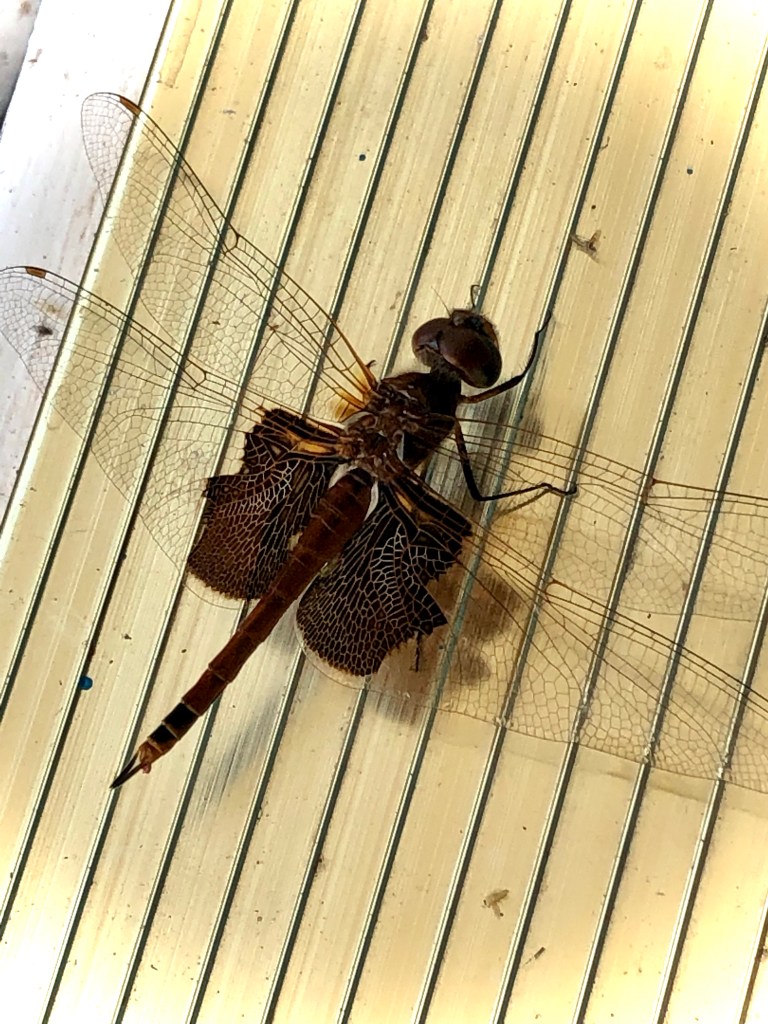
Dragonfly resting
weary, heavy-laden wings
—what ARE those patches?

Curiosity
drives me to investigate.
I learn that your name

comes from your luggage:
Carolina Saddlebags.
What do you carry?

Ancient traditions
abundant superstitions
folklore taking flight.

Symbol of wisdom
messenger between the worlds

born underwater

to rise new, transformed.
Your stories go on and on,
tired traveler.

My phone’s search engine
resolves one more mystery
from a day ago:


That red dragonfly
—the first one I’ve ever seen—

may have been your mate.

So otherworldly,
that darting scarlet body.
I caught just glimpses

for it never stilled.
Now I learn red dragonflies
are believed sacred.

A slight fluttering
of your strange saddlebag wings
seems to validate.

To me, you are rare.
Pleased to make your acquaintance
here on this portal

this dividing line
between shelter and tempest,
living and dying.

Take your repose, then.
I ponder birth and rebirth
as I close the door

where I discover
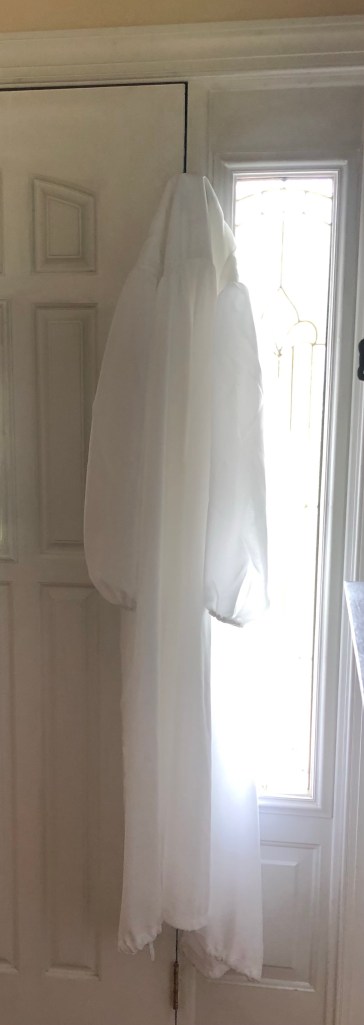
my husband’s baptismal robe
hanging up to dry
.

*******

My pastor husband doesn’t like to dry his robe in the dryer. After a recent baptism, he happened to hang it here on the door where the sidelight flooded it.

I’ve seen many dragonflies in my life, but this is the first Carolina Saddlebag. I hope to get a photo of the male, which has a brilliant red body and a violet head. That might be a feat; I read that they don’t land often. The female on my threshold soon regained her strength and flew away.

The sightings on each side of the portal filled me with awe—the word that chose me this year. More reminders to stay open to it every single day, not to miss it.

As a lover of symbolism…well, there’s enough here to last me pretty much forever…

The post is written in haiku, as dragonflies have spawned infinite haiku and inspiration in Japan where they are considered harbingers of life, prosperity, courage, happiness, strength. They have also represented the emperor and immortality. In Native American tradition, the dragonfly is a symbol of resurrection.

Special thanks to the Slice of Life community at Two Writing Teachers for also spawning courage, inspiration, and strength through the writing and sharing of stories. To teach young writers how to write, we must write, and by writing we discover infinitely more about the world and ourselves.

A walk back in time

After many years of mentioning it, my husband and I finally visited the Country Doctor Museum. Off the beaten path in a nearby town, the museum consists of three small buildings, one of which is a combination of two actual 19th century doctors’ offices. The museum began as a memorial to rural physicians, expanding over time to include the nursing profession, home remedies, and the apothecary. It now houses an impressive collection of artifacts from the 18th to early 20th centuries.

I expected to learn things. I didn’t know, for example, that this is the oldest museum in the United States dedicated to the history of rural healthcare, or that it’s been taken over by my alma mater, East Carolina University. The docent said: “That saved us during COVID. We had the funding to reopen. Many private-funded museums could not.”

I mourned the loss of museums that had to close for good as we crossed the threshold of the apothecary… where an otherworldly, unanticipated, delicious strangeness awaited on that side of the portal…

A mammoth cabinet of gleaming cherry wood with ornate scrollwork, sunbursts, and Victorian spindles runs the length of the left wall. On its shelves, behind glass doors, stand hundreds of large jars bearing white labels and names of their contents—assorted dried herbs, powders, and liquids—in large black script: Crocus, Cloves, Mace, Valeria, Aq. Rosa., Pond’s Ext., Sol. Benedict Quantitative, Lotio Pilocart Morrow, Pepsengia. Some labels look new; others appear to be timeworn, the lettering nearly illegible. The docent speaks in a low, unmodulated voice about paregoric, opium, mercury, and poisons that were often part of remedies mixed by the apothecary, dispensed to a largely illiterate population which couldn’t read labels. In order to prevent overdose, some of the pills were fashioned into tiny black coffins.

As I look at these coffin-pills, trying to imagine ingesting such a thing, the docent points to the show globes in the cabinet. Tall, decanter-like vessels of different-colored liquids—green, yellow, blue, red—stacked upon each other in rounded triple towers. They seem art deco or like something from the 1960s. “Show globes are an official symbol, like the striped pole is to the barber,” says the docent. “People entering a town would know this is where to find the apothecary. The show globes were displayed in the shop’s front window, and every color had a meaning. The apothecary kept a recipe for mixing dye in water and a guide for when to display certain colors. Red, for example, would warn travelers that there’s widespread sickness in this town, an epidemic…”

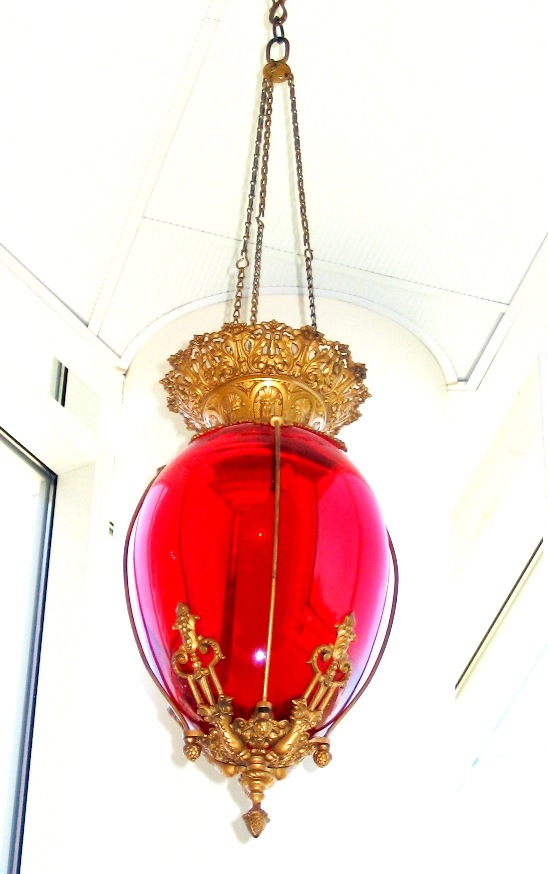
I turn to see a large, single-tier show globe with antique bronze trim sitting alone on a pedestal behind me. Full to the brim with bright red, transparent liquid.

Of course, I think. The docent is wearing a mask. I wonder if the all the museum guides came by cover of night in March of 2020 to mix this red solution. And if it will remain red until COVID-19 makes its full departure.

Hanging show globes were sometimes mounted in the apothecary’s shop window.

The docent is now speaking of bloodletting and leeches.

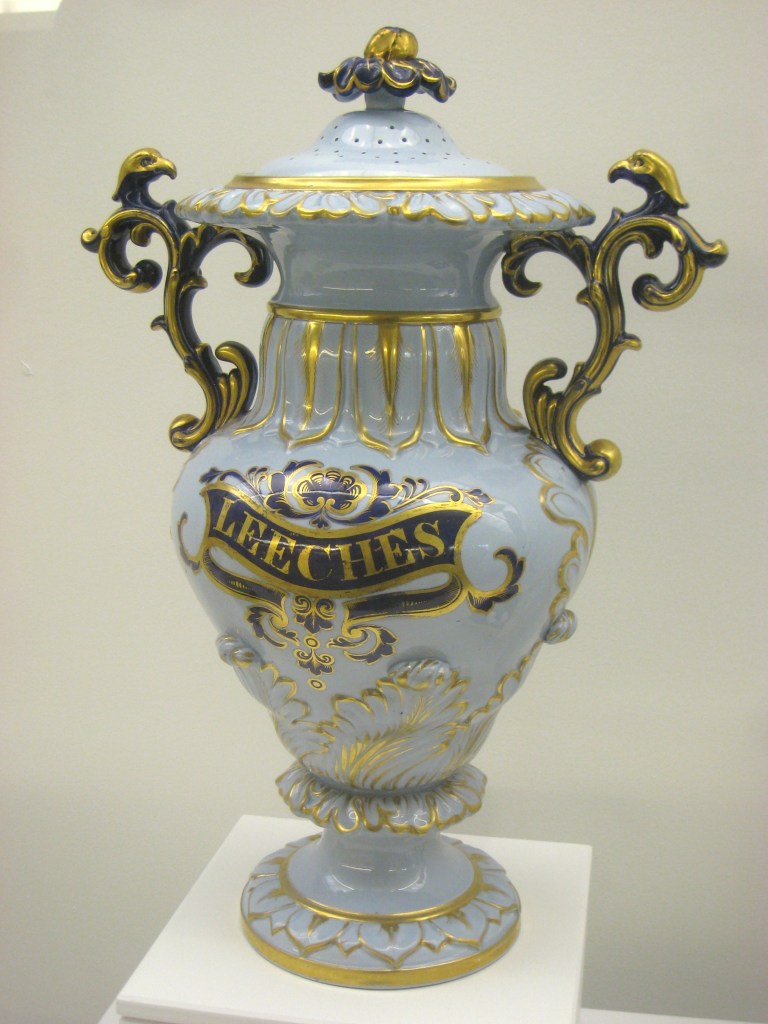
There are, in fact, live leeches on display. They’re floating contentedly in a clear glass bowl of water beside a large vase decorated with a delicate floral pattern…along with the word LEECHES in utterly incongruous, glorious gilt adorning a black banner.

The museum’s leech jar is very similar to this, only with a sweet pattern of tiny pink flowers and vines.

“The apothecary kept leeches in leech jars such as this…” the docent is saying. “It was advertising. The fancier the jar, the better the quality, people believed…”

I’m awed by the jar, that it was designed solely to hold worms. Albeit important ones… and I read once, somewhere, that leeches are amazing escape artists: A more recent druggist had a leech that chewed through a modest gauze lid covering; he found the escapee several days later, lounging on the turntable of his record player.

The docent continues: “Leeches are still in use today. We had a plastic surgeon visit once. He told us of reattaching someone’s ear and using a leech there to increase the blood flow for healing…leeches are often used when fingers are reattached…you don’t feel the leech, of course…”

We are about to move into the next room where there’s a real human skull and kits of amputation tools from the Civil War era, but I want to linger here, I have a thousand questions about the tinctures and remedies and practicesand I want to study the magnificent 1700s era painting on the right wall, above the counter where the apothecary would make pills by mixing powders and dough, rolling and cutting with a pill-roller. The artwork depicts Christ as an apothecary, with elaborate calligraphy in old German. It presides over the whole room.

But time does not wait; it moves on and so must I… prying myself away from the painting and jars and show globes, I content myself with the knowledge that a healing-herb garden waits at the end of the tour. I hurry into the next room just to make the intriguing discovery that I am now standing in the office of a Victorian doctor whose not-very-common surname is my own maiden name.

What a peculiar sense of belonging…and, I think, beginning, of something I’ve yet to name.

*******

I plan to write more about the painting on Thursday.

You can visit the Country Doctor Museum online to learn more and to view many fascinating artifacts.

Sustaining words

As I turned the pages of my academic planner from April to May, I discovered a quote from Buddhist nun Pema Chödrön…

You are the sky. Everything else is just the weather.

The implication is to just be. To remain. To not worry about things beyond your control. The storms of life may rage and wreak havoc, but not indefinitely. They pass. And they’re interspersed with moments of incredible beauty. The sky exists above clouds. It is the sphere through which the sun, moon, and stars pass…what would it mean, then, to “be the sky”? I feel more posts coming on this later…

Meanwhile, more Chödrön:

Each moment is just what it is. It might be the only moment of our life; it might be the only strawberry we’ll ever eat. We could get depressed about it, or we could finally appreciate it and delight in the preciousness of every single moment of our life.

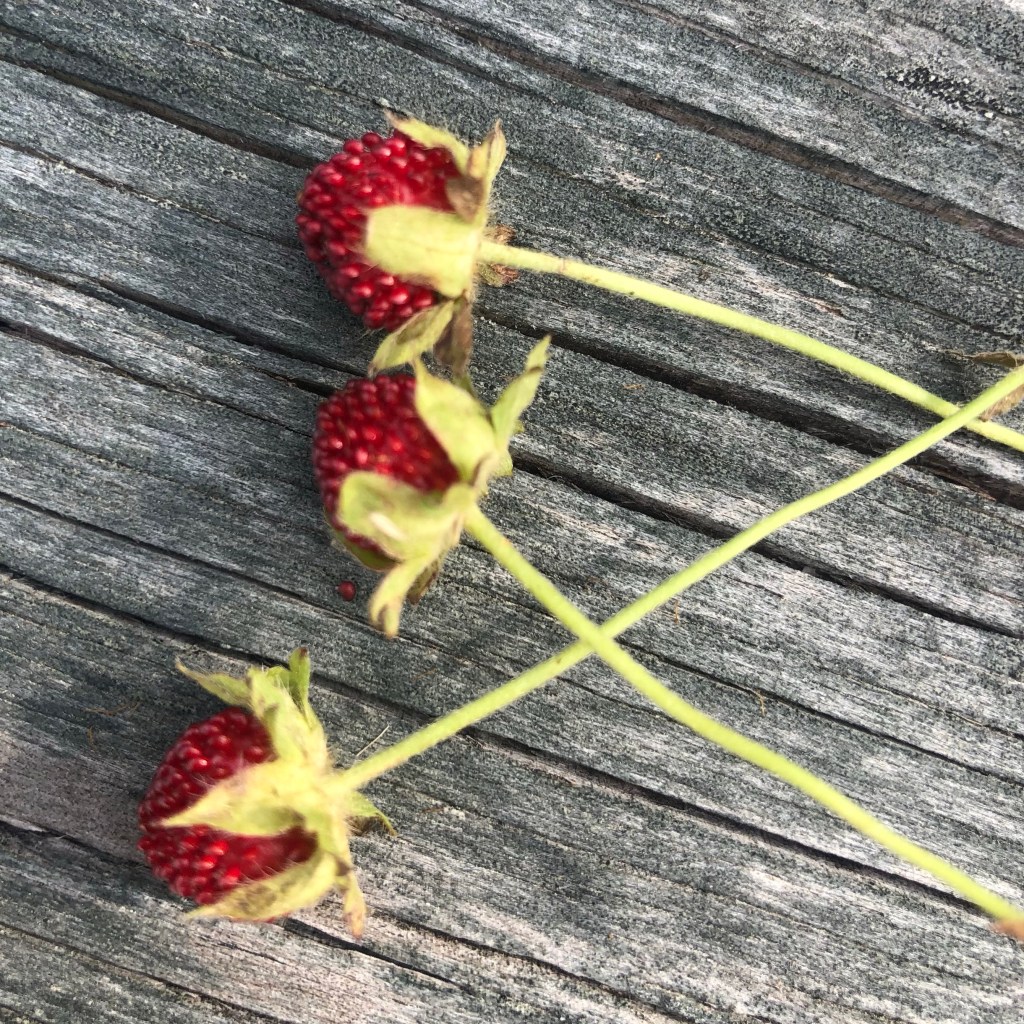
On Mother’s Day my family gathered for lunch. Sunday afternoons have an ethereal quality; they are not your ordinary afternoons. They beckon sleep, or reading, or other quiet pleasures; they also offer an outlet for expending physical energy and embracing joie de vivre, joy of living. After lunch my granddaughter, age five, needed to “run and get her wiggles out.” Her mother and I watched her running through a sea of white clover in my backyard. I’d been irritated that our lawn service hadn’t yet cut the grass but as I breathed the sweet, clover-perfumed air, I thought How perfect is the fragrance of this day. My daughter-in-law and I began identifying all the different types of plants growing with the grass in my yard with the “Picture This” app on our phones: Tall goldenrod. Spreading hedgeparsley. Ryegrass. Bluegrass (who knew?). Posion ivy on the far corner of the fence under the pines (lawn crew must be notified). Woodsorrel. Wild geranium. And wild mock strawberries, which enchanted my granddaughter. She picked them and carried them around, tiny red fruit in a tiny pink hand… my son said, “I never knew those grew here!”

There are a lot of things we never realize. Such as the value of simple moments, in the living of them. We cannot imagine how the memory of these will remain with us, like the sky, for our lifetime.

One more quote…

Rejoicing in ordinary things is not sentimental or trite. It actually takes guts. Each time we drop our complaints and allow everyday good fortune to inspire us, we enter the warrior’s world.

One of the thick, spiky weeds we identified on our backyard exploration is a species of “Everlasting.”

I said to my daughter-in-law: “I had no idea so much poetry lived in the grass.”

I think about all that would have been lost in these dappled Sunday afternoon moments, if the grass had been cut like I’d wanted. My granddaughter didn’t complain. She savored it all, blue eyes as brilliant as the sky above.

I do not know what tomorrow will bring. For now I only know we stand as we are, in our shared sky and story, moments in the making, entering the warrior’s world, a family of everlastings like those growing in the universe beneath our feet.

Where nothing is ever really ordinary.

Voices

On the last Sunday in July, 2019, my husband went to the gym after church. He had a great workout on the stationary bike (always proud of accomplishing five miles in fifteen minutes).

He got in his truck to come home.

That is the last thing he remembered for a long time.

At the house, our dog went crazy, barking. Someone in the driveway. Police officer: Your husband’s had an accident. Do you have a way to the hospital… truck ran off the road into the woods…appears to have been a medical event…sorry, I don’t know how bad it is. EMS was working on him when I left…

Both of our grown boys happened to be home that afternoon. We rode together to the ER, not knowing what we’d find.

My reeling mind wondered if their black suits were clean…in case…

At the hospital, a nurse was waiting for us. She ushered us into a side room.

Massive heart attack, said the ER doctor, but he’s alive. He wasn’t when EMS got to him. He was in cardiac arrest. They did CPR, defib…they are heroes…heroes…

Heart attacks killed his father and grandfather in their fifties.

After emergency surgery, he underwent induced hypothermia to allow his brain time to rest from the trauma. No one knew how long he’d gone without oxygen. EMS had arrived on the scene quickly, as the station is just up the street from where the truck ran off. My boys and I learned that their dad endured forty-five minutes of CPR and ten – TEN – shocks from the paddles. We would learn that his sternum was broken. Attending CICU physicians warned: After hypothermia, we’ll do a waking test. There’s no guarantee he’ll wake, or how extensive the damage will be to his brain…

As we endured those long hours, we learned that his truck was barely dented as it ran off the road, that it stopped just short of a deep ravine in the woods. We were told that he swerved into oncoming traffic and back into his lane before running off on the right. He never struck another vehicle. People behind him called 911. One thing different, and all would be different…

As one doctor said: Everything aligned for him. Everything.

He did awaken. He knew us. He was soon able to ask, in a raspy voice after coming off the ventilator: What happened?

It would be a long recovery involving another hospital stay and more surgery…but he recovered.

He could remember leaving the gym, but he could not recall anything from earlier that month, or from many months before. All of his long-term memory remained intact; all his stories, all his sports trivia and stats. There was just a period completely erased, leading up to the heart attack. He could not recall a thing from our family vacation to the beach earlier in July, the glorious time we had.

The brain’s way of protecting itself from pain, our oldest son said. I had a professor who told us about this in class. It’s not good to try to make a person remember…

He didn’t recognize the scenery on the way home from the hospital: Why are we turning here? Everything looks so new…have I seen this before?

The doctors said, Some memories may return as he heals. Some may not. It’s hard to say; everyone is different.

After a couple of months, he returned to his work at the church. He’s a minister. The number one question people had after he began regaining strength: Did he see anything? when he was… you know… ‘gone’? I mean, he IS a pastor… such curiosity tinged with hope, in that questioning.

All he could remember, much to people’s disappointment: It was just like going to sleep. No pain, just fading into sleep. So peaceful.

Then one day he saw pictures of our family vacation and recognized the giant tortoise we chanced upon at a roadside display: I remember that!

Random bits returned to his mind, here and there.

Then on another day, much later, he told me: I heard voices.

What do you mean, you ‘heard voices’?

When my truck ran off the road. When everything was going dark.

What did they say?

They said, “He’s in trouble. We have to get him off the road.”

Did you…did you recognize the voices? Do you think that maybewell, it could have been just the EMTs…

He shook his head. All I know is, I heard them when I was driving and I thought, if I can just get over there to the grass, to that little hill… where that sunset is…everything will be okay.

He left me staring after him as he headed out to the park for the eight-mile hike he makes now, several times a week.

He’s in trouble. We have to get him off the road…

Everything aligned for him. Everything.

I ponder the mystery of memory, and the miraculous…in ceaseless awe that he is returned to us, restored, rejuvenated, whole.

In his own words, with his characteristic wit and big, contagious laughter, as “a member of the Lazarus Club.”

*******

Photo is entitled “The Day Black with Night” and is in the public domain on Creative Commons with this verse: “Go for help to Him who makes Orion and the Pleiades, by whom the deep dark is turned into morning, who makes the day black with night; whose voice goes out to the waters of the sea, sending them out over the face of the earth: the Lord is His name.” —Amos 5:8.

The annual Slice of Life Story Challenge with Two Writing Teachers is underway, meaning that I am posting every day in the month of March. This marks my fifth consecutive year and I’m experimenting with an abecedarian approach: On Day 22, I am writing around a word beginning with letter v.

Opal

It looks like a glass teardrop there in my hands. I tip it this way and that, watching the tiny white pieces inside floating up and down in the clear liquid, catching the light and glowing with bits of colored fire. I’ve never seen anything so magical.

“Grannie, what IS this?” I breathe. I can see it’s a necklace. It has a little cap of silver leaves and a silver chain.

She understands. “A floating opal,” she replies, rummaging through her jewelry box.

I can’t look at anything else.

I wonder about the liquid. Is it water? From where? A magic spring bubbling up in a wizard’s garden? What if it isn’t water but tears cried by an enchanted princess and collected in the teardrop-shaped globe as a powerful talisman? Why is the opal in little pieces and how can there be such fiery red, blue, and green in its luminescent whiteness? Colored fire burning in water…is there a spell on this floating opal? What does it MEAN?

I don’t even realize how spellbound I am, or how long I would sit staring at this otherworldly object, until Grannie speaks, breaking the hypnosis:

“You can keep it, if you want.”

*******

I’ve loved opals ever since. Their beauty, their symbolism, their lore. They’re said to be stones of emotion, freedom, and independence; that certainly sounds like my Grannie, who had a fiery streak herself. It sounds like what she may have wished for me. Opals also have a mixed-bag reputation of misfortune and hope, and once it was believed that an opal wrapped in a bay leaf would render a person invisible; it was accordingly dubbed patronus furum, “patron of thieves,” says the International Gem Society.

Come to think of it, I never did ask Grannie how she came by this floating opal…not that she would have taken it. Surely not. But as freely as she gave it, I wonder: Might it have belonged to my Papa G’s first wife who died years before? A floating opal necklace like this dates to the 1940s…

No matter, really, as was it my grandmother’s to give thirty-something years later, and I was the receiver.

Recently I stumbled upon this story about opals I’d never heard before One more mesmerizing, mysterious thing… courtesy of the International Gem Society:

In a chapter of Sir Walter Scott’s 1829 gothic novel, Anne of Geierstein, we learn the unusual story of the enchanted and mysterious Lady Hermione.

The grandmother of the titular character, she appeared to possess magical powers. At times, she seemed more an indefatigable spirit — an ignis fatuus or will-o’-the-wisp — than human. She always wore in her hair a golden clasp with an opal that “amid the changing lights peculiar to that gem, displayed internally a slight tinge of red like a spark of fire.” This gem seemed to reflect her moods, showing “a twinkling and flashing gleam which seemed to be emitted by the gem itself” whenever she became animated or agitated, “as if it sympathized with the wearer’s emotions.”

On the day of her daughter’s christening, drops of holy water struck her opal, which “shot out a brilliant spark like a falling star, and became the instant afterwards lightless and colorless as a common pebble.” Hermione then collapsed. Two hours later, all that remained of her was a handful of gray ashes.

So. A grandmother, a granddaughter… named Anne.

Let me just say that Ann is my middle name.

I will not even address the name Hermione in this legend; I will just let Harry Potter fans savor that on a whole ‘nother level with me.

And let me also say that somehow, in the passing of the years, Grannie’s floating opal got misplaced. When one of my babies snapped the chain long ago, I put the teardrop pendant somewhere for safekeeping. I finally found it in a little heart-shaped velvet case inside a larger jewelry box.

The globe had separated from the silver-leaf cap. The liquid had dried up. All that remained were the little pieces of broken opal.

Tears welled in my eyes; I couldn’t help wondering if the opal stopped floating when my Grannie died.

But, if I ever write a fantasy someday, you can be sure a floating opal will play a significant role.

*******

The annual Slice of Life Story Challenge with Two Writing Teachers is underway, meaning that I am posting every day in the month of March. This marks my fifth consecutive year and I’m experimenting with an abecedarian approach: On Day 15, I am writing around a word beginning with letter o.

Wherever I Gogh

He just keeps turning up everywhere I go.

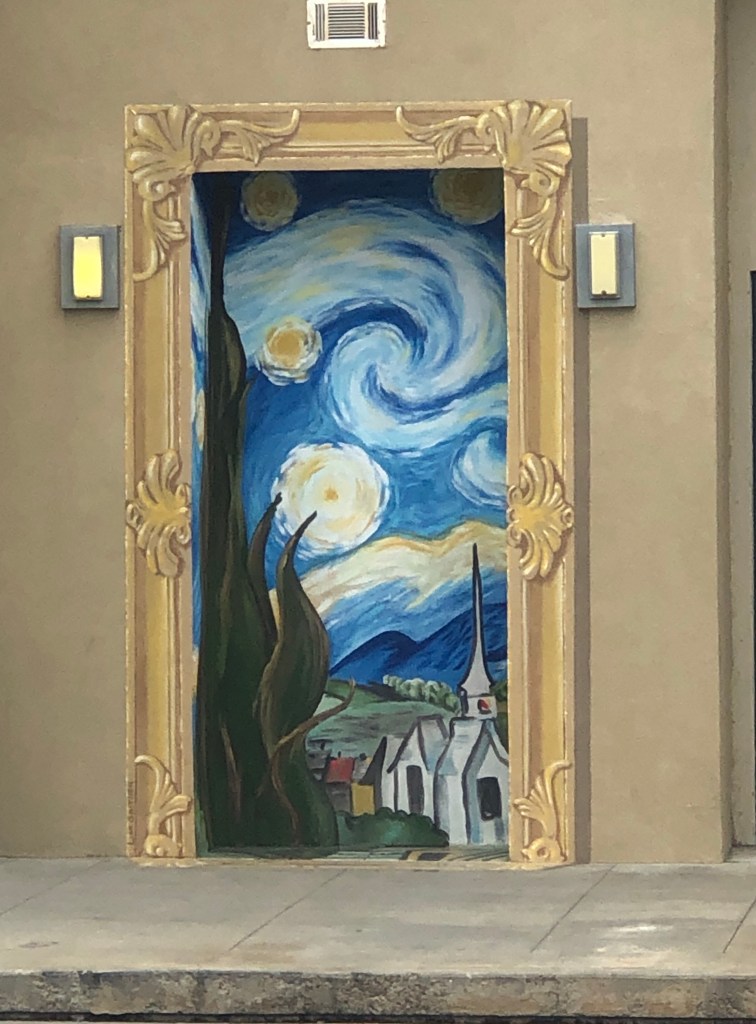
It started with the painting on the otherwise unremarkable side of a building in an uptown shopping mall last summer. An unexpected portal:

Got me thinking a lot about imagination, passages, transitions, transcendence, overcoming…and faith. See how prominent the church is. And maybe a touch of magic—who has not encountered mysterious doors leading from one world to another in fantasy novels?

The Starry Night beckoned, took me in, adopted me. It became a personal motif during the COVID pandemic. Consider these definitions of motif:

a usually recurring salient thematic element (as in the arts); especially : a dominant idea or central theme.  —Merriam-Webster

a symbolic image or idea that appears frequently in a story. —literaryterms.com

My version: A “salient” (noticeable, as in you can’t miss it) symbol that keeps recurring, that has significant meaning to a narrative. Which is, in this case, my life. For I began taking note of how often van Gogh’s famous painting appeared in my daily existence, and what it could mean. Perhaps it is those deep blues, or those stars, or the peaceful village, or the presence of the church, or all of the above, that impart a sense of calm, benevolence, and well-being to me in the time of crisis. Maybe much as the artist felt when he painted it.

I have The Starry Night on a mask. A sort of literal and figurative protection. I used its imagery in a poem I wrote about awe, the word that adopted me when I turned the pages of my planner from 2020 to 2021 and found it in a quote there on January 1st. Awe and well-being are also deeply linked. When I wrote the poem I was thinking of all those blues in the painting and how blue is the rarest color in nature. Like forgiveness. Hence my closing lines: “The color of forgiveness/in the blue hour.” Those lines were born of awe just after The Starry Night resurfaced yet again in a startling way; one day I will be able to explain, but the time is not yet ripe for that story. Let us leave it at love, for love and forgiveness do not exist apart from one another.

And so we come to February.

Where this quote appears in the pages of my planner:

He just keeps turning up everywhere I go.

I marvel at those words and their truth for an artist, a student, a teacher, a writer.

Furthermore, we learn life by doing it.

One more thing…

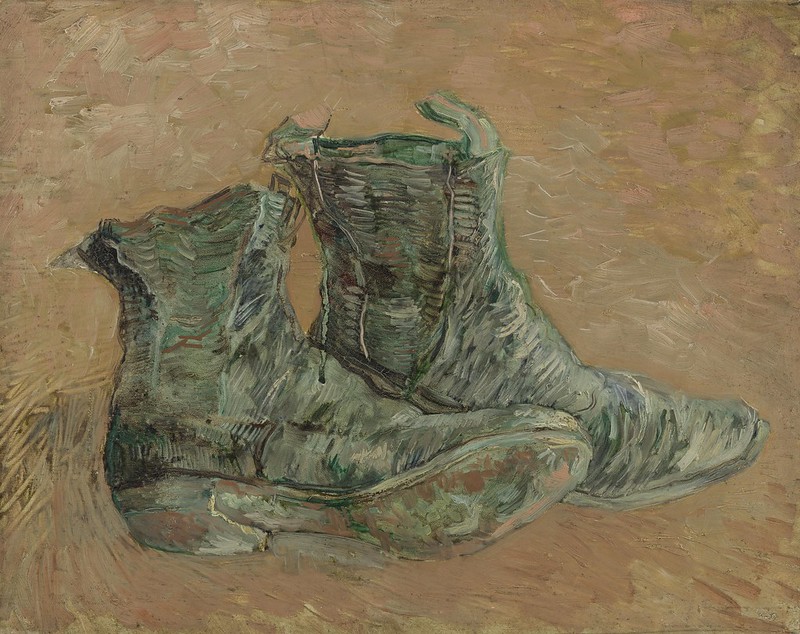
I recently stumbled across van Gogh’s paintings of shoes. I wasn’t aware that this was a favorite subject for him. The story is that he would buy old shoes from flea markets and wear them through mud until they were interesting enough to paint.

I have to wonder about the symbolism. Shoes are necessary protection in daily life. A motif with many meanings in many cultures. A fashion obsession and status symbol in some. Deep spiritual connotations in others; shoes are often mentioned in the Bible, especially removing them as an act of reverence and faith. I wonder if van Gogh thought while he painted about the places these shoes had been, the people who wore them, what their life-journeys were like. What stories the shoes might tell, maybe just metaphorically, humbly, in their layers of dust and mud from long, hard travels on this Earth.

Lots to ponder with van Gogh and his shoes.

As I travel through life in my own.

He really does keep turning up, everywhere I go.

My shoes.

I’ve found these to be the most comfortable since breaking my foot, a year ago today.
Lots more to explore there, on brokenness and healing
.

How perfect is it that they are Vans. Wherever I may Gogh.

*******

written for the Tuesday Slice of Life Story Challenge with Two Writing Teachers.
Our stories often remind us of where we’ve been, where we are going, and who we are.
Writing them leads to surprising discoveries.
Sometimes those within ourselves.
Sometimes awe, at what lies beyond.