A faint, feathery swishing against the bedroom windowpanes. A silvery glow at the blinds, beckoning. I crawl out from under the warm coversto peer through.
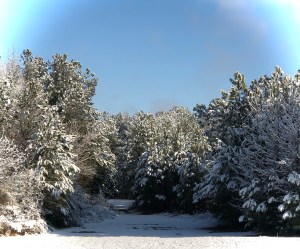
It’s a different world. Softer. Purer. At peace in its perfect winter-white blanket, illuminated by the full moon. Big flakes descend to the ethereal stirring of wind chimes.
I imagine animals curled in their cozy dark burrows.
In the spirit of affinity, I return to mine.
I waited well into the morning before texting my son: Is she so excited?
His daughter, age five, has been longing for snow. Some winters pass without it here in central North Carolina.
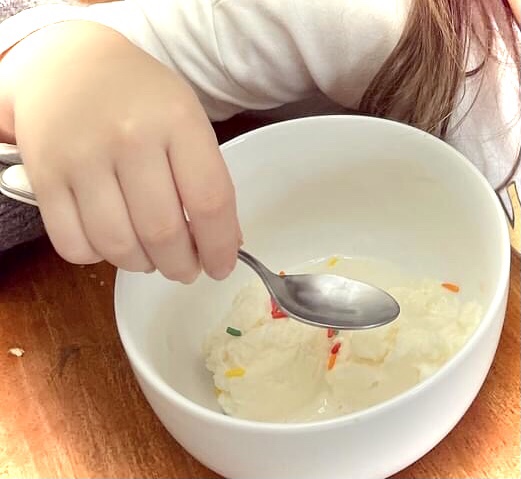
He texted right back: She’s so wound up. We have already been out to play. We made snow cream. Put sprinkles on it and ate it for breakfast.
How awesome is that, I thought. She will remember it all of her life, this snow, getting to eat it for breakfast.
Magical moments. They will be stored away, deep in the hallowed halls of her mind.
I was just rereading The Power of Moments: Why CertainExperiences Have Extraordinary Impact by Chip Heath and Dan Heath. They explore moments we remember and revere the most. Some are tied to great emotion or to shared meaningful experiences. Others transcend “the normal course of events; they are literally extraordinary.”
The authors write: “The most precious moments are often the ones that cost the least.” They relate the story of a three-year-old who succumbed to a severe E. coli infection. They describe (brace yourself) her kidney failure, horrible pain, portions of her colon being removed twice, her heart failure and resuscitation; she desperately needed a kidney transplant and a compatible donor could not be found. At Halloween, her costume had to be laid on top of her because of all the tubes. She was still in the hospital as Christmas neared, and it began to snow:
For a child from Vermont, it was cruel, having to watch the snow through the windows. Wendy loved to make snowmen, to go sleigh riding. She hadn’t been outside for two months. Her lead nurse, Cori Fogarty, and and patient care associate Jessica Marsh hatched a plan. If Wendy couldn’t play in the snow, they would bring the snow to her. But it was more complicated than that. Because of Wendy’s heart condition, the staff was monitoring every milliliter of water that she consumed. So Jessica went and filled an emesis bucket with snow, weighed it, let it melt, and poured it into a graduated cylinder. Now they knew how to translate the weight of snow into its volume of water. So they went and filled the bucket with exactly the right amount of snow so that if Wendy ate it all — as three-year-olds are prone to do —she’d be just fine.
Can you see them, bringing the bowl of snow into the hospital room? Can you see that little girl’s expression when she saw it? Jessica Marsh said: “I have never seen such joy and pure innocence on a child’s face.” Wendy’s mother: “It was bliss, it was joy.” Many years later she would write: “It’s easy to forget the monotony of the endless days that stretched together during her recovery. But that one moment of brightness, that is one moment we will never forget.”*
Perhaps that is just the image we need right now, as COVID-19 drags on. A bowl of snow for a child…a bit of magic to escape the moment, maybe to carry us through.
As parents, as teachers, as writers, compassionate human beings, we have this power within us to imagine such moments, to make them happen. The most precious moments are the ones that cost the least…
Just so happens that as I write these words on this new, dark morning, flurries have started falling again.
Let us go and seek our bowl of snow. And where we might share it.
Maybe even for breakfast, with sprinkles.
*******
*Wendy’s story is from the chapter “Making Moments Matter” in The Power of Moments by Chip Heath and Dan Heath (Simon & Schuster, New York, 2017, 263-265). You might like to know that she did receive a transplant and went on to be an athlete.
Thanks to all at Two Writing Teachers for the power of your shared stories. Where there’s writing, there’s a way.
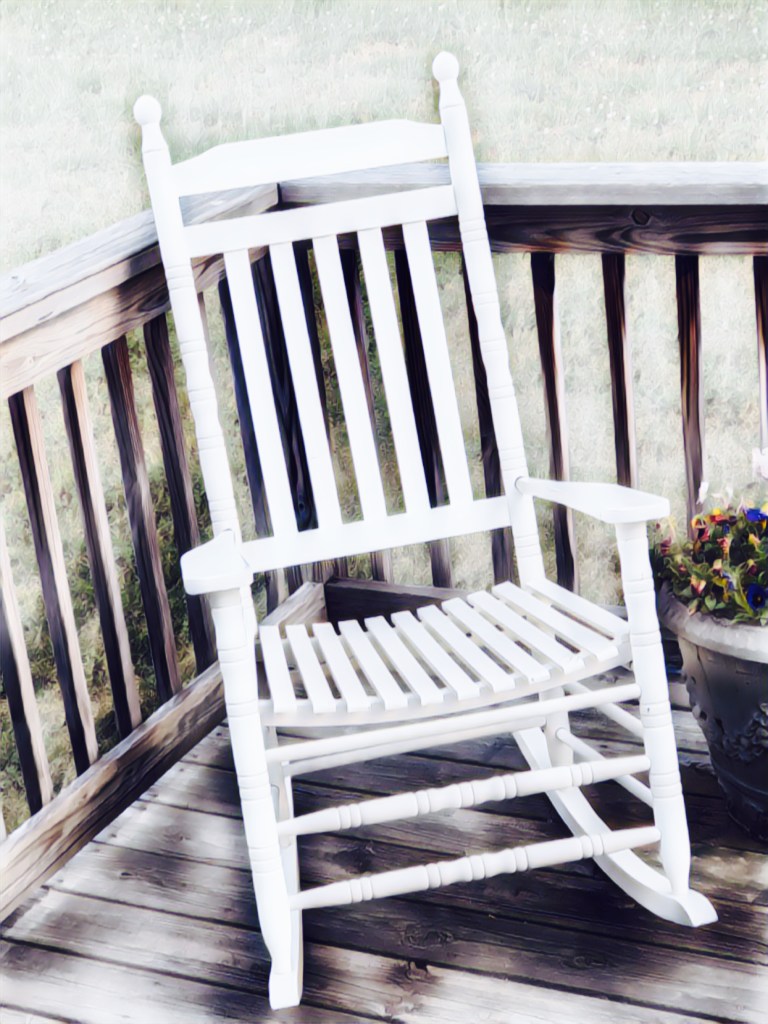
New day. Opening window blinds to a flood of sunlight. Glimpse of pines, grass grown tall overnight (how??), weathered wooden deck railing, old white rocking chair, large cement pots draped in long ivy vines, new tendrils waving, geraniums blazing green and red, interspersed with spiky brown starbursts—oh, time to deadhead.
Within moments, scissors in hand, reaching for exposed bones of skeletal blooms, crisping, decaying, red petals shriveled, let loose, bled away, spent…
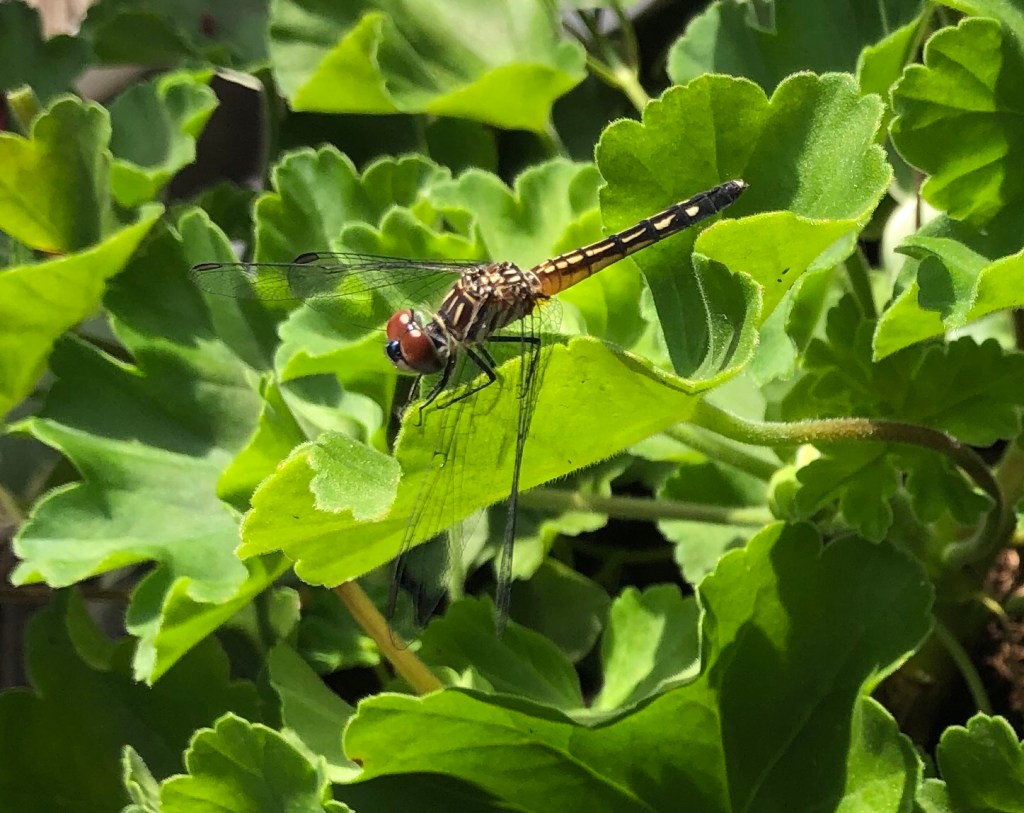
—Oh! Hello. Didn’t know you were here, Dragonfly.
Swapping the scissors for the phone-camera…
How close will you let me get?
—Surprisingly.
You’re small. Maybe two-and-a-half inches. Not like the first dragonflies I ever encountered in my grandmother’s yard when I was a child. Enormous things, terrifying… “They won’t hurt you! They eat mosquitoes”… good thing I didn’t know the old Scandinavian folktales then, how dragonflies come to weigh people’s souls, doling punishment on the bad, stitching children’s eyes closed for telling lies. Instead I learned to see the beautiful in the strange. Living sticks of metallic blue, iridescent gleams against the sunlit grass, darting any which way, impossibly. Air acrobats. —You’re very still. Not blue but yellow with bold black stripes. Clinging to a deadhead. Wonder why. Can’t cut the dying bloom away, not while you’re on it, Dragonfly. Won’t disturb you.
Returning later: You’re still present, resting on a green leaf.
Why should this feel so reassuring?
Maybe because the symbolism of a dragonfly is usually positive. You’re said to be bringers of light, restoring joy when it’s waning. Just as those bright geranium blooms are waning. Many new buds are already evident. Growth from within. The ability to change, transform, adapt—that is what we humans say about you dragonflies, as you begin life submerged in water (most of your lives being lived there) yet you eventually take to the air and learn to fly. By then the time remaining to you is short. Seems you make the most of it. Maybe you are harbingers of the soul. Not in judgment, but in self-realization, mental and emotional maturity, acceptance. A call to wisdom. A recurring word for me, of late.
Whatever motif lies written in iridescent ink on dragonfly wings, my grandmother knew it was good: You eat mosquitoes. You will not hurt me. You’re helpers. Protectors.
Sitting so still, amid decay juxtaposed with new growth… an inexplicable stab of delight, vibrant little messenger from nature, oblivious of your mission, perhaps, of nudging, not judging, human souls toward our own betterment … oh, and do you know? Could you know? In human lore… geraniums represent unexpected meetings.
Sunny May afternoon. Warm, lazy. Neighborhood moderately quiet but for the occasional baby-like cry of young goats from a pen hidden in a snatch of mixed-woods across the street. They sound like little kids … which is exactly what they ARE …
Absolutely nothing is happening.
I will check the mail.
Again.
Patches of thick, furry moss nestled in the wide brick steps of the porch. Clean fragrance of mulch from the empty beds along the house. Sudden coolness on rounding the corner, where the sun casts the shadow of the house across the sidewalk—
Snake.
Right in front of me, in my immediate path. If I hadn’t been looking down …
Two steps backward.
I am not a fan of snakes.
It’s little. The second of its kind I’ve seen. The first one appeared on this sidewalk months ago, belly-up, dead, when the old boxwoods were pulled out. I needed to know what kind of snake it was, so I researched it: Smooth earth snake. Lives in woodsy debris, usually underground (technical term: “fossorial”). Nonpoisonous. Very shy.
—This one isn’t moving at all. Is it dead, too?
—Do I really want to know?
I do.
Two steps forward, leaning over as far as I dare.
Almost imperceptibly, its sides rhythmically expand and contract.
It is breathing.
I have never seen a snake breathing.
But I don’t usually get close enough to determine such.
I wonder if it is scared of me.
I won’t harm it. This is a living thing, lying here on my sidewalk, breathing rather hard for a snake, I think.
It won’t harm me.
We’re just occupying the same shadow, breathing the same air.
I can see a dark lump through its translucent beige-gray skin, about halfway through its body. Is that part of the snake? Or something it ate?
Then …
I don’t expect anyone to believe this. I’m not completely sure that I do.
I hesitate to say. It sounds crazy.
But…
A little light flickers inside the snake.
Just for a second or two.
A fluid-like glimmering, mid-snake, very near that dark lump.
—Am I dreaming?
I stare, unblinking, not sure I trust my eyes or my brain. Have I ever even heard of such a thing?
And then, one more glimmering of light, faint, in the tail region.
I did see it.
Twice.
Is it just a reflective shimmer of sunlight?
But this snake lies wholly in the shadow of the house; the sun’s not shining on anything close by.
A reflection of something I am wearing, then?
But I am wearing no rings, no glittery flip flops. Only one fine, rose-gold chain on my right arm that I never remove (my son gave it to me), and it’s wholly in the shadow, too. Not catching the sunlight. Not casting it.
Furthermore, the glimmer came from inside the snake. It radiated only within the confines of its motionless body. Not on the sidewalk. Nowhere else.
—A trick of my eyes, then.
But my optometrist has never seen anything amiss with my eyes. Got a fabulous report at my last checkup in December: “No change in your vision. Everything looks great. See you next year!”
A migraine for me begins as a spot of light in my eyes; it grows until I can only see the outer edges of things.
But I don’t get migraines often, and am not getting one now.
Nor, to my knowledge, have I ever had a hallucination.
—I shall need proof, then. A picture.
My phone is in the house.
Stepping backward, I ease to the corner of the house, out of sight of the snake (well, at least until it’s out of my sight. Snakes don’t see well). I make a run for the porch steps, the front door, the bedroom where my phone is charging.
The snake has not moved by the time I return.
I wait for the longest time, phone poised, cued to video, but the glimmering doesn’t come again. I record a few seconds of the snake breathing. Zoomed, of course, from a comfortable distance.
Absolutely nothing is happening.
So I walk way around in the grass, giving the snake a wide berth. Short jaunt down the driveway to the mailbox, retrieving uninteresting, unimportant ephemera.
Back up the driveway to the sidewalk …
—The snake is gone.
Where?
—There in the mulch, just ahead of where it had been.
I try for several minutes more to capture some glowing, any glowing, on video, but the phenomenon is over. Whatever caused it has apparently conspired not to do so again, certainly not for one wishful human.
I do, however, get a bit of video of the snake’s tiny black tongue flickering — from a safe and comfortable distance.
I wonder if any neighbors have spotted me, if they’re wondering what in the heck I am doing, hunched over for so long here in my yard. But there’s nothing really stirring outside except those goats in their secluded pen, a meandering bee, birds in the distance, a random, rusty cock-a-doodle-doo from the rooster who lives up the street, as, in his mind, anything with ears to hear needs reminding he’s king of all times of day, not just the morning.
I have troubled this shy little snake enough. Time to let it be. Live and let live.
Trudging up the steps to my porch, wonder and hesitation stir my soul: I will write about this. I think. Or should I? How can one explain the inexplicable? How can one know what is really real? When “I saw it with my own eyes” isn’t exactly enough to drive away doubt? What about logic: Have earth snakes ever been known to glow? Is there a plausible scientific explanation? Bioluminescence is a real thing. In some eels, for example. Fireflies. Glow worms. Perhaps my snake ate one of these larvae—? Might that be the dark lump in its midsection? Perhaps some released phosphorescence traveled through its body, which is just transparent enough to reveal it. Or maybe this is a defense mechanism? A means of survival for a thing that usually lives underground? Did it ingest some compound in the soil that might give off a glow? Or did this snake simply, literally absorb some sunlight?
All I know is that I saw a light glimmering inside a rather translucent little earth snake. Twice. And that I am unaccustomed to seeing random light running along anything in shadows.
Not physically, anyway. Metaphorically I see light in the shadows all the time.
I sit rocking in my new porch chair. My thoughts sway back and forth, rolling over and over and over like paper in the wind … and I realize that my questioning awe is tinged, the tiniest bit, with something like sadness: I am not likely to ever see this again, let alone prove that I saw it. Some things are once-in-a-lifetime occurrences, one-shot-only golden glimpses, like the eagle I saw last spring, sitting huge and majestic by the side of the road. Not that I want to encounter another snake (any more, I am sure, than one wants to encounter me). No. Still not a fan. Not aiming to be a herpetologist. Although I could contact one and ask if earth snakes ever glow … what’s the risk, other than skepticism and dismissiveness?
I just want to know why. That is all. And am having to accept that I likely never will.
That glimmering … if nothing else, it means Aliveness. The little snake is alive. I am alive. For one moment, maybe, the life force acknowledged and honored itself …
For all I know, the snake saw the same glimmer in me.
More of it each day. Driving the darkness away with its gentle appearing, rousing bright-eyed birds earlier and earlier, which respond in uninhibited chirps, songs, chatter. New day new day new day day day …
It’s a beautiful time to be alive. To be reborn. To mark having been born.
“What do you want for your birthday?” asked my husband.
“New rocking chairs.”
I’d been thinking on it.
The old chairs on the front porch are cracked, broken, portions held in place with wood glue. Time for them to go. Time for new ones. I want to sit outside in the light, in the breeze, even though it remains oddly chilly, to hear the birds, to see Papa Finch alight on the roof. I hear him before I see him; I wonder what his loud twitter means but I always answer, “Hi Finch!” Then there he is, tiny brown creature with his chest faintly dusted red, sitting high above the garage against the cloudless blue sky, looking directly at me. The porch is part of his domain. Sometimes from inside the house I hear his loud chirp; looking through the window, I find him sitting on the white porch rail. I suspect he’s eyeing the front door wreath for his bride’s nest. Although I took the wreath down for the winter, I’d left the old nest from last year attached. With the coming of March, and with great care, I put the faded, bird-loved wreath back in hopes that the nest would be reused. It hasn’t. So I removed it to make way for new.
Like my rocking chairs.
When my granddaughter visits now, it’s only on the front steps for a while, until the coronavirus social distancing expires. She comes with eyes full of spring light, as blue as the sky above my finch, who never fails to join our gathering and to add his voice to the conversation.
“That’s a loud bird!” says my granddaughter, age four.
“He is. Look, there he is, on the roof. Hi, Finch!”
And in these bright little moments, I revel in the poetry of life, that this bird (I wonder if he was one of the previous hatchlings from my wreath? ) should be a mainstay. Especially as my granddaughter’s name is Scout. Yes, from To Kill a Mockingbird. Whose last name was … Finch.
I want sturdy chairs on the porch, for resting. As a place to quiet my mind with the greenness of the grass in the yard and over where the path leads round the pond through greener trees. He maketh me to lie down in green pastures: he leadeth me beside the still waters. He restoreth my soul … To share with my granddaughter as she grows, to have coffee with my husband who almost didn’t live to see another spring. To celebrate living, being, enduring. To converse with generations of finches who’ve chosen to make my home theirs. To know, as evening falls, and I must go in, that I savored the gifts of that day to their fullest, their deepest.
My husband bought the chairs.
“We’ll put the old ones on the back deck,” he told me.
I wanted to say Why, they’re held together with glue, they’ll last maybe three days out there with no shelter, let’s just throw them away. But I didn’t. He wants to keep them, for some reason …
Truth is, the old chairs look kind of nice on the back deck by the flowerpots. For ever how long they last out there.
It was the rocker nearest the kitchen that made me realize.
Thump thump. Thump thump.
Dennis the dachshund woke from his sleep in a patch of sun-stripes at the back door. Ears perked.
“What is that?” I asked him from my chair at the kitchen table, where I was typing on the laptop.
Rising, looking through the window.
The rocker, rocking all by itself.
Thump thump. Thump thump.
The other rocker opposite sat motionless.
The wind, I thought.
Second thought: Why this rocker and not the other?
Third thought: Is the wind — or something — IN that chair?
It reminded me that I’ve always wanted to write a collection of ghost stories. An incongruous thought on such a bright, gold-green day.
Then.
How have I missed it?
For all the weeks—months—of the wind’s extended gusting and moaning under the eaves, unlike I’ve ever heard it before, I failed to notice it had stopped. All through the COVID crisis it’s been a grieved entity, swirling around my house in desperation, haunting my spirit with its voice, agitating the tall pines.
It’s still here, as my rocking chair can attest. But subdued.
Perhaps the wind has decided to sit a spell and rest. Perhaps the rocker was an invitation.
I am not sure we are friendly, yet, the wind and I, but I will offer it hospitality as long as it’s a benevolent guest. Is it taking up residence here, like the finches?
Perhaps I will take my coffee out there one afternoon and ask—begging the wind’s pardon, of course—why it cried so long and so hard.
But as I have no wish to stir anything up, maybe I’ll just let the wind rock to its heart’s content, in peace.
When our second grade team had quarterly planning, one of the subs didn’t show and I was summoned to cover the class for a while. I knew there would be sub plans.
But I brought three books with me anyway.
I gave a quick book talk and let the class choose which one to hear. The high vote-getter was A Deal’s a Deal, the story of two little rabbits swindling each other while trading toy cars. There’s a (delightfully disgusting) surprise ending, which is why I brought this book; it never fails to elicit big belly laughs and loud cries of EEEWWWWWW!
I wanted, in my few moments with these kids, for them to experience the joy of reading. I love to watch children’s faces while I read aloud; it is my favorite thing to do, next to writing with them.
A read-aloud, done well, is a theatrical performance. The kids hung on every word, they could feel the action building, they covered their faces, they howled and hollered EEEWWWWWWW!
—Perfect.
Then they went to work on the activities left for them.
I walked the room, well-aware that teachers are trying their best to adhere to a new curriculum that offer less individual reading and writing choices. I watched the children at their tasks. I watched the clock … and decided to set my timer.
“All right, you have a few minutes left to finish this work before my time with you is up. Let’s get it done, and I will read you the book that got the second-highest vote.”
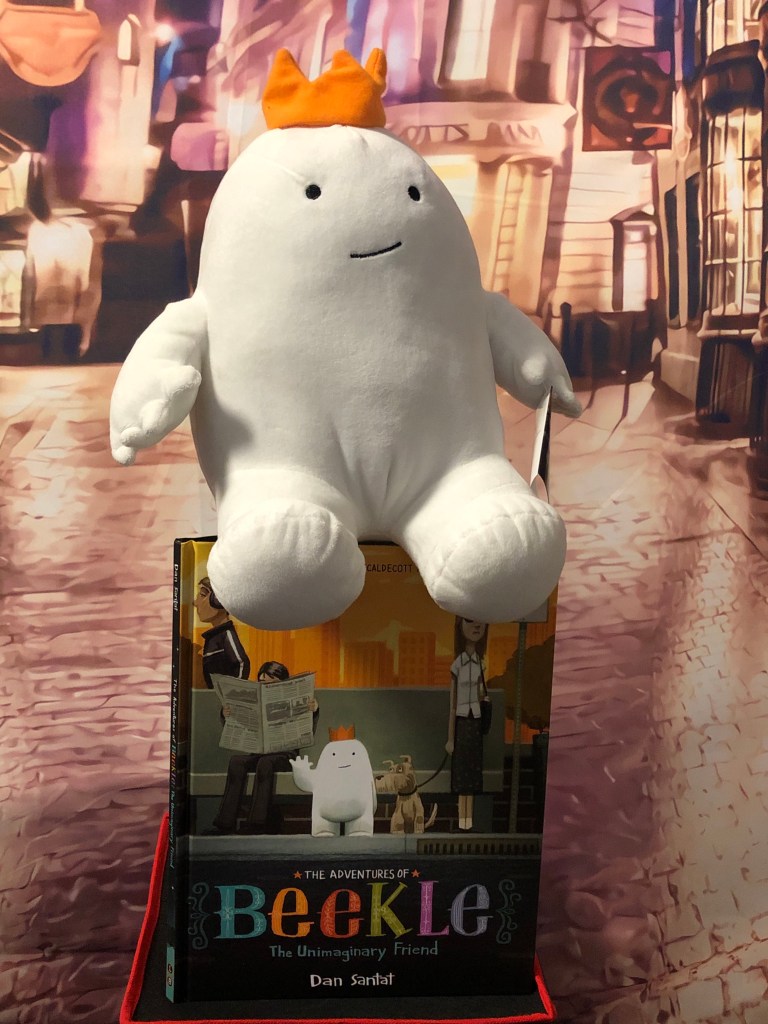
In short order, the work was done, desks cleared, random things on the floor picked up. They gathered at my feet to hear The Adventures of Beekle, the Unimaginary Friend.
I first encountered this book in a summer writing institute for teachers. Our guest author, Matt de la Peña, used it as an example of perspective, asking what’s the story really about, who’s it really about. There was a good bit of debate, as I recall …
But I didn’t set it up this way with the kids.
I just read, letting the words and the illustrations work their magic.
Turned a page, heard the collective Oooohhhh.
Saw light playing on their faces, wonder in their eyes.
I savored them as they savored this book on friendship and imagination.
Whispering in my mind: You were my first friend, too. My oldest and my dearest, even now.
All too soon we reached the end of the book, if not the end of Beekle’s and his friend’s adventures. And here’s the interesting thing: the kids knew who the story was really about, what it was really about, something I’d watched grown-ups—teachers—struggle with.
As I prepared to leave, the children gravitated to the stuffed Beekle who’d been sitting off to the side by himself. He usually sits on my bookcase in my room, an outlier amid all my Harry Potter memorabilia. At the last minute I’d grabbed him and brought him along.
Seems he was here by design, waiting for every child in turn to embrace him, in the way that only children can.
“Ah,” said the orthopedist, displaying the X-rays, “this is excellent progress.”
I breathed a little more freely.
I knew it was better. I’d walked on it a little at home—just a little—without the boot, without pain, even though I wasn’t supposed to.
What concerned me most was … well … I am growing older. All I did was fall off of three garage steps and the bone just snapped.
Are my bones becoming fragile?
“It’s a common break,” said the tech. “What’s not common is the completebreak. Usually it’s a fracture. Yours is a hurty one.”
“Yeah, it hurt plenty in the beginning,” I replied, “but not now. This progress means my bones are good and healthy, right?” Translation: I’m not decrepit, yet?
“They’re very good,” smiled the orthopedist. Who looks about fifteen.
He graduated me to an orthopedic shoe. But still no driving for four more weeks. State law says not while I require “medical equipment” on my gas foot.
<sigh>
But, I have good bones.
I examined them up on the screen. Marveled at how much the broken one had already knitted itself back together in just three weeks. Amazing how bones can even do that.
“That’s the best part of this particular field,” said the orthopedist. “Getting to watch people heal. Oh, and you can walk some in the house without the shoe. Movement stimulates bone growth.”
He looked at me knowingly.
I just smiled.
Walk to knit, knit to walk …
Rather meta of us, don’t you think, my little metatarsal.
Better is the end of a thing than its beginning, and the patient in spirit is better than the proud in spirit.
-Ecclesiastes 7:8
Last week didn’t start so well.
On Sunday, I broke a bone in my foot while simply walking (and falling, somehow) down the garage steps.
I’d already taken Monday off to attend my brother-in-law’s funeral but spent it on my couch instead with my newly-damaged foot elevated, commiserating with my husband, whose leg has developed a discolored, painful bulge—the leg from which veins were removed for his bypass surgery last fall. It’s not a clot, and that’s all we know until his appointment this week.
“I never would have believed that I wouldn’t be able to attend my own brother’s service,” he sighed. It’s a seven-hour round trip; neither of us was up to it.
I surveyed our legs, propped on the same stool. His left, my right. Mirror-images of each other. Except for my orthopedic boot.
I sighed, too, the entire left side of my body sore from overcompensating for the right. “I know. This is like being eighty years old or something.” Which is decades away…
Our college-student son, passing through the living room, quipped in his deadpan way: “Well, at least you’ll know what to expect when you are eighty.”
So. That was Monday.
On Tuesday I returned to work. It happened to be the 100th day of school, meaning that most kindergarten and first grade students (and many of their teachers) came dressed as old people. White hair, glasses, wrinkles sketched with eyeliner, canes galore.
For a split second, I mused: Who wants to live to be a hundred?
But the kids were adorable, their teachers were having fun, and God knows we all need to have more fun at school. Too much of it isn’t.
That is where my mind was when a little “old” person wandered up to me in the lobby where I rested on a bench between the arrival of buses, my morning duty.
A kindergartner. Big, mournful eyes moving from my boot to my face: “Are you all right?”
“Oh yes! I am fine,” I said, touched by the obvious concern in that small voice.
“What happened to your foot?
“Well, I broke a bone in it.”
“Does it hurt?”
“No, really, it doesn’t. The boot is a cushion for it, see, and it doesn’t hurt at all right now.”
A flicker of relief across the little, made-up old face. The tiny pseudo-centenarian went on her way.
That was Tuesday.
And Wednesday, and Thursday, and Friday. Everywhere I went, the kids wanted to know: What did you do to your foot?
I shared the X-ray with some of them, saw the fascination in their eyes.
Some didn’t ask anything. They came up to me just to say I hope you will be okay. I hope you feel better.
As I labored up and down the staircases, one careful step at a time—the elevator at school is BROKEN—I thought a lot about the curiosity and compassion of children, how natural these things are for them, how comfortable children are with asking and expressing. If we can preserve, nurture, stir curiosity and compassion through all of their formative years … what a different culture, what a different world, it would be. Possibly our greatest work.
The week ended much better than how it began. Not because of satisfying still more curiosity about my broken foot with ongoing questions, or the taste of true human compassion at its purest. Not because I made it through the first week of recovery, although that was a glad milestone. No. Friday was a day of festivities, of celebration, all shining from the children’s faces.
“Happy Valentime’s Day, Mrs. Haley!” called the little ones when they passed me in line in the hallways, inviting me to their classrooms to share their candy, their cupcakes, their joy.
Valentimes. The mispronunciation seems almost poetic. As in, these times are made for Valentines. Definitely for love.
Oh my, thank you, I’ll come see your goodies but you keep them; they were given to you.
You yourselves are gifts enough to me, children.
You as well as puppy therapy. ❤️
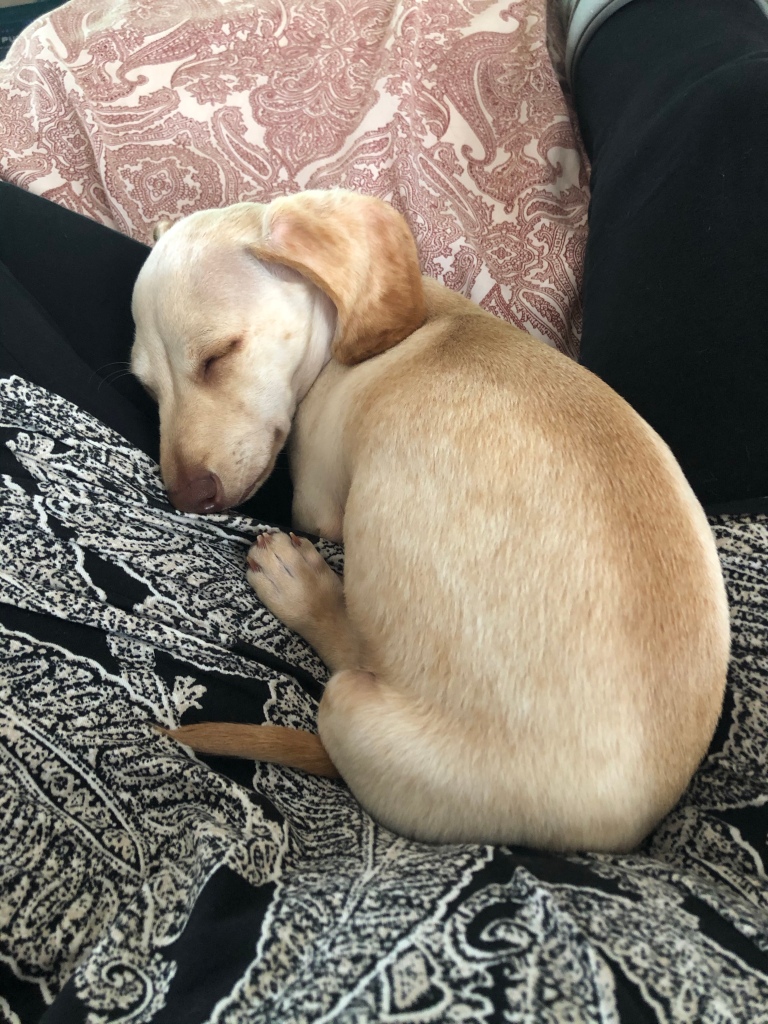
Dennis the dachshund takes turns between my lap and my husband’s while we propour legs.
Midway through lunch, the din in the cafeteria is too much. The new boy brings his tray to where I’m standing:
“Can I sit here at this table?”
It’s an empty table, save for my phone, closed laptop, electronic entry key, all the things I carried with me because I didn’t have time to put them in my room before this daily duty.
I consider his brown eyes, looking up at me. Pleading.
I consider his boisterous classmates and the seat he left behind.
“Are you moving yourself here because you feel it’s a safer place for you to be right now?” I ask.
He nods.
“All right. That seems like a good choice.”
His face breaks into a grin. He sits.
And the questions start: What kind of phone is that? Do you have a dog? Do you like Doritos? What kind do you like best? What’s your favorite color? Where are you from?How old are you, twenty-nine? Forty? Older?
—How old are YOU? Eight? Did you move over just here to ask me all these questions?
He just smiles and takes a swig of his strawberry milk.
Then:
“Mrs. Haley, what’s your favorite snake?”
“What? My favorite SNAKE, did you say? Yikes—I don’t …”
Of course I am about to say I don’t like any snake whatsoever, but something in his expression stops me. “Um, do you like snakes?”
He nods. “I like pythons.”
Heavens. I refrain from telling him about a man I saw on the news this week. He happened to find a boa constrictor in his couch and had no idea how it got there or from whence it came.
—He’s watching my face. A keen observer, this child. He’s waiting for my response.
I could say I like green snakes, but I don’t. I could say I like black snakes because my granddaddy said they eat rats and mice, so don’t ever kill a black snake. I think about the copperheads Granddaddy killed on the dirt road where his barefoot grandchildren ran in the summertime. I think about the coiled baby water moccasin I found in front of the kitchen cabinets when my first son was just three, and I how I was about to pick it up, thinking it was an odd piece of rope . . . until I almost touched it. And saw its eyes. Or that time I was cleaning the attic and discovered a complete shed snakeskin; I nearly knocked a whole new exit in my ceiling, trying to scramble out of there . . .
I DO NOT LIKE SNAKES.
But this boy with the strawberry mustache is waiting. His eyes are shining.
And then I recall a little creature lying across my sidewalk a couple of weeks ago. So little that I thought it to be a large worm at first; it was the same pale tan. I noted a faint pattern of scales on it. Could it be a snake? I looked it up. It was. “Smooth earth snake.” They are shy; they live mostly in the dirt around trees and bushes. I’d just had all the old bushes around my house pulled up. Apparently this little fossorial serpent was disturbed, or even damaged, as the equipment pulled away deep, tangled roots. For whatever reason, it crawled out in the open only to die there on the sidewalk. Who knows, maybe it was just trying to get to safety.
—Poor little snake. The only one I’ve ever mourned.
I look at the boy. He’s new here. He’s been uprooted.
Perhaps he did come to this table for safety, after all.
Even as I begin to speak, I think of earth and geosmin, the organic element in soil that humans can smell to something like the trillionth degree (we can detect one tablespoon in three Olympic-size swimming pools) and why that should be, unless it’s because we were meant to live close to the earth, that we came from the earth, and to the earth we will return. A curious kinship with that little snake. With all living things.
“My favorite snake is the earth snake. It’s very small. Have you heard of it?”
He wants to see a picture, so I do a search on my phone just as it’s time for classes to clean up and go outside for recess. To run, to play, to breathe the fresh air, to enjoy being children . . . how well I remember.
It was not a thing I expected to see while on a Chick-Fil-A lunch run.
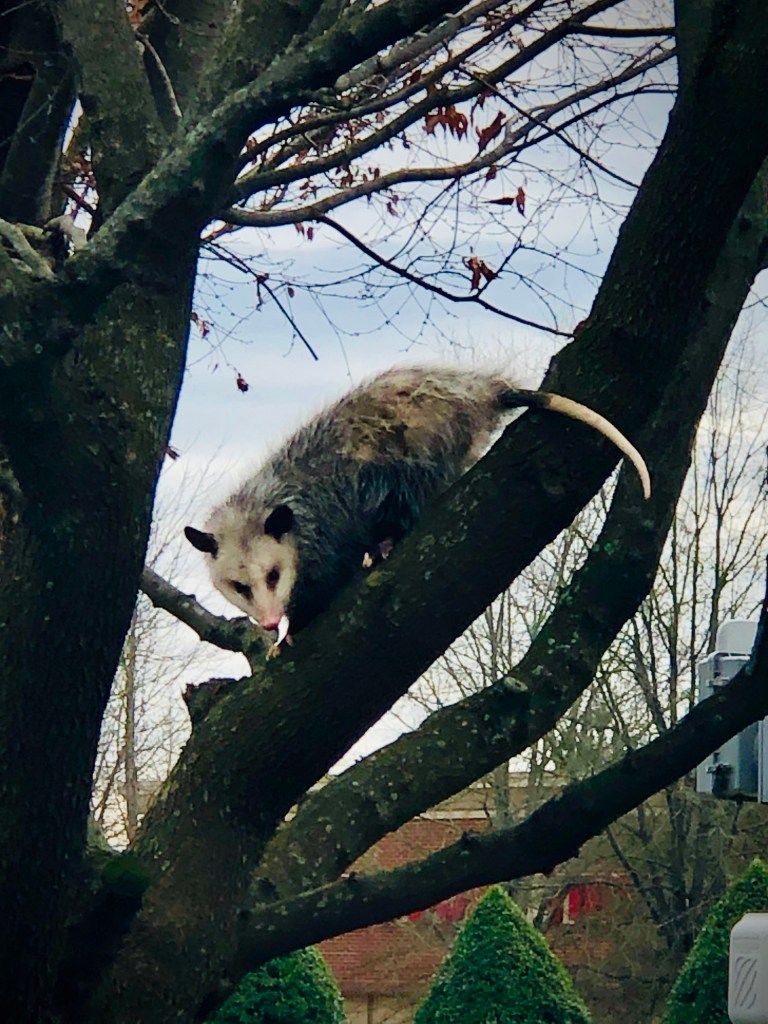
But there it was, directly opposite the drive-through menu board for ordering: A possum in a tree.
First thoughts: What’s wrong with it? Why would a possum be out and about during the day?
Next thoughts: Where did it come from? Why is it here? Has the smell of food lured it? Did it somehow manage to cross the busy street? Or (I shuddered): Will it TRY to cross the busy street?What will become of it?
Then: I need a picture. I’ll have to write about this.
And so I left the drive-through with the possum’s image preserved in my phone. Before I pulled into traffic, I looked back at the tree one last time. The animal wasn’t there any more.
It’s hard, for a storyteller, to not know fate or destiny.
I wondered many things as I drove away: Will restaurant workers or patrons call Animal Control? What does Animal Control do in a case like this? Will some random person decide to shoot it, deciding it poses a safety hazard, or just for the sake of shooting it? I am not a big fan of opossums but I didn’t want harm to come to it. Maybe it was old, weak, confused, like a person wandering in a nursing home. Maybe it was a female with babies hidden in her pouch. One Sunday morning when I was coming home from church a possum darted in front of my car. “Dart” isn’t really accurate; it hobbled as fast as it could. A mother laden with knobbly pink and gray babies on her back. Four little faces with eyes looking right at me. I slowed; they skittered across the road to safety.
That time, anyway.
And so I remembered them as I drove farther from my drive-through possum, contemplating the whole gamut of what might happen to it. Then, thankfully, my fanciful side kicked in: It knew where the speaker was. Maybe the possum comes on a daily basis to place an order: “Twenty-piece nuggets, please. Don’t forget my ketchup.” With those little pink hands, it could probably peel the ketchup foil back for dipping. Maybe the famous renegade cows are initiating this possum for the next round of their advertising campaign to ‘Eat Mor Chikin‘. . .
Oh, I thought, children would really like that story! I wonder what THEY would write . . . ?
There was a time when I’d take the photo and my story right into classrooms, across grade levels, as a model for any kind of writing. Small moment narratives, opinion, informational (for I ended up researching why an opossum would be so visible during the day and guess what? It’s not out of the ordinary at all. I further learned that opossums have a natural resistance to rabies and snake venom. Imagine people shooting it out of the tree because they don’t know). As an intro I might ask students if they know that the opossum is the only marsupial native to the Americas and link it to the koalas and kangaroos in Australia; we might consider relief efforts and life preservation, for all life is connected.
I’d even use my possum for teaching poetry writing. My mind is playing, this very minute, with opposite and opossum and tree and see, with an atmosphere of fear, wishing for a safe place. . . and of course there’s the fabulous fun of writing fantasy. Perhaps this possum took Chik-Fil-A home to its family where the bigger possum kids are playing video games (it always appears in some students’ writing). Maybe the possum babies got their nuggets “to go,” eating them in their mother’s pouch, with the littlest one crying that it didn’t get a toy . . .
The possibilities—or, in this case, “possumbilities”—are endless.
Or were endless, in the days when we did those kinds of writing, in that way, before the advent of programs that “incorporate” writing via a series of formulaic steps with whole classes writing on the same thing for the same amount of prescribed time. When authentic process was valued above uniform product and the end results were all different, because students—humans—are all different. In the days when students asked questions they generated themselves, because they really wanted to know the answers, because the answers mattered to them. When mining their own experiences for meaning lit up their faces and exploring their own ideas illuminated their minds. When the most priceless gift of childhood, imagination, wasn’t constrained and when teachers were not conscripted to teaching writing this way (with some believing that it’s better because it’s “easier”).
—Not me.
I saw a possum in a tree.
And I wondered, knowing I’d write about it, to find out why I needed to write about it.
It’s not about knowing fate or destiny.
It’s all about seeing possibilities, great and small, without and within, following a thread of thinking, of feeling, of life, to see where it takes you.
In other words, not blindly driving through and missing possumbilities.





 lit bits and pieces