Not another hand turkey

Last week ended with a professional development session. One of those “compliance” types for which it’s hard to muster enthusiasm. I’ve led professional development under some tough circumstances—like, for an entire staff on the last day before winter break, when snowflakes began billowing on the other side of the window—so I know how hard it can be. I attempt to make whatever PD I do as inspirational and practical as I can for teachers (in the case of the snowfall, it was “Bye! Vacation starts now!”).

But this time, I was an attendee. The whole week had been out of whack between the holiday on Monday and my battling a minor illness. I was happy to see the end arrive despite some trepidation about this PD session.

Especially when we participants were asked to draw hand turkeys.

For real? I sighed. Is this in any way productive? 

I couldn’t recall the last time I did this. In my early elementary years, surely.  I tried to remember helping my own children trace their little hands in autumns past.

But I complied. I penciled the outline of my hand onto white paper.

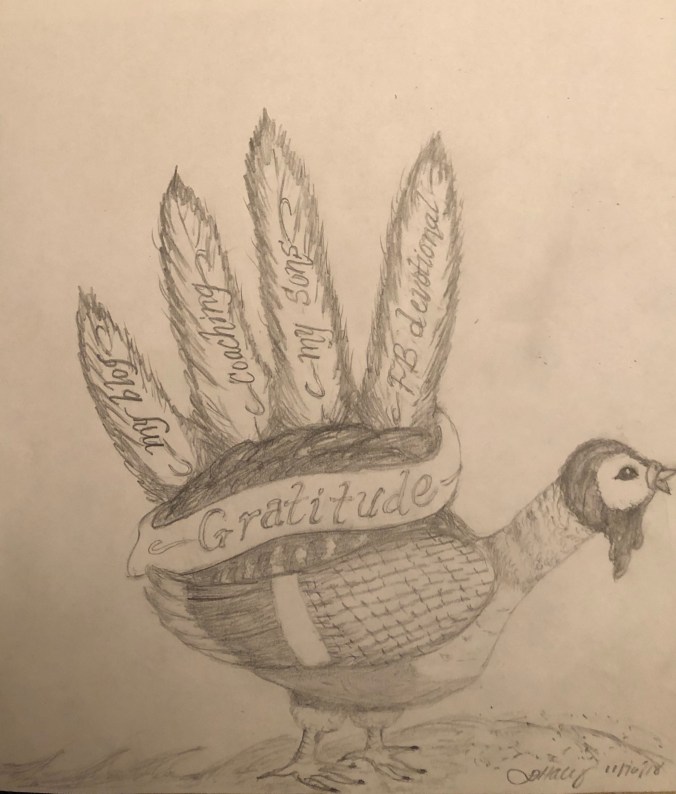
We attendees were then told to write “something we’re proud of” on each of the four so-called tail feathers. These things could be personal, professional, or both.

Well, this was kinda different. The four things came to me pretty quickly:

My blog. It was born as a way of making myself write regularly, evidence of “walking the walk” as a teacher-writer. I can’t stand before colleagues and profess my love of writing or testify to its impact if I’m not doing it on a regular basis. That’s how the blog started; it soon became a keeping-place of memories and reflections, a patchwork quilt of my life now and long ago. Not to mention that it threw the doors wide open for meeting other teacher-writer and reader friends who’ve enriched my days immeasurably. That I’ve sustained it for nearly three years feels like a true achievement.

Coaching. My daily work. I collaborate with K-5 teachers on English Language Arts instruction.There’s a different ebb and flow to it each year.  The work can be like riding a train and watching the landscape zip by at an alarming rate. It’s sometimes like trying to irrigate monotonous, barren deserts. There’s a lot of new expectations of my teaching colleagues this year, new curriculum, newly-tweaked standards (again). With new and greater demands on top of all the old ones, it’s easy for a teacher to feel constrained, paralyzed. Every time I can help simplify, problem-solve, or streamline the work of classroom teachers, I feel like the “flow” gets better for them and for their students. We ALL grow.

My sons. I am so proud of who they are and where they are in life. Both of them are working on seminary degrees, one in music, the other in graduate divinity studies. One knew his path from early childhood, the other took the long way round, but both have chosen paths of service. On this note, my heart becomes too full for words. . . .

The Facebook devotional.  I don’t have a Facebook account (preferring Twitter) but my husband does. He’s had it for years and has never written a post. Last week, out of the blue, he said: “I need your help.” He’s a pastor. For three decades now he’s tirelessly served churches and communities. He’s married people, buried them, held their hands during their darkest times, laughed and rejoiced with them in the better ones. And ministry is changing; social media is a way to reach out . . . so, enter me.  Would I help him craft a short devotional post each day? It’s a small thing, really, but if the words help someone, or give them hope . . . then to me it’s a way of giving back. See, November marks three years since my husband was diagnosed with ocular melanoma. He lost his eye, but he’s alive. He’s here. Cancer-free. Every day is a celebration. There’s always, always, always something to be thankful for . . . yes, I’ll help him share it each day.

I suppose the professional development presenters may have wondered why I kept working on my hand turkey throughout the entire session. They may have thought I’d tuned them out. I hadn’t. I was listening. What they had to say was actually quite helpful. I processed it all as I added more and more detail to my turkey—let’s hope the facilitators thought I was sketchnoting. One thing just kept leading to another until I realized that the words on the tail feathers represented more than things I was simply proud of. This is the work of my hands, I mused, as I wrote and drew with one hand inside the outline of the other. Each thing I’ve listed is an opportunity, a piece of life’s work given to me.

—Gifts. 

Pride wasn’t the appropriate sentiment. Not even close.

I draped my turkey in a banner bearing the word “Gratitude.”

Isn’t that where the personal and professional roads should converge, anyway? Or the point of origin from which they radiate?

It is for me.

It is from this crossroads of gratitude that I wish you professional and personal joy, in all the work of your hands.

Happy Thanksgiving.
Metaphor

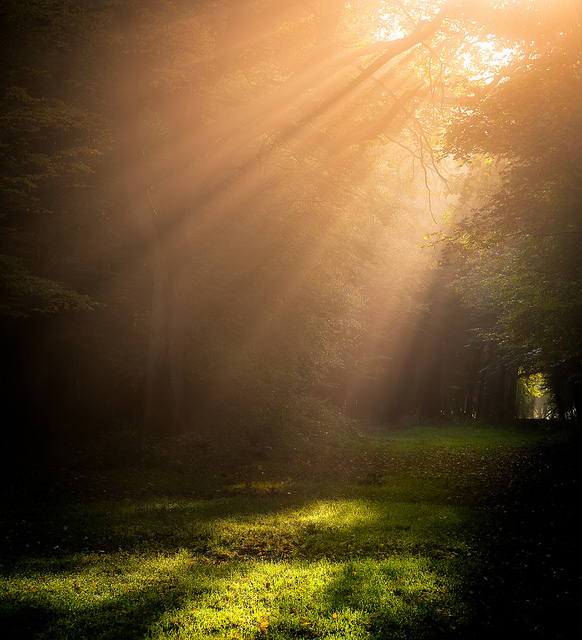
For metaphorMorning glory. Jason BolderoCC BY

Following a poetry unit in fourth grade, the teacher invited me to collaborate on arts-integrated assessments. We set it up by having students choose 1) Poetry concepts they learned and 2) The vehicle for conveying their understanding, one of the multiple intelligences: arts smart, math smart, music smart, body smart, self smart, people smart, word smart, science/nature smart, and one extra that we added, tech smart.

Students could collaborate if they’d selected the same “smart.” They were free to think and design as long as the activity or product defined or represented the selected elements of poetry – imagery, personification, alliteration, simile, etc. Some students chose to make games and puzzles (math smart) with their poetry concepts. Some went straight for Chromebooks. Some preferred sketching and drawing (later in this process one student who struggles with academics will show me how she intentionally incorporated perspective and 3D elements in her art smart visual representation of imagery). A team of body smart students began choreographing a dance to define three concepts. One student wanted to write a song. 

So much excitement, so much brilliance, yet no one picked “metaphor”— the word sat all alone on the chart where students placed their names beside the poetry elements that they wanted to demonstrate.

And no one chose “word smart” as the mode. They had, however, written their own poems during the unit.

I pointed out that word smart is naturally interwoven with music smart in writing a song, and with body smart in the chants accompanying the dance. Words play their part in slideshows, in the puzzles and games, and in all the conversation the kids were having about how to best represent the concepts in these ways.  

As for metaphor . . . the students grinned. With lots of teeth. “You said you’d give us a model.”

Ah. So I did. Is that why no one picked “metaphor” and “word smart”? Was this a conspiracy?  A throwing down the gauntlet?

I smiled inside myself. I would have chosen metaphor anyway (I think). And what better “word smart” way to convey its meaning than through poetry?

When I returned, rough draft poem in hand, I posed a question: “First, I need to make sure you know for yourselves what metaphor is. How would you define it?”

Their responses:

“An image that stands for something else.”

It helps paint a picture in the reader’s mind.”

You can’t say ‘like’ or ‘as’ because that’s simile. You have to say something IS something else.”

A comparison.”

Wordplay.”

Really, guys? And none of you picked metaphor? Seriously?” I asked in mock exasperation.

Giggles. They sit gathered round my chair, on the rug at my feet, these young sages waiting for me to read.

What is metaphor?

Metaphor is the sun behind the clouds

the heavens reaching long, shining fingers

down to the earth of our minds.

Metaphor is the moon on the ocean of knowledge

bits of silver smiles shining on a dark surface

that’s always moving, moving, moving.

When I say that home is the velvety warmth of my dog

and the laughter of my family around the dinner table

that’s metaphor.

What is metaphor for?

Well, meta means beyond.

Metaphor is understanding

in a deeper way.

Without metaphor

imagery is a just a strange skeleton

without flesh and color

something we don’t recognize.

Metaphor is what we know

helping us to see better.

Metaphor is new glasses.

Metaphor is the cloak

thrown over the invisible

to make it appear

and have shape

and make sense.

Without metaphor

poetry would shrivel

and maybe die.

Metaphor waters the poet-tree

and keeps it alive.

That’s meta.

That’s what it’s for.

Metaphor.

In one motion their hands went up to flutter or “sparkle” in silent applause; I had a fleeting sense of being in a beatnik coffee house, minus the sound of finger snaps. Of course these artists, mathematicians, scientists, all, will be chomping to give me specific feedback with the rubric that I helped them create. They’ll do it thoroughly and gleefully, rest assured.

Such a jewel-encrusted, double-edged sword, teaching.

Why I Write 2018

Fossil - Aurora

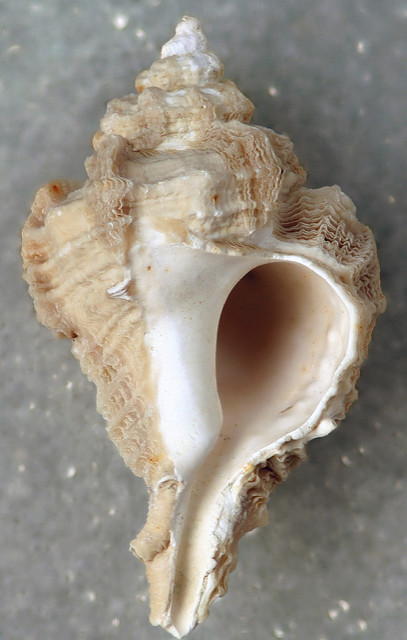
Pterorhytis conradi fossil murex snail shell, Croatan Formation, Lower Pleistocene. James St. JohnCC BY

It has been said that we are the sum total of our experiences (B.J. Neblett).

Our experiences are our story. Who we are. And why.

We are, therefore, our stories.

I write to tell mine.

I write because stories lie buried within me. I write to dig them out, to examine them, to find their value.

I write because ideas continually deposit themselves on top of one another like fine sediment in my mind. I am always sifting, sifting, finding the bits with meaning, determining how these random pieces connect to one another, for they surely and always do.

I write because my words will remain when I do not, imprints of my time on Earth. In the summers of my childhood, I walked little country roads covered with rejects from a local phosphate mine, gravel of shell and coral skeleton from epochs as old as Time itself. As my shoes crunched over this gravel I sometimes discovered primeval treasures—sharks’ teeth, whale ear bones, vertebrae—remnants of life gone before, lying there in my own shadow.

I write because I also walk upon all the books, all the words I’ve read in my lifetime. Within these layers upon layers of ever-deepening strata, too, lie treasures: phrases, emotions, images—again, remnants of life gone before, stowed away in the depths of my mind like the fossil bits in my childhood pockets. I carry with me always the impressions of other writers, the echo of their voices.

I write because I hear the echo of shoes scurrying in hallways, young voices calling my name: When I stop and turn, the children are there, eyes bright, faces glowing, asking a breathless question: “When are you coming to write with us again?”

I write to help them find their own treasures within, because their voices, their experiences, their stories matter; their existence matters, and they need to know it.

I write to preserve. To leave a record of those I’ve loved who’ve gone before, to celebrate those living and loving now. To share little fragments of hope, of peace, of pressing on, of rising above. My stories are my fossils, with or without value to the few who find them. No matter. They have immense value to me while I live them. They are my writing identity. My human identity.

I write because humans think and remember in story, because humanity is defined and connected by story. The sum total of our shared experience.

I am a storyteller.

And so I write.

*******

Another writing celebration: This is my 200th post published on Lit Bits and Pieces.


Tell your stories

Tell your story

You Can Tell Your Story. Cate StorymoonCC BY

“As a teacher now I make a point of sharing my personal stories as a way of connecting and building relationships with my students … My hope is that my students can feel their classroom is a safe space for sharing their unique background stories and experiences.”

 —Julian Rolden in I Wish My Teacher Knew by Kyle Schwartz

The staff at my school is participating in a study of the book I Wish My Teacher Knew: How One Question Can Change Everything for Our Kids. At the first meeting, we were asked to share a quote that resonated with us.

Several lines struck me, but the ones that went deepest were of a teacher making a point to share his personal stories with his class.

I thought of how teachers create the atmosphere in their rooms; where personal stories are valued, individuals are valued. Story is where humanity meets. Where we see, understand, and feel for each other. Story is where identity and belonging begin.

I thought about teaching writing, primary grades to adults. In the end all writing is about life, about having lived, about recording images, observations, emotions. To share with others is to make an impact. As I share snippets of my life in the modeling process, it spawns questions and conversations but most of all an electric synergy in the air, as writers of all ages come to realize the power of their own stories.

Last night I was invited by a dear colleague to share some of my writing with students during their family literacy event. I brought a stack of stories written over the past few years in front of classes. After a brief description I let the students choose between memoir, realistic fiction, and fantasy for me to read aloud. I explained that while memoir is a real experience, writers also weave pieces of their real lives into fiction.

And so I read my work to the students, who opted for fantasy and fiction. I was a stranger to them in the beginning, but somewhere in the sound of my own voice reading my own words, in the sudden stillness of the young bodies seated around the foot of my chair, something changed. It wasn’t visible or tangible, but it was there. Born of curiosity, interest, empathy, rapport. I was a stranger no more after the readings when the questions came, as students wanted to know more about the characters and was I going to keep writing about them and what pieces of these stories were the ones I’d really lived.

The time grew short; I answered the questions, all the while thinking how I’d freeze these moments if I could so that I could go on watching their faces as they absorbed the words. I’d stay there always, encouraging writers to find and tell their own stories. Many lingered at the end and I knew it was, it is, it always is, the power of story, that kept them wanting more, that stirred their own thoughts, feelings, ideas, images that they, too, need to share.

I packed my bag, walked into the throng of strangers at an unfamiliar school, and didn’t feel alone.

Making space

Anyone who’s ever worked in kindergarten or first grade knows that emergent writers often write strings of letters.

For example:   The flowers grow.

Sometimes the strings of letters are much longer and harder to decipher. A next teaching point would be working on the concept of words.

Enter Mr. Finger Space.

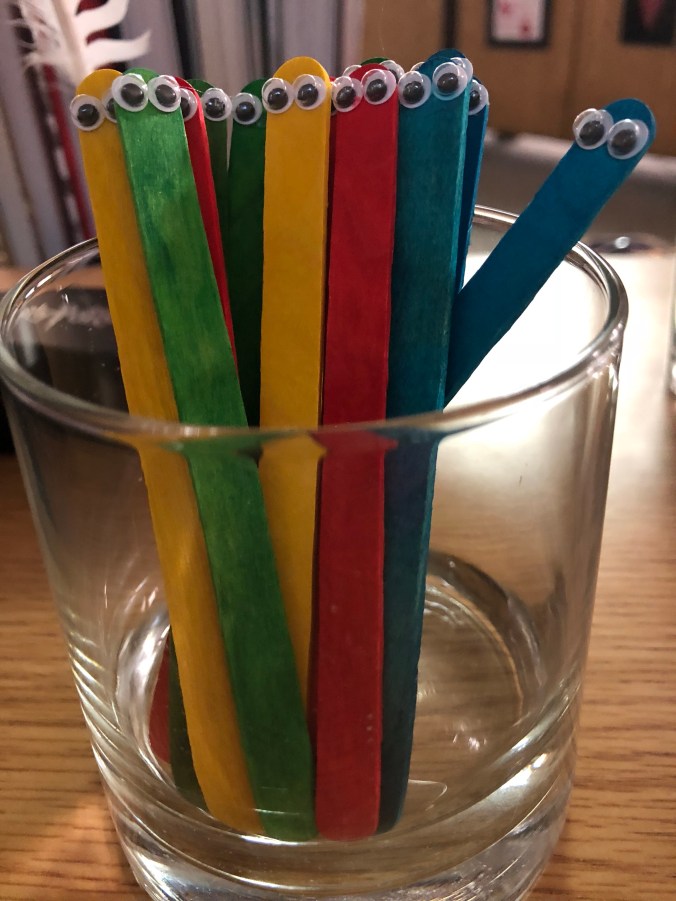
He’s a handy little tool for young writers, to facilitate their thinking about each word they’re trying to write and to begin making spaces between them.

I have, as you can see from the leading photo, a colorful collection of googly-eyed Mr. Finger Spaces ready to get to work.

Today as I passed by the jar, this gathering of Spaces seemed so beguiling that I thought: There’s a blog post in this. Somehow. 

I snapped a photo and went on my way.

I knew the accompanying story would come. That’s how it always works. A spark of inspiration, given time to grow . . .

This time it came pretty quickly.

As usual, it didn’t arrive as the expected story. Not about a little writer employing a cheery craft stick—I mean, a Mr. Finger Space!— to compose a sentence of separate words for the first time.

No.

It came after a conversation with a colleague about her wonderful weekend getaway, reconnecting with old friends, reliving priceless experiences:

There’s so much I’d forgotten, that I haven’t thought about in so long . . . it was incredibly meaningful to have those memories come rushing back. How important they were, those times we shared. I loved every minute of remembering and at the same time was saddened by how much I’ve lost because day-to-day responsibilities take all my focus . . . you know there’s not room to carry it all around in your head all the time . . . .

You need to write about them now, I told my colleague. My friend. Those memories, while they’re freshly stirred. Preserve them before they leave you again. Spend time going back in your mind, immersing, and you’ll be surprised at what you can recall.

I know this to be true from my own experience, over and over again.

A sigh. The longing was etched on her face: Just how to find the time . . . 

That’s when the googly eyes of Mr. Finger Space appeared in my mind; I immediately understood the message.

Moments of love and laughter, priceless gifts, slipping away under the weight of just living. Fragile strings of memory running together until the beautiful meaning is nearly obscured . . . .

The only way to stave off such loss is to push this often senseless, insensitive, jumbled-up world back, if only for a few precious minutes, in the midst of every run-on day. To breathe. To plunge deep into the recesses of your mind, to know yourself, who you are, and what really matters. Feel the stories pulsing through your being. Fight for them, to keep them alive.

Find the words. They’re all there, within you. They just haven’t been put into organized form yet.

Make the space. 

Put your pencil to the paper. Just start.

The rest will come.

Getting in

Keep your eyelids up

And see what you can see.

-Dr. Seuss, And to Think That I Saw It on Mulberry Street!

Any writer knows how important it is to be a noticer of things. All things. To catch a sudden spark of inspiration, to fan the flame of an idea until it’s spent.

Around the elementary school where I work, for example, there’s plenty of intriguing things to notice. In this old building a careful observer can find some obsolete oddities.

Such as the dumbwaiter that connects the first floor of the media center to a second-floor loft that, once upon a time, must have been an extension of the library. In my time here the loft has been a computer lab. Until this year. With the arrival of new Chromebooks and iPads in classrooms, the computer lab was disassembled to become the shared space of instructional staff; three colleagues and I are housed there now. The dumbwaiter stands in our space, appropriately silent and still, long out of use. It must have been created as a lift for sending stacks of books or old overhead projectors up and down in decades past. I cannot think of another explanation for its presence. If it were ever opened I’d halfway expect to see Harriet the Spy hiding in there, making her anecdotal notes.

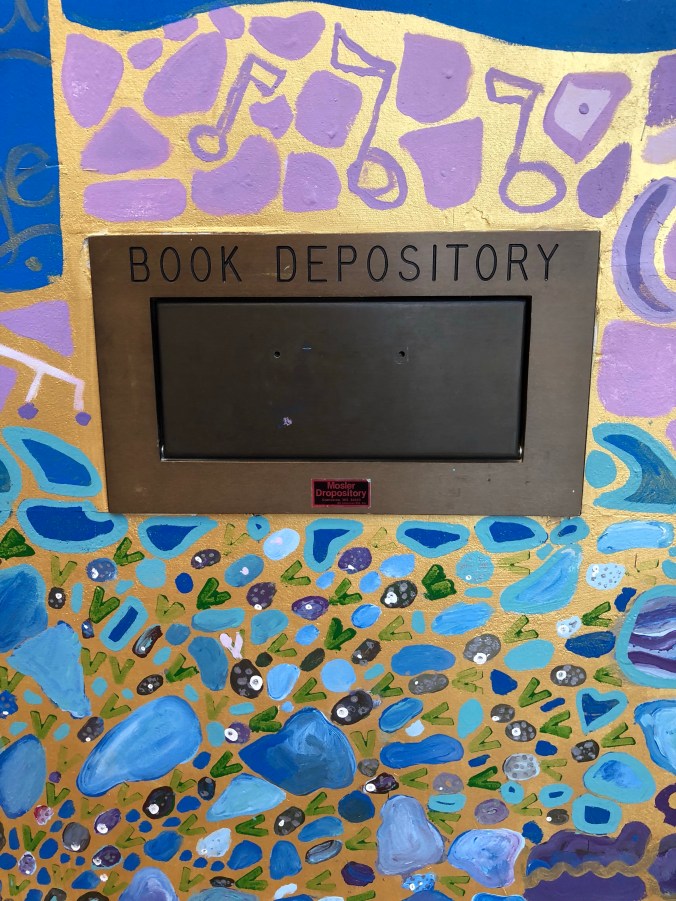
Downstairs in the main lobby, a colorful, student-painted mosaic wraps around the exterior of media center, disguising a flat metal drawer in the wall—an old book depository. As books are now returned at the circulation desk, the handle of the depository was removed years ago so that students wouldn’t keep putting books (or anything else) in there. Every day, throngs of students come and go without ever noticing the plain metal plate embedded in the mosiac artwork that overshadows it and draws the eyes away.

Except for one particular pair of eyes, that is.

One morning, as I stand at the back of the lobby greeting students arriving from buses as usual, I notice that a boy is over at that book depository. I’ve never seen a student acknowledge its existence, so I just watch to see what he’s up to. His back is to me. He’s doing something to the drawer. The lobby has cleared except for a couple of boys who realize something’s going on. They linger to check it out. Next thing I know, the two bystanders are bending over with laughter:

“He opened it! He opened it!”

That’s when I walk over to see. The bystander boys scatter. Sure enough, the first boy has the drawer open. He’s so immersed in his task that he’s unaware of my presence.

“So,” I say, “how’d you do this?”

He starts a bit, automatically hands me two opened, extended paperclips. He’d worked them into the two little holes where the depository handle used to be.

“Where’d you get these?” I query, the mangled paperclips resting in my open palm.

“Upstairs,” he says, somber-faced.

And he shuts the drawer, takes off.

I watch him go, marveling.

He’d planned this.

Who knows when he first noticed the depository and wondered about it, whether it could be opened. When he saw the two holes or when he went to find two paperclips to fashion his own handle. How long it took him to think all this through.

And I wonder about him, whether he pays attention in class or gets in trouble for being off-task, if he’s motivated academically. One thing’s for certain: He’s a critical thinker. This book depository experiment is problem-solving at its finest. The greatest thing a learner can possess, perhaps, is curiosity: What if . . . 

As the tardy bell rings, I walk upstairs, wondering what he expected to see when he opened that drawer, pondering what I saw, just before he relinquished his improvised tools.

He was writing with his finger inside the depository. In the dust of the ages, lying there undisturbed for so long. I caught just a glimpse before he shut it away, and I couldn’t quite make it out, so only he knows exactly what he wrote. I’m pretty sure part of it was a smiling face. This much I know: he accomplished his goal. He got in. He made his mark and there it will remain  for ages and ages hence, or at least as long as the building stands.

One day, perhaps, someone else will come along and notice the depository. And wonder what’s inside. And figure out how to get in, and discover that someone was there before. Likely the boy and I will be long gone by then.

And just now, as I write, I think about books themselves as depositories of thoughts, ideas, and images, places where others have gone before, leaving their marks behind from time immemorial, waiting for us to find them. Indelibly marking us, when we finally get in.

Now as for that old dumbwaiter . . .  don’t even think about it, Harriet, it’s permanently sealed . . . .

Circle of light

Good fairy

The Fairy Queen. Shayariel TeardropCC-BY

I have a colleague, mentor, and friend who retired a few years ago but who remains tirelessly dedicated to supporting teachers as writers. I was about to describe her here as a small, lively lady but those words don’t do her justice; she’s a vivacious dynamo. Her bright blue eyes always sparkling with energy, she’s mission-minded, a visionary, able to discern and speak hard truths with grace, even humor.

This past summer, as we co-facilitated a teacher-writer institute in our district, my friend was constantly thinking of ways to empower our attendees: “You know, if we need additional assistance, she would be wonderful; she knows so much about teaching young writers,” or “We need to think about a way to get them to share their experiences as writers; more teachers need to hear this!”

Listening to her one afternoon, as she made more suggestions on how colleagues could maximize their strengths, an image formed in my mind: My friend garbed as a fairy, walking a twisting path through an ominous, dark forest, wand held aloft, casting a welcoming light, seeing the good that’s hidden, calling it to her.

“You’re like a good fairy,” I told her, “the way you see people and empower them to find and use their gifts. It’s amazing how you’re always drawing more people into your warm circle of light, no matter how dark the path might get.”

“Oooh, I love that!” laughed my friend. “With a frog on my shoulder!”

“You know I will have to write about this,” I warned.

“Okay, just don’t forget the frog,” she said, eyes twinkling, moving on to a table to give feedback to a teacher who was just beginning to see herself as a writer. I watched as tears flowed down that teacher’s radiant face.

I thought about how I wouldn’t have been here at this institute, wouldn’t have had numerous opportunities as a literacy coach and writer if it hadn’t been for this friend who tapped me almost immediately for the work. Nearly from our first encounter, she encouraged me to use my voice, to seize moments, to inspire others, to keep pressing on, and, above all, to WRITE.

How thankful I am for her circle of light, that she drew me into it. Greater than any candle, torch, or wand, the light of inspiration passes from one to another as we march onward in the journey of life, with its inevitable twists, unexpected turns, obstacles, and darkness. Sometimes we cannot see further than our own immediate, wavering circle of light. That’s when it’s most important to look ahead, to recognize those going before us like beacons, vibrantly carrying on. Whatever comes, my friend will always be there, shining bright, holding her light as high as she can to make the circle larger . . . her little frog riding on her shoulder.


September 11

Healing field

The Healing Field. Randy HeinitzCC BY

Out of the blue

a student asks:

“Mrs. Haley,

if you could have

one magic power,

what would it be?”

Other students 

look up from their writing

to listen. 

I think of suffering

of strife

of festering

scars and stripes

visible

and invisible.

Broken bodies

hearts

psyches.

The children watch

and wait.

What power would it be?

“Healing,” I say.

They absorb this

without a word

their young eyes

looking far away

or maybe far within

to make

their own meaning.

They nod

as they return

to creating

their own stories.

Important things

On Day One of school, I had a conversation about informational writing with a third-grade class.

I asked them if they know what informational writing is.

They said, “Writing that helps people learn things. Important things.”

I read excerpts of three different texts aloud to them, and then I asked:

“Why is informational writing important?”

They said:

“We learn about our world and why things work like they do” (after reading about the sun).

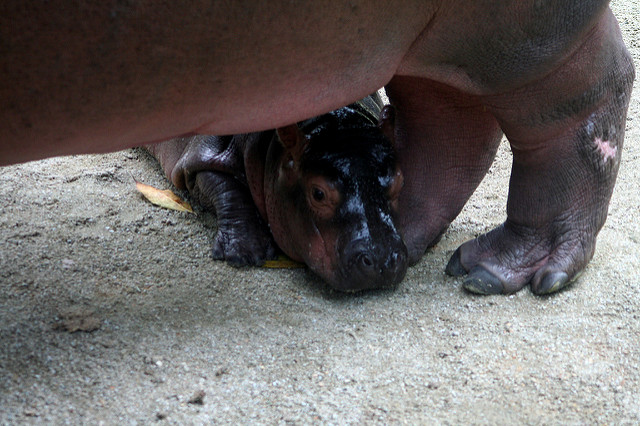
“We learn about friendship. We learn about relationships. We think about why we need each other” (wait—we’re in what grade? That’s right, third. Those are their exact words after a page of Owen and Mzee: The Language of Friendship. If you don’t know it: An orphaned baby hippo is brought to a park to share the habitat of a grouchy, 130-year old tortoise and . . . well, you need to read it).

“We learn about history. We learn from the past. Like why things like wars happen and what to do different, so they don’t happen again. We learn things that can save our lives” (after a page of a book about the Titanic, a topic that never, ever fails to captivate third-graders).

I basked in the glow of their words, their thoughts, their voices. Eight years on the planet and they already know so much.

My task: To channel this knowledge and energy into their own informational writing as they study the craft.

I asked one last question: “So, what do you think about informational writing?”

A general “It’s so interesting!”

Day One.

We’re off and running.


A fine mess

After being away on vacation all last week, my first order of business on returning home was to check on the four baby house finches that hatched in the wreath on my front door. I’d been chronicling their development daily, so I knew many changes would occur in my absence.

Here is what I discovered:

1) The babies are now well-feathered; their skin-head mohawks have become mere wisps upon their downy crowns.

2) Two of the babies can fly. They sailed out of the nest this morning as I approached. The other two stayed put, their bright little eyes regarding me with a mixture of curiosity and apprehension.

3) Their nest is one spectacular conglomeration of droppings.

To be fair, the droppings are only around the rim; the mother collects them there. What a job, building a wall of excrement. Worse than diapers. When I first wrote of the perfect, flower-graced nest, the pale blue eggs, the hatching of the tiny pink nestlings, I concentrated on the beauty and wonder of life. I pointed out that the collective noun for a group of finches is a charm.

And charmed I was.

There is nothing charming about that nest now.

The fledglings themselves, of course, are enchanting. They’ll soon be gone, the circle of life will go on, and all that will remain of these magical moments is a monumental mess.

But that’s the story of life. It’s messy. It can’t be comprised solely of breathtaking beauty and newness; if it were, we could not recognize these moments for what they are. They’d lose their value. Only when contrasted with ugliness, hardships, and pain can we see and cherish the beautiful when it comes. We inevitably deal with messes, some that occur naturally, some created by others, some of our own making. Therein lie all the stories . . .

Which makes me think of writing. This nest is a tangible (although I do not wish to touch it) reminder of these commonalities:

-Life is messy.

-Writing is messy.

-Thinking is messy.

-Teaching is messy.

To do any of these well, we have to be willing to accept and even embrace the messiness. We must certainly persevere through it to arrive at the beautiful. It takes courage, stamina, and a lot of hard work, to write well, to think well, to teach well, to live well.

The strength to do so, I believe, lies in believing that the beautiful will come. It’s all a matter of trust, of faith. And pressing on.

Although I was appalled by the quantity of accumulated—um, bird-doo—around the nest, I was also amazed that two of my four little finches could fly. Last night they couldn’t; today they can. Tomorrow the others might.

This is a message to me about readiness.

Everyone arrives as a writer, a thinker, a teacher, a good practitioner of life, in their own time. Lots of messes will be made along the way. Sorting this out is what grows us. One by one, as children, as adults, as long as we live, we are continually growing the necessary wings to fly beyond where we are. And it’s truly a collective, collaborative growth; we are to nudge each other when needed, but not too hard, too soon. We’re not to hold back, to hold one another back, simply because we cannot see all that lies ahead and for fear of navigating the unknown. Knowledge comes by trying. By experiencing. By taking risks. There’s an implicit difference between throwing caution to the wind and taking a leap of faith, that being potential self-destruction versus healthy maturation. These finches know. As the day wears on, I watch the two fledglings that can fly going back and forth from the eaves to the nest, coaching their other two siblings on how to do it. See see see, I hear them cheeping. A bit at a time, a bit at a time. At any moment, those last two are going to get up on that nasty, messy rim and let go.

In more ways than one . . . .

So you make a mess. So what? So you’re alive and growing.

Tomorrow you stretch your newest feathers and find you can move on.

To where the beautiful awaits.