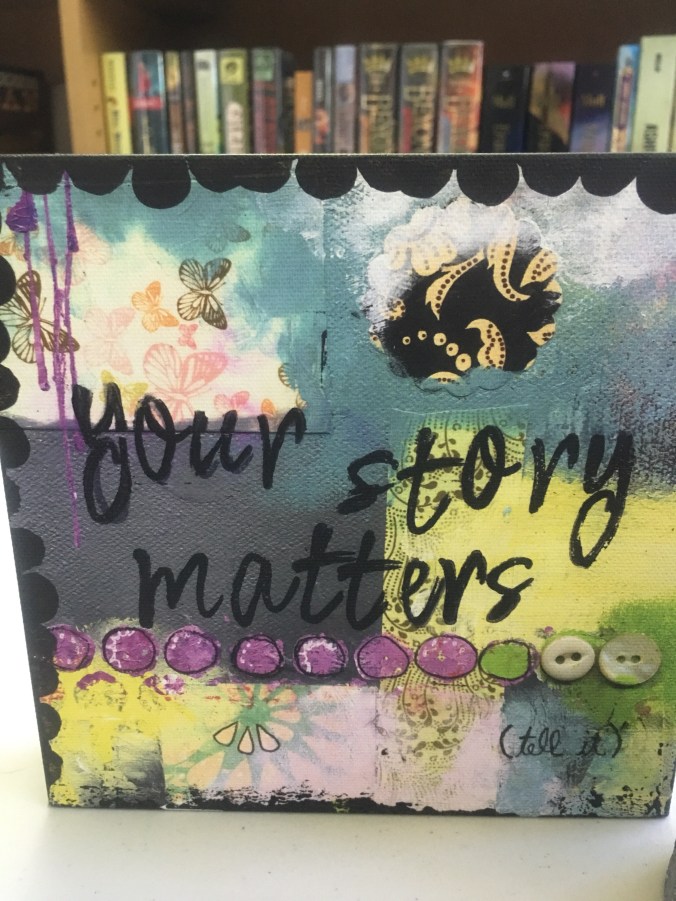
Your story matters

img_4990

“The world needs stronger stories.

We’re here to live a story and we’re made to live a good one.”

– Ruth Ayres

The focus of Day Two of my district’s Teacher Summer Writing Institute was Your story matters, with the driving question for teachers: “Why is it important for me to see myself as a writer?”

The bottom line is that we grow strong at writing by writing. If teachers expect to help students grow as writers, teachers must be actively writing. And teachers must believe in the craft, in the process, in the transformative power of writing, if they expect students to. As Ruth Ayres states in Enticing Hard-to-Reach Writers (Stenhouse, 2017): “When writers believe their words matter, nothing can stop them.”

Our group of K-12 cross-curricular teachers took some time to delve into their own stories by charting “peaks and valleys” from their life experiences. Peaks meaning moments or experiences that were positive—not necessarily milestones like getting married, seeing your newborn child, etc., although these can be peaks. Exploring moments or memories that have stuck with us over the years, those that carry great emotion, can impart greater insight to why we are who we are (see Your why for the expanded explanation of this activity). One of my peaks, for example, is from 5th grade, when I saw a classmate  do something extraordinarily brave. It’s my definition of “noble” to this day (if you want to read that story, see The Valentine ).

Valleys, or pits, are harder moments that have also defined who we are and why. They’re often ones of loss, but not always. Sometimes the valleys are moments of despair or disappointment, especially in yourself. Yet there’s great learning and insight attached to these moments. One of my valley-moments occurred when my mother invited a boy who bullied me to my birthday party.  When I began writing this piece, I recalled only my anger at my mother and our conflict. But a funny thing happens when one continues to write . . . I learned a truth that has stayed with me, subconsciously, all these years; it continues to shape me and my relationships with other people (you may read this story, if you like: The birthday ).

So the teacher-writers explored their peaks and valleys. They watched an extraordinary Ted Talk on perspective and assumptions of others, The Danger of a Single Story,” by Chimamanda Ngozi Adichie. They read articles and books of their choosing on writing. They studied visual texts.

Their takeaways:

“Writing about the peaks and valleys was so therapeutic.”

“I loved having the space to write. I began writing about one of my peaks and my mind hopped to something I saw recently; these two things don’t seem to be remotely connected . . . I wrote that instead because the image and what I was thinking were so vivid. I don’t know the last time I wrote like this.”

“I thought about things I haven’t thought about in years.”

“It’s so cool how writing takes you to places you don’t expect.”

You stories matter. Not just to you, but to others who may need to hear them.

Write first, Writer, to know thyself.

Find your stories and to discover where they take you, and what they mean. What they reveal to you about who and why you are.

Then tell your stories. Encourage others to tell theirs.

That’s what stories are meant for.

Stone speaks

img_4963

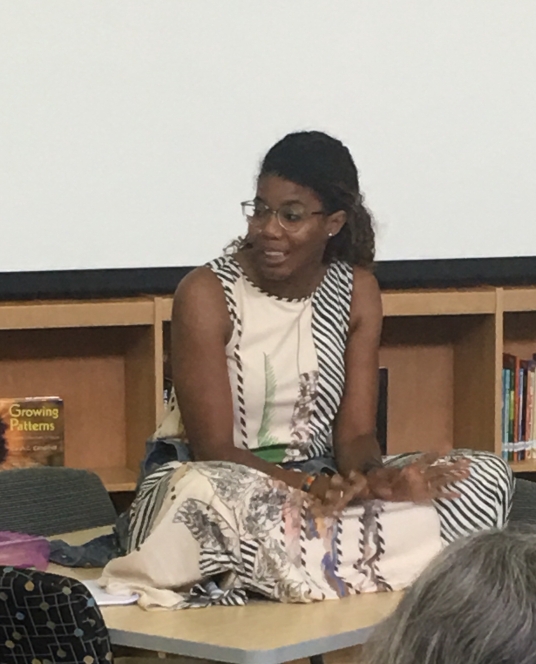
Author Nic Stone shares her passion and insight with teachers.

I scribbled notes as fast as I could while Nic Stone spoke to the gathering of teachers yesterday.

Stone is the author of the young adult novel Dear Martin. She’s straightforward, funny, warm, and passionate about reading and writing. The teachers are K-12 cross-curricular educators from across my district who’ve chosen to attend our second annual Teacher Summer Writing Institute—an entire week dedicated to growing as writers and teachers of writing. As a co-facilitator of this event, I sat in the back of the room for the panoramic view: The writing guru, seated comfortably on a tabletop, delivering her wisdom to the crowd who eagerly awaited.

Here are my favorite words of Stone:

“Literacy is about collaboration. Reading and writing are collaborative efforts. We have to be able to talk to each other.”

“I wanted to write from an early age but it took me until age twenty-eight to really try . . .  finding your voice is validating yourself and what you think and feel . . . READ what makes you think and feel.”

“Write for yourself first.”

“The beauty of writing is that it is always in your head.”

“You don’t have to write every day, but you have to develop the habit of writing.”

“Writing is solitary. Storytelling is collaborative.”

“Schools with the highest reading and writing successes are those where students have freedom to choose what they want to read and write about. Kids see each other doing it.”

“These are conversations you should be having in your buildings: Why do standards exist? What does it mean to be literate?”

“That you keep on doing the work without answers . . . that shows your amazing strength.”

“There’s no room for being wrong in American schools. Kids need to know it’s okay to fumble; it’s how they learn  . . . they need a soft place to land.”

“Reading and writing can unpack fears.”

“There’s no better way to help students find their power, their agency, their validity as human beings, than in the beauty of books, in words, in writing.”

“The thing about research is how one thing leads you to another. Everything connects. Reading and writing are all about connecting. Our connecting to the world around us, our connecting to each other.”

“Emphasize the fun in research.”

“For authentic writing, voice is more important than grammar. Let students drop commas, play with punctuation, write run-ons, fragments . . . tell them they have to know the rules before they’re allowed to break them.”

“All first drafts are garbage. They’re supposed to be.”

“Do yourself and the kids a favor: Don’t grade first drafts. Assign a date to have students finish them. They’ll have a sense of accomplishment in just finishing. Then after a couple of days, have them go back and revise.”

“I finish writing a draft before I revise, or I’d never finish.”

“Do what’s best for you to get your work on the page . . . it’s just not in the first draft.”

“Your writing doesn’t have to be be good to get an agent. It has to be good to get an editor.

“Always be working on something else. Always.”

“I’m amazed at the compassion I’ve developed just from writing books.”

“Writing is my life. I can’t not do it.”

Stone opened and closed our time together with three-minute timed free writes; the closing prompt: Now that this mess is over, I feel . . . 

My final lines in response, in my journal: I feel validated in so many ways, as teacher, writer, human spirit.

For all of these connect.

img_4989.jpg

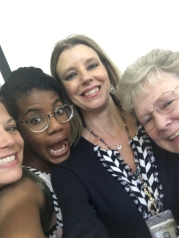
Kindred spirits: My co-facilitators and I with Nic Stone.

*******

See my post Write me for more background on the Summer Teacher Writing Institute and the value of teachers as writers.

Write me

Write me

Write me. Menno Abbink. CC-BY

As I stood at a checkout counter this weekend, the young lady ringing up my purchase eyed my #WhyIWrite T-shirt.

“So, you’re a writer?” she smiled, scanning my items.

Someone asks me this every time I wear the shirt in public. The interest always surprises me.

And, in spite of blogging for two years, having an untold number of stories in various stages of completion since I was six, and continuously capturing ideas in notebooks for more things to explore through writing, I still pause when asked this question. Funny how hard it is to own I am a writer. 

After a slight beat, I gave the young lady my short answer: “Yes. And I teach writing.”

Although she kept smiling, a shadow crossed her beautifully made-up face. “I struggled with writing in high school,” she said. “I speak well” —unmistakable pride glimmered in her dark eyes— “but I can’t write as well as I speak.”

There was something almost apologetic in her self-assessment. A trace of shame over this perceived shortcoming.

I hear this in people’s voices every time they tell me that they’re “not good writers.”

Some of them are teachers.

And I mourn, because, somewhere along the way, others have made them believe this.

“How often did you see the writing process modeled?” I asked the cashier, already knowing the answer. “Did you see examples of what the teachers wanted you to do, to make it concrete? Did you get feedback from the teachers during the writing of your essays, to help you improve your writing?”

She shook her head. “Oh, no. We were just told ‘Here’s the assignment, here’s when it’s due.’ ”

She completed my transaction. A long line of people waited behind me; I couldn’t ask this affable, well-spoken cashier if she’d ever enjoyed writing, or tried it for fun, just to see what she could do. I couldn’t say: You think you’re not a writer, but that is not the end of your story. 

I left the store knowing that I’ll have to return for a follow-up conversation in which I will say these things and encourage her to write. Maybe I’ll even take her a journal. I have several lovely ones waiting to be used.

My checkout conversation reiterates to me, yet again, that students struggle with writing because teachers struggle with teaching it. Writing is labor-intensive. It’s time-consuming. Teacher education programs often offer very little in the way of solid writing pedagogy, and unless teachers have access to professional development that provides them with the “how” and “why”—positive writing experiences of their own—the struggle goes on. Systems, administrators, and teachers battle over a clear vision of what quality writing instruction is, what the authentic writing process is versus any program, and why effective writing instruction matters (that’s another whole post in itself). I know educators who confess to “not being good” at teaching writing. Some happen to be in positions where they are advocating for the removal of writing workshop in schools.

In truth, it all begins with So, you’re a writer?

For the answer to that question must be yes before one is equipped to be a teacher of writing.

As for me, I’d start a grassroots SAVE EDUCATION THROUGH WRITING movement if I could.

In the meantime, I content myself with helping whomever I can, whenever I can, to grow themselves as writers.

The timing of my checkout encounter happens to be uncanny; I was, in fact, preparing to co-facilitate my district’s second annual Teacher Summer Writing Institute, which starts today.

In a few hours, I’ll meet the participants, elementary through high school cross-curricular educators who are willing to give up seven hours a day for an entire week during their vacation, ultimately to benefit the students they serve. Part of our institute rationale reads:

Everyone has the capacity to write, writing can be taught, and teachers can help students become better writers.

Writing grows out of many different purposes. 

Participants will be invited to be writers and engage in creative struggle.

We become experts at teaching writing by writing.

We will coach one another as we want our students to be coached on their writing journeys.

I know great things lie in store for the teachers who are coming. Not because of anything I or my co-facilitators say or do, but because of what lies within these teachers, these writers. I anticipate my own surprises— about the craft, about myself—because it always happens when I work at writing. The wellspring never runs dry. Never. Whenever writing is involved, I’ve learned to expect the unexpected. And to let it pour.

However these teachers may feel about writing, they’re already illustrating an important truth before Day One is up and running: This is not the end of the story.

It’s a beginning.

New pages await, expectantly, beckoning:

Write me.

You can do it.

And so can that cashier . . . .

*****

See Stone speaks for words of wisdom on teaching, literacy, reading, and the power of writing as shared by author Nic Stone on Day 1 of the Teacher Summer Writing Institute.

Most meaningful moments in school: A student’s perspective

Jumping for joy

Jumping for joy. kilgarronCC BY

“So,” I ask the student, “what are some of your favorite memories from all your time in elementary school?”

She’s working on her fifth grade graduation speech. Making this farewell address to the school is part of her official role as Student Council President. She’s struggling with framing her thoughts, which is why I’m here.

She looks off in the distance, past the walls of the room where we’re sitting, scrolling back over the chapters of her young life. I wonder what she’s remembering. Maybe a time she accomplished something she thought she couldn’t? Winning a class competition? A book that a teacher read aloud? A moment in a lesson when she learned something powerful that will remain with her for the rest of her life? I hope that’s it because I want to know it. And tap into it.

Finally she smiles. “There was this one time my first grade teacher just started tossing candy around the room.”

I blink. “Um, okay . . . why did she do that?”

The student shrugs, still smiling. “I don’t know. I don’t think there was a reason. I just remember she had a lot of candy and she started tossing it around for us and the other classes.”

Six years of elementary school and this is her favorite memory.

Having nothing to do with learning, achieving, growing, or rationale . . . but everything to do with spontaneous joy.

“All right then,” I say as I jot notes. “You can put this in your speech. Maybe call it the time you remember it ‘raining candy’ and explain what your teacher did.”

“That’s good,” she nods.

“Can you think of any other special or meaningful moments from all your time here?”

I wait as she scrunches her face a bit, thinking hard. Then another big grin:

“Yeah, the time the fourth grade teachers got together and sang to our classes.”

They sang? I never knew they did this. I’m curious. “Why did the teachers sing to you?”

“Just for fun, I think.”

Her eyes are so bright.

We finish fleshing out the draft of her speech. She is pleased. As she heads back to her classroom, I walk the hallways, replaying the conversation, mulling the moments that hold significance for such an accomplished student.

Just simple, unscripted, uninhibited moments when teachers were having fun.

How few and far between are they?

But how priceless to students, in the long educational scheme of things.

I walk on, carrying both the lightness and the weight of it.

Wisteria, part 5

Wisteria long arbor

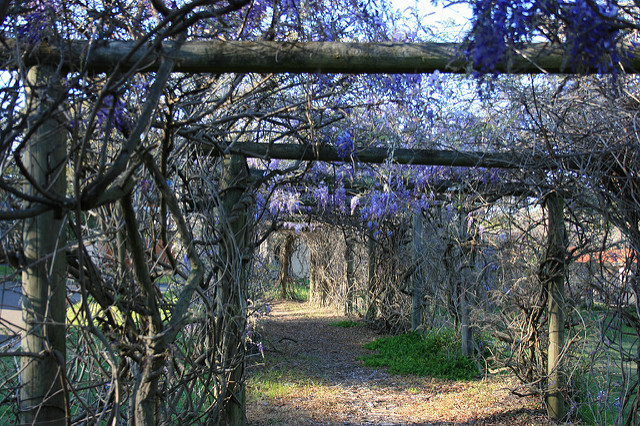
Wisteria arbor. Jason BakerCC BY

Here’s my last installment of a tale told by a wisteria vine.

“Setting is everything,” said the facilitators at the writing workshop I attended last summer. “Setting drives the plot, the actions of characters . . . .”

That’s certainly true of this story.

All my life I’ve been haunted by an old house in the woods beside my Dad’s childhood home. I looked for it every time I visited my grandmother and we walked down the narrow dirt road. She’d point it out through the trees (she knew where to look; I had trouble finding it):

“There it is, the Griffin house.” 

I’ve seen many old, abandoned houses since, in various stages of falling down, but the Griffin house, obscured by thick woods, was the first. The allure, the spooky wonder I felt as a child, was immediate and intense.

It’s never left me.

None of the people who lived in this house were my relatives. They’re in my blood only because of the place and the stories, real and imagined. My aunt, as a child, used to run on a path between her house and the Griffins’ to play with the Griffin grandchildren. Eventually, said my aunt, the wildflowers and weeds grew taller and taller, and then . . . well, everyone and everything grew up.

The Mixon road began across from the right front of my grandparents’ yard. Standing in the Griffin yard, to the left of my grandparents home, the Mixon road would have been visible to the far right, branching off of the main dirt road. By the time I came along the Mixon road consisted of only two wheel tracks in the grass, a path leading partway through the woods and fading away where fields were still being farmed. There’s no trace of the road at all now; scrubby brush has overtaken it. No one would know a road, or a house, was ever there. Grandma said that the Mixon home down this vanished road was beautiful. It was two stories with a double porch, dating back to the Civil War. That house was gone long before I ever came to be. 

Perhaps this story springs only from a hopeless romantic streak, but as the wisteria grew heavier and heavier in the trees of my ancestral homeplace with each passing year, it stirred the stories, imaginings. For fractions of seconds, I could see the old, hidden Griffin house as it was. I could feel the thrum of farm life, see a mother surrounded by little children, sense a man pouring his soul into the earth to make it produce enough to feed his own.

That house is, for me, an abiding image. I can forever pull back layers to find new and deeper meanings: the passing of time, “memento mori,” we are mortal, and who will remember us when we’re gone?

The wisteria is another abiding image. If it has attached itself so to me, then why not to my characters?

When I happened upon an science article about plants having memory, I wondered, What if such memories could be tapped? What if a botanist actually had a means of, say, sticking a needle in a plant to extract its memories? 

As a writer, I get to do just that. Without the needle.

In previous segments of this story, Jennie Jay Mixon has grown up to marry the widower neighbor, Thomas Griffin. The wisteria finally blooms for the first time. The affinity between girl and plant deepens; their lives, their maturity, mirror one another. In this final segment, the mirroring takes an unexpected, divergent turn . . . .

*******

So Jennie Jay transplanted herself in the Griffin household as the mother figure to six children, the oldest being barely younger than she. Jennie rooted herself in the family as if she’d always been there. And in some ways, she had. She wrapped her love around Thomas Griffin the way I wrapped myself around the arbor frame. Like my arbor supported me, Tom’s strength secured Jennie Jay. Under the arc of their love, the children, the farm, flourished.

Until their first baby died, weeks after birth.

She spent that day drifting between the house, the cemetery, and me, wandering as if she were that lost toddler of long ago.

He finally pulled her to a bench he’d placed under me, sat her on his lap.

I did all I knew to do, Tom. She seemed to be getting stronger. What did I do wrong?

Nothing, my love. She was just too little. You can’t blame yourself.

I ache to hold her. To feel her warmth. I think somehow I needed her more than she needed me. I am just so empty. 

There’ll be others to come, who need you. And I need you, Jennie.

She smiled a little then. She pressed her wet face against his coat. He leaned his head back against my trunk, let her cry, and cried along with her.

But he was right. In time, more babies arrived: Twins, then two more.

I was a part of that last fertilization. Really, I was.

They crept out of the house one balmy summer night under a waning crescent moon when I was blooming riotously, having been pruned back a few times for my own good. I sheltered them as they loved each other, murmuring of long ago: dandelions, destiny, The Powers That Be.

And me. Jennie Jay and Tom whispered of me, even then.

Let it be duly noted, however, that I find the efficient business of self-pollination far superior, although this interlude did clarify some finer points.

And children grow almost as fast as vines; one by one, they all left home.

Tom began to wilt.  Rheumatism, Jennie called it. She fussed over him, waited on him. He basked in her attention much like I bask in the sun.

Considering the span of their ages, everyone expected him to go first; it was the natural order of things.

I perceived it before she did.  How, I cannot convey, but I discerned something stealthily growing, snaking its way silently through her inside parts, bit by bit. The terrible truth is that this Thing was like me. Powerful in the way it grew and took over. I had not fully known my own power until Tom extended the arbor with an enclosed walkway of trellises. My new shoots, innocent, so tender, had spiraled through the lattice. As I grew, my tendrils tightened; I began to pull the lattice into myself, out of control, until Jennie Jay and Tom cut that part of me away.  They left the overhead beams of the new walkway for me to extend myself and luxuriate, but no more lattices, as I would only destroy them.

I sensed nothing good in the Thing that slowly choked the life out of Jennie Jay. It wanted to live, she wanted to live, I wanted to live; but I could not desire to live if my living was at the expense of hers.

The elongated arbor allowed me to get near the bedroom window. Jennie Jay, so small and white, lay still on the bed. Tom’s cane remained in the corner, for he seldom left her side, even when the neighbors came to relieve him, or when the children came to say good-bye.

He held her whenever she screamed, when the Thing, out of control, took, bent, consumed, destroyed. He was holding her on that last morning. The sun had just risen; dew sparkled like scattered seeds of fiery rainbows.

Her eyes opened, looked through the window at me.

It’s morning, Tom. Time to get going. I’ll wait for you under the wisteria. Come on whenever you’re ready, dearest.

Humans say envy is green. I am green. I know envy. I envied the pine tree given for her casket. I wanted to be the one, would have sacrificed myself, to hold her forever and ever.

Of course he knew. Before he nailed the lid shut, he hobbled outside with a pair of shears to clip a little sprig of my purple flowers. When his children and the neighbors attempted to help, he shooed them all away. He carried my flowers, placed them under Jennie Jay’s white fingers, kissed her hands, her face, one last time, and nailed the lid himself.

He planted her beside their first baby, a wise distance away from the first Mrs. Griffin.

In his grief I was powerless. I could offer no condolence, could not weep, could not acknowledge our loss in any way other than shedding my blossoms, borne by the breeze to collect on the mound where she lay.

I lost track of time then. So did Tom.  He did not come to me again but went quickly after her, his existence too intertwined with hers for him to adapt to a world without Jennie Jay in it. She was his world.

By then the garden was no more. The yard soon went wild. Grasses and weeds grew tall; the pecan tree rotted away. The Griffin children, their grandchildren, their great-grandchildren, came back from time to time, always in a hurry, visiting the graves, showing the land to potential buyers.

No one wanted it.

The barns collapsed. The house and I kept standing, even as saplings grew into trees around us. My arbor could not bear my weight; I crushed it. I latched onto a sturdy oak, where I climbed and climbed above the darkness of the woods which claimed for itself what was once the productive farm of a good, kind man.

I reached the house, at last. All traces of the whitewash were long gone. I wove myself through the bare clapboards and window frames, up the narrow staircase, back out between the cypress shingles.

She lived here, she was happy here. Her babies were born here. The walls and I were the last testaments to their love, that peculiar human gift. My tendrils tasted it all, absorbed it, took every bit and stored it deep within myself. My twisted trunk attained the girth of a man. Parts of my vine grew larger than Thomas Griffin’s muscular arms when they first wrapped around Jennie Jay.

I am all that remains. The house caved in from the ravages of time, weather, and me, but I am compelled ever onward and upward. Trees do not grow fast enough to suit me, for my goal is to reach the sun, that life-giving, golden orb beckoning from the periwinkle sky; I sense that something of Jennie Jay is there, just on the other side.

Until then, I draw from the essence of her deep within myself, where every sensation is preserved, where she lives on and on and on.

Her first and last words were of me.

First and last, first and last. My images of her keep circling, circling, ever-circling.

She was the first child I ever saw . . . .

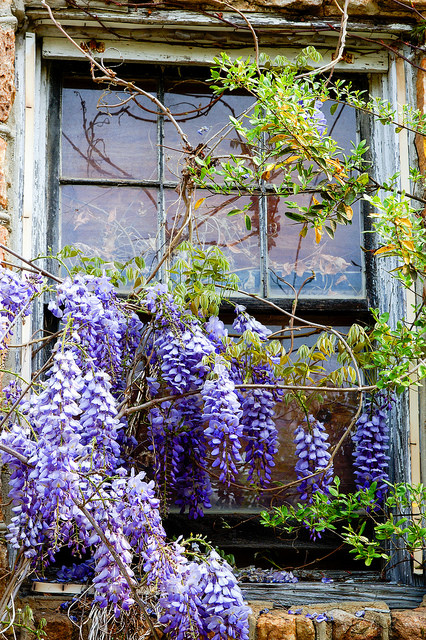
Wisteria & old house

Old North Carolina home covered in wisteria. David R NCCC BY

*******

The End.

But maybe not.

Wisteria’s last line is also its first, so, back to The Beginning . . . .
Wisteria sprig

Wisteria sprig. Maggie McCainCC BY-SA

Wisteria, part 4

Wisteria vine

Wisteria. Asiya QureshiCC BY

I love things that are old. 

I am having fun tinkering with this little story about the old days, based on my grandmother’s childhood memories and stories that occurred before she was born. The ancient oral tradition . . . as I listened to her, faint images of people partially materialized in my mind. I wondered what their extended stories might be, what their lives were like on family farms in this remote, woody place that I visited each summer. In my lifetime, it was nearly all woods; few traces of the community remained. 

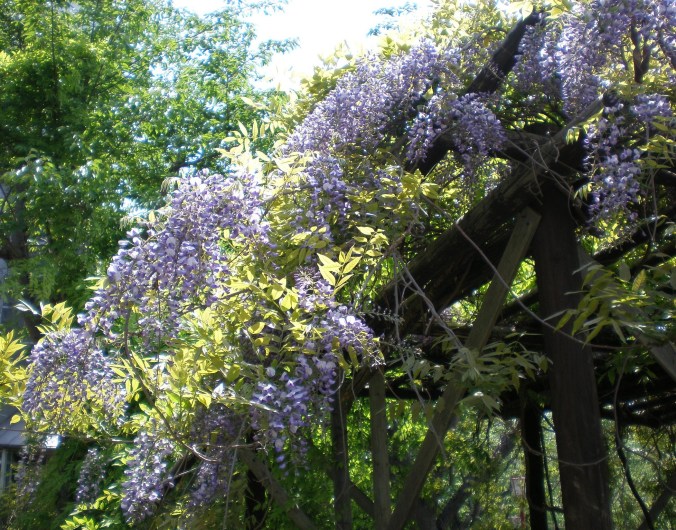
The wisteria remains. It hangs in the trees where the farm houses once were, its abundant, pale purple flowers the very image of April in North Carolina, whispering of long ago.

I starting wondering what stories the wisteria could tell, what it had witnessed across the years.

Then I heard its voice. 

I guess I’ve always had a wild imagination . . . 

It’s also fun to relate Wisteria’s story, beginning in the 1880s to the turn of the twentieth century, thus far, in segments somewhat like a serial in newspapers or magazines of that era. 

In the preceding installments (Wisteria, Wisteria, part 2 , and Wisteria, part 3), the vine tells of its mysterious origin on the Griffin farm and its developing kinship with a girl named Jennie Jay, who’s become a teenager harboring a secret. Mr. Griffin, father of six, has just lost his wife in childbirth with the seventh. The vine isn’t able to bloom, not an uncommon condition.

In today’s post . . . well, just sit back and listen to what Wisteria has to share . . .

*******

I woke the next spring to find Mr. Griffin building a porch on the front of his house. Every day, neighbor women stopped by with fudge or a pot of chicken and dumplings or stew for his family. The married women stayed only minutes, but the widows . . . they lingered, smiling and chatting at Mr. Griffin as he tried to work. By now I understood a lot more about humans than I used to. I stretched myself closer to the house for snatches of conversation.

Mr. Griffin, it seemed, had little to say.

He managed, somehow, to finish the porch. He left the gardening to his children and whitewashed the house. It stood tall, narrow, and bright in the sunlight by day; it glowed in the moonlight at night, as white as the stone markers just across the dirt road.

In all this time Jennie Jay did not make an appearance.

Her mother walked over one afternoon, bearing a basket, when the Griffin children had gone Up the Swamp to visit their mother’s relations. Mr. Griffin leaned against a porch column, smoking his pipe, gazing at the place where his wife, his baby, and his parents were planted.

He straightened, nodded, when he saw who was coming.

Miss Aurelia.

Hello, Thomas.  Here, I fried a chicken and made some biscuits for you.

I greatly appreciate it.

Your porch is lovely.

Thank you. The children enjoy it. Just got the swing up this morning.

How are you?

Can’t complain. You?

We’re all well.

A pause. Then—

Jennie Jay came home today.

Ah. So she’d gone away, had she.

Mr. Griffin puffed his pipe. He took a long moment to respond:

How did she like Raleigh?

She says she likes the shops but hates the city.

They both chuckled.

My sister said she was terribly homesick. She couldn’t understand why Jennie Jay wanted to come back to the ‘sticks,’ you know.

A slight smile played on her face.

Mr. Griffin just stared ahead. He made no reply.

She asked about you. Wants to come by.

He turned and looked directly at her for the first time since she arrived.

His voice was suddenly hoarse:

Well, by all means, Aurelia, go and tell her to come.

********

From my high perch on the arbor they built for me, I knew she was coming before he did.

In a yellow dress, her wide-brimmed hat a corona, she gleamed against the reeds and trees, a far cry from the tottering child who once escaped her mother.

He’d hurried in the house to shave, then waited for a while in the new swing, which faced the old Mixon road. Where she’d be walking. Then he took to pacing back and forth out in yard by me, until she finally came into sight.

He stood in my shadow as if rooted, drinking her in the way I drink in sunlight: Jennie Jay, pink-cheeked, blue eyes shimmering, pulsating with life. Her pale hair, long tendrils that my thin green ones could never begin to match, hung loose under her hat.

His gray eyes were as sharp as knife blades when she drew near, his expression unreadable.

He extended his hand:

Welcome home, Jennie Jay.

She grasped his hand, smiling.

Is that all you have to say to me, Mr. Thomas?

He trembled. Oh, could I feel it.

Just say it, man, say it!

God above, Jennie, you are beautiful.

Did you miss me while I was away?

I did.

That is good, because, Thomas Griffin, I. Missed. YOU.

She threw her arms around him.

Her hat fluttered to the ground beside my trunk; there were no more words. He clasped her to him like he might never let go. He sobbed, but Jennie laughed, even as the salt water flowed down their faces; she reached up and pulled his to her own.

By my calculations, she was in her eighteenth year.

I was about sixteen.

****

It happened.

On the day Thomas Griffin married Jennie Jay Mixon and brought her home in his old mule-drawn buggy—by her request— he had a special wedding gift waiting. He wouldn’t let her look; she had to keep her gloved hands over her eyes until he was ready:

All right, love, you can look now.

It was me, of course. In full bloom for the first time in my existence.

My heavy lavender clusters spilled like grapes over the arbor; my fragrance filled the air. I was majestic and I knew it, nearly as resplendent as the young bride.  My one regret—if my kind is allowed a regret—is that I couldn’t bloom yellow for her.

She laughed and cried at the same time, just as when Mr. Griffin first held her in his arms.

It is amazing, amazing! Oh, Tom, how…?

It just happened, Jennie. Of its own accord. All for you, I’m sure.

That wisteria is the most beautiful thing in the world.

Ah, my sweet, salty Jennie Jay.

Wisteria blooming

*******

This isn’t the end of the story. Not yet.

To be continued, one last time . . . Wisteria, part 5.

Wisteria, part 3

Wisteria arbor

Wisteria arbor (cropped). Jon CallasCC BY

Here’s the next installment of a short story based on a tiny North Carolina farming community at its peak, circa 1880-World War II.  While short stories typically don’t cover a period of years, this one does, as it’s told from the perspective of a wisteria vine that may have lived through the entire period, and may be living still; I will have to visit the area again, just to see . . . 

I grew up on my grandmother’s stories of long ago. Here I am basically just having fun weaving bits of them together, taking liberties, watching the story unfurl with the long tendrils of the wisteria vine. 

Another source of inspiration was an article posing the question, “Do plants have memories?” That’s all I needed for fact and fiction to take root in my mind; the wisteria sprouted then and there, and began to speak.

In the previous two installments (Wisteria and Wisteria, part 2), the vine relates its beginnings on the Griffin farm and its attachment to a little girl named Jennie Jay. Sent to the Griffins to escape diphtheria at her home, Jennie Jay is miserable. Mr. Griffin (Thomas) offers comfort by reminding her of her first encounter with the vine, which vows, whenever it blooms, that its blossoms will be yellow—Jennie Jay’s favorite color. Now we discover that plants, as well as people, harbor secrets . . . 

*******

I couldn’t bloom at all.

The seasons came and went again, one after the other, on and on. I grew thickly over Jennie Jay’s arbor, but I was all leaves, spirals, and shoots, without flower. I made a nice shade, however. In the dead of summer, when nothing but mosquitoes, dragonflies, and snakes desire to move, the Griffin children—six of them—sought refuge under me. I was strong and healthy. Every spring I woke back up to the world, sure my flowering would come. Every autumn when I began ebbing away, it was having failed to flower.

Mrs. Griffin had no such trouble. She budded out yet again.

One black summer night, as lightning flickered and flashed, and thunder shook the earth, Mr. Griffin drove the mule and buggy up the Mixon road. He came back with Miss Aurelia. Bowed against the pounding rain, the wind whipping hard enough to rip away a portion of my leaves, he ushered  her into the house. He set off again, yelling at the mule when it shied at the thunder. After some time, he returned with Doc Martin.

The storm raged all night. As it subsided, and the morning dawned gray, Miss Aurelia left the house. She ran toward her home, holding her skirts up from the muddy road. Within moments, she came back with Jennie Jay.

How she’d grown. Taller than her mother, now.

Holding onto each other to keep from slipping, minding their skirts against the mire, they hurried back to Mr. Griffin’s.

They stayed all day, washing, cleaning, cooking, consoling the sobbing Griffin children. Other neighbor women arrived with more food and husbands for Mr. Griffin’s chores. Jennie Jay’s Papa, Mr. Mixon, took the doctor home and returned with a pine box on the mule cart.

Late in the evening Jennie Jay came outside and rested her head against my frayed leaves. I felt her warmth, her energy; she radiated aliveness. Strong and healthy, like me. Always like me.

Wisteria, she whispered, I wish you could know what’s in my heart.

Tell me, I longed to say.

I’m not a good person.

Oh, but you are.

I wasn’t fond of Miss Rachel. She wasn’t especially kind to me. But I didn’t want her to die. Honest, I didn’t.

It comes to all of us sooner or later, Jennie Jay.

And the baby, that poor baby . . . 

I had no words for that.

Mama says Mr. Thomas wants them buried together. They’ll be together forever and ever.

Jennie Jay fell silent for a while. Then she sighed as deeply as any human ever did, I am certain.

I can’t stop thinking about Mr. Thomas. He’s so good and gentle. I will never forget how he comforted me when Papa nearly died, how he got me to help him build this very arbor. Look at you now, how great and green you are.

Thank you. Look how tall and strong you are yourself.

Why haven’t you ever bloomed, Wisteria?

Alas, Jennie Jay, you cut me to the quick!

Can I tell you something I can never tell anyone, any person, ever?

Yes, of course; I can never divulge your secrets, you know.

I’ve loved him ever since.

Naturally.

I think she—Miss Rachel—knew. It’s part of why she didn’t like me much. Do you know she told Mama once that she wanted to tear this arbor down? She despised it. She’d have gladly destroyed you.

She is dead and gone now. She cannot hurt me. Or you.

—Jennie Jay?

She jumped.

Y-yes, Mr. Thomas?

Please come eat a bite before you and your Mama go home. The children are asleep now. Don’t know how we would’ve gotten along without you today.

Jennie Jay’s long fingers lingered on my leaves, caressing, as she turned to go. I caught her parting whisper: Well, I owed you, didn’t I.

Tell him, Jennie Jay. Tell him every bit of it.

*******

To be continued, in two more installments … here’s Wisteria, part 4.

Wisteria, part 2


Wisteria leaves

Wisteria leaves. “Leaf edge.” Rebecca SiegelCC BY

I recently posted the first part of a short story about a real wisteria vine that grows in an old, forgotten place. Forgotten people are buried there. An article about plants having memories made me wonder what this hardy old vine may have witnessed in its long lifetime . . . here’s Part One , if you’re interested, in which the vine relates how it mysteriously sprouted, took note of its surroundings, and had its life saved by a little girl, Jennie Jay, and her mother. It was the beginning, shall we say, of a very curious friendship.

Here’s Part Two. The vine has lain dormant during its first winter . . . 

*******

I awoke to a gentle sun and delicious, cool dew. I felt new greenness coming on, so I spread what there was of myself.  I was bigger, definitely bigger. Several days went by before I realized how much time had passed while I slept. A whole season, it seemed. For one thing, the cow had a calf.

For another, Mr. Griffin had a Mrs. Griffin.

Intriguing.

As they planted the garden together, I learned her given name, Rachel, and that she came from Up The Swamp. She must’ve already bloomed, as her fruit was showing right in her middle. I wondered how the fruit would transform into a miniature human like Jennie Jay; did new humans burst forth from pods fully formed like that, or did they just drop off? The fruit kept growing but apparently never ripening. Something taking that long to grow surely could not be healthy.

Finally, near harvest time, Mrs. Griffin shut herself in the house with other female humans. Mr. Griffin scoured his garden for the last of the beans, peered at his pumpkins, sighed, repeated the meaningless motions and hoed, although nary a weed was to be found.

He didn’t see the door when it opened, didn’t see Aurelia Mixon until she called, You’ve a fine son, Thomas! Squalling his very lungs out! Come and see him, Papa.

Mr. Griffin’s face glowed like the risen sun, but I considered myself cheated not to have witnessed the human fruit falling.

****

The seasons cycled and cycled again before Jennie Jay came back to me.

I knew her at once. She’d grown. A lot. I’d grown, too. I no longer needed a cage. Mr. Griffin hadn’t built an arbor for me so I squatted instead of standing upright, but my trunk was decidedly thicker.

By this time there were three little Griffins, one in his Mama’s arms and two hanging from her skirt as she went partway up the Mixon road to meet Jennie Jay, who trudged along wearing a straw hat tied with a wide yellow ribbon. She dragged a curious bag behind her, making a noise like Mr. Griffin’s beagle pup when it got its back leg stuck in the fork of the grapevine.

Mrs. Griffin’s face looked ominous, like storm clouds gathering. Heavens, what a fuss, Jennie Jay. Quit that howling and pick up that valise. You’re getting it filthy. Come on and I’ll fix you a bite to eat.

Ain’t hungry.

Your Mama wouldn’t like that. Say ‘I’m not hungry, thank you.’

Ain’t hungry!

What a stubborn little cuss you are. No matter. You’ll do what you’re told until your Papa gets over this diphtheria and you can go back home.

I want my Mamaaaaa!

She can’t come, she’s tending to your Papa. Besides, you can play with Tommy and Molly; I’m sure you’ll all have a big time together, now won’t you?

They made it to the house but Jennie Jay didn’t stay inside long. Within minutes, the door flew open and she ran as hard as she could toward the garden. She flung herself down so close to me that if a stiff breeze blew, I might bend just enough to touch her. A drop or two of the water flowing from her eyes seeped into the earth, to my underparts. The taste surprised me: humans are remarkably salty.

Mr. Griffin drove up in a cart pulled by one of his more pleasant mules. He saw Jennie Jay, called Whoa, hopped down.

Well, if it isn’t little Jennie Jay.

She paid him no attention. She continued dripping.

He knelt beside her. Tell me what’s the matter.

I want to go hoooommmme!

I know you do. I know your Papa and Mama are missing you as much as you miss them. But your Papa has to get well first. He wouldn’t want you to get sick too, would he?

Jennie Jay sat up and wiped her face, leaving smears of earth.  She shook her head.

It’ll be all right, Jennie. Don’t cry, now. Want to know something?

What?

See that vine there?

Mr. Griffin pointed to me.

The funny bush?

Yes. Know what that is?

Jennie regarded me thoughtfully. She shook her head.

It’s wisteria. Once when you were very small you got away from your Mama and came here to pick every last one of my dandelions. We found you here by this vine. I didn’t even know it had sprung up. I aimed to yank it right out of the ground but your mama said no, let it be, on account of you called it by name and that was your first word.

It was?  A flicker of recollection crossed her face.

It sure was. I witnessed it myself. You didn’t start with something easy, no sirree; you had to go and try to say ‘wisteria.’ It came out something like ‘siria’ or ‘siwia.’

Jennie giggled. The dripping had ceased.

Your mama said I ought to make an arbor here, so this vine could grow and grow. It might even bloom one day, Jennie Jay, with flowers hanging all over.

 Ohhhhh . . . will it?

 It just might. Of course I have to build the arbor first, and see, the trouble is, I ain’t had anyone to help me.

 I’ll help you, Mr. Thomas!

 Well then, let’s get started.

 Mr. Griffin held out his hand and helped Jennie Jay to her feet. She stared up at him with shining periwinkle eyes.

  Mr. Thomas, will them wisteria flowers be yellow?

  Probably not. Usually they’re purple.

  Oh.

  Reckon that will be all right, Jennie Jay?

  I reckon.

Mr. Griffin unhitched his mule and off the three of them went toward the barns, Jennie Jay skipping, Mr. Griffin smiling, the mule laying its ears back, looking altogether like Mrs. Griffin at the doorway.

As for me, I vowed that, whenever I finally bloomed, my blossoms would be yellow.

*******

To be continued . . . here’s Wisteria, part 3


Blowin’ in the wind

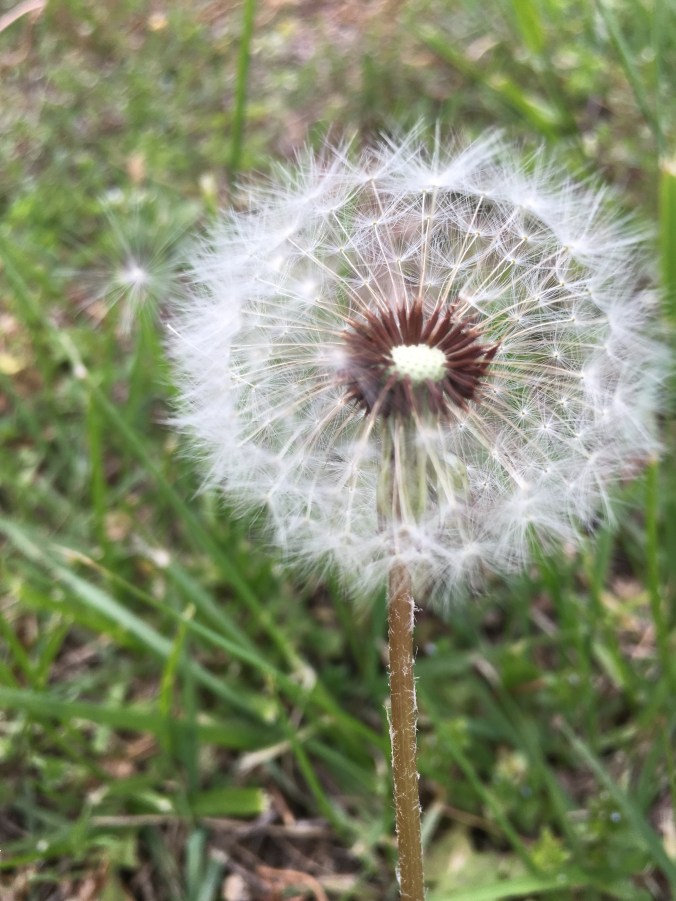
Yesterday, while outside with my old dachshund, Nikolaus, I saw this old dandelion.

It stood trembling in the soft spring breeze, holding its seeds tight under its parachute sphere, and I thought Any second now they’ll be blowing in the wind.

Which reminded me of the song.

When I was a child my parents had a stack of record albums, and in it was Peter, Paul and Mary’s In the Wind. Only now do I wonder which of them purchased it, for my young father and mother seemed more representative of the fifties than the sixties. No beads and long hair or tie-dye. Daddy wore a crew-cut all of his adult life. My parents were . . . just parents. Pretty mainstream. I don’t know how old I was when I first heard the album, but as a child I played it over and over on the old stereo, a huge, bench-like piece of furniture on four legs that took up half the length of the living room wall.

Bob Dylan’s “Blowing’ in the Wind” was one of my favorites, mostly because Peter, Paul, and Mary’s harmony was as haunting as his lyrics. But it wasn’t the song I loved most on the album.

That was “Stewball.”

It’s about a racehorse, the underdog, and how a man laments betting all of his money on “the gray mare” and “the bay,” how he wishes that he’d bet on Stewball, who somehow managed to win the race.

The ballad’s content is mournful—Oh, the hoot owl she hollered, and the turtledove moaned, I’m a poor boy in trouble, I’m a long way from home—but the instrumentals jingle along, almost incongruous with the words. Perhaps not as incongruous as me, less than ten years old, swinging as hard as I can, round and round on a tire swing that Granddaddy hung from a pecan tree in the yard of my father’s childhood home, singing at the top of my lungs: Oh, Stewball was a racehorse, and I wish he were mine, he never drank water, he always drank wine . . . .

So long ago.

Funny how songs can weave their way through chapters of our lives, as they do through movies. There are stories to be told about the poor choices of adults, and the consequences, with “Stewball” playing in the background.

Nik the dachshund makes his way back to me, staggering in the grass. At sixteen he’s unsteady on his feet and blind; he plows into the old dandelion. Instantaneously the perfect white sphere dissolves, the seeds go airborne.

The answer, my friend, is blowin’ in the wind

The answer is blowin’ in the wind.

Maybe it’s answers I seek.

Maybe they’re seeking me.

I do not know.

But I do know that ideas are everywhere, blowing in the wind; I sense them and I know they’ll land, somewhere, sometime, that they’ll take root and grow. If I write them, they’ll spawn more and more ideas.

I gather Nik in my arms, careful of his old, fragile bones, and go back inside the house, humming.


Like Superman

Superman

Superman. Ian HarveyCC BY-SA

I’m seated at the old computer table, listening to second-graders read. Poetry conferences, we’re having. Revisions and final edits before their teacher sends everything off to publish a class book of poems.

“Is it my turn? It is it my turn?” he keeps asking me, from his seat in the middle of the room.

Actually, he’s not on my list of students that his teacher asked me to meet with. So I say, “Not yet. Not yet.”

He manages, somehow, to sneak between his classmates. I look up from notes I’m making to find his impish face beaming up at me. His tiny body wriggles in the chair beside me.

“My turn!” he insists.

I call across the room to his teacher, who’s also conferring with students: “May I PLEASE work with our friend here?”

“Yes, sure!” she answers. “I’m about to meet with him, but if you want to  . . .”

If I want to?

How can I say no?

“Okay, YOUR TURN! Read your poem to me,” I tell my exuberant conferee.

Grinning, he shoves his paper over to me.

There’s nothing on it. Not even his name.

“What, you haven’t written anything yet?”

He shakes his head. He’s still smiling. “No! But my English is bigger!”

He remembers.

At the beginning of the year, I assessed his reading. Just as I was about to console him on his having missed all of the words, he patted my arm and said, “You have big English. Me”— he patted his chest— “little English.”

His perception of everything around him is astonishing.  Whether he has all the words for it or not.

I’ve noticed, in the hallways, that he doesn’t greet me as Haley! anymore. Now it’s Hi, Mrs. Haley. That when I say How are you? he says, I’m good.

“Yes,” I say, “your English is a LOT bigger. That’s for sure. Now, this poem. What do you want to write about?”

He shrugs. “I don’t know.”

“Well, what do you like?”

His face lights up. The response is immediate: “BASEBALL!”

“Okay, so, what do you want to say about baseball?”

I take the paper and pencil.

“I like baseball,” he says.

“Perfect.” I write down the words. “That’s your first line. What else?”

“I like hitting the ball with the bat.” He acts this out. He’s a boy full of endless energy.

“Great. That’s your second line.” I write it down. “What else can you say about playing baseball?”

He thinks, gets excited, garbles his words. Something about running . . .

“Wait, slow down. Did you say running?”

He nods, bouncing in the chair. “I run like SUPERMAN!”

Superman . . . 

The first time I saw him, over a year ago, when he came to the United States, to our school, he had no English at all. Unused to a school setting, he frequently had outbursts because he couldn’t communicate his wants, his needs, his questions, his feelings, anything.

He was a frustrated, forlorn soul.

Wearing a Superman shirt.

My first words to him were, “Hey, you’re Superman.”

I pointed to the on his little shirt.

He didn’t understand, but he smiled.

Now, he understands.

Within five minutes, the poem is written. I point to every word, reading to him, then he points to every word, reading back to me. I watch him bounce away to his desk to copy the poem over in his own handwriting.

I write, too:

So you run like Superman when you play baseball.

Maybe you really mean that you fly

because you do

because you ARE Superman.

We shall stand marveling in your wake

it’s a bird, it’s a plane

it’s you.

Supersonic.

*******

For an earlier encounter with my little friend, read Big English

For the record, poetry is an excellent way to help English language learners—really, any student—write more. Poems can be brief with less emphasis on conventions. Energy can go freely into capturing images, ideas, emotions, and building vocabulary.