Wisteria

In recent years, I’ve written lots of short stories, beyond those as models for students or posted here on the blog.  Some of my stories are realistic, usually centering on a character making a self-discovery or a difficult decision. Other stories are more ethereal, with a slightly supernatural element.  

“Wisteria” is one of the latter.

April in North Carolina brings life to the heavy vines snaking through the woods. One day the woods are dark, gray, forlorn, and the next, it seems, they’re bursting with color. Along the highways and back roads, cascades of soft purple blooms reminiscent of grape clusters swathe the trees. The wisteria is beautiful. Its perfume laces the fresh spring air. To me it speaks of old things, old ways, long ago, things we cannot see and did not know, but are with us still, even so.

Regular visitors to this blog will know that I frequently write of my grandparents’ country home in eastern North Carolina, where I spent many childhood summers. It is a tiny, old, remote place. Utterly foreign and mysterious to a little city girl. The images abide with me to this day for myriad reasons: I was happy there. To be with my grandparents was to be in a stronghold of love and safety. Absolute sanctuary. Not until I was grown did I realize how much the environment, the setting, nature itself wove its way into my very being much like wisteria stealthily weaves its way through a forest, grabbing hold of anything it can. Like it did in the thick woods looming eternally dark and secretive around my grandparent’s home. Suddenly, in the spring, these tall, ominous trees were laden with wisteria blooms. They made my grandmother sneeze; they made me stand still and dream. 

Grandma told stories of long ago, before these woods existed. When a whole community thrived along this old dirt road. When the people in the cemetery in the tiny clearing  across from her house were alive. As a child, listening, these people lived and breathed once more, just briefly, in my my mind. Like ghosts temporarily made corporeal before dissolving again. I stood by their aging white stones, some eroding or so weather-streaked or moss-covered that names and snippets of verse were hard to read, seeing my own moving shadow cast over the grass of their graves, as a soft breeze picked up. Leaves and pine needles rustled; birds chattered with wild abandon; frogs plopped into the tiny canal at the cemetery’s edge; crickets chorused from the recesses of the woods because it’s always night there. 

The cemetery vibrated with life. 

I looked up and saw the wisteria nodding, high in the trees.

I tried growing it myself, once.  

A few years ago, a friend of mine, knowing my affinity for the vine, brought me a potted wisteria. I planted it by the back deck with great glee. Another friend built a trellis for me on the deck, so that as the vine grew—which is alarmingly fast—I could tease its tendrils through the lattice. Soon I’d have a glorious arbor of soft purple bliss.

That is not what happened.

Those tendrils, so tender and unassuming, grew daily; they began reminding me of something out of science fiction. Like thin green antennae, they grew out and up from the woody trunk. They held themselves aloft in the air, swaying, twisting—I could actually see these movements. Some tendrils eventually reached the deck and coiled around its posts. Still others stretched, as if consciously, toward the lattice; I guided these green strands to spots where they could weave through in their ever-onward and upward way. 

The first small blooms appeared.

-Joy.

And then one day as I walked across the deck I realized that the lattice was bending, was already quite convex. The wisteria, pulling and pulling, continually gaining strength and momentum (as best I can describe it) was destroying the trellis, was literally drawing it into itself. 

I gazed in fascinated horror. How did this happen so fast?

I noted that one sweet little tendril had reached the gutter of the house, so benignly . . . 

It had to go. 

I cut down the vine. Hacked it to bits.

And mourned.

Not long afterward, I read a science article that posed the question: “Do plants have memories?”

Oh. Oh. Oh . . . .

That wisteria in the woods by my grandparents’ home surely must. . . it’s been there for how long? A century? More?

What, exactly, would it remember?

And that is how my story “Wisteria” was born.

My friends enjoy it. Contest judges and magazine publishers apparently do not.

For whatever it’s worth, I’ve decided to share a bit of the story here, maybe tinkering with it as I go, just because it’s April and the wisteria blooms are once again hanging in the trees, nodding high above whenever I pass by.

*******

She was the first child I ever saw.

I did not recognize her as human. Tiny, clad all in white, she was rather daisy-like, with her upper petals drawn toward her capitulum. I have since learned that this curiosity is a bonnet, for shielding the female’s face from the sun.

I have never understood this.

I came up craving the full sun over my entire being, excepting my under parts that forbid any relocation, that stretch incrementally downward and outward, darkly drawing moisture. This flower possessed the astonishing power of locomotion. She tottered along the dusty road and into Mr. Griffin’s yard where the pecan tree shadowed the patchy grass. Apparently she attracted dandelions; wherever a fuzzy yellow head dotted the ground, she paused and somehow drew it right to her.

Nearer and nearer she came. To her own fate, I suspected, should she enter Mr. Griffin’s garden. Vigilant about his cultivation, he allowed no weed or creature of any kind to interfere with it. I’d poked my way aboveground to discover him plowing painstakingly straight rows, followed by weeks of planting, fertilizing, constructing poles for his beans, staking his tomatoes, scanning the sky wistfully for rain. The black earth bubbled up into greenness, a ceaseless unfurling, blooming, enlarging. The garden was, I must confess, a magnificent human endeavor. If this mobile daisy dared invade, Mr. Griffin might well appear with his shotgun, as he frequently did with four-footed fauna. I preferred not to witness the annihilation of the only known walking-flora specimen.

I shuddered when the vibration came.

Not the crack of the shotgun; a human cry, a scream:

JENNNNNIEEEE! JENNNNIEEEEE JAAAAAYYYYYYYYY!

A harrowing sound.

I know about harrows.

Mr. Griffin heard it from the cow barn. He came running, pitchfork in hand, looking every which way. He couldn’t see the daisy; she had fallen flat behind a sprawling squash vine. A movement at the road caught his eye: A woman, running hard, clutching her long skirt.

JENNNNNIEEEE!

By this time the daisy had righted herself. She proceeded on through the furrows, right in my direction.

They saw her. Just as her warm shadow fell upon me, the woman was there, Mr. Griffin immediately behind her.

Up into the woman’s arms went the daisy.

Oh, Jennie Jay, you frightened Mama to death. You could have fallen in the creek and drowned.

No harm done, Miss Aurelia. Looks like she was just hunting dandelions. Got a whole bouquet of ’em clutched there in her hands, don’t she.

She loves anything yellow. She’s strong-minded, to be such a little thing. Lord-a-mercy! Sound asleep on the quilt under the oaks one minute and gone the next, when I stepped in to stir the soup!

She didn’t get far.

Thank heaven. Your garden’s a wonder, Thomas. What made you decide to start a wisteria?

Ma’am?

Miss Aurelia pointed to me.

Your little wisteria, there.

To tell the truth, that ain’t my doing. Ain’t even noticed it.  Here, I’ll pull it right out . . . 

Oh, no, Thomas—don’t. Let it be. You could build an arbor for it, train it up. That wisteria would make the place real pretty for a bride, now wouldn’t it?

Mr. Griffin’s sun-browned face burned as red as the kerchief in his bibbed overalls. Miss Aurelia grinned and turned away. A little face peeped over her shoulder, and that’s when I perceived that the white-petaled thing was no walking flower but a miniature human, as capitula do not have two great blue eyes.

Siwia, she said.

My land! Did you hear that, Thomas? Jennie Jay just said her first word! Say it again, Jennie.

Siwia. Siwia.

What on earth?

Sounds to me like she’s trying to say ‘wisteria’, Miss Aurelia.

Well, I never. Not ‘Mama’. Not ‘Papa’. Wisteria! That does beat all. I reckon you have to leave that vine now, Thomas, to mark this occasion for Jennie Jay.

From the moment she spoke my name, I was enchanted. As her mama carried her away, Jennie Jay’s eyes stayed fixed on me.

Thus our kinship germinated.

We were both so new.

That evening, Mr. Griffin cut some chicken wire and made a cage around me.

Just you stay out of my garden, he muttered, the first and last time he ever addressed me directly.

I vowed to try.

Some weeks later he brought mulch—oh, so rich and warm!  Before I knew it, I slipped into a deep sleep.

*******

To be continued . . . see Wisteria, part 2.
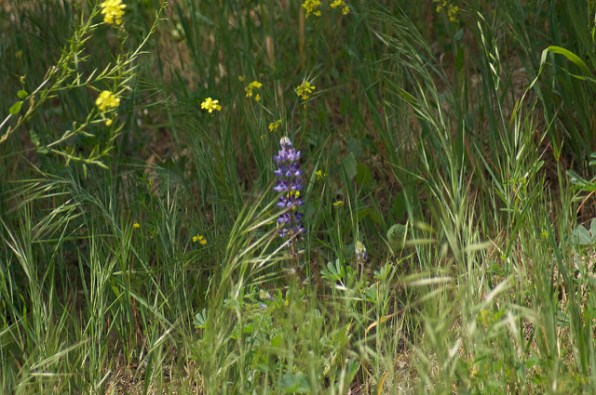
Wisteria in yard 2

Wisteria and spring blooming. Ryan BasilioCC BY

Last times

To commemorate my last post of the month-long Slice of Life Story Challenge with the Two Writing Teachers community—this is my second year of completion—I write about “last times.”

Yesterday I shared the “first time” heart map template from Georgia Heard’s Heart Maps: Helping Students Create and Craft Authentic Writing. I use these templates when I lead professional development for teachers in writing; it’s astonishing how often I hear teachers say, “I used to love writing but I don’t do it anymore.” More frequently, I hear: “I’m not good at teaching writing.”

The first step is simply to start writing.

The first and last time maps are excellent guides for this, and, furthermore, when teachers have taken these back to their classrooms, they tell me they’ve been amazed at what they learned about their students: “One of my boys wrote ‘the first time I rode a camel’. The class was so intrigued that he had to tell the story right then! We never would have known this if we hadn’t used the first times map.”

On to last times . . .

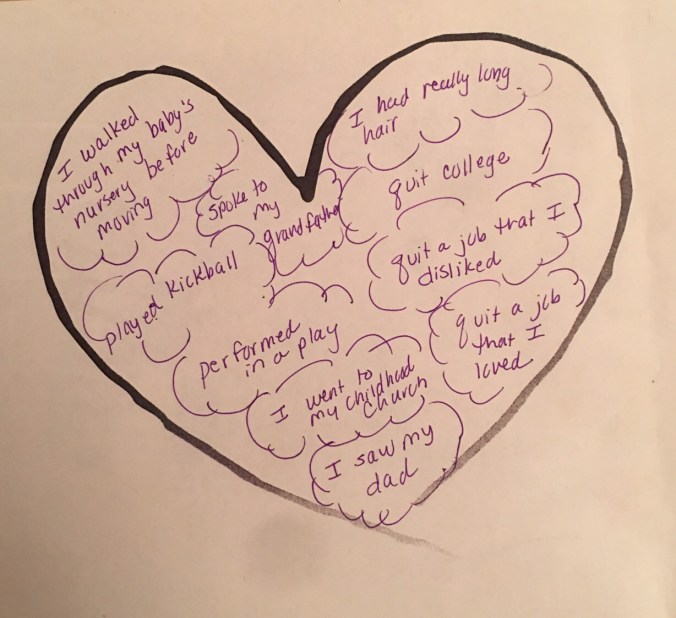
Here are mine, maybe to be spun out into full stories, one day:

The last time I walked through my baby’s nursery before moving. My older of two sons was born when my husband was in his first pastorate. The parsonage where we lived was a former sea captain’s house, built in 1915 (the year my grandmother was born), two blocks from the Chesapeake Bay. The congregation was mostly elderly; there hadn’t been a baby in the church, or the parsonage, for a long time. I was just twenty-two when my husband and I moved in, and I got to choose the wallpaper for the bedrooms. For the room that adjoined the master bedroom, I picked an ivory paper with little muted-red hearts between dusty blue stripes. A year later, I bought ivory crib sheets and bumper pads along with coordinating quilts and wall decor all adorned with these same little rustic hearts, teddy bears, and rocking horses. Our son was three when we left the Eastern Shore of Virginia to serve a church in North Carolina. I walked through the empty nursery last, where the only the little hearts remained on the walls; I stood there, running my fingers over them, and wept.

The last time I had really long hair. From kindergarten and first grade, when my hair was cut in an assortment of horrible shags, not to mention my cowlicks, I wanted long hair. By fifth grade, it was finally beginning to happen. In sixth and seventh grade, my hair reached down to my waist, was parted in the middle and as straight as a stick. In eighth grade I had a crush on a boy in my algebra class. He sat behind me. He’d speak to me occasionally, sometimes asking for help (which shows what dire straits he was in, to ask ME for help with algebra). I decided to cut my hair solely to get this guy’s attention . . .

The last time I played kickball. That was about a week ago! Due to a series of unfortunate events, there was a shortage of substitute teachers at my school on fourth grade’s quarterly collaborative planning day. I found myself taking a class to recess. It was a sunny, first true spring-like day, and the kids produced a kickball. “Mrs. Haley, will you pitch for us? Pleasepleasepleaseplease?” I haven’t played kickball since I was ten years old . . . but I was good at it, so . . . I took my place on the pitcher’s mound. My beginning teacher in kindergarten, walking past the game with her class on the way to the gym, stopped to gleefully take pictures.

The last time I quit a job I disliked. I’d had enough. I told the employers so and walked out. I never went back. Better things came along. Since then, when colleagues and friends have spoken of how much they detest their jobs, I’ve asked: What are you going to do about it?  Life is too short to be spent doing something that makes you miserable every day.

The last time I performed in a play. I was in my second year of college. I planned to be a theater arts major, having performed in numerous high school productions, and I’d just auditioned and been accepted to the American Academy of Dramatic Arts in New York City. This really sounds like a story of beginnings, doesn’t it? To stay immersed until I left on this huge new venture, I performed in community theater. At the audition for the very next play, after receiving my letter of acceptance to the Academy, I walked in, saw the handsomest man I’d ever seen in my life . . . and got married that summer instead of going to acting school.

The last time I went to my childhood church. My husband and I attended the service honoring my retiring childhood pastor, who’d become mentor to my husband, the last of over fifty young men my pastor ordained into the ministry. The church building was large; I remembered how, as a child, I’d occasionally run upstairs—there were flights and flights of stairs, some of them not adjoining; I’d have to run across some entire floors to pick up other staircases—and I’d go as far as I could, up to a little door with a dark window. I tried the doorknob. It was locked. I wondered: What’s behind there? Can I go any higher? Is God on the other side, somewhere? Who keeps the key?

The last time I spoke to my grandfather. He was dying of lung cancer, at ninety-two. He stayed at home with hospice care and refused morphine. From his years around loud equipment in the shipyard, Granddaddy was notoriously hard of hearing. He never talked on the phone for this reason, but one day when I called to see how he was, he answered the phone. Grandma had stepped outside. I talked to him for just a few minutes, almost shouting into the phone so he could hear me. He understood every word. I said, I love you, Granddaddy. You’re safe in God’s hands. He said, emphatically: I love you, Honey, and there’s no better place to be.

The last time I saw my dad. It was the week of July 4th. I’d come home with my boys to stay a few days, as Daddy wanted to take us to the shipyard to see the fireworks. He was retiring at the beginning of October, after almost forty-one years as a security guard, so this would be the last time, the only time, we’d get to do this. There’s a lot to the story that I’m not up to telling, even now; maybe one day . . .  so we went, my boys and I. As I sat there in the dark, watching the sky explode in lights over the vast, beautiful river of my childhood, sipping the ginger ale Daddy brought to share, I thought: Surely this is the beginning of better times. Daddy’s going to have more time to spend with us now. In my heart, I celebrated for him, that his working days were just about done, that soon he could take it easy and enjoy life . . . I could never have imagined it would be the last time I’d see him.  In September, just three days before he was to retire, he died with a massive heart attack. In uniform, on his way to work.

Writing about last times can be so hard, so hard, so hard.

But not always . . . as my workshop participants tell me, there’s that last car payment, that last mortgage payment, causes for celebration, indeed. Maybe even a step toward health, as in the last time someone smoked a cigarette.

So I close my thirty-one day writing streak, celebrating that I made it to the last post, celebrating my fellow Slicers who did the same, who wrote alongside me, who walked a part of the journey with me every day. Here’s to writing, friends. Here’s to sharing each other’s stories as long as we can, though perhaps not daily until next March.

Thank you all.

Here’s to your first and last times, to what’s in your heart, and to life.

Keep trusting.

First times

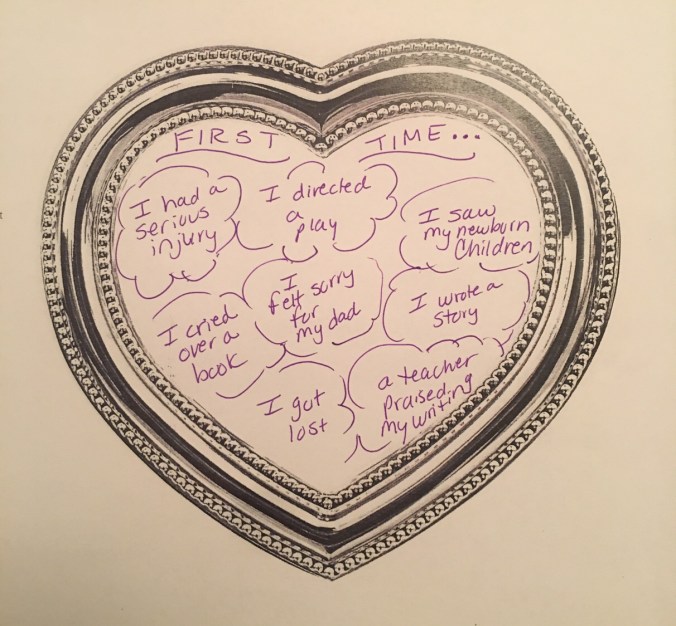
Georgia Heard’s book, Heart Maps: Helping Students Create and Craft Authentic Writing, has been out for a couple of years now, but when I facilitate writing workshop training for teachers in my district, many still haven’t heard of heart maps.

Since the first step in being an effective writing teacher is to write, I show teachers how to use this tool for themselves first.

The photo is of Heard’s “First Times” heart template. I’ve filled in many of my personal “first times” which can be spun into stories. Such as . . .

The first time I had a serious injury. I was in the fourth grade, on the playground, standing on a tire cemented to the end of a pole (two of these poles would be used to hold up a volleyball net; this pole was lying down, and I was standing up on the tire’s edge) with the intent of jumping and grabbing hold of the tallest chin-up bar. I missed. I broke my left arm. When I get around to writing this story in all of its gory detail, I must also include my dad, who came to take me to the orthopedist. He brought me an old, smudged doll that I didn’t play with anymore. It was humiliating, but at the same time, seeing him there, holding that bedraggled doll I’d outgrown, his face pinched because of the pain I was enduring, I understood that he was trying to help in the best way he knew how. Yes, I’ll need to write this story, one of these days.

The first time I directed a play. I was a high school senior and my drama teacher was  asked to send two students to the elementary school to lead a small production for advanced learners in the fifth grade. I was chosen to direct the play and a classmate was chosen to teach the students some of the tech, such as scenery and lights. One little boy in the elementary group was painfully shy; I gave him the role of the bad-boy motorcyclist and, well . . . I need to write that story.

The first time I cried over a book. Fourth grade again. The teacher read Charlotte’s Web to the class. Later in the year, she read Old Yeller to us. I didn’t think I’d live through fourth grade (broken arm notwithstanding).

The first time a teacher praised my writing. Fifth grade. The class had written “All About Me” books and the teacher complimented my description of the allergy medicine I had to take. Until this moment, I had no idea my writing had any real value.

The first time I felt sorry, really sorry, for my father. When he got paid at the end of the week, he would cash his check and go to the store for our family’s groceries. Once the shopping was done, he’d put the rest of the money in the bank. One day, when I was a young teenager, Daddy got in line with his loaded cart, reached for his wallet to pay the cashier—and discovered that his wallet was missing. Along with his whole week’s pay.

So, I walk teachers through the process of brainstorming their own “first times” for writing inspiration, before we ever talk about how students might use the heart maps.

And the teachers write. Some stare off into space, thinking; others smile. There’s not a lot of tears when we write about first times.

Those tend to come when we write about last times.

Happy blog birthday

Cake & two candles

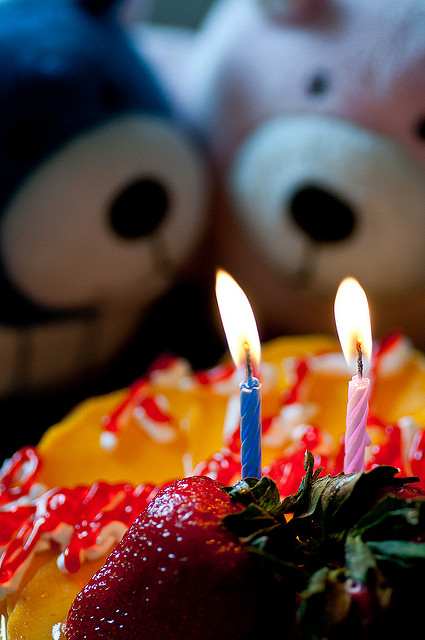
Matching candles. Ray_LACCC BY

My blog, Lit Bits and Pieces, is two years old today.

I celebrate with a little recap.

My first post, Seeing past the surface, combines a bit of memoir with teaching struggling readers. When I was a child visiting my grandmother in the summer, she took me crabbing. This activity takes a little more finesse than one realizes . . . as does helping readers make meaning of their reading.

The post with the most views is Deeper than data. It opens with a conversation during a meeting at school, where a child’s reading data is projected and I, as the literacy coach, am expected to make a pronouncement on what all this data means and what to do for the child. I say I can’t answer these things until I listen to that child read first. This post is about seeing the children behind the data points.

The post with the most likes occurred just a few days ago: Blanket. I wrote it when I was too tired to write, and I am still sitting in amazement at the response.

A post frequently mentioned to me, that seems to strike a deep chord in others, is Fresh-cut grass. As long as I live, the fragrance of cut grass will remind me of my father and evoke my childhood.

I can’t say I have a favorite post, really.  It’s akin to saying which of your children is your favorite.  I think a couple of my best are To love that well, a tribute to my mother-in-law’s life on her passing, and What child is this, remembering a former student killed in an accident. I ponder the importance of college and career ready versus life ready. Especially when a life lasts only eleven years.

One of the great joys of writing is turning back time to relive moments too precious to live just once. Here I am as a child with my Granddaddy: Red rubber boots. I walk the old paths with Granddaddy again many times in these posts.

I started this blog for a couple of reasons: to stretch myself as a writer and to walk the walk as a writing teacher and coach. If I’m going to be encouraging students and teachers to write, I’d best be writing myself. And, as Dr. Mary Howard says of her Facebook posts, that they’re her “writing playground,” so this blog is my my own writing playground. I didn’t want it to be all about education; I want to write about whatever comes to my heart and mind at given moments.

Here I simply ponder the meaning behind experiences, images, and ideas. I strive to capture what I find as best I can. If you come away feeling uplifted, then I’ve accomplished what I’ve set out to do.

I celebrate two years of writing Lit Bits and Pieces. I celebrate life.

I celebrate you.

Thank you for reading.

Hearts

Thirty-four words

img_2687

“Teaching Practices That Position Students Closer to Reading and Writing Excellence” presentation, Kelly Gallagher, NCRA, 03/19/2018.

When Kelly Gallagher gave the keynote address at the North Carolina Reading Association last week, he cautioned educators about overwhelming student writers. He said: “Start off small when modeling. Use high-interest models.”

Before students write an essay, for example, they might write a 100-word memoir after the teacher models it.

Gallagher doesn’t begin there. He starts even smaller.

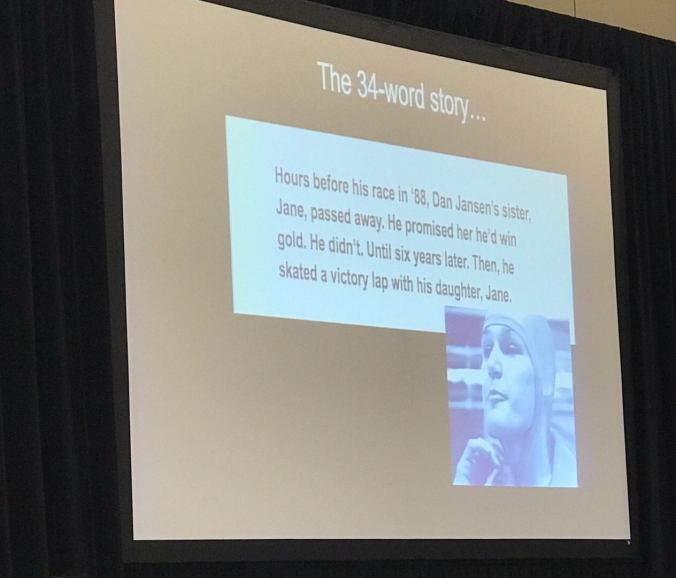
He shared the example of the “34-word story” he uses to inspire his students—that of Olympic speed skater, Dan Jansen, as seen in the photo above. Gallagher plays this Visa commercial at the outset of the lesson, to illustrate the impact of these few words:

He knows what he’s doing, Kelly Gallagher.

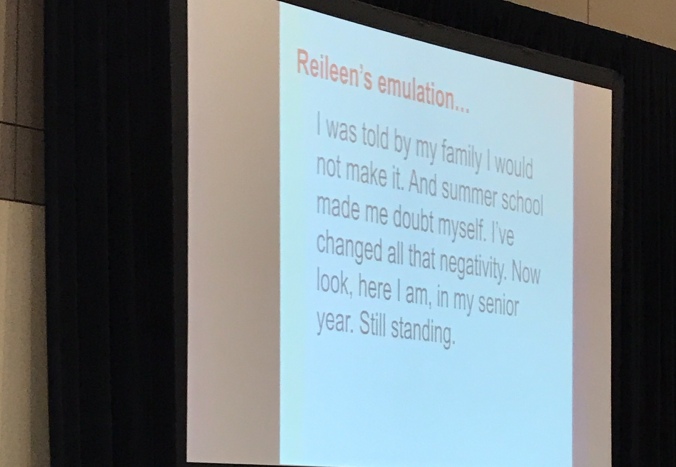
As if the hearts of the audience members weren’t pierced enough, he then shares this “34-word story” written by one of his students:

img_2688

“Teaching Practices That Position Students Closer to Reading and Writing Excellence” presentation, Kelly Gallagher, NCRA, 03/19/2018.

The absolute power of words.

Just thirty-four of them.

*******

Challenge: What would your “34-word story” be? I experiment with my own. . . .

A teacher once told me, after seeing my performance in a play: “I didn’t think you had it in you.” Guess what, teacher? There’s a lot more in me, too. Including the last word. 

I asked a friend to read my first blog post for feedback. She said, “What’s your niche? You need to target an audience.” I said, “I write for humans. My niche is the world.”

When all’s said and done, and my time here is over, I will go celebrating these things: I lived. I loved. I was loved. I got to write about it all. Thank you, God.

Heroes

img_4479

They’re heroes. All of them.

From across the state of North Carolina, they gathered in the capital city. Fighting crowds and full parking decks, between a St. Patrick’s Day parade, a street festival with an Irish band, a pub crawl, and educators arriving for the North Carolina Reading Association conference, the children made it to the Young Authors Project celebration.

These young people, from kindergarten through twelfth grade, and some of their teachers, were previously recognized by their local reading associations for writing on the theme “Show Your Strength.” Finalists went on to be judged by a panel for the state, and yesterday the North Carolina Reading Association awarded winners a book of their published entries and a medal.

Prior to the ceremony, such figures as Batman, Wonder Woman, and the X-Men swept through the audience, greeting the children, congratulating them, posing for pictures with them.

Project Superhero, Inc. and Causeplay Carolinas team up at the NCRA Young Authors Project celebration. Photo: Twitter, @superheroorg 03/17/2018.

Note the word POWER on the photo-op backdrop . . .

I thought immediately of the power in writing.

I watched as the children were called, county by county, to receive their awards on stage, their faces glowing. I’ve read their stories, how they showed their strength by sticking with tasks they thought they couldn’t accomplish, reaching desired goals, drawing inspiration from others, overcoming bullies, conquering their greatest fears, coping with illness, the loss of pets, of family members. How they got through, even when they didn’t think they could.

It takes courage to be a writer, courage to be a child.

There they stood, heroes, all.

Celebrating each other, celebrating their stories.

Celebrating perseverance. Celebrating courage. Celebrating hope.

Celebrating life.

img_4482

Cadillac man shares his writing!

A few days ago, I wrote about my son, the Cadillac man. I call him this for his lifelong love of the brand, especially his grandfather’s 1989 Sedan de Ville, which was bequeathed to him. I wrote how the Cadillac man hates writing and only did what was necessary all through school, to my despair.

Sometimes the smallest things shift the universe in mighty ways. During my month-long daily Slice of Life Story Challenge, Cadillac man read my blog post from our dog Henry’s perspective and was inspired, for the first time in his twenty years, to write a story.

“I wonder,” he said, “if I can write a post from Nik’s perspective. To see if I can actually do it.” 

He DID do it.

Then he said, of his own volition (wonders never cease!), “Mom, you can put it on your blog if you want to.”

Here’s what you need to know: Nik is our very old dachshund. We got him as a puppy when Cadillac man was only four. The old man in this story is my husband (“WHAT?” my husband howls with laughter—he’s loud, all right—”Old man? Really?”). The boys are Cadillac man and his big brother. Then there’s me.

Note the recurrence of Darkness. Cadillac man says to tell you that for Nik, “the Darkness” is being confined to a crate, the worst thing of all to him. The “something wrong” is my husband’s diagnosis of ocular melanoma two years ago, resulting in the loss of his eye. 

Today, I celebrate my son’s writing. Again I say: When you finally show up for the writing, the writing shows up for you, and gets you through. 

Published with permission from Cadillac man:

Nik’s Perspective

“Nikolaus, get back on your bed!”

The old man was screaming again. This was nothing unusual. He always seemed to be screaming at something. Whether it was at the people in the glowing window, or in the box he holds to his head, he screamed at everything. I don’t even think he’s angry most of the time; he just seems to be perpetually screaming.

The difference now is that I can barely hear it.

In January, I celebrated my sixteenth birthday. Sixteen years of life, celebrated in one short day.

When I was born, the first Human I had was an elderly lady, not much older than me in human years now. I don’t remember much about her, but I remember the Darkness. The closed-in Darkness that haunts me to this day. I still have to endure it occasionally, but it’s nothing like it was. The Darkness was always there; it enveloped me and I couldn’t leave it until the mesh door was opened, and back then it was only open for eats.

My first vivid memory was when I met them. The loud old man, the (then) teenager, the (then) toddler, and her. Oh, how I loved her. She always filled my bowl just right, she always gave the treats I loved, and she was the warmest lap to nap on. She was also the one who took me to the white place, which was almost as bad as the Darkness. The white place was where these humans poked and prodded me and gave me the needle. But if I was a good boy, which I always was, she, the teenager, or the toddler would give me a treat.

Most of my time was spent with the two He’s, the teenager and the toddler. I vividly remember nights spent curled up in their arms. Those were the warmest places. I felt safe there. I’ve seen the teenager grow into a man, leave the home, make a life for himself, and come back. And I saw the toddler grow into his 20s. I saw him through every hardship, every death, every break-up, and every victory. I remember his long sleepless nights as he stayed awake holding me for warmth, as I am a very warm dog. I remember the sudden screaming at night that would scare me to death at first, but I got used to it and eventually learned how to wake him up when it happened.

I remember all the other associates I had over the years. Some left to find other families, and some left when their time down here was no more. There was Duke, the tough yellow one with whom I worked the first six years of my life, until heartworms took him way too soon. There was Toby, who came after Duke, who was a bit older than me. He was a great partner until he just didn’t wake up one morning. There was Phoebe, Godiva, Tex (I’m not convinced he was even a real creature of this earth). There was Natalie, whose tenure here was ended after an altercation left me with a bloody nose.

Then came the dark day. I don’t understand exactly what it was; perhaps I never will. All I remember was the loud old man coming home, looking defeated and unsure. I remember being in the big room with the glowing window, which wasn’t glowing at that time. I couldn’t understand what was going on, but suddenly the whole room fell completely dark, like the Darkness had gotten control of the Humans. I knew there had to be something wrong with the old man. I had never really liked him. He was loud and scary. But I knew I had to do the right thing. I spent that whole day curled up next to him, which I rarely did. He seemed so calm and so quiet that it worried me.

The old man is back to his old self again, with the exception that I don’t think he can see very well anymore. But for that matter, neither can I.

My only way of finding out where I am or who I’m with is by smelling. I can’t find my bowl on my own anymore, but every morning they still fill it just right, and I eat every bite. I can’t walk up the steps to the room where I sleep, but the toddler-now-20-year-old still carries me up there every night. There are two other associates who do most of the comfort and protection work for me. There’s Banjo, the loud boisterous one who stays outside and protects from intruders, and Henry, who stays inside with me and tries his best to make me stay in my bed, even if it gets on my nerves. They both will carry my torch of comfort and protection long after I’m gone, I have no doubt. The Humans are in good hands with these two.

These humans were my life. I spent years as their comforter, their walking partner, their protector, and their friend. They saved me from the Darkness that could’ve endured my entire life. And as I sit here, just waiting, all I can hope for is that I saved them from their Darkness, too.

-Nikolaus Haley, expert red dachshund

The writing shows up

While I—er, I mean Henry, our dog—composes his own blog post, my younger son (the Cadillac man) drifts through the kitchen.

I pull up a previous post on my phone and hand it to him:

“Here, read the comments about you and Pa-Pa’s Cadillac.”

He reads, smiles. He’s pleased but says little. He’s a man of few words.

He won’t ask, so I tell him what I—um, Henry—is working on: “This is the next post. Henry is writing it in response to one I wrote about him interrupting my writing.”

“Hmmm,” replies the Cadillac man.

“Want to read it?”

“Sure.”

So the Cadillac man sits down at the table and takes my laptop. He reads Henry’s post-in-progress.

“I like it,” he says.

He sits for a minute.

Then: “I wonder if I could write from Nik’s perspective.”

Nikolaus is our sixteen-year-old dachshund. We got him as a puppy when my son was four.

As I take my laptop back, I say, rather airily, “You should try it.”

I don’t expect him to.

He hates writing.

This is a big, jagged stake in my heart.

His older brother loves writing and even maintained a blog for a while, long before I started this one. But the Cadillac man has gone all the way through his academic career cracking books only when he had to, writing only when forced for assignments, and utterly exasperating me with his lack of interest. He didn’t struggle with reading or writing. He just didn’t care about any of it.

At all. Ever.

He’s a brilliant musician, however, and a powerful vocalist. He’s loved music all of his life. At age seventeen, two weeks after graduating from high school, he was hired as a church music director. He’s working on a degree in that field. He’s adapted songs, composed a little—”just the music, not the words. I don’t do words”—and coaches others as they try playing instruments new to them. He speaks beautifully before a crowd, did so at Ma-Ma’s funeral despite not having any notes, because . . . he hates to write.

So, when he mentions writing about Nik, I think he’s just wondering out loud, nothing more.

He leaves the room. He comes back to the kitchen table with his new Chromebook.

“Do you have homework?” I ask.

“No, Mom, it’s spring break, remember? I’m going to write a story from Nik’s perspective. To see if I can actually do it.”

What?

The first time in his twenty years that he’s chosen to write a story.

I feel like the floor under my feet is shifting, that the Earth itself hangs in the balance. I have to leave the room.

I can’t stand it. I have to know.

I creep back into the kitchen.

He’s typing away.

“How’s it going?” I dare to ask.

“Pretty good.”

“Is it . . . fun?” I hear my voice quaver.

“It’s sad, really,” he says.

He finishes, lets me read it.

We know Nik won’t be with us much longer. He’s old. Frail. He’s going blind; his eyes are turning milky. My son’s words show Nik making his peace with all of this, that he’s satisfied he’s served his family well, and how he knows our other two dogs will “carry my torch of comfort and protection long after I’m gone.”

The attribution reads Nikolaus Haley, expert red dachshund.

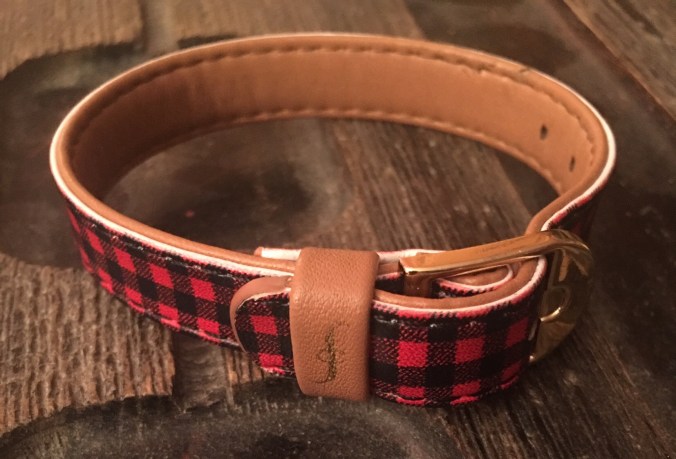
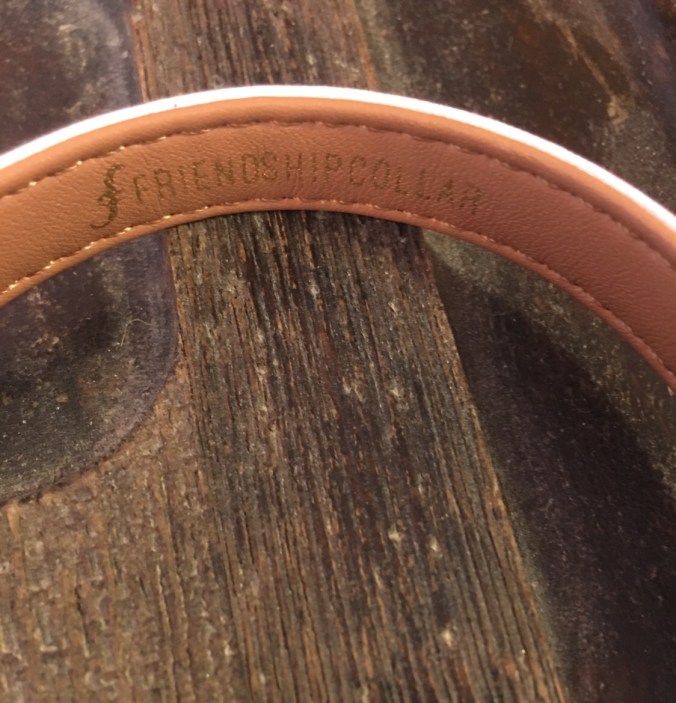
My throat is tight. Nik and the Cadillac man have been together almost their entire lives. Every single day. They wear a matching red-and-black checkered friendship bracelet and collar.

“It’s a powerful story,” I manage.

“Thanks,” says my son, softly. He gets up from the table, gathers Nik, who’s been wandering aimlessly around the kitchen this whole time, and takes him upstairs to “the lair,” as we call it.

I read the story again and again.

Thinking how he said to see if I can actually do it.

I think he meant getting in Nik’s head to write from his beloved dog’s viewpoint, rising to meet a challenge he set for himself.

And then I think how, when you finally show up for the writing, the writing shows up for you, and pulls you through.

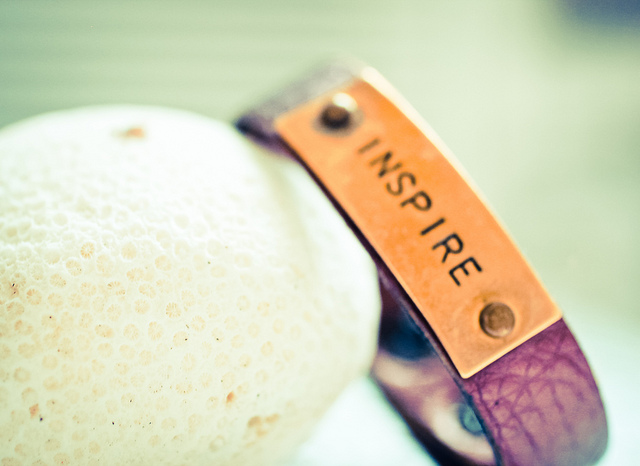
How do I inspire them?

Inspire

Inspire. chattygdCC BY 

The crowd of educators goes to lunch, posting their “gots” and “wants” on a chart as they exit the morning’s session on growing young writers. My co-facilitators and I look over these sticky notes, preparing to address the “wants” in the afternoon when the participants return.

One note in particular grabs my attention:

I want my students to be excited about writing and to write more. How do I inspire them?

“It’s all yours,” say my colleagues.

I smile.

This is what I love.

Educators talking about inspiration. It’s vital to professional development, to the work that we do

To inspire, one must first be inspired.

Author Avi, in a Skype with students at my elementary school a couple of years ago, defined inspiration as breathing life.

Writers are life-breathers.

So are teachers.

Lucy Calkins, speaking of launching writing workshop, says: “No matter how tentative and insecure you may feel, role-play your way into being confident of yourself and your children because they will hitch a ride on your enthusiasm.”

It’s more than modeling the writing; it’s modeling a passion for writing. It’s digging deep within yourself to find your own stories, your own ideas, your own stances, and giving life to them . . .

The crowd returns. Little knots of teachers, support personnel, and administrators spanning kindergarten through high school, chattering, laughing. They take their seats one by one; an air of expectancy settles over all as my co-facilitators and I respond to their “wants.”

It’s my turn.

I want my students to be excited about writing and to write more. How do I inspire them?

“If we want students to get excited about writing, we must be excited about writing. We must write more ourselves, for ourselves first. Walk the walk; if we’re telling them writing is important, we’d better be writing ourselves. That’s why I started my blog, to keep me writing consistently. Tap into your own memories, the things that matter to you. Write in front of the students; show them every step of the way, how the ideas and images come to you, why you want to say what you’re trying to say, why it’s important.  That’s authentic writing. Tell students writing is the closest thing to magic that there is. Show them the power that’s in it. That what THEY think and feel matters. Good writing is labor-intensive; they have to get a taste of why it’s worth it. Tap into their emotions; there’s always a way . . . help them see that writing isn’t just something to be done for school for a grade, over and done. Writing is about life itself . . . .”

Breathe life. From your writing to theirs, from your soul to theirs.

There’s a whole world within each young writer. There’s a world around them that they’re grappling to understand. A world with a place for each of them. We don’t create these worlds for them. We just open the doors.

“Another world is not only possible, she is on her way.

On a quiet day, I can hear her breathing.”

– Arundhati Roy

Why I DON’T write

img_3902-2

I think this picture says it all . . .

I took it while trying to write a blog post.

This is Henry.

He belongs to my older son. Who’s back home for a while.

Hmmm . . . thinking of all those pets I foisted on my dad . . . is this poetic justice?

I type a few words, then stare, unseeing, trying to capture the elusive idea, drawing vague images out of the shadows, turning words and phrases around and around for the right rhythm, my mind miles away. I am not even in the world at the moment . . .

A nudging at my lap. The worming of a furred head between me and the laptop.

I am pulled back from wherever I was.

From my lap, two brown eyes look up at me, unblinking.

The images recede, the lovely phrases fall apart in chunks, the idea skitters away.

“What, Henry, WHAT?”

Wagging of tail, perking of ears.

He runs to the back door. Does a dog-dance to go outside. I call it his reindeer dance, because that’s what he looks like, back feet stationary and the front part of his body springing upward, repeatedly.

He’s out there for forty-eight seconds before he’s barking to come in.

He needs his treat.

Okay.

I settle back at the laptop. What was I thinking about—? Oh yeah . . . 

I type, oh, five or six words.

A nudging at my lap.

I ignore it.

A warm head worming its way between me and the laptop.

I am NOT looking at him. I am WRITING.

He finally withdraws his head. Good. He’s giving up. He’s going to to the living room to get on the couch, thank heaven.

But no.

A soft whine.

I don’t look. I reach over, pat his head. Tail thumps. I am going to finish this post . . .

A low grumble.

Then a louder, longer, much more rumbly one.

“Henry. STOP.”

I make the mistake of looking . . . and take the picture to prove why I don’t write.

He needs to be loved right now. That’s all he wants, to be petted and to snuggle. For me to give him my undivided attention.

It’s my own fault. I’ve spoiled him. I cave, but it gladdens my heart. His fur, especially the white patch at this throat, is silky-soft; he arches and rubs against my hand as if he were a cat.  He exudes comfort and luxuriant well-being. Henry could be a therapy dog; it’s impossible to be sad, angry, or troubled in any way when he’s leaning against me or lying with his head on my feet or even while he’s devising clever ways to get petted. He craves being touched, responds to it with absolute bliss, wriggling, writhing. The words I say to him most often are Sweet boy. Sweet sweet boy. 

He intrudes on my writing. He’d say my my writing intrudes on him.

One day I’m going to put Henry in a story. It’s a really important role; I’ve got it figured out.

I guess I’ll have to teach him to write it, because he’s certainly not going to let me do it.