Your why

Last Friday at school our professional development centered on finding our whys. For we are not made of what we do; we’re made of why we do it.

In a YouTube video, comedian Michael Jr. puts it this way: “When you know your why, you have options on what your what can be.” To illustrate the difference between knowing what and knowing why, he calls on a member of the audience (a school music director by the name of E. Daryl Duff) to sing a few bars of “Amazing Grace.” Duff’s voice is resonant, beautiful. Michael Jr. then asks Duff to sing as if a couple of specific, tragic things had happened to him; the transformation is stunning. Duff sings in a higher key with a vibrato full of emotion and energy—see the “Know Your Why” video).

It’s a perfect example of how our power, our potential, lies in knowing why we do things.

So, my colleagues and I got to work on finding our whys. 

We were to map at least five peaks and valleys in our lives; if we needed help, we could use a memory prompt based on the work of Simon Sinek:
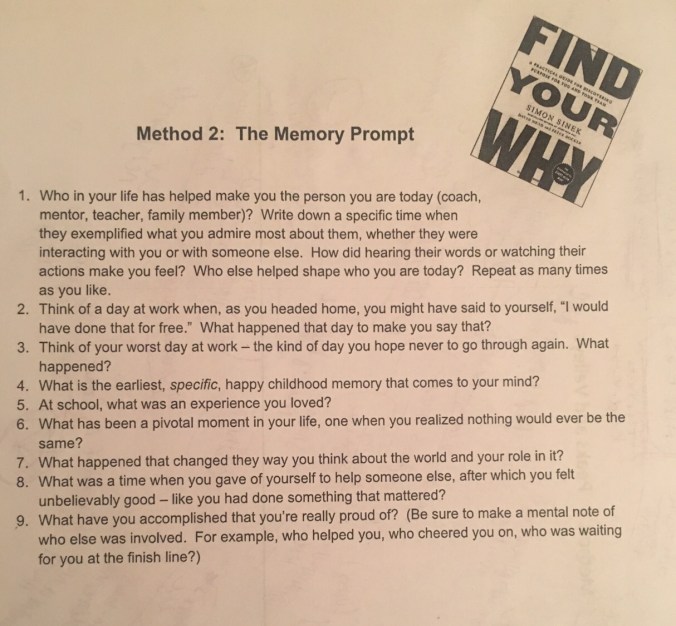
Our principal modeled the activity first (let us remember that good teaching and good writing have a primary rule in common: Show, don’t tell). The peaks and valleys didn’t necessarily have to be milestones in our lives, but experiences surrounded with much meaning or emotion, maybe turning points, times we gained knowledge that changed us. The more specific we could be in listing several significant life events or people that made an impact on us, the better we’d get to our why. 

Mulling the suggestions and the need for specificity, I chose these events, people, and moments that first came to mind as being beyond the norm:

Thinking of such experiences and writing them can be emotional, but sharing is where the emotion really kicks in.

Laughter. Tears. Reassuring hugs.

In pairs who were moderately comfortable with each other, but who didn’t know each other really well, we shared some of our peaks and valleys. We didn’t have to share everything we wrote, just the items we wanted to share. We told why we chose these points in our lives and what stood out about them. While one partner read, the other listened for connections or patterns in those life events, made notes, and then the roles switched.

We then shared what we discovered about one another.

In my case, my father’s sudden death (my lowest valley), reading “The Murder of Robbie Wayne, Age 6” in The Reader’s Digest when I was a young teen, my birthday party when my mother invited a boy who had bullied me, and a boy who did one of the greatest acts of kindness I’ve ever seen back when we were in 5th grade (I wrote about it: The Valentine) all connect to my present notions of fairness, doing what’s right, and being an advocate.  My having asthma as a child, my husband’s loss of an eye to disease two years ago, and my return to college to finish after a span of many years have a common theme of overcoming. The others—my husband’s ministry, my grandmother’s belief in me, my volunteering to do a play with elementary students when I was still in high school, my blog, the professional development I’ve led in writing, my boys’ individual accomplishments in music and leadership, and the high school teacher who saved the lead role in The Matchmaker for me to read in class—are tied to inspiration.

Synthesizing all of this leads to drafting a why statement comprised of our contribution and our impact:

To _____________________ [contribution] so that ___________________________ [impact].

Mine, at the moment, is this (still working to tighten it further):

To inspire others so that they know they can overcome obstacles and setbacks.

This is why I do what I do; some of the whats are literacy coaching, encouraging others to write, and writing this blog.

I wonder, now, how many colleagues—how many people in the world, actually—have their whys and whats aligned. Seems to me there’d be incredible frustration, anger, anxiety, depression, imbalance, and utter lack of fulfillment when whys and whats aren’t aligned, when people don’t recognize their contribution or see the impact they can make. I think of people in jobs that don’t match their whys and how such dissonance makes for misery.

In The Art of Coaching, Elena Aguilar writes of a teacher struggling with classroom management. The man couldn’t bring order because, when he was in school, he suffered being stereotyped and devalued by a teacher. Being the authority figure for his students felt like he was doing the same to them. He went into teaching because he had a genuine love for the kids, but his core beliefs, his why, the very essence of who he was, wouldn’t allow him to establish the needed structure.

He couldn’t change his why; he could only change his what. He ended up leaving the teaching profession.

“When you know your why, you have options on what your what can be.”

We are not what we do.

We are why we do it.

Knowing that, as Robert Frost might say, makes all the difference.
Believe

img_4350

A writer is first a receiver, open to messages all the time, always watching and listening. A message or image can come at any moment; the writer’s job then becomes How do I interpret this? What meaning shall I attach? How will I shape this notion, this idea, this sense of something, into words to relay it?

The greatest challenge is capturing that first fleeting message before it’s lost; I heard an author say once that “a new idea is fragile thing.”

Sometimes a writer recognizes that an idea is hovering close and just hasn’t landed yet. Some ideas flutter and dart about like hummingbirds for a while. For me this is like Yeah, I know you’re there, Idea, whatever you are. I feel you darting in and out. One of these days I’m going to get ahold of you but right now I am tired of the chase.

So it was on a day that I visited the hair salon. One of my favorite things there is the complimentary coffee bar for clients. As the iCoffee machine whirred and glowed with blue light, illuminating the cup (so mesmerizing), I reached for a napkin.

The napkins here are always pretty, often seasonal. A lot of thought on someone’s part clearly goes into the napkin choices, no detail being too small or insignificant in creating a pleasant experience.

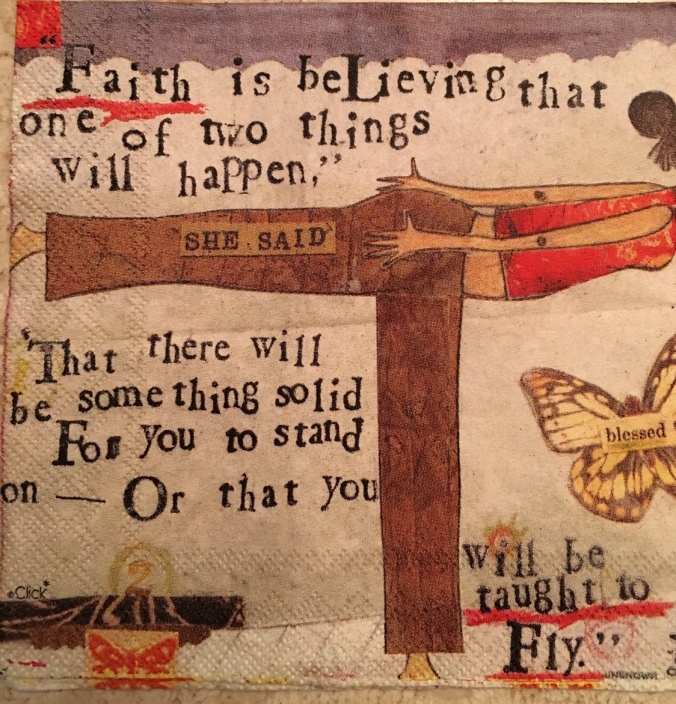
This napkin was a message.

You saw it yourself, at the top of this post—that’s a picture of the napkin.

Coffee momentarily forgotten, I stood there thinking, I’ll write about this. Somehow . . . 

Yesterday I told someone: “When an image comes to you, Writer, use it!”

Today I return to the napkin, thinking. I finally decide to Google the phrase printed on it, suspecting that it’s connected to an author out there somewhere.

Aha. The quote seems to have come from Patrick Overton’s book of poems entitled The leaning tree: 

“When you come to the edge of all of the light you’ve known, and are about to step off into the darkness of the unknown; faith is knowing one of two things will happen. You’ll have something solid to stand on, or you’ll be taught how to fly.”

The idea is so near now that I can feel its wings beating against my soul

Believe. Believe. Believe.

Like the beating of a heart.

I wonder what word would remain if the napkin were tossed outside, trampled on, battered by wind and rain. What the last surviving word would be.

Maybe faith.

Maybe believing.

Maybe fly.

For the napkin in my hand is ephemeral, meant to be thrown away.

Faith, believing, and fly — hear the wings, feel the breeze stirred by their rustling? — are eternal.

Oh, wait—there’s one tiny word there on the napkin, there on the butterfly—how could I have almost missed it?

Blessed.

Thank You, I whisper at last.

And I write.

Celebrating Young Authors

Show Your Strength

Raleigh-Wake Reading Council 

This afternoon, I am celebrating young writers from kindergarten through high school. Our local reading council, affiliated with the International Literacy Association, sponsors the Young Authors Project annually. Students write on a given theme and council members submit their work. A committee then scores the pieces for quality of content and structure. This competition is about encouraging young writers to work hard at the craft, to tell their stories well. The stories are published in a local book. Some stories have gone on to the state level, to be recognized and published later this month by the North Carolina Reading Association.

This year’s theme is “Show Your Strength!” The students could write about their personal experiences of perseverance, how they’ve overcome obstacles, how they found strength in a time of weakness, and who or what inspired them to rise above a particular challenge.

It’s my honor today to be the speaker at the awards ceremony.

Here’s my tribute to these courageous writers:

Thank you, members of the Young Authors Committee and the Raleigh-Wake Council for encouraging students of all ages to write. Thank you, families and teachers, for being the wind beneath the wings of these young writers; because of your support, because of your belief in these writers, many of them have now flown higher than they ever thought they could before.

And thank you, Writers, for your stories. I’ve read your work and it’s breathtaking. I stand in awe of what you’ve experienced and how you captured it on paper.  It’s an honor and a joy to celebrate your courage, your beautiful work, and your personal victories today.

So you know that I am a writer, too. I remember being six years old and sitting at the coffee table in my living room with some notebook paper and a pencil, trying to write a story, not because a teacher told me to, but just because I wanted to. Something inside me needed to get out and even at age six, all by myself, I understood that I needed to write it. I’ve been writing all my life and I’ve written a lot of different things for different reasons, but I do it mostly because I love it. Why do I love it? I think it’s because writing helps me see things in different ways, sometimes in deeper ways than I would have if I didn’t write.

Here’s an example from last summer: I noticed that seahorses had started showing up in my life. Yes, seahorses! When I ordered some books, they came with a tote bag that had a seahorse on it. A friend gave me a notebook that happened to have a seahorse on it. I took my seahorse tote bag and my seahorse notebook to a teachers’ writing workshop at the beach, where I was given a journal to decorate . . . guess what was in the decorations? Seahorses! This, Ladies and Gentlemen, is what we a call a motif, a symbol that keeps recurring, or showing up. I started wondering if there was a reason for all these seahorses suddenly appearing —what could they mean? I do what writers always do: research. I looked up seahorses and I learned a few pretty cool things: The scientific name of the seahorse is hippocampus, the same word for the part of the human brain that’s the center of emotion and memory. As a writer, this connection between the seahorse and the human brain fascinates me. I also learned that seahorses are a species recorded as the slowest swimmers in the animal kingdom. They swim so slowly that they can die of exhaustion when storms come and churn the seas, so seahorses use their tails to anchor them to long grasses and corals. They survive by being anchored.

And that’s another big thing that writing does for me; it anchors me, it helps me survive whatever comes.

Seahorses, Writers, are a symbol of perseverance, the very theme that you wrote on for our Young Authors Project. You’re here today because you persevered in writing your stories.

Your stories show your strength as writers and your strength as human beings. Stories, in the end, are gifts that we give to others. We give these pieces of ourselves away to make other people think and feel; writing is an almost magical connection between the heart and mind of the writer and the hearts and minds of readers. There’s power in it. Think about it. We can use our words, our power, to hurt others or to strengthen them. Be mindful that you always use your power for good.

It is my hope, as a teacher of writing, that you will keep writing. Today is just the beginning of what you can accomplish, and you’ve started off so strong! Good writing is hard work. Sometimes it comes so, so slowly. Don’t give up. Always remember there’s power in writing and the effort is always worth it. The more you work on your writing, the more your writing will work on you; it will give you more and more strength to share with the world, and the world needs you.

Thank you all.

Get words

Imagine what is over there

Imagine what is over there. Kenneth BarkerCC BY

Last night I met with a small group of teacher-writer-colleagues from my district.

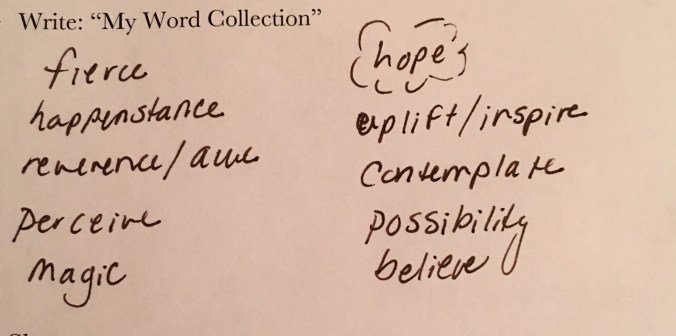
We started our discussion by writing words that resonate with us.

-Quickly.

Mine are:

fierce    happenstance   reverence   awe   perceive  magic  hope   uplift   inspire               contemplate   possibility   believe

I don’t know why this was hard or why some of these words came to me (happenstance? Go figure. Must just be the sound of it. What other reason could there be?).

Then we had to pick the word that was most significant to us.

Mine is

      hope

for in every aspect of my life, I am hopeful. If I could impart one thing to others, it would be hope.

Hope is vital to the human spirit.

My colleagues and I talked about our work with students, other teachers, and our own writing. Where we’ve been, where we are now, where we want to go.

       uplift

               inspire

Going home, the lively discussion and energy circles round my mind. Something in there is trying to find a landing place.

                         contemplate

The “something” is tied somehow to student reactions . . . the ooooohhhh moment that’s such music to a teacher’s ears . . . like when a student connects a thing he/she loves to a book, or to writing . . . this week in fourth grade, it was me asking Why is opinion writing important? with a student responding You write about what you feel deep in your heart and another student saying Like music. I can write about why I love music. I want to write songs and me saying, Well, maybe you need to write your opinion piece AS a song.

—beat—

OOOOHHHH

       reverence

                             awe

And then I think, fierce is an odd word for me to pick yet it was the first one that came to mind. Why is that?

Fierce love like mother for child, fierce dedication to excellence, fierce desire for learning.  Maybe that’s why.

The something circling in my mind is materializing. I think it’s another word . . .

                                                    perceive

Not that word.

The word is—well, awfully simple:

Get.

Get?

Yes, get.

Get what?

Get them reading

Get them writing

Get them talking

Then get out of the way.

Oh, I get it.

My colleagues and I talked about that.

And

Get out of the box.

Because that’s where all the

          magic

happens.

We don’t make it happen.

They do

but only after we tear down the walls

of windowless boxes

so that they can see the glimmering horizon beckoning

and be free to

imagine

what is over there.

                       possibility

And that they can

get excited

get through

get there

if they only

      believe

And that comes only from the stirring the ocean within

Not by sea-spray on the wind without

never never by

                           happenstance

March (writing) madness

slice-of-life_individual

I’ve just noticed how much the Two Writing Teachers Slice of Life badge resembles a basketball.

I find this coincidence captivating, as today kicks off a special season of challenge for both: a month-long daily writing commitment and March Madness.

Bracket predictions are not my thing, but writing is, so I am fondly dubbing these thirty-one days March Writing Madness.

Truthfully, it’s almost madness for me to write a blog post every single day in March. A quality post, that is. I can’t share something until I feel I’ve hammered it into the best possible shape, and in a normal week, that comes to just a post or two. This daily venture is daunting. It’s expensive. I know what the Slice of Life commitment is going to cost me in time and energy. Sacrifices will be required.

But, oh, the payoff . . .

First things first: I started Lit Bits and Pieces in March 2016 as a means of stretching myself as a writer. As much as I enjoy teaching writing and coaching teachers of writing, I recognized the hypocrisy of encouraging others to write consistently if I wasn’t doing so myself. I needed to walk the walk . . . and so this blog was born. I set only two goals in the beginning: To write about whatever comes to mind and to make it uplifting to readers.

In the two years since, the blog has become a life-library for me.

I’ve relived childhood moments; I’ve explored the mysterious; I’ve turned events and things around in my mind, finding connections and analyzing meanings; I’ve tinkered with poetry, flirted with fiction, and captured precious, priceless experiences with students, colleagues, family members, and friends.

I knew when I signed up for last year’s Slice of Life Challenge—my first—that I would be pushing myself even harder, further, as writer. That was expected, desired.

The unexpected, greater payoff: My fellow Slicers. People whose powerful words kept my momentum going when I was almost out of steam, who valued what I wrote, who encouraged me to a degree that I can’t adequately convey. People to whom I owe a debt of gratitude and the honor of encouraging in return . . .

What a difference a month and a writing community make.

While the March Madness basketball tournament is about eliminating the competition (hence those NCAA bracketeers), the Two Writing Teachers Slice of Life Story Challenge is about cheering each other on to the very end, so that all are victorious.

Today, as I take my place in the line-up, I celebrate you, Slicers, extraordinary individuals that you are, every one of you a champion, in this arena where the joy you get is also the joy you give.

That’s the buzzer, friends . . . time to write like mad.


The Valentine

Broken heart

Here’s a mentor text, a modeled memoir originally written for a fifth grade class a few years ago. It’s a true story from my own fifth grade year. These long-ago events etched themselves on my young heart as they unfolded. Some of the minor details are fuzzy, but I remember the intensity of these moments. I see every classmate’s face; I recall every name, although I’ve opted to alter all but my own for a comfortable anonymity in the face of hard truths.

For it’s a hard slice of life.

Today I dust off that Valentine’s Day I’ve never forgotten, reinforce it with a bit of word-glitter and glue, and give it to you  . . . 

On a cold but sunny February afternoon, my fifth grade class gathers on the kickball field to choose teams. The two captains flip a nickel to decide who’ll go first; my friend Shannon wins. She and Davy stand side by side for a moment, scrutinizing the rest of us as if they are drill sergeants and the rest of us are boot camp recruits.

“Allen,” says Shannon.  Allen is always the first pick because he’s a go-cart racer, competitive and very popular. He likes to win.

Allen jogs over to stand behind Shannon.

“Jon,” says Davy.

I think, That’s kind of surprising.

Jon came to our class late in the fall. He used to be the last pick for our teams, since he wears big, thick glasses and doesn’t seem very athletic. At first the boys called him Four-Eyes and the girls said he looked like a little old man because of the way he hunches his shoulders up to his neck most of the time, in addition to the bowl-style cut of his hair. We really don’t notice him that much any more, as Jon is so quiet. When Davy calls his name, Jon trots in his stooped-over way to stand behind him.

“Fran,” says Shannon, after a pause.

YESSSS!” I whisper. I take my place behind Allen, who gives me a high five.

I love kickball. Next to jacks, it’s my favorite game to play with the class—these are really the only two games I’m any good at playing. Once when I slid into home plate I peeled up a whole strip of turf in my shoelaces, but I was safe!

The captains continue choosing players, until only one girl remains.

Eloise.

She, too, is new to our class, arriving just after Christmas break. Eloise is unusually tall, taller than Shannon, who’d been the tallest girl in the school until now. Eloise is as big as a grown woman. Her brown, frizzy hair puffs out from her head like a cloud. It flutters when she walks. One of her front teeth is chipped. Her eyes are the color of the summer sky, and at the moment, they’re a little teary.

Davy sighs: “All right. Eloise.”

Eloise scurries to the end of Davy’s line, looking at the ground.

During the game, Eloise tries with all her might to run and kick the ball, but she misses and loses her balance. When she falls, we can’t help laughing. Eloise, her face pink, gets up by herself and runs to the back of the line once more.

I don’t know what makes me keep my eyes on Eloise, and why I began wondering what it must be like to always be picked last, or to hear other kids whispering things like Neanderthal and  Amazon, never when Mrs. Peterson might hear. I try to imagine how embarrassing it would be if I was too big to be comfortable in the classroom desks and if regular girls’ clothes wouldn’t fit me. I am already clumsy, which is why I’m not good at most sports. Except kickball.

What would I do if no one wanted to sit by me at lunch or went the long way around my desk, the way we do to Eloise?

Watching Eloise with her face turned toward the ground, I suddenly don’t feel like laughing anymore.

Back in class, after a stop at the water fountain, Mrs. Peterson passes out sheets of Manila paper.

“Today, Class, you will write the first letter of your name in cursive on the paper and turn it into an animal or a design that represents you.”

Mrs. Peterson’s first name is Felicia; she holds up  her paper to show how she’s turned her cursive “F” into a giraffe.

Everyone gets to work. Except me. I am stumped for how to turn my own cursive “F” into anything artistic. I have trouble making a cursive “F” in the first place. Everyone says my “Fs” look like “Ts.”

I have no idea what to draw.

To waste time, I get up and sharpen my pencil. I pass right by Eloise’s desk, where she’s bent hard at work. On her paper, she’s written a large, elegant cursive “E,” the fanciest one I’ve ever seen.

She’s turning it into the open wing of a bird.

Before I know what I’m doing, I blurt: “Oh my gosh! That’s beautiful, Eloise!”

Mrs. Peterson comes to look. “It’s lovely. Why don’t you show the class?”

Eloise, looking alarmed, shakes her head. Her fuzzy brown hair bobs like ocean waves.

“May I show them?” asks Mrs. Peterson.

Eloise nods, turning pink again.

Mrs. Peterson holds the paper high. “Just look at what an amazing artist Eloise is, everyone.” She turns slowly so all can see, the way teachers do with pictures in books.

“Oooooo,” breathe my classmates.

Someone says “Wow.”

Eloise’s pink face glows. She smiles, revealing her chipped tooth; her sky-colored eyes sparkle.

I want to freeze this moment for Eloise, and for myself, to capture it for the wonderful and powerful thing it is, but it is quickly gone, and the next day at lunch when she knocks her milk carton over, we all laugh at Eloise again.

Even as we laugh, I feel bad inside.

What’s the matter with me? Why do I laugh when it doesn’t feel right? 

After lunch, Mrs. Peterson gives a speech:

“Ladies and Gentlemen, as tomorrow is February fourteenth, you may bring Valentines to exchange. Listen carefully: If you bring Valentines, you will bring one for everybody in this class. Do you understand?”

Her dark eyes stare right through us.

“Yes ma’am!” we answer in unison.

We know why she makes this point.

Eloise knows, too, and keeps her eyes on her feet.

I’ve already got my box of Valentines and can’t wait to give them out. Inside my box there happens to be a bonus Valentine; I’ve never seen one like it before. It’s about five times larger than the other little cards. It has to be unfolded several times to show the gray, fluffy dog decorated with silver swirls all around. The dog holds a big red heart in its mouth, which reads You are special. This big Valentine is just too beautiful to give away. I am keeping it for myself.

The next day, Mrs. Peterson makes us wait until after lunch to distribute our Valentines. We have to open them together, all at one time.

“Hey, thanks for the candy!” Shannon tells Allen.

“Cool—gum!” says Davy, even though he has braces and isn’t supposed to chew it.

Just then, Eloise cries out. It’s a loud, terrifying sound.

Everyone turns to look at her.

Everything just freezes.

She’s sitting at her desk with her hands over her face, sobbing.

No, I think. Tell me someone hasn’t given her a mean Valentine. Or put something gross in her bag.

Then I recognize, from several desks away, that open Valentine on Eloise’s desk.

The fancy silver dog, the big red heart, the message. You are special.

“Who gave you that?” someone demands.

I walk over to read what’s written at the bottom of that most beautiful card:

Your friend, Jon.

Obviously, Jon’s mom shops at the same store where my mom shops, since we have the same box of cards.

Unlike me, however, Jon has chosen to give his best card away.

To Eloise.

She continues to wail, but we all look from her to Jon, who’s sitting slouched worse than usual at his desk. His face is a darker shade of red than Eloise’s has ever been. He won’t look at the rest of us.

“Oooooo!” says one of the girls.

A boy starts chanting: “Jon and Eloise, sittin’ in a tree . . . ”

But something new is happening here; the energy in the room is changing. This isn’t the regular boy-likes-girl situation. I feel it.

So does Allen.

“Hey, stop it, guys!  Leave him alone!” Allen gets up to stand by Jon.

Mrs. Peterson  is there, too. She places her hand on Jon’s shoulder, her wide brown eyes glimmering with tears. “You, young man, are a noble person.”

I don’t know exactly what “noble” means, but I know that Jon, all of ten years old, is the biggest hero I’ve ever seen.  My emotions swirl inside me like the silver designs on the card—shock at Jon’s choice, guilt over not treating Eloise better, sadness that I hadn’t been the one to give so freely. I look at Jon, the boy new to us this year, who’d endured teasing, too, until he faded into the background in a way Eloise can’t, and I know I want to be like him. Today he isn’t in the background; today he’s the champion of us all. Today he taught us—or at least me—the power of kindness and selflessness, to forget yourself and help someone else.

Perhaps that’s what “noble” means.

I want to be as noble as Jon. I want to help Eloise. So after Mrs. Peterson calms her down, I go to sit beside her.

“You can make Valentines prettier than these, Eloise, the way that you draw.”

“Maybe.”  She shrugs, her face splotchy.

“Don’t you live in my neighborhood?” I ask. “I think I’ve seen you walking that way after school.”

“Yeah. I know where you live. I’ve seen you playing in your yard with your sister.”

“We could walk together sometime. If you like,” I offer.

Eloise looks at me. She smiles. I think of the elegant E-bird she drew; I imagine it stretching its wings just now, preparing to fly high and far in the wide blue sky.

“Sure,” she said. “I’ll walk with you.”

So after school, that’s what we do. We walk together.

Home.

Photo: Broken Heart. David Goehring. CC BY

Still tripping the write fantastic


Pencil sky

Pencil sky. Ricky BCC BY

She settles into the armchair at the front corner of the classroom. The students, gathered on the carpet at her feet, lean in. There’s an air of anticipation, of expectancy, an unusual sort of hush for fourth grade.

She pushes her new glasses back up on her nose. Pale winter sunlight streams from the window over her shoulder onto the large binder in her lap.

She opens it, finds the page she wants, and commences to read.

She’s not a professor, a lecturer, or even a teacher. The chair almost dwarfs her, having been designed for an adult, not a pixielike middle schooler.

She’s a former student coming back to share her writing.

The fourth graders listen. They laugh. They hardly move a muscle until she finishes the chapter, when they applaud.

She grins self-consciously, but clearly pleased.

Hands go up in the air. The questions begin:

How much of this story have you written?

Just a few chapters, but I have other stories I am working on, too.

Where do you get your ideas?

Mostly from books I read or stories I hear. I start thinking, what if there was a character who had an experience a  little different from this, like, what if a character from our time could go back to a time long ago, to a setting from the historical novels I read. Stuff like that. Sometimes ideas just come; I don’t know from where.

What’s your favorite thing about writing? Why do you like to do it?

I can make anything happen in stories I write. It’s a lot of work but it’s so much fun!

How did you get so much detail in your story?

I have to look a lot of stuff up. Sometimes I don’t know what things are called or what things were like if I am writing about long ago. Or, if I decide to write about an earthquake or anything I haven’t, you know, experienced myself, I have to know what it it would be like to live through it, so I look stuff up all the time.

The questions go on and on. She answers them all patiently, honestly, with a grace and wisdom far beyond her years.

Do you want to publish a book one day?

Yes, I really want to.

She looks right at me and smiles.

Just two years ago, she was a shy fourth grader who didn’t call attention to herself. In fifth grade, between her teacher’s read alouds and writer’s workshop, somewhere betwixt historical fiction and fantasy units, the writing bug bit hard, prompting her teacher to send this child to me for extended writing lessons in every moment we could manage.

These sessions were the highlight of many a day—what a gift it is to work with a student so passionate about writing when writing is the very thing you love most yourself. Together we tripped the write fantastic, so to speak, with me listening to her story (multiple chapters with multiple revisions), asking her to clarify portions, to add detail to others, and to fill in the “holes” that leave readers behind, where the writer’s mind leaps ahead too much.

Then fifth grade was over and she was gone.

At the elementary Fall Open House, however, I happened to look up just as she came barreling toward me from across the media center, face all aglow, her mother and younger brother in tow.

Her mother’s comment: “She’ll stay up all night writing in her bed with a flashlight, long after I tell her it’s time to go to sleep.”

But Mom’s face glowed, too, with unmistakable pride.

Now our young writer returns again, by her own choosing, to share her sheer love of the craft, to pay it forward. Watching her from the back of the classroom, I am flooded with an incomparable warmth, an inner light that a thousand years cannot extinguish. She will go on to create more worlds of her own and to people them. She will conceive more problems for her characters, how they’ll cope and eventually overcome; such will be extracted from, and parlayed back into, her real life, her own future. She’s already learned the value of a driving question and how to research for answers—a true self-guided learner, a critical, creative thinker. She’s exploring ideas, generating new ones, playing with language, writing with voice for an intended impact on readers, and inspiring others to do the same.

And she’s just eleven years old.

All this world, and those springing from her mind, from her pencil, lie ahead of her; I can hardly wait to see how far they’ll take her, how far she’ll go.

Still tripping the write fantastic. What an absolute thrill.

May it always be so.

*******

For more about this student’s initial falling-in-love-with-writing experience, read Tripping the write fantastic.


To dream, to write, perchance to connect

Connection

“Connection” by Dylan O’Donnell

Henry is sound asleep on the sofa, his head on two throw pillows, snoring like a middle-aged man.

He is my family’s  endearing, shamelessly-babied Lab-Pit mix. Three years old and in his mind, he owns this sofa. It exists solely for him.

We don’t tell him otherwise.

Within moments, Henry’s breathing changes. His smoky gray body shakes; his white paws twitch. He whimpers at a higher pitch than he ever does when he’s awake.

“He’s dreaming,” we humans say to each other.

That whimper. It sounds puppy-like. Afraid. Vulnerable. Nothing like the rumbling from deep within his chest when Henry “talks” to us (translating to “Hello, I want something, so drop what you’re doing, pronto, to do my bidding”).

Which leads me to wonder: What is he dreaming about?

He is a rescue dog, found wandering the streets. He was timid for a long time before attaining his current level of confidence (and world domination).

Is he reliving a scene from his early life? Was he mistreated? Abandoned? Did something frighten him badly when he was a puppy?

Do dogs really dream like humans do?

The answer, according to Live Science, is yes: “Dogs likely dream about waking activities much like humans do.”

I am the one chasing a rabbit here: Captivated by the article,  I keep on reading beyond dogs to rats to flies—yes, says a cognitive scientist, even flies may dream in some form.

Sounds like something straight out of fantasy . . .

You may visit the site to read about the rats and flies yourself, if you like, but here are the article’s big clinchers for me: That sleep “adds something” to the process of learning and remembering, that sleep is “a sort of categorizing of the day’s activities” and a chance for the brain “to explore in a consequence-free environment”:

The idea is that, in sleep, the brain is trying to find shortcuts or connections between  things that you may have experienced but you just hadn’t put them together.

Cognitive scientist Matthew Wilson, “What Do Dogs Dream About?” Live Science

Categorizing of the day’s activities . . . yes, this often happens to me as I fall asleep. Reliving moments, subconsciously archiving them in specific mental folders for future retrieval as needed. A subliminal attempt at order and organization—how I appreciate that. The brain is an indescribable marvel, the ultimate computer. I envision lines arcing this way and that along a grid, an image of our brains actively searching, reaching, connecting and grouping things, while we rest.

My uncle once told me he could sleep on a problem and before he woke, the solution would materialize in his mind. Some mornings, in the transition between sleeping and waking, I can “see” the day’s events before me, and a detail or an approach will offer itself in a way I hadn’t thought of before. This has a name: liminal dreaming. 

But as I am awake, here is where I very consciously, intentionally, connect some psychological dots.

As Henry lay dreaming, prompting me to wonder about his background and the stuff of his dreams, I happened to be reading Ruth Ayres’ new book, Enticing Hard-To-Reach Writers. It is a must-read for educators, whether one teaches writing or not. Ayres has a lot to say, from firsthand experience, about the brains of children who’ve suffered extreme trauma and neglect. She also has a lot to say about the power of writing, of story, to heal and to save . . . I cannot help thinking now of the thirteen Turpin children in the news and the discovery of  their “hundreds of journals” which officials speculate may have helped them survive the unimaginable at the hands of their parents. If this is true, we’ll soon know.

But as for my dog, his dream, a website, the book in my hands . . . they all converge on the work of the brain:

When I write, I realize new ideas. I make connections. I figure out what I need to do next. When I write about what’s happening . . . something significant happens: I begin to see things from a new perspective. This is how learning happens. This is how growth happens. 

-Ruth Ayres, “Writing Always Gives More Than It Takes,” Enticing Hard-To-Reach Writers

To sleep, to dream, to subconsciously categorize, make connections, problem-solve . . .

To wake, to write, to consciously realize ideas, make connections, problem-solve . . .

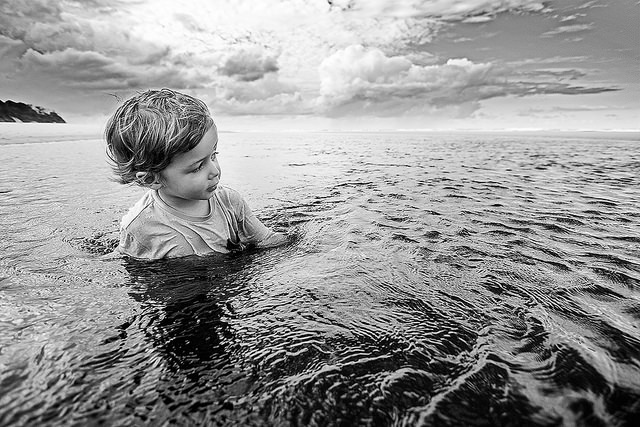
Revisit the child in the photo at the top of this post. He’s immersed in water, a symbol of life, an expression of contemplation on his little face. He’s absorbing the experience. The world is big. Sometimes alarming. Not always fair. When he lies down to sleep, what dreams may come? Will they haunt or heal? Hold him back, or help him overcome? He is at the mercy of his dreams. As are we all.

But to wake, to write, is to immerse in thought, to gain unexpected perspective, to remain open to questions, to answers, to possibility, to wonder, to hope.  Dreams, in all their mystery, come and go at random; their meanings and value often elude us. When we write—an equally mysterious process—we actually take hold of meaning. We continually unfold it, one layer of thought leading to another, branching off in directions previously unseen. To write is to go both deep and wide, to actively broaden the scope of one’s own world, to expand one’s sphere of interest, to explore what’s within to better relate to what’s without  . . . to connect.

I mark the page in my book and reach over to rub my quivering dog.

“Shh, shh, Henry. It’s okay. I’m here.”

At the touch of my hand he eases. He lifts his head, regards me with bleary eyes. His tail thumps. He readjusts, curling himself into a tighter ball there on his sofa.

He sighs.

The sound of satisfaction, of being connected, of being safe.

Memory box

Memory box

Memory Box. AntaraCC BY

This weekend I caught a bit of an interview with Jon O. Newman, a senior judge of the U.S. Court of Appeals for the Second Circuit. Judge Newman has written a memoir entitled Benched. The subtitle is rather epic, something you should experience on your own . . .

What caught my attention, however, was the Judge’s statement that “everyone should write memoir, for your children, your grandchildren.” He went onto say how valuable a person’s memories are to the successive generations, especially for the unique knowledge they impart.

These statements were both invigorating and validating to me for a number of reasons.

First: I’ve been writing a good bit of memoir here on Lit Bits & Pieces. It may well be my favorite thing to write. When I am composing a piece, it’s almost like I have “street view” of moments and people as they were long ago; I can see it all from so many angles, from within and beyond my childhood self.  Judge Newman said, “The more you write, the more detail you will remember.” It’s astonishing, really, the little things I begin to recall, one after the other, once I start writing. The images return in startling clarity. I write in scenes, small moments. I tell writing teachers that memoir is really small moments on steroids, all pumped up and full of meaning.

Secondly: I write these pieces of memory because they hover so vividly, begging a landing place, and because I truly love the time-travel. They’re meaningful to me, so I try to preserve them as best I can. What’s astonishing is the response I sometimes get from a  reader; I never anticipated such deep chords would be struck. It leaves me, every time, in wordless awe at the power, the “magic,” of writing.

Lastly, having watched my mother-in-law and grandmother suffer the ravages of dementia — and the loss of their dignity — I write to celebrate the human brain at its most glorious, the triumph of the human heart over its darkest moments, the joy and the story of lives well-lived.

In this way, my blog serves as a memory box for me, homage to those who’ve gone before, and perhaps a gift to those who come after. As the photographer of the beautiful image at the top of this post wrote: We should save part of our memories in a box . . . we may need it later . . . 

Tonight I celebrate memory. My own and the bright fragments given to me by those I loved — those I still love, for in truth, when I write, they are ever so near.

Imagine

Central Park

On a Central Park pathway, near the Strawberry Fields memorial to John Lennon.

A group of fifth-graders sits in the hallway, making a poster about the human nervous system. I stop to admire their work:

“Wow, that’s a really vivid brain you have there.” It is, in fact, neatly colored with the brightest neon pink.

“Thanks,” grins one of the girls.

“We forgot the cerebellum, though,” says another.

“Yikes! That creates a problem for your diagram-person, doesn’t it?”

“Yeah, with his balance and movement and stuff.”

One of the boys turns away from his work drawing . . . something. “Do you know who Albert Einstein is?”

Struggling to keep my face composed, I reply, “Yes, he’s my favorite scientist.”

“I was thinking how we only use about ten percent of our brains and as smart as Albert Einstein was, just imagine what he would have done if he could’ve used the other ninety percent.”

“Fascinating, isn’t it?” I muse. “For all of us. If we could use our whole brains, we might be something like superheroes.”

The kids nod sagely.

“So, here’s my favorite Einstein quote,” I tell the kids, who pause in their illustrating. Expectation is clearly written on each face. They truly want to know what this brilliant man had to say. “When a parent asked Einstein how to raise a child to be a great scientist, Einstein replied: If you want your children to be intelligent, read them fairy tales. If you want them to be more intelligent, read them more fairy tales.”

As their brains process this thought, the young faces look ethereal. Unblinking, gazing somewhere beyond the immediate surroundings, bathed in a light from an unseen source.

Especially the boy who mentioned Einstein.

“Whoaaaaa,” he finally says.

“Think on that a while. Later you can tell me what you believe it means.” With that, I leave the children to their work.

Imagine.

As I walk down the hallway,  my own brain is ajumble: Cerebellum. Balance. Einstein. Intelligence. Fairy tales . . . fiction. A conversation with an esteemed colleague at a recent meeting returns to mind.

I am glad to see greater focus on nonfiction writing, she’d said. After all, these children won’t be writing fiction in college.

It took my breath away.

Perhaps none of the kids we teach will grow up to get MFAs in creative writing— in other words, possibly earning a degree in composing fiction.

But some might. And are there really no more creative writing electives in college these days?

I understand the rationale behind the words, that in college students will primarily be writing research papers and essays. It’s important to put the foundation in place now, at the elementary level, for their future success.

But are all students going to college? Aren’t the standards college and career ready? In a day and age when innovation and creativity in the workplace are highly valued, think about the impact of understanding plot, subplots, character motivation, personality traits, overcoming obstacles to reach goals, ingenuity—all of which can be developed by reading fiction, surely, but writing fiction takes complex problem-solving and creativity to incomparable heights. So many seemingly random pieces must connect pretty perfectly to make a finished, meaningful, compelling whole—much like the beautiful leaf-and-gumball mandala I discovered on a pathway while walking through Central Park.

And what about sheer enjoyment? And poetry, and songs, and plays?

Or being LIFE ready?

If you want your children to be intelligent, read them fairy tales. If you want them to be more intelligent, read them more fairy tales.

Imagine what we could accomplish if we all wrote them. Make-believe stories, making mandalas with words. Maybe we’d tap into some of that unused part of our brains.

Because, heaven knows, we need balance to move forward effectively.

Take the pencil, find the neon pink.

If the cerebellum is missing, draw it in.