Get words

Imagine what is over there

Imagine what is over there. Kenneth BarkerCC BY

Last night I met with a small group of teacher-writer-colleagues from my district.

We started our discussion by writing words that resonate with us.

-Quickly.

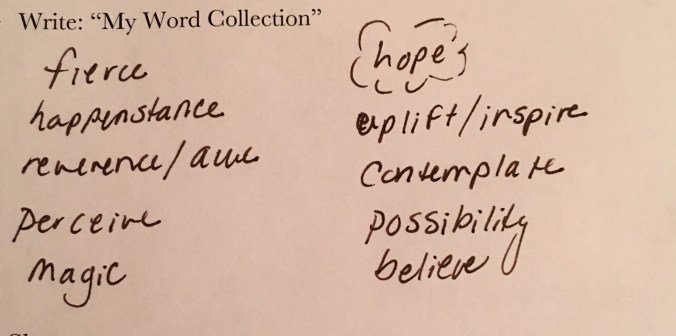
Mine are:

fierce    happenstance   reverence   awe   perceive  magic  hope   uplift   inspire               contemplate   possibility   believe

I don’t know why this was hard or why some of these words came to me (happenstance? Go figure. Must just be the sound of it. What other reason could there be?).

Then we had to pick the word that was most significant to us.

Mine is

      hope

for in every aspect of my life, I am hopeful. If I could impart one thing to others, it would be hope.

Hope is vital to the human spirit.

My colleagues and I talked about our work with students, other teachers, and our own writing. Where we’ve been, where we are now, where we want to go.

       uplift

               inspire

Going home, the lively discussion and energy circles round my mind. Something in there is trying to find a landing place.

                         contemplate

The “something” is tied somehow to student reactions . . . the ooooohhhh moment that’s such music to a teacher’s ears . . . like when a student connects a thing he/she loves to a book, or to writing . . . this week in fourth grade, it was me asking Why is opinion writing important? with a student responding You write about what you feel deep in your heart and another student saying Like music. I can write about why I love music. I want to write songs and me saying, Well, maybe you need to write your opinion piece AS a song.

—beat—

OOOOHHHH

       reverence

                             awe

And then I think, fierce is an odd word for me to pick yet it was the first one that came to mind. Why is that?

Fierce love like mother for child, fierce dedication to excellence, fierce desire for learning.  Maybe that’s why.

The something circling in my mind is materializing. I think it’s another word . . .

                                                    perceive

Not that word.

The word is—well, awfully simple:

Get.

Get?

Yes, get.

Get what?

Get them reading

Get them writing

Get them talking

Then get out of the way.

Oh, I get it.

My colleagues and I talked about that.

And

Get out of the box.

Because that’s where all the

          magic

happens.

We don’t make it happen.

They do

but only after we tear down the walls

of windowless boxes

so that they can see the glimmering horizon beckoning

and be free to

imagine

what is over there.

                       possibility

And that they can

get excited

get through

get there

if they only

      believe

And that comes only from the stirring the ocean within

Not by sea-spray on the wind without

never never by

                           happenstance

March (writing) madness

slice-of-life_individual

I’ve just noticed how much the Two Writing Teachers Slice of Life badge resembles a basketball.

I find this coincidence captivating, as today kicks off a special season of challenge for both: a month-long daily writing commitment and March Madness.

Bracket predictions are not my thing, but writing is, so I am fondly dubbing these thirty-one days March Writing Madness.

Truthfully, it’s almost madness for me to write a blog post every single day in March. A quality post, that is. I can’t share something until I feel I’ve hammered it into the best possible shape, and in a normal week, that comes to just a post or two. This daily venture is daunting. It’s expensive. I know what the Slice of Life commitment is going to cost me in time and energy. Sacrifices will be required.

But, oh, the payoff . . .

First things first: I started Lit Bits and Pieces in March 2016 as a means of stretching myself as a writer. As much as I enjoy teaching writing and coaching teachers of writing, I recognized the hypocrisy of encouraging others to write consistently if I wasn’t doing so myself. I needed to walk the walk . . . and so this blog was born. I set only two goals in the beginning: To write about whatever comes to mind and to make it uplifting to readers.

In the two years since, the blog has become a life-library for me.

I’ve relived childhood moments; I’ve explored the mysterious; I’ve turned events and things around in my mind, finding connections and analyzing meanings; I’ve tinkered with poetry, flirted with fiction, and captured precious, priceless experiences with students, colleagues, family members, and friends.

I knew when I signed up for last year’s Slice of Life Challenge—my first—that I would be pushing myself even harder, further, as writer. That was expected, desired.

The unexpected, greater payoff: My fellow Slicers. People whose powerful words kept my momentum going when I was almost out of steam, who valued what I wrote, who encouraged me to a degree that I can’t adequately convey. People to whom I owe a debt of gratitude and the honor of encouraging in return . . .

What a difference a month and a writing community make.

While the March Madness basketball tournament is about eliminating the competition (hence those NCAA bracketeers), the Two Writing Teachers Slice of Life Story Challenge is about cheering each other on to the very end, so that all are victorious.

Today, as I take my place in the line-up, I celebrate you, Slicers, extraordinary individuals that you are, every one of you a champion, in this arena where the joy you get is also the joy you give.

That’s the buzzer, friends . . . time to write like mad.


The Valentine

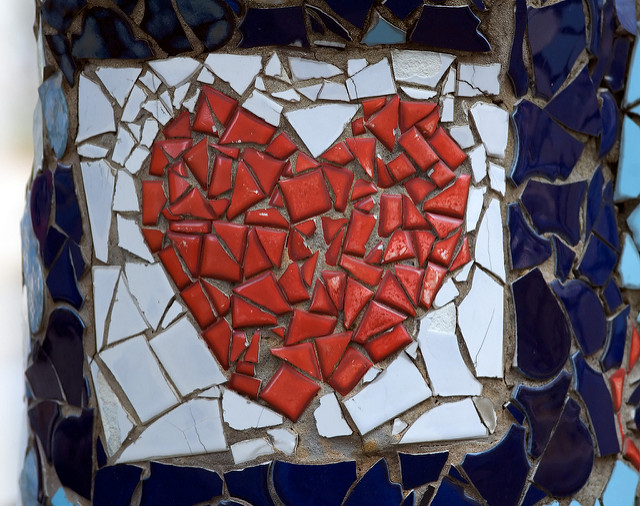
Broken heart

Here’s a mentor text, a modeled memoir originally written for a fifth grade class a few years ago. It’s a true story from my own fifth grade year. These long-ago events etched themselves on my young heart as they unfolded. Some of the minor details are fuzzy, but I remember the intensity of these moments. I see every classmate’s face; I recall every name, although I’ve opted to alter all but my own for a comfortable anonymity in the face of hard truths.

For it’s a hard slice of life.

Today I dust off that Valentine’s Day I’ve never forgotten, reinforce it with a bit of word-glitter and glue, and give it to you  . . . 

On a cold but sunny February afternoon, my fifth grade class gathers on the kickball field to choose teams. The two captains flip a nickel to decide who’ll go first; my friend Shannon wins. She and Davy stand side by side for a moment, scrutinizing the rest of us as if they are drill sergeants and the rest of us are boot camp recruits.

“Allen,” says Shannon.  Allen is always the first pick because he’s a go-cart racer, competitive and very popular. He likes to win.

Allen jogs over to stand behind Shannon.

“Jon,” says Davy.

I think, That’s kind of surprising.

Jon came to our class late in the fall. He used to be the last pick for our teams, since he wears big, thick glasses and doesn’t seem very athletic. At first the boys called him Four-Eyes and the girls said he looked like a little old man because of the way he hunches his shoulders up to his neck most of the time, in addition to the bowl-style cut of his hair. We really don’t notice him that much any more, as Jon is so quiet. When Davy calls his name, Jon trots in his stooped-over way to stand behind him.

“Fran,” says Shannon, after a pause.

YESSSS!” I whisper. I take my place behind Allen, who gives me a high five.

I love kickball. Next to jacks, it’s my favorite game to play with the class—these are really the only two games I’m any good at playing. Once when I slid into home plate I peeled up a whole strip of turf in my shoelaces, but I was safe!

The captains continue choosing players, until only one girl remains.

Eloise.

She, too, is new to our class, arriving just after Christmas break. Eloise is unusually tall, taller than Shannon, who’d been the tallest girl in the school until now. Eloise is as big as a grown woman. Her brown, frizzy hair puffs out from her head like a cloud. It flutters when she walks. One of her front teeth is chipped. Her eyes are the color of the summer sky, and at the moment, they’re a little teary.

Davy sighs: “All right. Eloise.”

Eloise scurries to the end of Davy’s line, looking at the ground.

During the game, Eloise tries with all her might to run and kick the ball, but she misses and loses her balance. When she falls, we can’t help laughing. Eloise, her face pink, gets up by herself and runs to the back of the line once more.

I don’t know what makes me keep my eyes on Eloise, and why I began wondering what it must be like to always be picked last, or to hear other kids whispering things like Neanderthal and  Amazon, never when Mrs. Peterson might hear. I try to imagine how embarrassing it would be if I was too big to be comfortable in the classroom desks and if regular girls’ clothes wouldn’t fit me. I am already clumsy, which is why I’m not good at most sports. Except kickball.

What would I do if no one wanted to sit by me at lunch or went the long way around my desk, the way we do to Eloise?

Watching Eloise with her face turned toward the ground, I suddenly don’t feel like laughing anymore.

Back in class, after a stop at the water fountain, Mrs. Peterson passes out sheets of Manila paper.

“Today, Class, you will write the first letter of your name in cursive on the paper and turn it into an animal or a design that represents you.”

Mrs. Peterson’s first name is Felicia; she holds up  her paper to show how she’s turned her cursive “F” into a giraffe.

Everyone gets to work. Except me. I am stumped for how to turn my own cursive “F” into anything artistic. I have trouble making a cursive “F” in the first place. Everyone says my “Fs” look like “Ts.”

I have no idea what to draw.

To waste time, I get up and sharpen my pencil. I pass right by Eloise’s desk, where she’s bent hard at work. On her paper, she’s written a large, elegant cursive “E,” the fanciest one I’ve ever seen.

She’s turning it into the open wing of a bird.

Before I know what I’m doing, I blurt: “Oh my gosh! That’s beautiful, Eloise!”

Mrs. Peterson comes to look. “It’s lovely. Why don’t you show the class?”

Eloise, looking alarmed, shakes her head. Her fuzzy brown hair bobs like ocean waves.

“May I show them?” asks Mrs. Peterson.

Eloise nods, turning pink again.

Mrs. Peterson holds the paper high. “Just look at what an amazing artist Eloise is, everyone.” She turns slowly so all can see, the way teachers do with pictures in books.

“Oooooo,” breathe my classmates.

Someone says “Wow.”

Eloise’s pink face glows. She smiles, revealing her chipped tooth; her sky-colored eyes sparkle.

I want to freeze this moment for Eloise, and for myself, to capture it for the wonderful and powerful thing it is, but it is quickly gone, and the next day at lunch when she knocks her milk carton over, we all laugh at Eloise again.

Even as we laugh, I feel bad inside.

What’s the matter with me? Why do I laugh when it doesn’t feel right? 

After lunch, Mrs. Peterson gives a speech:

“Ladies and Gentlemen, as tomorrow is February fourteenth, you may bring Valentines to exchange. Listen carefully: If you bring Valentines, you will bring one for everybody in this class. Do you understand?”

Her dark eyes stare right through us.

“Yes ma’am!” we answer in unison.

We know why she makes this point.

Eloise knows, too, and keeps her eyes on her feet.

I’ve already got my box of Valentines and can’t wait to give them out. Inside my box there happens to be a bonus Valentine; I’ve never seen one like it before. It’s about five times larger than the other little cards. It has to be unfolded several times to show the gray, fluffy dog decorated with silver swirls all around. The dog holds a big red heart in its mouth, which reads You are special. This big Valentine is just too beautiful to give away. I am keeping it for myself.

The next day, Mrs. Peterson makes us wait until after lunch to distribute our Valentines. We have to open them together, all at one time.

“Hey, thanks for the candy!” Shannon tells Allen.

“Cool—gum!” says Davy, even though he has braces and isn’t supposed to chew it.

Just then, Eloise cries out. It’s a loud, terrifying sound.

Everyone turns to look at her.

Everything just freezes.

She’s sitting at her desk with her hands over her face, sobbing.

No, I think. Tell me someone hasn’t given her a mean Valentine. Or put something gross in her bag.

Then I recognize, from several desks away, that open Valentine on Eloise’s desk.

The fancy silver dog, the big red heart, the message. You are special.

“Who gave you that?” someone demands.

I walk over to read what’s written at the bottom of that most beautiful card:

Your friend, Jon.

Obviously, Jon’s mom shops at the same store where my mom shops, since we have the same box of cards.

Unlike me, however, Jon has chosen to give his best card away.

To Eloise.

She continues to wail, but we all look from her to Jon, who’s sitting slouched worse than usual at his desk. His face is a darker shade of red than Eloise’s has ever been. He won’t look at the rest of us.

“Oooooo!” says one of the girls.

A boy starts chanting: “Jon and Eloise, sittin’ in a tree . . . ”

But something new is happening here; the energy in the room is changing. This isn’t the regular boy-likes-girl situation. I feel it.

So does Allen.

“Hey, stop it, guys!  Leave him alone!” Allen gets up to stand by Jon.

Mrs. Peterson  is there, too. She places her hand on Jon’s shoulder, her wide brown eyes glimmering with tears. “You, young man, are a noble person.”

I don’t know exactly what “noble” means, but I know that Jon, all of ten years old, is the biggest hero I’ve ever seen.  My emotions swirl inside me like the silver designs on the card—shock at Jon’s choice, guilt over not treating Eloise better, sadness that I hadn’t been the one to give so freely. I look at Jon, the boy new to us this year, who’d endured teasing, too, until he faded into the background in a way Eloise can’t, and I know I want to be like him. Today he isn’t in the background; today he’s the champion of us all. Today he taught us—or at least me—the power of kindness and selflessness, to forget yourself and help someone else.

Perhaps that’s what “noble” means.

I want to be as noble as Jon. I want to help Eloise. So after Mrs. Peterson calms her down, I go to sit beside her.

“You can make Valentines prettier than these, Eloise, the way that you draw.”

“Maybe.”  She shrugs, her face splotchy.

“Don’t you live in my neighborhood?” I ask. “I think I’ve seen you walking that way after school.”

“Yeah. I know where you live. I’ve seen you playing in your yard with your sister.”

“We could walk together sometime. If you like,” I offer.

Eloise looks at me. She smiles. I think of the elegant E-bird she drew; I imagine it stretching its wings just now, preparing to fly high and far in the wide blue sky.

“Sure,” she said. “I’ll walk with you.”

So after school, that’s what we do. We walk together.

Home.

Photo: Broken Heart. David Goehring. CC BY

To dream, to write, perchance to connect

Connection

“Connection” by Dylan O’Donnell

Henry is sound asleep on the sofa, his head on two throw pillows, snoring like a middle-aged man.

He is my family’s  endearing, shamelessly-babied Lab-Pit mix. Three years old and in his mind, he owns this sofa. It exists solely for him.

We don’t tell him otherwise.

Within moments, Henry’s breathing changes. His smoky gray body shakes; his white paws twitch. He whimpers at a higher pitch than he ever does when he’s awake.

“He’s dreaming,” we humans say to each other.

That whimper. It sounds puppy-like. Afraid. Vulnerable. Nothing like the rumbling from deep within his chest when Henry “talks” to us (translating to “Hello, I want something, so drop what you’re doing, pronto, to do my bidding”).

Which leads me to wonder: What is he dreaming about?

He is a rescue dog, found wandering the streets. He was timid for a long time before attaining his current level of confidence (and world domination).

Is he reliving a scene from his early life? Was he mistreated? Abandoned? Did something frighten him badly when he was a puppy?

Do dogs really dream like humans do?

The answer, according to Live Science, is yes: “Dogs likely dream about waking activities much like humans do.”

I am the one chasing a rabbit here: Captivated by the article,  I keep on reading beyond dogs to rats to flies—yes, says a cognitive scientist, even flies may dream in some form.

Sounds like something straight out of fantasy . . .

You may visit the site to read about the rats and flies yourself, if you like, but here are the article’s big clinchers for me: That sleep “adds something” to the process of learning and remembering, that sleep is “a sort of categorizing of the day’s activities” and a chance for the brain “to explore in a consequence-free environment”:

The idea is that, in sleep, the brain is trying to find shortcuts or connections between  things that you may have experienced but you just hadn’t put them together.

Cognitive scientist Matthew Wilson, “What Do Dogs Dream About?” Live Science

Categorizing of the day’s activities . . . yes, this often happens to me as I fall asleep. Reliving moments, subconsciously archiving them in specific mental folders for future retrieval as needed. A subliminal attempt at order and organization—how I appreciate that. The brain is an indescribable marvel, the ultimate computer. I envision lines arcing this way and that along a grid, an image of our brains actively searching, reaching, connecting and grouping things, while we rest.

My uncle once told me he could sleep on a problem and before he woke, the solution would materialize in his mind. Some mornings, in the transition between sleeping and waking, I can “see” the day’s events before me, and a detail or an approach will offer itself in a way I hadn’t thought of before. This has a name: liminal dreaming. 

But as I am awake, here is where I very consciously, intentionally, connect some psychological dots.

As Henry lay dreaming, prompting me to wonder about his background and the stuff of his dreams, I happened to be reading Ruth Ayres’ new book, Enticing Hard-To-Reach Writers. It is a must-read for educators, whether one teaches writing or not. Ayres has a lot to say, from firsthand experience, about the brains of children who’ve suffered extreme trauma and neglect. She also has a lot to say about the power of writing, of story, to heal and to save . . . I cannot help thinking now of the thirteen Turpin children in the news and the discovery of  their “hundreds of journals” which officials speculate may have helped them survive the unimaginable at the hands of their parents. If this is true, we’ll soon know.

But as for my dog, his dream, a website, the book in my hands . . . they all converge on the work of the brain:

When I write, I realize new ideas. I make connections. I figure out what I need to do next. When I write about what’s happening . . . something significant happens: I begin to see things from a new perspective. This is how learning happens. This is how growth happens. 

-Ruth Ayres, “Writing Always Gives More Than It Takes,” Enticing Hard-To-Reach Writers

To sleep, to dream, to subconsciously categorize, make connections, problem-solve . . .

To wake, to write, to consciously realize ideas, make connections, problem-solve . . .

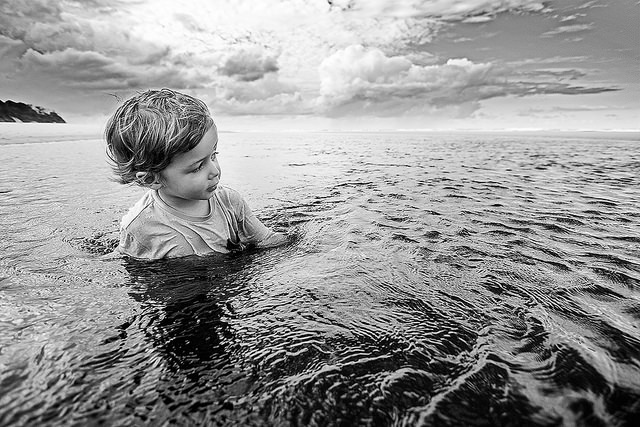
Revisit the child in the photo at the top of this post. He’s immersed in water, a symbol of life, an expression of contemplation on his little face. He’s absorbing the experience. The world is big. Sometimes alarming. Not always fair. When he lies down to sleep, what dreams may come? Will they haunt or heal? Hold him back, or help him overcome? He is at the mercy of his dreams. As are we all.

But to wake, to write, is to immerse in thought, to gain unexpected perspective, to remain open to questions, to answers, to possibility, to wonder, to hope.  Dreams, in all their mystery, come and go at random; their meanings and value often elude us. When we write—an equally mysterious process—we actually take hold of meaning. We continually unfold it, one layer of thought leading to another, branching off in directions previously unseen. To write is to go both deep and wide, to actively broaden the scope of one’s own world, to expand one’s sphere of interest, to explore what’s within to better relate to what’s without  . . . to connect.

I mark the page in my book and reach over to rub my quivering dog.

“Shh, shh, Henry. It’s okay. I’m here.”

At the touch of my hand he eases. He lifts his head, regards me with bleary eyes. His tail thumps. He readjusts, curling himself into a tighter ball there on his sofa.

He sighs.

The sound of satisfaction, of being connected, of being safe.

Memory box

Memory box

Memory Box. AntaraCC BY

This weekend I caught a bit of an interview with Jon O. Newman, a senior judge of the U.S. Court of Appeals for the Second Circuit. Judge Newman has written a memoir entitled Benched. The subtitle is rather epic, something you should experience on your own . . .

What caught my attention, however, was the Judge’s statement that “everyone should write memoir, for your children, your grandchildren.” He went onto say how valuable a person’s memories are to the successive generations, especially for the unique knowledge they impart.

These statements were both invigorating and validating to me for a number of reasons.

First: I’ve been writing a good bit of memoir here on Lit Bits & Pieces. It may well be my favorite thing to write. When I am composing a piece, it’s almost like I have “street view” of moments and people as they were long ago; I can see it all from so many angles, from within and beyond my childhood self.  Judge Newman said, “The more you write, the more detail you will remember.” It’s astonishing, really, the little things I begin to recall, one after the other, once I start writing. The images return in startling clarity. I write in scenes, small moments. I tell writing teachers that memoir is really small moments on steroids, all pumped up and full of meaning.

Secondly: I write these pieces of memory because they hover so vividly, begging a landing place, and because I truly love the time-travel. They’re meaningful to me, so I try to preserve them as best I can. What’s astonishing is the response I sometimes get from a  reader; I never anticipated such deep chords would be struck. It leaves me, every time, in wordless awe at the power, the “magic,” of writing.

Lastly, having watched my mother-in-law and grandmother suffer the ravages of dementia — and the loss of their dignity — I write to celebrate the human brain at its most glorious, the triumph of the human heart over its darkest moments, the joy and the story of lives well-lived.

In this way, my blog serves as a memory box for me, homage to those who’ve gone before, and perhaps a gift to those who come after. As the photographer of the beautiful image at the top of this post wrote: We should save part of our memories in a box . . . we may need it later . . . 

Tonight I celebrate memory. My own and the bright fragments given to me by those I loved — those I still love, for in truth, when I write, they are ever so near.

New

New

The new year sparks contemplation of the word new.  

So the year is new, but what else? Monday still follows Sunday, January still follows December. The days roll into each other without any notable variance. Today looks almost exactly like yesterday; it’s still winter, still below freezing, and my dogs still do not want to stay outside more than the necessary few minutes. The holidays are ending and work is resuming, as they always do. None of this is new.

As I sought to apply new to something today—since the usual and very regular passing of time really should not count—I got the mental image of the word new on a dictionary page. This led me to do something paradoxical: I moved a chair over to one of my bookcases, pulled down a heavy volume, blew off the dust (alas!), and snapped the above photo of the definition in The New Century Dictionary. 

I say paradoxical because that dictionary, despite its title, is hardly new. It was published in 1952. The original copyright is 1927.

The dictionary and the definition are old indeed. I know there are better, far more concise definitions of new in online dictionaries now.

Why, then, turn to something so old to examine the meaning of new?

Well, first of all, I needed an image for this post and that’s the one that came to mind.

And I love old books, old things in general. Any vintage artifact holds great appeal to me, mostly because of the invisible layers of story wrapped around it. I never tire of stories of long ago. I am endlessly fascinated by how people survived and how resourceful they were, often with so little.

In fact, resourceful was nearly my chosen word for 2018, because of this definition on Dictionary.com:

able to deal skillfully and promptly with new situations, difficulties, etc.

And this one, at LearnersDictionary.com:

able to deal well with new or difficult situations and to find solutions to problems.

Resourceful seemed well-suited to my role as educator, instructional coach, and for life as a whole, really.

Then I realized that the thing that stood out to me in both of these definitions of the worthy word resourceful, aside from its emphasis on excellent problem-solving, is that one word, new. Coping with new and difficult situations.

Suddenly resourceful, for all its allure, was overshadowed. Do you remember the scene in The Wizard of Oz when Dorothy explained the demise of the Wicked Witch of the West? “Please sir, we’ve done what you told us. We brought you the broomstick of the Wicked Witch of the West. We melted her!” To which the Wizard replies (one of my favorite lines): “Oh, you liquidated her, eh? Very resourceful!” But remember Dorothy’s intent: When she threw that bucket of water on the Witch she was saving the Scarecrow, who was on fire. She didn’t mean to melt the Witch, or even think Hmmm, what would happen if I doused the Witch with water?

Resourceful, yes—in saving the Scarecrow. Dorothy’s use of the water was intentional. It implies thinking and quick action to solve a problem. Resourceful in her mission of getting rid of the Witch? No. That was a stroke of amazing luck.

I really wanted to write this post about being resourceful for my fellow educators who often work with so little, in adverse situations, to encourage all of us to be more mindful, intentional, and creative with what we have to reach intended outcomes, when it occurred to me that something else is needed before any of this can happen.

Something different from anything preceding, something only lately or now seen,  encountered, experienced, or used for the first time . . .

Something new, in the face of the same old same old.

If you look back at the photo for this post, you’ll see the morning light spilling across the old dictionary page, illuminating the word new.

And that’s exactly what is needed. Not new things or resources themselves, but light. Seeing things, situations, people in a new light.

My wish for students is that they see their learning in a new light, with excitement, with inspiration. For that to occur, their teachers, my colleagues and I, must see our work with new excitement and inspiration, pushing past layers of compliance, of going through the motions, of saying We can’t, because . . . .

Think of variations of new: renew, anew. Newness is generated. It is created. It starts with really seeing, then taking a step, even just one, out of the comfort zone, to see what will happen, what might actually change. For the better.

Whoever you are, whatever you do, new starts within you and moves outward. One ray of light, one spark at a time . . . keep it up, and there’s no telling how far the light will travel, and how much more will become new. We can’t change people (ever tried?). We can’t always change situations. Some old things will remain, and sometimes that’s good, for every new thing that comes along isn’t. But we can have new perspective, new vision, new vigor, new approaches. All of these are within our own power. A true and valuable new is both possible and attainable, if we aspire to it. If we dare.

That is my prayer for this new year, that we make it truly new.

To love that well

Drema Gaye Spencer

Drema Gaye Spencer. Her first name means “reverie,” or dream. Her middle name, “merry, lighthearted.” Her surname is Old English for “guardian,” “object of awe,” “dispenser of provisions.”

She stands on the precipice between childhood and womanhood, facing the camera directly, her hooded eyes steady and confident. She does not know it yet, but she will be like the mountains framing her background, where she and her seven siblings loved to run, calling to each other across the distance, teasing, playing jokes, laughing with wild abandon at their own mischievous humor. As intense pressure, heat, and time formed the ancient Appalachian coalfields, so the course of her life would forge an internal fuel, the deep, burning drive to keep going under the weight of crushing adversity.

It’s the early 1940s. World War II is in full swing; her three brothers have enlisted in the Navy. The family has survived the Great Depression in the place it struck the hardest, where the economy has always been precarious. When she arrived with the January snows of 1926, her coal miner father hadn’t had steady work in a year due to frequent safety shutdowns; the West Virginia Office of Miner’s Health Safety and Training references nearly 700 fatalities for 1925.

She’s just a teenager with a head full of dreams for the future.

Maybe she could teach English literature and composition—What fun that would be! Maybe I’ll even visit England one day.

Innately musical, singing harmony with her sisters in church, she also harbors aspirations for the stage. She knows she has true dramatic and comic talent, which, along with her natural beauty, lands her roles in high school plays. Her blue eyes sparkle: Well, I AM a good actress. Very good. Eventually, of course, I’ll get married and have children. I do want children . . . Sometimes she can almost see their little faces, these someday-children. I hope one’s a boy with brown eyes.

So she looks at the camera and smiles, the mountain beneath her feet, her childhood behind her and her whole future lying ahead.

But I, being poor, have only my dreams; I have spread my dreams under your feet; Tread softly because you tread on my dreams.

-William Butler Yeats

The reality is that just a few years after this photo was made, she married a man who would be killed in a mining accident, leaving her with a toddler and a baby at twenty-three.

Several years afterward, she married a widower, an Army man with two older children. Eventually they had a boy and a girl together.

Her boy with brown eyes.

When her husband completed tours of duty in Korea and Vietnam, she cared for the six children by herself.

When the brown-eyed boy was four, he developed acute bronchitis, necessitating an emergency tracheotomy. His temperature spiked to 107 after surgery. The nurses packed the child in ice. The hospital doctors told her that her little son might not make it. She sent for his father, away at Army summer camp; a police escort was dispatched to meet him at the airport. As the boy drifted in and out of consciousness, she sat by his oxygen tent, praying, weeping.

The boy survived.

She wrote him a letter on the inside back cover of a book of Bible stories.

4:00 a.m. In hospital.

Dearest . . .

When you are well and safe at home again, I’ll read you this little note I’ve written to you during the hours I sat by your bed and watched you sleep so soundly . . . Mommy and Daddy have been so scared . . . We love you so much, our little son . . . Little angels have been all around your bed since you have been sick and Jesus sent them to watch over you and keep you . . . soon all the suffering and fright you have had will pass from your little mind but Mommy will always remember and thank God for giving you back to me.

Your Mother

She could never speak of the ordeal without tears.

Staggering losses were yet to come.

When the brown-eyed boy was twelve and his sister nine, and all the others grown and on their own, her Army man died suddenly, instantly, with a heart attack.

Widowed twice—each time with a boy and girl at home to care for.

Love bears all things, believes all things, hopes all things, endures all things.

-I Corinthians 13:7

When her sobbing son asked, “Who’s going to take care of us now?” she wrapped him in her arms.

“God will. And I will.”

And she did.

Survival ran in her veins like coal beds through the Appalachians. She dug deep within herself, tapping into the hardy DNA passed down by her ancestors, into the wellspring of her faith, into the fierce love for her children, and carried on. When her son was consumed with fear of something happening to her, she said:

“I have prayed and prayed that nothing will happen to me until you’re grown. And I am convinced that God will allow it.”

For the next ten years, she poured herself into her children and her home.

Still she laughed. Still she sang. She called her brothers and sisters, who still teased each other with jokes old and new. She gardened. She arranged flowers. She organized a women’s political group, taught Sunday School, went to her son’s basketball games all through high school.

She managed, and managed well.

When her son said he found the girl he wanted to marry, she gave him her blessing and the diamond engagement ring that his father, the Army man, had given her.

The brown-eyed boy—now the man—gave the ring to me on my twentieth birthday, long, long ago.

For the boy who lived (apologies, J.K. Rowling) is my husband; the woman in the photograph is my mother-in-law.

When I came to know her, I first admired her elegant, impeccably-kept house, which she was forever redecorating. And the food, the food, oh, the food! Her table always looked like something from Southern Living, down to the coordinating linen napkins and rings. Her iced tea was always blissfully sweet and there must always, always be lemon slices with it. I came to appreciate her ever-present wit, her spunky humor, her fashionable attire. Being well-put together was a priority to her. I browsed her bookcases on every visit, knowing she’d have a new bestseller for me to devour. I was instantly at home in her home.

When she was sixty years old, a third man proposed to her. She hesitated. “I’ve buried two husbands. I don’t want to bury a third.”

But he was a good man; she took a chance on him. For the next three decades, they celebrated the coming of grandchildren and the first great-grandchildren.

Three years ago, she was widowed for the third time.

There were no children at home to care for now.

She was, for the first time in her nine decades, alone.

With housekeeping being too much for her, it was time to go to the home of one of the children or to assisted living.

And her genes, or her Appalachian roots, or the rising dementia—or all three—kicked into overdrive.

She would not go.

The house had become her whole identity. It was where she’d provided for the last of her children. It symbolized her strength, her ability to survive. This was her mountain; she would not be moved. She dug in her heels. Deep.

Until the stroke.

After surgery, when her family was allowed to see her in intensive care, she greeted us with a smile. “I can’t believe I’ve had a stroke! Can you believe it?” she said, as if she were sitting in the den at home, making everyday conversation, even as the nurses watched her monitors. Blue eyes sparkling as bright as ever, she reached out her warm hand to grasp mine. “Hey, you’ve got a birthday coming up. We’ll have to celebrate.”

I held her hand, marveling.

She rebounded for a short while, working hard at her rehab, thinking she could go back home. She couldn’t. She went into a nursing home instead, for, as the weeks wore on, her strength waned.

So did her mind.

The one thing that waxed bright and hot was her fighting spirit. She grew more determined to go home, even as she grew weaker, less hungry, more and more tired.

Do not go gentle into that good night,
Old age should burn and rave at close of day;
Rage, rage against the dying of the light.

-Dylan Thomas

She raged. She burned within like a coal seam fire, until her energy was spent at last.

Lying in her nursing home bed, she stood on the mountains again, seeing her brothers and sisters in the distance. She called their names over and over—only the ones who’d already died. She carried on conversations with them.

“I can’t go on up,” she told these siblings that the rest of us couldn’t see. “Not just yet.”

She knew us, called us by name when we last gathered with her, at Thanksgiving. Within the hour, she couldn’t recall who we were, or why we were there.

Still she sang.

There is coming a day, when no heartaches shall come

No more clouds in the sky

No more tears to dim the eye

All is peace forevermore

On that happy golden shore

What a day, glorious day, that will be . . . .

“My throat hurts,” she said. “I can’t sing any more.”

“It’s okay,” said her children. “You don’t have to.”

They moistened her lips and mouth with water.

And still she sang.

If we never meet again this side of heaven

I will meet you on that beautiful shore.

And then she sang no more.

She rested a while, then, with her eyes closed, turned her face toward her brown-eyed son, my husband.

“Where do you live?” she asked.

“North Carolina,” he replied, smiling through his tears.

“Oh, my son lives there,” she said.

“Yes. I am your son.”

She opened her eyes the tiniest slit. “Well. You’re all grown up.”

It was the last thing she said to him.

I have prayed and prayed that nothing will happen to me until you’re grown. And I am convinced that God will allow it.

A few days later, my husband, his younger sister, and my son, the youngest grandchild, sat by her bedside all morning, watching her labored breaths. Finally they told her, “We’re going to go eat lunch, Mom, but we’ll be right back.”

The minute they finished eating, the nurses called. “The time is near.”

They came. They took her hands.

She took two labored breaths, and was gone.

She’d waited for them to have their lunch. To the very last, making sure her children had what they needed.

She never taught school.

She was never an actress of renown.

She never made it to England.

She lived one of the most extraordinary lives I’ve ever known.

The diamond on my finger shines as bright as it ever did; I can only hope that a portion of her strength, her courage, her wisdom has passed on to me along with it.

I look at her teenage photo, contemplating all that she will endure.

All that she did endure, and need endure no more.

That time of year thou mayst in me behold
When yellow leaves, or none, or few, do hang
Upon those boughs which shake against the cold,
Bare ruin’d choirs, where late the sweet birds sang.
In me thou see’st the twilight of such day
As after sunset fadeth in the west,
Which by and by black night doth take away,
Death’s second self, that seals up all in rest.
In me thou see’st the glowing of such fire
That on the ashes of his youth doth lie,
As the death-bed whereon it must expire,
Consum’d with that which it was nourish’d by.
This thou perceiv’st, which makes thy love more strong,
To love that well which thou must leave ere long.
-Shakespeare, Sonnet 73

She loved as deep, as far, as long as she possibly could, with every ounce of her being. That is what I will remember most, her fierce, fierce love. It burns on, and on, and on, bright and warm, forevermore.

First, do no harm

land planarian

Land planarian. Pavel KirillovCC BY-SA

Granddaddy and I are walking around “the horn.” I am puzzling over why he calls this path “the horn.” When he says it, I know he means the journey from his house down the gravel road past the formidable, fairy-tale-dark woods with a tiny cemetery in the clearing, past unpainted houses in various stages of falling down, to the narrow paved highway and on around to the other side of this gravel road where, in a tiny screened-porch house, an old widow woman dips snuff, on past Grandma’s homeplace where her disabled brother lives alone and grows sunflowers that loom over my head, always turning their faces toward the sun, which is now obscured. It rained earlier in the day, breaking the blazing summer heat. The thirsty ground drank its fill; the rest of the blessed rain hangs invisible in the air, as heavy and warm as bathwater, and drips amongst the trees, where the birds are chattering against a background of crickets who think it’s night again, along with cicadas buzzing in such numbers that the earth vibrates with the sound. Granddaddy and I are on the last leg of “the horn,” passing his garden, a steaming, lush, leafy paradise that looks to me like an artist painted it with watercolors. We walk by the ditch bank where his scuppernong vines drape the trellis he built, past the line of pink crape myrtles curving along the edge of the yard, back to the sidewalk in front of the house where we started.

Granddaddy stops to get the newspaper from the box and I go on ahead— 

“Granddaddy!” I shout, for he’s hard of hearing, although Grandma says he hears what he wants to. “What is this?”

There on the damp sidewalk, headed toward the house, are three long worms, side by side. They are tan like earthworms, but many times longer than any earthworm I’ve ever seen. Maybe a foot long. Their skinny bodies undulate like snakes; they glide over the cement holding up their big, almost-triangular heads. 

Granddaddy comes near, leans down. 

I don’t know,” he says after a moment. “I ain’t never seen anything like them before.”

I’m stunned. Granddaddy has farmed all of his life, except for the years he worked at the shipyard. He knows everything about the outdoor world, has told many stories of the things he’s seen, like a fully-formed tree growing underground when he had to dig a well once. If he doesn’t know what these worms are, they are strange indeed.

I look up at his pleasant, wrinkled face, shielded by his ever-present cap. His crinkly blue eyes are thoughtful. I wonder if he’ll kill these alien creatures, chop them up with the hoe like he does the copperhead who dares enter his realm.

But he pats my back: “Let’s get on in the house, hear.” 

And so we do. I don’t see where these three hammer-headed worms go, and I never see them or anything like them again.

The worms resurfaced in my memory recently; I’d almost forgotten them. If the Internet had been around at the time, Granddaddy and I could have learned within seconds that these were land planarians—toxic predatory monsters that destroy the ecology of a garden by feeding solely on earthworms, the great garden benefactors that aerate the soil and add rich nutrients. Planarians aren’t native to the United States; they hail from Asia, so a remaining part of the puzzle is how they ended up in the far reaches of rural, coastal North Carolina.

This story isn’t really about the planarians, however. It’s about my grandfather, infinitely wise despite having quit school in the third grade to work on the family farm. A man who used the phrase “the horn” which I have just now learned is a mathematical synonym for a cornicular angle, which, yes, describes the country path we walked (new question: How did he know?).  My grandfather saw something he’d never seen before, these three worms. He analyzed them carefully. He let them live, not knowing they could do harm to his garden. Which ended up being the best choice, for if he’d smashed them or chopped them up, every piece would have grown into a new planarian. He would have thereby ensured the destruction of his garden and its bounty, which benefited his whole family. He would have, essentially, spread the poison.

The lesson I take away from this long-ago surreal encounter is First, do no harm. In pretty much any situation. Analyze. Evaluate. Proceed with caution and discernment. Consider long-range ramifications; if they cannot be known at the moment, forbear. Poison is often invisible; be wary of tapping into it, spreading it.

Point to ponder: What are the planarians of your own life and work? What threatens to destroy what’s valuable? To answer that, you must define the garden, the earthworm, and their relationship. I speak as an educator. As a wise old farmer’s granddaughter. For me, metaphorically, the garden is not humanity itself, but something which springs forth from the human spirit—organic, beautiful, beneficial. In a sense, teaching (or writing, as I clearly do that also; think about your own work and how it applies here) is about being the earthworm, aerating the growing ground, devoting yourself to developing the richness and nutrients needed for the collective good of those who follow, that they might also produce that which is beautiful and beneficial. Harm comes in the form of anything that would limit, stunt, or destroy this exploratory, creative, thriving growth process. Planarians attack and destroy their own kind for their own benefit. We don’t always know them when we first see them, for they resemble that which is good.  Not everything has a noticeably triangular head. Watch, analyze, evaluate, discern over time. Avoid blindly buying into the toxicity, the very thing that counteracts and defeats all your best efforts, and multiplying it.

First, do no harm.

To the children

writing in notebook

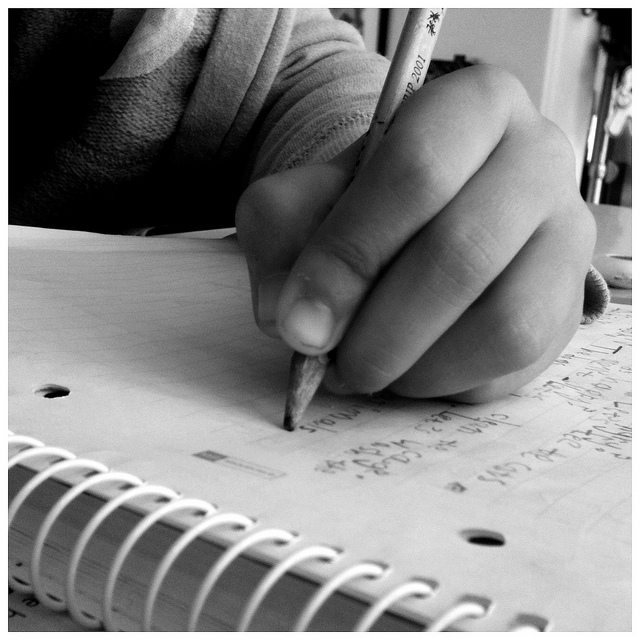
Writing. VassilisCC BY-SA

Dear Children,

I am thankful for you.

For your uniqueness, for your existence, for the lens through which only you can see the world.

I am thankful for your courage, your stories.

That you feel free enough to write about what you know, what you’ve lived, endured, and overcome in your young lives.

That you have the strength to share your early taste of loss—of pets, of parents, of siblings, of homes.

That you escaped abusive homes for ones where you could thrive.

That you left another country for mine—for ours.

That you learned from watching the failures and mistakes of others close to you.

That you learned to forgive others and even yourself.

That you learned to persevere, that you accomplished what you set your mind to because you kept trying.

That you faced your fears and came safely through.

I am thankful for what you teach me each day about listening, seeing, discerning, wondering.

I am thankful for the reminder that curiosity and questioning are natural, that creating something from whatever happens to be lying nearby is a hallmark of the human soul.

I am thankful for the beauty you bring to the world.

I thank you for daring to pour your hearts onto the page, for laboring at it, and for your truth.

I thank you for the unparalleled honor of reading your words, for the moments of laughing with you, crying with you, and standing in awe of you. For the privilege of helping you capture your ideas and communicate them clearly, of seeing you realize the power of your own voices. Of simply being on the receiving end of the important messages you have within you.

If I have inspired any of you, know that I am inspired a hundredfold in return.

Keep writing, Children, and I will do the same, for we owe it to ourselves and to each other—we need to read our stories as much as we need to write them.

I carry you and your stories, your abiding images, with me always.

Always believe in yourself, for I believe in you. In who you are now, in who you will become.

With love and profound gratitude,

your writing teacher

*******

Inspired by students I’ve taught and others whose work I’ve read.

Thanksgiving challenge: To whom are you deeply grateful, and why? Write this person a letter expressing your gratitude. If  your person is still living, read your letter aloud to them face to face or by phone. If your person is no longer living, read it aloud in a place that’s meaningful to you. Celebrate what this person has added to your life. Celebrate the power of writing and the transformative power of gratitude. 

slice-of-life_individual

Letters

img_2699

It’s a neither-here-nor-there day in June, the middle of the year, not exactly warm but not really cool, either. The blinding noon sun makes for dark shade under the trees while an intermittent breeze stirs the new leaves, dappling the sidewalks with moving shadows. People come and go from assorted shops, crossing the cobblestone street. Their voices are muted, distant. I concentrate on guiding my husband’s steps over the uneven pavement. Still adjusting to having just one eye, he struggles with depth perception and will stumble, so he grabs hold of my arm. The restaurant where we’re headed for lunch is just ahead and I am fantasizing about the she-crab soup when I happen to glance to my left, and that’s when I notice something unusual.

There, nestled close to a house entrance, in the flickering light and shadows, is an old letter box.

I’ve walked here many times and haven’t seen it before.

It appears to be wrought iron, standing on a pedestal. Ornate. I can’t tell how old it is; probably a replica, fittingly weathered.

It captivates me completely.

I forget my soup, my husband; his hand slips away. I wonder what stories might surround this vintage mailbox.

I can almost see a woman in long skirts, shawl pulled tight in one hand, a poke bonnet enshrouding her face, a creamy parchment envelope clutched in her other hand. A letter to her husband, off in battle:

The garden is thriving. I’m putting up quarts of snap beans and pickles, and soon I’ll be about the fig and pear preserves. The cow is sickly, however. I don’t think she’s long to be with us. I pray that your cough is better than when you last wrote. I think of you every passing hour, marking them with determined delight, as each one that passes brings your return that much closer. Baby and I miss you desperately. You will not believe how she’s grown in your absence, or how like you she is, so full of confidence. It shines in her eyes, which are your eyes, always reminding me . . . .

Or maybe there’s a barefoot girl in a long white gown, loose hair rippling over her shoulders, sneaking from upstairs to leave a letter just before daylight, darting back inside before the roosters crow and before a young man on a horse clip-clops down the street. He dismounts, goes to the box, finds what he’s waiting for—a time and a place. She’ll be there. He folds the letter, tucks it inside his shirt pocket, against his pounding heart, just as he remembers he shouldn’t be seen here. In one swift motion, he’s astride the horse and down the cobblestone street, fog closing in after him.

Maybe there’s a portly, mustachioed man in an overcoat, golden watch chain glittering against his vest, retrieving a notification that all his investments are gone. He staggers back against the house, slides down, collapses in a heap on the sidewalk.

Or a black-haired boy in breeches mailing a scrawled envelope: Santa Claus, North Pole. He isn’t asking for anything for himself: Dear Santa, This year can you please bring my Christmas present early? It isn’t really for me. It’s for my Mama and Papa. My baby brother only lived three days and they’re so sad. I didn’t even get to play with him or teach him how to play ball or take him for a ride in the goat-cart. If you could, please, Santa, could you bring a new baby brother? Or even a sister? Or can you ask God to send one soon, so Mama will not cry anymore?

Or . . . .

“Are you coming or not? Why are you just standing there?” My husband has gone several paces without me and has had to come back.

“Oh!” I start, my reveries vanishing. “I, um, just wanted to take a picture of this old mailbox.” Out with my phone. Center, snap. Done.

“Okay. Let’s go. I’m starving,” I say.

But it’s not she-crab soup I’m now hungry for, or food at all. I am craving the character of people who knew how to persevere, who could not have imagined sending and receiving messages on devices within seconds and growing impatient even with that. People who didn’t have the entire world at their fingertips but who read the world in a different way, with a wisdom born of living close to nature. People who knew how to read one another, who knew what mattered most, who had to wait for it, who kept on living in the meantime lives that were far richer with much less.

For everything that is gained, I muse, how much is lost.

For a time, then, I leave the mailbox behind me, but it remains in my mind, an image even clearer than the one on my phone. It pulls at me like an ancient lodestone draws iron. Every time I pass by now I will have to look and make sure it’s still there. I need for it to be. I want to step into the silence, into the moving shadows, to discover what messages await me there, to marvel over whence they come.

slice-of-life_individual