The Harry Potter club

harry-potter-club

Every semester a new group of them arrives, fresh-faced, wide-eyed, often clutching owls or wands, quivering with excitement and  ready to be sorted into one of the four houses … no, they’re not at Hogwarts. These are third, fourth, and fifth grade students who signed up to be in the Harry Potter club at our magnet school.

A colleague and I are the founders, the “co-deputy headmistresses” of the club, formed in conjunction with the school’s mission to expand arts and science integrated opportunities for the students. Staff chooses what to offer; students can sign up for anything from cooking classes to a foreign language to astronomy. Since it began, the Harry Potter club has operated at maximum capacity. Once we know students’ names, they receive their own rolled parchment letter of acceptance (as yet not delivered by owl, but we headmistresses are working on that).

My colleague and I expected to have fun – after all, we chose a theme that was fun for us. We expected that the kids would have fun, and they do. From Day One when they are sorted with the help of an online quiz  – we call it the “technological Sorting Hat” and we always end up with an alarming number of Slytherins, prompting discussions about character traits – through sessions of making their own wands, Quidditch pencil brooms, golden snitches, and patronus pictures, the students savor every moment. One of us, a teacher or student volunteer, reads aloud from the books while the club members work on their crafts. As students are sorted, someone reads Harry’s sorting experience to the group; when students make wands, one of us reads the scene where Harry goes to Ollivander’s for his wand. All students chime in right on cue, because they’ve seen the movies and they know: “The wand chooses the wizard.”

What my colleague and I didn’t expect were the far-reaching effects. Parents frequently tell us: “My child is SO excited about being in the Harry Potter club!” We didn’t expect the depth of the discussions students would initiate on their own, regarding various characters and their motivation:

“Professor Snape was really protecting Harry the whole time, not trying to hurt him.”

“That’s because Snape loved Harry’s mother – they knew each other when they were little, before she knew Harry’s father.”

“It was Harry’s mother’s love that protected him – she died to save him, and that’s why Voldemort couldn’t defeat Harry.”

One would have expected students to be drawn most by the magic, the fantastic, or the old good vs. evil theme, but at the ages of eight to ten or eleven, the students talk more about love, the huge, shining thread that winds through the stories and ties them all together.

My colleague and I certainly never anticipated one student’s attending the club from its inception to the day he left for middle school. As the club is in high demand, repeaters are not usually allowed. One of his teachers made the appeal: “He doesn’t like school, but he loves the Harry Potter club. He’s always here on club days. Can he please be in it again?”

His mother said: “It’s all he ever talks about – the Harry Potter club.”

Our young friend turned out to be a jubilant Gryffindor (as is yours truly, for the record). By his third go-round in the club, he was made Head Boy; he coached newcomers on club matters. He occasionally stopped by my room to discuss Potter trivia and other topics of his interest, always smiling. When he graduated from the fifth grade, my colleague and I presented him with a Hogwarts T-shirt. He wore it for the ceremony.

Just before his departure, our veteran member was asked why he loved the club so much. His brow furrowed in thought for a moment before he replied: “It’s this whole story about a boy who loses his parents and everything is hard for him all the time, but he still tries to save everyone. He’s so brave.”

He paused. We listeners wondered, with tears brimming, what sage, profound connection might be coming next. Our Head Boy just shrugged: “And there’s no Star Wars club.”

Ah, perspective.

Reflect: The power of story is limitless. Read a story to someone. Tell yours. It matters.
 

Why I write 2016

writing

I write because it’s the closest thing there is to magic.

From words spring worlds.

Worlds of understanding, perception, knowledge – of humanity and of myself. I write to explore the world without and within, the real and the fantastic, the important and the insignificant, the extraordinary and most certainly the ordinary. Where there are ideas and images, there are words – lanterns for encircling thoughts, illuminating objects and scenes, mystically shining from one mind to another.

I write because the narrative voice in my head is continuously composing, often drowning out other important things.

The power of story compelled me to write when I was six years old, sitting at the living room coffee table with a pack of wide ruled paper and a fat pencil. A few years later, a teacher said, “What vivid descriptions! Keep writing.” Every year thereafter, a teacher strategically appeared to give a refining bit of feedback: “Wonderful writing. Here’s a way you can make it even better … and keep writing!”

I kept writing, even when my dad grumbled, “Why are you wasting so much notebook paper?”

Today, I write with children. I witness their discovery of their own voices, their courage in putting pieces of their souls on a page. I share in the excitement of their creations, in every little triumph over challenge. I work to empower teachers as writers, for the empowerment of student writers, that all might tap into the magic.

And I keep writing.

I write to wrap a cloak of immortality around everything I have loved – what was, what is, what will be.

I write to scatter the ashes of all my yesterdays, to walk in the light of all my tomorrows.

I write to celebrate having lived.

In honor of National Day on Writing, October 20.

Reflect: Why do you write? What have you wanted to write, but haven’t yet? Carve out a pocket of time today and begin. Tomorrow, repeat.


The secret gates

ditch-gate

Into the ditch. jam343 CC BY

When I was a child, my neighborhood flooded regularly.

I lived on a block where all the backyards joined at a long ditch. When I went to play with a friend, I took a shortcut by running alongside the ditch and jumping over it, taking care not to land in it, for the ditch was lined with thick, black mud; if it did not stink outright, it certainly smelled organic, stagnant. Sometimes fleabane, tiny, hairy daisies, grew along the banks. That’s about it for ditch decor.

Whenever a heavy rain came – and a few times during a moderate rain – the ditch overflowed. Storm drains in the curbs overflowed as well, until water covered the streets and most of the yards. My friends and I had fun wading through it as we walked home from school, sloshing as much as we could.

My father, however, was irate every time.

As soon as he saw the water backing up, he got the city on the phone.

“Listen, I’ve called before,” he’d snap at the City Official on the receiving end. “You ought to have a record of it. This whole neighborhood is flooded AGAIN. Get whoever is paid to do it to open those drainage gates.”

Every time, the City Official pleaded ignorance about said gates.

I watched Daddy’s florid face redden. “You people always act like you don’t know what I’m talking about, but I am telling you, there are flood gates controlled by a switch and somebody up there knows how to use it. There’s NO EXCUSE for a place to flood like this. Open the gates!” He glanced through the picture window in the living room. “A canoe is going down my street right now. So help me, I will get in it, come down there, and find that switch myself.”

A canoe was going down our street, neighbors having dragged out their camping stuff, rowing merrily along. A teenage boy in waders, hip-deep in the water, pulled younger siblings on a raft behind him. To my horror, one young neighbor tossed a puppy from the front steps out into the water to make sure it could swim. It could; that the puppy swam back to its owner amazed me.

Daddy’s voice got louder, his face redder, until he hung the phone up in disgust, but within an hour of his call, the flood began to diminish.

As the water level went down, so did the color in Daddy’s face. In his eyes was a glint of victory, or perhaps vindication. The City Officials had, yet again, scrambled to open the secret gates they kept forgetting about. Good thing they had my dad to remind them.

Did the gates actually exist? Did they lead to the nearby river, or where? I never knew for sure, but the timing between my father’s phone calls and the floodwaters receding is intriguing, suggesting more than a fluke.

Our regular neighborhood floods were mild annoyances in comparison to the devastation experienced by anyone whose home has been lost or whose life has been endangered. The forces of nature are beyond human control, despite the best of foresight and man-made safeguards. On a small scale, my father did what was within his power to change a situation. One voice, persisting. Today I think of the labyrinthine educational system, of American politics, the overwhelming need for change when so much is at stake, and those who are suffering. What are the gates to clearing the way, and where lies the switch? Change is a force within human control. As Anne of Green Gables author Lucy Maud Montgomery penned: “All things great are wound up with all things little.”

Believe, be the voice, reclaim what is of value, before it is lost.

Reflect:  Water is a symbol of life, as well as adaptability, healing, and cleansing. When things become overwhelming, one of these might well be a switch to seek. Which might be yours? How might you help others?


What lies within


scuppernongs

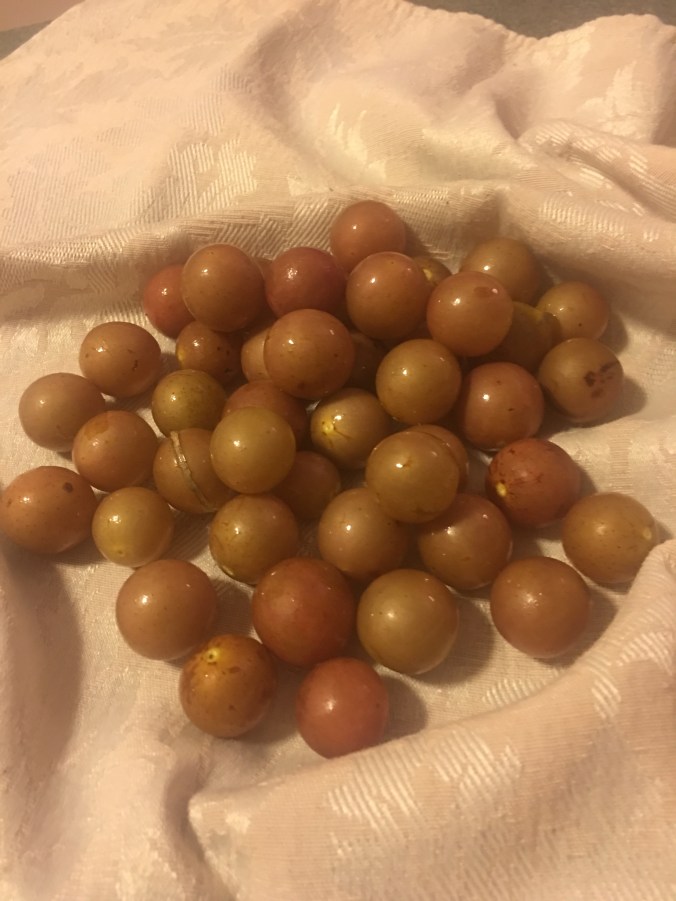
They aren’t beautiful, scuppernong grapes. Their unassuming greenish-bronze skins are flecked as if with age spots. Hardly inviting.

If you have never tasted one, you have not fully lived.

Yes, the seeds are a nuisance, difficult to manage in polite company, as one must spit them somewhere.

But put one in your mouth, gently split its remarkably thick skin open with your teeth … oh! The burst of richness is almost breathtaking. Embryonic wine, a touch of dying summer, a whisper of sweet things to come, something of all Christmases and bit of Heaven is encased in that homely little orb. No other taste on Earth compares. When I first studied mythology, I wondered if ambrosia, the food of the gods, was actually scuppernongs.

I first encountered scuppernongs as a young child. I can see the vines towering over my head, the flickering sunshine and shadow of wide leaves, the poles my grandfather erected, his straw hat, the plaid pattern of his sleeve as his big wrinkled hand reached up to pick the grapes for me. No words; just richness. Just joy.

A lot of things are like scuppernongs – unappealing on the outside, messy and more work than seems necessary. Teaching is like that. Writing is like that. Living is like that. Get beyond that first impression; it’s misleading. Press on to the heart of it. What you find there will take your breath away.

Reflect: When has the appearance of a thing, an experience, deceived you? What surprise was waiting for you within?


So we beat on

fitzgerald-grave

In the summer of 2013, my older son and I embarked on what we now call The Dead Writers Tour. The Great Gatsby film, newly released, was creating a resurgence of interest in the novel and F. Scott Fitzgerald himself. My son had just completed his second year teaching high school social studies, his favorite portion of which is the Jazz Age; he had even begun coordinating his history lessons with the English classes’ reading of Gatsby and teaching his students how to dance the Charleston.

Perhaps it was our shared loved of literature and writing, or the joy of the whole summer lying before us, teachers on the loose, that beckoned us like the green light beckoned Jay Gatsby. Perhaps the movie was the impetus for adventure, capturing the zeitgeist and ending, as the novel does,  with my son’s favorite literary quote:

So we beat on, boats against the current, borne back ceaselessly into the past.

Fitting, indeed, for a young history teacher who was born by a bay (albeit one in Virginia, not New York).

“You know, Mom,” said my son, as we left the cinema, “That quote is on Fitzgerald’s grave.”

“Is it, now,” I mused. “As much as you love it, you ought to go take a picture and put it up in your classroom.”

The light in his eyes was instantaneous. Out came the phone to research the grave’s location: Rockville, Maryland. How far is that from home in North Carolina? A quick check in Apple Maps: Right at four hours.

“That’s a day trip,” I said. “I’ll come with you. It will be our summer celebration kick-off.”

So, on a mid-June morning, we left long before daylight. We ate breakfast while it was still dark, chattering about our teaching accomplishments that year and our dreams about writing, lamenting the constraints of time in the daily grind of making a living. The hours passed quickly, despite the epic traffic snafu of D.C. Once on the other side, however, we sailed right into Rockville.

The cemetery is at a Catholic church in the midst of bustling city streets. After navigating such noise and chaos, I was not expecting utter silence on entering the graveyard. It was like a cosmic mute button was suddenly pressed, or that I had passed through a portal from one world to another. The city receded at once; all I could hear was a faint shivering of tree leaves overhead in the breeze, oddly cool for June, and the occasional flap of little American flags, remnants of Memorial Day, at the graves of veterans.

How incredibly peaceful, I thought.

“There it is,” whispered my son, pointing.

Fitzgerald was easy to find; his grave was the most adorned. As we approached, a brown rabbit hopped out of our path to a more remote patch of sun-dappled grass where it could nibble, undisturbed. At at the foot of his grave a flag commemorated Fitzgerald’s World War I service. On the headstone, the author’s full name signifies an even deeper connection to the flag: his famous cousin wrote the lyrics to the “Star-Spangled Banner.” I reveled in having my own first name in common with these writers and Fitzgerald’s daughter, buried nearby. A pot of daisies had been placed by the headstone, a nod to the love of Jay Gatsby’s life. Most interesting of all is that Fitzgerald’s wife, Zelda, who was at least part of the inspiration for the character of Daisy, is buried with him in the same grave.

Any student of F. Scott Fitzgerald knows his struggles, that he was always teetering on the brink of financial ruin, that he and Zelda lived a frenzied life, that both of their deaths were sudden and tragic, him with a heart attack in his forties and her a few years after, in a fire at the mental hospital where she was a patient. Fitzgerald never knew The Great Gatsby would become the beloved American icon that it is.

We stood there in the stillness, my son and I, drinking in the sight, lost in our own thoughts. After a bit, we took the pictures.

One or the other of us sighed. I am not sure which.

“What do you want to do now?” asked my son.

I looked up at the sky. The day was golden, still young; we had time, perhaps, for another adventure.

“You know,” I grinned, “Baltimore is only forty-five minutes farther. Poe is buried there.”

My son chuckled. He took one last look at the final Gatsby lines etched on the weathered granite slab. “All right, Mom. Let’s go.”

So we beat on.

Reflect: What literary works or quotes strike a deep chord in you? Why?

-Happy Birthday this week, F. Scott Fitzgerald.

Cicada rhythm

cicada-on-post

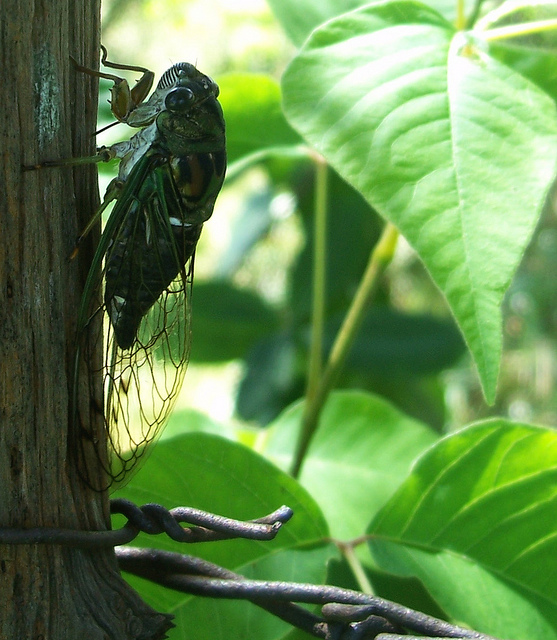
Image: Cicada on a post. Jo Naylor CC BY 

Summer is dying now, taking with it one of the things I love best: The song of cicadas.

If you’ve ever heard cicadas in full throttle, you might not agree with “song” as a fitting description of their cacophonous buzzing. It’s not pretty. The noise can be deafening.

Yet when I hear that first discordant rattle sometime in May, my spirit rises, my own heart sings in response.

The song of cicadas calls to me from long ago, when I was a little city girl spending sultry summers in the country. The song evokes narrow dirt roads keeping an ominous forest from encroaching on rustic homeplaces, tiny cemeteries where baby after baby is buried under white monuments adorned with lambs, and the old church just around the bend. The song is one of ages, the rising and falling of generations, all of us coming and going in our time. It is a song reverberating with tire swings hanging from pecan trees, canals teeming with frogs and turtles, white-tailed deer bounding up from lush ditch banks along fields at dusk. It is the bright song of the sun, of hope, of continuity. It is the dark song of the night, oddly comforting; something out in the blackness is vibrantly alive, maybe keeping watch, while children drift off to sleep. It is the sound of safety, stability, belonging. Calling and calling, the crescendo mirrors the rhythm of life, brimming with promise, echoing eternity. When I hear it, I am a child again, no matter how many summers have come and gone. My home is in the countryside now and it is with a deeper pang each September that I note the song fading out. Every May, as I mark another year of my existence, I listen for the first returning rattle. You’re back! my heart sings. Ah, but we were here all along, they might say, if cicadas had words. There’s a lot of living and loving yet to do. You have today. Carry on.

Reflect: What’s one thing in nature that inspires you? Why?


Making it real


4790195477_6dc88e3c93_b

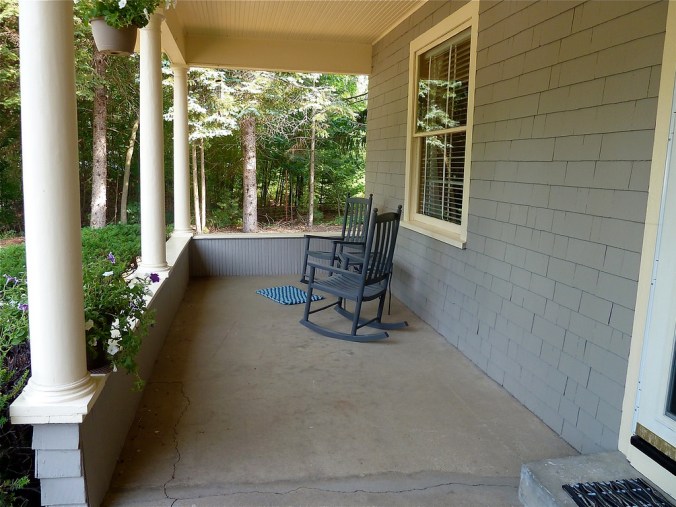
Image: Porch front. Liz West CC BY

Many of the second graders were bent over their desks, writing. Others were rereading their work with pencils in hand, like diminutive journalists editing reports in a newsroom. A few more looked off into space, thinking, before returning to the pages lying before them.

One of the joys of my role as literacy coach is getting to write with students and teachers across grade levels. The previous day I had come to model realistic fiction writing for this class, focusing on how to bring the stories to life with detail and dialogue:

“When I write realistic fiction, ladies and gentlemen, I often use what has happened in my own life. That’s why you were sad when my main character’s favorite toy got ruined – you felt what she felt, because it was something that had happened to me. I could give a lot of descriptive detail because I really lived it. That’s why you laughed at the conversation between my characters, because those were real conversations I had when I was that age. I just let my characters say those things. If you want to bring your realistic fiction to life, try using some things you have really seen, said, done, or felt.”

The children decided individually whether dialogue or more detail in setting was the thing they most needed to work on, and today I was back to see how it was going. One by one, I knelt beside them to hear revisions they’d made. I noted excited twitches as I approached – these kids knew their work was better.

I paused by a desk where a girl was absorbed in writing. I remembered her piece from the day before, in which she described a porch where two little girls were having a conversation. When she’d read it aloud, I could envision the girls sitting together on the porch, but the dialogue didn’t seem to be about anything in particular. “Try to think of what might matter to these girls,” I had advised. “Are they happy about something? Worried? Think about what matters to you and see if you can help your characters have a meaningful conversation that a reader would want to read.”

Now I knelt beside her. “Do you want to read your writing to me, or keep working?”

“I want to read it to you.”

She did. As I listened, a line from Emily Dickinson’s letter to a publisher sprang to mind, asking if her verse “was alive”: Should you think it breathed – and had you the leisure to tell me, I should feel quick gratitude . . .

“What a major improvement in dialogue! This part, here, where your main character tells her friend that she’s excited about getting a stepfather to do things with, but is also a little afraid – that’s the best line in your story. This is where it really comes to life. It’s great writing.”

She looked up at me, eyes big and solemn. “I did what you said. That’s how I feel. My mom is getting married again.” And she bent back over her writing, drawn like a duck to water or a swallow to the air, a compulsion I fully recognized, for when we write, we are putting pieces of our souls on the page. Facing our fears, meeting ourselves where we are, daring to hope, finding a safe haven, maybe to heal. Even in the second grade.

Very real, indeed.

Reflect: What truth will you write about today?


Lit legacy


Kobo

I love words because of my grandmother.

It’s a simple thing, really, to gather a child on your lap with a book open for the little eyes to see,  and read aloud as if time and duties and all the other business of life do not matter. In truth, none of those things matter more than creating a literate legacy for a child.

Did Grandma know the far-reaching effects these moments would have? She wasn’t a teacher. She just loved to read, and I caught it from her long before I ever started school. Over and over she read The Squirrel Twins to me, the adventures of Chitter and Chatter, immortalized in rhyme:

There were two little squirrels, who lived in a tree

As happy as two little squirrels could be…

She chuckled at the illustrations every time. Cozy there in her arms, enveloped in the light fragrance of her Avon sachet, the cadence of her voice seeped deep into my brain. One day I surprised her by taking the book from her hands and reciting every word on every page:

And this is the song they sang on the way,

“What a hippity-happity-hoppity day!”

“My goodness!”

“What, Grandmama?”

“You memorized all the words!”

I knew what was coming because of the repeated readings, connecting the visual story with the simple pattern of the rhyme before I could actually read the print. It’s such a simple thing: What was poured in came pouring back out.

She poured in so much more than words – the love of words, the love of story, eventually the love of writing. My grandfather retired when I was five years old. He and Grandma moved “back home” to eastern North Carolina, leaving me behind on the Virginia peninsula. “It was the hardest thing I ever had to do,” she said years later. Determined to stay connected, she began writing letters to me. I was soon old enough to write back, and when I told her that my dad (her son) complained about my using up his postage stamps, Grandma promptly sent a letter containing a book of stamps so that “you can write to me whenever you want.” I could almost see the defiant twist of her mouth when I read that line. Every summer when I came to stay for a few weeks with my grandparents, the first item on Grandma’s agenda was taking me to the tiny, musty town library where I checked out more books than I could carry. Nothing was ever deemed off-limits or inappropriate. I was completely free to read what I wanted, as much as I wanted, whenever I wanted.

When Grandma died, I inherited her piano, which now belongs to my musician son, and twenty-five years worth of diaries in which she recorded the minutiae of her days. In those pages, all those we loved and lost are still alive, the grievances of the time are now hysterically funny, almost sitcom-worthy, and her prayers for my teenage self are yet another heart-wrenching reminder of the lasting power of words.

She was a gift, my grandmother. A priceless jewel. Her name, in fact, was Ruby. Of all the things in life for which I am thankful, one of the greatest is that Ruby read.

Reflect: How are you helping light the literate way for the children in your life? Who lit the way for you? How might you return thanks? 

Breakfast Island

island

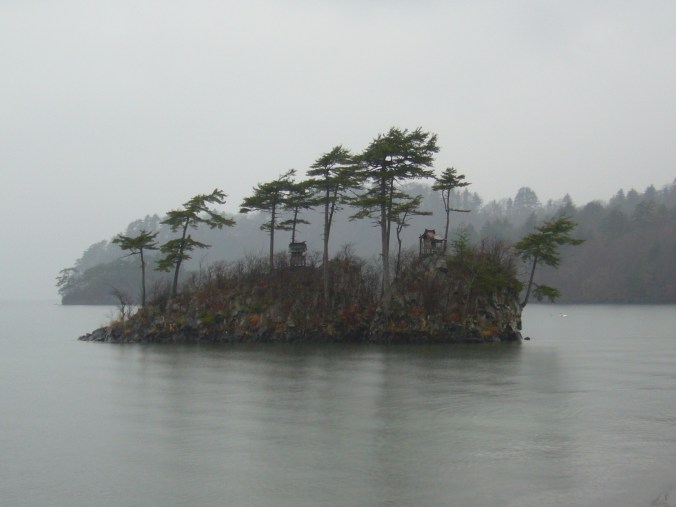
Image:  studio tdes CC BY

Somewhere in Maryland’s scenic Severn River is a tiny island that belongs to me.

Not that I have a deed to it, or that the island was even the giver’s to give, but those are minor details.

The transaction came about when I was around seven years old, during a family gathering. My aunt and uncle, avid boaters, decided to treat everyone to breakfast on the beach. In the chilly gray dawn, a bunch of us piled into my uncle’s motorboat and sped across the Severn. Unbeknownst to me at the time, this majestic river connects with the Chesapeake Bay; the U.S. Naval Academy stands at the convergence. I only knew I was cold and hungry. I shivered in the breeze, thinking that going to the beach for breakfast was just about the most exciting thing ever.

The beach turned out to be an island right in the middle of the river. If Huck Finn had seen it, he would have called it a towhead, a mere islet with a thicket of brush in the middle. As the grown-ups busied themselves with building a small fire, I walked the whole sandy circumference in a couple of minutes, marveling at the island’s diminutive size.

“What is this place?” I asked my uncle, who was crouching by the fire with a skillet full of sausage links.

“Just an island where people sometimes stop off,” my uncle answered, as the sausages began to sizzle.

The sun was bright now, the Severn very blue against the island’s golden sand. A few white sails appeared in the distance.

“What’s the island’s name?” I wondered aloud.

“It doesn’t have one,” replied my uncle.

“Why not?”

“I guess it’s too small for a name.”

How disturbing, that such a pretty place did not have a name.

“Why don’t the owners want it to have a name?”

“Nobody really owns this island,” my uncle said, carefully turning the sausages. Thin blue smoke drifted up from the skillet.

“What! How come nobody owns it? ”

“It’s just here, hon. It isn’t like the big islands, where people live. That’s a good thing, because anyone who wants to can stop and visit, like we’re doing now.”

An inexplicable sorrow welled up in me. It wasn’t fair that no one cared enough about this little island to want it or give it a name. It hurt my heart.

My uncle squinted at me. “What’s the matter?”

“It should belong to somebody.”

“Ok, then, why not you?”

“WHAT?!”

“It now belongs to you.”

“For real?”

“You’re the owner of this island. Congratulations.”

Pride surged through me – I owned this island, the prettiest place in the world! I loved it. Somehow I felt it was mutual, that the island loved me back, was happy that I was there, that we were meant to be. Then a fleeting fear struck me:

“Do I need to pay for it?”

My uncle howled with laughter. “Goodness! Well, since there is no other owner, it’s free.”

The sausages were done; someone filled another skillet with apples and cinnamon. I never knew apples could be fried. Their aroma filled the air like incense from an altar, sweet, pleasing, mouth-watering. For the rest of that morning I basked in the glory of possessing my own island,  soaking up the sun and asking for more apples, until they were gone. I never wanted to leave.

I have never returned. I do not know if the island still exists, or if time and weather have dissolved it, the way that relationships eventually dissolved. What I know is that for that one halcyon morning, I was the richest person on Earth; I owned an island, and it was free.

Reflect: In what ways can you take a child beyond the realm of “the usual” to experience something rich and unusual? How can you creatively instill a sense of ownership? 


Seeing past the surface

Blue crab

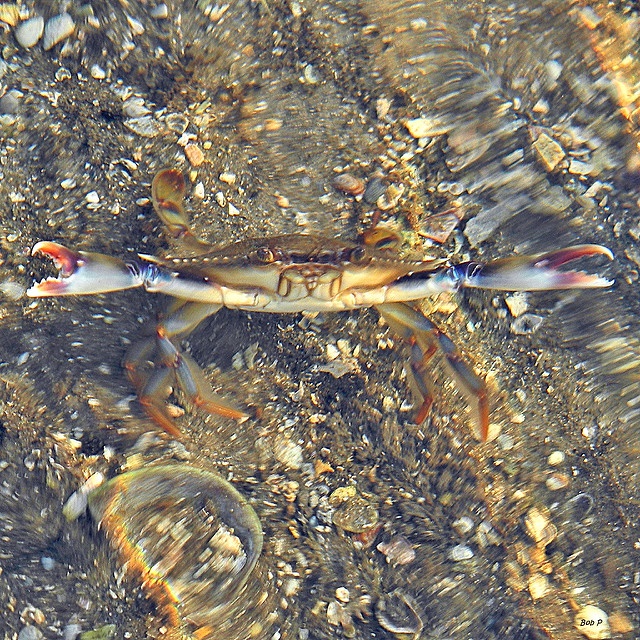
Blue crab (Callinectes sapidus). Image: Bob Peterson CC BY

One summer long ago, my grandmother took me crabbing at South Creek, a tributary of the Pamlico River. We knelt on the weather-beaten pier, tied a long string of twine to a raw chicken neck, and lowered the bait into the murky green depths. Grandma anchored the loose end of twine to a rusty nail jutting out from a piling.

“Now we wait,” she said. “But keep your hand on the string so you can feel when a crab starts nibbling.”

Being a novice, I was sure I felt a crab nibbling right away. I pulled up the length of twine ever so slowly, only to see the fleshy chicken neck. I released the twine. The bait plummeted out of sight again. Within minutes, I was positive I felt nibbles. Reeling in my string, I found only the bait once more.

Grandma chuckled. “You have to be patient. Give the crabs time.”

“I thought I felt nibbles,” I said in my own defense.

“You feel the bait drifting. You’ll know when it’s a crab.”

I waited, my mind wandering. The day was bright; Grandma’s sunhat cast a ruffled shadow on the gray boards, warm and splintery.

Next thing I knew, there were erratic tugs on my line.

“Easy,” said Grandma, sensing my excitement. “Pull slow and easy or you’ll lose it. Pull so the crab doesn’t realize you’re pulling.”

Bit by bit, I inched the twine up through the water to find not one but two – two! – blue crabs picking at opposite ends of the chicken neck. Holding my breath, I pulled until the crabs were just below the surface of the water. I dared not move as Grandma scooped them up with the dip net.

As the crabs scuttled inside a galvanized tub, I tossed the slightly-gnawed chicken neck back into the water, observing: “It would be a lot easier if we could just see to the bottom. Then we would know when we have a crab.”

“Well, isn’t that the fun of it?” asked Grandma. “Not being able to see what’s there, but pulling until you can?”

Decades later, I sat listening to a group of fourth grade intervention students rereading a script.

“You’ve all come a long way with your fluency, recognizing words automatically without needing to self-correct. I can hear some great expression,” I commended them. “I have one question: What is this scene really about?”

As students tossed out random answers, images of a weather-beaten pier, twine, and raw chicken necks came to mind. “Wait, you guys. You’re all skimming along the surface, just seeing the words. There’s a deeper meaning you’re not seeing; it goes past the words into the ideas behind them.” I told them of my long-ago crabbing days, how I knew the crabs were there, hidden from my view, and how I had to watch, feel, and finally pull them to the surface. “Reading is like that,” I told the kids. “There is more than what you see at first. To infer, you have to take your time, go back, and try to feel what’s not actually said before you can grasp the meaning. Some words give you more clues than others, but a deeper understanding is always there. Sometimes you have to wait, think, and work to pull the meaning out.”

Until that moment, I hadn’t imagined crabbing as a metaphor for reading comprehension, or, for that matter, teaching. The students often come to us with their backgrounds, experiences, struggles, and gifts hidden from us at first. The depths can be murky, indeed; how easy teaching would be if we could automatically see everything that each child needs to be successful. The best way to start is by throwing out the greatest “twine” we have: the love of learning. Keep your hand on the string, Grandma said. You’ll know. Pull easy so you won’t lose them. Be patient. 

To me, the true joy of teaching is first hooking students with a love of learning, then watching myriad treasures rise from those depths, especially when students start pulling on their own.

Reflect: Where can you strive to see past the surface of experiences and relationships to something deeper, of value? What unique exploration can you share with a child?