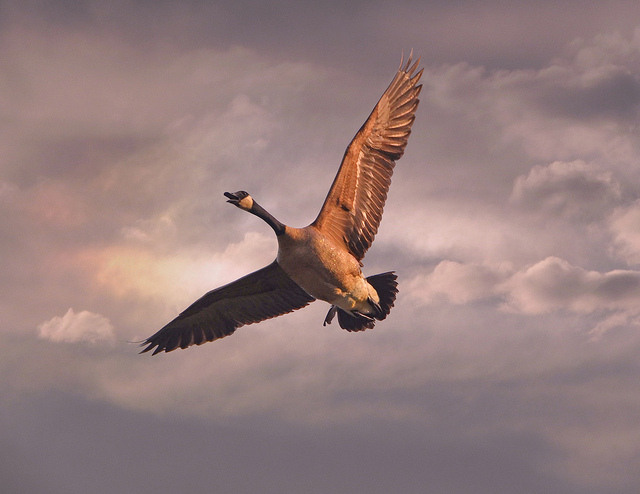
Canada Goose in flight. Richard Hurd. CC BY
Meanwhile the wild geese, high in the clean blue air,
are heading home again.
Whoever you are, no matter how lonely,
the world offers itself to your imagination,
calls to you like the wild geese, harsh and exciting –
over and over announcing your place
in the family of things.
-from “Wild Geese,” Mary Oliver
During a summer workshop, I read Oliver’s poem “Wild Geese” and was charged with interpreting what it mean to me in a quick write.
I wrote:
No regrets. Life goes on. Heading home again – from wherever you are. This is a poem of belonging, of recognizing that we all have despairs, losses, soul-aches. We have to keep living, keep trusting life, keep reaching for it, because it reaches for us. Life calls to us as the geese call to one another. Reform – fly in formation. Geese mate for life – they keep going on. They know their places. We must know ours, must find ours, must believe in ours, even if we have never seen it, recognized it, known it existed at all – we have a place of belonging, for all things are connected with meaning, and have meaning. Home may not be home in the sense we know it. Home may be somewhere else – but we all have the homing device inside us. We must keep flying, trusting.
I put that particular notebook away. I didn’t think about my interpretation again until I prepared to facilitate a recent “writing studio” workshop for teachers, touching on the power of poetry, abiding images, the interconnection of body, mind, heart, and spirit. I got the notebook out and took it with me. Not until I read my words aloud, months after the writing, did this realization come to mind – one so obvious that I can’t believe it didn’t come before.
My father loved Canada geese. I didn’t know this until the last years of his life and even now I do not know why he was so fond of them. On our last Christmas, I gave him two Canada geese lawn ornaments for his front yard (his yard was a great source of pride to him, as I wrote in Fresh-cut grass). Daddy was delighted; his face lit up at the sight of the goose statues. He set them on the lawn in the shade of the maple tree, where they stood, elegant and life-like, until his sudden, too-soon death.
Many things are a painful blur about those days, but on the re-reading of my interpretation of “Wild Geese,” a stark image returned to me: Walking behind my father’s uniformed, white-gloved pallbearers through the veteran’s cemetery, past a wide field to my right where, standing at attention, was flock of Canada geese, silently watching my father’s casket go by.
Not that they were paying homage, as much as my fanciful imagination would have me believe. The geese were likely keeping wary eyes on this odd processional of invaders so near their space.
Geese, I know, represent fidelity, valor, protection, navigation – returning home – among other things. I treasure their presence and their symbolism at my father’s funeral.
For, with my father gone, there would be no heading to my childhood home again. It marked the end of that family of things.
But I was grown, with children of my own. I had another home, another place of belonging. Life goes on, I’d written after reading of Oliver’s wild geese. This is a poem of belonging, of recognizing that we all have despairs, losses, soul-aches.
It occurs to me now that Oliver’s poem is about identity.
Whatever our losses, our lot in life, there is a place of belonging. A place of protection, nourishment, growth, and being. However harsh life may be, this place calls to us. It’s up to us to hear and respond.
Home may not be home in the sense we know it. Home may be somewhere else – but we all have the homing device inside us.
So the question is: What is that home, that place of belonging, where it is safe to be who you truly are? For some, it’s family. Or one’s life’s work. Or a community of faith, believing in an eternal home yet to come.
Others also find it in a group of like-minded people – artists, writers.
I find my place in all of these.
Wife, mother. Teacher, coach. Christian.
Writer.
Each my identity, each my gift.
Over and over announcing your place in the family of things.
Listen. Know who you are. Where you’ve come from, where you’re going. Come into your place in the family of things.
My father’s house was in the city; my home now is in the country. Early in the morning, as the sun rises over the vast field at the end of my lane, geese fly, calling to one another in their discordant, raspy voices. I can hear them long before I see them. They fade in louder and louder as they come near. If I stand outside as they fly over, I hear the silken sweep of their wings. I can hear them, calling and calling, even when they’re gone, when I see them no more.
The family of things – it is there, always, even if we cannot see it, even when we see it no more.
So is the belonging. Wherever else I find my place, I’m still a daughter, a granddaughter, the living remnant of a family of things.
From my teacher-place, I reflect on how we must create a sense of belonging for the students, encouraging and guiding them to find their places in the family of things.
The world offers itself to your imagination, calls to you like the wild geese.
Whoever you are, wherever you are, whatever has gone before: Trust. Recognize. Reach. Open your wings, stretch them as far as they’ll go.
Fly on.
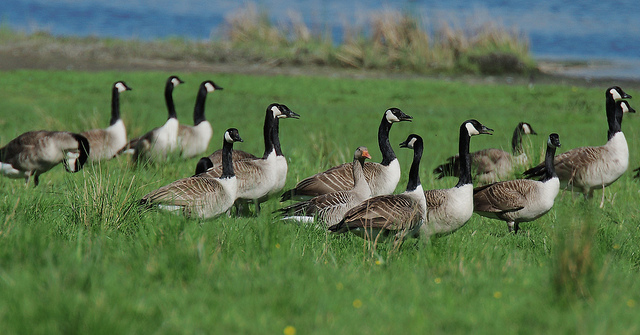
- Kanadagås / Canada Goose. Stefan Berndtsson. CC BY
 lit bits and pieces