Sanctuary

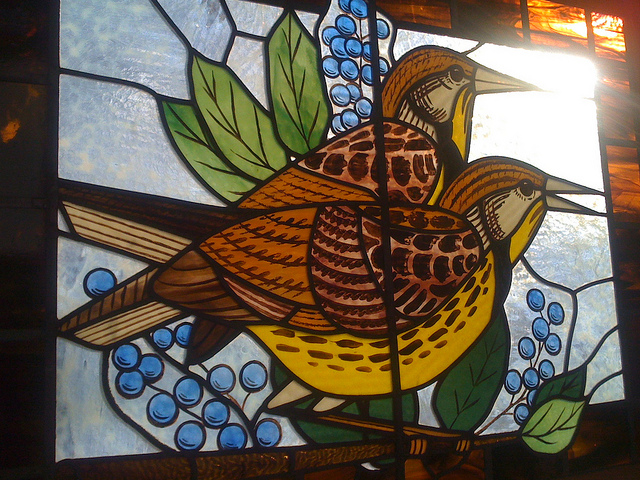
Stained glass birds

Stained-glass birds. Jesse RadonskiCC BY

Elizabeth, Elspeth, Betsy, and Bess

They all went together to seek a bird’s nest.

They found a bird’s nest with five eggs in,

They all took one and left four in.

—Mother Goose

It’s the summer of birds.

They became a recurring motif in my summer writing workshop. 2018 is actually The Year of the Bird, marking the 100th anniversary of major bird protection laws. I’ve discovered that I’ve written enough bird stories to give them their own category for this blog. I am reading a stunning, lyrical book recently recommended to me, When Women Were Birds: Fifty-Four Variations on Voice. I recalled the friendly little parrot I saw at a store a while back, and thought—for maybe seven seconds—about how nice it would be to have another pet bird.

And so they came. As if summoned.

House finches, they are. A pair built a nest in my lantern porch light fixture. I would not let my family turn on that light at night for fear of burning the birds. A brood hatched, grew quickly, and was gone; here’s a fledgling tarrying behind on the last day:


Once the nest was empty, our younger son, Cadillac Man, removed it and my husband had the house power washed (a thing well past due).

A day later, I heard a commotion on the front porch.

Birds. Very loud ones.

The front window blinds were up; I could see a male finch, a soft dusting of red on his breast, hopping to and fro along the white railing like an Olympic gymnast on a balance beam (forgive the mixing of genders here but that is what he looked like). He paused to stare right back at me. A speckled brown female flew to him, then instantly away again. Two or three more finches skittered nearby. The collective chatter seemed highly agitated—consternation is the word that came to mind.

It’s the nest, I thought. They’ve come back and it’s gone.

They had to be the same mother and father. I wondered if the others were part of their newly-grown brood. Or a support group. Some sort of council?  They seemed to be consulting over the vanished nest. Maybe problem-solving? Collaborating? Making decisions?

For two days, the lively bird debate continued.

Then it died down.

And a piece of pine straw appeared in the bottom of the lantern.

From the window I saw both male and female bringing more pieces, saw the male drop his on the porch floor, fly down to retrieve it, and hover like a hummingbird to work it into place.

My older son, The Historian, passing through the hallway, stopped beside me to watch: “It’s amazing how they know to do this.”

“What’s going on?” his father called from the living room.

“The birds are building another nest in the porch light,” I told him.

“Oh, no they’re not,” he said. “We just had the house washed. The porch was disgusting.”

He went to the kitchen, rummaged in a drawer. He went to the porch, pulled out the three pieces of pine straw.

And put aluminum foil in the lantern:
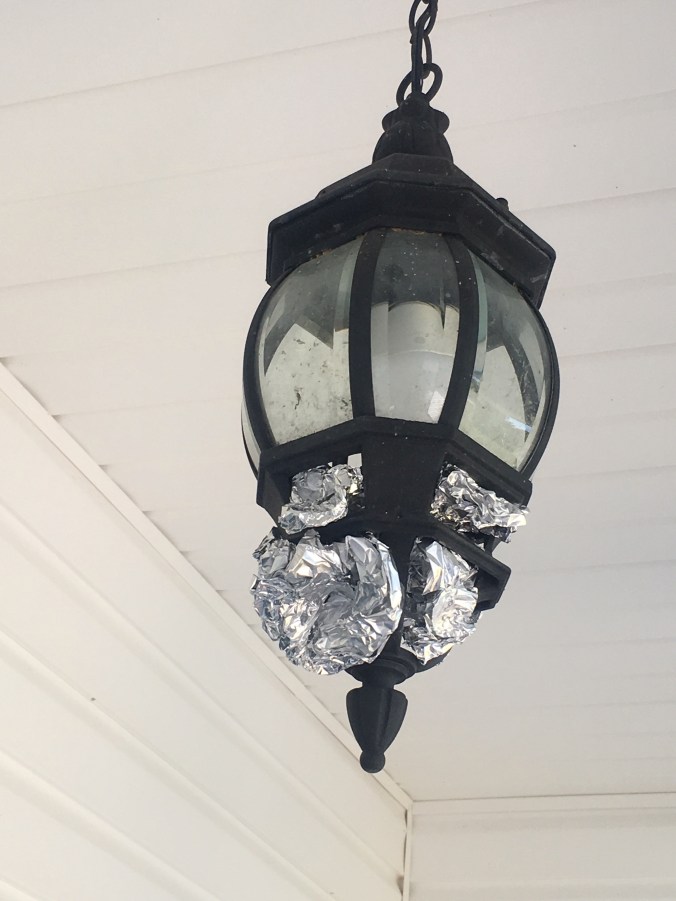
It sent the finches into a frenzy. For another day, the loud bird-chatter resumed. I found a bit of foil on the porch floor; had one of them tried to tug the stuff loose?

And I worried about the birds cutting themselves on the aluminum, about time elapsing when they clearly needed their nest. The female must be getting ready to lay more eggs, or why all this fuss?

What would they do?

The next day when I opened the front door to go get the mail, I heard a rush of wings and I knew.

The wreath on the door.

Sure enough, on the top of the wreath lay a few long grasses.

I chose to keep this a secret for several days, until:
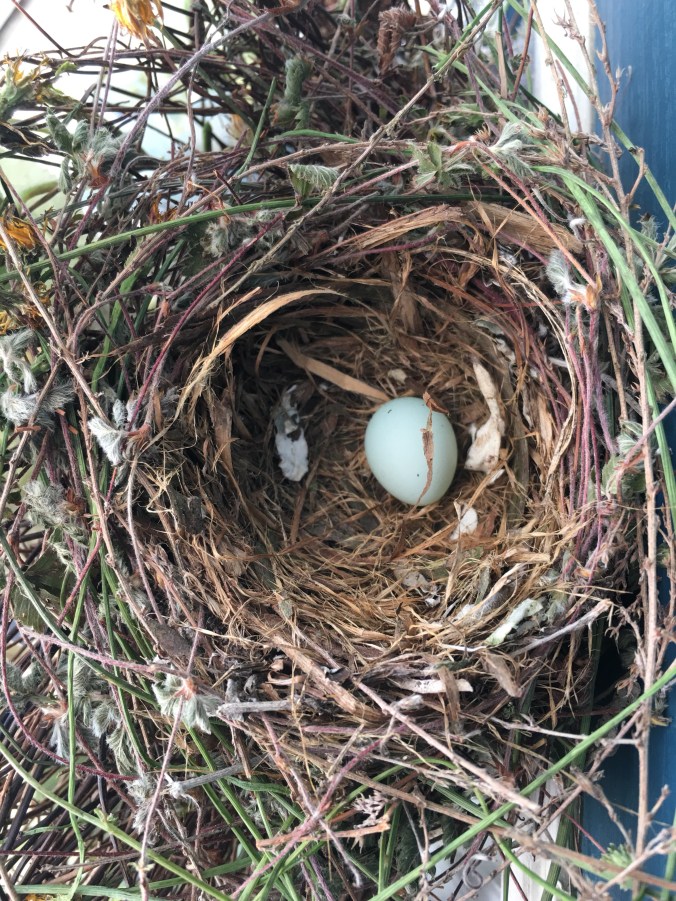
“All right, you guys,” I announced to my menfolk, “we now have a nest on our wreath with an egg in it. No opening the front door until these birds are gone.”

I may have also mentioned, nonchalantly, that it is illegal in the United States to remove a nest containing eggs.

And then I worried even more: Is the wreath secure enough? How many more eggs will there be? Will they—will the babies—be safe?

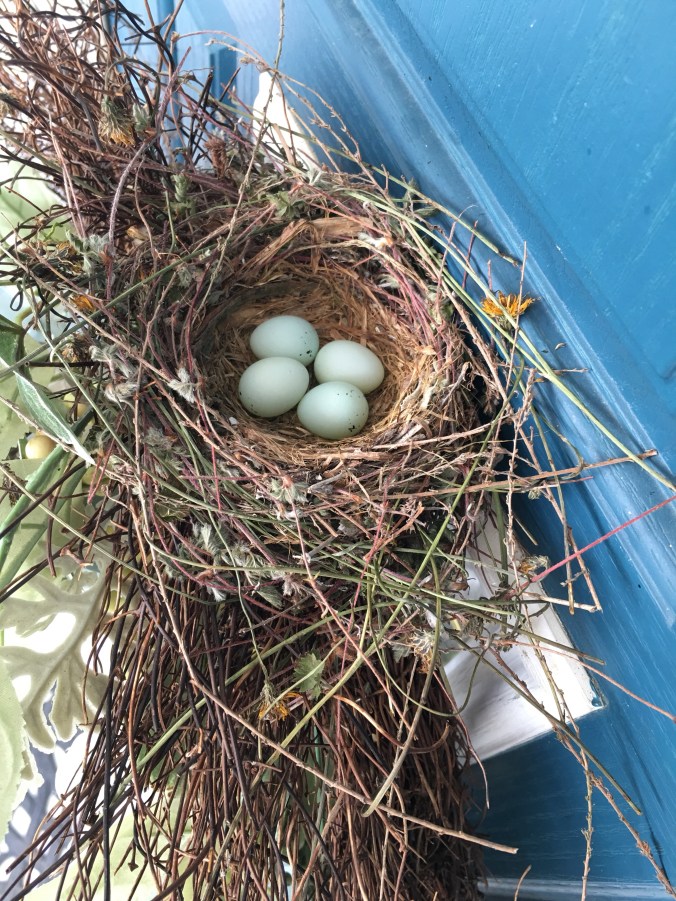
The nest made me want to cry. At the perfection of it, at the dried dandelions laced through it like deliberate decoration, an artist’s touch. I wanted to cry at the determination of these birds to live on my porch, how they persevered in rebuilding their home from scratch. They do not know that they built on the door of my home as well as on my heart, where there’s an especially tender spot these days for little creatures and their well-being. I still mourn a small dog, grown old and frail, that I could not save. A rawness in my soul that has yet to grow new skin.

While these birds do not really need me, they spark a sense of ownership and protection. They’re in my realm now, in my sphere of influence.

All I can give them is sanctuary.

I remember how, when I was a child riding in the backseat of a car watching the cityscape give way to fields and forests, a little green sign appeared:

BIRD SANCTUARY

I puzzled over this: Where’s the bird church?

It took some time to understand that birds can’t be hunted here, that sanctuary means safe place. 

A place to be, grow, flourish, and fly. Something every living thing needs.

Sanctuary was the word I chose to describe the writing workshop just a month ago. The workshop that had the bird motif running through it. A safe place to think, explore, write, share.

So now, every morning, when the sun is new, when shadows are sharp on the ground, while the dew is still sparkling on the grass, I walk from the garage door to visit the sanctuary. Mama Finch sees me coming as soon as I round the corner; she flies out of the nest, bobbing through the air without a sound. There’s a reverent silence, a holy hush, in sanctuaries, you know. She waits on the rooftop while I quickly admire her handiwork. I go before she’s troubled. I’ve learned from these visits that she lays her eggs between 7:00 and 8:00 a.m.

As soon as my husband and I returned from a trip to the beach, he asked: “Have you checked on your eggs?”

“Yes,” I said, smiling at his words. My eggs.

I have four.
*******

Stay tuned for the hatching announcement.

While writing this post I could not help thinking how “sanctuary” applies to teaching and instructional coaching. As with the house finches—which are symbolic of joy, happiness, optimism, variety, diversity, high energy, creativity, celebration, honoring resources, and enjoying the journey—a safe place to be, grow, flourish, and fly comes through concentrated, collaborative effort. Right now my finches are singing. A song, perhaps, that all of humanity still needs to hear.
Stone speaks

img_4963

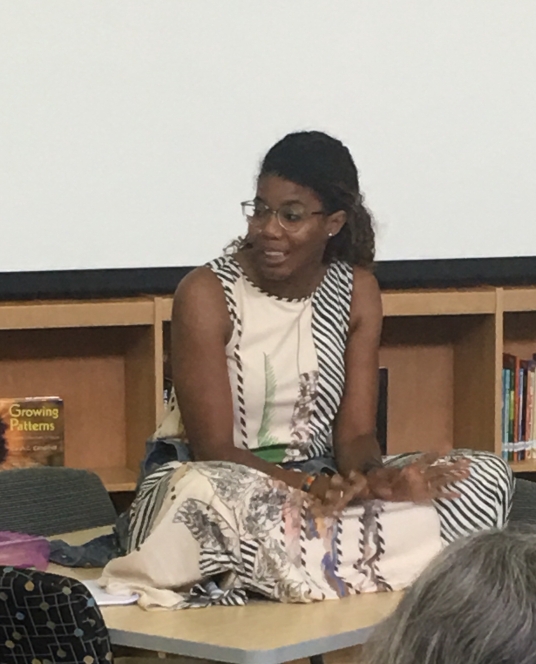
Author Nic Stone shares her passion and insight with teachers.

I scribbled notes as fast as I could while Nic Stone spoke to the gathering of teachers yesterday.

Stone is the author of the young adult novel Dear Martin. She’s straightforward, funny, warm, and passionate about reading and writing. The teachers are K-12 cross-curricular educators from across my district who’ve chosen to attend our second annual Teacher Summer Writing Institute—an entire week dedicated to growing as writers and teachers of writing. As a co-facilitator of this event, I sat in the back of the room for the panoramic view: The writing guru, seated comfortably on a tabletop, delivering her wisdom to the crowd who eagerly awaited.

Here are my favorite words of Stone:

“Literacy is about collaboration. Reading and writing are collaborative efforts. We have to be able to talk to each other.”

“I wanted to write from an early age but it took me until age twenty-eight to really try . . .  finding your voice is validating yourself and what you think and feel . . . READ what makes you think and feel.”

“Write for yourself first.”

“The beauty of writing is that it is always in your head.”

“You don’t have to write every day, but you have to develop the habit of writing.”

“Writing is solitary. Storytelling is collaborative.”

“Schools with the highest reading and writing successes are those where students have freedom to choose what they want to read and write about. Kids see each other doing it.”

“These are conversations you should be having in your buildings: Why do standards exist? What does it mean to be literate?”

“That you keep on doing the work without answers . . . that shows your amazing strength.”

“There’s no room for being wrong in American schools. Kids need to know it’s okay to fumble; it’s how they learn  . . . they need a soft place to land.”

“Reading and writing can unpack fears.”

“There’s no better way to help students find their power, their agency, their validity as human beings, than in the beauty of books, in words, in writing.”

“The thing about research is how one thing leads you to another. Everything connects. Reading and writing are all about connecting. Our connecting to the world around us, our connecting to each other.”

“Emphasize the fun in research.”

“For authentic writing, voice is more important than grammar. Let students drop commas, play with punctuation, write run-ons, fragments . . . tell them they have to know the rules before they’re allowed to break them.”

“All first drafts are garbage. They’re supposed to be.”

“Do yourself and the kids a favor: Don’t grade first drafts. Assign a date to have students finish them. They’ll have a sense of accomplishment in just finishing. Then after a couple of days, have them go back and revise.”

“I finish writing a draft before I revise, or I’d never finish.”

“Do what’s best for you to get your work on the page . . . it’s just not in the first draft.”

“Your writing doesn’t have to be be good to get an agent. It has to be good to get an editor.

“Always be working on something else. Always.”

“I’m amazed at the compassion I’ve developed just from writing books.”

“Writing is my life. I can’t not do it.”

Stone opened and closed our time together with three-minute timed free writes; the closing prompt: Now that this mess is over, I feel . . . 

My final lines in response, in my journal: I feel validated in so many ways, as teacher, writer, human spirit.

For all of these connect.

img_4989.jpg

Kindred spirits: My co-facilitators and I with Nic Stone.

*******

See my post Write me for more background on the Summer Teacher Writing Institute and the value of teachers as writers.

Get words

Imagine what is over there

Imagine what is over there. Kenneth BarkerCC BY

Last night I met with a small group of teacher-writer-colleagues from my district.

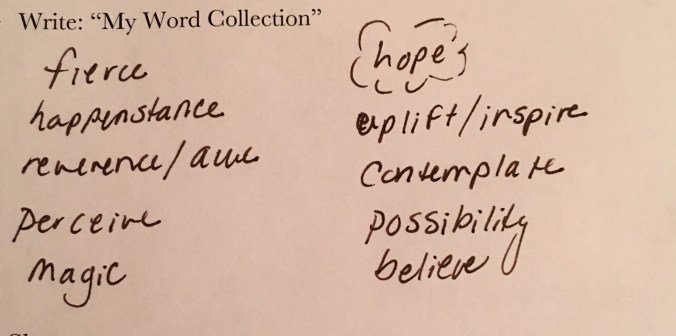
We started our discussion by writing words that resonate with us.

-Quickly.

Mine are:

fierce    happenstance   reverence   awe   perceive  magic  hope   uplift   inspire               contemplate   possibility   believe

I don’t know why this was hard or why some of these words came to me (happenstance? Go figure. Must just be the sound of it. What other reason could there be?).

Then we had to pick the word that was most significant to us.

Mine is

      hope

for in every aspect of my life, I am hopeful. If I could impart one thing to others, it would be hope.

Hope is vital to the human spirit.

My colleagues and I talked about our work with students, other teachers, and our own writing. Where we’ve been, where we are now, where we want to go.

       uplift

               inspire

Going home, the lively discussion and energy circles round my mind. Something in there is trying to find a landing place.

                         contemplate

The “something” is tied somehow to student reactions . . . the ooooohhhh moment that’s such music to a teacher’s ears . . . like when a student connects a thing he/she loves to a book, or to writing . . . this week in fourth grade, it was me asking Why is opinion writing important? with a student responding You write about what you feel deep in your heart and another student saying Like music. I can write about why I love music. I want to write songs and me saying, Well, maybe you need to write your opinion piece AS a song.

—beat—

OOOOHHHH

       reverence

                             awe

And then I think, fierce is an odd word for me to pick yet it was the first one that came to mind. Why is that?

Fierce love like mother for child, fierce dedication to excellence, fierce desire for learning.  Maybe that’s why.

The something circling in my mind is materializing. I think it’s another word . . .

                                                    perceive

Not that word.

The word is—well, awfully simple:

Get.

Get?

Yes, get.

Get what?

Get them reading

Get them writing

Get them talking

Then get out of the way.

Oh, I get it.

My colleagues and I talked about that.

And

Get out of the box.

Because that’s where all the

          magic

happens.

We don’t make it happen.

They do

but only after we tear down the walls

of windowless boxes

so that they can see the glimmering horizon beckoning

and be free to

imagine

what is over there.

                       possibility

And that they can

get excited

get through

get there

if they only

      believe

And that comes only from the stirring the ocean within

Not by sea-spray on the wind without

never never by

                           happenstance

Trust

Child jumping

Едно, две, триии…(One, two, three…). Vladimir Petkov. CC BY-SA

I am eleven years old, standing at the end of a pier beside my uncle. He’s holding both of my toddler cousin’s hands as she jumps from the pier’s edge toward the murky green depths of the Piankatank River. She squeals with delight. Just as she dips, her father swings her back. She lands safely on the wooden slats, laughing. Over and over she jumps. Her feet never touch the water. 

I know the water is over her head. The biggest jellyfish I’ve ever seen are floating all around. We can’t even go swimming because of these ghostly orbs, larger than my head and so heavy that when I catch one in the crab net, it fills the net and I can barely lift it from the water. Hunks of the jellyfish ooze through the net, too, plopping back into the water.

I shudder.

I’ve composed a song in my head:

The Piankatank River 

Ain’t the place to swim

Because it’s full of jellyfish

And other things within.

I don’t even know what other things are within but I sense that they’re utterly treacherous. My toddler cousin’s reflection zooms out again over the shimmering, placid surface. Back she swings to safety.

“Why isn’t she scared?” I ask my uncle.

He smiles, holding tight to his daughter’s small hands. “She knows I won’t let her fall. She has no fear because she trusts me completely.”

My little cousin jumps once more, with wild abandon. Her face turns toward the sky as she swings backward, dangling from her father’s hands.

Her expression is one of absolute joy.

That image, that moment, has never left me.

He was enjoying her joy. Allowing her freedom to dare, to be a risk-taker, yet keeping her safe at the same time. Had he been less attentive, less vigilant . . . she might have gotten wet, or worse. I knew what dangers awaited, the harm that could come, and also that my uncle wouldn’t be doing this if he weren’t confident in his own strength. I marveled at his easy assurance and peace of mind. He wasn’t afraid, either.

Of myriad connections I can make out of this moment, the one that rises to the surface of my mind first is teaching. Creating the conditions for good learning to occur means letting children explore, dare, make choices, take risks, all stemming from a foundation of safety, an environment of trust. Children have to know they can take leaps and that their teachers will not let them fall, that they have nothing to fear.

For that to occur, we as teachers must  recognize our own strength and continuously strive on behalf of those entrusted to us. Teachers must be risk-takers, too. We must believe that we can get students safely from where they are to where they need to be, even beyond. Not just for now, this quarter, this year, this test – but by inspiring students to actively pursue learning for the rest of their lives.

It’s no small feat, when our own piers stand in the murkiest of depths. But we’re standing in the singular position that affects outcomes. What lies within us is greater than external forces. By far. We make the leap when we move from belief to action, from self-esteem to self-efficacy. Trusting others, trusting self, trusting in the safety of shared trust, strengthening one another, propelling each other forward. Professional trust isn’t holding on loosely; it’s everyone holding on tight, not letting go. When done with confidence, responsibility, and mindfulness, we develop a dynamic of grace, a synergy of poetry in motion – swinging out over the depths with our faces turned skyward.

The safe environment of will not let you fall. 

A paradox, really, that it takes a collective grasping of hands to experience the freedom, the joy.

slice-of-life_individual

The coaching tree

Coaching Tree Lg

Early in the school year, my instructional coaching colleagues and I attended district training where participants were tasked with creating an image to explain the coaching process.

My group thought for a moment.

“You know, coaching is an organic thing,” I said. “Or at least it should be. We all know it takes time to develop relationships and trust. It’s about honing practices, sure, but this is a growth process for us as well as for our teachers. We grow together to reach goals.”

A colleague said, “Yes! I’m seeing a tree, branching out . . . .”

In a few minutes we’d sketched the tree. We began to label it, recognizing coaching elements that correlated to parts of the tree. The more we worked, the faster the ideas came.

Relationships are key in coaching, the foundation, but certain things must feed the relationships before the process can begin. These roots are trust, the human connection, listening, collegiality, safety, empathy, and support. Coaches must meet teachers where they are and be willing to plug in with what teachers want to accomplish – it’s not as much about seeing the work as it is seeing a fellow human being. The vision develops from there, and needs to be a shared one.

The trunk of the tree symbolizes this togetherness with inspiration from Shel Silverstein’s The Giving Tree. Near the bottom of our tree, we placed a little heart: Coach + You. The heart of coaching is just that – having a heart for each other.

A solid, thriving coaching relationship branches out into nearly endless possibilities, aspirations, and directions, such as goals, the 4 Cs (communication, creativity, critical thinking, collaboration), encouragement, self-modifying learners, reflection, growth mindset and learner agency.

My coaching colleagues and I stood looking at our work, feeling pretty happy with our Coaching Tree.

“We need to put the sun in,” said a colleague. “The sun is the climate, of course – a warm climate conducive to coaching is necessary for the process to work. That’s where administration comes in.”

We put the sun in.

At this point, something struck me – “Trees bear fruit! What is the ultimate goal of coaching, the payoff? What’s the fruit of our labor?”

We created a basket then, and labeled it The fruit of our combined efforts. It holds apples: Love of learning, data, increased student achievement, teacher fulfillment, students graduating college or career ready. 

As teachers are fulfilled and productive, we desire to branch out into new areas. The growth continues. As students achieve, as they go on with their lives, some will go into the teaching field and the cycle begins anew.

At the close of the training, small groups presented their work to the whole assembly of coaches. The other groups had designed diagrams, cycles, or flow charts, all of which artistically, appropriately encapsulated the continuous reflective coaching cycle of support.

My group was the only one to present the coaching process as a living thing, something organic.

We were startled by the enthusiastic applause from our fellow coaches.

Upon returning to school, my colleagues and I recreated the Coaching Tree in the teachers’ lounge. It stands there to encourage, invite, celebrate, and maybe inspire or spark hope when we all need it, a visual reminder that our work is not in vain, that we’re in this together, to help each other along, and the sky is the limit.

slice-of-life_individualEarly Morning Slicer

A rising tide lifts all boats

Boats

Fishing boats. karol m. CC BY

At a recent team meeting of K-12 cross-curricular educators dedicated to improving writing instruction, we discussed the Calkins and Ehrenworth article entitled “Growing Extraordinary Writers: Leadership Decisions to Raise the Level of Writing Across a School and a District” (The Reading Teacher, Vol. 70, No. 1, July/August 2016). While takeaways included the need for a shared vision of good writing and good writing instruction, as well as a need for shared expectations and ways to track growth – the reason for the formation of this team – what struck me most was this line on the transformative power of professional development: “It should be focused on strengthening teachers’ methods and spirits.”

Yes. Spirits must rise, I thought. Before we can raise the level of writing, before we can raise the students at all,  we must first raise each others’ spirits. 

The truth is that professional development is so seldom inspirational. For the last year, when I planned professional development in writing for teachers, my driving question was, How can I inspire them? How can they tap into the wellspring of their own power, their own voices, all that matters to them?

When I spoke on this at the meeting, a colleague chimed in: “We have to be the rising tide. If we rise, we’ll raise others with us.”

“Yes – a rising tide lifts all boats,” I responded, recalling those words associated with John F. Kennedy.

I grew up in the Tidewater region of Virginia. I have been on the Chesapeake Bay-Bridge Tunnel when the tide was high, in a storm; as I descended into the tunnel, waves crashed above the entrance and spilled over the car. A layer of salt remained on the windshield when it dried. I’ve seen boats grounded when the tide was low, making the would-be sailors push and pull that much harder to get them afloat. I’ve walked floating docks of marinas on sunny days, feeling the sway of the boards under my feet as boats rocked with the incoming tide, the metal of their moorings and buoys clanking softly, rhythmically, as if coming to life with with the rising flow.

When the tide rises, it lifts everything with it – everything rises.

When our spirits rise, we lift others around us – everyone rises.

That’s so needed in education today.

It’s so needed everywhere.

The power lies within you. Tap into that inner wellspring; let it flow.

And rise.

Note: The one word I chose for for myself at the beginning of this year is Rise. If you’re interested, here’s my little poem: Rise.

slice-of-life_individual