Descent of doves

Every evening around suppertime, they come.

The doves.

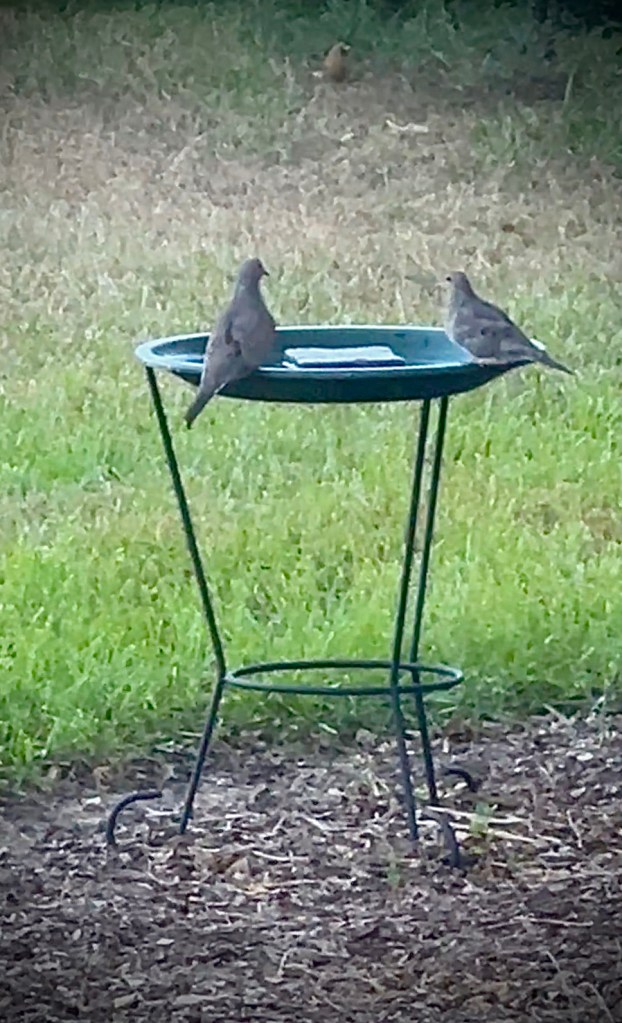
They adore my birdbath. Sometimes three of them cram in together. I think of the ancient Roman Baths, a place to gather and socialize, to share the events of the day while washing the grime away.

One dove tends to linger longer than the others, immersed in the water, fluffed to the size of a chicken.

As if staking claim to her personal pool.

Other birds do not know what to think about it. Occasionally another will land, say, a female cardinal. She sits cautiously, eyeing the dove. After a furtive sip she flits away.

The dove stays put. Doesn’t move a feather. Rather regal.

What I find most compelling is the effect of seeing the doves, of knowing they will come.

They represent peace, of course. Even if I didn’t know this, I think they’d impart it to me. They don’t fuss. They are gentle. Peaceable. Beautiful, in their impeccably smooth, pale-sand plumage. Restful, there in the still waters.

Most often I see two together, surely a mated pair, and the carol plays in my head: On the second day of Christmas my true love gave to me two turtledoves and a partridge in a pear tree.

Infinite symbolism, really. Spiritual, biblical…a sign of covenant. Of blessing.

In these days leading up to another heart surgery for my husband, when life is hitting the pause button yet again, the daily descent of doves in the evening imparts a calm I cannot fully articulate. I watch for them and they come. I refill the water for them and they savor it.

They do not know they’re between hunting seasons. It resumes here in early November.

I can’t bear to think of it, my sweet and precious birds. I didn’t even know until today that one of your collective nouns is a piteousness. To me it’s an unspeakable pity to kill such lovely and harmless creatures. So much in this world is a shattering, scattering pity.

Like the doves, none of us can know what lies ahead of us, all around us, in wait for us.

That thought was behind the closing stanza of a poem I wrote yesterday:

Yet again I cope with life on pause
redirecting my energy, because
no one can know what tomorrow will bring
only certainty that birds still sing, still sing
Come evening, a settling of doves
upon my birdbath. Oh, my loves, my loves—

Life is passing by

How I need this daily descent of doves. Their stillness, their peace.

My weary spirit rests with them in these moments and is refreshed.

See you at the baths tonight, my dears.

If you look closely you can see the female cardinal in the background, wondering if she might gather at the water, too.

*******

with thanks to Two Writing Teachers for the Tuesday Slice of Life Story Challenge

Angels

There are times in life when a theme chases you, and you find you need to write about it.

Such is the case today.

Angels.

They keep reappearing.

There’s the neighborhood rooster I wrote about on Sunday, and the ancient Muslim belief that a rooster crows because it has seen an angel.

There’s the memoir Angela’s Ashes that I returned to for my St. Patrick’s Day post, wherein author Frank McCourt’s mother keeps having babies and his father says an angel brings them, specifically the Angel of the Seventh Step, where he claims to have found Frank’s newest baby brother. Young Frank starts looking for the angel. When he wakes in the night, he goes to check the seventh step: Sometimes I’m sure there’s a light there and if everyone’s asleep I sit on the step in case the angel might be bringing another baby or just coming for visit…I’m sure the angel is there and I tell him all the things you can’t tell your mother or father for fear of being hit on the head or told to go out and play.

There’s my husband’s sermon series over the last months, in which he mentioned times of trial, temptation, suffering, and the appearance of ministering angels, with this repeated exhortation that I scribbled down on two different Sunday order-of-worship bulletins: Look for the angels.

There’s his sermon this past Sunday, which referenced the greedy soothsayer, Balaam, and his donkey which refused, three times, to not travel down the road where the increasingly irate Balaam was trying to direct it, because the donkey could see the angel of the Lord there with a drawn sword when Balaam could not; and haven’t we all experienced, in some way or other, animals seeing what we can’t? (Remember the rooster…).

There’s another book I pulled off my shelf this week, The Art of Comforting, in which author Val Walker tells of being diagnosed with premature ovarian failure; she will never have the child she’s longed for. Shortly afterward she’s laid off from her job in a massive downsizing. As her husband goes away on a business trip, she cries for the loss of the life she thought she’d been destined to live: “My angel books and angel music could no longer comfort me. I prayed to God to send me a real angel. I was ready for a bona fide spiritual visit from heaven.” To her shock, the doorbell rings…chiding herself for thinking it could really be an angel, she answers it to find a “small, sweaty man in a filthy T-shirt and muddy shoes. He must have been one of the laborers working on my neighbor’s lawn…” and with him is a golden retriever, staring at her, wagging its tail.

Turns out the man has come to ask, in broken English, if this is her dog (it’s not). He then asks for water for the animal; it’s a terribly hot day. Walker gives a bowl of water to the dog. She offers a glass to the man. The visitors leave together, and she reflects: Just ten minutes earlier, desperate enough to go begging to God, I had prayed for a brilliant, glowing angel to come to me…was this stranger my angel? I don’t know. But I do know that in witnessing his beautiful kindness toward that dog I was reassured that comforting still existed on earth…always remember, comfort is all around us. We are never alone.

I’m not sure the man was the angel, either.

I’m pretty sure the dog was.

Then there are experiences much closer to home, some of which I shared in yesterday’s post with my “Bad things are going to happen” poem.

There was my husband’s diagnosis of ocular melanoma…shortly after which, while driving and contemplating having his eye removed, he stopped at a traffic light and saw, he says, the brightest flash of white light before him. Nothing was there to cause such a flash. He’d never experienced anything like it before. Optical illusion? Maybe. Stress? Possibly. But he said he was instantly flooded with comfort and knew everything would be okay.

And it was.

Then there was his cardiac arrest on a Sunday afternoon, driving home from the gym. He lost control of his truck; it veered into coming traffic, then crossed back over and ran off the road into a grove of trees…without striking anything. The last thing he remembers, as all went dark and peaceful, are voices saying He’s in trouble. We have to get him off the road.

Angels?

You decide.

As for me, I realize the words were written on my heart long before I scribbled them in the Sunday bulletins. I know, whatever the days may bring, or how long the darkest night may seem, in times of my greatest need, I’ll heed my preacher’s advice:

Look for the angels.

They’re all around us.

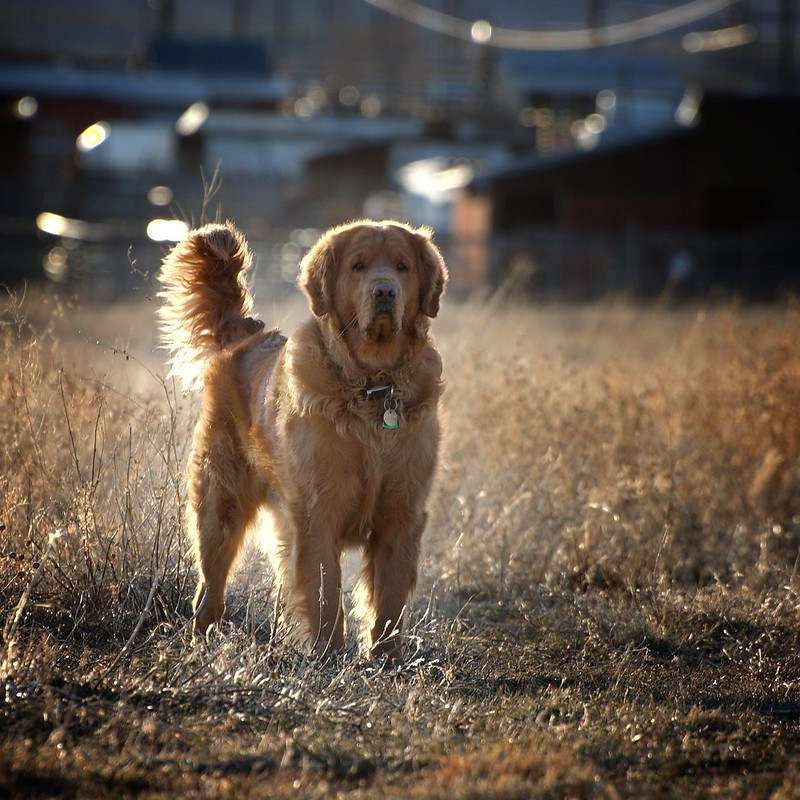
backlit Golden Retriever“. theilr. CC BY-SA 2.0.

*******

Composed for Day 26 of the Slice of Life Story Challenge with Two Writing Teachers

Works cited:

McCourt, Frank. Angela’s Ashes: A Memoir. New York, Scribner, 1996. (Pages 102-107)
Walker, Val. The Art of Comforting: What to Say and Do for People in Distress. New York, Penguin, 2010. (Pages 241-244)

Otters

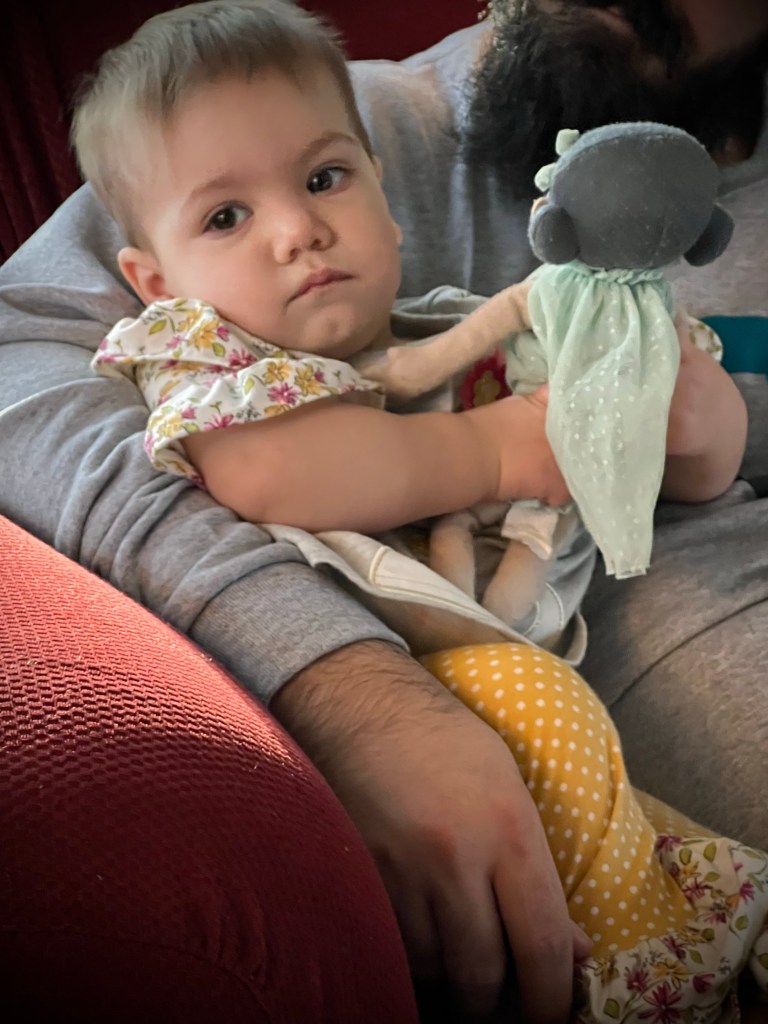
My granddaughter, Micah, loves otters.

It is my fault.

Last summer, when she was just a year-and-three quarters old, I showed her a clip of a squealing baby otter in water for the first time (I find this scenario confusing but I’ve chosen to accept it for the time being).

Her dad, my son, recorded her reaction…oh, and that’s Dennis, of course. He has to be in the middle of everything:

On every subsequent visit, Micah has asked to see the baby otter.

I’ve played the clip a million times.

Naturally I started buying her otter toys.

Micah’s Mama gave her the CUTEST otter bedroom slippers for her second birthday (I so wish I had a photo; I must get one).

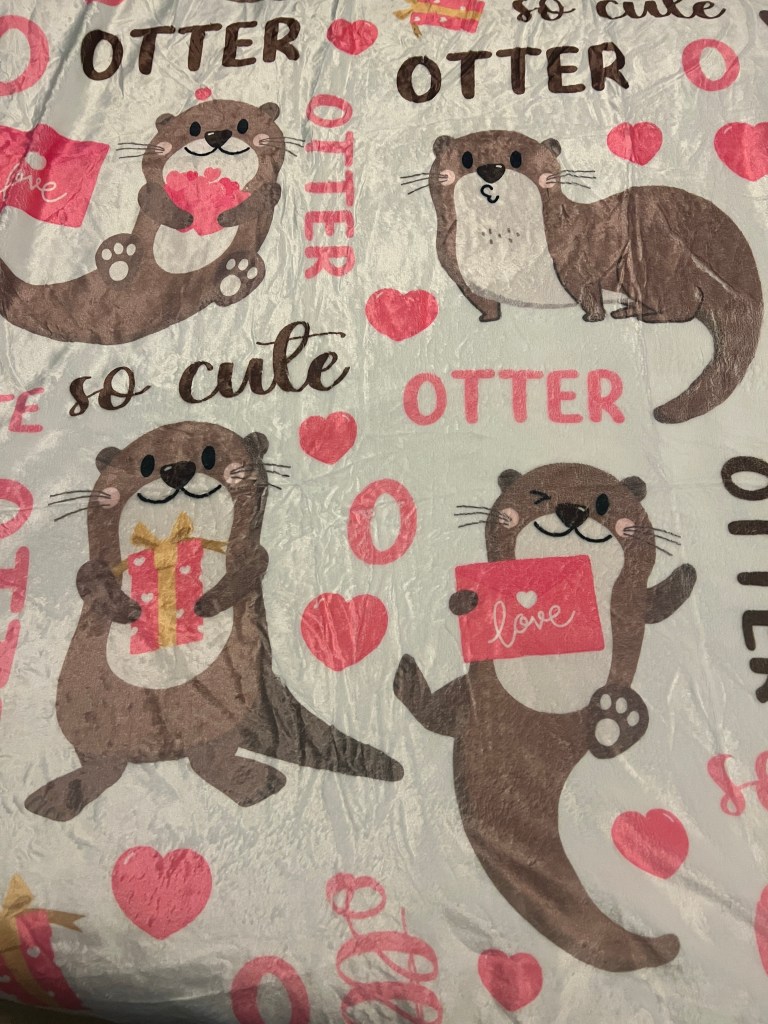
Imagine my delight upon finding this blanket at Christmastime:

Micah adores it so much that she must have it now to go to sleep.

This gives my Franna-heart so much joy, as she’s struggled with going to sleep all of her little life.

When she stays at my house, she will crawl into my lap and say, “Snuggle. Need baby otter blanket.”

So I carry her to retrieve it. We return to the sofa. I wrap the baby otters around her, rocking gently, gently, until she drifts off.

And I will hold her for ever how long it takes, until she wakes.

Once in a while
There comes a creature so wondrous
That you will hold it close forever
Embracing joy, erasing fear…
Rest here against Franna’s beating heart
Sleep, my darling, sleep.

*******

Composed for Day 12 of the Slice of Life Story Challenge with Two Writing Teachers

Intimate conversation poem

with thanks to Barb Edler for the Open Write inspiration on Ethical ELA. Barb invited poets to speak directly to a subject, perhaps a person from the past or present, a beloved or loathed object, or even a dream, frustration, or desire.

Refuge

In the dead of winter
in the dark of night
in the starlit silence
you come

to sleep
in the old
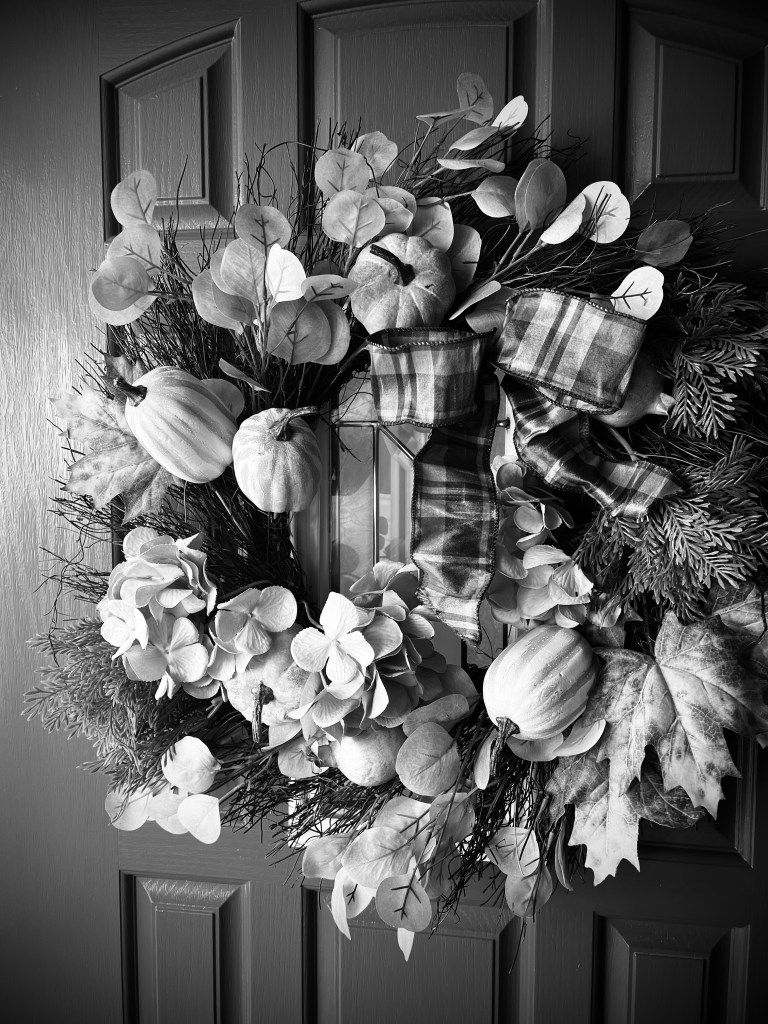
twig-vine wreath
on the front door

tiny warm presence
of which I’d be unaware
if not for the pull
of the stars

the frigid bite
of the night
is worth the sight
if only for a moment

so I open
the door

soft sudden flutter
wings taking flight
in the cold cold night

oh little bird
that I cannot see
you cannot know
how your presence
comforts me

that in this barren season
before the time
of nesting
you find your place
of resting

upon my door

little winged creature
of first blessing

*******

Note: Sea creatures and birds were the first living things blessed by God, Genesis 1:22.

Said wreath. When I woke before dawn, remembering there’s a comet to be observed, I bundled up to try for a view from the front porch. The little unseen bird flew out of the wreath as I opened the door. There is no nest; I am not sure where the bird tucks in but the idea of it sleeping against the safety of my door in winter makes a metaphor of immense comfort to me. I can’t determine if it’s a house finch (they build nests in my wreaths each spring) or a Carolina wren, tiny bird with a big, gorgeous song. In the darkness I can only hear small wings beating for a split second as it takes flight. Whatever it is… it is welcome.

Lullaby

Once upon a time
when baby had trouble
going to sleep
we played
soothing songs
on our phones
until she drifted off

and baby grew
(that is what babies do)
so that now
when we put baby down
to sleep
she cries for a minute
and then
she sings
and sings
to her own little self
without any words
a sound purer
than songs of birds

(know that I am outside your door
beloved baby
tears in my eyes
listening
listening
to your own angelic
lullaby)

Someone’s getting sleepy…

In the treetops

Today I kept you
and you cried because it’s new
so we went outside

to see all the trees
you touched the green leaves sweetly
with your baby hand

and you looked up high
at the pines rattling with song
cicadas, at last

first time this season
oh how I love their comfort
oh how I love you


Walking poem

Today on Ethical ELA Leilya Pitre invites teacher poets to “walk to your place of comfort.” The idea is to take a break, rest, relax, maybe noting things that capture your attention when you’re on a walk, or maybe walking back in time, through memories, or recalling a personal revelation that occurred on a walk. Just walk, poetically.

I love walks and have written of many… today, I meander back through memory to a place of comfort.

Walking with Granddaddy

Sunday afternoon
sidewalks aren’t crowded
no rush hour traffic
clogs the street
just a few cars
stopped at the intersection

can’t walk over to Rose’s
at the corner today
to buy a toy 
like my Slinky
or click-clacks, 
glass amber spheres
suspended on a string
to pull back and hear
that loud CLACK CLACK,
or a powder-blue
sachet ball made of satin
decorated like a lion’s head
with blue googly eyes
and an aqua feather-tuft mane

no, Rose’s is closed today

so is the drugstore
at the end of our row
no chocolate-covered cherries
or Peppermint Patties
or those caramel creams
that you love so

no, today we walk
hand-in-hand
across the street
while cars wait
at the lights

past the fire station
round back of the 
Baptist church

to the playground

you let me climb
the big sliding board
not letting go
of my hand
until I am sitting at the top

you are there
at the bottom
when the sliding stops

you push me in the swing
until my feet touch the sky
I am a bird 
flying so high

until the shadow
of the steeple-cross
grows long on the grass

hand-in-hand again
I watch our feet pass

back over the pavement
crossing the street
each step measured in time
of heart-to-heart beats

—oh, how yours to mine
still talks
so long after
our Sunday walks 

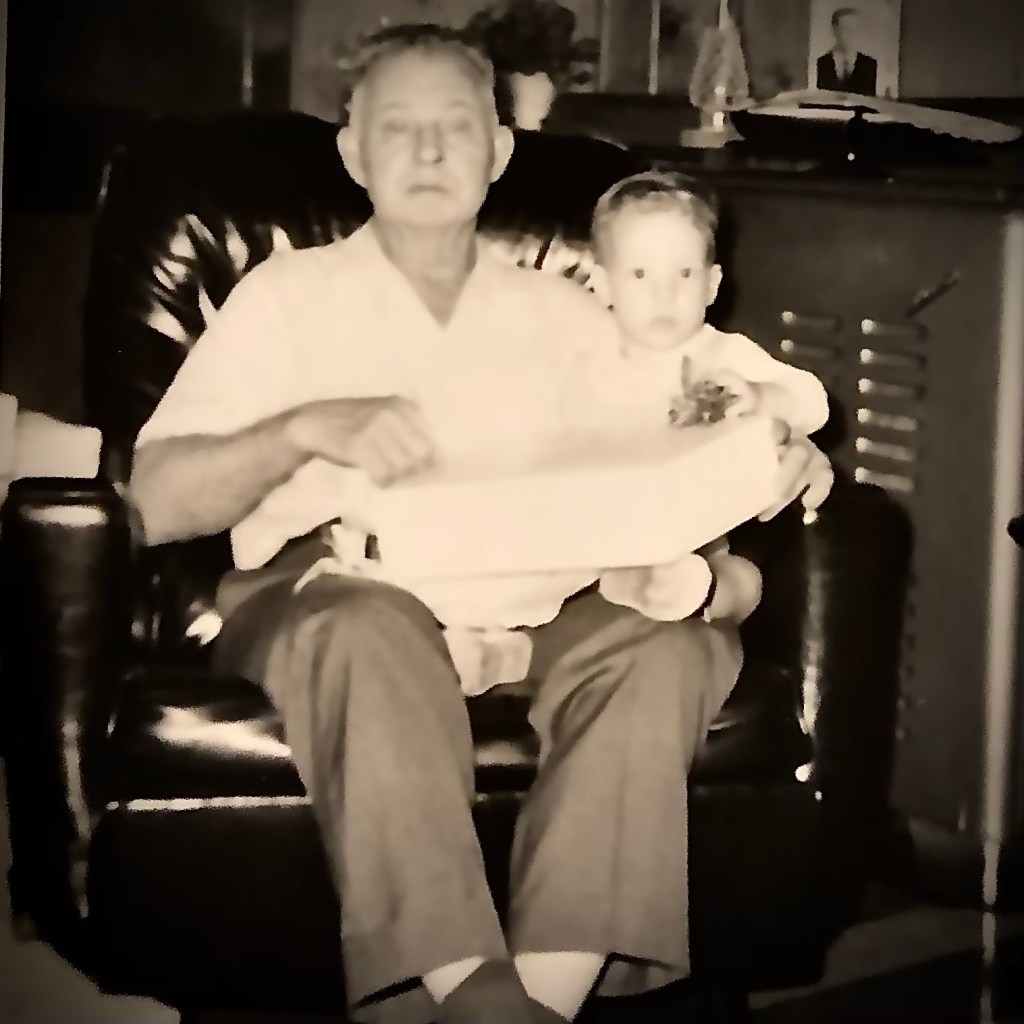
Granddaddy and me on his 61st birthday.
I am two and a half.

Thirty years later:
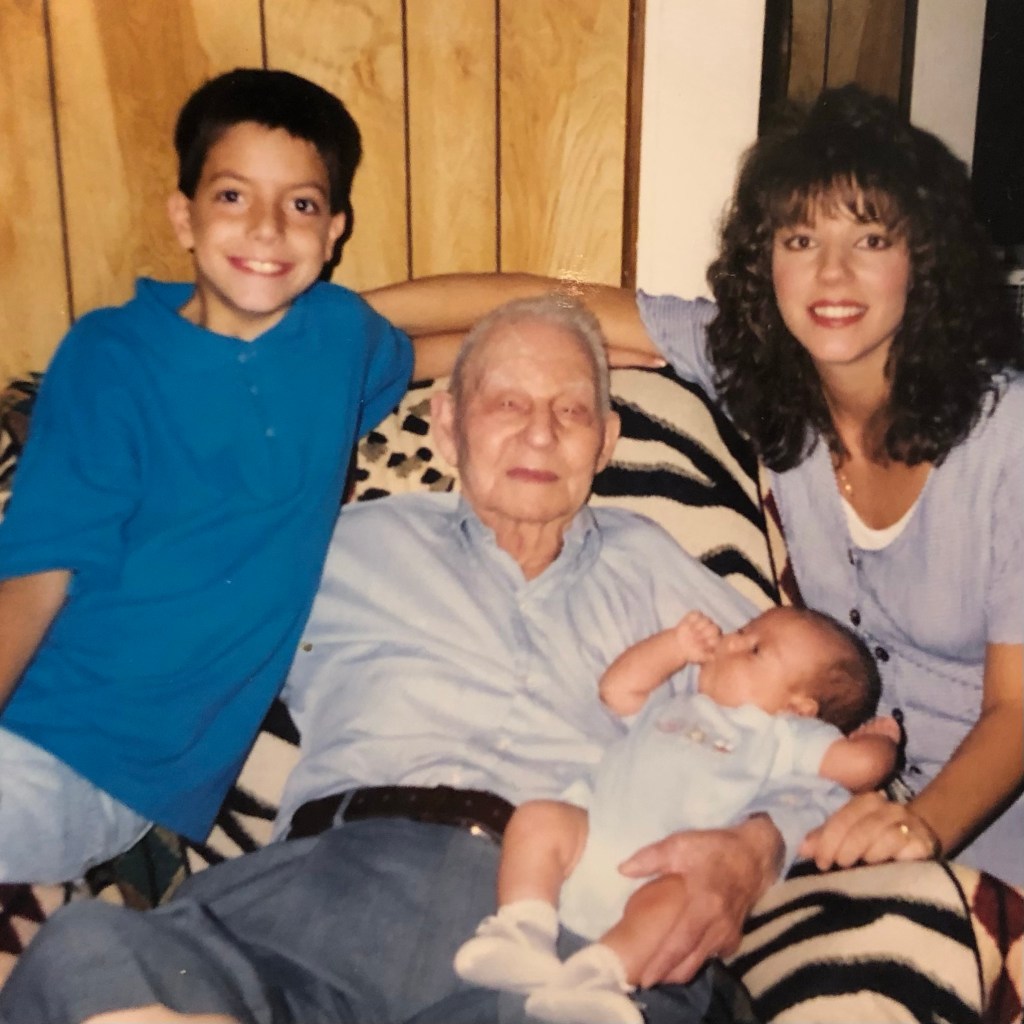
Granddaddy with my boys and me, on his 91st birthday,
a year and a half before he died.

He is gone, but never far away.

The robin

Plump little robin
we stand around you, aghast
at your misfortune

stuck there in the grille
of the SUV after
two hours’ interstate

yet you are alive
calling in your bird language
blinking and trembling

head twisting, trying
valiantly but in vain
to set yourself free

I think you’re impaled
except there’s not any blood
plus, your voice is strong,

full of warning, as
I lean in to examine
the situation:

both feet balled up tight
against your belly, somehow
straddling metal bars

wedged body, aslant
—can it really be intact?
—little eyes, so bright

that we three humans
standing before you in awe
vow to do our best

I grab a towel
(my childhood pet parakeet
often flew the coop

and had to be caught.
I learned to cover him first;
that small beak is sharp)

and we cover you,
but your loud cries of distress
tell us pulling hurts

—oh, you’re a fighter,
courageous little robin
biting at the cloth!

My sister-in-law
covers your face; my husband
hands me an ink pen

(ever-present in
his shirt pocket, a good thing,
as you never know

when you might need it,
in this case, to save a life)
so I wield the pen

through the metal grille,
through your feathers, bit by bit
freeing a pinned wing

until you’re sliding
into my cloth-shielded hands
like a newborn child

like a miracle
released at last, in the grass,
suddenly running

yes, flapping both wings
before taking a nose dive
into the clover

unable to fly
at least for now, surely bruised
needing time to heal

—the backyard becomes
bird rehabilitation,
bird sanctuary

where I can watch you
hopping along, pulling worms
these warm winter days

unseasonable
but I’m glad on your behalf,
keeping my distance

hoping predators
do the same, until you’re healed
and take to the skies

lucky bird, forgive
my bad Shakespearean pun:
you’re Robin the Plucked

for salvation comes
in the most peculiar ways,
begging the question

of mortality,
the taking and the giving
in daily living

these two days I’ve watched
your grounded red breast gleaming
by the old arbor

—today, no sighting,
inexplicable sadness
despite the wonder

of your survival
and the part I got to play.
Little Robin, plucked

to live life anew,
here’s to taking flight on your
wings and my prayers.

Robin the Plucked right after his rescue from the grille of my sister-in-law’s SUV. She’d driven down I-95 a few days after Christmas to visit us. Robin had some feathers askew from his ordeal but his wings weren’t dragging; my husband and I put him in our fenced backyard in hopes that nature would take its course, that he’d soon be fit enough to fly again (and that he’d want to). There are no words to adequately describe him enmeshed in that grille, very much alive and calling out, or for the sight of him immediately trying to run once we got him loose and laid him on the grass. I was amazed and elated to see him eating in the backyard with other birds that came and went the next day. I didn’t go near him again, as when I attempted it, he ran. I refused to distress him any more (heaven knows being trapped on the front of a car going 70 mph is enough for a lifetime). I joke that he’s my last good deed of 2021; I kept an eye on him all yesterday. On this first day of 2022, he is gone.

I keep watching, however.

One final observation, regarding the symbolism of robins: They’re tied to a number of legends and mostly positive connotations like spring and good luck (begging another question: Who’s the actually the bringer of luck here, Robin the Plucked or me?). But the perspective of Mother Teresa moves me most at present, as quoted in No Greater Love (Benenate & Durepos) on the legend of the robin and Christ’s crown of thorns: “Each of us should try and be that bird – the little robin. When we see someone in pain, we must ask ourselves: ‘What can I do to give them comfort?’”

Happy New Year and new life to you, Robin, wherever you are.

And to you all.

Out of the shadows

Late June afternoon on the porch. A long-settling stillness, the day’s brilliance deepening to amber, shadows slanting across lawns and pavement, a cool pre-dusk breeze riffling trees and wind chimes, carrying the sound of a child calling in the distance. It’s not a child; it’s a little goat from a neighbor’s pen, hidden in a patch of woods. Bleating for its supper, I suspect. Startlingly humanlike voice. A neither-here-nor-there sound, disembodied, suspended in the air like time itself, clinging to these green and gold moments, unwilling to let go…

“Mom, let’s go for a walk,” says my youngest son (aka Cadillac Man).

I grab my shoes.

Walking beside me along our neighborhood street, my boy speaks, as he always does, of music. Songs he is learning, one he wants me to practice with him (it has to be simple for me. He can sing any part he likes in any key he likes; he can play anything he wants on the piano or guitar). I say I’ll try. He speaks of his new job at the funeral home; we reflect on the recent death of a beloved friend who’s the same age I am. Fresh-grated sadness, still surreal.

As we talk I note that no neighbors are out and about this afternoon. We seem quite alone. At one house, pool towels draped over the front railing billow in the breeze. American flags on front porch flagpoles ripple and flap with crisp smacks. A couple of cicadas rattle from high in the trees that frame backyards. Our long shadows stretch out on the pavement before us, where flecks of quartz wink; when my boy and I turn at the road’s end, the shadows disappear.

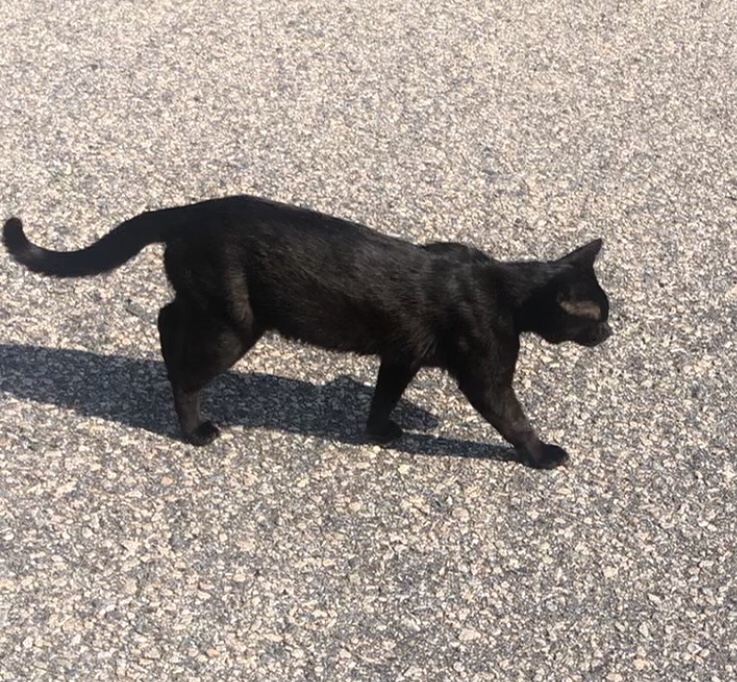
We pass a row of cypresses where there’s sudden movement in the grass. A black shape materializes, runs after us, crosses right in front of us…

Good thing we aren’t superstitious.

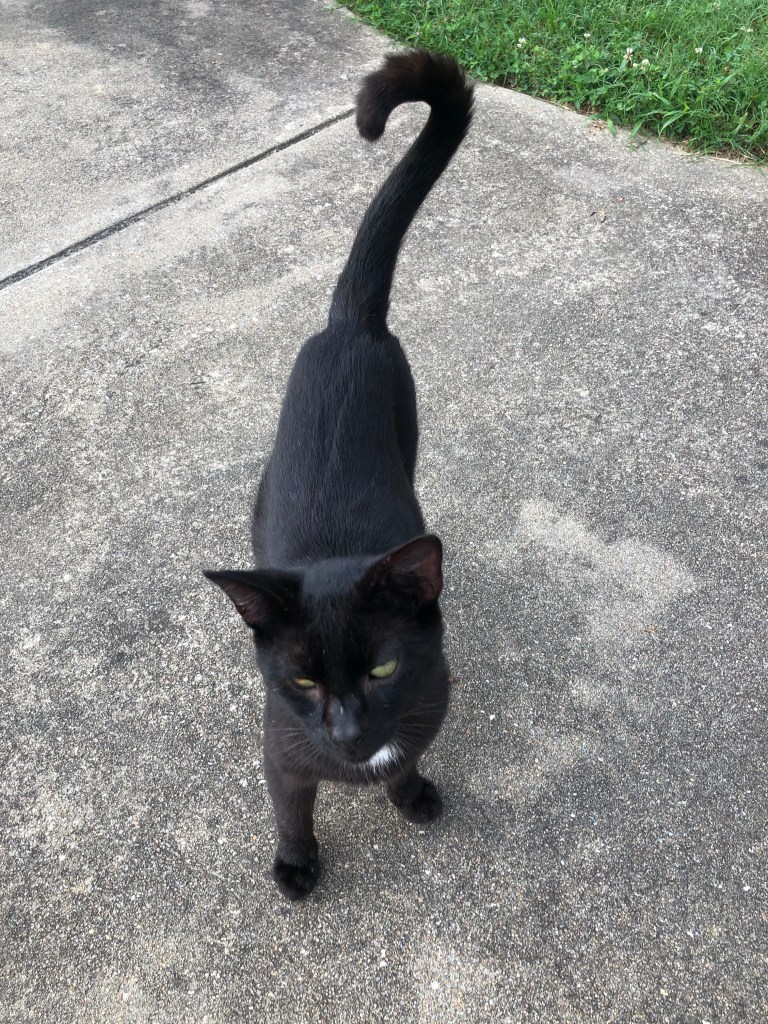
A young black cat, meowing.

“Awww,” says Cadillac Man, as it rubs against his legs. “What a sweet little cat.”

It comes over to me, rubs against my legs, purring madly.

We are devout dog-people. I can’t have a cat. I’m allergic. I learned this at age five or six when my family took in a stray Siamese (Mr. Cat, we called him) that took refuge on the stoop of my childhood home during a storm. Swollen eyes and asthma didn’t stop me, however, from bringing home a black kitten nobody else wanted when I was in college…

“It looks so much like my cat Moriah,” I tell my son. The name came from a magical cat in The Forgotten Beasts of Eld, a book I read when I was about twelve.

Cadillac Man bends down, picks up the creature. “I would keep it if you could breathe.” The little cat nestles against him. Animals love my boy. They seem to sense his gentle spirit.

After a moment, the cat twists to get down. Cadillac Man releases it.

“It looks kind of thin. I wonder if it’s hungry…” Do moms always think about this first? Is this our deepest default, this hard-wired compulsion to feed all little living things, to keep them living?

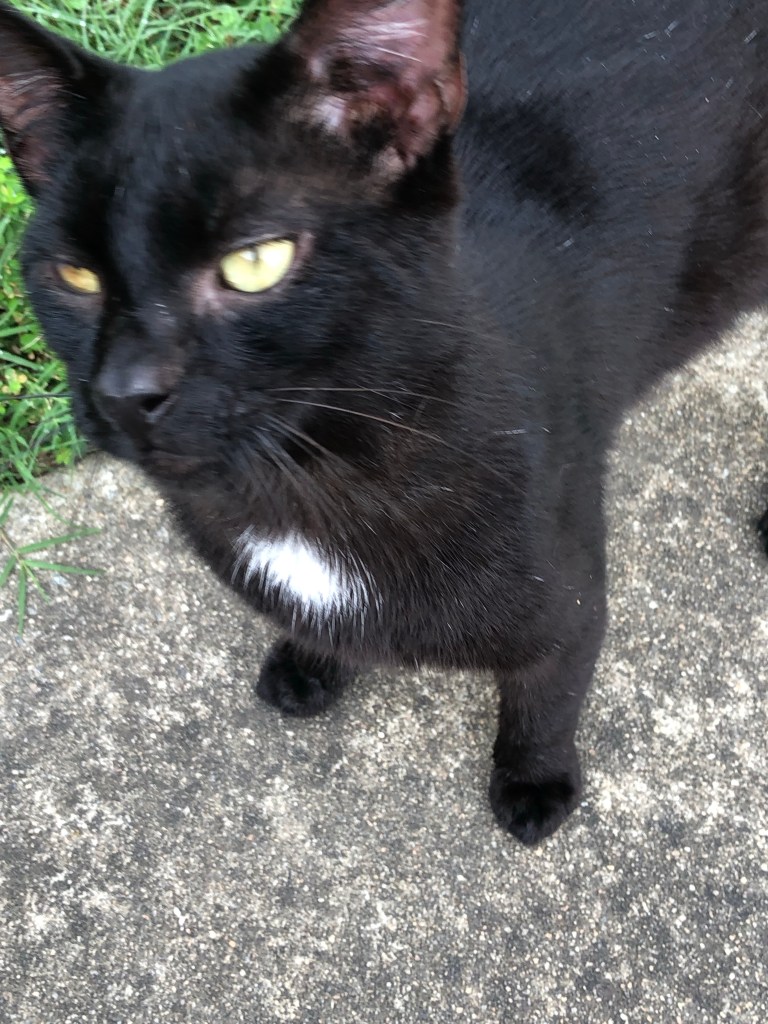
The cat sits looking up at us with big, unblinking, green-yellow eyes. Meow.

And it trots right beside us, like a good dog would, back to our driveway where I feed it some of Dennis the dachshund’s steak-flavored food in an old dish.

“I hope it stays,” says Cadillac Man. “It can be an outside cat.”

I examine the cat as it eats. “It has all its claws.”

“We should name it,” says Cadillac Man.

“Look how rusty its fur is in the sunlight,” I observe. “Black cats aren’t exactly black. It’s a genetic mutation of the tabby pattern. See the faint rings in its tail, there at the tip? So much like Moriah, only she was smaller and didn’t have a tail…” another mutation. She was the last kitten left in the Free Kittens box on campus the day I found her and took her home. Shelters say black cats are the hardest to find homes for; no idea on stats of cats with stumps for tails…

“We aren’t naming it Moriah, Mom.”

“Of course not. She was one of a kind and besides, this one’s a boy.”

Cadillac Man is silent for a moment. The cat has nearly finished his steak dinner. “Well, you know it has to be a musician’s name…”

This is what he does. Since childhood he’s named pet fish after bass singers; his dachshund, after drummer Dennis Wilson of The Beach Boys.

I can see what’s coming: “Brian, I suppose?”

Cadillac Man smiles. “Not quite. I christen this cat Douglas.

Brian Wilson’s middle name. I was close.

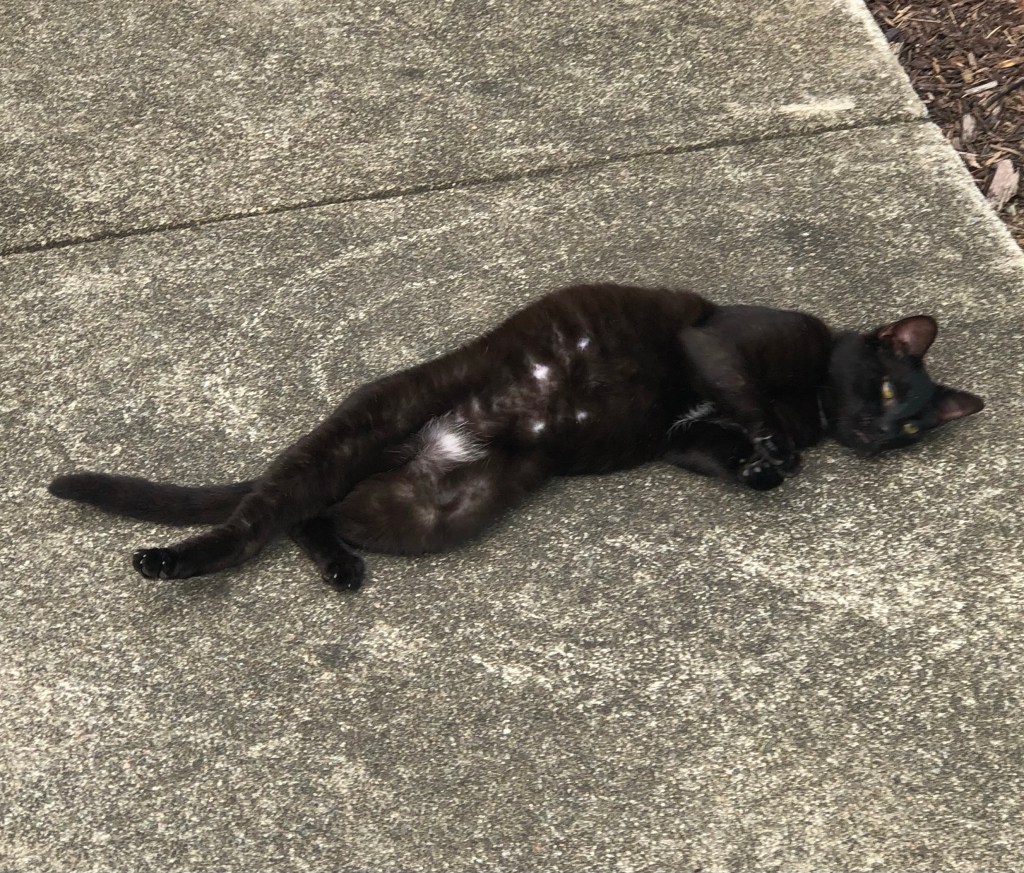
After licking the bowl clean, Douglas follows us up the sidewalk, cutting in front of Cadillac Man to roll over just like Dennis the dachshund does for a belly rub.

“Awww,” says my boy, rubbing the proffered belly. “Listen—he’s purring like a truck!”

Indeed he is.

It’s getting late. We need to go in to wash up and have our own supper, so we stroke Douglas one last time. I make sure to wash my hands well, with extra soap.

We peek out of the windows from time to time. Douglas is lying on the porch, and then he’s gone.

But not really.

He’s curled up under the rocking chair, sound asleep.

When he wakes, I take one of Dennis’ soft blankets out and put it in his chosen sleeping spot. Douglas sits on it at once.

“There,” I tell him. “Now you know that if you need a safe, comfortable place to sleep, you have one. If you’re hungry, I’ll feed you whenever you come around. I’ll leave water out for you. It’s summer, see…”

Douglas purrs as if he understands…and maybe he does, for the next morning he comes to polish off a whole bowl full of food, and he’s waiting in the driveway to greet us on Wednesday night when we return from prayer meeting.

And then he vanishes.

A day passes, and another, and another. No Douglas.

It storms. Thunder, lightning. Rain gushing from the gutters.

I hope he’s all right, wherever he is. If he belongs to someone, I hope he’s back home and happy. We ought to have named him Macavity, the Mystery Cat.

I shake out his blanket, fold it, replace it. I toss yesterday’s water from his new dish and refill it with fresh.

I think of Mr. Cat. Of Moriah. So long ago.

I wonder if it’s absurd to keep leaving fresh water out for a cat that may never return.

But I do it anyway, because I told Douglas I would.

I also told Cadillac Man we could have named him Question Quigley (from Harry Potter) for that tail

The best shot I could get of his face; Douglas kept trying to rub against me while I attempted to take his picture

Asking for a belly rub

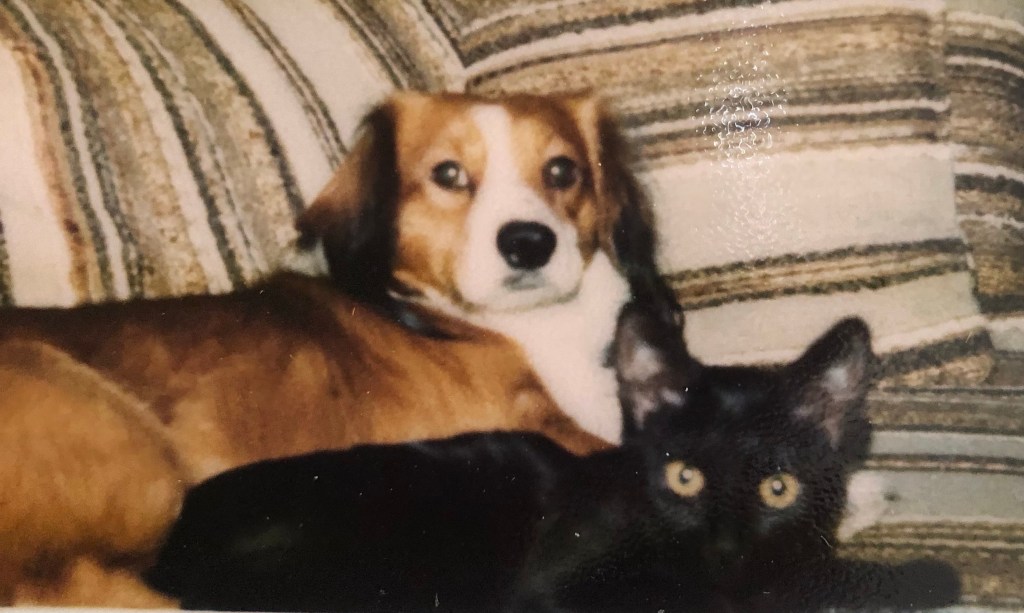
For comparison: my cat Moriah, almost forty years ago, with my childhood dog, Bagel

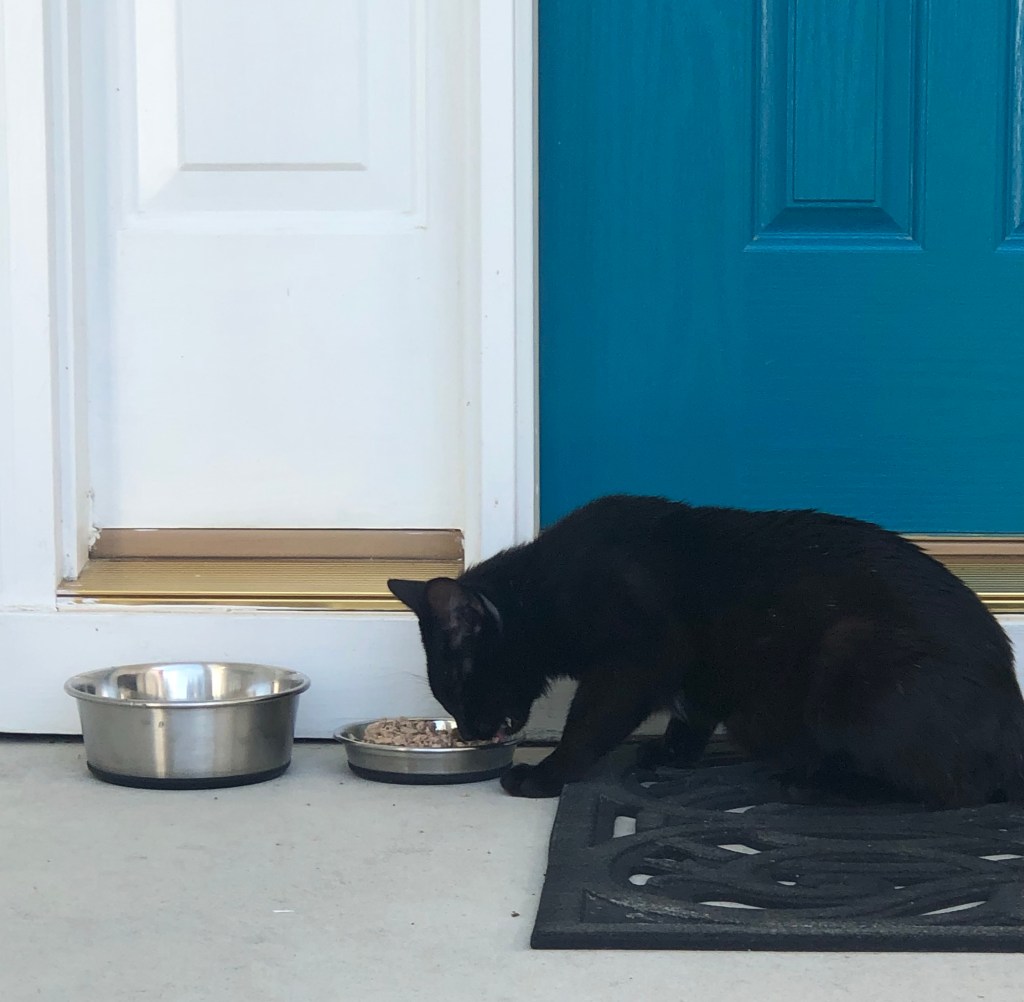
—OH, and P.S. Guess who came for dinner last night?

Memories, like little shadows, return, too.

*******

And so it is that black cats are my favorite, despite their long-maligned history (another reason I feel concerned for Douglas). I wrote another take on them if you’re so inclined: 13 Ways of Looking at a Black Cat Crossing Your Path in the Time of COVID-19 While Driving to School to Teach Online Near Halloween of Election Year 2020.

with special thanks to the Slice of Life community at Two Writing Teachers.
We are our stories.