Atmosphere

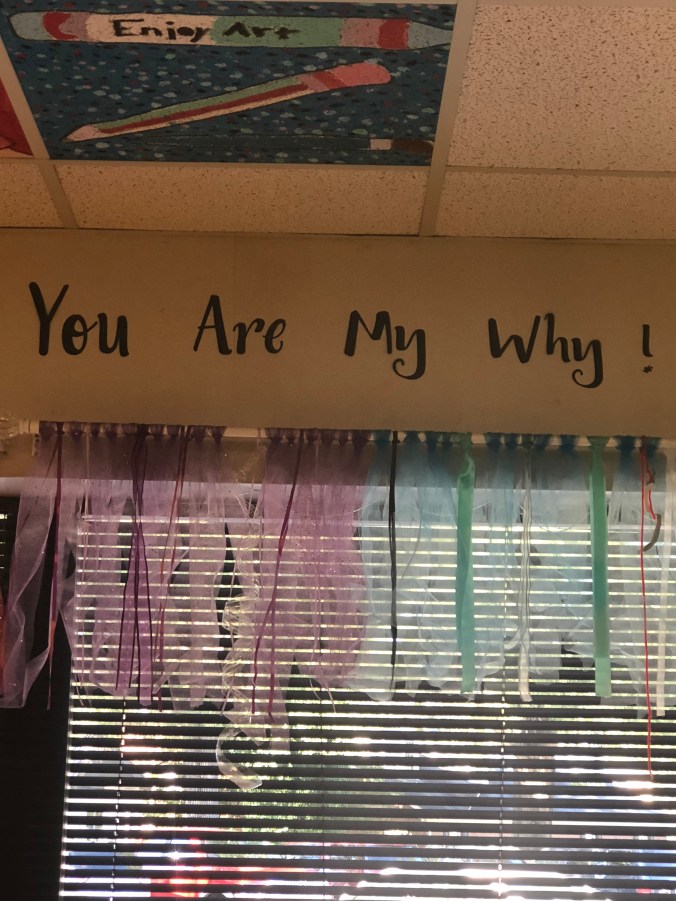
By the worktables in the art room at my school is a window, and above that window is a message from the art teacher to her students:

You are my why!

The words draw your eyes as soon as you walk into the room. They convey more than a greeting; they impart a sense of importance, of being wanted, of being cared about. They are a word-hug of welcome, of belonging, of mattering.

I think about how little is in teachers’ control these days, how the art of teaching is increasingly straightjacketed, hijacked. Expectations on top of expectations, a precariously unwieldy, wobbling mountain, stones heaped one by one, Greek thlipsis until a person’s spirit is crushed rather than one’s actual body. I see, hear, and feel this incremental adding of weight in every day interactions with colleagues. Opening lines from the old Christmas movie It’s a Wonderful Life come to mind, when the angels, appearing as stars in the cosmos, are talking:

FRANKLIN: A man down on Earth needs our help.

CLARENCE: Splendid! Is he sick?

FRANKLIN: No, worse. He’s discouraged.

—Truth.

A gallery of teacher faces appears in my mind.

Then I see these words on the wall and I think, that’s the breathing room. 

The beginning of atmosphere.

Before learning, before discovering, before creating, before engagement, empowerment, objectives or standards, before all the materials and tools are ever distributed, there’s atmosphere. 

It’s both bigger and smaller than the what of climate and the how of culture. Atmosphere in a classroom still lies wholly within the power of the teacher. It starts as small as the heartbeat of the teacher that keeps showing up to say You are my why.

The heartbeat, the breath, that keeps the entire organism alive.
Tell your stories

Tell your story

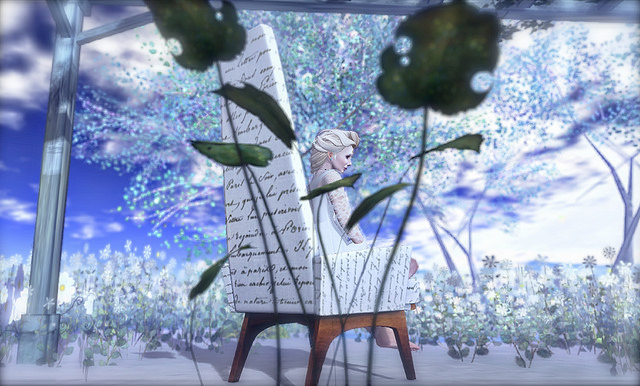
You Can Tell Your Story. Cate StorymoonCC BY

“As a teacher now I make a point of sharing my personal stories as a way of connecting and building relationships with my students … My hope is that my students can feel their classroom is a safe space for sharing their unique background stories and experiences.”

 —Julian Rolden in I Wish My Teacher Knew by Kyle Schwartz

The staff at my school is participating in a study of the book I Wish My Teacher Knew: How One Question Can Change Everything for Our Kids. At the first meeting, we were asked to share a quote that resonated with us.

Several lines struck me, but the ones that went deepest were of a teacher making a point to share his personal stories with his class.

I thought of how teachers create the atmosphere in their rooms; where personal stories are valued, individuals are valued. Story is where humanity meets. Where we see, understand, and feel for each other. Story is where identity and belonging begin.

I thought about teaching writing, primary grades to adults. In the end all writing is about life, about having lived, about recording images, observations, emotions. To share with others is to make an impact. As I share snippets of my life in the modeling process, it spawns questions and conversations but most of all an electric synergy in the air, as writers of all ages come to realize the power of their own stories.

Last night I was invited by a dear colleague to share some of my writing with students during their family literacy event. I brought a stack of stories written over the past few years in front of classes. After a brief description I let the students choose between memoir, realistic fiction, and fantasy for me to read aloud. I explained that while memoir is a real experience, writers also weave pieces of their real lives into fiction.

And so I read my work to the students, who opted for fantasy and fiction. I was a stranger to them in the beginning, but somewhere in the sound of my own voice reading my own words, in the sudden stillness of the young bodies seated around the foot of my chair, something changed. It wasn’t visible or tangible, but it was there. Born of curiosity, interest, empathy, rapport. I was a stranger no more after the readings when the questions came, as students wanted to know more about the characters and was I going to keep writing about them and what pieces of these stories were the ones I’d really lived.

The time grew short; I answered the questions, all the while thinking how I’d freeze these moments if I could so that I could go on watching their faces as they absorbed the words. I’d stay there always, encouraging writers to find and tell their own stories. Many lingered at the end and I knew it was, it is, it always is, the power of story, that kept them wanting more, that stirred their own thoughts, feelings, ideas, images that they, too, need to share.

I packed my bag, walked into the throng of strangers at an unfamiliar school, and didn’t feel alone.