A president, a poem

Today on Ethical ELA’s Open Write, Stacey Joy invites participants to lift a line of poetry and use it in creating a Golden Shovel poem.

I was thinking about it being President’s Day, so I went in search of poems written by our presidents. This led me to Jimmy Carter, the first U.S. President to publish a book of poetry in his lifetime. He is our longest-living president; at age 98, he has just entered hospice care. I have lifted a line from his verse.

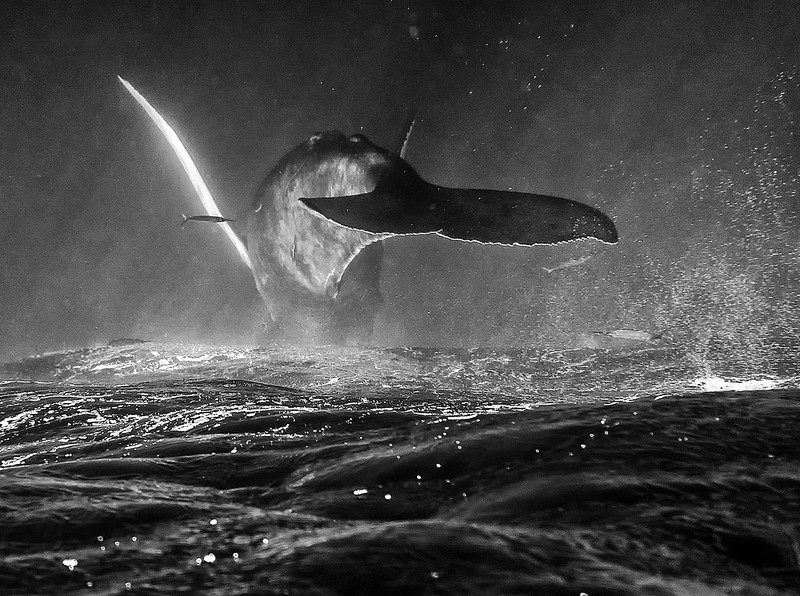
“To hear the same whale’s song” – Jimmy Carter, “Life on a Killer Submarine,” Always a Reckoning and Other Poems

Homeward Hymn

when my life draws to
its close I imagine the last thing I hear
will be cicadas rattling high in the
green oaks as I pass, fervently calling, calling the way, same
lost and found returning sound of whale’s 
pulsating destination song

If Whales Could Fly. Christopher.MichelCC BY 2.0.

I can’t be the only one poem

Today on Ethical ELA’s Open Write, Britt Decker shares a beloved C.S. Lewis quote: “Friendship is born at that moment when one person says to another, ‘What! You too? I thought I was the only one.’” She invites participants to share “quirky, unusual, uncommon things you do, believe, or say and turn the list into a poemstarting with the line ‘I can’t be the only one who’…”

To begin with: I have loved Lewis since I was ten years old and first landed in Narnia. I have a shelf of his books. When I read Britt’s words about Lewis, I echoed his own: “What! You, too?”

And so I keep that as my title…

What! You, Too?

I can’t be the only one who

would rather write than speak

drinks more black coffee than water

puts pepper on popcorn

is enchanted by abandoned houses
in various stages of falling down

left my Christmas tree up
until February this year
simply because it was beautiful
and looking at it
made me happy

barely dips in social media anymore

follows murder cases daily
for the latest developments

loves my Grandma name (Franna)
better than my actual given name

looks for hawks and herons
on my drive to work

grieves over the blue heron
not having been at a certain pond
in weeks
(please be all right)

savors the harsh rattling
of cicadas in summer
(heartsong
in the background orchestration
of my life)

senses the presence of my father
in the fragrance
of fresh-mown grass

thinks best and sees solutions
in the dark morning hours
before I’m fully awake

journals my dreams, to be awed
by the constant presence of birds
and the recurrence of
vivid green

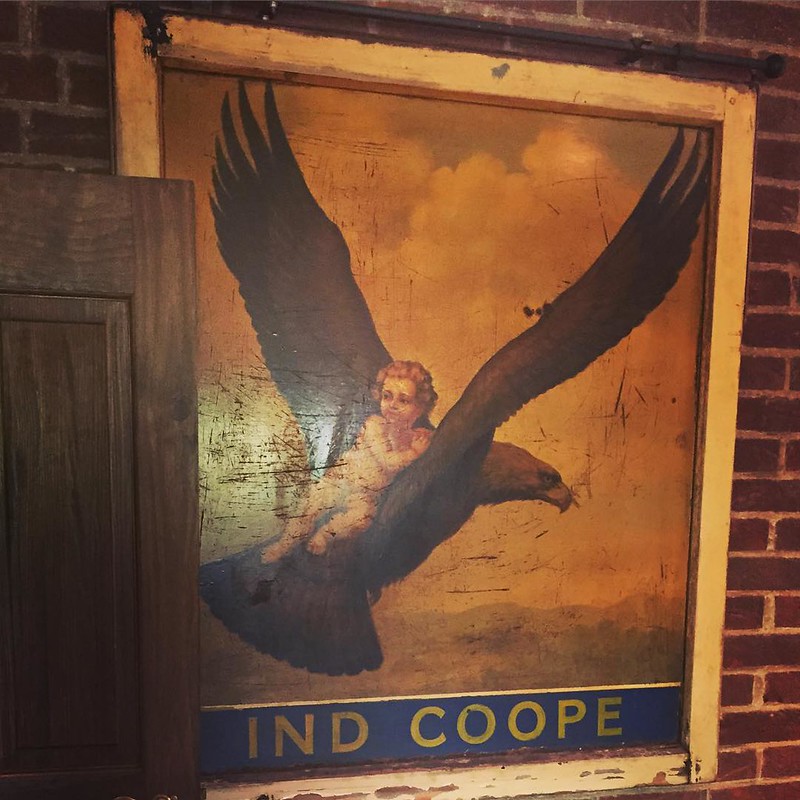
The original sign from The Eagle and Child (at CS Lewis’ home, The Kilns). #TXinUK. david_normanCC BY-NC-SA 2.0.

Tale-based poem: The Legend of Water Rabbit

Today on the Ethical ELA Open Write, poet Stacey Joy invited participants to read a few short folktales, fables, fairytales, myths, or legends to inspire a poem: “Your poem might be a response to, a retelling of, or a new version of the original piece.”

I wanted to work with a fable but the children’s tale that came to mind first was… well, maybe you will recognize itmy poem is meant to be something of a mythological sequeltribute.

The Legend of Water Rabbit

In the forest deep
upon a cushion of emerald moss
Water Rabbit sleeps

and dreams

of the Child.

In his dream
he cannot tell the Child
how much
he loves him

for to the Child,
the Rabbit isn’t real

and there is no language
for conjuring a bridge
across the chasm
of unbelief.

Water Rabbit twitches,
remembering

the nursery
the toys
the Wise Horse
who spoke of love

and longsuffering.

It was Fate that placed
the Rabbit in the arms
of the Child that night
when a favorite toy
was lost.

It was only for a season
that the Child embraced him
and carried stuffed Rabbit
everywhere he went…

Water Rabbit’s whiskers tremble
with dream-reliving.

He sighs.

Other rabbits nearby
cock their heads
and perk their long ears

for in a moment,
Water Rabbit begins
to whimper
and weep
and wail
in his sleep

—the dream
is all too real:
the Child’s fever,
the separation,
the command that
Rabbit and all the other toys
be burned.

It isn’t fire or fears
that brings Rabbit’s tears

but the thought
of never being
with the Child again.

Wake up! Wake up!
The colony surrounds
Water Rabbit,
dozens of their small front feet
against his shimmery fur,
shaking, shaking him

into reality.

Water Rabbit gazes at them
through his tears
from his emerald-moss bed

and asks…Is it time?
 
The colony nods in unison.

Water Rabbit rises
wiping tear tracks
from his velvety face.

The colony parts
Water Rabbit
makes his way through…

he hops and hops with 
boundless energy until
he reaches the clearing 

where the Child
bigger now
(for he’s bigger every Spring)

sits on the blanket
spread over the grass
with a picnic feast 
made ready.

Into the Child’s arms
leaps the Rabbit. 

There are no words
for there is no language
that can capture
love so great
and eternal
and real

as real as the solitary tear
of a toy Rabbit
about to be burned
for the sake of the Child.

For it was that teardrop
the inevitable price
of love
and sacrifice
that brought life,
transformation,
salvation.

That is how
Water Rabbit
came to be.

*******
-with thanks and apologies to Margery Williams and The Velveteen Rabbit.

2023 is the Chinese Year of the Rabbit.

More specifically, the Year of the Water Rabbit.

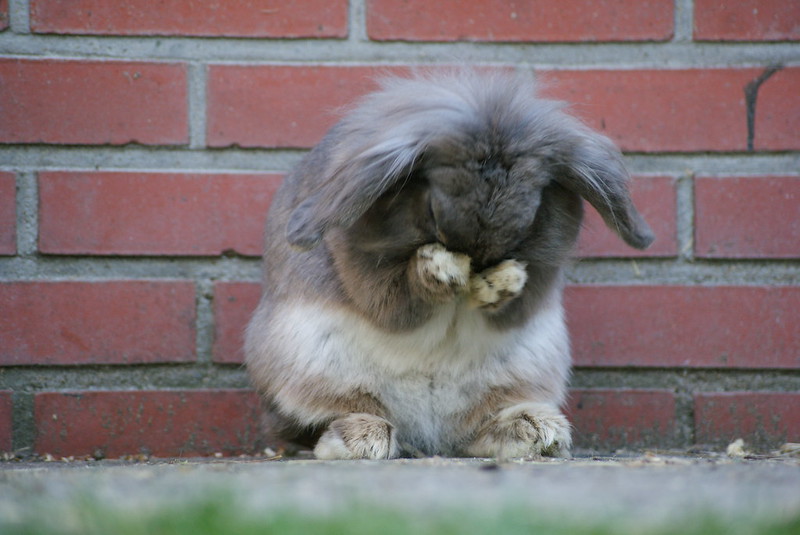
You make vita cry!jpockele. CC BY 2.0.

A bit of light

Today on Ethical ELA I encountered a poetic form new to me: the lantern. My understanding is that it is a five-line Japanese shape poem beginning with a one-syllable noun followed by successive lines of nouns containing two, three, and four syllables, ending with another one-syllable noun, all connected to and building on the first word.

I was immediately captivated and had to give it a try.

It is challenging.

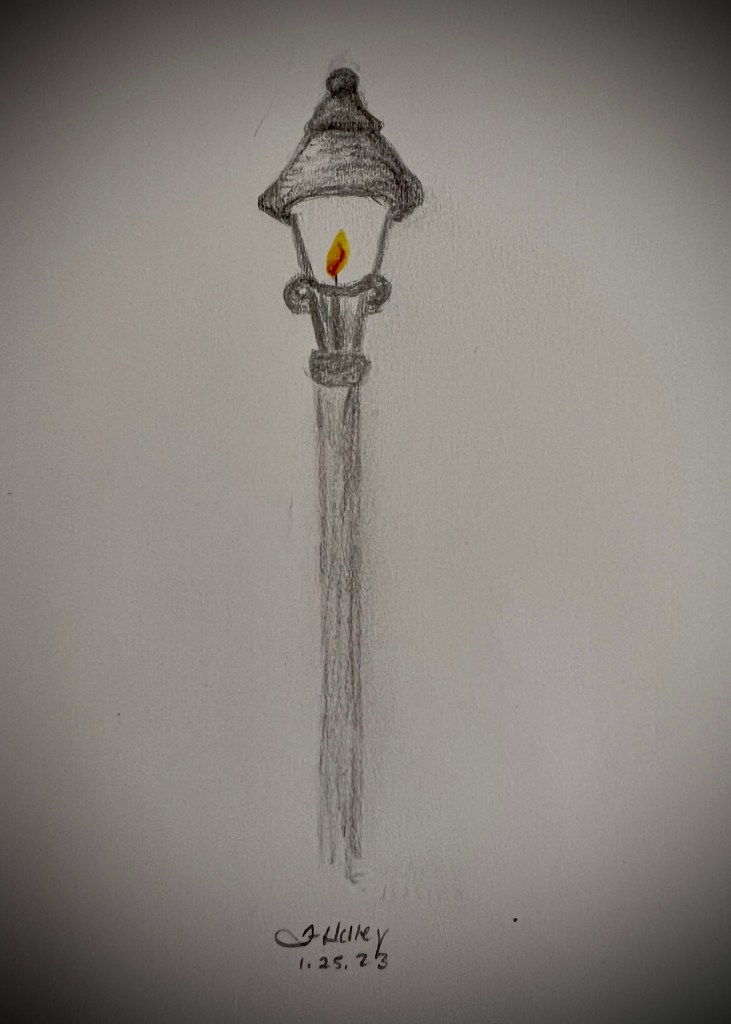
In my mind the lantern image morphed into a lamppost, a symbol with much personal meaning. Like the indelible image in Narnia, a lamppost marks the way home for me: one stood in front of the house where I grew up. Whenever I was out at night and turned the last corner, I’d see the light of that lamppost.

I went with the image. I kept the syllable count but gave up on sticking with just nouns. I could write a lengthy essay about all the other meanings the lamppost holds for me, but this is poetry; interpretation belongs to the reader. 

It is dark and dreary in my neck of the woods today, pouring rain… perhaps that’s another reason the lamppost remained.

I needed a bit of light.

To the Lamppost

Your
good light
still guides me
home through darkest
night

Intimate conversation poem

with thanks to Barb Edler for the Open Write inspiration on Ethical ELA. Barb invited poets to speak directly to a subject, perhaps a person from the past or present, a beloved or loathed object, or even a dream, frustration, or desire.

Refuge

In the dead of winter
in the dark of night
in the starlit silence
you come

to sleep
in the old
twig-vine wreath
on the front door

tiny warm presence
of which I’d be unaware
if not for the pull
of the stars

the frigid bite
of the night
is worth the sight
if only for a moment

so I open
the door

soft sudden flutter
wings taking flight
in the cold cold night

oh little bird
that I cannot see
you cannot know
how your presence
comforts me

that in this barren season
before the time
of nesting
you find your place
of resting

upon my door

little winged creature
of first blessing

*******

Note: Sea creatures and birds were the first living things blessed by God, Genesis 1:22.

Said wreath. When I woke before dawn, remembering there’s a comet to be observed, I bundled up to try for a view from the front porch. The little unseen bird flew out of the wreath as I opened the door. There is no nest; I am not sure where the bird tucks in but the idea of it sleeping against the safety of my door in winter makes a metaphor of immense comfort to me. I can’t determine if it’s a house finch (they build nests in my wreaths each spring) or a Carolina wren, tiny bird with a big, gorgeous song. In the darkness I can only hear small wings beating for a split second as it takes flight. Whatever it is… it is welcome.

Bad advice poem

with thanks to Scott McCloskey, today’s Open Write host on Ethical ELA. Scott says there are plenty of poems offering advice, but few offering bad advice… today we set about rectifying that shortage…

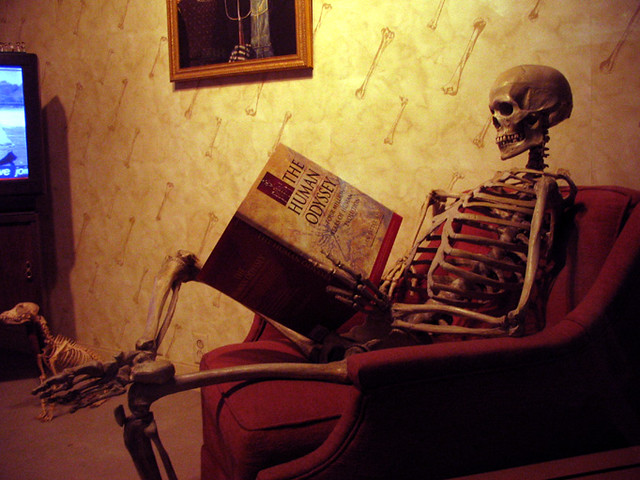
How to Manage a Skeleton

When sitting with a skeleton
it is best to remind him (?)
it is his own fault
he has no flesh

unless, of course,
you fail to recognize
a skeleton in the first place
(it’s possible
even probable
despite the garish array
of teeth
and the empty sockets
and all those ribs
gleaming white)

you might go so far
as to remind the skeleton
to keep a stiff upper lip
(although ‘twill do
little good
when one
has no lips
no more)

better yet to focus
all your time, energy,
and efforts with the skeleton
in pointing out the priority
of having a backbone
over having a heart

by all means,
continue extracting
your pound of flesh
ignoring, of course,
the feeble rattling
of wind whistling
through the bones
—this does not matter
in the slightest
when the spirit
is long gone.

Reading Skeleton. leted. CC BY-NC 2.0.

In our shared autumn

with thanks to Denise Hill for the prompt on Ethical ELA’s Open Write today: American Sentences, a poetry form invented by Allen Ginsberg, are comprised of seventeen syllables.

To my husband.

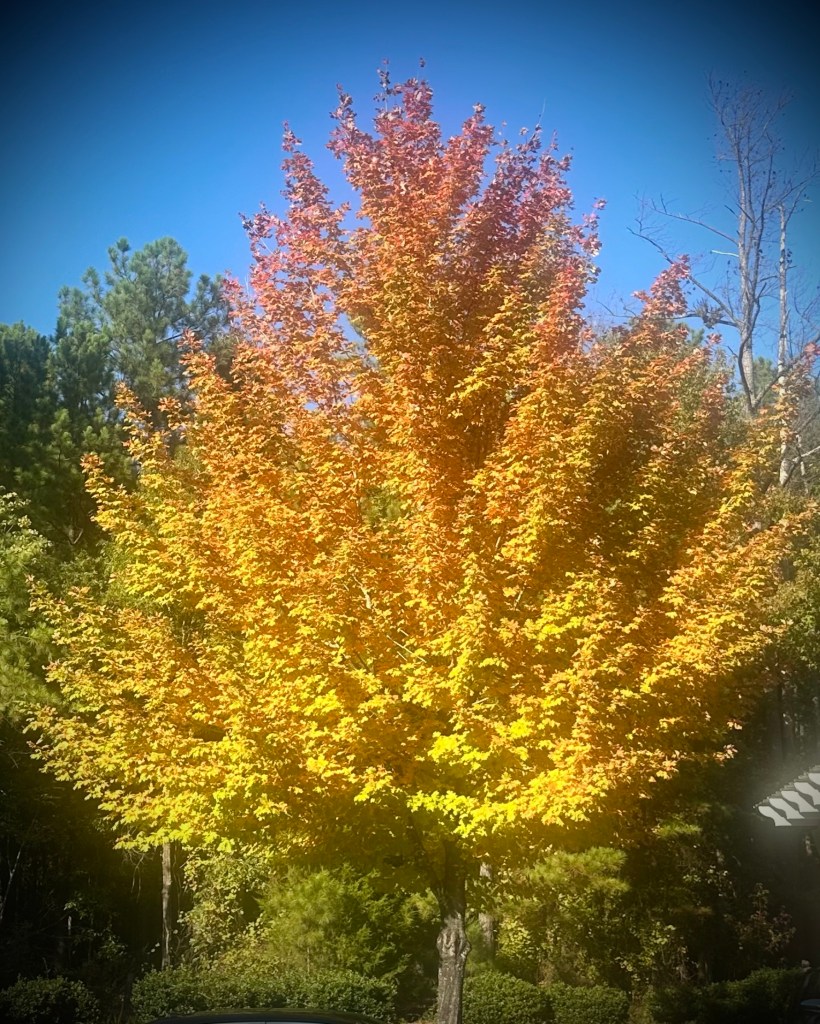
An Observation, While Watching Oblique Light Striking Fiery Leaves

What shall I say to you, in the long afternoon of our shared autumn?
Memories of many colors scuttle across sidewalk existence.
I cannot decide which I would gather to preserve, to toss, to burn.
Trees have no compunction about shedding their fragility—should we? 
Give me your hand while it is yet light, for evening comes earlier now.
Moments, in their gilded crowns, are more beautiful than ever before.

Memory is…is not

with thanks to Susan Ahlbrand for the invitation to write a “this but not that” poem based on an abstract noun over at Ethical ELA’s Open Write today

Memory is a blanket
of new-falling snow
over barren ground
where nothing would grow

Memory is not static
it is ever-changing
reinventing itself day by day
ever so slightly
around the edges

Memory is sparks
crackling and popping
from the inner fire
in the grate

Memory is not reliable—
it goes its own way,
its own consummation
and consumption,
ashes stirred to life
rolling in the breeze

Memory is a river
life-giving, sustaining, sacred
flowing free until obstructed
necessary and nourishing
yet potential danger for drowning
—you cannot live there, submerged

Memory is not tomorrow
or yesterday

Memory is now

Memory is not a book,
a record carefully preserved

Memory is written in disappearing ink

happy snow. tamaki. CC BY-NC-ND 2.0.

Starting a semi-sestina poem

with thanks to Wendy Everard for the Open Write invitation today on Ethical ELA. A traditional sestina has six stanzas and a three-line envoi; the initial six ending words rotate through remaining stanzas in a prescribed order. Today’s process begins with brainstorming six words. For a semi-sestina, one can alter stanzas and lines, exercising creative freedom…

Here are my six words and opening stanza at present. It will take some time to see where they lead…

fabric
scissors
fall
damage
pieces

pattern

Childhood Memory

She spreads the pattern across the fabric
placing the pins. Wielding her sharpest scissors,
she cuts along the grain. The scraps fall
to the floor, haphazard collateral damage.
She will not save the pieces
or remember their wholeness, before her pattern.

Cobbler cutting fabric with scissors. Ivan Radic. CC BY 2.0.

Art into words poem

On Day Three of Ethical ELA’s Open Write, Margaret Simon invited participants to “transform art into words” by “choosing a work of art or creative practice and explore phrasing, spaces, and repetition.”

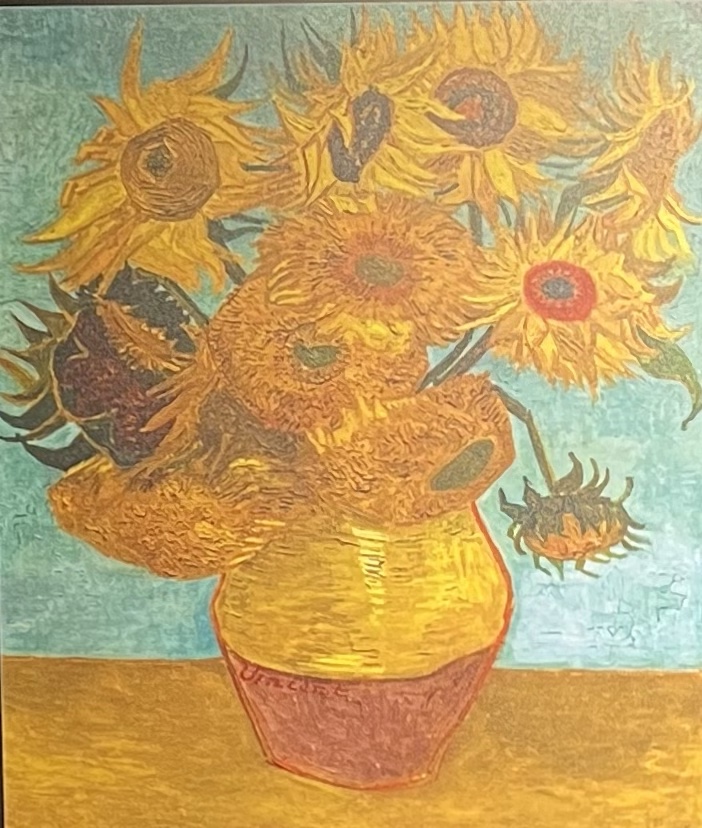
My mind immediately went to Van Gogh and the Immersive Experience I recently attended. The last two lines of my poem are Van Gogh’s own words, written in a letter to his brother, Theo, referencing other artists who were known for painting specific flowers: “You know that Jeannin has the peony, Quost has the hollyhock, but I have the sunflower, in a way.” My poem’s title comes from Van Gogh’s artist friend Gauguin, who loved Vincent’s sunflower paintings in a time when many artists thought they were too rustic a subject. Van Gogh, however, was fond of the flowers. Newly-invented pigments of yellow oil paint enabled him to experiment and innovate, creating the two series of seven paintings collectively known as Sunflowers. At his funeral, the flowers graced his casket; a friend later planted sunflowers on his grave. 

“Completely Vincent”
Van Gogh, painting sunflowers for Gauguin

Yellow
and yellow
thirty shades 
of yellow
new
alive
wilting
dying
returning
with faces
forever turning
toward the sun
light shining
in darkness
returning
returning thanks
for my friend
for the beauty
of these flowers
growing in
wild array 
by the paths
I walk 
day by day
I offer them
to you, 
my friend
can you see
in my oil-bouquet
all the shades
of gratitude
so much
I cannot even say
whether it’s still 
in me to pray
be that as it may
today
today
I have the sunflower
in a way