Born

“They said it would be a while,” announced the young man, as he came through the apartment door. “I gave the nurses your number – I figured I could wait here just as good as at the hospital, since it’s so close.”

“Yes, that’s true!” beamed his mother, closing the door behind him. “I’m so glad you came!”

The young man’s father nodded from the table. “You’re just in time for strawberry shortcake. Come have a bite.”

The young man seated himself at the table while his mother dished up another serving of shortcake topped with freshly-whipped cream. He’d hardly tasted it when the telephone rang. He froze – it couldn’t be the hospital, could it? 

His mother darted to the phone: “Hello? Yes … yes he is.”

She held the receiver out to him.

Was something wrong? Despite the juicy strawberries, his mouth was dry as he took the phone.

“Congratulations!” said the chipper nurse on the other end. “You have a daughter! Mother and baby are doing fine.”

He managed to thank the nurse. He hung up and looked into the rapt blue eyes of his parents.

“It’s a girl,” he said, blinking. “She’s already here!”

His mother hugged him. She began to cry.

In a flurry, they gathered the dishes and set them in the sink. His mother took off her apron and grabbed her pocketbook. His father put on his black cap, and the three of them fairly scrambled out of the kitchen door and down the back stairs.

His mother-in-law and sister-in-law were standing at the nursery window when the young man arrived with his parents in tow. 

Said his sister-in-law: “It’s a girl – finally!” She sounded almost wistful, having no children of her own.

Turning to hug the young man, his mother-in-law said: “Looka there – a granddaughter, after five grandsons! I thought this baby might come fast. All of my mine did.”

“Mine did, too,” said the young man’s mother, dabbing her eyes with a tissue.

The mother-in-law took her by the arm.”Come up close and see your first grandbaby.” And she stepped back to let the new grandmother near the nursery window.

“Ohhhh,” whispered the young man’s mother, gazing through the glass. “She looks just like a little angel.” Tears streamed down her cheeks, unabated. 

Her son, the brand-new father, peered through the glass beside her, frowning. He hadn’t known exactly what to expect, but one thing was for sure – the newborn wasn’t pretty. “Good Lord. She looks just like Daddy.” 

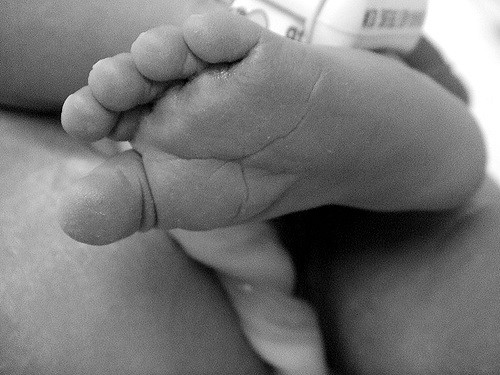
Everyone laughed at that. It was true – the wrinkly, ruddy newborn had hardly any hair and looked like a little old man – indeed the image of her granddaddy, who beheld her silently, smiling, his heart bursting with pride. He thought of the twenty silver dollars he’d collected  for his first grandchild. One day when this baby was old enough, he’d give them to her.

The in-laws congratulated each other on one side of the glass as the baby slept soundly on the other, while somewhere in the bowels of the hospital, the baby’s mother wanted to know when she was getting some supper, since the baby’s arrival had preempted it.

Thus was I born, that long-ago evening in May, strawberry season, in the city, when fathers were relegated to waiting rooms instead of witnessing and participating in births, before Cool Whip was even invented – alas.

As the day rolls around yet again, with every celebrant who gathered at the nursery window long passed on, it occurs to me that knowing the story of my birth is a gift. It ranks high, priceless, among all the gifts given me over a lifetime. I owe this mostly to my grandmother, a tireless storyteller, and some to her son, my father, who, in his matter-of-fact way, told me that my mother grumbled about missing her supper and that newborns aren’t pretty – not even his own! He made a similar observation at the funeral of his father – my grandfather – as we stood by the casket. “He looks really good,” I said, stroking Granddaddy’s snow-white hair for the last time, marveling at the smoothness of his skin. My father frowned: “I don’t know why people say that. Corpses don’t look good.”

Geez, Daddy.

Nevertheless, I cherish my birth narrative as told by those who were there.

Tonight I celebrate them and their truths, their personalities, their wit, their lives – and their stories, which allow me to see events from their perspectives. Tonight, for just a moment, I am at the window, watching through their eyes, when I am born.

The fascinating reciprocal, of course, is that because of their stories, they live on through mine.

Reflection: Do you know your birth – or adoption – narrative? If you do, write it down! If you don’t, ask, if possible. If not possible, well, that’s a powerful story in itself. Explore your beginning, experiment with perspective  – and write. And, by all means, if you know the birth stories of others – tell them.


The value of value

Rose & shadow

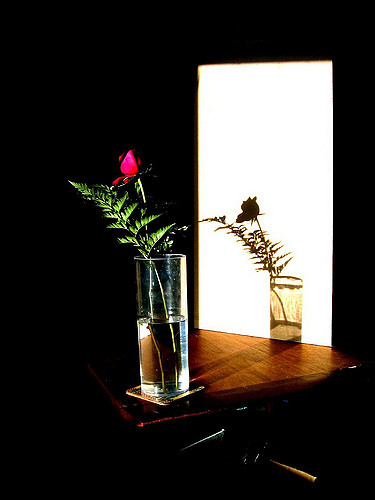
Rose and shadow. ankakayCC BY

We have a new principal at our school.

On his office wall is a certificate presented to him by his previous school: “Most likely to make you feel appreciated and valued.”

That word, valued, set my thoughts firing like electrical arcs in a dozen directions.

The first thing that came to mind, strangely, was an image of light and shadow. From an artist’s perspective, in artist terminology, value is the shading that gives depth to a two-dimensional object, almost magically transforming it visually to three dimensions. Values make an image pop, bring it to life.

A fascinating concept for a leader of a school, or any leader, isn’t it – to be an artist of sorts, to harness the light and the shadows of the given entity, to have a vision, to go beyond the surface and bring depth, meaning, and make it work. Artistically speaking, that’s the value of value.

Another image was immediately conjured – the vast machinery of systems. Have you ever had the sensation of being a tiny cog rotating in a mind-boggling conglomeration of structures that do not fit well or operate properly together, with old, vintage pieces welded precariously to shiny new ones, like something out of steampunk? As the cogs we cannot even see the full extent of the machinery looming far beyond us; we can only feel the unwieldy vibrations as it lumbers on. That’s often how education feels today. In truth, it’s not the structures that hold things together and keep everything running – it’s the cogs, the teachers. Teachers are the most crucial pieces – and the end product isn’t the perfectly standardized student. The students aren’t end products at all – don’t we want them to keep growing, learning, discovering, contributing, as long as they live? That’s something no machinery can produce.

Which gets back to value.

To value something means to hold it in high regard, to recognize its worth and usefulness. We value things that are important and beneficial to us.

My thoughts branch out into a hierarchy of what-ifs:

What if systems valued schools more than data? What if they scaled back and simplified rather than adding on?

What if principals communicated their value of teachers through their actions instead of words?

What if teachers made all students feel valued – and valued their differences? And taught students to do the same?

What if everyone realized that these are matters of the human heart and spirit?

I can see the light and shadows separating already, magically transforming things, creating a depth that’s been needed for so long.

slice-of-life_individual

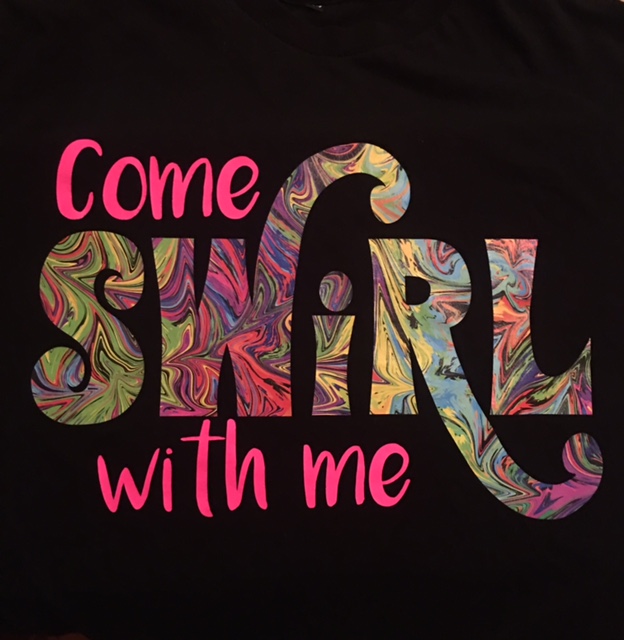
Come SWiRL with me

SWiRL

Our Literacy Lunch team’s T-shirt design

Q: What’s a fun way to engage families in English Language Arts activities with their children?

A: Have a Literacy Lunch!

Every year, families look forward to Literacy Lunch at our school. It’s one of our best-attended events.

Our theme this year, “Come SWiRL with Me,” centered on the facets or domains of language: Speak, Write, Read, Listen (we added the “i” to the SWRL acronym to make a real word), as speaking, writing, reading, and listening comprise the ELA standards and language skills needed across all disciplines.

So, grade levels came up with activities that encompassed all elements of SWRL. Some included poetry, in recognition of National Poetry Month.


Spring poems 1st

First graders wrote spring poems with families, to read aloud. Second graders wrote “I wish” poems.

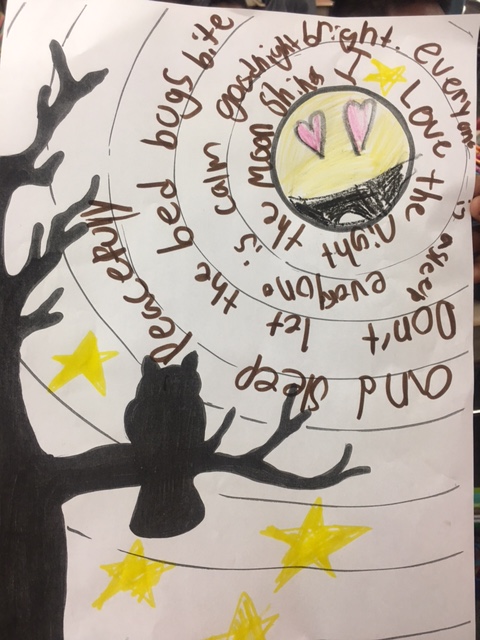
Swirl poem 4th

Fourth graders composed “swirl” poems with families.

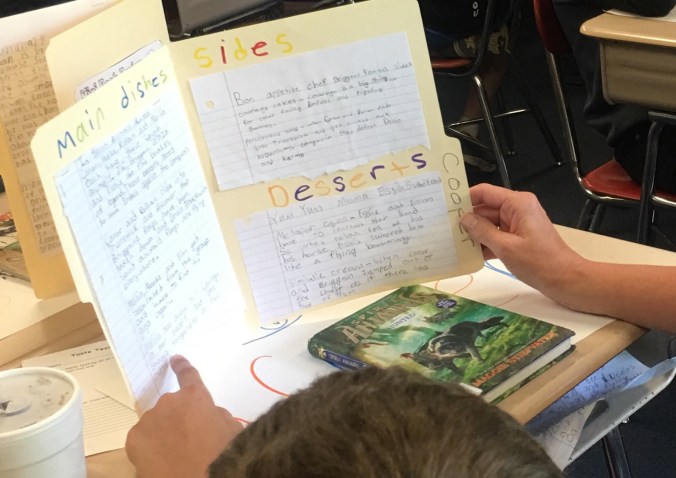
Book tasting 5th

Fifth graders treated parents to a “book tasting.”

Wax museum 3rd

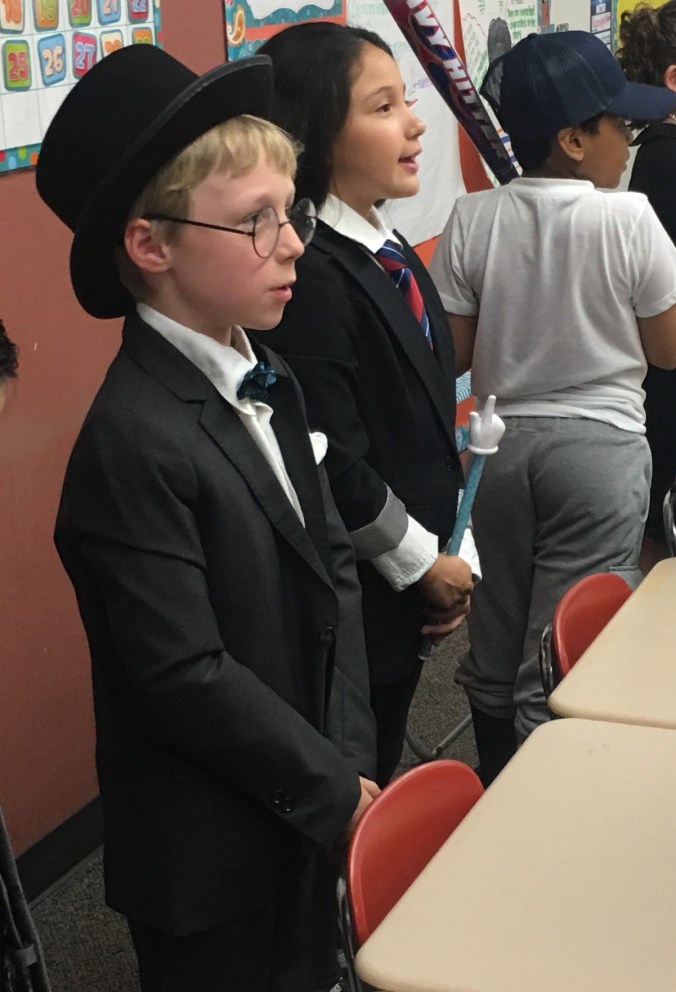
Third grade’s wax museum: Meet Woodrow Wilson, Frederick Douglass, and Jackie Robinson. Visitors pressed a “button” to hear the historical figures speak. This was the culmination of a biography writing unit.

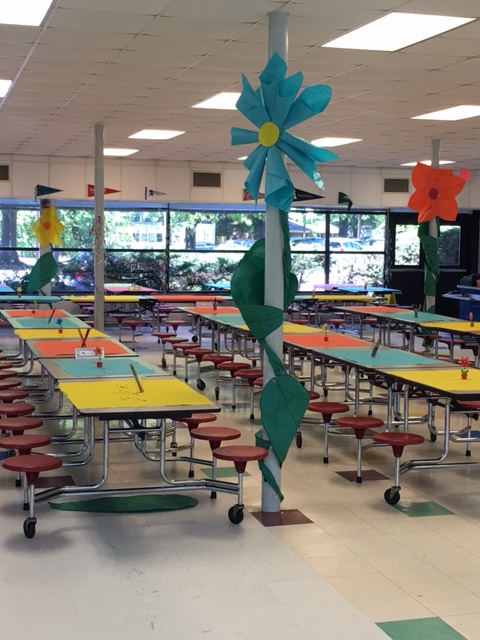
After the in-class activity, families went to the cafeteria:

SWiRL - Cafe

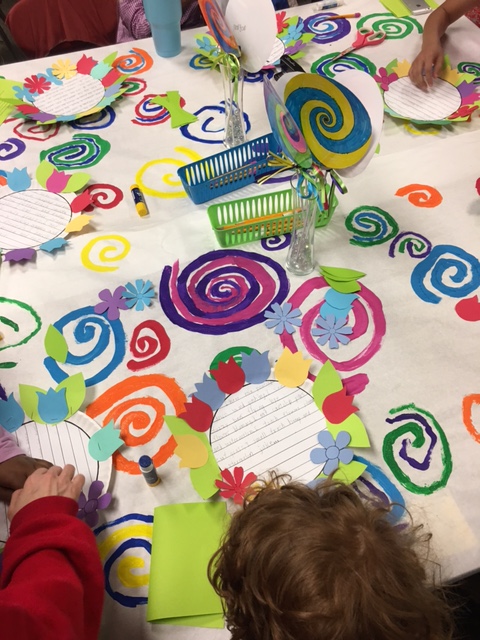
All ready for families to eat together – and to write on the tablecloth.

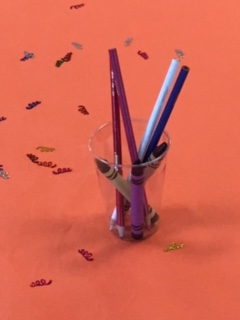
The children seemed to enjoy writing on the paper tablecloths at lunchtime the most – at the end of each lunch, tablecloths were covered with messages and small sketches. One carefully crayoned note from a first grader: “I love you.” Underneath, the neat printing of a parent: “I love you, too.”

Upon exiting, parents gave feedback: They were in awe of the artwork,  fascinated by the children’s ideas and their creative expression. One parent commented: “Public speaking is VERY IMPORTANT!” Another parent, after attending kindergarten’s renditions of reader’s theater, wrote: “I’ve seen so much improvement in my son’s writing and speaking.”

Perhaps most telling is this comment, one frequently echoed throughout our years of Literacy Lunches: “Thank you for this special time with my child.”

Speak, write, read, and listen well, for words are important.

So is time.

SWiRL table

Reflect: What message do you need to communicate to someone today? Make time.


Elegy written in the countryside

Tobacco barn

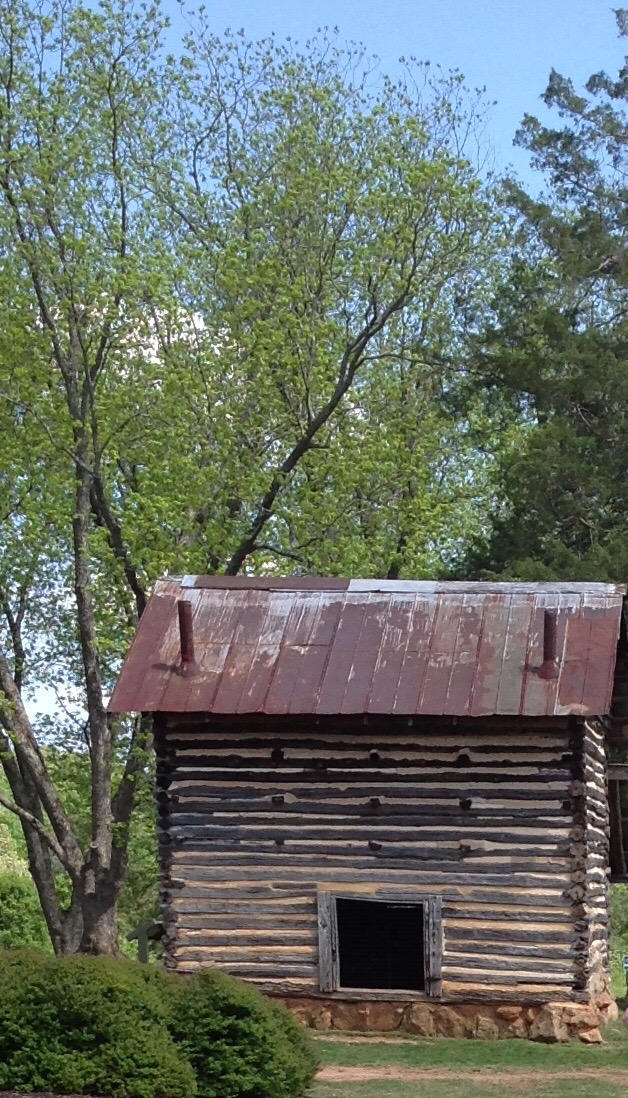
A friend tells the story of a visitor from England who, while riding through our rural North Carolina community, asked: “What are all those quaint, narrow houses in the fields?” My friend chuckled: “Those aren’t houses – they’re tobacco barns.” 

I thought: They’re really elegies written all across the countryside.

I love tobacco barns. Within a short radius of my home stands a grand one with a shiny tin roof, another crumbling in a timbered wood, and another housing two mules – seeing this makes me feel as if I’ve stepped back in time. So, with serious apologies to Thomas Gray, I attempt to pay homage to tobacco barns on this last day of National Poetry Month.

Along the winding roads, bereft, they stand
Beyond their use, and most beyond all care,
Just empty shells of creaking wood, unmanned;
Gone gold, within, leaves sweetness in the air.

The fires no longer burn, nor flues convey
The curing smoke, the farmer’s cash-crop dreams;
Those hands and hearts that worked all night and day
Lie spent, burned out, unremembered, it seems

But for the spectral structures standing yet,
Hand-hewn ghosts, whispering to passers-by:
“Press on, work hard before your sun shall set,
Live, love, build well.” – I hear the old barns sigh.

Reflect: What in your landscape, your neck of the woods, speaks to you? What does it say? Why? Listen – and write. 


My book bag

Bookbag

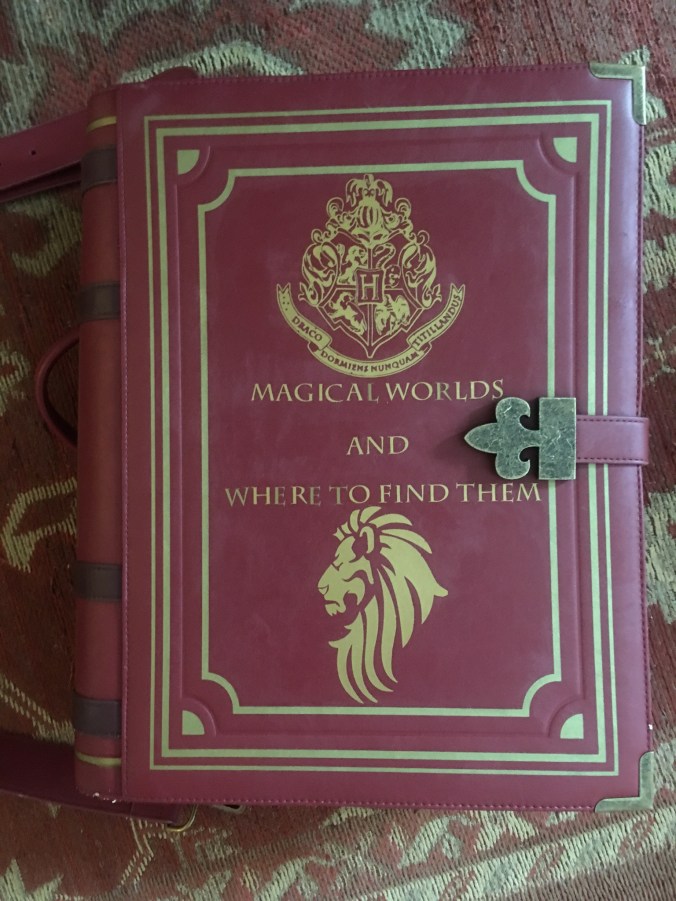
Everywhere I go, my customized book bag is a topic of conversation.

First of all, it’s literally a BOOK bag, sending the message “I’m a reader.”

Then people realize what the “book” is about. A play on Fantastic Beasts and Where to Find Them, my book bag bears the title “Magical Worlds and Where to Find Them.”

Opening a book, for me, is akin to Newt Scamander opening his suitcase – we step in and walk through magically expanded worlds. Whatever the book, it’s a passport to the minds and souls of other people, where I find myself reflected not always as a writer or thinker but as a fellow human being on the common, complex journey of life.

That’s the message I want to send to my young students, who are frequently in raptures over my book bag: Read. Expand your world, your mind.

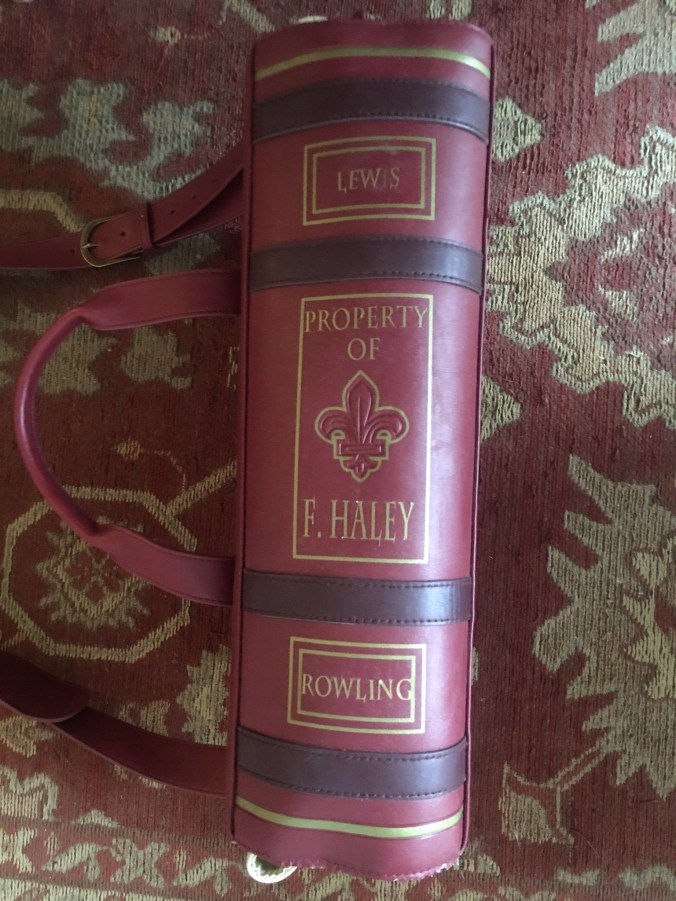
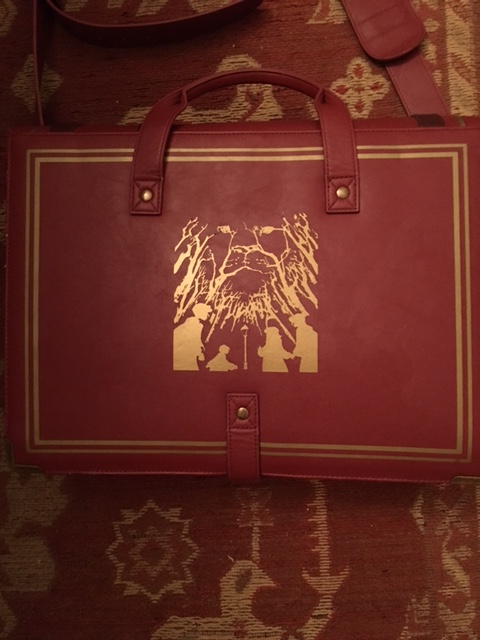
My book bag actually sends more than one message:

Bookbag spine

It’s an homage to my favorite fantasy writers and the worlds they created, old and new.

Much is written and debated, perhaps, on the importance of reading fantasy. Here’s a favorite quote on the subject:

The problem with people who are afraid of imagination, of fantasy, is that their world becomes so narrow that I don’t see how they can imagine beyond what their senses can verify. We know from science that there are entire worlds that our senses can’t verify. 
-Katherine Paterson

The magic is a draw, certainly – in regard to Lewis’ Chronicles of Narnia, who wouldn’t want to experience singing stars and merfolk, a centaur, talking animals? Who wouldn’t want a chance to feel the tingle of the box of dust from the lost island of Atlantis and ride on the back of a huge owl? Truth is, the bigger, deeper exploration is not the mysteries of the magical world but the real workings of the human heart – we read fantasy to escape our world, to live in another for a time, and all the while we’re looking into a mirror. This is where our thinking truly broadens – in understanding self, then in pushing the parameters of possibility.

Dr. Seuss said:

Fantasy is a necessary ingredient in living, it’s a way of looking at life through the wrong end of a telescope, and that enables you to laugh at life’s realities.  

The lines between the fantasy stories we love best and the world we live in are much blurrier than we realize. It’s where the impossible and possible merge – who’s to say where all the boundaries really are?

Which is fun, sometimes even comforting, to think about.

So everywhere I go, I carry a little fantasy, a little magic, with me.

Via my book bag – a messenger bag, indeed.

Bookbag back

slice-of-life_individual

Committing assumicide

Through the window

Through the window sepia. Jo NaylorCC BY

Your assumptions are your windows on the world. Scrub them off every once in a while, or the light won’t come in.
Isaac Asimov

This quote brings a little girl to mind.

She shows up in my classroom early for her reading intervention group. I am hunkered over my laptop fighting with a SMART Board activity I’ve created on word families.

“Hello,” I say, without looking up, frowning at my screen and the uncooperative technology. “Come have a seat. The others will be here in a few minutes.”

She sits right next to me, a small warmth at my elbow. “What are you doing?”

I sigh. “Trying to fix this activity for your group to play – it will be fun. Something’s not right, though. I’m trying to figure it out.”

She watches while I attempt to cut a word from one side to paste on the other. Unsuccessfully.

Even as I fight the program, I wonder what she is thinking.

She struggles terribly in all academic areas, an ESL student with processing issues beyond the language barrier. She is soon to be tested for disabilities.

“What is that line in the middle?” she asks.

“It’s a dual screen – two screens instead of one.”

“Oh. You are trying to move this word to here?” She points from one side of the screen to the other.

“Yes. I don’t know what I’m doing wrong,” I say in exasperation. I glance at the clock – I should have caught this problem sooner! “I’m going to have to quit now – I’m out of time. Your group will have to do something else instead.”

Without removing her eyes from the laptop, my student reaches over, clicks on the obstinate word, then drags and drops it on the other side.

“There,” she says, matter-of-factly.

I stare at her. “How did you know that? Have you seen a SMART Notebook before?”

She shrugs, laughing at my expression. “No. Just a try.”

The group was able to play the interactive word game. That day my little girl was a much more willing participant, with considerably more confidence.

The outcome could have been quite different. In my frustration, it would have been easy to answer her questions with Oh, never mind. It’s too hard. I could have thought, There’s not much need of my explaining. You won’t understand.

Had I done so, I would never have known that she had this ability, that she could “see” what to do with the new software when I couldn’t.

I would have committed assumicide.

It happens every day.

Teachers assume that students who struggle in academic areas struggle in all things – and thereby limit the students further. Although the thought may never be verbalized, it lurks in the mind: They can’t do that . . . so surely they can’t do this . . . .

A friend of my family was born with cerebral palsy. His father was an avid golfer who decided early on that he would treat his son as if he didn’t have the disability. As soon as the boy was big enough, his father started teaching him the game.

I have often wondered how many eyebrows were raised at the time: What is that man doing? His child can barely walk or dress himself – why in the world would he teach him something requiring as much precision as golf? That boy will never be able to hit the ball! I wondered if some people may have been angry over the injustice.

If so, they eventually learned that they’d committed egregious assumicide.

The boy grew up living and breathing golf. He remains a local expert on the game with a room full of trophies won in multiple tournaments, long after his father had passed away.

Yes, that’s right – a room full of trophies in a precise game like golf, when the two halves of his body don’t work together for him to climb stairs and his hands shake when holding a cup so that it can only be partially filled, lest he spill the contents.

When I needed a fast P.E. credit one summer to complete my teaching degree, the only thing available, to my great chagrin, was golf – and this extraordinary man coached me through it. I have page after page of his painstakingly handwritten notes and drawings on “the fundamentals of golf.”

When I was growing up, my parents had the In the Wind album with Peter, Paul and Mary singing Bob Dylan’s “Blowin’ in the Wind.” As a child, I loved the three-part harmony and haunting lyrics:

How many times can a man turn his head

And pretend that he just doesn’t see? 

Maybe it’s not always a matter of not seeing, but seeing wrongly – seeing the deficits, not the potential.

For the teacher, what isn’t working too often overshadows what might. Sometimes we see but don’t act because we don’t know what to do, or because we believe our efforts won’t matter. We assume we are defeated before we begin. Sometimes our focus just isn’t where it needs to be when worry, exhaustion, fear, discomfort, directives, even the need for self-preservation and validation, occlude our vision. Sometimes it’s hard, in the throes of teaching – and of living – to stop and breathe, to listen, to see, to let go when we’re so focused on whatever it is we are trying to make happen. Accordingly, we close more doors than we open – for ourselves as well as for others.

We assume, and something dies.

I decided at the end of eleventh grade that I wanted to go to college. Higher education wasn’t talked about at my home, wasn’t encouraged. The general expectation is that I would keep taking courses like business typing (which I bombed, miserably) to become a secretary.

I needed to take several college prep courses in twelfth grade even to apply for college, and the college prep English teacher wouldn’t let me in his class.

He had the reputation for being the hardest teacher in the school. He reluctantly met with me, frowning over my transcripts. “You haven’t taken the prerequisites for this class or demonstrated that you can handle this caliber of work,” he commented, handing the transcripts back.

“Y-yes, sir, I know,” I answered, trembling. “I hadn’t planned to go to college until now.”

He eyed me over the rim of his glasses. Piercing blue, absolutely no-nonsense eyes.

“Tell me why I should let you into my class.”

“I’ll work hard. I can do it,” I said.

He sort of snorted. “A lot of students before you thought they could do it, too, and transferred out of my class, even when they had prepared for it.”

“Please.” It was all I knew to say.

He shook his head. “I am doing this against my better judgment,” he grumbled, and signed my special permission form.

That year I encountered the great poets, studied sonnets, wrote so much about the spider in Robert Frost’s “Design” that my teacher noted at the end of my interpretation: Exhaustive analysis! I memorized and recited – in Middle English – the first thirty-four lines of Chaucer’s Prologue to the Canterbury Tales. I hung on my teacher’s every word about London during the time of the Black Death; his descriptions were so vivid that the images remain clear in my mind to this day. For my final paper I wrote about the function of King Claudius in Hamlet – and when our teacher announced that four students tied for the highest score on the paper, I was one of the four.

He returned my paper on the last day with this comment: “For someone who had to have a special conference to get in this class, you have done remarkably well. You have surpassed expectations.”

All of which leads me to believe that the First Commandment of teaching should be Thou shalt not commit assumicide.

Perhaps it may even need to be the First Commandment of humanity.

slice-of-life_individual

Deeper than data

Moonrise

Moonrise. magnoidCC BY-SA

Papers are spread across the conference room table. The projector shines a graph – a student’s reading assessment history – on a screen. Discussions center on interpreting the erratic data points on a trend line in relation to the aim line toward a goal, the rate of improvement, and whether or not this student is a retention candidate.

A colleague turns to me: “What do you think? You’re the literacy person.”

I consider the numbers, the color-coded risk categories, where this child falls in all of it.

“I don’t know,” I reply. “I haven’t heard this child read.”

Silence. Eyes are on me.

“I need to know what exactly this child is doing during reading, how the child approaches it, feels about it, what the actual strengths and weaknesses are. Until I do, I cannot say what I think. Data is information but it doesn’t tell the whole story, only little pieces at specific points in time. I have to listen to the child.”

I leave the meeting to do just that.

The child is eager to read and turns out to be highly accurate, reading slowly and deliberately; the time that it takes this child to finish reading is why a high risk is indicated on some measures. In fact, the child can read and fully comprehend text above grade level expectation. The only enemy is time, and that’s only an issue in assessing. The desire to read, the ability to self-monitor, and an obvious work ethic so early in life will take this child far.

I think of Brené Brown, professor-author, who says: “I am a storyteller. I’m a qualitative researcher. I collect stories; that’s what I do. And maybe stories are just data with a soul.”

Data is the dust jacket; behind it there’s a story, and in the center of the story is a little soul.

It takes another soul to reach it.

I listen to another child reading with great flow and prosody, to discover that this young reader isn’t making meaning beyond the surface of the text – and struggles a bit even to retell what’s explicitly there. This child, whose data looks near-ideal, “in the green,” is of far greater concern. Supports need to be put in place immediately or this child will fall through the cracks.

On paper – on the dust jacket – this child looks just fine.

A few months ago, as I was printing data reports in the computer lab, I saw a young man walking with a class down the hallway. Subs are getting younger and younger, I thought, gathering my papers and returning to my room to begin analyzing them. Two colleagues joined me at my table.

The young man came into my room, smiling. “Mrs. Haley, do you remember me?”

I look at him. A little face, frowning over a book, springs into my mind. “Yes, I do! Goodness, you’ve grown up!” Mentally, I am counting off years – Good grief, how long have I been doing this?

Turns out he’s not a sub, he’s a high school volunteer. I breathe a little easier about the passage of time. He was one of my first intervention students at this school.

“I am planning to go to college to teach,” he says with a grin. I marvel at his poise. He exudes young professionalism.

“Really? What do you want to teach?”

“Reading. In fifth grade. I think I can help the kids love it. I really didn’t love it until I was in high school and suddenly I couldn’t read enough – I read all the time.”

I am awed. “That’s amazing! I am so glad to know. The kids need you. What a great role model you’ll be.”

One of the colleagues at my table asks: “Was there a particular teacher who inspired you?”

His face – once so little and serious, nearly scowling as he sat at this very table – lights up with a beatific smile.

“Yes. Mrs. Haley.”

My colleagues’ eyes tear up. I cannot even blink, cannot quite process this.

“But – you said you really didn’t enjoy reading until high school,” I manage.

“It took a while,” he laughs. “Reading was hard for me when I was little. I didn’t think I’d ever be good at it. You were the one that gave me the confidence, the one who said I could do it. I kept trying.”

Behind the data is a story. Behind the story is a little soul. A precious one.

Sometimes we never know how the story unfolds once the children go on. We only play a part for a little while, but how priceless is that tiny window.

If data were the whole story, I wouldn’t be a teacher, wouldn’t be writing this now. My parents didn’t go to college; one didn’t finish high school. The odds were against me. But my parents bought books and magazines, my grandmother read to me long before I went to school, and teachers challenged me all along to strive for more.

Another meeting, another table strewn with papers. I stand up. “I have to go now. It’s time for me to read with a student.”

This student and I read every day, if we can. He struggles with vocabulary but his primary issue is lack of confidence – he doesn’t want his peers to hear him.

I am running late. When I find him, he tries to hide a smile.

“I thought you forgot,” he says, as we settle at the table.

“I was in a meeting,” I explain. “I had to leave it.”

Pure astonishment is on his face. “You left a meeting? To read with me?”

“Well, yes. Your reading is important. Let’s get going.”

He looks at me, wide-eyed. “I can’t believe someone would do that.”

“You’re more important than the meeting,” I say.

He smiles in spite of himself.

And he reads.

I listen.


Celebrate today

Dogwood

Dogwood. JenniferCC BY

The first day of April – glorious. A sky as blue as it ever gets, hardly a cloud to be seen. Dogwoods and redbuds, bare just days ago, flowering profusely. On the breeze, the scent of blossoms, almost like perfume – winter daphne, I think.

All marking the end of desolation. Nature composes a theme of renewal with color, fragrance, amber light and birdsong.

At the close of the day, I celebrate its beauty. I celebrate the inherent message of hope with the arrival of another spring. Even the news carries a rare inspirational story about a man opening his front door to find his dog, missing for four years, back home on the porch. He sat down and the dog put her head in his lap – what an emotional celebration that must have been.

Today is also the first day of National Poetry month. I have recently discovered a lost booklet of poems that I wrote as a teenager. All things considered, this particular poem struck me as one appropriately celebratory  – winter is over, spring has returned; a lost dog has returned home; my lost poems are found.

I wrote it when I was sixteen. Back then, I called it “Yesterdays.”

Yesterdays are gone

Leaving nothing but memories behind

And, if meant to be, a chance for tomorrow.

So weep no more

For what once was,

For it may be

Once again.

Celebrate today.


Three cheers

Candles

Three is a magic number. Alan LevineCC BY

I love the sound of chimes.

I always have.

There’s something magic in those ethereal tones, something stirring, uplifting, echoing the fairy world, whispering of good things and better yet to come, hinting at happily-ever-afters. Perhaps this is why chimes sometimes play at the end of weddings, their light, airy sound signifying the beginning of a new, hope-filled chapter, the turning of a page.

Come to think of it, when I was little I had read-along books with audiotapes that chimed when it was time to turn the page.

The telephone on the kitchen wall of my childhood home was avocado green with a six-foot cord, and instead of ringing, it chimed. Visitors always said, “There’s the doorbell,” and we always responded, “No, that’s the phone.”

I never knew of anyone else’s phone that chimed like mine.

As a teenager my pulsed quickened at the sound, because I was sure the chiming meant someone was calling for me. It often was. I stretched that cord at least another two to three feet, enough for me to sit on the bed in my room and talk with the door closed. Yes, on the cord.

My smartphone is set to chimes now. When it rings, the melodic tones are like strings of tiny silver plates in the wind.

Perhaps no chime has given me as much pleasure as that of my WordPress app, however.

For me, that’s truly the sound of celebration.

I’ve heard this chime so often in the past month, denoting likes and comments on Lit Bits and Pieces during the Annual Slice of Life Story Challenge with Two Writing Teachers. The chime has come to represent the warmth of this community, the connection of minds, hearts, and kindred spirits, reiterating the power, the magic, of words. I am a first-time slicer and the words of others have borne me far in the completion of thirty-one posts in thirty-one days.

This is the thirty-first post. With it, I cross the finish line – my first cheer.

The WordPress chime also proclaimed two other milestones, two days ago:

Lit Bits 50

I hit the 50-post mark. My second cheer.

Lit Bits Anniversary

Lit Bits and Pieces turned one year old on March 29th, along with my first post. Cheer number three.

When I started Lit Bits and Pieces a year ago, I asked a friend to give me feedback. The friend said: “Hmmm. What’s your niche? Your target audience?”

I said, “I don’t really have a target audience in mind. I just want to write whatever I want to write.”

The friend looked skeptical.

I added, “It’s for human beings.”

To you, Dear Reader, I leave three parting thoughts on this Lit Bits and Pieces celebratory post. Chimes play for you, somewhere in the wind – I hope you hear them as you read:

  • Do, or do not. There is no try. -Yoda
  • Inspire. That means be a life-breather of ideas, tiny notions of stories. – Avi
  • Write.

 slice-of-life_individual31-day-streak-with-border


The escape artist

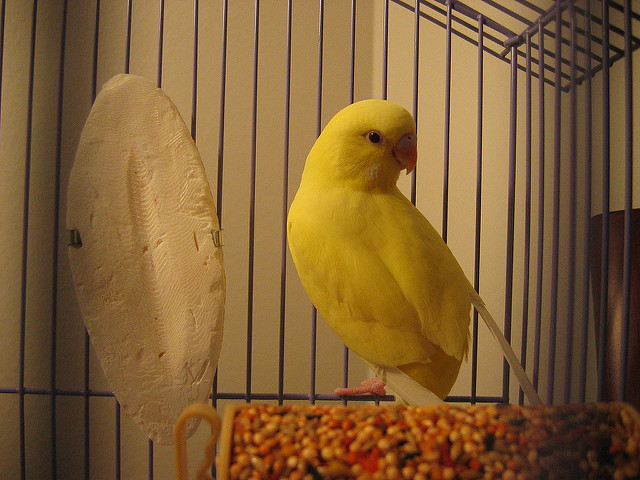
Yellow parakeet

Yellow parakeet. IMG_3172. lobo325CC BY

Yesterday’s post, Just the Right Word, was about writing realistic fiction with a third grade class. I modeled taking an event from one’s one life – a slice of life – to create a work of fiction. As a child, I had a yellow parakeet that frequently escaped his cage (the part about the window in this story is true!). “The Escape Artist” was composed over the course of several days with the class making suggestions during the process, some of which strengthened the story profoundly.

Enjoy. 

Tweety Bird sat inside his cage on his swing, rocking back and forth. He lifted one yellow wing, preened it, fluffed all of his yellow feathers, and went back to swinging.

As if he didn’t know Jake was watching.

“You don’t fool me, Bird.”

Tweety blinked his purple eyes at Jake and kept on swinging.

“Jake,” Mom called from the kitchen, “Did you get the mail for me like I asked you to?”

“No, ma’am,” Jake replied. “I’ll go now.”

As Jake left the living room, he turned back toward the birdcage. He shook his finger at Tweety:

“You better stay put. I’m going to figure out how you keep escaping from your cage.”

With that, he walked through the front door.

As soon as the door closed behind Jake, Tommy popped up from behind the sofa. He was wearing his Batman costume, mask, cape, and all.

Tommy looked to the left.

He looked to the right.

Tommy snuck very Ninja-like over to the cage.

“Don’t worry, Robin,” Tommy whispered to Tweety Bird. “I’m here!”

Tweety Bird chirped happily.

Tommy reached for the door of the cage just as the front door opened and Jake walked back into the living room.

“The mail truck is on its way down the street … HEY! TOMMY! WHAT DO YOU THINK YOU’RE DOING!”

Tommy twirled around and hurtled himself in one motion over the top of the sofa. He crashed onto the floor on the other side.

“Uggghhhh,” came Tommy’s voice from behind the sofa.

Jake stomped over to the couch. “You little dirtbag! You’ve been letting Tweety out this whole time and I thought he was doing it all by himself. Some mystery!”

“Acckkk…” groaned Tommy. “I think I hurt myself.”

“I don’t care!”

“And I haven’t been letting him out ALL the time. Sometimes Robin gets out by himself,” said Tommy, beginning to cry.

Mom, with her radar-hearing for crying, came into the living room from the kitchen.

“What’s going on in here?” she demanded, with her hands on her hips.

Tommy wailed louder. “I’m HHHUUUUURRRRT!”

Mom stepped over to Jake. “What did you do to your brother?”

“I didn’t do anything to him!” shouted Jake. “I caught him trying to let Tweety out of the cage! He’s been doing it all along!”

“Tommy, is this true?” Mom asked the sofa. “Have you been letting Tweety out of his cage?”

Loud sniffles echoed behind the sofa. “Maybe once or twice … and he’s not Tweety, he’s Robin!”

“He’s Tweety, you bonehead!” Jake rolled his eyes.

“Jake!” Mom snapped. “You used to like make-believe, too. Besides, Tweety – or Robin – has gotten out of the cage when you boys are not home, so it’s not always Tommy letting him out.”

Mom shoved the sofa over and pulled Tommy out from behind it. “Come on, let’s go have some cookies and milk, Batman. You too, Jake.”

Just as they turned toward the kitchen, a scratching sound came from the birdcage.

They turned back.

Right before their eyes, Tweety, clinging to the bars on the front of the cage, used his beak to lift the cage door so that it fell open.

Tweety looked to the left.

He looked to the right.

And he flew out of the cage!

“Fly, Robin, fly!” screamed Tommy, jumping up and down, his Batman cape flapping.

“Jake!” cried Mom. “Go grab a dishtowel! We have to catch Tweety!”

Jake ran for the towel. He came back and threw it at Tweety, who was squawking madly and flying back across the room in confusion. The towel landed on Mom’s head.

Tommy ripped off his cape – Jake could hear the Velcro – and swiped at Tweety, who was now flying rather low. Tommy missed. Feathers floated through the air as Tweety flew high again.

Jake stared as Tweety flew as hard as he could across the living room, right toward the huge picture window with a view of the trees in the front yard.

Oh no, Jake thought, he doesn’t know that’s a window! He thinks he will escape to the outside!

Just then, Tweety smacked into the window with a sickening SPLAT. He slid down the glass and landed on the floor.

“NO!” shouted Jake!

“Tweety!” cried Mom.

“ROBIN!” screamed Tommy.

All three of them rushed over to Tweety’s crumpled yellow body.

Tweety’s eyes were closed.

He’s broken his neck, thought Jake. Hot tears stung his eyes.

Then he noticed that Tweety had opened one purple eye.

“Robin, you’re all right!” shouted Tommy, jumping up and down.

“Shhh, let’s be calm and quiet,” said Mom. Very carefully, she picked Tweety up.

Tweety promptly bit her hand as hard as he could with his beak.

“OUCH! Quick, Tommy, give me your cape!”

Tommy handed Mom his Batman cape. Mom covered Tweety, head and all, and wrapped the cape into a tiny bundle.

“Ok, escape artist, back to your cage you go,” she said, and she carried him over, put the bundle inside the cage, and shook gently until Tweety stepped out. She shut the cage door.

Tweety looked at them with his purple eyes. He lifted a wing, preened it, then climbed up the bars on the side of the cage to hop on his swing, like nothing at all had happened.

“I’ll have to get one of my ponytail holders from the bathroom to keep the cage door tied shut from now on,” said Mom. “We must keep Tweety safe.”

Tommy looked through the bars at Tweety. “Sorry, Robin,” he said. “It’s better this way.”

Tweety chirped. He swung back and forth on his swing.

Jake sighed. “At least he’s all right.” He looked at his little brother.

“You know, Tommy,” he said, “I have a Batman flashlight that I used for the Bat signal, if you want it.”

“Awesome!” said Tommy. “I can shine it on the wall behind the cage. I can still play with Robin.”

With that Tweety chirped loudly, flapped his wings several times, then held them out like a bat, just for a second, before he settled back to swinging.

Tommy and Jake stared at Tweety with their mouths hanging open.

“That’s one tricky bird,” Mom smiled. “You never know what he might be up to next.”

Tweety blinked his purple eyes and kept on swinging.

As if he didn’t know all three humans were watching.

slice-of-life_individualEarly Morning Slicer