A rising tide lifts all boats

Boats

Fishing boats. karol m. CC BY

At a recent team meeting of K-12 cross-curricular educators dedicated to improving writing instruction, we discussed the Calkins and Ehrenworth article entitled “Growing Extraordinary Writers: Leadership Decisions to Raise the Level of Writing Across a School and a District” (The Reading Teacher, Vol. 70, No. 1, July/August 2016). While takeaways included the need for a shared vision of good writing and good writing instruction, as well as a need for shared expectations and ways to track growth – the reason for the formation of this team – what struck me most was this line on the transformative power of professional development: “It should be focused on strengthening teachers’ methods and spirits.”

Yes. Spirits must rise, I thought. Before we can raise the level of writing, before we can raise the students at all,  we must first raise each others’ spirits. 

The truth is that professional development is so seldom inspirational. For the last year, when I planned professional development in writing for teachers, my driving question was, How can I inspire them? How can they tap into the wellspring of their own power, their own voices, all that matters to them?

When I spoke on this at the meeting, a colleague chimed in: “We have to be the rising tide. If we rise, we’ll raise others with us.”

“Yes – a rising tide lifts all boats,” I responded, recalling those words associated with John F. Kennedy.

I grew up in the Tidewater region of Virginia. I have been on the Chesapeake Bay-Bridge Tunnel when the tide was high, in a storm; as I descended into the tunnel, waves crashed above the entrance and spilled over the car. A layer of salt remained on the windshield when it dried. I’ve seen boats grounded when the tide was low, making the would-be sailors push and pull that much harder to get them afloat. I’ve walked floating docks of marinas on sunny days, feeling the sway of the boards under my feet as boats rocked with the incoming tide, the metal of their moorings and buoys clanking softly, rhythmically, as if coming to life with with the rising flow.

When the tide rises, it lifts everything with it – everything rises.

When our spirits rise, we lift others around us – everyone rises.

That’s so needed in education today.

It’s so needed everywhere.

The power lies within you. Tap into that inner wellspring; let it flow.

And rise.

Note: The one word I chose for for myself at the beginning of this year is Rise. If you’re interested, here’s my little poem: Rise.

slice-of-life_individual

My grandfather, St. Patrick

Columbus St. Patrick

Columbus St. Patrick Brantley, circa 1924-1925, age 18 or 19.

On a small family farm in Beaufort County, North Carolina, in late September of 1906, my great-grandmother had her fifth of ten children. Her previous children were named Franklin, James, William Hosea, and Penelope (not pronounced pe-nel-o-pee, mind you, but pen-a-lope, rhyming with cantaloupe).  Thankfully the girl was called Penny,  which the family spelled Peaney.

This new son was named Columbus St. Patrick.

We do not know why.

He wasn’t born on March 17th.

The family wasn’t Catholic; they were Baptists and Methodists.

Legend has it that a great-great ancestor came over from Ireland, but this isn’t evident in the family tree roots running deep in North Carolina and Virginia to the 1700s. In fact, as Columbus St. Patrick grew up, his southern dialect carried traces of Elizabethan English: He pronounced his brothers’ middle names as Acey and Hosey – that’s Asa and Hosea – and a neighbor’s name as Miss Etter, which I believed was spelled that way until I saw it on her mailbox: Etta.

His middle name troubled him.

I became fascinated by names around the age of five. My own given name is in honor of my grandmother, Ruby Frances. I asked her: “What’s Granddaddy’s middle name?”

“It’s just S,” Grandma replied.

“S?”

“Yes.”

“How can a name be S? That is just a letter.”

“It’s an initial. He had his name changed to an S.”

I didn’t know anyone could do that. Your name is your name; it’s who you are.

Grandma went on: “It’s S because his middle name was St. Patrick and it bothered him his whole life, so he changed it.”

Even as a preschooler who knew nothing of Saint Patrick yet, I felt a pang at this. What a magical-sounding name. Strange, but pretty.

Later that day I crawled into his lap and in the blunt way of children, asked: “Granddaddy, why did your mother name you St. Patrick?”

Granddaddy shook his head, briefly drawing a hand over his face as if to brush the thought away.

“I have no ideer,” he replied, sighing.

Those who did know were already long gone.

When St. Patrick’s Day rolls around, of course I think of Granddaddy. He was St. Patrick. He was a man of faith and a man of the earth, a farmer; Saint Patrick is depicted holding a cross and a shamrock. Saint Patrick sailed on ships in the fifth century; his namesake built them in World War II. Columbus St. Patrick spent his life serving others, putting their needs ahead of his own, always a compass for doing what is right, what is good.

The venerated saint is said to have driven the snakes out of Ireland. I recall Granddaddy killing copperheads with a hoe on the dirt road of his country home when I was a child. When he grew too old to manage the hoe, he simply grabbed his shotgun and that was it for the copperheads. No harm was going to come to his own, not on his watch.

“Never kill a black snake,” he told me. “They keep rats and mice away.”

I suppose it would not do for North Carolina to be rid of all snakes.

Today I celebrate my heritage as do many others, but I suspect very few can say they are St. Patrick’s granddaughter.

slice-of-life_individualEarly Morning Slicer

Courage (part two)

The surgery took longer than expected, but the surgeon came to the waiting room at last.

“It went well,” he said. “Your husband’s eye is removed and the implant is in place, covered by membrane and attached to the muscles as it should be, if he were to get a prosthesis.”

He paused.

If it went well, why is he pausing? Something’s not right.

He continued: “I had to remove a lot of extra tissue, as it was dark and there’s no way for me to tell if it’s just natural pigment, or bruising, or melanoma.”

I was shaking. “What does this mean?”

“I took all of the dark tissue but he may never be able to wear a prosthesis, as there may not be enough support for it,” said the surgeon, gently.

I nodded. How are we going to tell him?

“Pathology will send the eye to Wills Institute in Philadelphia – they’re the best. They’ll analyze the tumor, whether or not any cells have spread . . . .”

 I closed my eyes as he spoke, not having considered this possibility.

I recalled the oncologist’s words when we consulted him: By the time it’s found, it’s usually metastasized. Radiation and chemotherapy are ineffective. It’s nasty.

That doctor had treated five patients with ocular melanoma in the last two decades.

All five had died.

Please, God. Please let those cells not have spread.

And then I went to recovery to hold my husband’s hand.

He squeezed mine, hard.

Half his head was bandaged. When an eye is surgically removed (enucleated), that side of a person’s face bruises badly. A conformer, a clear plastic piece like a huge contact lens, is put under the eyelid to hold its shape during healing so a prosthesis will fit.

The pain is intense for the first few days.

When the bandage had to be removed the first time for the application of antibacterial ointment, my husband said, “Get me a mirror.”

I handed it to him.

“Dear God,” he said, looking at his reflection.

It was the only time he cried.

After that, he never complained, not once – all of his energy went into healing.

The first night back home, when he went to bed, my husband said, “I see a light.”

“There isn’t a light,” I said. “I just turned it off.”

“I see it with my . . . what used to be my eye,” he said. “A bright light at the floor. Then it sort of swept up to the ceiling.”

I thought about amputees who still feel rings on fingers that are gone, or sensations in legs that are not there anymore. Phantom pain.

“I think it’s a phantom light,” I told my husband.

 He saw it for a few nights, this ghost light, the optic nerve trying to adapt to not seeing anymore. And then it stopped.

The bruising absorbed in a week or so and the eye – what do you call an eye that’s not an eye? A non-eye? – didn’t look as alarming as one would imagine. Just a pale orb, sort of like sclera without an iris. Not frightening at all, nothing like a hallowgast from Miss Peregrine.  Just different.

And every day we wondered about that pathology report.

Three long weeks went by before the surgeon called:

“No rogue cells in the tissue around the eye! The timing couldn’t have been better – the tumor was in the early stages.”

We threw our arms around each other; we could get on with living.

It wasn’t all that easy.

At first my husband wore a black eye patch to shield the removed eye. Everywhere we went, little kids called out, “Look, a pirate!” My husband just laughed and waved at them. An eye patch, however, is quite convex. It bumped against the lens of his glasses, which he had to wear all the time now for his remaining eye, as it was becoming strained.

He tried adhesive bandages designed for eyes next. Our grown sons said, “Dad, the eye patch looks better than those Band-Aids. A lot better.”

My husband sighed. He decided to try wearing a contact lens in the real eye, doing away with glasses so he could go back to the eye patch, which worried all his doctors:

“You only have one eye now – you can’t afford an abscess or corneal infection,” they told him.

He tried it anyway – and learned that in order to put a contact in, you really need two eyes to see what you’re doing.

At last he resorted to tinted lenses and gave up on coverings altogether.

He had trouble with depth perception, driving after dark, merging onto the highway. He was startled by people approaching him on his left side, because he couldn’t see them coming.

He bumped into things, hard enough to leave bruises.

He had trouble reading, which worried him more than anything else – he’s a minister, and reading is the foundation of his life’s work. He got a magnifying glass to be able to study his Bible.

He became restless, quiet.

At an appointment for his strained eye, the neurological ophthalmologist asked: “Why haven’t you gotten a prosthesis?”

“The surgeon said with all the tissue he removed, there may not be enough support for it,” answered my husband.

“Hmmm,” said the ophthalmologist. “How long has it been since your surgery?”

“A year.”

“I think you should investigate it. Here’s the name of the ocularist. He’s only about an hour away.”

We called, and learned that the ocularist sets appointments in the morning. If the patient is a candidate for a prosthesis, he makes it in his office that day and the patient leaves wearing it.

My husband hung up the phone, his face alight with hope.

“What if . . . ” I struggled, “what if you’re not a candidate?”

“Then I tried, and that’s all I can do.”

I worried the whole trip about how the idea buoyed his spirits, fearing that we’d be sent away, and how would that affect him?

Our younger son drove us. The three of us sat in the office together as the ocularist examined my husband.

“Oh, that was a lovely surgery,” he said. “Lovely. Great movement of the implant. Let’s get to work.”

“Do you mean,” I hardly dared to confirm, “that he will be able to wear a prosthesis, after all?”

“Sure – not a problem.”

I sat there watching as the mold was made of my husband’s non-eye, then as the resin was poured into it to create the prosthesis, thinking, This is like a cross between a medieval apothecary and Lemony Snicket. It might have been downright gothic, except that the room was sunny and cozy, being part of a house converted to an office.

The last step of the process was painting the prosthesis. We watched this man, this artist extraordinaire, open his set of paints and create his little masterpiece. He held the prosthesis up to my husband’s eye for comparison: “You have a lot of ocher in your iris. I have to add more.”

Back to dabbing paint he went.

As long as I live, I do not expect to see anything like it again – it was nothing short of a miracle when the ocularist placed the prosthesis over the implant, and my husband looked at me with two big, beautiful brown eyes.

My mouth fell open.

So did my husband’s, when the ocularist handed him the mirror.

We arrived at 8:00 that morning.

We left at 3:00 that afternoon, with the new eye.

On the porch of the office as we were leaving, in the bright the afternoon sun, my husband said, “Tell me how it looks.”

A perfect match – one would not know which was the real eye.

“It’s unbelievable,” I said. “Amazing.”

“It looks great, Dad,” said our son.

“I feel like myself again,” said my husband. A grin spread across his face.

“I just wonder how long it will be before someone asks if I can see out of it,” and he dissolved with laughter.

That was just three weeks ago.

He hasn’t stopped smiling since.

*******

(Note:  Just before the surgery, when we didn’t know what would happen next, we made the seemingly insane decision to adopt a seven-week-old Lab puppy who needed a home. If you are interested in the puppy’s story in relation to this experience, here’s a previous post: The unplanned baby.

slice-of-life_individualEarly Morning Slicer

Courage (part one)

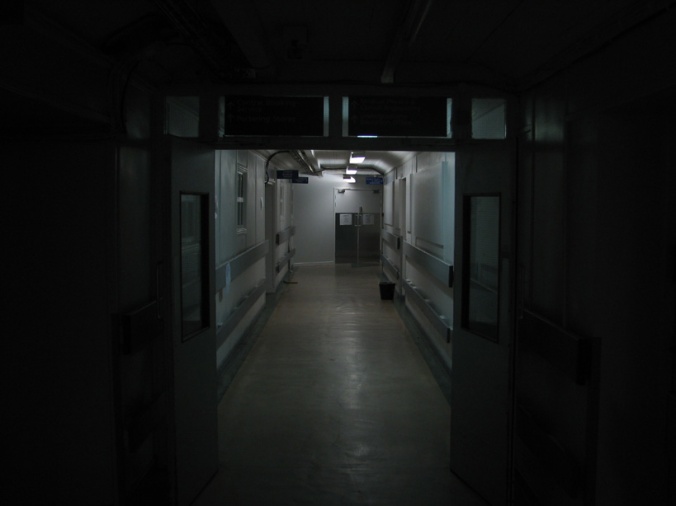
Corridor

Corridor. danie; CC BY

“Do you know why you’re here?” the doctor asked.

When doctors don’t smile, the conversation isn’t going to be good.

My husband, pale but resolute, nodded his head.

Ocular melanoma. We’d never heard of it before.

It’s rare.

He had a freckle on his retina near the optic nerve in his left eye. Probably a birthmark, the optometrist said. We’ll just watch it.

They watched it for six years.

It was growing now, spreading, causing light flashes, changing color, leaking fluid.

The retina specialist looked grim. Maybe a radiation chip could be applied to slow the growth of this thing, but it would still be there. The sclera would have to be cut and peeled up for the chip, which would stay in for seven days.

The research hospital wanted to wait and see what the tumor – not a freckle anymore, but the tumor – would do.

Everything we read online about ocular melanoma said Do not wait. 

There is no cure.

The cancer doctor we consulted said, By the time it’s found, it’s usually metastasized.  Radiation and chemotherapy have no effect. It’s nasty.

My husband looked at me. I could see myself reflected his big, beautiful brown eyes.

He said:

“I want the eye out. As soon as possible.”

The optic nerve is connected to the brain, you see, and the pictures showed the lesion -the tumor – reaching for the optic nerve like a hand reaching for a piece of savory fruit, for juicing.

“Okay,” I said, without even blinking.

We found a surgeon, a highly respected one,  who agreed. “I have to tell you enucleation is an easy surgery to perform, but it’s an extremely painful recovery.”

My husband said: “Let’s do it.”

On the night before the surgery, I kissed his left eyelid. It was the last thing, the only thing, I could do for that beautiful eye which would be no more.

It was a long wait at the hospital. When the orderlies finally came, my husband’s sister, our niece and I told him we loved him, kissed him good-bye. As the gurney rolled down the hallway he was sitting up in his gown, waving at us, grinning from ear to ear in his usual gregarious way.

He knew he would come out of there without an eye, that the recovery would be rough, and he was smiling.

That’s profound courage, I thought. The bravest thing I’ve ever seen. 

I waved back, tears blurring my vision, until he vanished from my sight.

(To be continued tomorrow).

slice-of-life_individualEarly Morning Slicer


Follow the light

Hermit crab

Hermit crab. Jessica DiamondCC BY-SA

Daddy has a story to tell this morning:

“Last night, a sound woke me up.  I got out of bed and listened.  A steady clinking was coming from the bathroom. I thought: What in the devil could be making that noise in the bathroom? I went and looked around – didn’t see anything. I bent down to look at the pipe under the sink. Nothing. The noise was much closer, though, almost right in my ear . . . I turned my head and there on the sink leg was that hermit crab, crawling up. His shell was hitting against the metal leg – that was the clinking.”

I look in the glass bowl where my pet crab Shermie lives. He’s completely inside his black-and-white shell now, obviously sleeping off his late-night adventure. 

“He got out of his bowl and went that far? Why would he do that, Daddy?”

 “I guess he was following the light.”

The bowl is in the living room. I look at the hallway. The bathroom is at the end, around the corner on the right. That’s an awfully long way for a little crab. I imagine him crawling along the hardwood floor past the bedrooms in the dark. It’s a good thing none of us got up and stepped on him. 

Shermie’s stalk eyes peek out of his shell and I wish I could ask him: Why were you trying so hard to get to the light?

Maybe it wasn’t the light. A quick skim of the Internet reveals that hermit crabs are nocturnal creatures which often climb out of cages at night, when they would normally be in search of food and water; in the wild, they do this in droves, traveling for miles. When a pet hermit crab escapes – apparently quite a few do – the experts say to check the bathroom, as the crab might be seeking the humidity of its natural habitat.

In the days before the Internet, however, we didn’t know all of this.

For years I thought of that tiny creature and the Herculean task of climbing out of a wide, smooth glass bowl – how, I do not know to this day – to make his way, alone, through the dark toward the only light in the house.

And I would think: If Shermie could figure out where the light is, then so can I. There’s a light to follow out of this darkness, somewhere. I’ll find it. I’ll climb out.

slice-of-life_individual Early Morning Slicer


Morning snow

Snow

There was crisp, dry snow under his feet and more snow lying on the branches of the trees. Overhead there was a pale blue sky, the sort of sky one sees on a fine winter day in the morning. Straight ahead of him he saw between the tree trunks the sun, just rising, very red and clear. Everything was perfectly still, as if he were the only living creature in that country.

-C.S. Lewis, The Lion, the Witch and the Wardrobe

Snow swirled down in the gray dawn yesterday, winter whispering farewell in its dying breath: I’m still here, but not for long. Just one more time . . . .

There’s a silence, a stillness, to Sunday mornings anyway, a sense of expectancy, an invitation to step away from the world.

Of course I think of Narnia. I always do when it snows.

I was ten years old, scouring the school library shelves for a book I hadn’t read yet, when I encountered a compelling title: The Lion, the Witch, and the Wardrobe. 

“Sounds interesting,” I thought, opening the cover, not realizing that it was a portal to another world that I’d never fully leave  – or want to leave. I fell in and never climbed all the way out again. Part of that pull is the longing C.S. Lewis infused into the Narnia Chronicles, the sense of “realness” that pervades the magic. Lewis poured what he loved into the stories, and they live because of it.

Having facilitated a writing workshop for teachers just the day before on “creating the magic” – writing about what matters to you, tapping into your heart, your dreams, your struggles, your memories, making your writing authentic so you can help students do the the same – I watched the snow, remembering Narnia.

Writing is the closest thing to magic that there is. As teachers we create the atmosphere for our writers. It’s one of excited expectancy, of energy, when young writers discover the power within them, learning how to harness words to impact readers. Writing, after all, is meant to be shared – it’s the connecting of human minds and hearts.

Which is why, for me, Narnia is never very far away.

Especially when it snows.

slice-of-life_individualEarly Morning Slicer


All that you hold dear

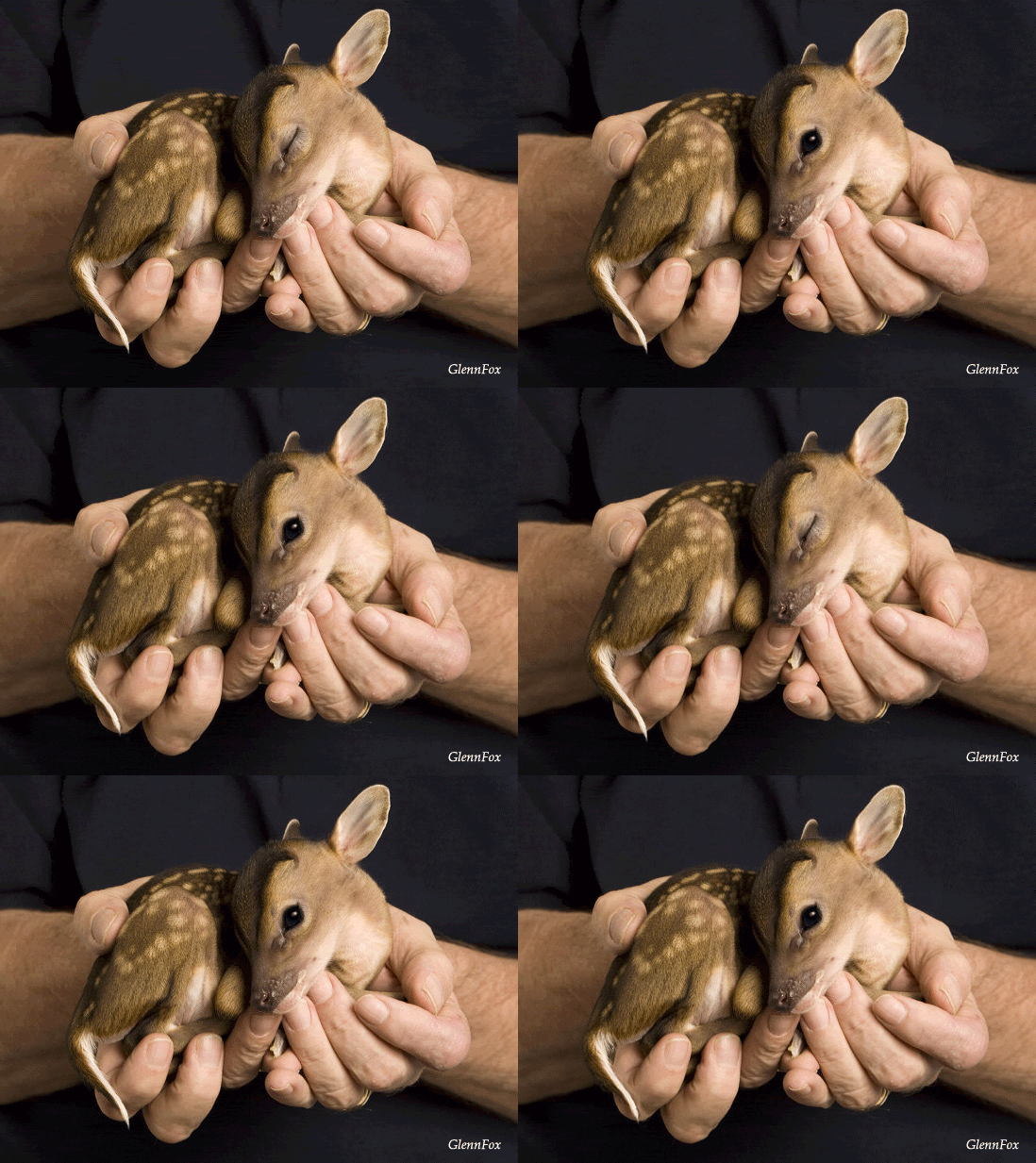
Fawn in hands

A new idea is fragile, fleeting

capture it as soon as you can.

Find the meaning

what it makes you think

how it makes you feel.

Nurture it

as you nurture the artist within you

so the idea and the artist will grow.

Play with the words

the images will come.

Play with the images

the words will come.

Trust your inner writer

to find a way

of conveying that idea, that image

so that others think and see

and feel.

There’s power in that fledgling thought

in every feeling connected to

 all that you hold dear.

More power in sharing it

than in holding it tight, unspoken.

Let it breathe

let it live.

It wants to.

It is precious.

Even

priceless.

Inspired by my writing workshop with teachers yesterday on “creating the magic”  – first as a writer, then for your writers.

slice-of-life_individualEarly Morning Slicer

A long time ago in a Galaxie far, far away

Galaxie

Truly wonderful the mind of a child is. – Yoda

A long time ago in a Galaxie far, far away . . .

A little girl clutches Mama Bear and Papa Bear. Baby Bear has accidentally been flushed down the toilet.  Clad in a mod red pantsuit instead of a long white dress, and with hair too short for cinnamon buns on the sides of her head, the little girl is nevertheless a princess of sorts, if not a rebel. Yet.

“Stand right there and smile,” says the little girl’s grandmother, who snaps a picture. The little girl really cannot not see the camera, as the sun is in her eyes. She smiles anyway.

Behind her stands the Galaxie  – a 1964 Ford Galaxie 500 that the little girl’s Granddaddy bought, used, for her Grandma. The exterior of the car is red. The interior is red, the fabric of the seats trimmed with silver cord.  The Galaxie doesn’t have power steering or air conditioning. In the summer its windows must stay rolled down if the people inside are to survive. Once it lost a hubcap and the girl’s Granddaddy had to run after it in the city streets.

Yet the Galaxie represents power, things far beyond the little girl. Ford Motor Company named it for the Space Race before the success of the United States over the Soviet Union, which came to pass in 1969, when Neil Armstrong and Buzz Aldrin walked on the moon. The little girl has no memory of this event but likes watching Star Trek with her dad: “Beam me up, Scotty.” She sings The Jetsons theme song:  “His boy, Elroy . . . .” She loves the Jetsons’ dog, Astro. Space gets up close and personal in March of 1970, around the time this picture is taken. A total eclipse occurs in the southeastern United States. The little girl’s family and all the neighbors run out of their apartments in an excited frenzy to watch it. A hush, a stillness, falls over them as the bright day goes as dark as night. The sun disappears,  becoming a mere halo around the huge, black moon. 

“Don’t stare at it,” says Grandma, drawing the little girl close. “It will hurt your eyes.”

The little girl stares anyway, because it is so strange to see the sun go dark.

The world was changing fast. So was my universe. In the year following the eclipse, my grandfather retired. He’d been a shipbuilder since World War II. “We turned out ships in three months in during the war,” I recall him saying, “when it used to take a year.” The war had been over for twenty-five years and it was time to go home; my grandparents packed everything, loaded the Galaxie, and returned to the remote outskirts of Aurora, North Carolina – a tiny town named after the Roman goddess of the dawn. I thought at first it was named for Sleeping Beauty.

My summer voyages began. There on the old dirt roads where my dad ran and played as a child, I learned how to drive with that Galaxie. It was, after all, more indestructible than the Death Star. It was still running after the birth of my first child. My grandparents finally gave it away to the man who hauled trash off for them.

It’s probably running still, somewhere.

Which is more than can be said of our spacecraft.

slice-of-life_individualEarly Morning Slicer


Six-word memoir

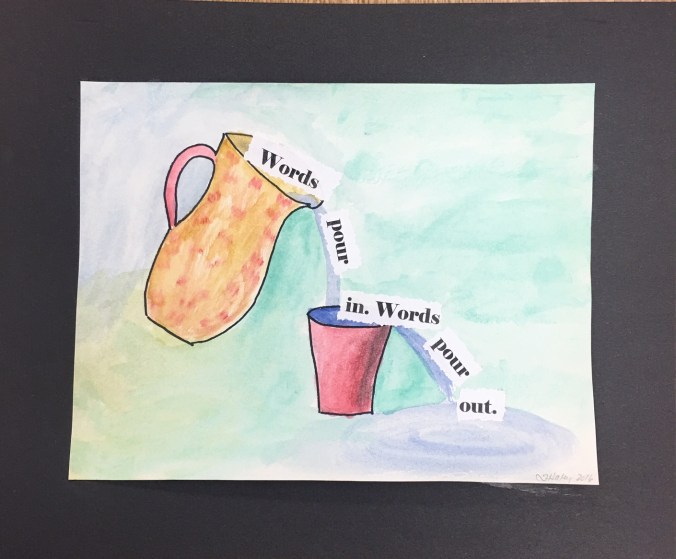
Words pour in

“What do you love best? How can you use the things you love to represent you, to describe who you are, in just six words?”

I pause to let the fifth graders think.

“One thing that I love,” I continue, “is the sound of cicadas. Have you heard that sound?”

Hands shoot up. I nod to a girl who replies: “Those bugs that buzz really loud.”

“Yes. Every spring I look forward to hearing the cicadas again – they will buzz all summer long. They remind me of summers spent with my grandparents. The sound was deafening in the thick woods around their home. Hearing cicadas now makes me feel happy and safe, no matter what else is going on. It’s one of the things I love best. So I might try to write my six-word memoir about the sound of cicadas.”

With pencil on paper, using the document camera, I write:

Nature sings to me. I listen.

I see heads nodding.

“I might keep working these six words to see if I can make them represent me better. I might decide to work on another idea. Today you will make a list of things that you love – maybe things you love to do, or favorite objects, or even dreams you have of things you want to do or be – and think about how each thing represents you. Then we will work on capturing and hammering out those descriptions in just six words.”

Off they go around the room, to brainstorm.

I brainstorm, too. What else can I write? What’s another example I can give them?

Well, as far back as I can remember, I loved reading and writing – it’s who I am. It’s what I do. It’s why I’m in this very room this very minute, teaching it.

I think about it all night, and am ready for the next lesson.

“So, ladies and gentlemen, yesterday we brainstormed ideas for writing our six-word memoirs. We thought of things we love and how they might represent us. I thought of something else to represent me. Let me ask you: What do you think represents me? Think about what I do and what you know about me.”

A boy waves his hand: “I know! Harry Potter!”

The class giggles and a few say, “Yessss!”

I laugh. “Excellent. But think bigger than Harry Potter, if possible! Think about who I am and what I do.”

A quiet girl’s hand sneaks up. “You teach reading and writing.”

“There you go. I’ve loved reading and writing all my life. I think this idea might be a great choice for a six-word memoir. It really describes who I am. I have to think now about how to capture this idea in six words.”

With pencil, paper, and the document camera, I write:

I read, I write, I am.

Heads nod – and an image materializes in my mind just then.

A pitcher, a glass, water pouring . . . .

“I just got an idea of how to make this better!”

I write:

Words pour in. Words pour out.

The children study these words.

“What do you think this means, ladies and gentlemen?”

A boy says, “First you wrote I read, I write, I am and you said you could make it better so I think you mean that if words pour in, you’re reading, and if words pour out, you’re writing.”

Across the room, faces light up.

I smile. “Well done. For a few minutes, share your ideas with your partner and talk about possible ways to begin writing your six-word memoir. Then we’ll all write.”

I listen as the ideas flow in and out, with a hum as vibrant as that of cicadas.

(If you’re interested in reading an earlier Slice on the sound of cicadas: Cicada rhythm)

slice-of-life_individualEarly Morning Slicer

But I’m not a teacher

Encourage

He’d saved his own money to buy me a Christmas present. He told his dad he wanted to go to the bookstore, so his dad took him.

He bought me a picture instead of a book and watched with great pride as the clerk wrapped it.

“I got it for my mom,” he told the clerk.

“Oh, she’ll love it!”

He clasped it to his heart all the way home.

He burst into the house, calling, “Mom! Mom! I got you a present!”

His dad said, “Son, just put it under the tree. It’s for Christmas.”

“I want to give it to her now!”

“All right,” I said,  sitting down on the couch. My little boy scrambled up beside me. “I’ll go ahead and open it, if that’s what you want.”

He watched my every move as I unwrapped the paper and pulled out the matted picture bearing the quote: A teacher in wisdom and kindness helps children learn to do exactly what they thought could not be done.

I didn’t know what to say for a moment.

“It’s beautiful, honey,” I said, hugging him. “Thank you so much.”

“Do you love it, Mom?”

“I do … but I’m not a teacher.”

My son surveyed me with huge dark eyes that seemed far older than his six years: “Oh yes you are, Mom.”

At the time, I wasn’t even a college graduate. Teaching wasn’t on my radar. Thirteen years, a degree, and another baby later, I actually became a teacher. In all of those education courses that required me to describe my educational philosophy, I wrote: A teacher is an encourager, recalling that solemn little face, those big eyes, the absolute conviction shining in them. Children, sometimes, are the greatest of sages, the most profound of prophets.

Three more years, and the boy graduated college himself with a degree in history. “What am I going to do for a job?” he asked one afternoon, a slight hint of anxiety in his voice.

“Teach,” I answered, smiling.

He didn’t smile back. “But I’m not a teacher.”

“Oh yes you are, Son.”

Before the summer ended, he had a job teaching social studies at his old high school. When he went to set up his classroom, he cleaned out the cabinets and found old tests – including his own.

He also became a soccer coach, taking his team to the championships and winning regional Coach of the Year this past season.

We didn’t seek teaching; it found us. We’ve done exactly what we thought could not be done – we do it every day, all over again.

And every day is new, if not easy; every day offers wisdom, beckons kindness, invites us to believe in others, in ourselves, every moment a chance to create, to reinvent, to overcome. It can be done.

Encourage one another.

slice-of-life_individualEarly Morning Slicer