Auspices

In Roman times, priests called augurs studied the activities of birds to divine the will of the gods. This practice of reading signs and omens was called taking auspices.

Likewise, many ancient legends depict the language of birds as perfect and divine; predating human speech, it was communicated by deities, understood by prophets and angels. Some say bird language was the original language n the Garden of Eden, spoken by Adam, Eve, and God.

I cannot speak to these mystical beliefs. But I agree there’s something of the sacred in birds.

I assumed I’d developed this affinity later in life. Birdwatching as an older person’s pastime. My mother-in-law loved birds. So did my grandmother. What is the correlation between aging and deriving such pleasure from birds? An acknowledgement that life in this world grows short, and the beautiful should be savored? Or something deeper? Once upon a time, when women were birds, there was the simple understanding that to sing at dawn and to sing at dusk was to heal the world through joy. The birds still remember what we have forgotten, that the world is meant to be celebrated, writes Terry Tempest Williams.

I’d forgotten that my love of birds began early in life. It all started with parakeets named Angel and Lucifer (how’s that for spiritual connections?). Angel was blue and white, sky-and-clouds. Lucifer was yellow and green. They were pets of my parents’ friends and after my first mesmerizing encounter, I begged for a parakeet. I got one for my sixth birthday. Solid yellow (although I’d wanted one like Angel). The pet shop folks boxed my bird in a carton decorated like a circus train, with little holes in the sides. Riding home in the car, I peered in to see a red-purple eye looking back at me…

Tweety lived until I was twelve.

I could never have a caged bird now.

They are meant to be free.

Living in a rural area offers daily doses of bird-awe, from the blue herons standing like statues in stillwater ponds to the snowy-winged hawks perched high on power lines…last week on my way to work, I felt lighter than I have in a while. It’s been an exceptionally trying year at school. It helps that there’s actually more daylight now that spring is on the way (I should have my vitamin D checked, perhaps). On this particular day last week, I sensed that good things are coming. I even said it to myself, so strong was the sense: Good things are coming. A little farther on, I happened to notice a large brown clump up in a bare tree by the road. A nest of leaves, maybe? Work of squirrels? But as I drew near, I saw a white head…a curved beak..

An eagle.

For the rest of that day I felt I had wings myself.

And then there is the return of the house finches, which, truth be told, never actually leave. One or two little birds have been sleeping in my door wreath this winter. They startled me a few times at night, flying out of the wreath when I went to the porch. I suspect finches although I couldn’t get a good look in the dark. If you’ve read my blog a while, you know the finches build nests in my door wreath each spring. In fact, I left the old grapevine wreath out for this very purpose.

A couple of weeks ago, I heard the telltale chatter on the porch. Finches discussing the wreath. Probably planning the nest. It was a loud, spirited conversation, hard to tell if the pair was in agreement or not…

I kept checking the wreath, but all I saw was the indented place where a bird or two had been sleeping.

No nest. It was still February, after all.

This past Saturday, the finches were the loudest yet, out there on the porch. My son and granddaughter, age sixteen months, were visiting.

“Is that your finches, Mom?” he asked.

“Yes. They’re talking about making a nest,” I explained.

We listened for a while to the happy trills.

The next morning I went out to check… surely a nest was started, with all that cheerful bird language?

I saw nothing.

Until…I don’t know what made me get the stool and check the far side of the wreath…

This is what the finches were up to:
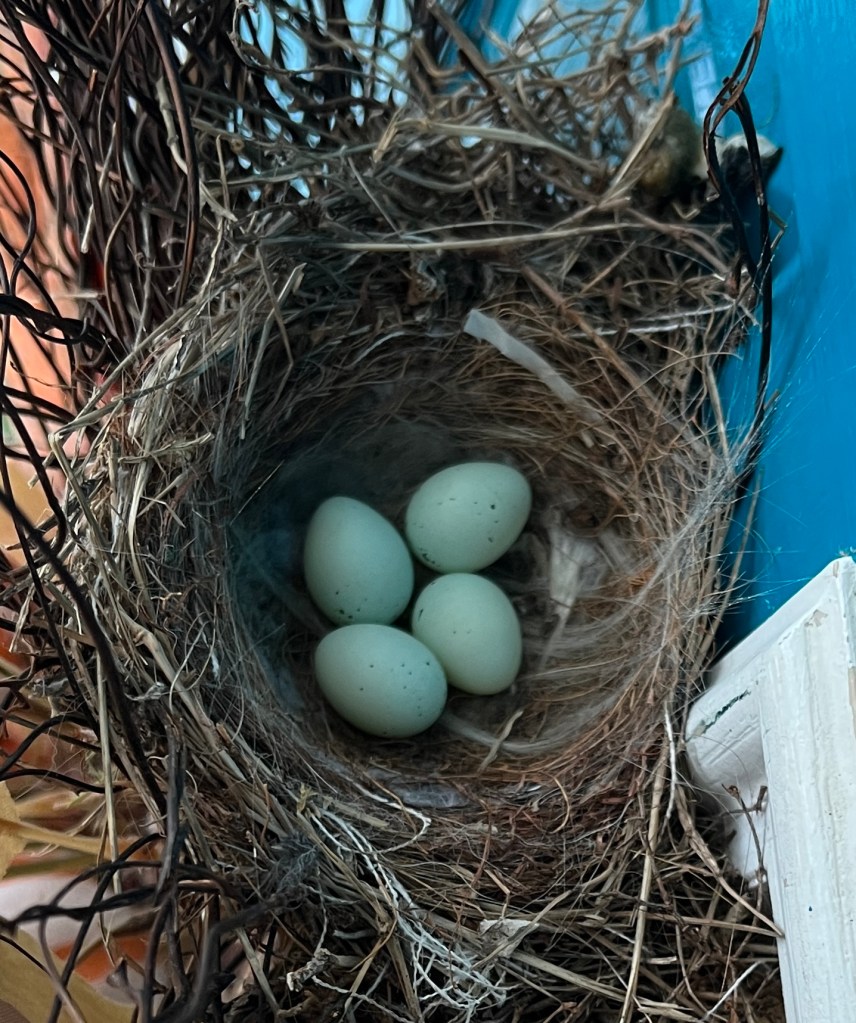
A perfect nest, so perfectly disguised that even I, who was watching for it, didn’t find it until four eggs had already been laid.

I know this happens every spring across the Earth, but to me, it is a miracle. The eggs, incubating life, laid on a bed so carefully and lovingly lined with soft hair…it is soul-piercingly precious.

As is the father finch’s glorious, glorious song from the rooftop, morning and evening, his voice rolling down and echoing across the countryside. His is the predominant voice of all the birds around, and there are many…I will write of them later.

For the father finch’s song of deep joy is my own right now…celebrating family, life, light.

Good things are here.

******

with thanks to Two Writing Teachers for the Slice of Life Story Challenge every day in the month of March.

I suspect there will be lots of birds in my posts… spirit-lifters that they are.
A president, a poem

Today on Ethical ELA’s Open Write, Stacey Joy invites participants to lift a line of poetry and use it in creating a Golden Shovel poem.

I was thinking about it being President’s Day, so I went in search of poems written by our presidents. This led me to Jimmy Carter, the first U.S. President to publish a book of poetry in his lifetime. He is our longest-living president; at age 98, he has just entered hospice care. I have lifted a line from his verse.

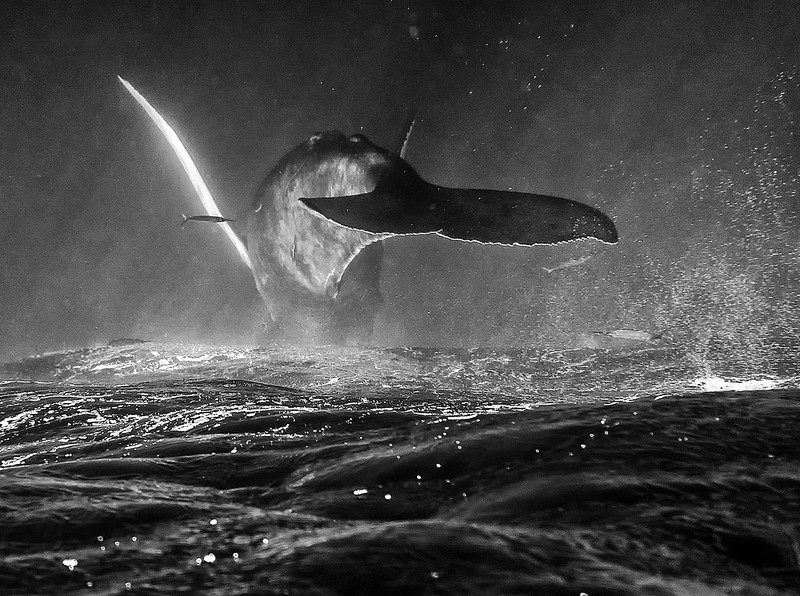
“To hear the same whale’s song” – Jimmy Carter, “Life on a Killer Submarine,” Always a Reckoning and Other Poems

Homeward Hymn

when my life draws to
its close I imagine the last thing I hear
will be cicadas rattling high in the
green oaks as I pass, fervently calling, calling the way, same
lost and found returning sound of whale’s 
pulsating destination song

If Whales Could Fly. Christopher.MichelCC BY 2.0.

I can’t be the only one poem

Today on Ethical ELA’s Open Write, Britt Decker shares a beloved C.S. Lewis quote: “Friendship is born at that moment when one person says to another, ‘What! You too? I thought I was the only one.’” She invites participants to share “quirky, unusual, uncommon things you do, believe, or say and turn the list into a poemstarting with the line ‘I can’t be the only one who’…”

To begin with: I have loved Lewis since I was ten years old and first landed in Narnia. I have a shelf of his books. When I read Britt’s words about Lewis, I echoed his own: “What! You, too?”

And so I keep that as my title…

What! You, Too?

I can’t be the only one who

would rather write than speak

drinks more black coffee than water

puts pepper on popcorn

is enchanted by abandoned houses
in various stages of falling down

left my Christmas tree up
until February this year
simply because it was beautiful
and looking at it
made me happy

barely dips in social media anymore

follows murder cases daily
for the latest developments

loves my Grandma name (Franna)
better than my actual given name

looks for hawks and herons
on my drive to work

grieves over the blue heron
not having been at a certain pond
in weeks
(please be all right)

savors the harsh rattling
of cicadas in summer
(heartsong
in the background orchestration
of my life)

senses the presence of my father
in the fragrance
of fresh-mown grass

thinks best and sees solutions
in the dark morning hours
before I’m fully awake

journals my dreams, to be awed
by the constant presence of birds
and the recurrence of
vivid green

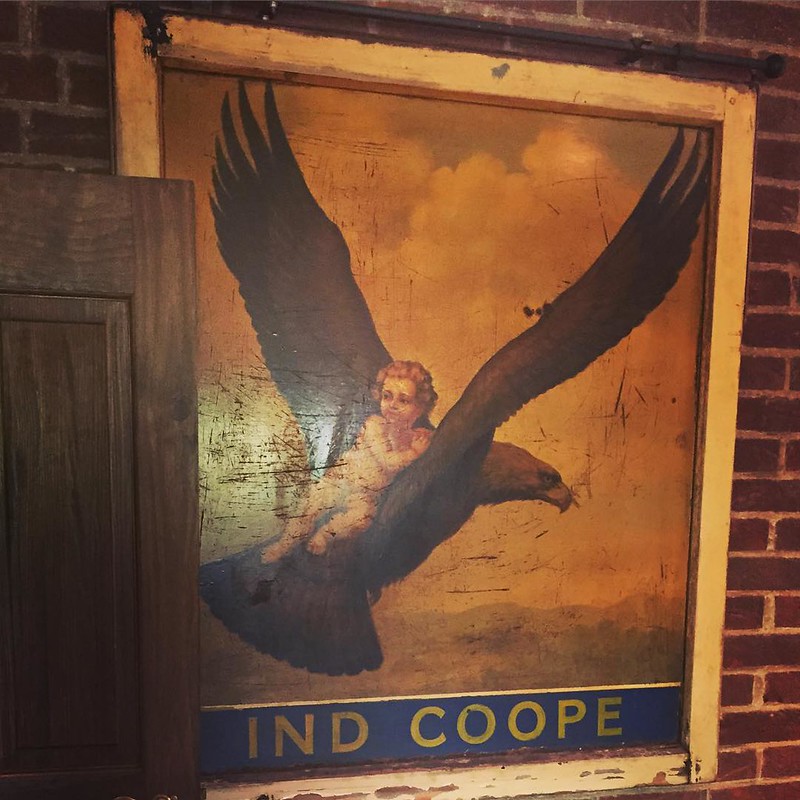
The original sign from The Eagle and Child (at CS Lewis’ home, The Kilns). #TXinUK. david_normanCC BY-NC-SA 2.0.

Tale-based poem: The Legend of Water Rabbit

Today on the Ethical ELA Open Write, poet Stacey Joy invited participants to read a few short folktales, fables, fairytales, myths, or legends to inspire a poem: “Your poem might be a response to, a retelling of, or a new version of the original piece.”

I wanted to work with a fable but the children’s tale that came to mind first was… well, maybe you will recognize itmy poem is meant to be something of a mythological sequeltribute.

The Legend of Water Rabbit

In the forest deep
upon a cushion of emerald moss
Water Rabbit sleeps

and dreams

of the Child.

In his dream
he cannot tell the Child
how much
he loves him

for to the Child,
the Rabbit isn’t real

and there is no language
for conjuring a bridge
across the chasm
of unbelief.

Water Rabbit twitches,
remembering

the nursery
the toys
the Wise Horse
who spoke of love

and longsuffering.

It was Fate that placed
the Rabbit in the arms
of the Child that night
when a favorite toy
was lost.

It was only for a season
that the Child embraced him
and carried stuffed Rabbit
everywhere he went…

Water Rabbit’s whiskers tremble
with dream-reliving.

He sighs.

Other rabbits nearby
cock their heads
and perk their long ears

for in a moment,
Water Rabbit begins
to whimper
and weep
and wail
in his sleep

—the dream
is all too real:
the Child’s fever,
the separation,
the command that
Rabbit and all the other toys
be burned.

It isn’t fire or fears
that brings Rabbit’s tears

but the thought
of never being
with the Child again.

Wake up! Wake up!
The colony surrounds
Water Rabbit,
dozens of their small front feet
against his shimmery fur,
shaking, shaking him

into reality.

Water Rabbit gazes at them
through his tears
from his emerald-moss bed

and asks…Is it time?
 
The colony nods in unison.

Water Rabbit rises
wiping tear tracks
from his velvety face.

The colony parts
Water Rabbit
makes his way through…

he hops and hops with 
boundless energy until
he reaches the clearing 

where the Child
bigger now
(for he’s bigger every Spring)

sits on the blanket
spread over the grass
with a picnic feast 
made ready.

Into the Child’s arms
leaps the Rabbit. 

There are no words
for there is no language
that can capture
love so great
and eternal
and real

as real as the solitary tear
of a toy Rabbit
about to be burned
for the sake of the Child.

For it was that teardrop
the inevitable price
of love
and sacrifice
that brought life,
transformation,
salvation.

That is how
Water Rabbit
came to be.

*******
-with thanks and apologies to Margery Williams and The Velveteen Rabbit.

2023 is the Chinese Year of the Rabbit.

More specifically, the Year of the Water Rabbit.

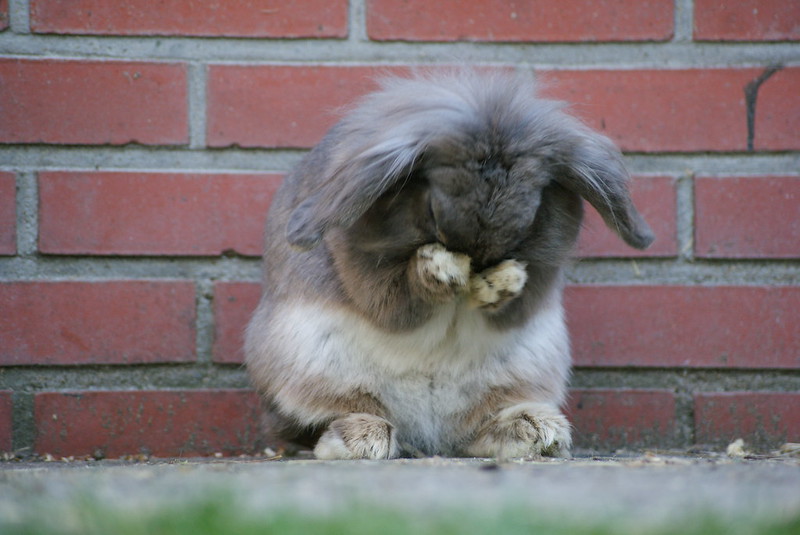
You make vita cry!jpockele. CC BY 2.0.

Heartdance


a celebration of love
in the unchoreographed dance
of life

two triolets

I.

On this Friday night
he prepares for the dance
much to his girl’s delight.
On this Friday night
her smile is country-morning bright
taking pictures out by the manse.
On this Friday night
he prepares for the dance.

II.

It was meant to be, you and me.
Let us dance
our own jubilee.
It was meant to be, you and me,
these moments, in our finery,
taking pictures out by the manse.
It was meant to be, you and me.
Let us dance.

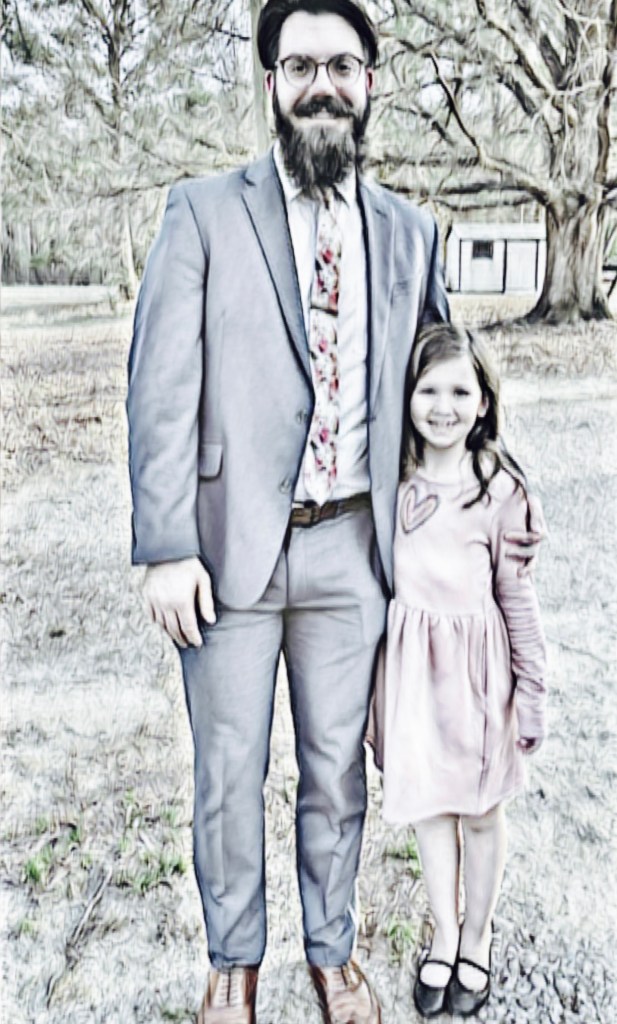
My preacher-son and his girl, going to the Father-Daughter dance.

*******

with thanks to the Two Writing Teachers community for providing a place to share our unfolding stories,
even when they are poems.

A word on writing

I love writing, teaching writing, and helping others love writing.

There was a time in my career when I designed and co-created workshops for teachers as writers so that they could channel their own positive experiences into the classroom with students, to model for them how an embryo of an idea comes to life, how it grows bones and flesh and begins breathing and crying and rejoicing and blazing trails right there on the page (or screen). I led professional development. I went into classrooms. I worked alongside teachers and kids. I witnessed powerful things…I can still see the tears, the glowing faces, the pride and awe in the eyes of kids (and their teachers) over something they’d created, that came from within.

They wanted more.

That was before changes in my district, moving away from the writing workshop model and Lucy Calkins in general. Now writing is embedded in the Language Arts curriculum, largely in response to reading. The goals are lofty and writing assignments follow a highly prescribed pattern. Neatly formulaic. Uniform.

That is not to say there’s never any creativity… for example, in a nine-week unit series of extensive reading and writing about frogs, the students get to compose poems and write pourquoi tales about frogs. The pacing and process are pretty intensive… which is why a teacher came to me: “Could you meet with some of my students to help them with the pourquoi tales? So many are struggling. Meeting with each one is taking so long.”

It was like old times, almost, these writing conferences…except with the unique challenges of writing a myth about how some true facet of frogdom came to be while describing the setting and the frogs, giving them character traits, having them talk, and ending up with a lesson learned, i.e., moral to the story. —Did I say, by the way, these kids are around eight years old?

And did I say that there’s no way to teach writing without conferring with the writers? This is, in fact, THE teaching…teachers learning about the learners and figuring out what to do for them.

For there is an English learner who understands so much more than he’s able to convey; his struggle is with grammar, as word order is different in his language. His ideas, however, are original; he incorporates what he knows about his own father’s work. There is a child who missed some critical days in the unit and didn’t understand what to write about, and therefore wrote a completely off-topic but interesting narrative. Once he understood, he went on to compose an engaging narrative with a brilliant, metaphorical moral.

One by one, the kids came, and we talked about what they were trying to accomplish with this pourquoi, and then we figured out the big “hows” and “whys” in the tale… usually by my asking “what if…” and the lights in their eyes would come on. The sparkly pink and rainbow-dotted and brown-and-blue striped frogs came to life. They had conversations. They made bad choices like cheating; they made good choices by helping each other anyway. The tales explained why frogs jump so high, why their tongues are so long, why some are so colorful, why some are poisonous. They learned a lot of lessons about being better frogs.

One resistant boy didn’t want to stop working on his draft revisions to go to specials: “This is fun!” he said.

Oh, child. Somewhere the King of Frogs nods his head in understanding. I can almost see his tiny golden crown cocked to the side of his head, by his ancient and all-knowing eye:

Ribbit.

Only I hear it as Pourquoi…

Why.

frog

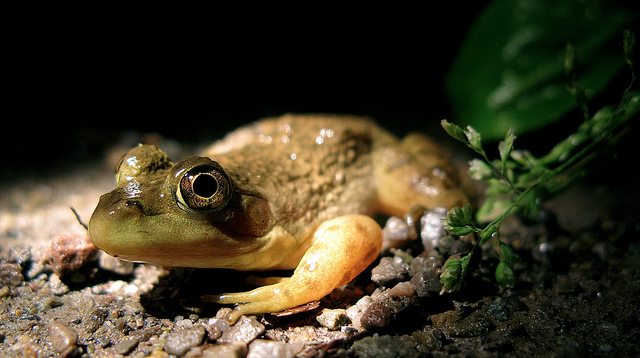
Frog. Dave Huth. CC BY

with special thanks to Two Writing Teachers for all you do on behalf of student writers and their teachers…our stories matter.

Colors of my life: Spiritual Journey

As host of my fellow Spiritual Journey writers on the first Thursday of this new month, Bob Arjeha asks: What colors make up your life? Do you shine bold…? Are you a more quiet light…? Are you a combination of both? What colors do you shine so that others may follow?

How creative, Bob. Thank you for providing such a compelling lens…

*******

It’s not a color I’d automatically choose to represent myself.

But then again, I have a hard time saying what my favorite color is. I love red for its bright power and cheer (think cardinals there by the roadside, bits of brilliant crimson against the drab gray-brown backdrop of winter, without snow). I love shades of coral for its vitality and unexpected freshness. I am drawn to neutral tones, grays, browns, taupes, creams, black and white, as far as a wardrobe goes, for they can be endlessly mixed and matched with every other color. I took a color personality test once and was told I am gold, which is quite gratifying on a number of levels, considering its value and connotations of endurance, faithfulness, and love.

I come at last to green.

It does not come readily to mind as one of my life’s colors.

For most of my life, in fact, I didn’t even appreciate that my birthstone is green. Why couldn’t it have been the lovely pale-purple alexandrite of June? The costly, iridescent-sparkling diamond of April? The fiery opal of October? I absolutely love opals…but no, my birthstone is an emerald. As a child I took a little consolation from Emerald City in The Wizard of Oz, but still… I didn’t love the color. Aside: children today do not know what their birthstone is. I remember poring over catalogs as a child, studying birthstones. Women proudly wore mothers’ and grandmothers’ rings bearing stones for every child and grandchild. I memorized the birthstone, modern and traditional, for every month.

I was given a little emerald necklace as a child (by Grandma, I think), and my Grannie bought me a simulated emerald-and-diamond ring for my tenth or eleventh birthday. Both pieces of jewelry have been lost over the years. I liked having them, but…green wasn’t really “my color”.

As a child of the 70’s, avocado green was a staple of home decor. Our telephone (with a wildly long cord that I stretched infinitely longer as a teenager) was this color. The panels on the front of my childhood house were this color. For years my dad owned only two suits, one polyester and one brushed suede, and they were both green. I didn’t like either one of them. My childhood bedroom had dark green carpet (and blue walls); my cat had kittens under my bed and Daddy had to cut away a good bit of that rug. My first car, a hand-me-down, was army green (an LTD Ford the size of an army tank; in those days, five bucks of gas would get you through the week). My high school colors were green and gold; most kids chose an emerald-green stone for their class rings. I chose pearl.

Why, then, does the color come tapping on the backdoor of my mind now, calling, Hello, it’s me, Green; I am important in your life. Let me in-?

How do I know Green is up to this, you ask?

Because of my dreams.

As a writer, I’ve learned to capture intriguing images for use later. My dreams are typically vivid. I know there’s much fascinating symbolism to them that I’m not able (and probably really don’t want) to analyze. I think of Jung. I recall the mighty gift of dream interpretation in the Bible. I decided to record my more compelling dreams in a journal. I’ve been astonished by several recurring patterns and images…including the number of times green has appeared in my dreams.

For the record, green isn’t always positive; we know it can represent illness, poison, envy, and even evil. Let’s go ahead and get that acknowledgement out of the way.

The rich, deep green in my dreams doesn’t manifest itself in any of these ways. At all.

Consider…

a friendly crow coming to see me and dropping a mysterious green ball (—stone?—fruit?) into my hand

vivid green grass growing on patches of barren ground

vast vivid green fields, going on and on

rich green leaves of trees at night, where owls are perched and calling

more than one dream of cicadas (which I love) with shiny emerald-green shells; in one dream, the yard was full of them, and they seemed to be burrowing in the ground. I so wanted to linger and watch…

There is more, but a couple of things are obvious: the green in these dreams is that of living things. It is the color of life, of nature, of growth. The cicada connection is one of my favorites; these green creatures represent fidelity and resurrection. There are clear overtones of wisdom beckoning in these dreams. Of being given some kind of gift. Of restfulness and rejuvenation: He maketh me to lie down in green pastures… of cycles and endurance and sustainability. Of being sustained. Green is the color of abundance and well-being and comfort. It makes me think about how we really don’t live as close to nature as we should, and what a terrible price we pay for that. I really didn’t recognize this great pull of nature at the core of my existence until I started writing consistently several years ago, and that’s when nature began revealing inextricable interconnectedness to human life on a spiritual level…just now I think of evergreen trees, enduring winter.

It is the color most often present in my dreams, by far. I may not have chosen it but it has chosen me, and I have come to treasure its significance in my spiritual life. I believe it is connected to my writing as well…for wring is a deeply spiritual activity. Green is, after all, a combination of blue, the color of sky and sea, and yellow, like the sun…life and eternity. Come what may, I shall go on. I know in Whom I trust. While I live, let me use the gifts given to me wisely and well.

Speaking of which: At Christmas my husband gave me a beautiful emerald necklace. He’d forgotten it was my birthstone; he chose it as a symbol of our Irish roots. I was wearing it when his sister came to exchange gifts… without any clue that her brother had given me the necklace, she gave me emerald earrings in the exact same shade, plus a jacket to match.

As it has chosen to wrap itself around me so…. let me be an open door, a window, to a world rippling infinitely rich and green with possibility.

A bit of light

Today on Ethical ELA I encountered a poetic form new to me: the lantern. My understanding is that it is a five-line Japanese shape poem beginning with a one-syllable noun followed by successive lines of nouns containing two, three, and four syllables, ending with another one-syllable noun, all connected to and building on the first word.

I was immediately captivated and had to give it a try.

It is challenging.

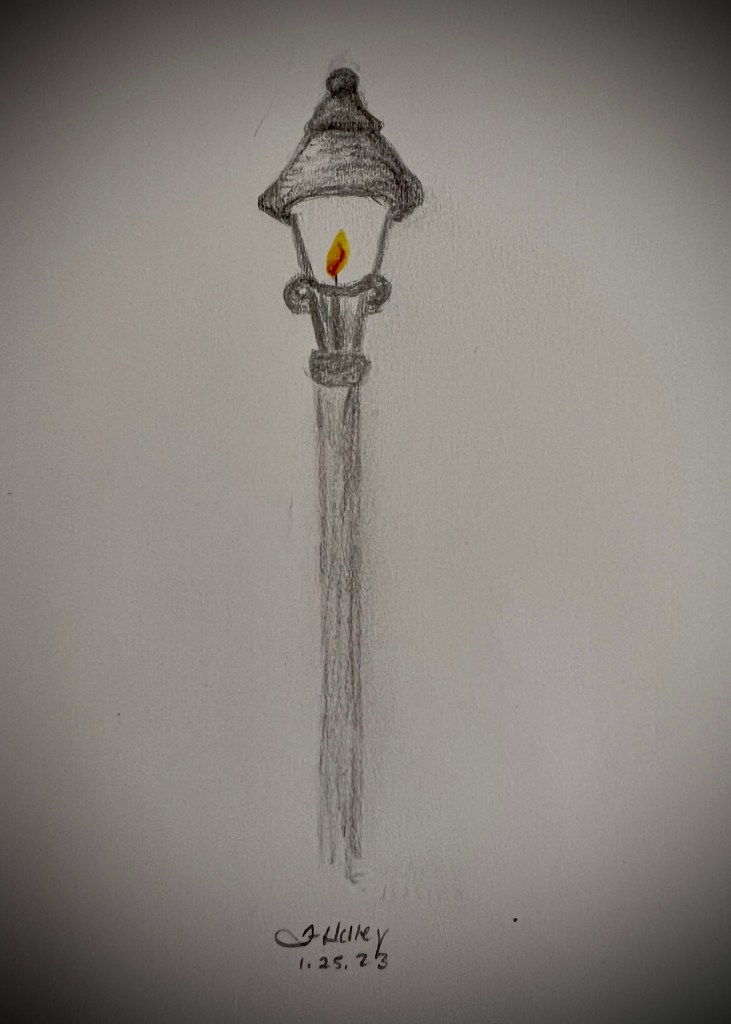
In my mind the lantern image morphed into a lamppost, a symbol with much personal meaning. Like the indelible image in Narnia, a lamppost marks the way home for me: one stood in front of the house where I grew up. Whenever I was out at night and turned the last corner, I’d see the light of that lamppost.

I went with the image. I kept the syllable count but gave up on sticking with just nouns. I could write a lengthy essay about all the other meanings the lamppost holds for me, but this is poetry; interpretation belongs to the reader. 

It is dark and dreary in my neck of the woods today, pouring rain… perhaps that’s another reason the lamppost remained.

I needed a bit of light.

To the Lamppost

Your
good light
still guides me
home through darkest
night

Intimate conversation poem

with thanks to Barb Edler for the Open Write inspiration on Ethical ELA. Barb invited poets to speak directly to a subject, perhaps a person from the past or present, a beloved or loathed object, or even a dream, frustration, or desire.

Refuge

In the dead of winter
in the dark of night
in the starlit silence
you come

to sleep
in the old
twig-vine wreath
on the front door

tiny warm presence
of which I’d be unaware
if not for the pull
of the stars

the frigid bite
of the night
is worth the sight
if only for a moment

so I open
the door

soft sudden flutter
wings taking flight
in the cold cold night

oh little bird
that I cannot see
you cannot know
how your presence
comforts me

that in this barren season
before the time
of nesting
you find your place
of resting

upon my door

little winged creature
of first blessing

*******

Note: Sea creatures and birds were the first living things blessed by God, Genesis 1:22.

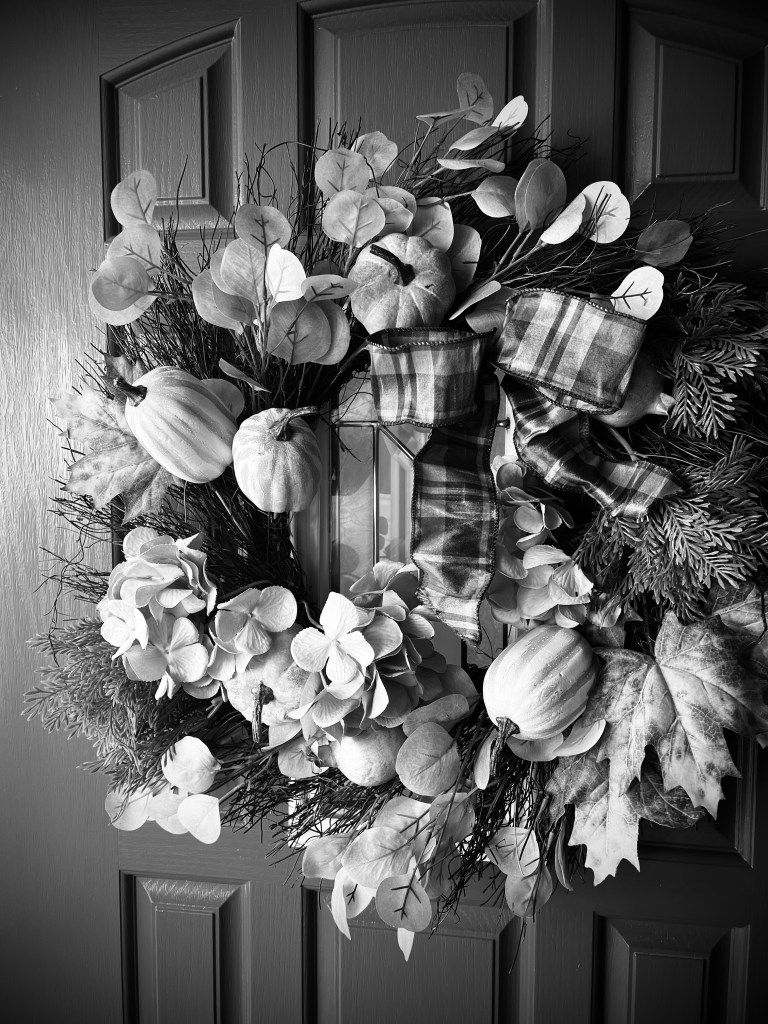
Said wreath. When I woke before dawn, remembering there’s a comet to be observed, I bundled up to try for a view from the front porch. The little unseen bird flew out of the wreath as I opened the door. There is no nest; I am not sure where the bird tucks in but the idea of it sleeping against the safety of my door in winter makes a metaphor of immense comfort to me. I can’t determine if it’s a house finch (they build nests in my wreaths each spring) or a Carolina wren, tiny bird with a big, gorgeous song. In the darkness I can only hear small wings beating for a split second as it takes flight. Whatever it is… it is welcome.

Skitterings

Winter morning, below freezing, ground covered with thick layer of frost like unto snow. Oyster-gray sky streaked with clouds aflame with sunrise. Breathtaking colors. I drive to work, looking for magisterial hawks perched on power lines. None to be seen. At the corner where the patch of woods has been cleared, old tobacco barns are melting into the stubble, overlaid with a thin veneer of crystal. So beautiful, I say aloud. Something pure remains in the devastation. I cannot think of what. I drive on, pondering destruction and human hunger for it.

In the new rose-light little birds skitter up from the wood-edged fields. What type of birds they are, I cannot determine, just upward movement and wings. A strange line plays in my head: This day your life will be required of you. I suppose it’s born of constant murder in the news and too much reading, this very morning the strange coincidence of Diana, Princess of Wales, attending the funeral of Princess Grace of Monaco, who died from injuries sustained in a car crash. Did the struggling Diana sense any foreshadowing?

Why am I even thinking of these things during such a glorious dawn?

A shape swoops from the right, directly in the path of my car…surely a bird. I hear no thunk. I see no skittering escape in my rearview mirror.

The bird—if in fact it was—must be caught in the grille of my car. This happened once, long ago, when I was driving a different vehicle: I discovered a dead cardinal hanging partway under the car. Why, why do they fly so low?

I will have to stop and check. There’s nowhere to pull over on these winding backroads frequented by too-fast drivers and farm equipment.

There’s a tiny church tucked in the woods up ahead, past the intersection. Steep driveway, deserted area, but I have to get out and look.

Nothing ensnared on the wide chrome grille of my old car. Beneath the grille, however, are unscreened compartments and there, on the dark, recessed shelf, is a bird.

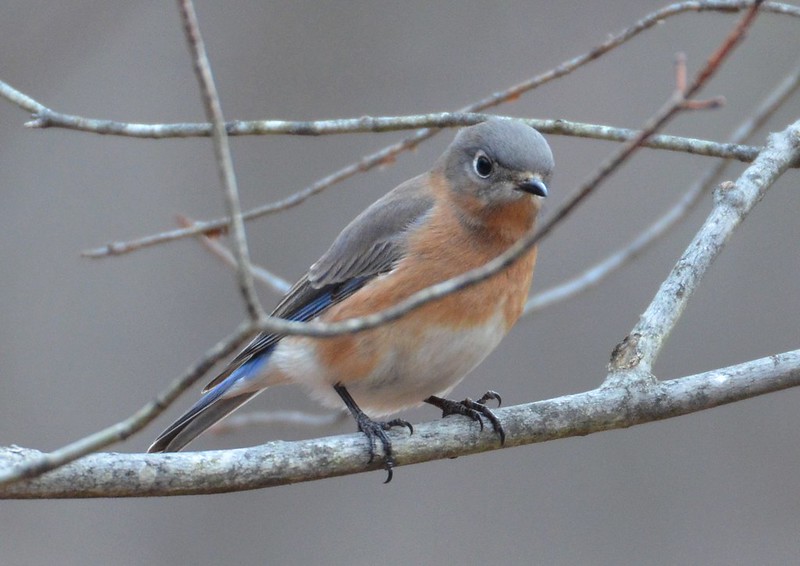
Alive and moving around. Gray, orange, and cloud-white, like the morning.

Oh, bird.

I take off my heavy black cardigan, wrap it around my hands, and reach in.

Gently, gently… then a soft, warm weight is in my sweatered hands. I make sure to cover its wings to avoid panicked and possibly injurious flapping. Its head is gray. Small gray beak opens and closes without a sound. Its eye, turned toward me, has a faint purplish hue, slightly reminiscent of my pet parakeet when I was six. The gray back and pale-orange coloring on the breast had me thinking robin, but now I can see it’s not. I don’t know what kind of bird this is.

Oh, little bird. I am sorry. As if my speaking will help, somehow.

I cannot stand here gawking at it. The creature has survived the trauma of my car; I don’t want it to die from terror of me.

I think of being in the hands of God.

Please don’t let it die, I pray. Is this a selfish prayer? I don’t know how badly the bird is damaged.

And what am I going to do with it now.

The woods…I skim for a sheltered spot. I step in the leaves and a sudden sound startles me: a rabbit goes skittering away, its big white cottontail bobbing against the sepia scenery. I had no idea it was there. What else is here that I cannot see—? I am shivering. I find a small ridge of leaves and pine straw by a bit of barren brush and there I lay the bird.

The bird turns itself from side to breast, facedown. There’s a bit of white edging on its tail feathers. I wish for to something cover it. The morning is so cold. My sweater might entangle its legs; scraping pine straw over it might alarm it.

I will go. I will not stay to see the outcome. It will recover, or it won’t. I recall the woodpecker that flew smack into the glass wall of the school where I work; it landed on its back in the flowerbed mulch and lay so still I was sure its neck was broken. Within a moment, it managed to flip itself right side up, ruffled its feathers, and flew off—zip!—as if nothing had happened. The robin I extricated from the grille of my sister-in-law’s car, having traveled miles down the interstate at 70+ mph, hopped around my backyard for a day before it flew away. Birds are hardier than they look…at least robins and woodpeckers are.

Still.

Should this pretty little bird die or recoup…it will be in its own natural setting.

In the hands of God. Not a sparrow will fall to the ground apart from the Father...

It is hard, yes, to leave it there and walk away. But I have done so before. With people whom I loved very much.

It is Yours.

Back in the car, I circle the tiny church named for St. John, heading on toward crystal-coated fields and misty-mirror ponds and the work that lies ahead. The little bird will never know that I will remember it, that it’s now part of me, stuck to my soul as long as I live. I know it and that is enough on this cold, fiery-sky morning, orange and gray, breathtaking glory tinged with, but not diminished by, loss.

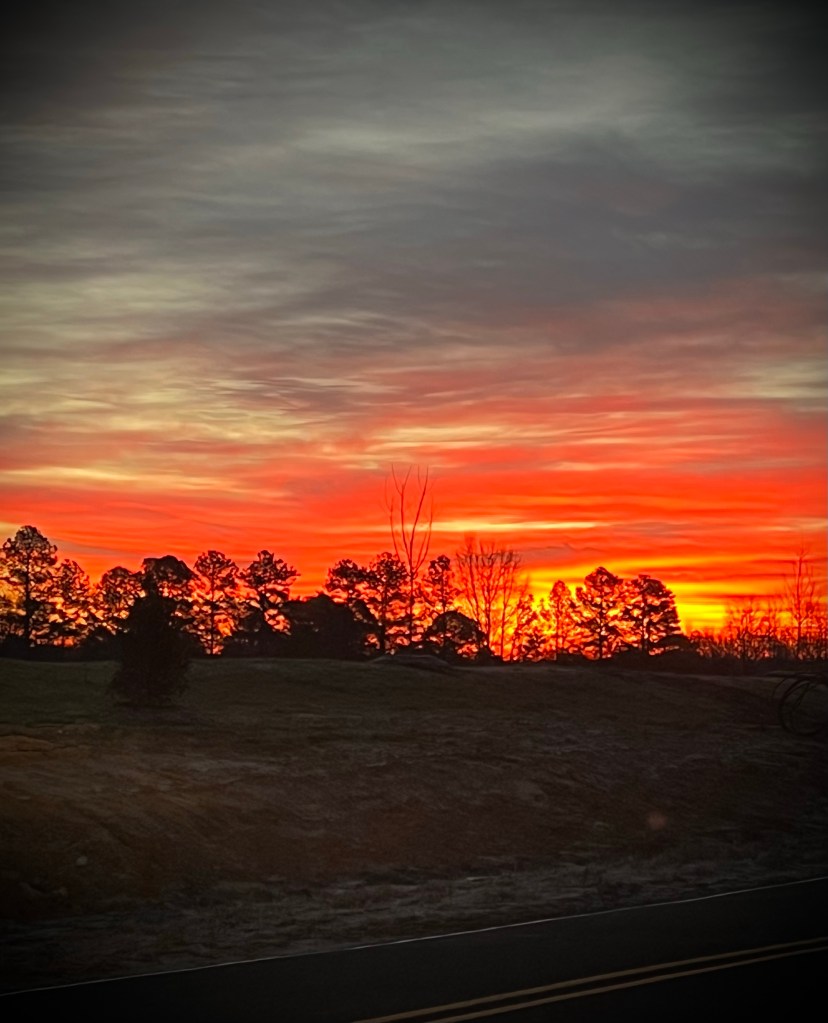
“If I take the wings of the morning and dwell in the uttermost part of the sea, even there your hand shall lead me, and your right hand shall hold me.”Psalm 139:9-10 (my favorite of the Psalms). This is the view leaving my neighborhood.

As best I can determine: My unexpected passenger was a female eastern bluebird.

DSC_3019e eastern bluebird–female. jjjj56cpCC BY-NC-SA 2.0.

*UPDATE, May 2023:

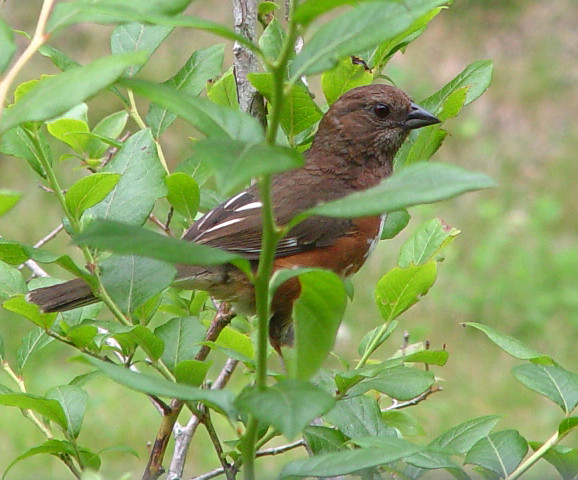
I’ve used the Picture Bird ID app to identify my mystery bird as a female Eastern Towhee.

Eastern Towhee.