Mix-up

On the way to a required professional development session, my colleague and I stopped for coffee (me) and Diet Coke (her).

“Gotta have something to keep us awake,” we told each other.

Upon arriving at our destination and settling in, I began looking over the materials, took a sip of my coffee, and—

“Good HEAVENS, that’s sweet!” I spluttered. I haven’t had sugar in my coffee in years, just two creams. Perhaps that’s why the taste was so intense?

And then I saw the tag on the cup.

Friends, and we wonder what is wrong with our country.

Equinox

Today’s post serves a dual purpose: My daily Slice of Life Story Challenge and Spiritual Journey Thursday, organized by my friend Margaret Simon on the first Thursday of the month. Thank you, Margaret, for the invitation to host.

I chose to write around the theme of “balance.”

Not necessarily what you may think…

*******

It’s almost here.

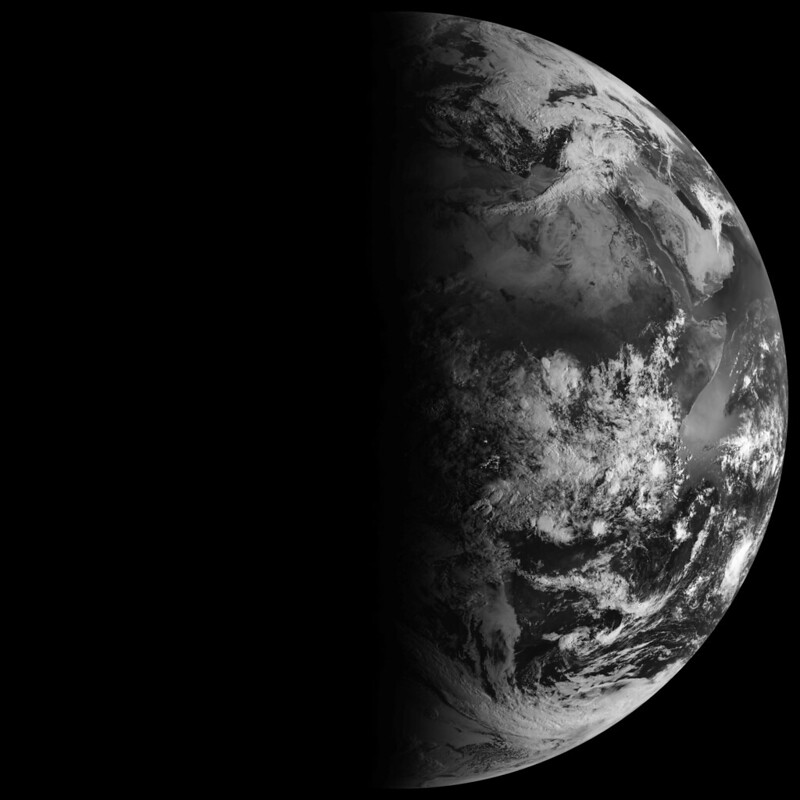
Spring. The equinox.

A balance of light and dark in the world, or “equal night.”

My thinking radiates in a number of metaphorical directions here but I’ll begin with the moment I was at school grappling with a new data reporting system that I have to teach to colleagues. I logged in and discovered this message: Alternate Data Entry for Dark Period.

Dark Period?

It has the sound of a span in history, like it belongs in the Holocene Epoch of the Quaternary Period, the current one in which we live, geologically speaking (“current” meaning over 11, 000 years old, for the record). As if it can be marked in time like the Ice Age or at least the Dark Ages.

Dark Period.

All it means, apparently, is the time when the data reporting system is shut down to be updated. It’s tech housecleaning. During the Dark Period, no additional data entry can occur, until everything is verified and balanced.

The words stuck with me, though.

Many would say we are living in a Dark Period now. It’s an era of strife, vitriol, backlash. An age of ever-increasing concerns over mental health. Over health in general—the coronavirus.

And at the heart of the darkness is fear.

A. Roger Ekirch writes in At Day’s Close: Night in Times Past: “Night was man’s first necessary evil, our oldest and most haunting terror. Amid the gathering darkness and cold, our prehistoric forebears must have felt profound fear … that one morning the sun might fail to return.” He goes on to say that many psychologists believe that our early ancestors feared not the dark itself but harm befalling them in the dark (for it was an unlit world at night) and over time night became synonymous with danger.

Fear leads to anger and anxiety. In the dark, things don’t look as they should; they’re distorted.

What’s the balance?

Now we’re back to the equinox, metaphorically.

Light. Day. The assurance that there’s still good working in the world, undoing harm. Think of the destruction of Australia and the human involvement in deliberately setting bushfires. Then think of soldiers in the Australian army, lined up in rows, cuddling and nursing koalas when off duty. Then apply it to people suffering around our globe …

We are our own greatest enemy and helpmeet. We all hang in the balance of these: despair and hope, destruction and edification, hurt and healing.

In The Forgotten Beasts of Eld, Patricia A. McKillip describes a monstrous creature like “a dark mist” who embodies “the fear men die of.” The novel is about learning how to live and love in a different world.

That would mean overcoming the dark, the fear.

Incidentally, in a strange balance, the current virus causing so much alarm shares its name with the crown of the sun.

And, speaking of the sun, here’s the secret of the equinox, why it’s not really equal: There’s actually more day than night.

More light. Literally.

And figuratively, it has nothing to do with moving around the sun and everything to do with moving the human heart.

Photo: NASA Goddard Space Flight Center. CC BY

*******

Dear fellow Spiritual Journey Thursday sojourners: Please click the link to add your post to the “party”:

https://fresh.inlinkz.com/party/f941589ea3ed4e83be8dd519044d3bfd

Spittin’ image

Memoir is probably my favorite kind of writing.

It’s like small moments on steroids. When I write myself back into childhood, scenes, conversations, little forgotten details are pumped full of meaning, for I have the advantage of understanding so much more than I did then . . .

This event occurred when I was seven or eight. As I write, I think of how we don’t know all that children are experiencing or how they’re trying to navigate life. Families don’t make perfect portraits. There are so many reasons why.

We are our stories.

With that in mind I’ve opted to change family names here. It gives me the final shot of courage needed to share “Spittin’ Image.”

*******

We are going to visit my grandfather.

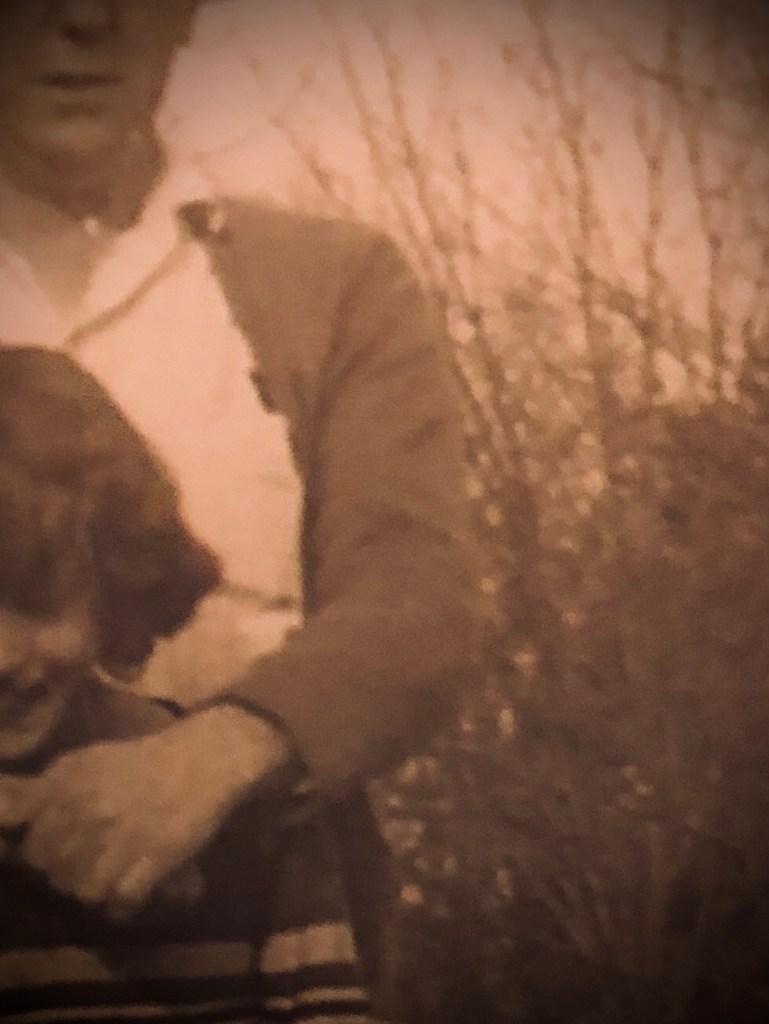
Not my Daddy’s daddy, my Sunday-afternoons-in-the park Granddaddy who bought me red rubber boots when I started school because all my kindergarten friends had them and I wanted them, too.  We are going to see my Mama’s daddy.  I don’t know him very well. He came to visit us once, sat in our living room chair with his hand stuck out so that when I ran by, not paying attention, not being careful, his cigarette burned me.

Mama says he lives in a hospital.

I don’t know why anyone would live in a hospital. I don’t want to go see him, don’t know why we have to go.

My mother gets snappy: “He’s your granddaddy—you’re going!”

My aunts are taking us because Mama doesn’t drive. She doesn’t know how.

“Last time I seen Daddy, he was looking better,” says Aunt Bobbie, who’s driving us in her maroon Ford LTD, a Marlboro sticking out from the first two fingers of her right hand on the steering wheel. I see her mouth in the rear-view mirror. There are little pucker lines around her lips. “I believe he’s eating good. Acted happy to see me, too.”

Aunt Imogene—Genie, I call her—is riding shotgun in front of me. She takes a long drag on her own cigarette. I slide over so I can see the thick white smoke pouring out of her mouth and how it all goes right up her nose, like a waterfall in reverse. It’s neat to watch. About ten minutes pass before she speaks; Genie never does anything fast.

“Waaaay-yelllll…” says Genie, stretching the word well into four or five syllables, “at least we know he’s taken care of at the Home.”

Beside me in the backseat, Mama puts a Salem Menthol in her mouth and flicks her lighter, inhales. She doesn’t do fancy stuff with her smoke. She is quiet.

She is often quiet.

The ride takes forever. Finally Aunt Bobbie says, “We’re here,” and we pull into a parking place bordered by pine trees.

Mama drops the butt to the ground and grinds it into the gravelly dirt with her sandal. This is my grandfather’s Home, I guess, but Mama told me it was a hospital, so I’m confused. When we go in there are many small rooms but no bright lights, no doctors in lab coats, no nurses wearing white dresses and little caps. There’s a lot of wood paneling. The Home makes me think of a really big cabin but the people here don’t look like campers. Some are in wheelchairs, some are standing. Some are in pajamas. Not all of them are old. They stare at us as we go by and I don’t like the feel of their eyes.

Aunt Bobbie leads the way, down a hall, around a corner. I peek in one room and see a man with long white hair lying in bed with his mouth open, but he’s not asleep.

I want to run out of here.

Genie says, “Waaaay-yelll, hey, Daddy.”

He’s sitting in an armchair in a little living room area, holding a lit cigarette in the first two fingers of his right hand. All of his fingers have yellow stains. His nails are brown and long, and the ashes on that cigarette are the longest I’ve ever seen; why don’t they fall?      

Genie hugs him. Aunt Bobbie hugs him. He says “Hey” to them in a high, raspy voice. He doesn’t have much hair. His face is long, kind of yellowish, kind of gray, with brown spots. His clothes have spots, too, except that they’re actually small holes. From dropping cigarettes. Or ashes.

Mama is hanging back but Aunt Bobbie pulls her over.

“Daddy, look who come to see you. Beverly Ann.”

“Hey Daddy,” says my mother, bending to hug him, then stepping back. “How are you doing?”

My grandfather looks at her, his daughter, my mother, and I can tell he doesn’t know her.

Next thing I know, she’s yanking on my arm.

“I brought your granddaughter to visit.” She tugs. “Come on, give your granddaddy a hug.”

I do not want to.  I don’t move. I just look at him.

Genie pokes me from behind.

“Go and see him,” say my aunts. “He’s your granddaddy.”

I already see him and he sees me. For a minute I look into his eyes—they are big, green like moss—and the emptiness there makes me think of a hole in the ground that has no bottom. Or the time Daddy was holding me when he opened the medicine cabinet and its mirror reflected into the mirror over the sink. Mirror, mirror, on the wall . . . it became a mirror, mirror, mirror hall, reflected mirrors going on and on and on, growing tinier and tinier, like a never-ending nothingness. I’m frightened of my grandfather’s eyes, frightened that he’s looking at me with them, that something about them makes me think of my mother.

Then they light up. He knows me! He holds out his hand—not the one with the cigarette, I have my eye on that one—and calls to me:

“Beverly Aaaannn…” he says, drawling like Genie does.

“No, Daddy,” says Aunt Bobbie, “this is Beverly Ann’s daughter. That,” she points to Mama, “is Beverly Ann.”

He keeps right on staring at me.

He doesn’t get it. He thinks I am my mother. When she was little.

I hug him because I have to, because the sisters, his daughters, are making me. His skin is cool and frog-like. When I pull away, he’s still looking at me.

 Am I supposed to love him? I don’t know him. And he doesn’t know me.

We don’t stay long. As soon as we’re outside, Genie bums a light off Mama, who’s shakily firing up another Salem. Genie sucks deep, does her dragon-smoke thing, nods at me.

“I’ve said it a thousand tiiiiiimes, you are your Mama’s child, that’s for sure. Spittin’ image.”

“Ain’t she though?” agrees Aunt Bobbie.

I walk beside Mama. The aunts move ahead of us. Hoping they won’t hear, I whisper: “Why did he think I’m you, Mama?”

“His mind’s not right. Never has been,” she says, taking a drag, looking off in the distance at nothing in particular. “I really wasn’t around him much. I was a little girl when he left home.”

“Why did he leave?”

She turns her eyes on me. Dark brown eyes, like mine, and for a second they have that bottomless look. She’s slow to answer but not in the way that Genie is slow to do things. She takes another long drag.

“Grannie sent him away because he tried to hurt her.”

“Were you sad?”

“No.” Then, softly: “I was scared of him.”

Aunt Bobbie cranks the maroon LTD; Genie is getting in the front passenger side. Mama looks back at the Home and I wonder what she’s thinking. As I reach for the door, I catch my reflection in the backseat window. I glimpse the pines and the cloudless blue sky behind me. Crows fly overhead, cawing loudly. Yes, I do look a lot like my Mama. Even I can see that.

I feel shaky, too. I lean in to look closely at my own eyes, hoping to God I never find them so empty.

Little girl blowing bubbles

Ever wish you could keep a small child safe and innocent forever? It’s a wish as ethereal as bubbles in the wind, drifting away like childhood itself. I took this photo last summer. It’s taken this long to figure out how to convey what I felt.

Little girl

blowing bubbles

in the sun

free of troubles

How they drift

on the breeze

turning, turning

as they please

Colors shimmer

ever bright

just a moment

in the light

Wave your wand

my temporary

iridescent

bubble fairy

All too soon

time shall pass

bubbles pop

in the grass

How I wish

things could stay

idyllic as

this summer day.

My new name

All the world’s a stage,
And all the men and women merely players;
They have their exits and their entrances;
And one man in his time plays many parts

—Shakespeare, As You Like It

Life’s transitions tend to sneak up on us.

For example, when it dawned on my oldest son that high school wouldn’t last forever and beyond it was college plus this thing called The Rest of Your Life, involving responsibility and duty, he looked at me with big brown eyes full of gloom: “I don’t want to grow up.”

Alas. It happens.

But he found his way. Last fall he simultaneously started the pastorate, married, and became the dad of a beautiful four-year-old girl. That’s a lot of transitions in one fell swoop, and he’s embracing them all. He’s thriving.

One man in his time plays many parts . . .

All of a sudden, his father and I have reached the grandparent stage of life. While it’s the loveliest transition, I can’t keep from thinking, with a pang, How did I become this old? Truth is, there’s exactly the same age difference between my grandmother and me as there is between me and my new granddaughter. It shouldn’t seem so astonishing.

The hardest transition isn’t mine, however. It’s my granddaughter’s. She loves to come over, loves to climb in my lap with a book as much as I loved climbing into my Grandma’s with one. All of this is glorious fun. No, the hard part is what to call me. She’s used to saying Miss Fran:

“Miss Fran, I’m hungry!”

“Oooo, Miss Fran, I like your nails. Can you paint mine?”

“Can we have a popcorn party and watch Frozen again, Miss Fran?”

“Let’s go outside and blow bubbles, Miss Fran!”

She likes telling everyone that I am her grandmother now. She even likes pretending to be me. My son said that after I broke my foot she went clomping around their house with one rain boot on, saying “I’m Miss Fran!” Yikes.

This transition away from Miss Fran has proved challenging. But she’s working on it.

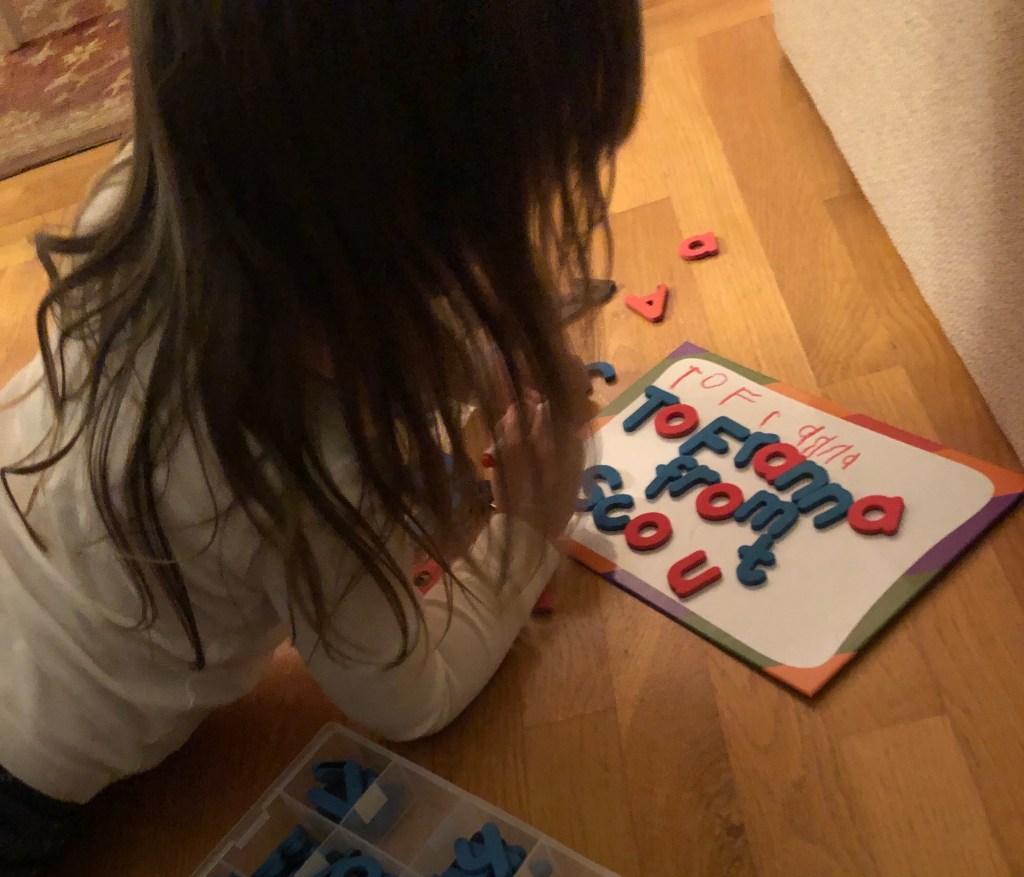
The other night she asked me to spell words for her with magnets on a whiteboard. I did, without realizing that she intended to copy them with a marker.

Here she is, writing with utmost care. A message to me.

With my new name, for the new role I get to play in her life:

Franna.

Life just gets grander.

I asked her if she wanted to spell “Franna” with one ‘n’ or two. She chose two.

Dear Writing

As a participant in the annual Slice of Life Story Challenge with Two Writing Teachers, I will be posting each day for the month of March.

What better way to start than by expressing my love for writing? Or, to be exact, by expressing my love TO writing for the profound impact it’s had on my life.

Inspired in part by Kobe Bryant’s retirement love letter, “Dear Basketball.”

*******

Dear Writing,

It occurs to me that I’ve never told you how much you mean to me.

It is time, for you mean more now than ever before.

I remember when you first materialized. I was, what, about six years old? I wonder now whether I discovered you or you discovered me, sitting there at the coffee table in the living room, wide-ruled paper in front of me and a fat pencil in my hand. All I know is that it began with story. A pull, a beckoning, a desire to get what was swirling inside me onto pages. By some great alchemy, my blocky letters, erratic spelling, rudimentary sentences ceased to be merely themselves; combined, they became something distinctly Other.

And there you were. Almost a living, breathing presence.

I didn’t know then that you’d come to stay. That as I grew, you would grow with me. That you would, in fact, grow me, always pulling me to more. To think more, explore more, discover more, strive more, play more. To be more.

Do you remember the diary Grandma gave me for Christmas when I was ten or eleven? Trimmed in pink, little girl on the front, with a brass lock and tiny key. Do you remember this entry: “I wrote a story that I hope will be published”? Whatever happened to that diary—? To that story? They’re lost in time. No matter. I can see that page in my mind to this day; is it you that keeps this memory alive?

People began to notice our relationship early on, didn’t they. Teachers who said it was a good thing, who gave tips on how we could be stronger. Friends and family who told me to stick with you: Please keep writing. I owe them all for how they shaped you and me.

Where would I have been without you in my teenage years? In the early days of my marriage? Those were the poetry years, the journal years, when you let me glimpse the beautiful inside the uncertain, when you compelled me to pour out my heart. You were bigger than my anguish, my anger, my fear. You channeled it all, absorbed it all. Ever how circuitous the path, how violent the storm, how steep the mountain, how dark the night, how deep the pain, you were there, leading me to safety, to calm. Even now, I reach for you and you are there. Like the ocean, you bring forth unexpected treasures. And healing. When my emotions and energy are spent, washed clean away, you reveal over and over one thing that always remains: Hope.

For there’s always more to the story, to the ones that I create, to the ones that I live. I think that’s one of the most important lessons you’ve taught me: This chapter of life is ending, but a new one is about to begin. Embrace it. It’s one of your most extraordinary powers. As amazing as your ability to mine my memory. With you I am any age I ever was. I sit on my grandfather’s lap once more; he walks with me, holds my hand. I hear his voice. I am in Grandma’s kitchen while steam fogs the windows, in her arms as she rocks me and sings: Jesus loves me, this I know . . . I see my father’s blue eyes, hear my mother’s laughter and the whir of her sewing machine late into the night. With you my children are still little, my husband is young, black-haired, healthy, whole, and out on the court shooting hoops. And every dog I ever loved comes bounding back to me in absolute joy, all my shortcomings forgiven.

With you, I relive it all. The parts I am proud of and the parts I’m not; the moments I cherish and the ones I survived. With you, they all become a celebration of living, of learning.

I learned long ago that I can harness your power to attack but you showed me that it doesn’t bring me peace; you taught me, instead, to defend. Not as a warrior with drawn sword but as a careful guardian of my own mind and heart. Not by destroying, but by edifying. You enable me to walk in another’s shoes and see through another’s eyes, to understand that fighting doesn’t move the hearts of others, but story does.

There’s something of the divine about you as well. Marvel of marvels, how a spark in the human brain becomes a thought and a thought becomes substance because of you. Like something from nothing. Ex nihilo. It’s how God created, speaking the world into existence. With words. Without limits. Anything is possible. Believe. To me there’s a sacredness behind the human spirit’s desperate craving to create, to express, to be heard . . .

Which brings me back to being six years old, at the table, pencil in my hand.

And you will outlive me. You are my record, what I leave behind.

Let it be the best of me.

Know that you’re an inextricable part of who I am, one of my life’s greatest gifts. Meant to be given. And so I give you away.

I am grateful beyond words.

I love you.

Fran

A poem written at age sixteen

A matter of diet

Listening to a friend extolling the value of a high-fat, low-carb diet (“My sister-in-law, who’s had a weight problem all of her life, has lost sixty pounds. She looks great!”) got me thinking.

The conversation went something like this…

ME: It’s contrary to all we were taught, you know, with the food pyramid.

FRIEND: Right. That food pyramid is wrong. All those grains-!! The carbs-!!

ME: Well, in this heart-healthy era …

FRIEND: The diets cardiologists promote are NOT heart healthy. They’re detrimental. Dangerous.

ME: Hmmm … high-fat kind of amazes me, though. We keep being told that eating low-fat is healthy.

FRIEND: Low-fat is the WORST OF ALL. Take milk, for example. You’re altering it if you remove the fat. It’s supposed to have fat. Our bodies don’t recognize food that’s altered, they’re not designed to handle it, don’t know what to do with it besides convert it to sugar … plus, we’ve depleted important nutrients that we need from the soil …

ME: So do you take vitamins or supplements with this diet?

FRIEND: Yes. Boron, for example …

Boron?

It’s in borax. A cleaning agent. When I was a child, my family used Fab laundry detergent. The jingle, “Fab, I’m glad, there’s lemon-freshened borax in you!”—heavens, I haven’t thought of that in decades.

Boron, stuff of cosmic rays and exploding stars. Not overly plentiful in the universe or in the Earth’s crust, yet necessary to plants’ growth. Apparently it has a number of human health benefits, for everything from the brain to the bones to attacking kidney stones. But too much can be toxic. Plants will die, humans can be poisoned …

ME: It comes down to what each person needs, really. The same amount of anything could be too little for one person and too much for another.

FRIEND: Exactly. It’s a matter of finding what works for each person.

—And THAT is what got me thinking about a reading diet.

As someone who’s in and out of classrooms across grade levels daily, listening to children read, here is what I know: They don’t all need the same things. Some need a little supplement—the right supplement. Some need extra decoding or phonics support. Some need comprehension support (the point of reading is, after all, making meaning of it). Some are learning the language. Some have intensive needs requiring highly specialized support. Many need help with phrasing, with prosody, with CONFIDENCE … and what about vocabulary? ALL need to be read to, every day.

Reading is complex. Teaching reading is complex. There’s even an argument as to whether it can actually be taught, for readers essentially grow by … reading.

A healthy reading diet really comes down to this: What does each child need in order to grow? What is a balanced diet for this child? Too much or too little of a thing can be counterproductive. Potentially toxic.

All too often I hear students say I don’t like reading.

I sometimes ask students why but I know the answer’s partly shadowed by a much larger question: What’s being done to help kids WANT to read? To enjoy it, to love it, to stick with it? Allure is part of a diet, is it not? The pull of some promise?

Trends and beliefs about reading and reading education, like diets, are going to come and go. There will be clashes of opinion. Research is going to be (and should be) tested for validity.

And …

FRIEND: The Food and Drug Administration shouldn’t be one entity. There’s big money to be made by people not eating the right stuff and needing medication.

ME: Big money … cure-alls … why am I envisioning buzzards on a branch, poised to swoop in and devour?

[shudder]

Exactly what—or whom—is being devoured?

Photo: PlusLexia.com.

A matter of heart

Better is the end of a thing than its beginning, and the patient in spirit is better than the proud in spirit.

-Ecclesiastes 7:8

Last week didn’t start so well.

On Sunday, I broke a bone in my foot while simply walking (and falling, somehow) down the garage steps.

I’d already taken Monday off to attend my brother-in-law’s funeral but spent it on my couch instead with my newly-damaged foot elevated, commiserating with my husband, whose leg has developed a discolored, painful bulge—the leg from which veins were removed for his bypass surgery last fall. It’s not a clot, and that’s all we know until his appointment this week.

“I never would have believed that I wouldn’t be able to attend my own brother’s service,” he sighed. It’s a seven-hour round trip; neither of us was up to it.

I surveyed our legs, propped on the same stool. His left, my right. Mirror-images of each other. Except for my orthopedic boot.

I sighed, too, the entire left side of my body sore from overcompensating for the right. “I know. This is like being eighty years old or something.” Which is decades away…

Our college-student son, passing through the living room, quipped in his deadpan way: “Well, at least you’ll know what to expect when you are eighty.”

So. That was Monday.

On Tuesday I returned to work. It happened to be the 100th day of school, meaning that most kindergarten and first grade students (and many of their teachers) came dressed as old people. White hair, glasses, wrinkles sketched with eyeliner, canes galore.

For a split second, I mused: Who wants to live to be a hundred?

But the kids were adorable, their teachers were having fun, and God knows we all need to have more fun at school. Too much of it isn’t.

That is where my mind was when a little “old” person wandered up to me in the lobby where I rested on a bench between the arrival of buses, my morning duty.

A kindergartner. Big, mournful eyes moving from my boot to my face: “Are you all right?”

“Oh yes! I am fine,” I said, touched by the obvious concern in that small voice.

“What happened to your foot?

“Well, I broke a bone in it.”

“Does it hurt?”

“No, really, it doesn’t. The boot is a cushion for it, see, and it doesn’t hurt at all right now.”

A flicker of relief across the little, made-up old face. The tiny pseudo-centenarian went on her way.

That was Tuesday.

And Wednesday, and Thursday, and Friday. Everywhere I went, the kids wanted to know: What did you do to your foot?

I shared the X-ray with some of them, saw the fascination in their eyes.

Some didn’t ask anything. They came up to me just to say I hope you will be okay. I hope you feel better.

As I labored up and down the staircases, one careful step at a time—the elevator at school is BROKEN—I thought a lot about the curiosity and compassion of children, how natural these things are for them, how comfortable children are with asking and expressing. If we can preserve, nurture, stir curiosity and compassion through all of their formative years … what a different culture, what a different world, it would be. Possibly our greatest work.

The week ended much better than how it began. Not because of satisfying still more curiosity about my broken foot with ongoing questions, or the taste of true human compassion at its purest. Not because I made it through the first week of recovery, although that was a glad milestone. No. Friday was a day of festivities, of celebration, all shining from the children’s faces.

“Happy Valentime’s Day, Mrs. Haley!” called the little ones when they passed me in line in the hallways, inviting me to their classrooms to share their candy, their cupcakes, their joy.

Valentimes. The mispronunciation seems almost poetic. As in, these times are made for Valentines. Definitely for love.

Oh my, thank you, I’ll come see your goodies but you keep them; they were given to you.

You yourselves are gifts enough to me, children.

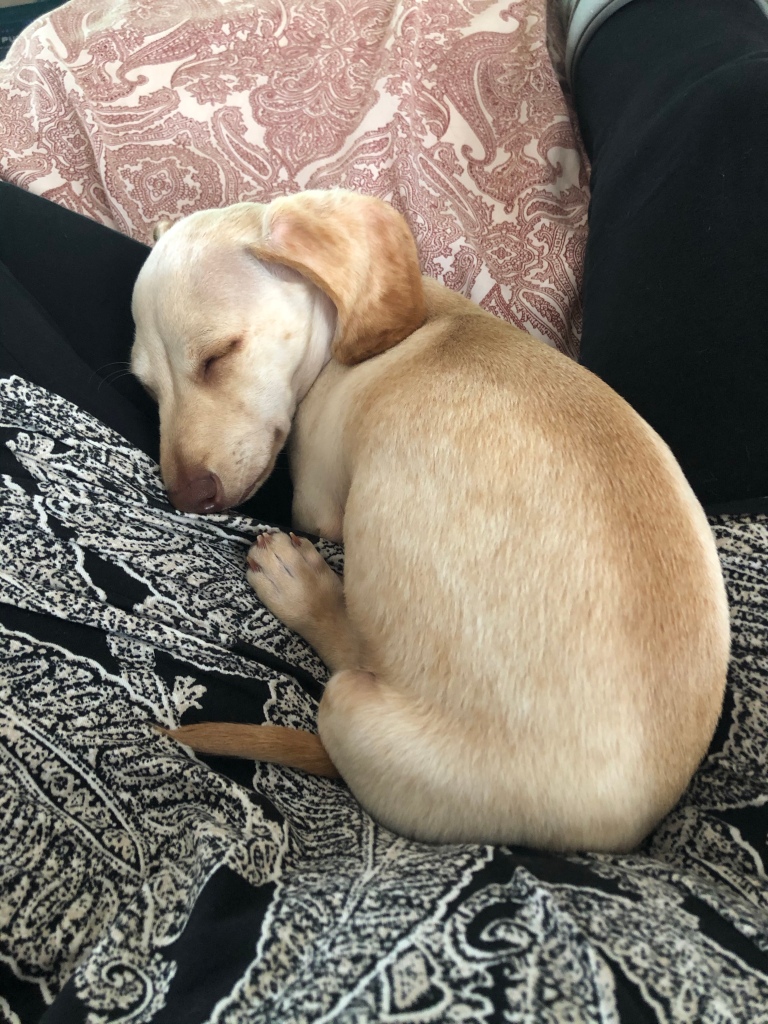
You as well as puppy therapy. ❤️

Dennis the dachshund takes turns between my lap and my husband’s while we prop our legs.

Twist of fate

For all the clear memories I have of moments and conversations in years past, I cannot quite recall how this happened two days ago…

Early Sunday morning. Tote bag with Bible and Sunday School lesson, studied and ready to teach. Annotated cantata book for Easter drama practice, ready for first rehearsal and casting. So much to do. So much to think about. Mind full of minutiae to remember. Let me put all this in the car, lest I forget something… wait, the sweet pickles for lunch. I forgot to take them to church with the sandwich stuff for rehearsal. Let me put the jar in my bag. There. Ready…

Opening door. Garage steps, red brick. Car is right there, I will put everything in the backseat floor…

—Falling. Fast.

Everything in my hands scatters across the cement floor; I watch the music book and all my papers sliding away with remarkable speed.

I cry out. I don’t know if it’s during that split-second fall, or on impact.

A snap.

Sharp pain in my right foot… I am only wearing socks, no shoes.

My son, Cadillac Man, is there in an instant. He heard me fall.

I am clutching my foot. It’s bad.

—Mom, is that blood dripping down your bag?

No. Pickle juiceget my Bible out of there.

And get your father.

His father tries to help me up but I can’t stand and he can’t be pulling on me; he is still healing from bypass surgery.

Don’t touch me, I tell them. I don’t know how to move. I have to figure it out.

I crawl back in the house. I take off my sock.

My foot looks intact.

I will try to stand…

Knife-like stab.

No.

My husband and son do not know what to do. It is Sunday morning; one is a pastor, the other, a music director. They each have church services waiting,

Go, I say. I have to figure this out. Maybe it will be better by the time you get back. If not, you can take me to an urgent care. Just go.

They go.

I wait until they’re gone to crawl down the hall and, sitting in the floor, change from pajamas to street clothes, for I know I’ll be going somewhere about this foot.

Suddenly everything is exponentially harder than it was.

That’s when I cry.

*******

X-rays reveal that I broke the fifth metatarsal on my right foot. The tech tells me I snapped it and I say yeah, I heard it. Now I am in a boot for six, eight, ten weeks; who knows? These things are slow to heal, says the orthopedist.

And no driving with the boot, she adds.

So now my husband and son must take me to and from work, every day for weeks on end.

I cannot do this, I say to myself.

But I walk, lopsided, imperfect, maddeningly slow in my Frankenstein boot, out of the office. My husband takes me home.

I watch the countryside whizzing past the passenger window. I know what this is shaping up to be. A hard lesson in dependence, at the least. It’s not like I haven’t lived this before. Seventeen years ago, just after my father died, I broke my foot—the same foot, different bone—while preparing to direct a church play. This second time occurs just after my husband’s brother died. Déjà vu. A curious twist of fate. None curious-er. I am seventeen years older; this is going to be harder.

—Well. It’s just going to have to be one deliberate step at a time.

Oh, how much I take for granted.

Today, back to work.

Just a good bit slower than before.

Of the earth

Midway through lunch, the din in the cafeteria is too much. The new boy brings his tray to where I’m standing:

Can I sit here at this table?”

It’s an empty table, save for my phone, closed laptop, electronic entry key, all the things I carried with me because I didn’t have time to put them in my room before this daily duty.

I consider his brown eyes, looking up at me. Pleading.

I consider his boisterous classmates and the seat he left behind.

“Are you moving yourself here because you feel it’s a safer place for you to be right now?” I ask.

He nods.

“All right. That seems like a good choice.”

His face breaks into a grin. He sits.

And the questions start: What kind of phone is that? Do you have a dog? Do you like Doritos? What kind do you like best? What’s your favorite color? Where are you from? How old are you, twenty-nine? Forty? Older?

How old are YOU? Eight? Did you move over just here to ask me all these questions?

He just smiles and takes a swig of his strawberry milk.

Then:

“Mrs. Haley, what’s your favorite snake?”

“What? My favorite SNAKE, did you say? Yikes—I don’t …”

Of course I am about to say I don’t like any snake whatsoever, but something in his expression stops me. “Um, do you like snakes?”

He nods. “I like pythons.”

Heavens. I refrain from telling him about a man I saw on the news this week. He happened to find a boa constrictor in his couch and had no idea how it got there or from whence it came.

He’s watching my face. A keen observer, this child. He’s waiting for my response.

I could say I like green snakes, but I don’t. I could say I like black snakes because my granddaddy said they eat rats and mice, so don’t ever kill a black snake. I think about the copperheads Granddaddy killed on the dirt road where his barefoot grandchildren ran in the summertime. I think about the coiled baby water moccasin I found in front of the kitchen cabinets when my first son was just three, and I how I was about to pick it up, thinking it was an odd piece of rope . . . until I almost touched it. And saw its eyes. Or that time I was cleaning the attic and discovered a complete shed snakeskin; I nearly knocked a whole new exit in my ceiling, trying to scramble out of there . . .

I DO NOT LIKE SNAKES.

But this boy with the strawberry mustache is waiting. His eyes are shining.

And then I recall a little creature lying across my sidewalk a couple of weeks ago. So little that I thought it to be a large worm at first; it was the same pale tan. I noted a faint pattern of scales on it. Could it be a snake? I looked it up. It was. “Smooth earth snake.” They are shy; they live mostly in the dirt around trees and bushes. I’d just had all the old bushes around my house pulled up. Apparently this little fossorial serpent was disturbed, or even damaged, as the equipment pulled away deep, tangled roots. For whatever reason, it crawled out in the open only to die there on the sidewalk. Who knows, maybe it was just trying to get to safety.

—Poor little snake. The only one I’ve ever mourned.

I look at the boy. He’s new here. He’s been uprooted.

Perhaps he did come to this table for safety, after all.

Even as I begin to speak, I think of earth and geosmin, the organic element in soil that humans can smell to something like the trillionth degree (we can detect one tablespoon in three Olympic-size swimming pools) and why that should be, unless it’s because we were meant to live close to the earth, that we came from the earth, and to the earth we will return. A curious kinship with that little snake. With all living things.

“My favorite snake is the earth snake. It’s very small. Have you heard of it?”

He wants to see a picture, so I do a search on my phone just as it’s time for classes to clean up and go outside for recess. To run, to play, to breathe the fresh air, to enjoy being children . . . how well I remember.

The silence in the cafeteria now is too much.

Photo: Smooth Earthsnake. Cygnus921. CC-BY