My own St. Patrick

In 1906, Theodore Roosevelt was president, Upton Sinclair published The Jungle, and the San Franciso earthquake killed around three thousand people. The Panama Canal was under construction and Cuba had its first president. Susan B. Anthony died that year. Lou Costello, Estée Lauder, and Anne Morrow Lindbergh were born.

In the far reaches of eastern North Carolina, a farm woman named Claudia Amanda Victoria delivered another of her ten children. A boy. She would have only two girls; one would die of diphtheria at age four.

But this baby boy would be hardy. He would outlive them all.

She named him Columbus St. Patrick.

Some folks called him Columbus. Those who knew him best called him Lump.

I called him Granddaddy.

As I grew up listening to the old stories, I tried to imagine living in his era. Seeing an early Ford Model T. Mail-ordering live chickens, delivered in wire cages by horse and buggy. Raising ducks that wandered off to the swamp on a regular basis, only to be herded back home again to eat bugs in the garden and to provide eggs for breakfast. Learning to plant and to harvest, to be in tune with the rhythms of the earth, following the steps of that ancient choreography, the seasons.

He was five when the Titanic sank, seven when World War I began. His older brother, Jimmy, served in the Great War and returned; I would know him and his wife Janie in their old age. They lived in a little tin-roofed house along one of the many dirt roads of my childhood summers. Jimmy and Columbus had a brother who drowned long before my time. Job Enoch. One brother accidentally shot and killed another on the porch of the family home. I knew their sister Amanda, who had a high-back pump organ adorned with brown-speckled mirrors in her house. The organ sounded and smelled of ages and ages past…but she could play it, and she could sing.

Columbus didn’t sing, but he loved country gospel songs and bluegrass to the end of his days.

And Columbus St. Patrick loved Sunday School. He had perfect attendance for years, garnering long strings of pins awarded to him. He did not enjoy regular school. He quit in the fourth grade to work on the farm. Later in life he had some regrets about this. But his father walked out on the family and Columbus rose to the role of provider.

He participated in community hog-killings, with the farm wives taking the backbone to flavor collard greens. The pork was preserved in barrels with salt brine. Some of the folks enjoyed scrambling hog brains into their breakfast eggs.

Columbus St. Patrick worked hard. He plowed fields with mules. He took part in the making of molasses, which required several people. Mules walked in a circle, harnessed to poles attached to large grinder where sugarcane was fed to extract the juice. The juice would be collected and heated in trays over a fire, skimmed numerous times until it became rich, blackstrap molasses. At the end of a meal, he sopped his biscuits in molasses, and poured his hot coffee in the saucer to cool it.

He competed with a scrappy little woman named Lula for the honor of being the community’s top cotton-picker. She often beat him.

Lula would be widowed when her husband Francis hung himself in the woods. One of their daughters would find his body.

Columbus St. Patrick’s youngest brother married another of those daughters.

Columbus made some time to hang out with the young people, attending taffy-making parties in their homes and driving groups of friends to the movies in town…all the while noticing Lula’s daughter with the wavy blonde hair and straight posture. There was a certain spark about her.

She considered him her mother’s friend. The “older” set. She was nine years younger and she had her eye on the preacher’s son, who would surely follow in his father’s footsteps: How wonderful, to be a preacher’s wife!

It didn’t happen. Desires of the heart sometimes come to unexpected fruition: I would be a preacher’s wife, a half-century later.

This daughter of Lula’s ended up marrying a farmer: Columbus St. Patrick. They planned to wed in September but he had the mumps. And so it came to pass in mid-December instead.

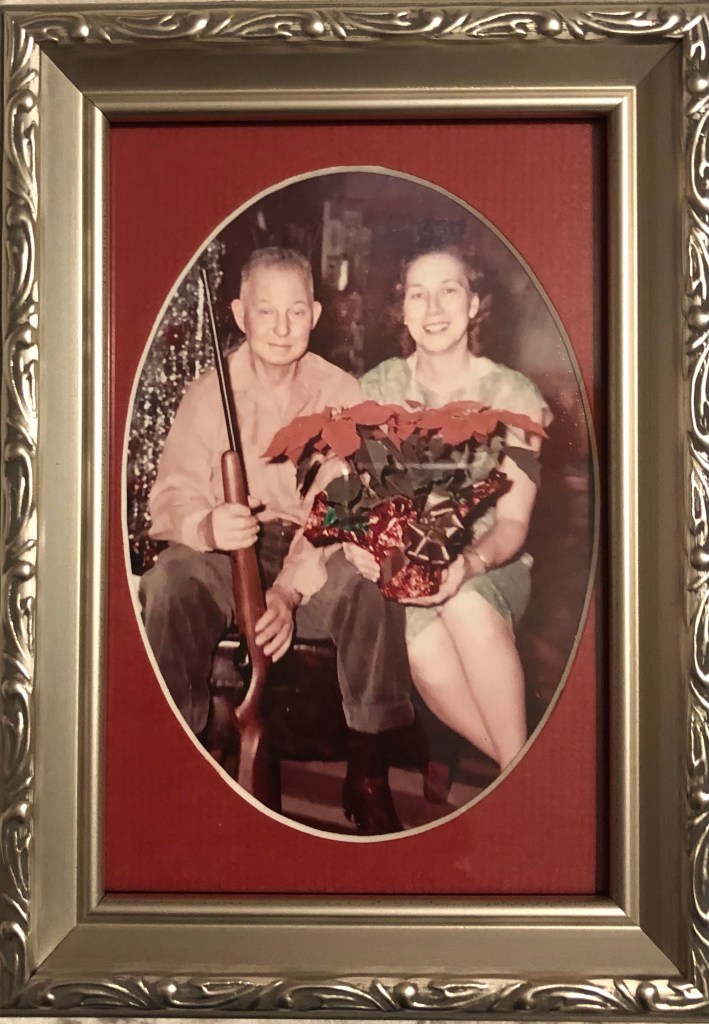
My grandparents.

Here’s a photo taken sometime early in their marriage:
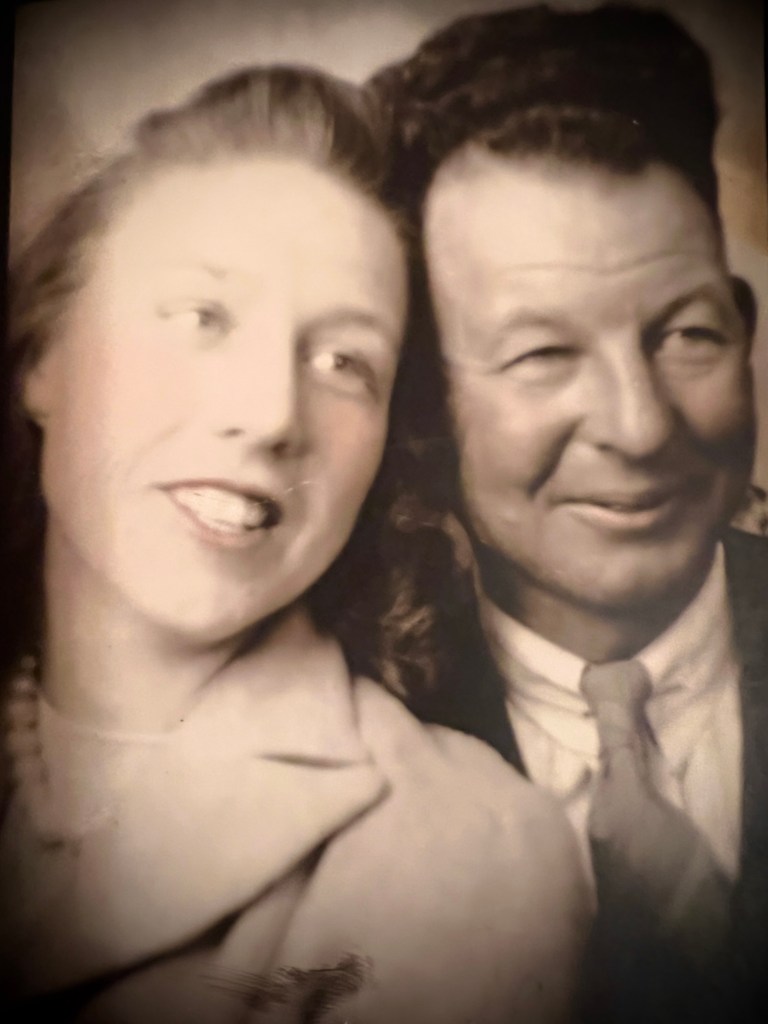
Ruby Frances and Columbus St. Patrick, circa 19371938.
She would have been around 23. He would have been 31 or 32.
If this photo was taken prior to October 1937, my father was not yet born.

They would endure the Great Depression and the second World War with a small child. My father. When Columbus St. Patrick couldn’t make a go of tenant farming and sharecropping, he traveled to the shipyard nearly 200 miles away with a group of men from down home. He was working there, building cradles for ships, when Pearl Harbor was attacked. Suddenly U.S. ship production went into overdrive; the Yard turned out ships in three months versus the usual year.

He would try, after the war, to make a living farming, painting, and doing other handyman jobs. By that time there were three children to care for. Columbus opted to go back to the shipyard, staying in a boarding house during the workweek and coming home to see his wife and children on the weekends.

For ten years.

His son (my dad) became senior class president and entered the United States Air Force after graduation. The oldest daughter was a high school basketball star; Columbus St. Patrick nailed peach crates to posts out in the yard for her to practice. By the time his youngest daughter was ready for high school, he’d had enough of separations. He moved the family to an apartment near the shipyard.

Hilton Village, built between 1918 and 1921, is the first federal wartime housing project in the U.S. It was created for shipyard workers. These quaint, English-style rowhouses would be the setting of my first memories. I would awaken in the dim gray morning at my grandparents’ upstairs apartment and my grandmother soothed me back to sleep while my grandfather, having risen at four, made his own breakfast before going to work. On Sundays, his day off, he took me to the playgound behind the Methodist church.

I felt as safe as I ever have in life, walking hand-in-hand with him.

He retired after I started school and lived another twenty-nine years. He saw my children. He survived the removal of his bladder after a cancer diagnosis. My grandmother would empty the urostomy bag and dress his stoma (surgical opening) every day until his death.

They would lose their middle child, their basketball star, to multiple sclerosis in her fifties. She died on Good Friday; they buried her on Easter Sunday. Their son (my dad) was just recovering from bypass surgery after his first heart attack. He would not survive the second, but Columbus would not be here to suffer the loss of his son.

Granddaddy died of lung cancer under hospice care, at home his own bed, as he wanted, on a fine spring day. He refused morphine in favor of keeping his mind clear. And it was, to the very end.

St. Patrick’s Day rolls ’round again and stirs all the memories. They spring to life, as rich and sweet as molasses that Granddaddy and I sopped with our biscuits. He was always embarrassed by the oddity of his middle name. I am proud of it. I have loved it all my life, just as I’ve loved him. Fiercely. I have learned many a valuable lesson from Columbus St. Patrick: Treat people well. Help those in need. Money doesn’t buy happiness (back in the old days, he said, nobody had any money but everybody was happier). Love your family. Love your neighbor. Get a dog to love. Work hard. Persevere. There’s always a way. Tend the earth. Do your duty. Spend time with children, for they are precious. Go to church. Trust in the Lord. Return thanks.

One day, he said, we will meet again in a better place. I am looking forward to it.

Me, too, Columbus St. Patrick.

Me, too.
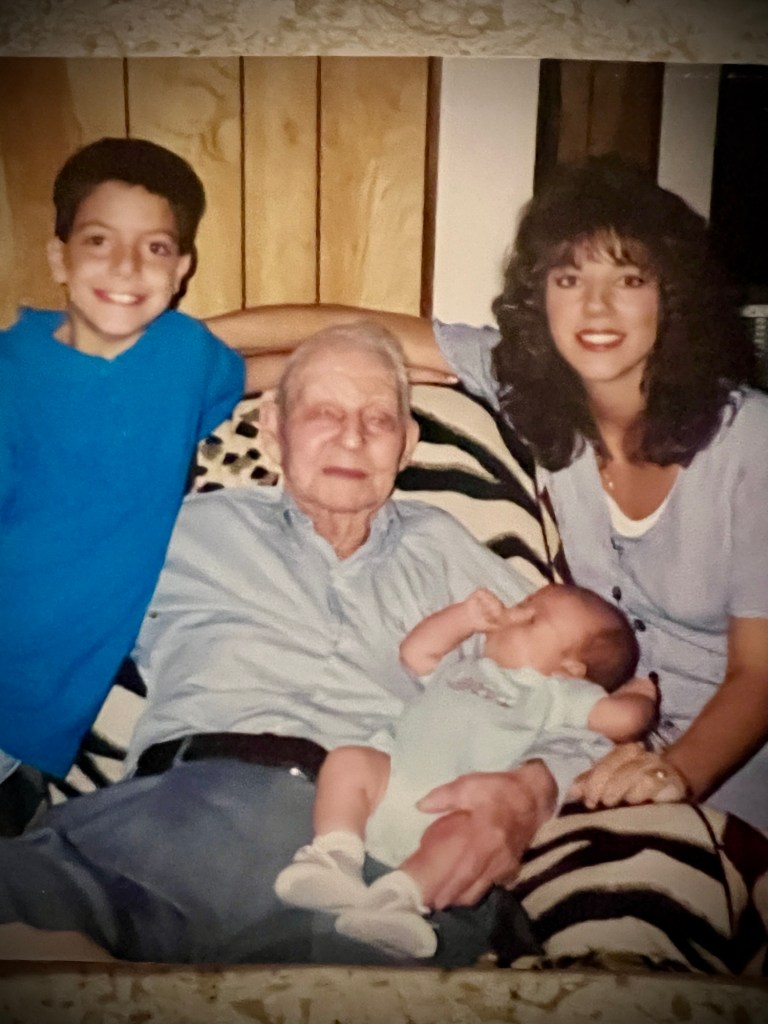
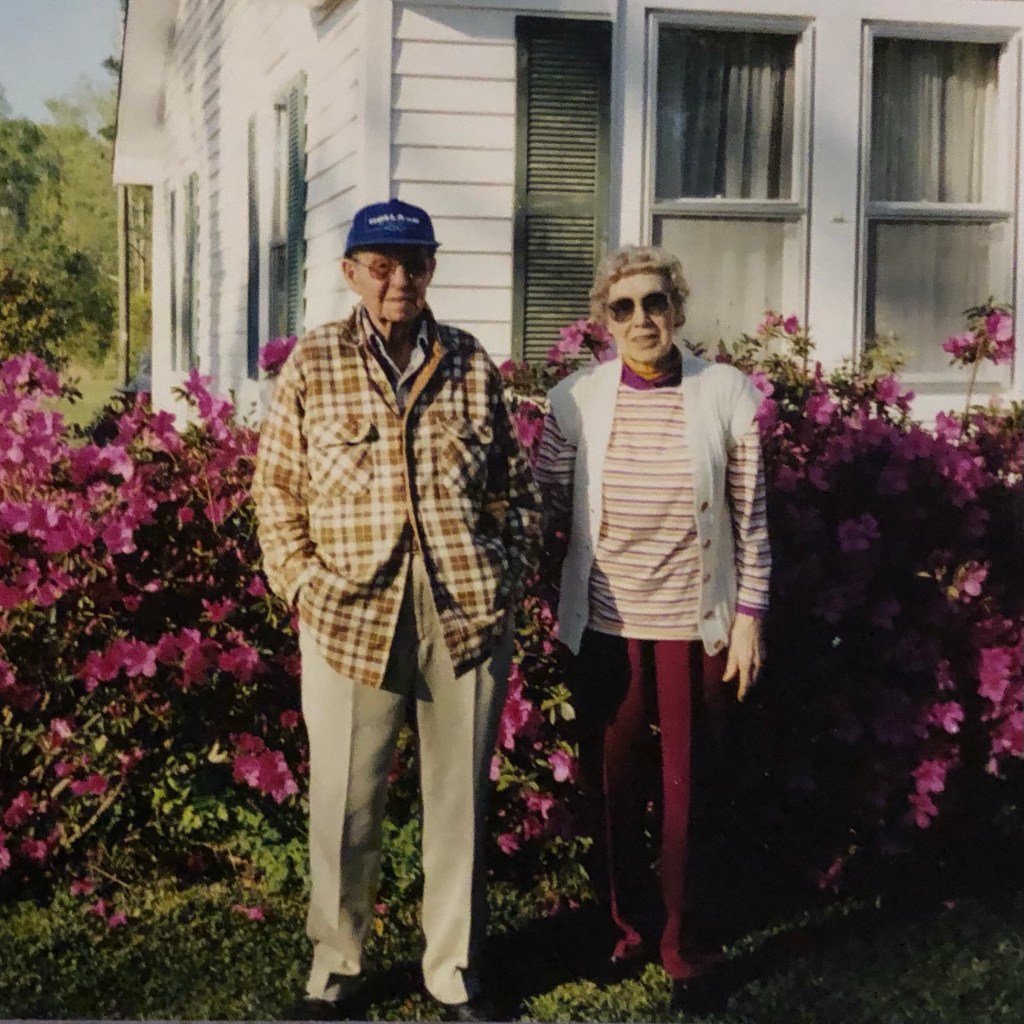
My boys and I visiting Granddaddy for his 91st birthday, 1997.
My youngest was six weeks old.

*******

with thanks to Two Writing Teachers for the March Slice of Life Story Challenge

Rosary beads

a backwards story

Let them be a memento of the first day I came to see you and of God’s divine grace.

I shall keep them for you until such time that you can understand the story.

I picked them up, brought them home, and washed them. Never mind that we’re not Catholic, your father and grandfather being Baptist preachers.

Considering the significance of my visit, their appearing seemed a rare and holy thing.

A set of rosary beads, right there in the parking lot, with no one else in sight. Perhaps meant for a child, as the beads are plastic, mostly bright blue, with six orange, three green, and a little white crucifix.

When I left the hospital to head home, the rain had ended. The sun sparkled on the wet pavement. My heart danced with the beauty of the day, of the whole world. I stepped gingerly around puddled water shimmering with rainbow swirls, and that’s when I saw it.

Grandparents and grandchildren are a special gift to each other, especially if many years together are granted. Time to love, to live all our own stories, to always be close ’til you’re all grown up and I must go… this is my prayer.

I sat in a chair and your dad placed you in my arms. Joy and awe flooded my very soul…my cup runneth over, and over. I could have held you forever and it wouldn’t have been enough.

And there you were…so little, so perfect…I’d cried when your dad texted the first photos on the previous day. Now, seeing you with my own eyes, I could hear my grandmother’s voice, her narrative: You looked just like a little angel. And that’s exactly how you looked to me, my beautiful Micah. A heavenly being sent straight from the hands of almighty God.

Down came a gentle rainfall, spattering the windshield as I flew to the hospital that morning…once I answered the COVID questions and passed the temperature check upon arriving, I was allowed to go the room.

The end of October is a lovely time of year here in North Carolina, when the sky takes on sapphire hues. I wore a light raincoat because the meterologists predicted sprinkling.

I had to wait until the day after you were born to come see you.

You came during the pandemic. The world struggled with masks and distancing. The hospital limited visitors to two a day…and your dad counted as one.

My grandmother loved to tell me the story of my birth. I shall love telling you yours.

Me holding Micah for the first time.

*******
Composed for Day 9 of the Slice of Life Story Challenge with Two Writing Teachers

December 12th

Eighty-six years ago
they married

during the Great Depression
with war on the rise

they meant for the ceremony
to be in September
but he had the mumps

so the wedding occurred
on the twelfth of December
before the justice of the peace

she wore a blue suit

on the day after Christmas
she turned twenty-one

Every December after
he gave her
a red poinsettia

he knew
how much she loved them

Across the decades
she’d jest about
having nothing
to look forward to
the rest of the year

with her anniversary
Christmas
and birthday all
in the same month

December
for her
was pure delight

celebrations
of Light
and life

In the last years
when he was gone
I gave her
a red poinsettia
during the season

for the sight
of her face alight
blue eyes bright

Someone else gave her
a silk poinsettia
after she went into
the nursing home

once when I visited
she was watering it

We did not know
all those years ago
that their wedding anniversary
would become
National Poinsettia Day

I just learned it

how she’d love it

just another sign
that love is divine
and lives on and on
and on

My grandparents, on my first Christmas.
Love lives on.

Photo: National Day Calendar

On this day

Nine months
since you entered the world
making mine
exponentially beautiful
every single day

Three years
since your Grandpa
had a massive heart attack
while driving
and the deputy sheriff
came to tell
your future dad, uncle,
and me (Franna)
that he’d run off the road
and was being taken
to the hospital
where we were told
he’d been resuscitated

they weren’t sure
he’d make it

he did

Grandpa lived
to see you
love you
and call you
“little angel”

I say
there must be
some mighty ones
all around

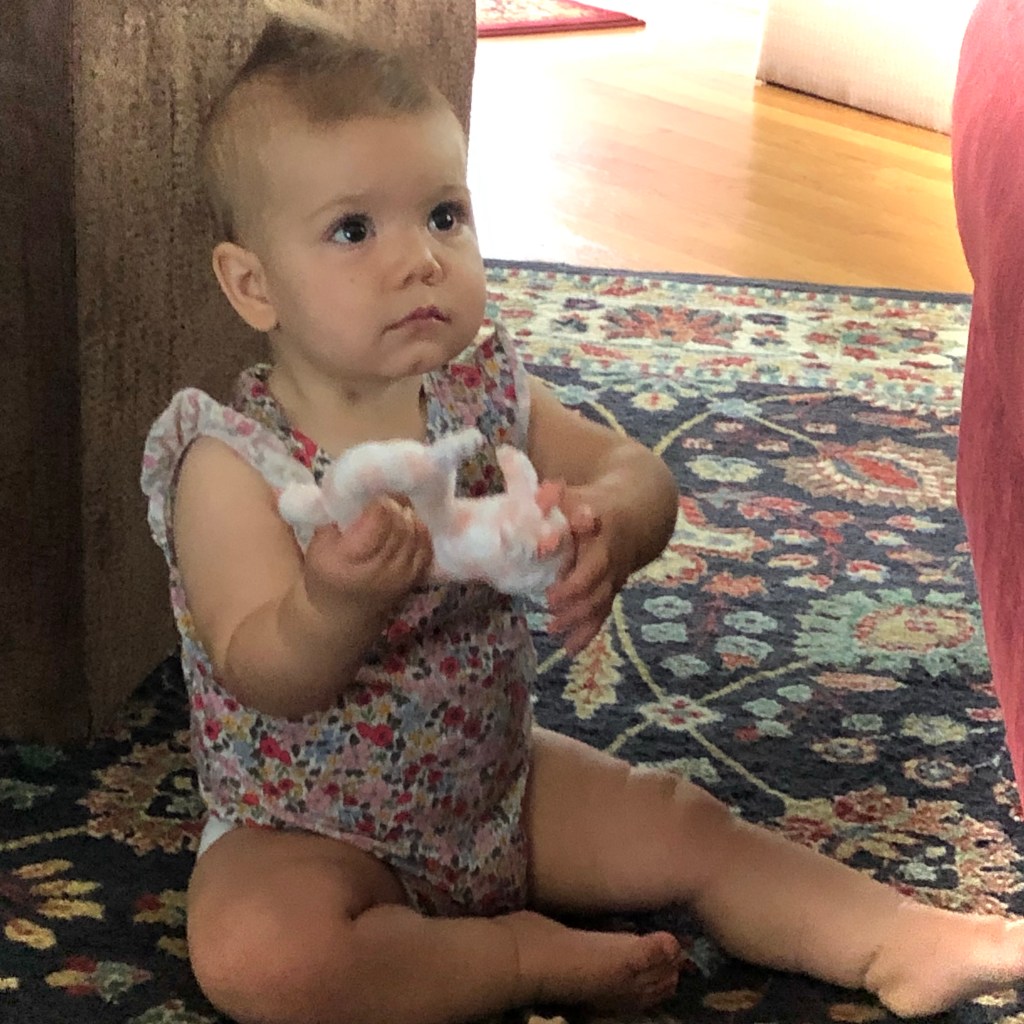
Micah, 9 months, looking up at her Grandpa

Eternal summer: memoir poem

with thanks to Jennifer Guyor Jowett for the Open Write invitation on Ethical ELA today: “Share your summertimes with us, whether it’s within the memories of your childhood or the place you are in right now. Take us there. Include sensory details to evoke the spirit of your summer.”

I have written lot about my childhood summers. Today I try a bit of reframing and recapturing the magic…

*******

Eternal Summer Reigns

Daughter of Eve from the far land of Spare Oom where eternal summer reigns around the bright city of War Drobe, how would it be if you came and had tea with me?

—Mr. Tumnus to Lucy, The Lion, the Witch and the Wardrobe

I live it every day of my life, summer.

By some great magic I am still a child
returning to my grandparents’ house
so deep in the country some people say
it’s at the end of the Earth

for me, ever the beginning

a place of woods, holding their secrets close
a place of enchantment, outside of Time
a place of belonging, of sacrifice

where ghosts of the past live again
in Grandma’s stories

there’s her Papa, tending bees
never getting stung
her Mama, picking cotton
and dipping snuff

her brothers and sisters
(eight in all)
playing softball
or piling in the goat-cart
to be pulled by a white mule
named Jenny

there’s my grandfather and his brother
courting my grandmother and her sister
gathering at friends’ houses
singing and make taffy

my father, being born
in a tenant farmer’s house
—Cotton-Top, they call him,
for the color of his hair
when he is a toddler

babies born into the family
some stillborn
(Daddy’s voice…Would have been
so interesting to see
what my double first cousins
would have looked like
if they’d lived)

—I live them every day,
the stories.

I am the stories.

Every day I am a child
unpacking my suitcase
for the summer
welcoming the ghosts
walking the old dirt road
eventually covered with gravel
from phosphate mining rejects

bits of ancient history
crunch beneath my feet:
shark’s teeth, some tiny and sharp,
some as big as my small palm;
coral skeleton, white chunks
embossed with lacy flower designs;
whale eardrums, curiously curved fossils
—with these, whales heard
their own stories, too
now, they are 
part of mine

and above all, above all
from the surrounding woods, bending near
keeping their secrets close
the crescendo and decrescendo
of cicadas

the true song of summer
and the sun
and living
and dying

and returning.

By some great magic I am still a child
still listening, still living summer every day
and forever
in that sound.

My grandmother in the summer of 1959, years before my birth. This is the setting of my idyllic childhood summers to come, beginning a decade and a half later. I would stay for a couple of weeks each year and never wanted to leave. Grandma fostered my love of reading, writing, and story. She drove me to the tiny county library at the beginning of my summer visits and helped me haul out the armloads of books I selected. She saved magazines, Mini Pages, and National Enquirers all year long for me.

We walked the old cemetery in the clearing diagonally across from where she sits in this photo and the graveyard of the church around the bend, where her parents are buried. As we read the stones, the blazing sun casting our shadows across them, Grandma told me the stories.

The fossils in the gravel of the poem were real. I found handfuls of them in the road here when I was a child.

Cicadas are an ancient symbol of immortality and resurrection. I write of them often because of their connection to this place. Their loud, rattling chorus was ever-present in the background of my childhood summers; the sound remains one of the most comforting on Earth to me. It’s a call of the sun, love, belonging, and home. There’s a myth about the goddess of the dawn, Aurora, asking Jupiter to grant immortality to her lover, which he did, only the goddess forgot to ask Jupiter to also grant her man eternal youth. Her beloved continued aging until Aurora finally turned him into a cicada. If you look closely at depictions of Aurora, you will see the cicada. Why tell this story here? This morning, before the dawn, before the cicadas woke to sing, I saw Jupiter shining high beside the moon. Then I sat down to write to this prompt of summer celebration, reliving halcyon childhood moments with my grandparents at their home, a place where my generational roots run deep in the earth, where my father grew up…an old, far place in the east, named Aurora.

For me, ever the beginning. Eternal summer reigns.

*******

thanks also to Two Writing Teachers for providing a place to share our stories – for we ARE our stories

Dirt road

On Ethical ELA’s Open Write today, Kim Johnson invites teacher-poets to compose poetry from paint chip colors. She happened to have “Dirt Road” in her own list.

As soon as I saw that name, it was over. I would have to take Dirt Road. Its pull is too strong for me, calling me back to a place I write about often.

So today I write a memoir poem, although I did incorporate a few paint chip names along the dirt road: Oyster Shell, Turtle Green, Pink Blossoms, Dreamy Memory, Forever Fairytale, Summer Sunflower.

Maybe tomorrow I’ll try whole new paint chip poem away from Dirt Road.

This is where the name led me today.

Dirt Road

I watch the highway
and my heart beats fast
when I see it coming
just around the bend

old dirt road

off to the right
threading through the trees
past Miss Etta’s tiny turtle-green
screened-porch house
where she dips snuff

past the homeplace
standing like a dreamy memory
white paint faded to tired oyster shell
sunlight gleaming
on the tin roof

Grandma was born here

past the tangle of sunflowers
planted by her brother
who still lives here alone
something is different about him
I don’t know what
it’s in his long face
he never says much
but he did give me some quarters
once

just beyond the sunflowers
Granddaddy’s garden
looks like something
an artist painted
in watercolor greens
in perfect rows
he grows collards 
and little round peppers for his vinegar
squash, cantaloupe, snap beans, 
Silver Queen corn, crowder peas,
and butterbeans, 
speckled pink and white
when I help shell them
from their furry green pods

then the grape arbor he built
laden with scuppernong vines
big leaves waving Hey
big brown-gold grapes
won’t be ready yet
and they aren’t even pretty
but to me
they taste like Heaven itself

then the row of crape myrtles at the curve
bright pink blossoms nodding their heads
sometimes shedding, rolling on and on
smooth forked trunks
where I like to climb and sit
and make up songs
thinking in forever fairytale

the house
bright white
black shutters

and I can’t think now
about the tire swing 
hanging there in the pecan tree 
studded with woodpecker holes
or the tiny cemetery with its ghosts
across the old dirt road

because Grandaddy and Grandma
are coming across the yard
straw hats shielding faces
lit with smiles
bright as the summer sunflowers
ever turning toward the sun

Daddy pulls off 
the old dirt road
into the yard

we’re here
we’re here

I am out of the car 
before it stops
running toward
open arms

and I never
want to leave.

My grandparents and my oldest boy on the old dirt road, a long time ago

*******

with thanks to Kim Johnson, Ethical ELA, and Two Writing Teachers for the weekly Slice of Life Story Challenge. Writing is but half the magic. Sharing is the other half.

Summertime poem

with thanks to Abigail, Betsy, and Soshi for the invitation to write on this topic for #verselove at Ethical ELA today (who’s not longing for summer right now?!).

Here’s why summer has such a special pull for me.

For Day Nineteen of National Poetry Month

Summer Second

Sunny afternoon
blue sky
bit of breeze
faint sound of a radio
from a neighbor’s yard
I can’t discern the song
it just sends me into 
reverie
for a second
conjuring
hot sand
under my bare feet
Coppertone in my nose
salt on my tongue
If everybody had an ocean
across the USA
then everybody’d be surfin’
like Californ-i-ay…

snatches of conversation
cresting and dipping
on the breeze
mighty waves of memory
crashing on the shore
my father’s big black sandals
flip-flopping to the old navy-blue Ford
the battered brown Samsonite
suitcase in his hand
the ride is so long
so long
the city gives way
to pastures, meadows
horses
fields
that go on and on, forever
plowed furrows running
like long crazy legs
to keep up 
with the Ford
as we zoom past
until at last
the lonesome highway
comes to a fork
on the left,
the tiny church
where my ancestors
sleep under stones
we veer to the right
turning 
onto the dirt road
my heart beats faster
Daddy drives slower
stirring clouds of dust
and I am already
grabbing the door handle
as Granddaddy’s lush garden 
comes into view
with just a glimpse of 
Grandma’s white angel birdbath
circled by orange marigolds
through the laundry 
lazily flapping
on the clothesline
and there they are, 
walking across
the green, green grass
and I am out of the Ford
before it’s hardly stopped
and in their arms
in the blinding sun
as the forest stands tall
all around
with its cool
dark mysteries
where the rattling cicadas
crescendo
vibrating on and on and on
through my soul
I can’t discern the song
it just carries me
through eternity
in this one
bright second

My new name

All the world’s a stage,
And all the men and women merely players;
They have their exits and their entrances;
And one man in his time plays many parts

—Shakespeare, As You Like It

Life’s transitions tend to sneak up on us.

For example, when it dawned on my oldest son that high school wouldn’t last forever and beyond it was college plus this thing called The Rest of Your Life, involving responsibility and duty, he looked at me with big brown eyes full of gloom: “I don’t want to grow up.”

Alas. It happens.

But he found his way. Last fall he simultaneously started the pastorate, married, and became the dad of a beautiful four-year-old girl. That’s a lot of transitions in one fell swoop, and he’s embracing them all. He’s thriving.

One man in his time plays many parts . . .

All of a sudden, his father and I have reached the grandparent stage of life. While it’s the loveliest transition, I can’t keep from thinking, with a pang, How did I become this old? Truth is, there’s exactly the same age difference between my grandmother and me as there is between me and my new granddaughter. It shouldn’t seem so astonishing.

The hardest transition isn’t mine, however. It’s my granddaughter’s. She loves to come over, loves to climb in my lap with a book as much as I loved climbing into my Grandma’s with one. All of this is glorious fun. No, the hard part is what to call me. She’s used to saying Miss Fran:

“Miss Fran, I’m hungry!”

“Oooo, Miss Fran, I like your nails. Can you paint mine?”

“Can we have a popcorn party and watch Frozen again, Miss Fran?”

“Let’s go outside and blow bubbles, Miss Fran!”

She likes telling everyone that I am her grandmother now. She even likes pretending to be me. My son said that after I broke my foot she went clomping around their house with one rain boot on, saying “I’m Miss Fran!” Yikes.

This transition away from Miss Fran has proved challenging. But she’s working on it.

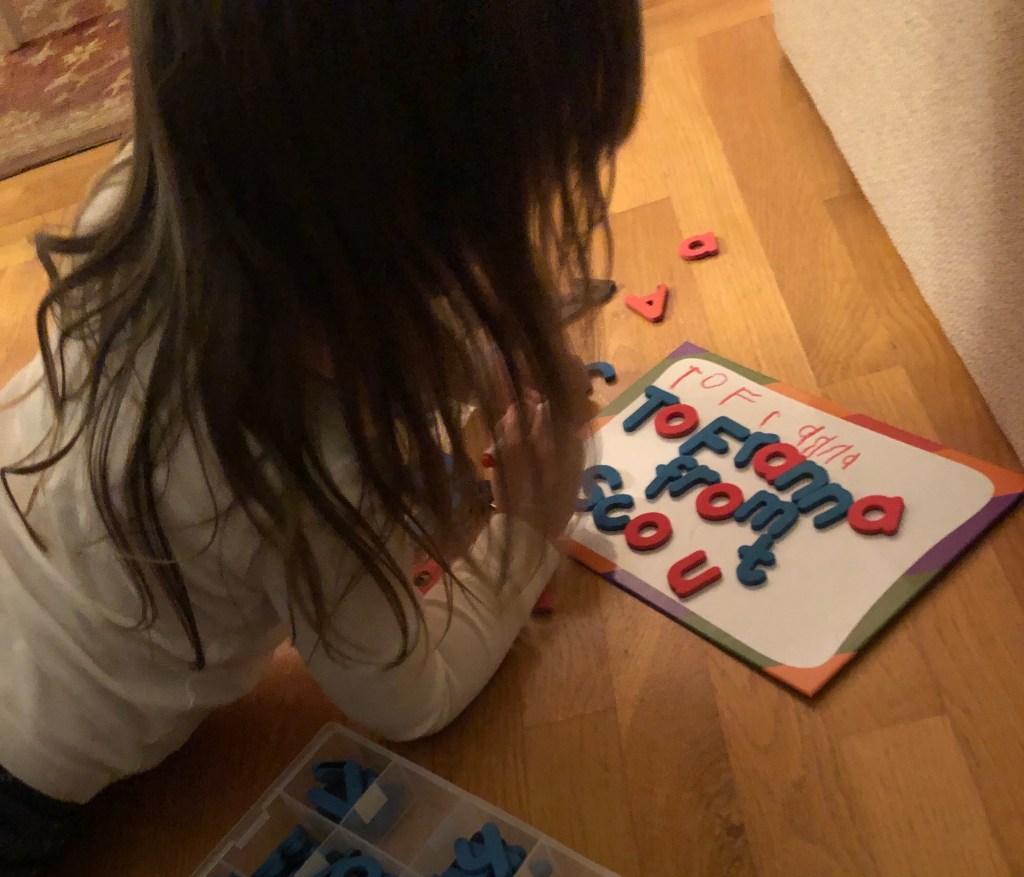
The other night she asked me to spell words for her with magnets on a whiteboard. I did, without realizing that she intended to copy them with a marker.

Here she is, writing with utmost care. A message to me.

With my new name, for the new role I get to play in her life:

Franna.

Life just gets grander.

I asked her if she wanted to spell “Franna” with one ‘n’ or two. She chose two.

Happy place

Sitting in the surgical room, waiting for a minor outpatient procedure, I try to redirect my sense of dread by listening to the nurses chatting:

“The knees, they’re the most unforgiving body part.”

“How about the uterus? The uterus is a vindictive organ. You mess with it and it’s going to fight back.”

Immediately I am looking all over the room for something to write with: The uterus is a vindictive organ –! That’s got to be one of the best lines I’ve heard in my entire life. Profound and very possibly inarguable . . . .

But pens apparently aren’t needed in the surgical room, as I can’t see one anywhere, and even if I did, I can’t get to it, I’m hooked to an IV, and besides, here comes a nurse, still talking: “The liver, now, it has a great sense of humor, but the uterus has absolutely none. —How ya doin’?”

She’s addressing me. “Oh!” I say, still etching the dialogue into my brain in a desperate attempt to preserve it. “I’m, um, good.”

—What does she mean, the liver has a great sense of humor? Because it’s able to regenerate? Or is there some other reason? What can that possibly be?

“So, you know you’ll get propofol, right, and this will all be over in a jif,” she says cheerily, busying herself with the tubes and such.

—Propofol. Isn’t that what killed Michael Jackson?

I am just about to ask when the anesthesiologist comes in and says, “All right, let’s do this.”

I want to say, Hang on a second, I really need to know about the liver’s sense of humor, when the anesthesiologist says in a low, silken voice:

“Do you have a happy place?”

I so know what THIS is. Get me talking about something happy so I’ll go under peacefully. A completely obvious ploy.

I don’t want to be put under, I don’t want to talk about my happy place, I want to know about the liver’s sense of humor before I wear myself out wondering about it.

But the moment’s upon me and suddenly this question about my happy place makes me want to cry.

See, I think my happy place is a little like Heaven, and if I start talking about it—will I wake up?

No need to fight. Just embrace it, says my own voice in my own head. At least, I think it’s my own voice.

So I say, “Yes, I have one.”

“Tell me about it,” says the silken voice, as warm as a blanket.

I sigh. “My grandparents’ home.”

“Where’s that?” asks the liver-humor nurse.

“In Beaufort County, out in the country. Some people say at the end of the world.”

“Why were you happy there?” coos the anesthesiologist.

“Well, because they were there. My grandparents. I always wanted to be with them.”

And they always wanted me, I think, but I don’t say it aloud. I can see them, faintly, as I speak. Standing out in the yard, watching for my arrival. One or the other or both, every time they knew I was coming. Watching, waiting.

“What was it like there?”

I’m not sure who asked this.

I can see it as I speak, as if through a window in my mind. The blue sky, the trees. Grandma’s azaleas, the camellia bush, the orchard, Granddaddy’s garden, the old hen house. I am not sleepy, yet. Maybe I can fight this, a bit . . .

“I grew up in the city and in the summers I’d go stay with my grandparents. I loved the country. It was a little paradise . . .”

It was love personified, love-infused, love written in the veins of every leaf, in every blade of grass, in the black earth itself that gave back so abundantly of what was given,  love echoing in every birdsong, in the vibration of every cicada, love painted on the iridescent bodies of dragonflies in a place more alive than any other I have ever known.

“Time to wake up, now,” says a gentle voice in my ear.

Grandma? Is it morning, already?

I’m so sleepy, still.

“Here you go. It’s all over, and everything is fine. You did great.”

It’s the liver-humor nurse.

I’m dressed, wheeled out to the car, buckled in beside my husband who’s driving, and well on my way home before I realize:

I STILL don’t know why the liver has a great sense of humor.