Compassion: a spiritual journey

My friend Kim Johnson chose the Spiritual Journey Thursday theme for October.

Kim is in the process of grieving her father. As she puts it: “I’m in the anger stage of grief, and along with everything else going on the world, I’m feeling the word COMPASSION calling to me as this month’s topic. I need to have more of it as I work my way toward acceptance.”

Compassion literally means to suffer together. The distress of another person sparks within us an intense desire to alleviate it. It is one of the purest facets of our humanity. Not mere emotion. Compassion is complex: I see your suffering. I am wiling to enter it, to help you.

There’s also a thing called compassion fatigue. It comes from prolonged exposure to traumatic events or being overwhelmed by the suffering of others, ultimately leading to physical, mental, and spiritual depletion. Our wellspring of compassion dries up. We find ourselves numb, in a desert devoid of hope, crushed beneath a boulder of distrust, breathing an atmosphere deprived of positivity. What is the point of it all, anymore?

The point is that we all need help. We want to get rid of the pain and anxiety eating us alive. We would heal ourselves, were it in our own power—even as our souls rage and wage war. Our fiery reaction, our fierce retaliation, is a temporary outlet that cannot bring true satisfaction, because it can never bring the peace we crave. How can we find peace when we are so unable to live peaceably? The fight is a wounded animal’s, a defense mechanism when existence is threatened. For…being alive… the innermost part of us is crying out against the knowledge that we will die.

I will speak now of the snake.

A week ago my granddaughter, almost four years old, asked: “Franna, do you like snakes?” She is asking all sorts of intriguing questions: Why is this your house? Why are you my Dad’s mother? She is forming her understanding of the world and affirming her place in it.

I answered as honestly I could. I do not want her to be afraid, like I was, for most of my life: “Do I like snakes? Not especially. But they can be helpful.”

Someday I will tell her how my Granddaddy taught me never to kill black snakes because they eat rats and mice. I may never tell her how he hacked copperheads to death with his hoe, or that when he became too elderly to manage the hoe, he shot them with his shotgun. It wasn’t that he didn’t like snakes. He was protecting his grandchildren and great-grandchildren from potential harm. Out of his love for us.

Note here how the spiritual journey employs foreshadowing. A thing is encountered; give it time. It is soon to reappear with greater significance. A portent.

The week after the snake question, I was at school, walking students down the sidewalk at dismissal, when I saw it, there on the cement by the edge of the grass: A little gray snake. Dead. Its body twisted, white belly frozen in an upward arch.

My first thought: It died painfully, in the act of writhing.

Second thought: Why aren’t the kids flipping out?

Not a one of them noticed the snake lying there.

Not that day, nor the next, or the next.

But I saw it, and it flooded me with…compassion.

For a snake, a creature I recently confessed to not especially liking.

It was alone. Abandoned. Not seen.

It was little. Not venomous (an earth snake). Not harmful.

And it was dead, with no one to acknowledge its existence or to mourn its passing.

I actually mourned it. I am sorry that it suffered, spiraling on itself in great pain as it died.

I am sorry we all have to suffer and die.

Every time I passed the snake the words mortal coil came to mind. Hamlet: When we have shuffled off this mortal coil…

I suppose that is the whole of the spiritual journey, is it not? Shuffling off this mortal coil. Someday shedding this battered body, being freed of the suffering.

Freedom from suffering is the very meaning behind the caduceus, symbol of the medical field. Snakes coiled around a staff. Odd. It just so happens if you research “symbols of compassion,” the caduecus appears. We do not think of it as representing compassion, but healing.

It is also linked to peace.

Many myths are behind the symbol, notably one in which the Greek messenger god, Hermes (Mercury in Roman mythology) saw two snakes fighting and cast his wand between them. The snakes gave up the battle and entertwined themselves peacefully around the wand.

In the Bible, God tells Moses to cast a bronze serpent and place it on a wooden pole as a cure for poisonous snakebite, a direct consequence of the people’s continued rebellion. God, out of his great compassion, provided a cure: Anyone bitten by a snake was healed of its venom by looking at the serpent on the staff, “high and lifted up.”

Herein lies THE point. Is there an antidote to the suffering we experience from the beginning of our existence, all the physical pain, mental anguish, and the thing we fear most—loss? Is it fighting venom with venom, or is it the active decision to stop battling each another, to cease provoking, retaliating, mocking, belittling, degrading, and causing more harm, until we seal our own destruction in utter carnage? Or is it a matter of realizing we’re all snakebit, and in the act of trying to alleviate another’s suffering, we ease our own? Can desperately-needed relief come in the very midst of our pain by desiring to help another….in compassion, “suffering together?” Not pulling others into our pain, but pulling ourselves into theirs?

Is this not THE point of Christ’s ministry and mission? He saw the suffering of people around him, out of compassion. He healed out of compassion. He wept at death for the ugly, unnatural thing it is, out of compassion. He was tortured and gave up his own life for broken humanity, out of compassion.

Compassion is born of love. Selfless love. Sacrifical love. As long as we have such love…we have hope.

Lest I sound too idealistic…today is my father’s birthday. A week ago today marked the twenty-third anniversary of his sudden death and the implosion of our family. It might as well have been dismemberment. Pain sliced us apart like a mighty warrior’s well-honed sword.

It isn’t supposed to be this way.

Someday, someday, we will shuffle off our heavy mortal coil and discover how great God’s compassion truly is…as well as his power to reverse and restore.

Until then, let us keep trusting. Let us wrap our wounds and our arms around each other. The pain will not disappear, not yet; but we can help each other through it.

That’s what the journey is for.

with special thanks to Kim — I hold you in my heart and prayers each day —
and to the SJT band of writers, for so often inspiring me to rise above.

The wound in the wood

A little slice of memoir

*******

I was five when my dad bought the house where I grew up.

There were good things about the house. A Big Bathroom and a Little Bathroom. Having two seemed luxurious to me, a child accustomed to apartments. Cloud-like swirls on the ceiling that my mother said were made by twisting a broom in the plaster while it was wet. A huge picture window in the living room, through which I could see a very tall tree behind the neighbors’ house. To me, the tiptop of the trunk appeared to be a lady sitting and gazing across the earth like some kind of woodland princess. Day in and day out, she sat there atop of her tall tree-throne, a regal silhouette, never moving.

There were things I didn’t like about the house. The red switch plate on the utility room wall that my father said to never ever touch. I believed that if anyone touched this switch, the furnace would explode and blow us all to smithereens. Even after I outgrew my terror, I steered well clear of that red plate. I didn’t like the thick gray accordion doors on the bedroom and hall closets. Bulky, cumbersome, and stiff, they didn’t really fold. They came off their tracks easily. These hateful doors eventually disappeared; one by one, they were discarded. Our closets were just open places.

The linen closet stood directly across from my bedroom door in the narrow hall leading to the Big Bathroom.

It wasn’t a true closet, just a recessed place with wooden shelves. I don’t remember an accordion door ever being there.

What I do remember is that one of those linen closet shelves had a terrible gash along its edge.

It looked like a raw wound that might start oozing at any moment. A gaping slit. When I pored over pictures of how to do an appendectomy in my parents’ set of medical encyclopedias (and why did we have these—? An exceptionally persuasive door-to-door salesman—?) the pulled-back human flesh and tissue made me think of the wound in the linen closet shelf.

This shiny-pink raw place bothered me. It was ugly. Almost…embarrassing. Something that shouldn’t be seen, shouldn’t be exposed…why had the builders done this? Couldn’t they have turned the shelf around so the wound wouldn’t show? It was an affront to me as a child, before I knew what taking affront meant.

I know now that the flaw is a bark-encased scar. The shelf came from a tree (maple?) that was injured, somehow. Maybe by a cut or fire. An online search produces this AI-generated explanation:

The tree’s cambium layer, which is responsible for producing new bark and wood, starts to grow new cells around the wound, forming a protective layer of tissue called callus. 

As the tree continues to grow, the callus tissue can expand and eventually cover the original wound, creating a scar that is encased within the new bark.

In short: The scar is evidence that the tree worked to prevent inner decay and heal itself after being wounded, and that it went on living for a good while before it ended up as the shelf holding our towels and washcloths beside the Big Bathroom.

I never touched that raw-looking wound in the wood. I averted my eyes from it, even hated it for existing.

Now, when I return in my mind to the rooms and halls of my childhood home, they are always empty, and that old scar in the shelf is the thing I want most to see.

How strange.

Maybe I am drawn to it out of kinship. I do not know the story of the tree’s life, only that this remnant is testimony to its suffering and ability to overcome. I could liken the scar to the ways adults damage children, having been damaged as children. I could see it as a symbol for my mother, whose early wounds festered long, the extent of which would eventually be revealed in addiction.

That’s the real red switch, for it blew us all apart.

Maybe I just want to place my fingers on the old raw place at last, tenderly, in benediction. I would say that I understand now about layers of callus tissue expanding, covering, and absorbing the deepest of cuts over a long, long time…it is always there, but it hurts no more, and I am no longer ashamed to see it or to let it be seen.

In the shelf or in myself.

Image by Wolfgang Eckert from Pixabay

*******
with thanks to Two Writing Teachers for the March Slice of Life Story Challenge

Dictionary poem

Katrina Morrison hosted the March Open write at Ethical ELA on Tuesday.

Her invitation: I am calling [this] a“Dictionary Poem.” If anything can define and expound upon the meaning of a word, it is poetry…pick a word to take apart and put back together in a poem. Begin with the dictionary definition of the word. Obviously, some words will offer multiple meanings. Craft your poem however you will. After the definition, expound upon the word’s meaningthe vicissitudes of life may direct you to write a haiku or a villanelle or free verse today.

I will NOT be attempting the villanelle again anytime soon; I wrestled that form to the ground on Saturday and haven’t recouped the stamina yet to give it another go. I went with an acrostic, because the word “shards” stays in my mind, and I keep turning it around and playing with it anyway, to find out all it wants to tell me. I love this word, so…the poem:

Defining

shard

  (shärd) also sherd (shûrd)

n.

1. A broken piece or fragment, as of pottery or glass.

2. Zoology A tough scale or covering, such as the elytron of a beetle.

Dictionary.com

The Poet’s interpretation:

shards

plural

sharp-edged fragments of memory, or

seeking healing among remnants, despite suffering

Somewhere in the shattering
Healing awaits, disguised
As sharp points
Ready to draw yet more blood…
Dare to touch the memories. Discover
Scattered diamondlight, all around.

Image: beasternchen. Pixabay.

*******

with thanks to Two Writing Teachers for the March Slice of Life Story Challenge

Ode to menthol

In the season
of sickness,
of a rattling
in the chest
that lingers
and lingers
and lingers
I seek
your healing power
O my elixir

none other will do
as well as you

your name
is not always recorded
on cryptic inscriptions

but I know
it’s you

nothing else
has that
distinctive
burn

Alas, you have become
such an elusive elixir

I search high and low
(on the shelves)
just to find
you’ve vanished

leaving no trace

it befits you,
vaporous thing
that you are

I cannot entertain
the notion
of orange
or honey
—fie!

These cannot
open passages
like you.

I wonder
what on Earth
I shall do

but wait…

memory stirs
like ghosts
like tendrils
like vapors, yes…

my own father
pouring your
precious substance
into a little silver tray
and plugging in
the vaporizer

there I was
suffering child
surrounded
by a steamy cloud
tinged with your
cool fragrance

sputtering
sizzling
on through the
long, long night

(you’re no cure-all
for childhood asthma, btw
but I’m not dealing
with that
anymore)

and speaking
of clouds…

back there
in the shroud
of Time
where sits
my father
and
my mother
puffing
puffing
puffing
on Salem cigarettes
there, the
telltale green carton
indicates your presence

I can still smell you
on the foil
of those packs
and in the
smoke ribbons
curling in the air
(aside: salem means
peaceful
complete
safe
perfect)

—what a cool operator
you are,
alternately healing
and stealing
breath

but then…

far back
so far back
I find you
at your purest,
perhaps

sick child
that I was
struggling
to breathe
(yeah, it’s a theme)

my grandfather
going to
his medicine cabinet
for a little
cobalt-blue tub
my grandmother
unscrewing the
aqua lid
and with one finger
slathering a good dollop
under my nose

(which now
no one is
ever
ever
ever
supposed to do
although clearly
I am alive)

and it is this memory
these moments
that are salve to my soul.
balm to my spirit

and so I come
to find you
like a miracle
in my own
medicine cabinet

whereupon I slather
my own self
up good

relishing your
mint-oil fire

your vapors
like a blanket
of love
enveloping me

breathing
breathing
Yea, with
a little
more ease

until this
lingering
lingering
rattle

evaporates
at last…

O, my elixir.


Fun facts: Vick’s VapoRub was invented in 1894 in the North Carolina county next to where I live now. It was originally called Vick’s Magic Croup Salve. From the NC Department of Natural and Cultural Resources: “The salve in the blue jar is made of menthol, camphor, oil of eucalyptus and several other oils, blended in a base of petroleum jelly.The creator invented it to cure his son of severe croup…which it did. Spanish flu killed the inventor in 1919 but, paradoxically, that pandemic drastically increased demand for his product. Oh…and guess who worked at the inventor’s drugstore as a teenager? O. Henry.

My ode, however is to menthol, not just Vick’s, seeing as I had to include my parents’ Salem menthols in the mix. I was an asthmatic child, my first attack occurring at age three months. As I grew, I often begged to stay with my grandparents when I was sick; they slathered me with this old remedy, hence my great affinity for VapoRub. Accordingly, my grandparents are ever-present in the healing power of that clean menthol burn…nowadays I am not troubled with asthma but when I feel a cold coming on, or, as in the present moment, trying to shake the rattling cough after a cold, Vick’s DayQuil with VapoCool is my go-to. It works, to which widely empty shelves attest. I finally had some delivered by Instacart (had to show ID, of course) so I can continue burning the rattle out of my chest…it’s the best thing I know of, outside of a certain homemade “recipe” made by one of my old-time church members from the country…not exactly sure what was in THAT jar, but it would’ve surely burned this stuff out long before now… that, however, is another story for another day.

Here’s to the healing power of menthol.

*******

with thanks to Two Writing Teachers for the monthlong Slice of Life Story Challenge
and to Kim Johnson,

whose series on Epsom salts convinced me that I really, really should write about menthol
(which, yes, can occasionally be dangerous, so use with care)

Grass poem

On the second day of the August Open Write at Ethical ELA, Margaret Simon shared “a photo that wants to be a poem.”

Here’s mine.

Release

I savor 
the secrets
of grass
in its returning
again and again
to a scarred surface.
I savor its growing
here in tangled profusion
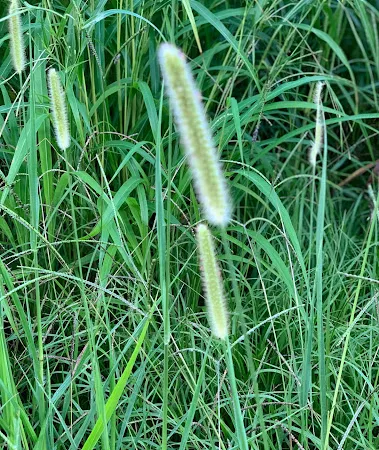
with yellow foxtails
beckoning in the breeze
in the knowing
that when there comes
a mowing
the inner balm
ever-flowing
secretes itself
across the brokenness
releasing its sweetness
in the air.
What I savor
most of all
is breathing
the fragrance of grass 
healing itself.

Photo: Margaret Simon

Light reading

A friend who knows my affinity for the natural world gave me The Book of Hope: A Survival Guide for Trying Times. It’s written as a conversation between Jane Goodall and her interviewer, Douglas Abrams. When I say it’s part of my current “light reading” I don’t mean easy (although it is) or frivolous (for it is not).

I mean light as in candleglow dancing on the walls of a dark room.

I’ve not gotten far yet but here are some lines that draw me in the first couple of chapters—flickerings of my own credo:

Hope is a survival trait.

The naturalist looks for the wonder of nature – she listens to the voice of nature and learns from it as she tries to understand it.

Hope does not deny all the difficulty and all the danger that exists, but is not stopped by them. There’s a lot of darkness, but our actions create the light.

And this from an Inuit elder, on confronting and healing our grief, which can manifest itself in the body as physical pain: Make space for grief…find awe and joy in every day.

—these, I believe. They are often the very reason why I write.

Recipe for Survival

Hold onto hope, and it will hold you
Open the ears, eyes, arms of your spirit
Perceive the call of awe, all around
Embrace it. Let the healing begin.

In the time of broken hearts

Heard on the news this week: Broken heart syndrome is a real thing.

It happens after significant stressors. Too much adrenaline. The heart is weakened. It hurts.

There’s a scientific name for it: takotsubo cardiomyopathy. It derives from the Japanese word for “octopus trap,” after the shape of the left ventricle of the heart in this condition.

It is temporary. The broken heart can heal in a short time, maybe days or weeks.

It can sometimes lead to complications. Rarely death, though.

It seems to affect mostly women 50 and older.

But I wonder.

I wonder, as I regularly step in for teachers who are out.

I wonder, as I absorb laments and frustration and anger about the depth of student struggles.

I wonder, as I listen to students reading poems about tasting the salt of their tears.

I wonder, when I wake up so tired on workdays, when I have so little left to give when I get home.

And I am usually one to see the glass half full, to find the awe in each day, like…

the blue heron standing a glassy pond on the drive to work

the whorls of white smoke floating up from the chimney of a little house in the countryside, struck by the rising sun and transformed into clouds of peach-colored light

the newest photo of my three-month-old granddaughter who’s beginning to smile more and more

hearing my boy play old hymns on the baby grand piano at church with such a multitude of notes and joyful liveliness that surely, surely the angels dance

the one little bird (a cardinal?) singing for all it is worth, from the treetops

-these things strengthen my heart.

And keep it, I think, from breaking.

It is a long season, this pandemic, with its deep layers of residue.

On this day of celebrating love and hearts…I wish you healing peace for the pieces.

Photo: Broken Heart Chalk 2Retta Stephenson.CC BY 2.0

Heart healing

“Heart” is the Spiritual Journey prompt for this first Thursday in February.
Thanks to Linda Mitchell for hosting our group of writers.

On a Sunday afternoon at the end of July, 2019, my husband had a massive heart attack and cardiac arrest. He was resuscitated by EMTs and went straight into surgery after arriving at the hospital. He got four stents and spent several days in induced hypothermia to reduce trauma to his brain, which can happen when blood flow has ceased and is suddenly restored. He recuperated slowly, painfully; his sternum had been broken by the CPR which saved his life. He came home. One morning in September he woke to jolts in his chest and tingling down his arm. I took him back to the hospital. More heart attacks. This time he had four bypasses. The surgeon mended his sternum with a little metal plate.

He is doing well now. In fact, up until winter settled in, he was doing eight-mile hikes in the park a couple of times a week and feeling as good as he ever has.

As this first Thursday in February drew near with Valentine’s Day and “heart” as the Spiritual Journey prompt for the month, I thought of a couple of things I might like to explore. I had chosen one, in fact, when I saw the heart-shaped hospital pillow that remains in our bedroom. This pillow was given to my husband after the bypass surgery. His attending nurse wrote on it with a Sharpie: “Keep hugging your heart!”

I thought, this is it. This is what I need to write about.

These pillows are given to all patients recuperating from open-heart surgery. The patients hug them when they have to cough or sneeze, lessening the severity of the jolt. The pillow protects the incision site whenever the patients move and when they practice the necessary deep-breathing exercises for their lungs.

It just so happens that the hospital where my husband’s surgery and recuperation has the lowest mortality rate in the country for heart bypass patients (according to reports from 2017-2019). It also just so happens that the county’s resuscitation rate is the highest in the nation. So, if you’re going to have cardiac arrest and need cardiac surgery, it’s the best place to be.

My husband is evidence of this.

I think about the surgeon who held my husband’s heart in his hands, who grafted those bypasses. He told us that as soon as the first graft was done, my husband’s heart immediately began beating stronger; it was hungry for the blood. It wanted to live.

Now. Where’s the spiritual element in all this, you ask?

Beyond the miracle that one human can cut open another and repair his heart, and that this repaired person can heal and live life awhile longer, is the Great Physician who is able to transform hearts and lives. When I was young, I attended a Bible study group in which a couple of guys could play guitars and we’d often sing this version of Psalm 51:10-12:

Create in me a clean heart, O God
and renew a right spirit in me

Create in me a clean heart, O God
and renew a right spirit in me

And cast me not away from thy presence, O Lord,
take not thy Holy Spirit from me.
Restore unto me the joy of thy salvation
and renew a right spirit in me.

Godly heart-grafting, I would say. Cleansing, taking away the bad parts, restoring. The heart must be transformed before the spirit can be renewed. Sometimes a great deal of work must be done…but the Lord is able. If we let Him work. If we are hungry for it. We often think of letting Him into our hearts but it’s really more a matter of offering our hearts—battered, damaged, tangled, sick as they may be—to Him. He knows exactly what is needed. Psalm 51 is the cry of David’s heart after Nathan the prophet confronted him with his adultery and murder. It can be the cry of any of our hearts as we place them in the healing hands of Almighty God, craving His mercy.

I rejoice that my husband lives, that he was made well, that the hospital and the EMTs are the best around.

I rejoice more that the Lord forgives and heals hearts and spirits. He works on my own, daily. He is the physician and the pillow, the healer and the comforter. The ultimate heart-hugger. He is the best place to be.

Not to mention that His own mortality record is unsurpassable.