This too shall pass

This Too Shall Pass

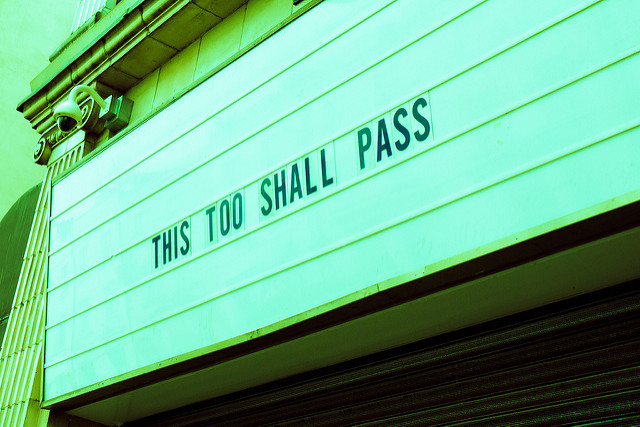
This too shall pass – Notting Hill. Florencia LewisCC BY

Once upon a time, long ago, I drove to work in tears. I couldn’t see a way out of a certain situation. Worry had consumed my thoughts for days. Like a moth desperately fluttering at a light but never landing, so it circled round and round my brain. Like the Grinch, I’d puzzled until my puzzler was sore, arriving at no logical resolution. The weight just grew heavier and heavier.

A sudden movement on my right startled me – a white pickup truck zipping by. That’s not the passing lane. I scowled at it, then nearly ran off the road in astonishment.

The bed of the truck had a tall, wooden rack on top, and on the slats was a white sign meticulously painted with black, Old English letters:

This Too Shall Pass.

I blinked, looked again. Yes, it was real. And it was literally passing me.

I looked around, half afraid I’d see these same words on barns and road signs like something out of The Twilight Zone, in which case I’d have to consider getting help with my state of mind.

But no – This Too Shall Pass was only on that white sign, on that white pickup, passing in the wrong lane to my right.

It was there for a few seconds, then on it went, out of sight.

As did the weight I carried. It melted away in the wake of that truck. I couldn’t see the future, but I understood this momentary trouble was just that, momentary. It would pass.

And so it did.

Whatever it was.

I said it was long ago.

I cannot even remember what I was so worried about.

At all.

But that truck is vivid in my memory. I can see those Old English letters, still.

I like to think that the driver painted them because he had a great sense of humor about his edgy driving. It’s too good, really . . . .

Except that I never saw the driver, nor have I seen that truck since. I hoped that I would – I watched for it on the roads for a long time after, but it’s the kind of thing that happens only once.

Once being enough to get the message.

This Too Shall Pass.

It always does.


Almost

It’s always there,

the ghost of Almost.

What might have been

but was not.

What should be

and isn’t.

Almost – ever how illusory, how ethereal

all but ephemeral –

is a penumbra bleeding from yesterday

into today,

a pulsing presence,

a ponderous weight,

despite its nonexistence.

A walking shadow,

the thief of Now

and its fullness,

the vacuum of Tomorrow

and all its possibility.

Inversion,

implosion.

Just images

without substance,

yet the mass of the universe

compacted

into one knot of aching.

That is the price

of living

with the pretty picture, 

the insatiably hungry, ever-gnawing

all-consuming 

ghost of Almost.

When the notion of Almost first came to me recently, it was about romantic relationships that didn’t work out.  Witnessing the death of the dream, how it takes its toll on the ones who wanted, and tried, to make it work. Broken promises, shattered hopes. It’s easy to cling to the idea of What Might Have Been, when it has been yanked away, leaving a gaping hole in a painful reality.

Then Almost beckoned me with its wispy finger: “Come in — come in, and get to know me better!”

(Before I go any further: Yes, I am borrowing that quote – thank you, Charles Dickens and the Ghost of Christmas Present, and yes, I borrowed “walking shadow.” Honestly, Mr. Shakespeare, it walked in of its own accord).

The ghost of Almost encompasses dysfunction, too. It’s the emissary of unraveling families, friendships. Within Almost are many shades of loss, of varying depths and proportions, all of which can overshadow daily life.

The game almost won.

The job almost attained.

The money almost saved.

The addict almost cured.

The temper almost controlled.

Almosts can go on and on.

Inevitably followed by “I should have … I should have …”

We have some choice, some power in some of those Almosts; in others, none at all. We cannot think for others,  cannot control their actions, decisions, feelings – only our own. Whether the ghost of Almost materializes because we throw the door wide open for it, or it arrives, unbidden, unwelcome, unwanted, through the choices of others, it wants to destroy What Can Still Be.

If we let it.

The only exorcism: See your Almost for what it really is. And release it, for it stays only if you keep hanging on to it. Decide that it will not devour your now, or your tomorrow, any longer. Seek the healing path over the haunted one.

A priceless quote from a friend of mine: “Don’t should on yourself.” No more dwelling on on what you should have done or what should have been. Move forward, one deliberate step at a time, one moment at a time, in wisdom  – for beyond Almost’s shadow, the sun still shines.

Be ready to walk in it.


I loved you at your darkest

At your darkest

August. Days of sweltering, snaky heat. Yet he donned a black tuxedo with a black-and-silver striped ascot and got to the church on time. 

In a back room, her bouquet of pink roses dripped on the front of her white gown, creating panic amongst the bridesmaids, but it didn’t stain. 

The morning’s thunderstorm cleared and the sun was shining for all it was worth when the ceremony began at 1:00. 

At 1:10 the preacher pronounced them husband and wife.

When they left the church hand-in-hand, the summer day was blinding – they shielded their eyes and made a run for it.

We’ve been running ever since, really.

For over three decades now. (I was a child bride. Well, sorta.)

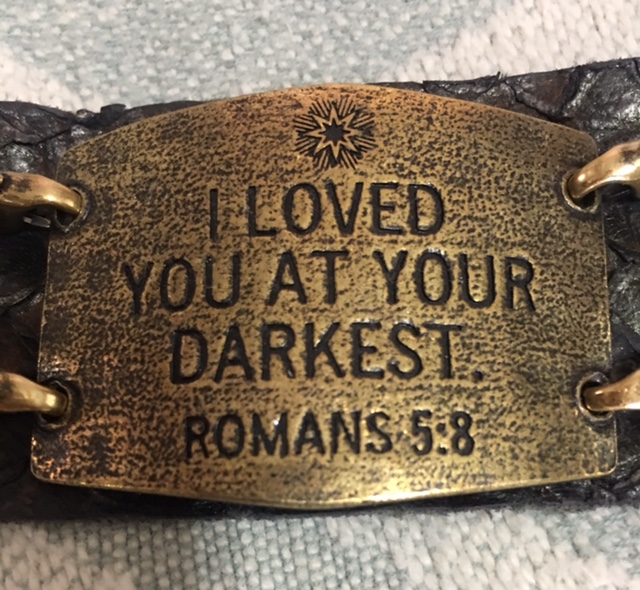
As we mark another anniversary this week, I consider one of my favorite gifts from him, a bracelet he bought a couple of summers ago. We were at the beach for a few days, trying to get away from the daily demands, the stresses and strains – a lot was going on in life at the time. We went into a shop, and I saw it –  a band with a metal plate reading I loved you at your darkest.

It pierced my heart, those words. The incredible forgiving, trusting, reliable power of them. The surety.

“Do you like it?” he asked.

I nodded, for I didn’t trust my voice at the moment.

And so he bought it. I wore it out into the brilliant August afternoon, holding tight to his hand.

We’ve come through many darknesses – losses of people we loved, various setbacks, our own inner dark sides. Seeing each other at our worst.

But we’ve also seen the best in each other.

Growing older means acknowledging that there are darknesses yet to come – watching his mother’s decline with dementia is a daily reminder. We will not always be as we were, as we are now. Our summer is brief.

Grow old along with me! The best is yet to be, wrote Robert Browning.

It’s the togetherness, the commitment, the laughter at silly stuff, the embrace in the hardest moments, that drive the darkness away. The sacrifices. The faith that the sun will rise again tomorrow, and with it, hope. Abiding gratitude for every day.

It’s never the darkness that we carry with us anyway. It’s the knowledge that we walked through it together, to come out on the other side. Our minds, our hearts hold to what is good, what is bright. It propels us onward. Makes the entire journey worthwhile.

Especially when the journey almost wasn’t.

On the evening of our first date, I called to tell him I couldn’t go. I had a raging fever; I was being admitted to the hospital for tests.

“I am sorry,” I said into the phone, tears stinging my eyes. “Please don’t give up on me.”

“I won’t ever give up on you,” said his voice, strong and sure.

He never has.

I loved you at your darkest.

I did, I do, I always will.

Thank you.


Mystical morning

Ocracoke surprise

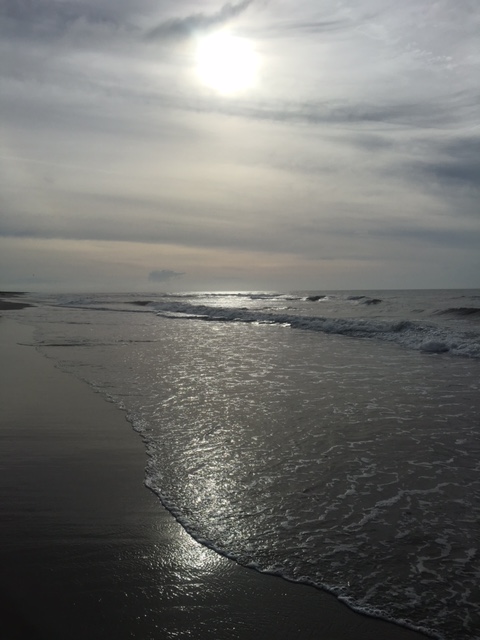
The island dawn is one of nebulous grayness, the sun an oblique white disc shrouded in veils of clouds. Painted from a palette of pearl, silver, and slate, the sand, the sea, the sky are starkly monochromatic, like an old black-and-white-movie. The temperature is indeterminate, neither hot nor cold. The morning is not uninviting nor inviting; it simply is.

As I make my way past softly rolling dunes of long grass shivering and undulating in the wind, I think only of the ocean, the opportunity to savor its splendor in relative isolation, away from commercialism. I expect to see a die-hard beachcomber or two; surely this a shell-collector’s paradise.

I do not expect the tree.

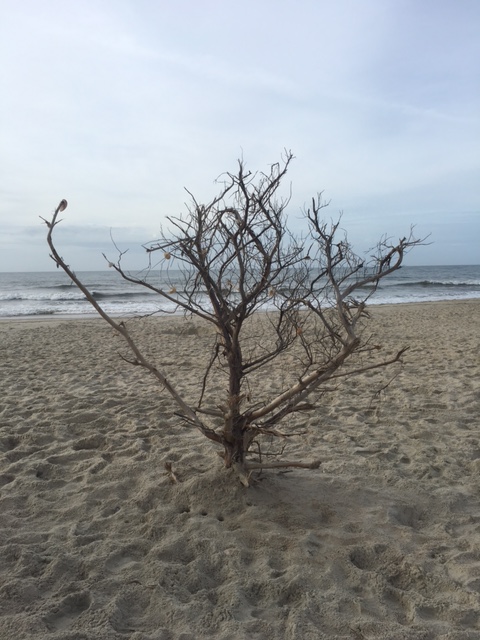
There it is, up ahead in the sand, directly in front of the path where dunes give way to the shore, with the shimmering, empty Atlantic for a backdrop.

How curious. I’ve not seen a tree smack in the middle of a beach before.

Are there others? I scan the shoreline, as far as I can see, on the left and the right.

No.

This is the only tree.

Did it grow here, somehow? I investigate. I suspect not, as the sand is built up around the tree’s base, although I can’t discern human handprints. Or footprints. I don’t even know what kind of tree this is, although I saw numerous others like it lying in the Pamlico Sound on the Hatteras side of the ferry ride to Ocracoke. I should have asked the crew what kind of trees these are and why they lie so far out in the water. 

Driftwood, then. 

It stands here on the vacant beach with its thin, snaky branches twisting skyward. Shells dangle from some of the vine-like tips, reminiscent of castanets on fingers. Or earrings.

I am enchanted. I’ve a sense of standing in no-man’s land, except that someone has clearly been here. Maybe someones, plural. Mystery people were inspired to plant this bit of driftwood and to decorate it with what was near at hand. 

The tree is dead. Shells, for all their intricate beauty, are but skeletons. I marvel at the human heart, its great desire for creativity and play. At the ability of the inner artist to see that random pieces of things no longer living, broken things, can come together in such an unexpected way. Whimsy in the wind. The beach tree stands as a mystical reminder that all is not lost, that all has value, that there’s beauty beyond the brokenness if we are willing to rearrange the pieces. The extraordinary lies not beyond the ordinary, but within it. Not beyond us, but within us, within our very grasp, if we just reach.

The ocean sparkles despite the obscured sun, like the twinkling of an eye when someone’s just about to smile.

Ocracoke morning

Note: The title is a deliberate play on that of a previous post about my son’s trip to Iceland – both attempts at capturing the essence of place: Mythical morn.

slice-of-life_individual

Twilight’s gleaming

Twilight Zone

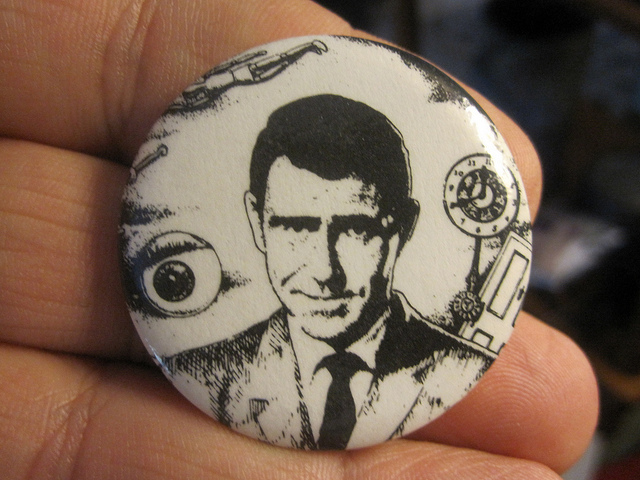
Rod Serling – Twilight Zone Button. Tony AlterCC BY

“It is a dimension as vast as space and as timeless as infinity. It is the middle ground between light and shadow, between science and superstition, and it lies between the pit of man’s fears and the summit of his knowledge. This is the dimension of imagination. It is an area which we call the Twilight Zone.” 

– Season One opening narration, The Twilight Zone television series (1959-1964)

What’s your Fourth of July tradition, fellow Americans?

For my family, it’s watching The Twilight Zone marathon on Syfy.

I have to ask myself: Why do I love this series? Why is it so addictive? After all, special effects have advanced light-years since these shows were filmed; some of the outer space/alien/futuristic costumes and settings are primitive, even laughable. Rod Serling, garbed in dress jacket and skinny tie, strolls out of inconspicuous places – other rooms in houses, offices, or even the woods – to comment on the rising action and the characters,  occasionally smoking a cigarette in true ’60s vogue.

Part of the fun is seeing famous people when they were heartrendingly young, when their stars were still on the rise: Carol Burnett, Telly Savalas, Elizabeth Montgomery, William Shatner (THE Captain Kirk, before the inception of Star Trek). There’s Burgess Meredith, the best of the best character actors, Mickey Rooney beautifully playing an angry drunk. The furniture and props in many episodes, some fashionably chic, some commonplace, are now vintage, nostalgic slices of a bygone era. Something must also be said for the show’s camera work, the strategic zooms, the compelling close-ups. In truth, between some captivating characterizations and the cinematography, there’s a great bit of artistry in The Twlight Zone.

But all that’s just part of it. What really draws the viewer, ultimately, is the story.

The Twilight Zone breaks the dimensions of time and space, to be sure – it takes us away from Earth, brings us to an Earth we don’t recognize, allows us to step into the past and sometimes into a future that isn’t future anymore (I just saw a calendar on the wall of a restaurant in  one futuristic episode: 1974. Geez.). Statues come to life;  a warm, vibrant grandmother is really a custom robot; dolls talk, wreaking havoc and destruction. People down on their luck find good fortune; people lose fortunes; people are at the mercy of forces greater than themselves; people possess supernatural powers that are often abused or taken advantage of by others.

The most haunting thing about The Twilight Zone isn’t the supernatural, however. It’s the journey within, the recognition of the worst parts of ourselves. Selfishness and greed are common themes, with catastrophic consequences – not that the Zone is didactic. In the spirit of the best short stories, with O. Henry-esque twists at the end, The Twilight Zone follows the dark convolutions of the human psyche. Endings are intriguing, but not always happy.

My favorite episode is “A Stop at Willoughby.” A man is locked into a job he hates by a demanding, socialite wife; a hardcore boss berates him for his ineptitude and lack of drive. He’s miserable; he can’t please anyone, least of all himself. On the train commute between home and work, he falls asleep and dreams of a stop that isn’t on the line – a back-in-time place, where women carry parasols and children go fishing and men ride penny-farthing bicycles (the ones with the huge front wheel). The vision of this place, Willoughby, is so real and inviting that the man thinks about getting off there in his dream.  He wakes to the ongoing pressures of his life, but yearns more and more for the slower, contented pace of Willoughby. His wife mocks him for wanting to be Huckleberry Finn, then turns her back on him just as he caves from the pressures at work. On the train, he dreams of Willoughby once more, and this time he gets off, where the townspeople greet him cheerfully by name, as if they’ve always known him, as if he belongs there.

The story doesn’t quite end here; there’s a final scene with a big final twist, but I would be the ultimate spoiler if I told it here. The episode – all the episodes – are meant to be experiences for the viewer. Here’s part of the closing narration: “Willoughby? Whatever it is, it comes with sunlight and serenity and is part of The Twilight Zone.”

Perhaps that’s the pull of the Zone – that beyond the darkness, horror, oppression, bad choices, fears, the worst of humanity, there lies something better, that’s worth the pain of overcoming. Where morbid fascinations, bystander mentalities, selfish desires and regrets melt away. A place of healing, of peace, of freedom – where the best of humanity thrives, has a voice that’s heard. It’s not a place to be merely maintained, but is always being actively created.

What does that sound like to you? What would a Magic 8-Ball say?

Utopia? Very doubtful.

America? Most likely.

The Twilight Zone? Yes definitely.

So celebrate.

Cherish. Savor. Digest. Mull.

Not just food, but your tradition, your story. Yours as well as others’.

And see beyond.
 

Celebrate today

Dogwood

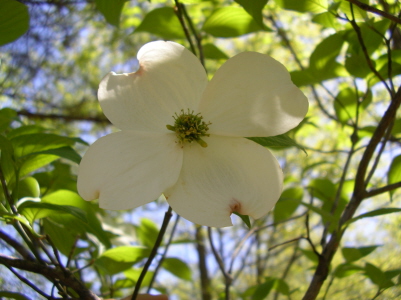
Dogwood. JenniferCC BY

The first day of April – glorious. A sky as blue as it ever gets, hardly a cloud to be seen. Dogwoods and redbuds, bare just days ago, flowering profusely. On the breeze, the scent of blossoms, almost like perfume – winter daphne, I think.

All marking the end of desolation. Nature composes a theme of renewal with color, fragrance, amber light and birdsong.

At the close of the day, I celebrate its beauty. I celebrate the inherent message of hope with the arrival of another spring. Even the news carries a rare inspirational story about a man opening his front door to find his dog, missing for four years, back home on the porch. He sat down and the dog put her head in his lap – what an emotional celebration that must have been.

Today is also the first day of National Poetry month. I have recently discovered a lost booklet of poems that I wrote as a teenager. All things considered, this particular poem struck me as one appropriately celebratory  – winter is over, spring has returned; a lost dog has returned home; my lost poems are found.

I wrote it when I was sixteen. Back then, I called it “Yesterdays.”

Yesterdays are gone

Leaving nothing but memories behind

And, if meant to be, a chance for tomorrow.

So weep no more

For what once was,

For it may be

Once again.

Celebrate today.


O. Henry

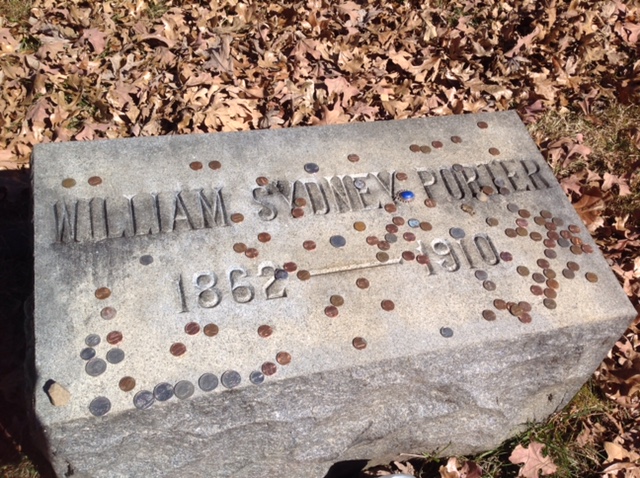
O. Henry grave 

Fall comes early in Asheville, North Carolina. The air is chilly when I get out of the car at the cemetery to visit the grave. I think of winter coming, of Christmas, of this writer’s most famous work. I take a picture, marveling at the coins spread over the gravestone. As I turn to go, a frigid wind gusts, scuttling leaves over the ground and across the driveway.

Leaves . . . I remember that story.

O. Henry’s headstone is covered in coins, mostly pennies, which usually add up to $1.87 –  the amount of money that Jim and Della had at Christmastime in his famous short story, “The Gift of the Magi.” This shortage of money is why Jim sold his gold pocket watch to buy combs for Della’s beautiful hair, and why Della cut and sold her hair to buy a platinum fob chain for Jim’s prized watch. Their sacrificial love for one another has made the story an enduring classic.

There is another story of O. Henry’s that I love almost as well.

I remembered it as I planned to write “Oh, Henry,” yesterday’s post about my son’s dog. I should write about O. Henry next, I smiled to myself. A little word play with the titles. How enticing.

That’s when I thought about the fallen leaves blowing over the writer’s grave.

I scrounged up my old paperback copy of O. Henry’s short stories and reread “The Last Leaf.”

In this tale, two young artists live in a three-story Greenwich Village building. One of them becomes sick with pneumonia. She watches the leaves dropping from an ivy vine against the wall just outside of her window, convinced that she will die when the last leaf falls. To her astonishment, the last leaf hangs on through high wind and rain. To make a short story shorter, the leaf remains because an old artist in the building crawled up a ladder in the dark of a raw November night and painted it on the wall with the vine. The girl begins to recover and the old man, Behrman, dies of the pneumonia he catches from being out in the weather while painting that night.

The old artist had always wanted to paint a masterpiece and never pulled it off – but the last lines of the story have the roommate telling the recovering girl about the leaf: “Didn’t you wonder why it never fluttered when the wind blew? Ah, darling, it’s Berhman’s masterpiece – he painted it there the night the last leaf fell.”

Self-sacrificial love at work again – but there’s more to it.

That leaf symbolized hope, sparking the desire to strive, to overcome. The old artist’s small gesture inspired the young artist to keep living.

This leaves me thinking, in the course of our days as teachers, as writers: Are we not the artists who paint the pictures of possibility, of hope, in the minds of others? Do we spark in others a desire to strive, to reach for what’s beyond their grasp, or to hang on only long enough until this, too, shall pass?

Our masterpieces may never be world-famous; they may be as simple as knowing the right word, the right idea, the right vision, the right story, and sharing it when it is most needed. Inspiration leaps from one heart to another, creating something to hang onto, outlasting high winds and rain. We may never see the full effect of our work, but that’s all right.

We paint the leaves where we can.

I close my old paperback book.

O. Henry, I am so thankful you were here.


slice-of-life_individualEarly Morning Slicer


Follow the light

Hermit crab

Hermit crab. Jessica DiamondCC BY-SA

Daddy has a story to tell this morning:

“Last night, a sound woke me up.  I got out of bed and listened.  A steady clinking was coming from the bathroom. I thought: What in the devil could be making that noise in the bathroom? I went and looked around – didn’t see anything. I bent down to look at the pipe under the sink. Nothing. The noise was much closer, though, almost right in my ear . . . I turned my head and there on the sink leg was that hermit crab, crawling up. His shell was hitting against the metal leg – that was the clinking.”

I look in the glass bowl where my pet crab Shermie lives. He’s completely inside his black-and-white shell now, obviously sleeping off his late-night adventure. 

“He got out of his bowl and went that far? Why would he do that, Daddy?”

 “I guess he was following the light.”

The bowl is in the living room. I look at the hallway. The bathroom is at the end, around the corner on the right. That’s an awfully long way for a little crab. I imagine him crawling along the hardwood floor past the bedrooms in the dark. It’s a good thing none of us got up and stepped on him. 

Shermie’s stalk eyes peek out of his shell and I wish I could ask him: Why were you trying so hard to get to the light?

Maybe it wasn’t the light. A quick skim of the Internet reveals that hermit crabs are nocturnal creatures which often climb out of cages at night, when they would normally be in search of food and water; in the wild, they do this in droves, traveling for miles. When a pet hermit crab escapes – apparently quite a few do – the experts say to check the bathroom, as the crab might be seeking the humidity of its natural habitat.

In the days before the Internet, however, we didn’t know all of this.

For years I thought of that tiny creature and the Herculean task of climbing out of a wide, smooth glass bowl – how, I do not know to this day – to make his way, alone, through the dark toward the only light in the house.

And I would think: If Shermie could figure out where the light is, then so can I. There’s a light to follow out of this darkness, somewhere. I’ll find it. I’ll climb out.

slice-of-life_individual Early Morning Slicer


Signals

signals

Untitled. abarndwellerCC-BY

The Scottish poet Robert Burns wrote, in “To A Louse: On seeing one on a Lady’s Bonnet at Church”:  O wad some Pow’r the giftie gie us/ To see oursels as others see us! It wad frae monie a blunder free us…

I have often pondered that idea, people needing to see themselves as others see them. To see myself as others see me. What a frightening prospect. Certainly the power to see ourselves as others see us would free us from many a blunder … one would hope.

The lines spark a question I pose to myself and teacher colleagues: What signals are we unwittingly sending to students?

Years ago, I wasn’t sure I wanted to teach. I thought I would try it, almost reluctantly, as I needed a job and my own children were still in school. I wasn’t thinking of teaching as a calling or whether or not I was cut out for it. I took a temporary position, fifth grade remediation in reading and math, with some trepidation.

“I am not sure what to do,” I confessed to the hiring principal. “I don’t know if I can really help the kids.”

She smiled. “Just love them. The rest will come.”

Here goes, I thought on Day One, as I stepped into a classroom where kids milled about, working collaboratively on math. It’s sink or swim.

From across the room, a boy saw me standing in the doorway. He didn’t know me, didn’t know why I was there, but he shot across the room through the throng of his classmates to throw his arms around me.

That was my induction to being a public educator.

A child, sinking fast, clung to me like I was a life preserver. Perhaps he perceived, instantly, that we were in – or out – of the same boat. It was sink or swim for both of us.

In this classroom, I watched the boy try his hardest to swim. He struggled academically. He struggled with controlling his impulses. He struggled socioeconomically – he wore the same heavy black ski jacket every day, even when the weather was hot. He was chastised by his teacher for every infraction, great or small. The teacher – widely respected by colleagues – was clearly suffering from burnout,  undoubtedly tired of swimming herself. Whether or not she intended it, she sent a signal: Do not approach me or question me.

Do we, as teachers, send a signal – with  or without words – that we are safe harbors or treacherous ground?

I remembered a teacher of my own. She stayed in a constant state of frustration with our geometry class, once giving me detention for leaving paper in my desk despite my impassioned protest that I hadn’t done it. Math wasn’t my strong suit and I sank to the point of dropping the course, as I had all the math credits I needed to graduate. Later that year I landed a role in the school play and this teacher came to watch it. As people congratulated me backstage after the performance, this teacher stepped forward:

“Well,” she said, “I never would have believed you had it in you.”

You decide: Would I have ever been successful in her class?

One last note on my little friend back in the fifth grade: He went on to graduate.

On his behalf, I thank all those teachers who were, along the way, safe harbors for him.

Reflect: What messages do you send to others, verbally and non-verbally, about their value? Think of the teachers you had: Were they repellents to the learning in their classrooms, or were they encouragers? Were they the treacherous ground or the safe harbors? Write. Find a viable preserver when you need to. Rest a for bit. Then keep on swimming, mindful of those who are swimming so hard, so close by. 

Rise

rise

Flight Envy. Pretty ParkinCC BY-SA

Above the negativity, the naysayers, to make room for the wondrous

Above the noise, to a place of productive peace

Above the superficial, the shallow, to the real, the valuable

Above the fleeting, to the lasting

Above constraints, to the creative.

Every day is new. Rise. Reach.

Believe.

Realize.

Repeat: Rise.

Reflect: Rise is a verb. It’s an action, a choice. How might YOU rise and step forward in newness?