My last hummingbird

She’s still here.

As of yesterday evening, anyway, after I went out in the rain to refill the almost-empty hummingbird feeder.

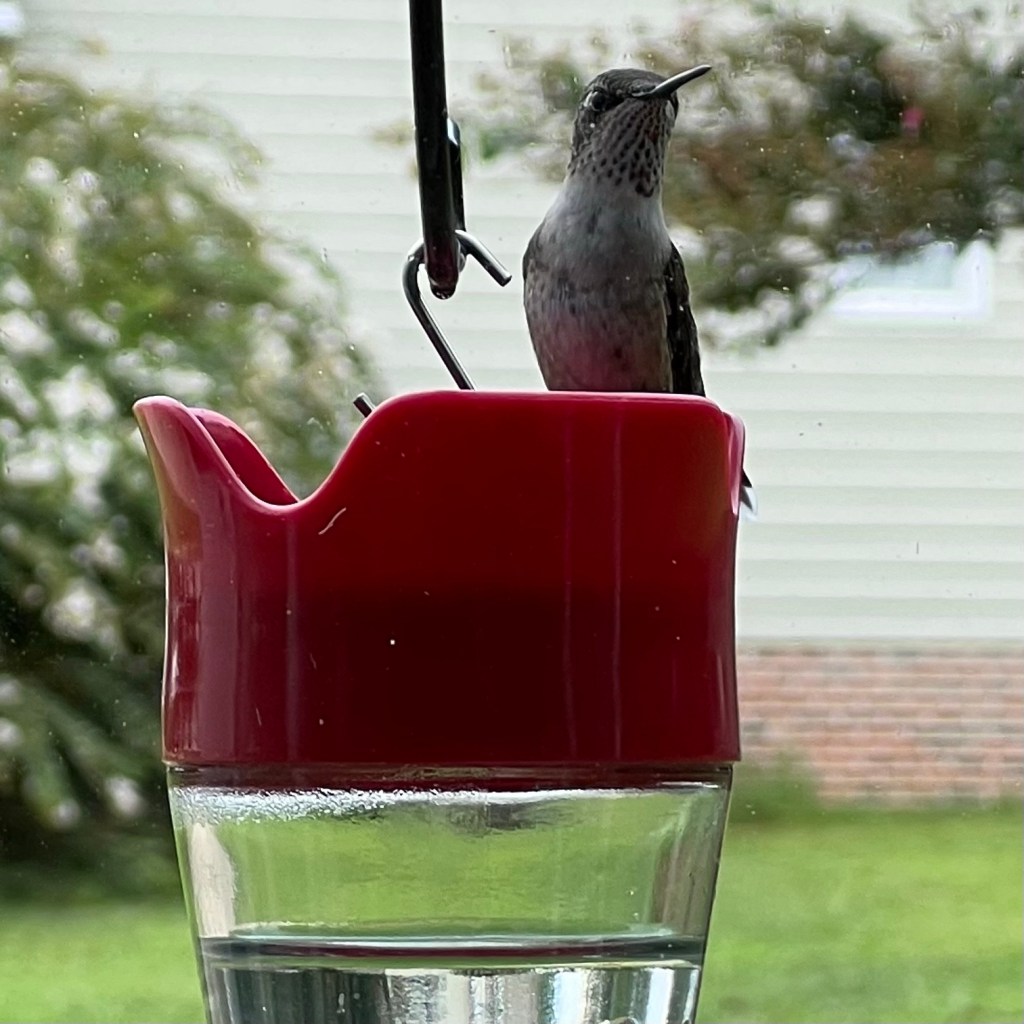
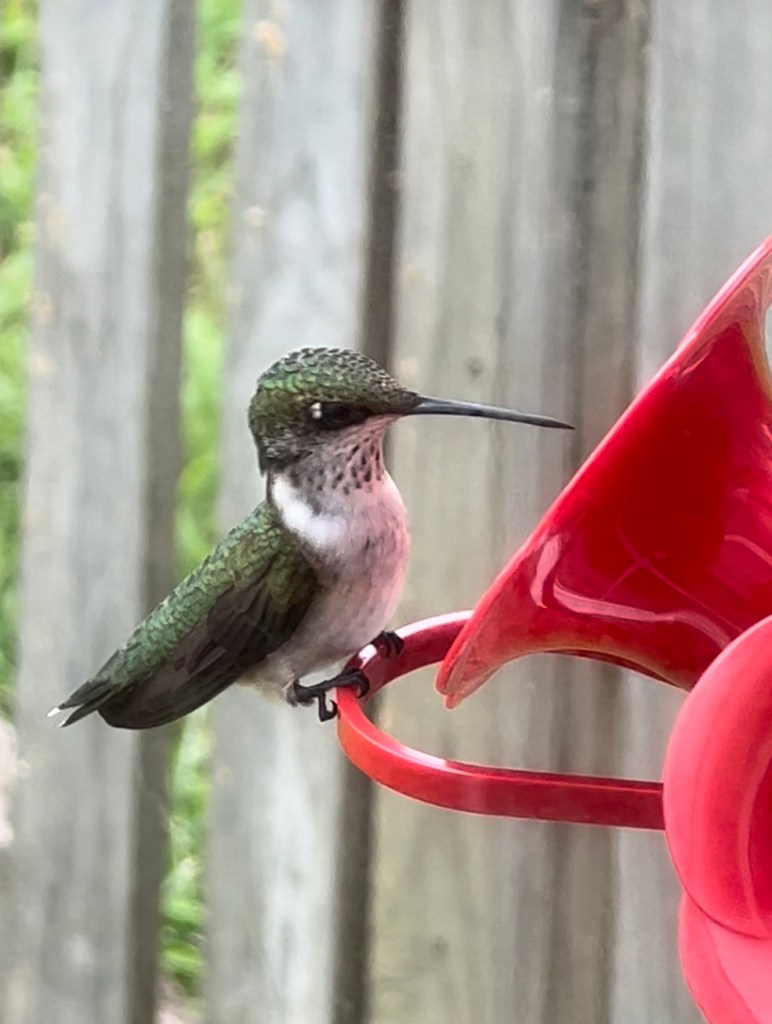
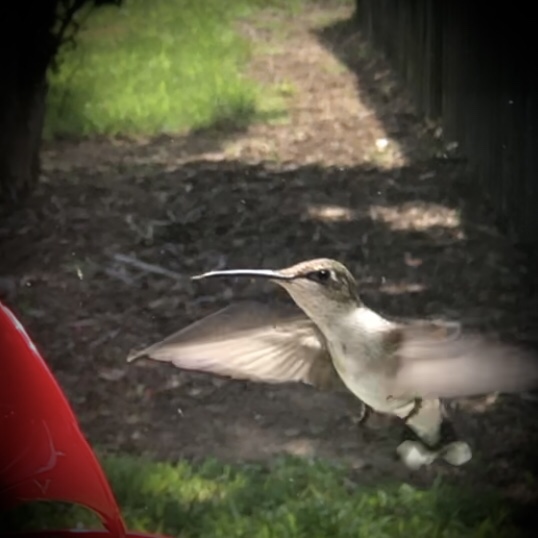
One little female, silvery-cream, with the faintest dark speckling on her breast.

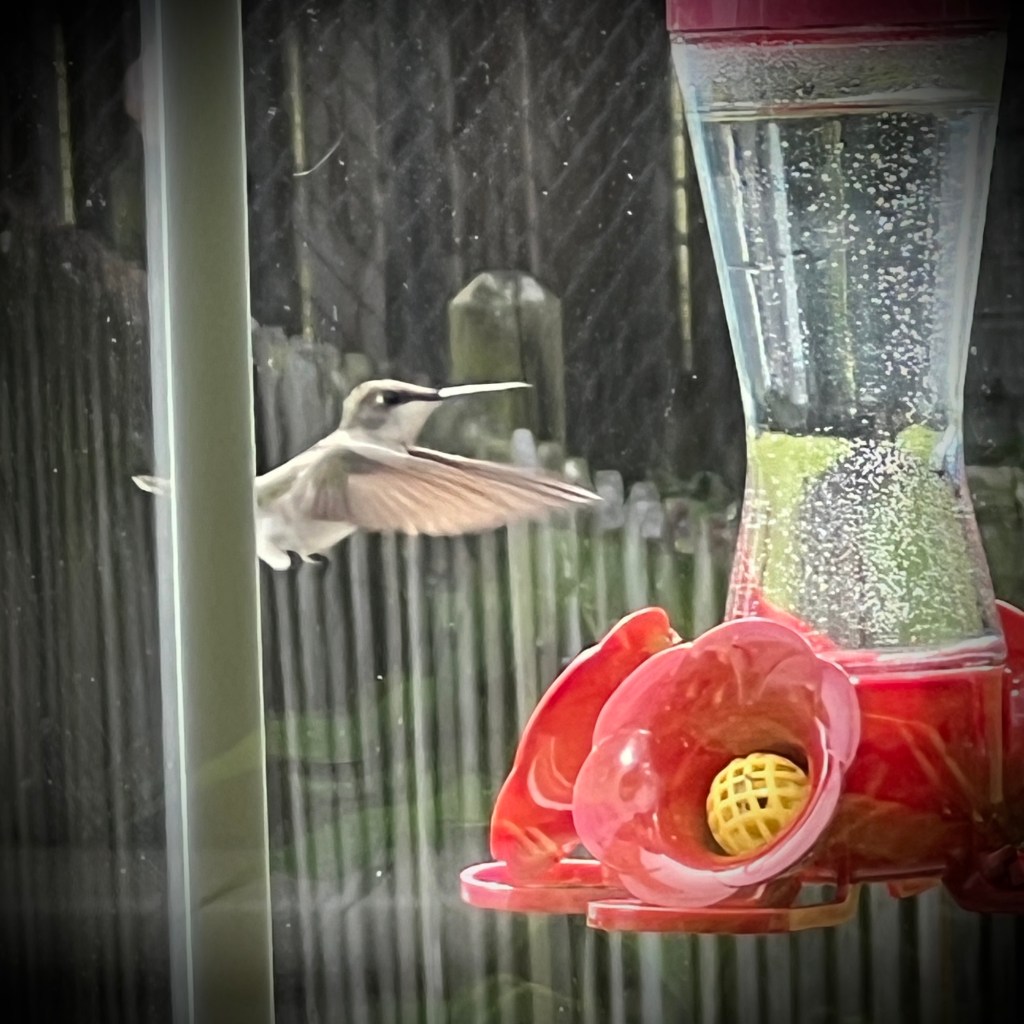
Upon my return to the house, I stand a few feet back from the window in the unlit kitchen, and —zip! —she appears like a fairy out of nowhere. She perches on the feeder (attached to my window with a suction cup hanger), gripping the thin red rim with unspeakably tiny feet. Her back appears gray in the dusk but I know how it shimmers in the sunlight: gold-dusted, olive-green, smooth as glass. Ethereal. I marvel at the exotic lining around her eye. For a moment, I forget to breathe.

For several days prior, she and another hummingbird were fighting like mad for possession of the feeder. Clearly a high-stakes frenzy. Remarkably loud squeaking. Palpable urgency. Throughout the summer, four or more of them kept vying for a turn. They do not share. They drive each other away. Each bird has her own unique markings, but the astonishing speed of movement sometimes makes individual identification impossible. Except for the one female with a rare dot of red at her throat. Fancy.

Ornithologists say that male ruby-throats return first each spring, but my first hummingbird sighting this year, at the outset of April, was a female. I pushed up the kitchen blinds one chilly morning and there she was, right before my eyes, hovering for a split second before darting away. I caught the implied question: Ummm…where’s my nectar?!

I like to think it was this same female. The first to arrive. The last to leave.

I wonder why she lingers.

It’s mid-September. The males left at the end of August. Punctually. I saw the last one on the last day of the month: A male perched on the feeder, his black ascot turning to crimson-fire whenever he lifted his head. I watched him take his fill of sugar-water. I noted the date. By Labor Day, I knew that was it. He’d gone, as if in keeping with the calendar page flipping or an inner alarm clock going off: Ding! Male hummingbirds vanish all at once. Now you see them, now you don’t. Poof.

Females remain for a few more weeks. I’ve sensed that mine have been leaving, one by one, in the last few days. Off to Mexico or Central America or wherever they winter. I am curious about where my birds go. I am certain each goes to its own exact spot; there’s no shadow of turning with hummingbirds.

I’ve read of their long, lonely, exhausting migration, but I can’t imagine hummingbirds ever feeling sorry for themselves. Prosaic writers have described them as “made of air” and “tricks of light” — I love the lyricality.  I also know that the hummingbird’s fragile appearance belies a tenacity and ferocity unrivaled by any other bird around, even the huge red-shouldered hawk that sits so majestically on our power lines and poles, scrutinizing the landscape for prey.

Last week I heard the cries of a hawk. I went out on my porch to listen and was rewarded with the sight of two red-shouldered hawks flying, one after the other, in the patch of tall pine woods across my street. I suspect there’s a nest nearby. While I stood gazing in awe, there came a sudden vibration: vvvvRRRR! A female hummingbird materialized to hover three feet away from my face, her wings beating like tiny fan blades on high.

I said, Oh it’s you.

I feel sure she was saying the same thing.

We seem to be equally curious about each other.

Maybe she was the one that still lingers, my last hummingbird.

She won’t stay much longer.

In the predawn hours, with a rainstorm raging and my electricity out, it’s too dark to see anything beyond my window except for the feeder. It still holds. Freshly replenished. I will ensure that it remains so for as long as my hummingbird should have need of it.

When she’s gone, I’ll experience a little autumnal pang of loss, the expected but unwanted shedding, the indefinable ache of transition, the instinctive pulling-inward preparation against the coming cold and dark. For a time. A season.

Until the morning I push up my blinds and we meet face-to-face once more.

 Godspeed, precious spark.
*******

With thanks to Two Writing Teachers for the Tuesday Slice of Life Story Challenge

and to the hummingbird that remains
even now, in the wind and rain
while I write
Today years old poem

On the final day of the August Open Write at Ethical ELA, Scott McCloskey extends this intriguing invitation:

“Have you heard of the saying, ‘I was today years old when I found out about…’?  It’s what we say when we find out something surprising, something new that we’ve just learned…Think of the most recent (most interesting /startling) thing that you’ve learned…You could examine the fact.  Interrogate it.  Expand on it.  Or simply just share it with the rest of us.”

I return to the hummingbird.

Inside the Skull

When I was
ten or eleven years old
supermarket tabloids
ran story after story
of UFOs
and alien abductions.
I half-believed 
these ridiculously weird
narratives…
at today years old
I sit at my kitchen table
looking through the window
at a hummingbird
hovering in midair
like an otherworldly thing
looking right back at me.
I wonder what it’s thinking
this tiny iridescent creature
that mesmerizes me
takes over my brain
controls me for hours
compelling me to read
everything I can
about its kind
which is how I learn
a hummingbird’s tongue
is so long
that it coils
around and around
its tiny skull
and rests behind
its ever-bright
and curious eyes
-ridiculously
unbelievably
weird
I say to myself
as I lose all track
of time…

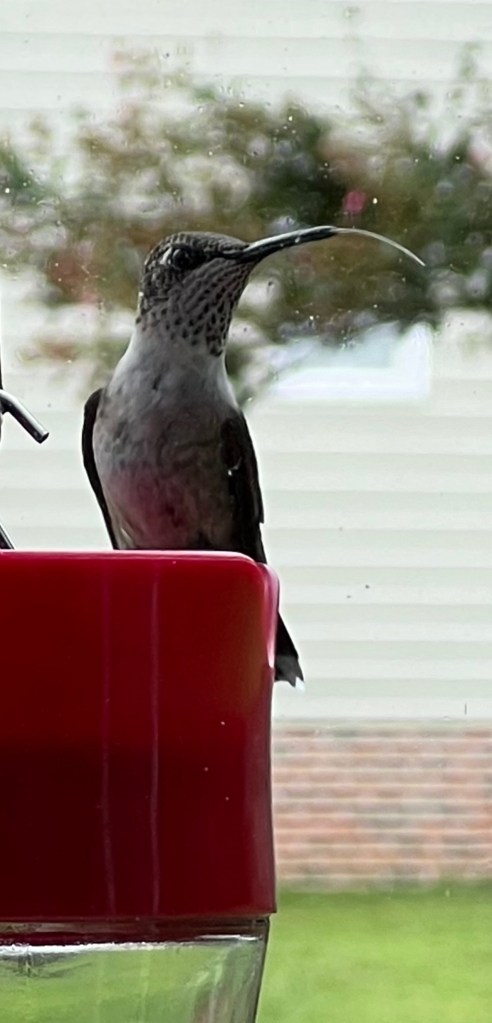
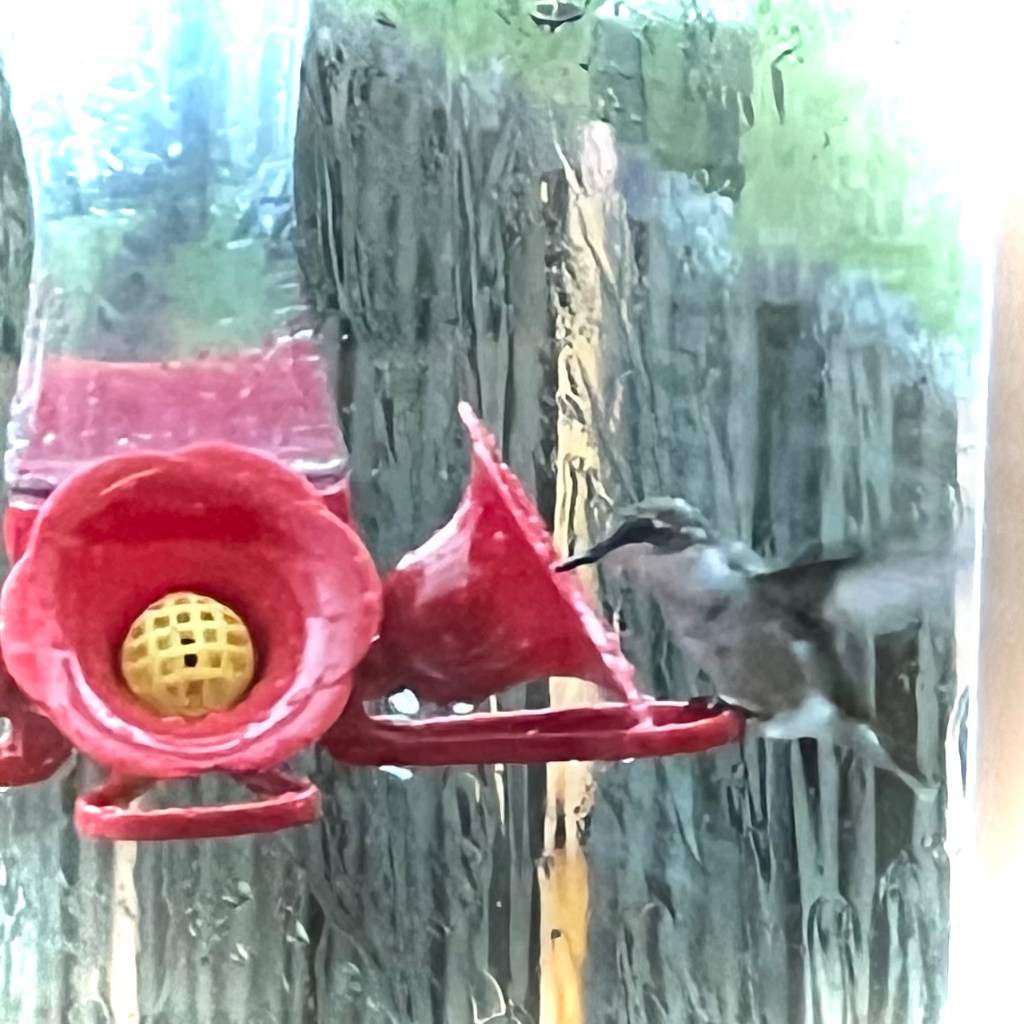
Resharing my photo of my hummingbird with her tongue extruded

Hummingbird observations

It all started last month when I saw one hummingbird in the backyard, out by the pines.

She appeared from nowhere, hovering stock-still in the air across the yard, directly facing my son and me as if to consider what manner of beings we are before she darted away—poof. Perhaps it’s just my overactive imagination, but I felt like some sort of message was in this magical appearing. Something the bird wanted…

I bought a feeder.

In a day or so, I had a bird. Or two.

Then there seemed to be three. All females.

Eventually a male showed up with his gorgeous fiery throat. From a distance he looked like a flying ember. He preferred coming early in the morning or around suppertime. It’s almost like His Tiny Royal Highness was letting his Royal Nectar-Tasters go before him to be sure the stuff wasn’t tainted. I cannot say, however, that he was any match for the females in regard to which was most vicious in the dive-bomber approach of driving all others away from the sugar water.

Hummingbirds are contentious creatures. Terribly territorial.

I’ve learned there’s a scientific reason for this: Their metabolism requires them to feed almost constantly. Hummingbird hearts have been recorded, I read, at 1200 beats per minute.

I bought another feeder.

As of mid-August, there’s a squadron of hummers at my feeders, so much so that the original feeder hanging on the kitchen window has to be refilled daily; I had to buy more sugar. I know that ruby-throats (the only kind of hummingbird that breeds in the eastern U.S.) are supposed to start migrating to central Mexico. The males go first, in early August, which explains their current scarcity, I think. Females wait a while longer. I’ve also read that some hummingbirds stay in residence all year. We shall see… I have learned to recognize some individual females by their different markings: one with black speckles all down her pale breast and belly, one with a pure ivory belly and a brighter, iridescent green back, one with a darker head, one with a lighter head and pale stripe on top, and one with a precious, tiny dot of red at her throat, like a lady bedecked in a ruby pendant. When I opened the blinds one morning last week, there was Little Ruby, hovering in the gray dawn; we were so startled by each other that we both froze for a split second in mutual awe (wonder on my part, likely fear on hers) before she zipped away.

At this point I must mention my grandmother. Hummingbirds and cardinals were her favorite birds, perfect symbolism for a woman named Ruby. I saw my first hummingbird by the spirea bushes in her yard one summer. The loud buzz of the beating wings alarmed me—was this a big bug coming after me?—but Grandma Ruby’s childlike delight quickly allayed my fear. And then there was nothing but enchantment for this tiny, dazzling fairy of a creature, glittering like an emerald, my own birthstone, in the sun.

Perhaps that is why I took my six-year-old granddaughter out with refilled feeders yesterday:

The hummingbirds hide in the crape myrtle and cheep at me whenever I take their feeders down.

They do? Why, Franna?

They just want their nectar. They are saying ‘What are you doing with my food!

I haven’t ever heard them cheeping.

Today you will.

And so, for just a moment, I held the favored window feeder out at arm’s length as my granddaughter stood by, very still. Two hummers appeared instantaneously, cheeping competitively before hovering, suspended in the air, eyeing me, uncertain, their whirring wings as loud as electric propeller fans. Each took a tentative drink before whizzing off to the pines out back.

I hung the feeder and my granddaughter said, Quick, let’s go in before all those wings come back!

I chuckled, remembering my first experience with the intimidating sound when I was about her age. We darted for the door. As we entered the house, she said: I heard them cheeping!

And then, before I could reply: Franna, look!

She pointed to the window, where a hummer was perched on the very top of the feeder.

Well, that is something new, I said. I haven’t seen any of them sitting up there before.

My husband, sitting at the kitchen table preparing a sermon, said: That bird was perched on the feeder hanger the whole time you were fixing the sugar water.

I am sure she was one of the two who dared to take a drink when I was holding the feeder.

For the rest of the day, this little bird perched, fed, flew off in skirmishes with other tiny feathered Amazons, and returned. Whenever I looked at the window, she was there, looking in, occasionally fluffing her feathers. I am not sure if she’s nominated herself Queen of This Feeder or if she’s simply curious—hummingbirds are known to be extremely so—and is watching me as I play with my granddaughters and cook supper.

I suppose the ultimate question is who’s observing whom.

And what we are learning about each other in the process.

Didn’t realize, until I reviewed the day’s photos, that I happened to catch her with her tongue extruded. Every minute with hummingbirds filled with absolute wonder. I have christened her Lilibet, the nickname of Queen Elizabeth (since she seems to be reigning over the feeder) and also in honor of my great-aunt Elizabeth, Grandma Ruby’s sister. I wrote about Aunt Elizabeth’s hummingbirds a couple of weeks ago: Solitary existence.

Next goals: 1) Get a good photo of Little Ruby and 2) Invest in hummingbird feeder rings for my granddaughter and me to wear…can we stand still enough for them to come drink from our hands? Will they actually do it?

*******

with thanks to Two Writing Teachers for the weekly Slice of Life Story Challenge

Time will tell

Went on vacation last week and upon returning, a discovery
that only the female hummers come to my feeders now.
Quite possibly, the fiery-throated males have migrated
to central Mexico or Panama. —How I miss them.
These females are suddenly voracious drinkers…preparation?

Previously, the sugar water in the feeders lasted several days until I had to change it to keep it from fermenting in the high heat, i.e, avoiding drunk hummingbirds. Now the feeders are drained in a day and half. Males migrate first…maybe these females really are stocking up. I have also read that hummingbirds occasionally remain in residence all year in some parts of North Carolina. Time will tell…in the meantime, the feeders stay out until I see the little birds no more.

Tongue of hummingbird

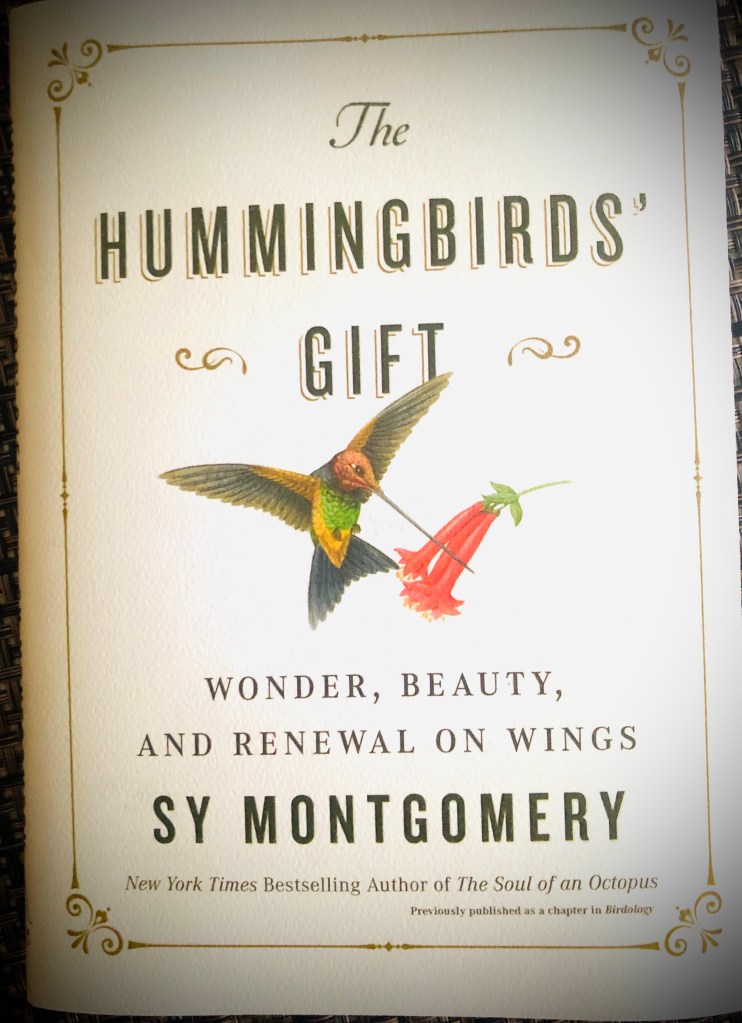
“At a feeder, a hummingbird extrudes and withdraws its tongue thirteen times a second. Hummingbirds do not sip nectar; they lap it. The tongue is forked, like a snake’s, with absorbent fringes along the edge of each fork…The tongue is so long that, when retracted, it extends back to the rear of the skull and then curls around to lie on top of the skull.”

—Sy Montgomery, The Hummingbirds’ Gift: Wonder, Beauty, and Renewal on Wings

Tongue of hummingbird outside my window.

The only way I can get such a photo is by videoing and going back, frame by frame, to select a still shot.

Utterly mesmerizing, these tiny creatures and the way they are designed. They have the largest brain and heart of any bird in relation to its size, plus a skullful of tongue.

—Wild.

Curious connection

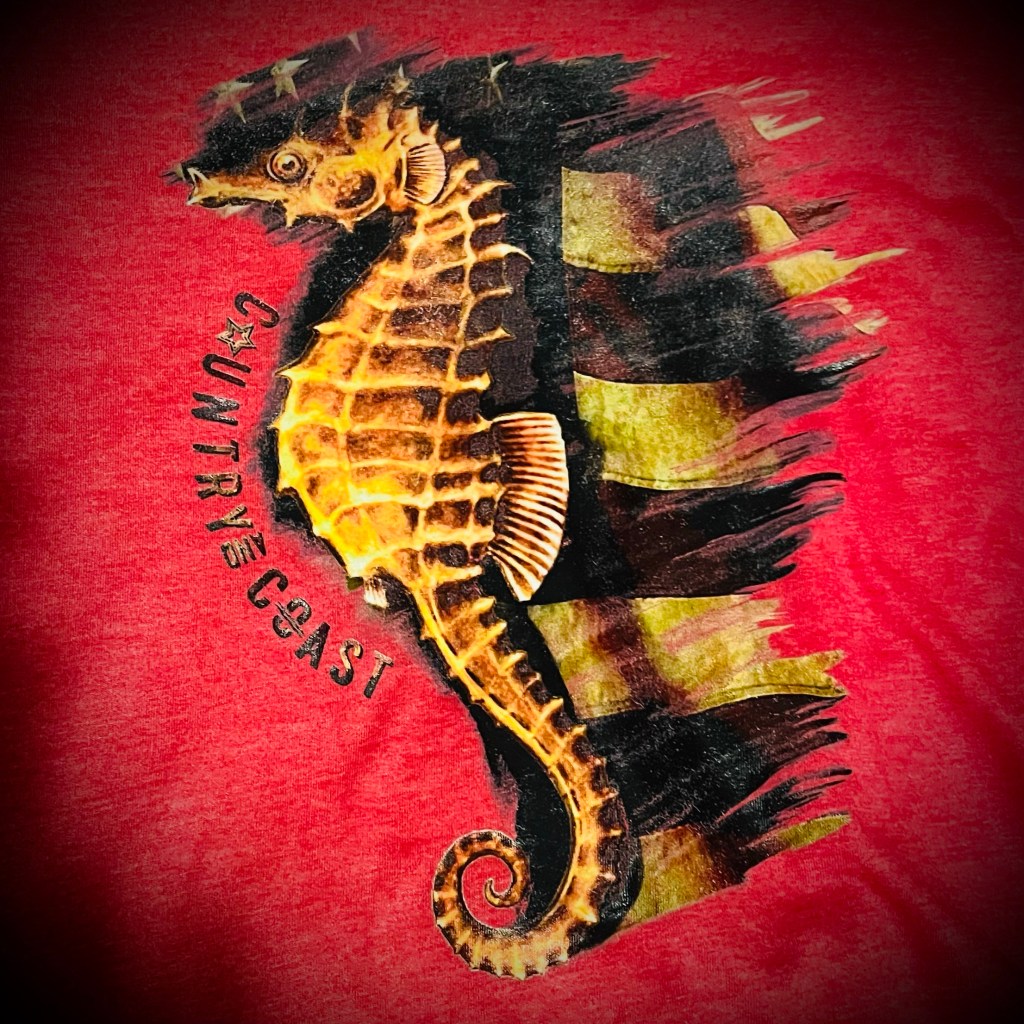
gogyoshi: a Japanese poem with a title and five lines

The Curious Connection of Seahorses and Hummingbirds
(Two of My Favorite Creatures)

One is the slowest creature in the sea
the other, the most agile in the air.
One armor-plated, one gorgeously plumed;
what could they possibly have in common?
Fins and wings beating at the same speed.

Solitary existence: the hummingbirds

Hummingbirds lead a solitary existence.

I saw one hummingbird out back last week, darting about the pines. It turned in my direction, tiny pale-bellied fairy-creature suspended in midair, as if to acknowledge my presence across the yard before zipping away. I wondered if it was making some kind of request. The next day I bought a feeder and hung it outside my kitchen window; within moments, a tiny female landed to sip my homemade nectar.

The next day another female arrived. I watched the two of them competing for turns at the feeder. All day they chase each other away, each still managing to land and feed for the few seconds it takes to sate a creature so tiny. One tentative male finally showed up today, his ruby throat resplendent in the sunlight. I haven’t managed to get a photo of him yet. I hope he’ll return, despite these territorial females.

There’s a lot I didn’t know about hummingbirds. They’re curious. They watch me through the window as I’m watching them. I read that they’re highly intelligent; they learn to recognize the person who feeds them and may even remind this person if their sugar water is running low. They are not social, not flock birds. When they migrate to Mexico in the fall, they go it alone. Why does this pull so terribly on my heartstrings? I cannot shake the image in my mind of this tiniest of birds flying so far by itself.

They do not think of themselves as fragile. They are not lonesome.

It’s what they do. They lead a solitary existence.

With that, the hummingbird memory stirs.

Summer, long ago. Riding in Grandma’s rocket-red Ford Galaxie 500 along the dusty dirt road to her sister’s house. The Galaxie doesn’t have power steering or air-conditioning so the windows are down and Grandma has a Kleenex stuffed into her cleavage to catch the trickling sweat. Fortunately Aunt Elizabeth only lives about a mile away, in a little bungalow house with square tapered columns, off to itself by cornfields and groves of hardwoods. There’s a path in the grass of her yard where her old maroon car (I think it was maroon, either a Ford or a Chevy, I can’t recall exactly) is parked by the weathered outbuilding. Grandma and I park behind it and walk in the shade of the trees to Aunt Elizabeth’s back porch.

Everything is old. The porch floorboards, the screen door that squawks on opening and closing, the tiny, cramped kitchen, the worn linoleum revealing a slightly swayed floor, the living room with braided rugs…it’s a dark house, faintly musty. The smell of Time hangs in the air, unmoved even by the square electric floor fan humming on high speed. Aunt Elizabeth is pleased to see me. She opens her arms to give me a hug and kiss. Her pale cheek, faintly mottled with reddish freckles, is cool. She’s two years older than my grandmother. She asks how my Daddy is, says she sure does miss him, oh, she used to enjoy having him over to eat…

Aunt Elizabeth doesn’t have children. Not any that lived. When I first asked about it, Grandma told me of her sister’s two premature, stillborn babies. Tiny things, said Grandma; she was there when it happened. She held them, grieved for them. Aunt Elizabeth was married to Granddaddy’s youngest brother, who died before I was born. He suffered from some kind of condition doctors could never figure out. Without any warning, he’d lose consciousness and collapse. It happened numerous times until the day he had a spell and couldn’t be revived.

So my great-aunt, in her sixties, lives here alone, way out in the country where, in the 1970s, people still don’t have telephones; they drive to each others’ houses to visit and catch up on news. It is good that a few of her eight siblings live close by, that grown nieces and nephews make a point to come by to see her when they can. Aunt Elizabeth gardens, cans her vegetables and preserves in glass jars for storing on her kitchen shelves, drives to town, tends to herself, is completely independent, yet it seems a solitary existence to me. As she chats with Grandma I wonder if she’s lonesome, if she still misses her husband, gone for so long, and if she’s sad about having no children or grandchildren of her own. She hands some bubblegum out to me and I know she got it because she knew I was coming.

When our visit is over, we all walk out on the porch — that’s what you do, in the country. You walk out and wave until your visitor drives out of sight. Unwritten etiquette. Everyone does it. Same for throwing your hand up to any other car you pass on the road.

But Grandma and I don’t leave yet, because of the hummingbirds.

They’re everywhere.

Aunt Elizabeth has strung up several red and yellow plastic feeders around her porch. At every one is a horde of the tiny birds, dipping in and out. The air vibrates from the rapid fanning of their wings; I feel the circulation, a coolness against the heavy summer humidity.

I am awed. I have never seen anything so magical before. I can’t even count how many hummingbirds.

The sisters, in their delight, laugh like young children.

—It comes back to me, watching the few contentious hummingbirds outside my window almost half a century later. I didn’t know how rare a thing it was, then, the communal gathering of hummingbirds. I remember my great-aunt, not with pity. I hear the musical sound of her laughter and the humming of all those tiny wings there on her porch….knowing that in the long enduring of life’s losses and trials come moments of pure enchantment and abundant richness.

I shall need more feeders.

*******

with thanks to Two Writing Teachers for the weekly Slice of Life story-writing invitation